Disclosure: Some links in this post are affiliate links. As an Amazon Associate I earn from qualifying purchases, at no extra cost to you. Learn more
Specs are compiled from manufacturer listings and verified buyer reviews and can change over time — please confirm the key details on the product page before buying.
Water almost never gets into a garage through the door itself — it gets in through the gap where the door meets the concrete. That gap is usually a finger’s width or more, and a sloping driveway funnels every downpour right at it. The fix is a raised PVC threshold glued to the concrete that the closed door presses down onto, not another rubber strip on the door bottom. This guide covers seven real flood-barrier options, from a half-inch PVC threshold that takes a couple of hours to install to a set of water-activated bags you throw down when a storm is already coming.
This guide is built by comparing the manufacturers’ published specifications and the patterns across verified customer reviews, so you get each pick’s real strengths and trade-offs instead of marketing spin.
Water creeping under a garage door can soak a floor and ruin a weekend before you notice it. Some barriers here sit permanently on the floor and take a vehicle rolling over them; others are emergency bags you deploy when water is already rising. Pick a permanent PVC threshold for a sloped driveway pushing water at the door gap, or water-activated bags for flooding that arrives across the floor. The right garage door flood barrier depends on if you need a permanent seal or a fast temporary dam.
Top Picks

How To Choose The Best Garage Door Flood Barrier
Measure the door opening and the gap under the closed door before you shop. Two numbers decide almost everything here: the length of your door opening, and the height of the gap between the door and the concrete floor. Get those wrong and even a well-made barrier will either arrive too short or leave a puddle at one end.
Measure the gap before you measure the width
Kneel down and look under the closed door with a light on the other side. A narrow sliver suggests a half-inch threshold, while a gap you can push two fingers into wants the one-and-a-half-inch version. A taller threshold also gives you more of a raised lip for the door to press against, but it is a bigger lump to drive over and harder to cut.
A permanent threshold versus a deployable bag barrier
A glue-down PVC threshold becomes part of the building. It seals the same gap every day, blocks wind-driven rain, leaves and vermin, and needs nothing from you when a storm hits. Water-activated bags work the other way — they sit in a cupboard until you need them, then you place them in the path of the water. They are the practical answer when the water is coming across the floor rather than under the door, or when you cannot glue anything to the concrete.
The adhesive is where installs succeed or fail
Almost every complaint in this category circles back to the glue rather than the seal itself. A cartridge that has sat on a shelf too long goes stiff and will not spread. Concrete that is dusty, damp or unsealed grips poorly. Plan for a warm day, a heavy-duty caulk gun, and a clean dry floor.
Side-by-Side Comparison
| Model | Best For | Threshold Height | Length | Material | Amazon |
|---|---|---|---|---|---|
| GaraDry ½” Threshold Seal Kit★ Best Overall | Everyday door-gap sealing | 0.5 inches | 10 ft 3 in | PVC | Amazon |
| Weather Defender XL 20’8″Widest Coverage | Wide commercial openings | — | 20 ft 8 in | PVC | Amazon |
| Quick Dam QD1224-10 Flood Bags | Emergency storm deployment | Rises to 3.5 in | 12 in per bag | Polypropylene | Amazon |
| Weather Defender Original 8’5″ | Single-car door sealing | 0.62 inches | 8 ft 5 in | PVC | Amazon |
| Warmoon Self-Absorbing Barriers 8ft | Long basement and roll-up doors | Expands to 3-4 in | 8 ft | Non-woven fabric | Amazon |
| Weather Defender Original 10’6″ | Standard double-garage widths | 0.6 inches | 10 ft 6 in | PVC | Amazon |
| GaraDry 1½” Flood Barrier Kit | Deep gaps and severe flooding | 1.5 inches | 10 ft 3 in | PVC | Amazon |
Detailed Reviews
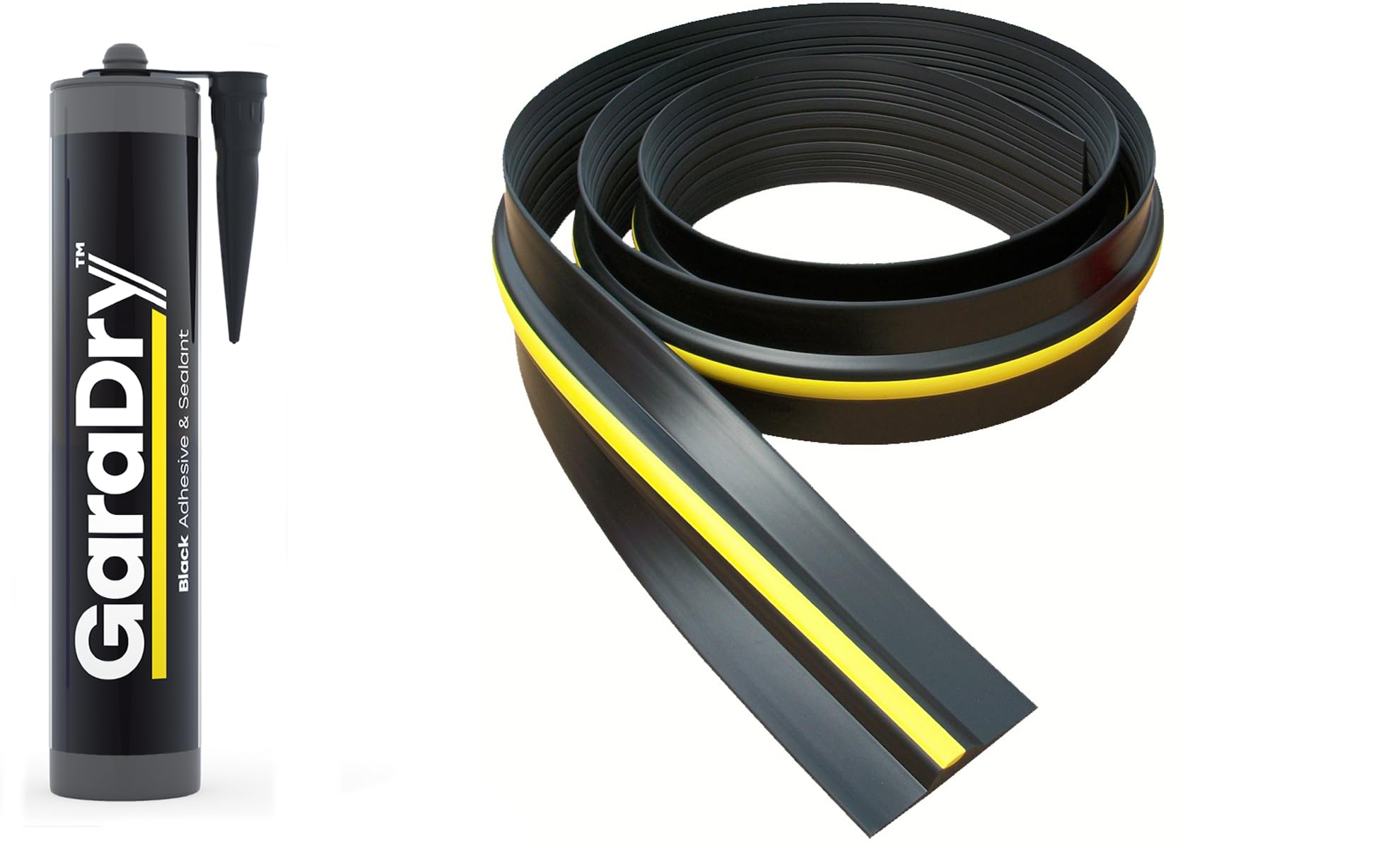
1. GaraDry ½” High Garage Door Threshold Seal Kit, 10’3″
Our pick — 4.5+★ from 400+ verified ratings; the strongest balance of quality and price.
A half-inch PVC lip that seals the gap under a standard single door and keeps driveway runoff out.
The half-inch height suits most single-car doors: tall enough to block driveway runoff, low enough to drive over without a jolt. It is tall enough to block rain that sheets across a sloped driveway, but low enough that your tyres roll over it without a jolt. And because it is made from PVC rather than rubber, it will not break down from sitting in water through every season — a real distinction in a category where the seal is wet half the year.
The 10-foot-3-inch length covers a standard single door with a little to trim off the ends. At 10 feet 3 inches long and 3 1/3 inches wide it covers a standard single door with a little to trim off the ends. The kit arrives with the GaraDry adhesive, full-colour printed instructions, and a 5-year product warranty — so the fiddly part and the reassurance both come in the box. What owners talk about most is simply that it does the job: it seals the gap between the pavers and the door and holds back water from driveways with a downhill run. One owner of a home near Phoenix described it holding a dry garage through heavy downpours. In the words of a buyer after a winter of weather, “Once installed we have had two snows and some very heavy rain and no water in my basement garage.”
The strengths you feel on day one
- Half-inch (0.5-inch) height blocks driveway runoff without a speed-bump feel under the car.
- PVC body won’t soften or crumble with constant wet contact across seasons.
- Genuinely doable as DIY — one buyer with no mechanical background got it installed following the pictured instructions.
- 5-year manufacturer warranty covers the strip itself.
Where to plan extra care
- The adhesive is the weak link — treat the floor prep as the whole job and it holds.
- A couple of hours of install time, and the strip wants to stay rolled up at first; a warm day flattens it fast.
Best for: a normal single-door garage with a thin-to-moderate gap and a driveway that slopes toward the door.
Think twice if: your gap is deep enough that a half-inch lip would still leave daylight under the door — the 1½-inch GaraDry below is the same brand one step taller.
2. Weather Defender XL 20’8″ Garage Door Threshold Seal Kit
Twenty-plus feet of marine-grade PVC for openings a normal single-door kit cannot reach.
The headline here is length. At 20 feet 8 inches this is the pick for a wide workshop door, a double bay, or a commercial roll-up — the sort of opening that would need two shorter thresholds butted together. That near-flush join is exactly where water finds a way through, so one continuous strip is worth chasing.
Owners praise the marine-grade PVC for taking a car, truck or commercial vehicle rolling over it. It is built from marine-grade PVC, the strip carries a high-visibility yellow safety line and anti-slip ridges across the top, and it will take a car, truck or commercial vehicle rolling over it. Better still, no drilling is required — the kit glues down with the supplied strong adhesive and includes step-by-step instructions. It is made in the UK. Owners in snowy corners of the US speak of it holding through a Maryland winter without trouble. One real caveat buyers raise: UK metric sizing means the 20 ft 8 in piece actually runs to 22 ft or more, so you cut the curled end off to fit.
The install reality: The strip ships rolled tight and does not want to lie flat straight away; heat, sunlight and a weight on the curled end get it down. The material is thick enough that a utility knife takes multiple passes, and the adhesive can be stiff to squeeze from the cartridge. Plan for a helper and a warm afternoon.
What it buys you: A single continuous seal across an unusually wide door — the gap that would otherwise get a leaky, glued-together join in the middle.
Reach for this if: your opening measures wider than a standard kit and you would rather buy one strip than glue two together.
Look elsewhere if: a single-car door is all you have — you would be cutting away a lot of expensive material.
3. Quick Dam QD1224-10 Water-Activated Flood Bags, 10 Pack
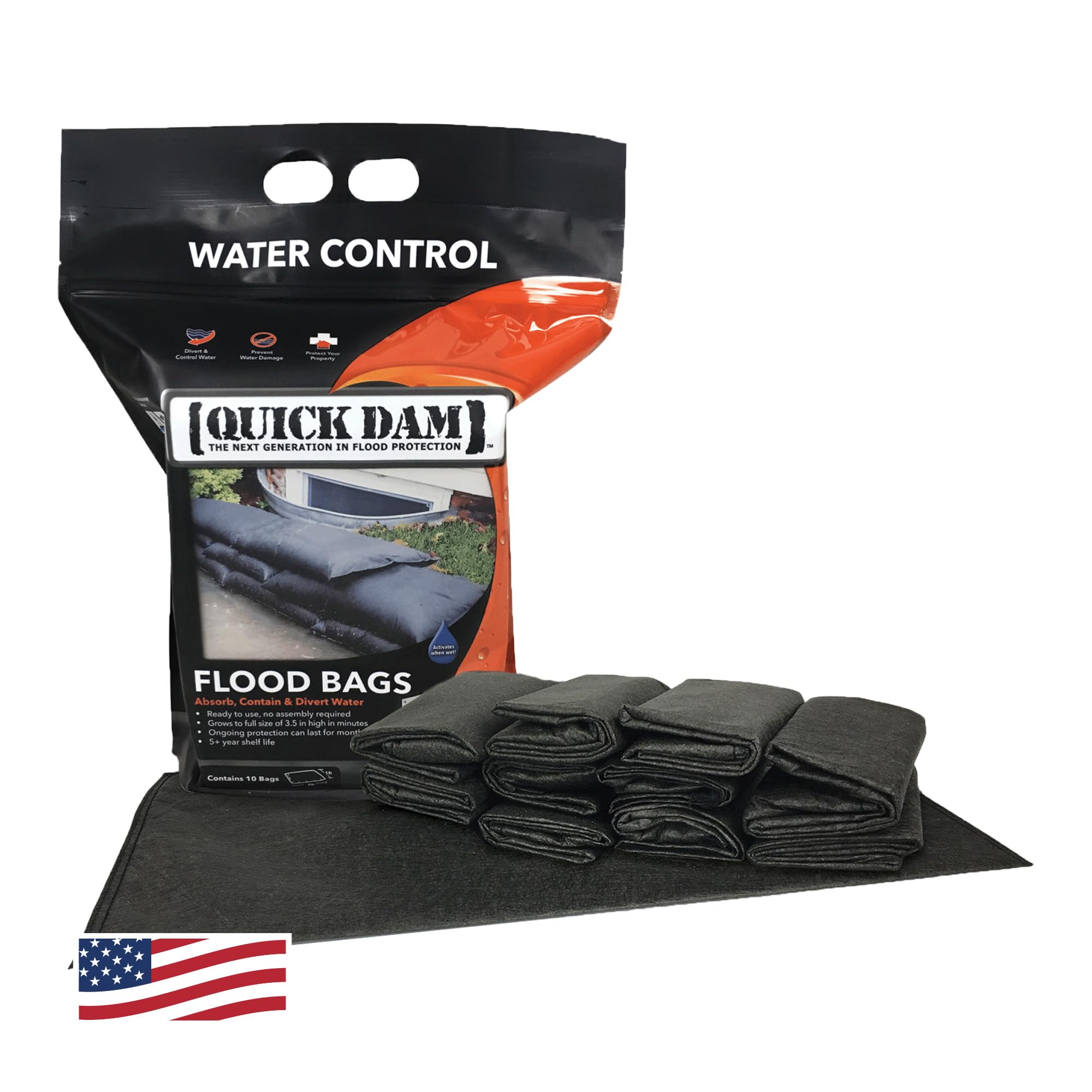
Ten bags that swell into a gel wall only when the water starts coming.
This is not a permanent seal — it is insurance you keep on the shelf. The pack holds ten 12 x 24 inch bags that lie flat and light (4.86 pounds for the whole box) until water reaches them. Then the absorbent inside turns to gel and the bag rises to 3.5 inches tall in about ten minutes, holding four gallons each. Stack them and you build more height.
That water-activated trick makes these the answer for a buyer who cannot glue anything down, or for a home where the water arrives across the floor rather than under the door. A woman in her sixties with bad knees praised how she could move them alone even after they expanded — versus the sandbags she used to wrestle. Bags kept dry and unopened carry a 5+ year shelf life, so they wait patiently for the one storm that matters.
The trade-off is reusability. These work best as a barricade for mild-to-moderate surface flooding, and bags used outdoors soak up grime and get slippery, so a box gets expensive if you deploy it often. Stored indoors and dried flat, they last multiple uses; left out in the weather, they don’t. Treat them as emergency stock, not a permanent wall.
Why it earns a place
- No sand, no lifting — the heaviest thing you do is carry a light bag to the door and add water.
- Swells to 3.5 inches in around ten minutes, so it responds while you watch the storm.
- 4 gallons of water held per bag, 10 bags to a box.
- 5+ year shelf life means you buy once and store it.
The honest cost of it
- Not really reusable outdoors — dried-out, crusty bags get retired after a few storms.
- Slower and messier to dry than a permanent threshold, and best kept indoors between uses.
The right call for: a garage or basement door you cannot modify, or a home that floods a few times a season and wants a fast, sandless dam.
Not the pick for: a sloped driveway that funnels water under a door gap you could seal permanently instead.
4. Weather Defender Original 8’5″ Threshold Seal Kit

The single-bay version of the Weather Defender formula: 0.62 inches of grip and seal.
This strip fits a one-car door at 8 feet 5 inches, and its 0.62-inch thickness sits a touch taller than the GaraDry half-inch kit — handy if your gap is on the deeper side of “narrow.” It shares the Weather Defender design: anti-slip ridges across the top (raised lines that give tires grip), a yellow safety line, a tear-off edge for a straight line, and a serrated base (a toothed underside) that holds the adhesive well. No drilling — it glues down with the supplied kit and its step-by-step instructions.
What owners praise most is the material itself. It goes through major wind-driven storms and the garage stays dry, and the PVC feels like the sort of thing that will still be there in years. One owner used it as a low bump stop and had it sealed to concrete through 12 inches of standing water for a week after a hurricane. Others note it keeps nighttime bugs out too, alongside the rain. The recurring grumble is the glue — occasionally the cartridge arrives stiff and hard, and that is the one part of the job to plan around.
The measure-first rule: Cut with heavy snips and dry-fit before gluing; a careful fore-and-aft measurement keeps the strip centred under the door.
What to budget for: Buy it for the strip, and be ready to supply your own fresh adhesive if the included tube feels firm — that single step protects the whole install.
Suits you if: you have a standard one-car door and want a slightly beefier lip than a half-inch kit provides.
Pass on it if: your concrete is unsealed or damp — no threshold in this category glues down reliably to a floor that is still curing or dusty.
5. Warmoon Self-Absorbing Flood Barriers, 8ft 5-Pack

Eight feet of water-activated barrier that lies across a whole basement door in one go.
If you have ever lined up individual bags along a door and watched gaps appear between them, the single 8-foot length here is the point. Each barrier is one continuous piece with a 10-inch dry width — the maker says that is 67% wider than common 6-inch models, so it sits flatter and overlaps the threshold better. Reinforced side handles mean a senior, a teenager or anyone with a bad back can carry and place one alone.
When water reaches it or you spray it with a hose, the SAP (a super-absorbent powder inside the fabric) turns to gel and the barrier swells to 3-4 inches tall in 5-10 minutes, clinging to the floor and blocking the gap under the door. The fabric is described as 2.5x strength non-woven with double stitching, rated to hold for 3-4 months per use. Vacuum-sealed and unopened, it lasts over 5 years on the shelf. Owners use them on roll-up doors on storage containers and against long basement doors and report the water stayed out.
The honest limit is information: the instructions are tiny type on the bag, so reading up before the storm matters. And like any water-activated bag, it is only reusable if you dry it fully between uses. The plain-language reviews reflect that — the fastest way to get it right is to know how it works before you need it.
Ideal for: a long basement door, a wide roll-up, or any opening where you want one continuous barrier instead of a row of short bags.
One thing to know first: the drying step is what decides how many seasons you get out of it — plan a dry, ventilated spot to lay it out.
6. Weather Defender Original 10’6″ Threshold Seal Kit
The Weather Defender most double garages actually need, at 10 feet 6 inches.
Choosing between this and the 8 foot 5 inch version is purely a matter of door width — this one runs to 10 feet 6 inches and covers a standard double-car opening that the smaller kit would leave short. It shares the same 0.6-inch body, the anti-slip ridges, the bright yellow safety line and the serrated base that grips the adhesive. Marine-grade PVC (a tough plastic built for wet, outdoor use) takes the weight of a car, truck or commercial vehicle, and it glues down with no drilling and the included instructions.
The install story is where owners get specific. Cut it with a hacksaw, dry-fit it, mark the concrete, then work the thick adhesive out of the tube with a two-handed caulk gun — that cartridge pressure is typically the only hard part. Unlike a door-bottom strip, no garage-door-opener travel adjustment is needed once it is down. One owner who kept it sealed through a week of standing water after a hurricane, and another who had a 43-foot motorhome roll over it, speak to how well it stays put.
The number that matters: 10 feet 6 inches covers a double opening in one strip, so there is no permanent join in the middle to leak.
The task to prep for: a stiff adhesive cartridge is the common snag — warm it indoors and use a solid gun, and the rest of the job goes smoothly.
Fits best when: your opening is around double the width of a single door and you want a no-drill PVC seal down the whole span.
Choose the smaller version instead if: you have a single-car door — this length would need significant trimming.
7. GaraDry 1½” High Garage Door Flood Barrier Kit, 10’3″
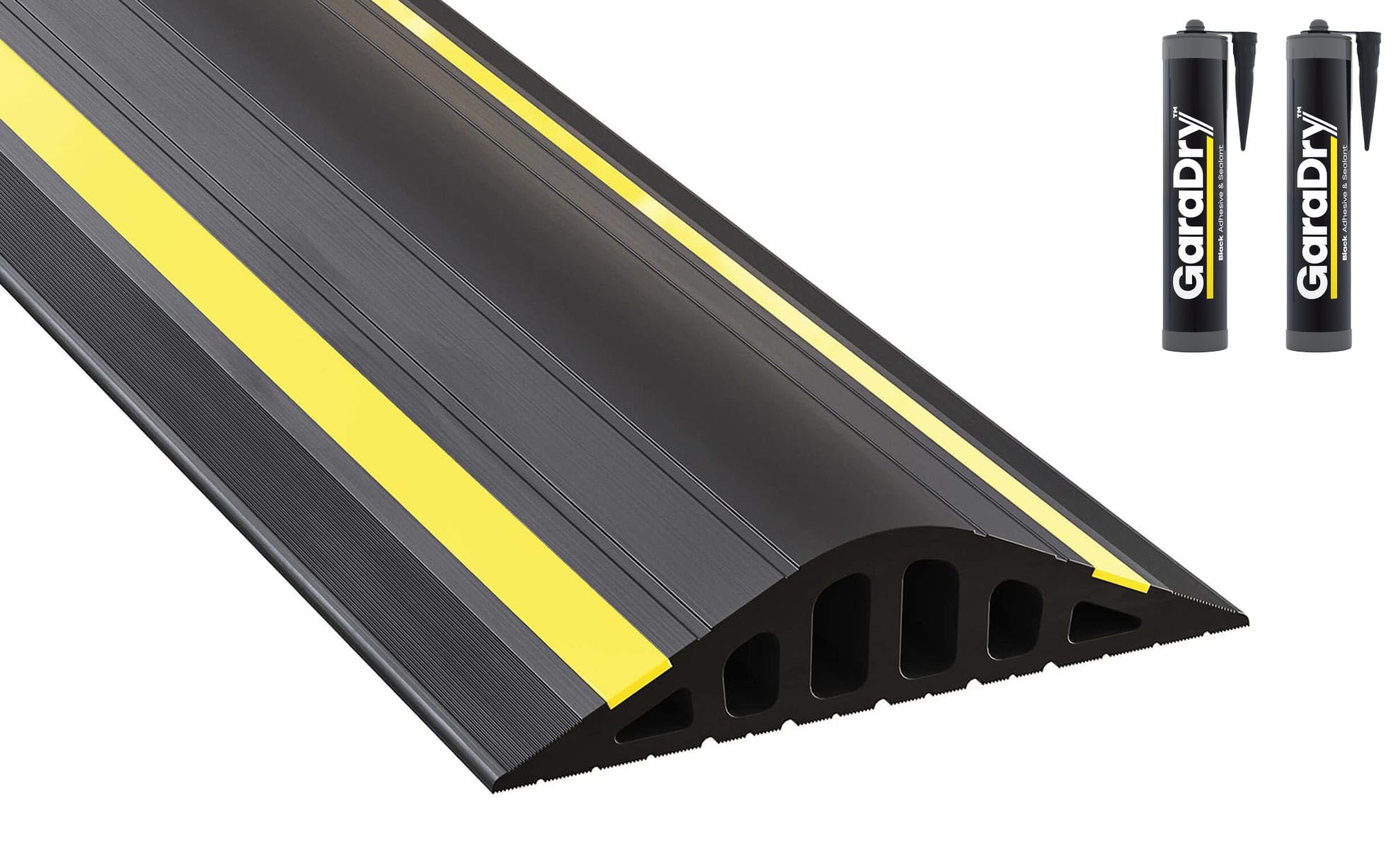
Three times the lip of the standard kit, for the garages that actually flood.
This is the same GaraDry build as the half-inch kit, scaled up to 1.5 inches tall and 7 inches wide — the answer for a garage with a genuinely deep gap or a floor that sits below the driveway. Three times the height of the half-inch version means it can stand against water that a slimmer strip would simply pass, and the heavy-duty PVC shrugs off prolonged water contact without degrading. It ships as a combo set with two adhesives, full-colour instructions and the same 5-year manufacturer warranty.
Heft is the honest catch — at 14.5 kg (about 32 pounds) it is a serious object to handle, and it is rated for a vehicle to drive over it, so placement has to be right the first time. Owners recommend warming the material in the sun, weighting it in place for a day or two while the sealant cures, and resealing the edges once a year. What wins people over is that it just works: the water stays out, and the vehicles still come and go. “No complaints,” one owner sums up after a simple install.
Built for the worst gap: 1.5 inches of height and 7 inches of width make this the barrier for a door that sits noticeably below the surrounding concrete.
The trade-off: it is a heavy, permanent fixture that wants proper tools and a solid concrete surface — and it is the deepest and costliest commitment on this list.
Only pick this if: water has actually come under your door and a thinner threshold would still leave a gap.
Try first: if you have never flooded and the gap is small, the half-inch kit above does the same job for far less money and effort.
Know the Specs
Threshold height
The height of the raised lip is the single number that decides what a PVC barrier can hold back. A half-inch strip handles driveway runoff that sheets toward the door; a 1.5-inch strip is for a deep gap or a floor that sits lower than the surrounding ground. Too low and water passes; too high and it becomes a bump to drive over and a chore to cut.
Length and door width
Barriers come in specific lengths, from 8 feet 5 inches to over 20 feet, and the wrong length means either a gap at one end or trim work. Measure the full opening — not just the door — then buy a strip slightly longer so you can square the ends with a clean cut.
Adhesive and surface prep
The glue is where most installs succeed or fail. Unsealed or dusty concrete grips poorly, a cartridge that has gone stiff will not spread, and cold weather stops the adhesive curing. Clean and dry the floor, warm the tube, and weight the strip while it sets.
Water-activated bags and gel barriers
These swells into a gel wall when they meet water rather than sitting as a hard lip. A standard flood bag expands to around 3.5 inches tall in roughly ten minutes and holds a set amount of water; a full-length fabric barrier spreads that seal across a whole door. Their advantage is deployment with no gluing; their catch is drying them out between uses.
Common Questions
Will a half-inch garage door threshold really keep water out?
How do I know which threshold height my garage needs?
Is a flood barrier bag reusable after a storm?
How long do water-activated flood bags take to expand?
Can I drive over a PVC threshold seal?
Why does the adhesive on these kits fail so often?
Do I need to drill into the door or floor to install one?
What happens if the threshold arrives curled from shipping?
Threshold seal versus flood bag — which one protects my garage better?
How long will a flood barrier last in storage?
The Bottom Line
For most garages with a sloped driveway and a thin gap under the door, the GaraDry ½” Threshold Seal Kit is the one to buy — it is a proven, DIY-friendly half-inch seal in durable PVC, and the crowd favorite, with 4.5+ stars across 400+ owners, backs that verdict up. If your wide opening or deep gap calls for more room to cover, the Weather Defender XL brings over 20 feet of marine-grade PVC in a single strip, and the GaraDry 1½” kit is the deep-gap answer when a half-inch lip would not be enough. If you want protection without touching the concrete at all, grab the Quick Dam flood bags — light to carry, quick to swell, and waiting on the shelf for the storm that matters.
How we choose
We do not accept paid placement. Every pick is matched to a real buyer and a real use-case; we do not hands-on test units.
Sources
Specifications: manufacturer listings and product documentation. Review insights: verified customer reviews, as of October 2026. Pricing: not shown on this page (it changes often); check the current price via the retailer link.
As an Amazon Associate, Aappliancez earns from qualifying purchases. This does not affect which products we feature.