Disclosure: Some links in this post are affiliate links. As an Amazon Associate I earn from qualifying purchases, at no extra cost to you. Learn more
Specs are compiled from manufacturer listings and verified buyer reviews and can change over time — please confirm the key details on the product page before buying.
Shot hole disease wins by repetition: spores splash up in rain, land on wet leaves, and punch out neat round holes that make a plum or cherry look like it lost a fight. No single bottle fixes it; you need a fungicide whose active ingredient targets the fungus, sprayed at the right point in the season at the right dilution. It is a fungicide whose active ingredient actually targets the fungus, applied at the right moment in the season, at the right dilution. The picks below are chosen on exactly that basis — what the formulation is, how it is applied, and whether the label covers the trees and shrubs you are trying to save. If you want the short answer first, the Quali-Pro Propiconazole 14.4 is the one most people should start with.
This guide is built by comparing the manufacturers’ published specifications and the patterns across verified customer reviews, so you get each pick’s real strengths and trade-offs instead of marketing spin.
Shot hole is stubborn, but the right spray timing and a properly mixed systemic fungicide usually turn the corner — start with this guide to the best fungicide for shot hole disease.
Top Picks


How To Choose The Best Fungicide for Shot Hole Disease
Shot hole disease is caused by a fungus that overwinters in twig cankers and old infected leaves. In spring, rain splashes spores onto new growth, and those spores need a wet leaf surface to germinate — often several hours of it. That lifecycle is why a fungicide alone will not save a tree. You need one that hits the fungus early, applied before the infection window closes.
Systemic vs. contact: which one actually works on shot hole
A systemic fungicide is absorbed into the plant’s tissue, so it protects from the inside rather than only where the spray droplet landed. For shot hole, that matters because spores infect through the leaf surface and into the twig tissue. A contact spray only helps where it physically covered the leaf, and rain washes it off. Propiconazole-based products are locally systemic, which is why they dominate lawn and tree disease lists.
Active ingredient is the buying decision — not bottle size
Propiconazole is the active ingredient behind most broad-spectrum tree and turf disease control. A neem-oil product works differently: it suppresses a range of fungal problems but is not a single-target systemic. A biological product (Bacillus-based) works by colonizing the root zone and out-competing pathogens — that is a soil-drench job, not a foliar spray for leaf spots. Match the mode of action to where the fungus lives before you buy anything.
Concentration and pre-harvest interval rules
A concentrate is mixed with water at a label rate; a ready-to-use spray needs no mixing. Concentrates offer more spray per bottle but demand accurate measuring. Critical for fruit trees: some propiconazole labels carry a long pre-harvest interval — the waiting period before you can eat fruit from a sprayed tree. Read the label on the exact bottle before you spray a cherry or plum you plan to harvest.
Side-by-Side Comparison
| Model | Best For | Active Ingredient | Volume | Form | Amazon |
|---|---|---|---|---|---|
| Quali-Pro 83013366 Propiconazole 14.4★ Best Overall | Best Overall | Propiconazole 14.3 | 32 fl oz | Microemulsion concentrate | Amazon |
| Southern Ag Garden Friendly Biological FungicideBest for Roots | Root zone protection | Bacillus-based biological | 16 fl oz | Concentrated spray | Amazon |
| Select Source Propiconazole 14.3 Pint | Turf & ornamental rotations | Propiconazole 14.3 | 16 fl oz | Liquid concentrate | Amazon |
| Fertilome (11378) Liquid Systemic Fungicide II | Rose and flower beds | Systemic concentrate | 32 fl oz | Liquid concentrate | Amazon |
| Garden Safe Fungicide3 with Neem Oil | Organic garden all-rounder | Clarified hydrophobic extract of neem oil | 128 fl oz | Ready-to-use liquid | Amazon |
Detailed Reviews
1. Quali-Pro 83013366 Propiconazole 14.4 Fungicide, 32oz
Our pick — 4.5+★ from 850+ verified ratings; the strongest balance of quality and price.
The propiconazole workhorse that treats a third of an acre without emptying the bottle.
If you own a plum, cherry, or flowering ornamental that keeps losing leaves in spring, this is the bottle to reach for first. The active ingredient is propiconazole 14.3 — a locally systemic fungicide, meaning it is taken up into the plant tissue rather than sitting only on the leaf surface. That inside-the-plant movement is exactly what you want for a fungus that infects through wet leaves and into twigs. The formulation is a microemulsion, which describes a concentrate that mixes into water with less odor and better stay-on-the-leaf coverage than a standard emulsifiable oil.
The 32 fluid ounce bottle is the biggest concentrate here — four times the volume of the Select Source pint, as a straight comparison of the two labels. One 32 fl oz bottle treats a third of an acre, and the propiconazole stays active inside the plant instead of washing off in the first rain. The labeled disease list is wide: rusts, gray leaf spot, dollar spot, anthracnose, leaf spot, brown patch, powdery mildew, and pink and gray snowmolds. It is a strong tank mix partner with most other fungicides, so you can rotate it with a different mode of action to slow resistance.
The two big wins on the review pages are effectiveness and value — the same two things that make it the starting pick. One verified buyer sprayed a third of an acre hit hard by brown patch at 2oz per gallon per 1,000 sq ft, repeated at 14 days, and reported new growth in a week and major recovery in a month. Another resolved orange rust on wild blackberries after three sprays at a diluted concentration. The one clear safety rule from that same account: full protective gear, and do not eat fruit for a year after the last spray. That pre-harvest interval is the real limitation on edible trees, not a flaw in the product itself.
What the label and buyers back up
- Propiconazole 14.3 in a locally systemic formulation that moves into plant tissue
- 32 fl oz of microemulsion concentrate — four times the volume of the Select Source 16 fl oz pint
- Wide labeled disease list including leaf spot, rusts, and powdery mildew
- Works as a tank mix partner to rotate modes of action
What to plan around
- Full protective equipment is a label requirement, not optional — spray in mild weather and avoid hot days
- Long pre-harvest interval means no fruit from sprayed trees for a season — plan for ornamental or non-edible use if you harvest
Go-to bottle: Anyone fighting leaf spot or shot hole on trees, shrubs, or turf who wants one systemic concentrate that covers real ground.
Not for: A backyard fruit tree you plan to eat from this season — the lengthy pre-harvest interval rules that out.
2. Southern Ag Garden Friendly Biological Fungicide, 16oz
A living fungicide you mix a teaspoon at a time into the soil, not onto the leaf.
Southern Ag takes a completely different route from the propiconazole picks: this is a biological fungicide, a concentrated spray built around beneficial bacteria. You mix it into water and drench the soil, where the bacteria multiply and crowd out the pathogens that attack roots. For shot hole disease that starts on leaves and twigs, this is a supporting tool rather than a direct treatment — but for any tree being weakened by a root-zone problem at the same time, it fills a gap no spray fills. The 16 fluid ounce bottle is eight times smaller than the Garden Safe gallon, and that comparison matters: this is a concentrate measured in teaspoons, so a little goes very far.
The praise clusters around effectiveness, then root protection — buyers describe drenching a wilting hibiscus and a collapsed tomato plant and watching the stems firm up again. One verified account of the hibiscus recovery is worth quoting: “Applied ~1 tsp Southern Ag Fungicide per gallon as soil drench (not foliar); wilting stem fully revived overnight.” That is the practical instruction that turns this bottle from confusing to useful: it is a drench, not a spray. Use roughly a teaspoon per gallon, soak the root zone, and repeat every 7 to 14 days.
The honest catch is the smell. The recurring note across the review pages is a strong, unpleasant odor, and the most vivid account warns to open it outdoors and wear gloves. There is also a split on how long a single application lasts — the label and buyers lean toward proactive scheduling rather than one-and-done. Treat this as a seasonal soil program alongside a foliar fungicide, not a substitute for one.
Where it earns its place: A biological soil drench that colonizes the root zone and supports a tree under stress — the effectiveness and root-protection response both point the same direction.
The trade-off you live with: A genuinely foul odor and the need for regular re-application every 7 to 14 days. Open it outside and plan a schedule.
Pick this if: A tree or shrub has root or wilt trouble and you want a biological product that works in the soil, applied as a drench.
Pass if: Your whole problem is leaf spots up top and you want a single foliar spray — go propiconazole instead.
3. Select Source Propiconazole 14.3 Pint Select Fungicide

The rotation partner for a lawn that keeps relapsing into the same patch of fungus.
Buy this one when your issue is a lawn or ornamental bed that gets hit again and again and you want a second mode of action to alternate against the Quali-Pro. Same active ingredient — propiconazole 14.3 — but at 16 fluid ounces and 1.4 pounds, a pint versus the four-times-larger Quali-Pro bottle. On the label the emphasis is different too: excellent residual control, low use rates, low odor, and high tank mix compatibility. Low use rates matter because a little measured concentrate treats a wide area, which is why a pint lasts a season for a home lawn. And it is labeled for both turf and ornamental applications, so it works across the whole yard.
This is the pick where the review pages are most upfront about the fine print. The clearest caution is the pre-harvest interval: propiconazole has a one-year wait before you can eat fruit from a treated tree. So if fruit is the goal, this goes on the non-edible ornamentals and turf, not the orchard. The buyer consensus leans toward rotating between azoxystrobin and propiconazole for lawn and shrub fungus rather than leaning on one alone — and toward liquid concentrates, which buyers report work faster than the granulated alternatives. The rest of the story is outright relief: “Baby it got my lawn back to green twice this year and last year!” The fungus returns each season, and a repeat application greens the lawn again.
Because this is the same active ingredient as the Quali-Pro at roughly half the volume, buy it as a rotation stock or as a smaller trial bottle before committing to a large jug. Some buyers call a pint pricey, but the long residual control means fewer sprays per season.
Why turf owners keep buying it
- Propiconazole 14.3 with long residual control and low use rates — a little covers a lot
- Low odor and high tank mix compatibility, so rotating it is straightforward
- Labeled for both turf and ornamental applications
Where the fine print bites
- A one-year pre-harvest interval on fruit — keep it off any tree you plan to eat from
- At 16 fl oz it holds four times less than the Quali-Pro bottle, so it is a rotation stock rather than a full-season jug for a big yard
Best matched to: A lawn or ornamental rotation where you want a second propiconazole concentrate to alternate.
Skip for: Fruit trees you harvest — the one-year interval makes it a non-edible-only spray.
4. Fertilome 11378 Liquid Systemic Fungicide II Concentrate
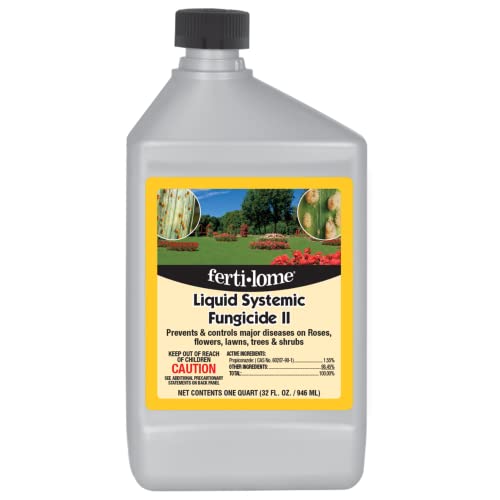
Built around the rose bed and the flower border, where sprays win on timing and mixability.
This is the pick for a garden built on roses and flowering perennials instead of a wide lawn. The label targets Take All Patch, Brown Patch, Dollar Spot, Leaf Spot and more, and it is a liquid systemic concentrate — meaning it is absorbed into the plant rather than sitting on the surface, so a spray protects new growth from the inside. It comes in a 32 ounce concentrate that mixes readily with water. The label’s own advice is to apply early in the growing season, which is exactly the shot hole window before spores have a wet leaf to land on. There is a weight comparison worth knowing too: this bottle is 2 pounds, and at that weight it is 43% heavier than the 1.4-pound Select Source pint.
For rose growers specifically, the label covers black spot and rust, the two big rose fungal threats. Because it is systemic rather than a plain contact spray, it can reach the tissue where black spot infections take hold. The instruction to apply early is the operational key — spraying a healthy plant at the start of the season protects it longer than chasing spots after they arrive. Follow the label rate for mixing; it is a concentrate, so a measured gallon goes further than a ready-to-use spray.
Effectiveness and quality both come through on the review pages, with rose growers noting it as a staple for their beds. The one limitation is what a concentrate asks of you: accurate measuring and a schedule early in the season. It rewards early-season spraying on healthy growth, not a rescue spray after the leaves already have holes.
The case for it: A liquid systemic concentrate labeled for leaf spot and the main rose diseases, with early-season application being the path to real protection.
The honest limit: It is a concentrate that asks for careful measuring and a planned schedule — a spray that works best before you see damage.
Made for: Rose and flower gardeners who want a systemic concentrate to spray early in the season.
Look elsewhere if: You want a no-mix ready-to-use bottle and nothing to measure.
5. Garden Safe Brand Fungicide3 with Neem Oil, 1 Gal
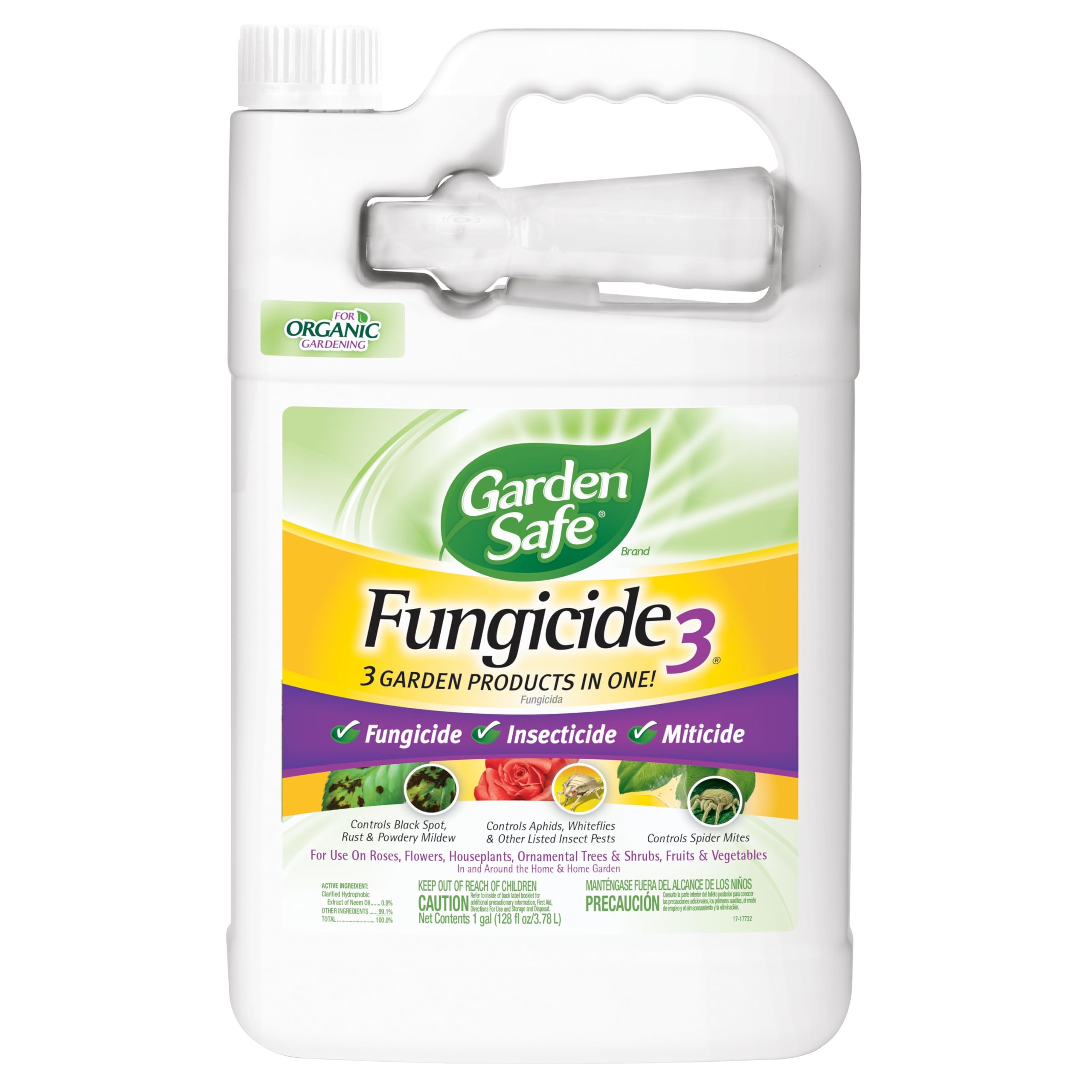
The gallon jug for an organic garden fighting fungus and bugs at the same time.
Garden Safe is the organic option, and one bottle replaces three products in a garden that has both fungal and insect trouble. The active ingredient is clarified hydrophobic extract of neem oil — a plant-based oil that works as a fungicide, an insecticide, and a miticide. It is labeled for prevention and control of black spot, rust, and powdery mildew, plus a range of insects and spider mites. At 128 fluid ounces it is eight times the volume of the Southern Ag 16 ounce bottle, and it comes ready to use, so there is nothing to dilute. The gallon jug needs no mixing, and its organic-gardening label lists roses, flowers, houseplants, ornamental trees, shrubs, fruits, and vegetables.
Where this one wins on the review pages is range and safety. Buyers describe using it across a vegetable garden and against rose black spot and zucchini silver mold, and the recurring praise is that it protects edible crops without fuss. As one verified buyer put it: “I am very pleased with this fungicide! It saved my beautiful Crepe Murtle tree.” It is also the one pick in the lineup that goes after aphids, whiteflies, and spider mites at the same time — useful when a stressed tree is also under pest pressure.
Be clear-eyed about its limits: it is not a strong systemic like propiconazole. It helps against squash bugs and grubs but does not kill them outright, so do not expect it to wipe out a heavy pest infestation. The packaging is the other real frustration — the pull-out spout can clog and the container is awkward to refill. If your shot hole problem is severe on a fruit tree, treat this as a supporting or organic option rather than the single cure.
What the gallon gets you
- 128 fl oz ready to use — eight times the volume of the Southern Ag 16 ounce bottle, no mixing
- Three jobs in one: fungicide, insecticide, and miticide against listed pests
- Labeled for organic gardening across roses, flowers, houseplants, fruits, and vegetables
Where it falls short
- Milder than a propiconazole systemic — helps against pests but does not wipe out a heavy infestation
- The pull-out spout can clog and the jug is awkward to refill
Right choice when: You garden organically and want one large ready-to-use bottle covering fungus, insects, and mites.
Think twice if: Shot hole has already spread badly on a fruit tree — you will likely want a true systemic alongside it.
Know the Specs
Propiconazole 14.3
The active ingredient behind the Quali-Pro and Select Source picks. It is a locally systemic fungicide — absorbed into plant tissue rather than resting on the surface — and it targets a broad disease list including leaf spot and rusts. “14.3” refers to the concentration strength stated on the label, not a percentage you read off the front.
Locally systemic vs. biological drench
A locally systemic product moves into the plant from where it lands and protects tissue from the inside. A biological drench like Southern Ag works differently: you water it into the soil, and the beneficial bacteria multiply around the roots. One treats the plant above ground; the other supports the root zone below it. They solve different problems.
Pre-harvest interval (PHI)
The waiting period between the last spray and when you can safely harvest and eat the fruit. Propiconazole labels can carry a long interval — one year or more on some products. This is the single most important label number for anyone with a fruit tree, because it decides whether a spray is an option at all.
Microemulsion concentrate
A type of liquid formulation that mixes into water with less odor and better plant coverage than a standard oil-based emulsifiable concentrate. It still needs accurate measuring. The Quali-Pro pick uses a microemulsion; the neem-oil gallon is ready to use with no mixing.
Common Questions
What is the best fungicide for shot hole disease on a plum or cherry tree?
Is neem oil effective against shot hole disease?
How often should I spray for shot hole disease?
Can I use propiconazole on a fruit tree I plan to eat from?
What is the difference between a systemic fungicide and a contact fungicide?
Can I mix propiconazole with other fungicides in the same sprayer?
Does Southern Ag Garden Friendly Fungicide treat shot hole disease?
How much area does a 32 ounce propiconazole concentrate cover?
Why does Southern Ag Garden Friendly Fungicide smell so strong?
When in the season should I spray for shot hole?
The Bottom Line
For most people fighting shot hole disease, the Quali-Pro Propiconazole 14.4 is the bottle to start with. It pairs true systemic action with a 32 fl oz microemulsion concentrate — the largest concentrate here at four times the Select Source pint — and it carries the widest labeled disease list of the bunch. If your problem lives in the soil rather than on the leaves, the Southern Ag Garden Friendly Biological Fungicide drenches the root zone with a teaspoon-per-gallon mix. And for an organic garden fighting fungus and pests together, the Garden Safe Fungicide3 with Neem Oil gallon handles the widest range of problems in a single ready-to-use bottle. Match the active ingredient to where the fungus lives — propiconazole for leaf and twig infections, a Bacillus drench for root-zone trouble — and you will not waste a bottle.
How we choose
We do not accept paid placement. Every pick is matched to a real buyer and a real use-case; we do not hands-on test units.
Sources
Specifications: manufacturer listings and product documentation. Review insights: verified customer reviews, as of October 2026. Pricing: not shown on this page (it changes often); check the current price via the retailer link.
As an Amazon Associate, Aappliancez earns from qualifying purchases. This does not affect which products we feature.