Disclosure: Some links in this post are affiliate links. As an Amazon Associate I earn from qualifying purchases, at no extra cost to you. Learn more
Specs are compiled from manufacturer listings and verified buyer reviews and can change over time — please confirm the key details on the product page before buying.
Powdery mildew on a crepe myrtle looks like someone dusted your tree with flour — and if you ignore it, the leaves curl, the buds drop, and the summer bloom you waited all year for never shows up. The fix is not complicated, but the wrong jug wastes a season. You want a concentrate you can mix to the right strength, a label that actually lists the disease you are fighting, and a spray you can repeat every week or two without harming the tree. This guide compares five real fungicide concentrates on exactly those points, in plain English.
This guide is built by comparing the manufacturers’ published specifications and the patterns across verified customer reviews, so you get each pick’s real strengths and trade-offs instead of marketing spin.
Crepe myrtles are mildew magnets because their leaves sit tight together and stay damp after rain. Below you will find the mix rates, the disease lists, and the honest trade-offs of each jug, so you can spray once and be done — a solid shortcut is picking the right fungicide for crepe myrtle the first time.
Top Picks


How To Choose The Best Fungicide for Crepe Myrtle
Start with the disease, not the bottle. Crepe myrtle’s most common problem is powdery mildew — a white or gray powdery coating that spreads across leaves and new shoots, especially in humid weather or where air movement between branches is poor. Some trees also pick up leaf spot or anthracnose. Whatever jug you buy must name that disease on its label, or you are spraying blind.
Does the label name powdery mildew
Read the disease list before anything else. A fungicide built for turf diseases may still list powdery mildew, while one built for orchard fruit may not. Powdery mildew appearing on the label is your first filter, and it is the single most useful line of text on the entire jug.
Concentrate versus ready-to-spray
A concentrate means you dilute it in water yourself, so one bottle covers far more tree. That matters because crepe myrtles are big shrubs — a single tree can soak up a full sprayer. A concentrate lets you mix only what you need for one pass, then mix fresh a week or two later.
How the active ingredient gets inside the plant
Some fungicides are locally systemic, which means the plant takes them up and moves them a short distance into the leaf tissue. That type resists being washed off by rain better than a product that only coats the surface. Biological products work differently: they contain a living bacterium that settles on the leaf or root and multiplies, which is why the label usually asks you to start early and repeat.
Mix rate and reapplication schedule
Crepe myrtle mildew comes back. Whatever you pick, plan to reapply on the schedule the label gives — often every 7 to 14 days — and re-spray after heavy rain if the label calls for it. A jug you cannot easily measure out is a jug you will stop using.
Side-by-Side Comparison
| Model | Best For | Bottle Size | Form | Powdery Mildew Listed | Amazon |
|---|---|---|---|---|---|
| Bonide Captain Jack’s Orchard Spray★ Best Overall | All-in-one spring defense | 32 fluid ounces | Spray concentrate | Yes | Amazon |
| Southern Ag Garden FriendlyBest for Roots | Root-level disease and soil health | 16 fluid ounces | Spray (biological concentrate) | Not listed | Amazon |
| Bonide Revitalize Biofungicide | Organic beds and foliage spraying | 16 fluid ounces | Spray concentrate | Yes | Amazon |
| Fertilome Triple Action | Bugs and mildew in one jug | 16 fluid ounces | Liquid concentrate | Yes | Amazon |
| Quali-Pro Propiconazole 14.4 | Serious long-lasting disease control | 32 fluid ounces | Oil (microemulsion concentrate) | Yes | Amazon |
Detailed Reviews
1. Bonide Captain Jack’s Orchard Spray 32 oz
Our pick — 4.5+★ from 1,000+ verified ratings; the strongest balance of quality and price.
One jug that hits mildew and the bugs chewing the leaves in the same pass.
Here is the number that decides it: one pint of this concentrate makes up to 6.4 gallons of finished spray. That is a whole season of crepe myrtle passes out of a single 32-fluid-ounce bottle. Dilution goes as low as 2 and 1/2 fluid ounces per gallon of water, so a small pump sprayer fills for one tree without mixing a batch you throw away. Just as useful for crepe myrtle, the label names powdery mildew directly, along with rust, blight, brown rot, and leaf spots.
What separates this from the Southern Ag jug is scope. Southern Ag is a bacterium that builds a protective population on leaves and roots, while this Bonide is a mixed fungicide, insecticide, and miticide — so the same sprayer handles the mildew and the thrips, mealybugs, and spider mites that show up on the same shrub. The volume gap is real too: 32 fluid ounces against Southern Ag’s 16 fluid ounces. Mix it in a hose-end or tank sprayer, and it can go up to the day before harvest on edibles.
The honest catch is the mixing window. Leave a batch sitting in the sprayer about a week and it clogs, so mix only what you will use that day and rinse after. This one is not a slow drip-feed tonic either — it handles today’s mildew and today’s insects, and it needs reapplication after rain or in humid stretches. Crepe myrtle owners in muggy zones should plan on a repeat pass by the calendar, not only when the powder returns.
What earns the top slot
- One pint makes up to 6.4 gallons of mixed spray
- Lists powdery mildew, rust, blight, brown rot, and leaf spots
- Covers insects and mites alongside the disease
- Dilutes as low as 2 and 1/2 fluid ounces per gallon
Where it asks for care
- Mixed spray clogs the sprayer if it sits about a week
- Needs another pass after rain or heavy humidity
- Not the cheapest way to spray if bugs are not your problem
Start here if: you want mildew and leaf-chewing pests handled from one bottle and one sprayer pass.
Worth a different bottle if: your mildew is the only issue and you are spraying a single small tree.
2. Southern Ag Garden Friendly Biological Fungicide, 16oz
A tiny dose of living bacteria that keeps working after the sprayer is put away.
The dose is the whole story. This is a biological concentrate, meaning the active part is a living bacterium that settles where you spray and multiplies on its own — and it is so concentrated that a small amount makes a full gallon. Buyers report: “Soil drench of ~1 tsp Southern Ag Fungicide per gallon revived wilting stem overnight.” That is a root-zone application, poured at the base rather than misted over the canopy, which is why this jug pairs so well with a crepe myrtle that looks wilted and unhappy rather than simply dusty.
Compare it with the Bonide Orchard Spray above: that one is 32 fluid ounces of mixed-purpose chemistry, this one is 16 fluid ounces of pure biological and needs far less per gallon. So the smaller bottle is not the weaker bottle — it is the more concentrated one. The reputation here is built on root protection and general plant vigor, and the same bacterial approach that keeps roots clean also has a following among growers fighting blight. Applied every 7 to 14 days at the base, it works as a background layer of defense while a knockdown spray handles the visible mildew up top.
The trade-off you have to accept is the smell. This is a strong, fishy biological odor, and it is worth opening outdoors and wearing gloves when you measure it out. Some users find the effect fades sooner than they would like, so treat it as a routine, not a one-time fix. It is also not built as a fast knockdown for a canopy already white with mildew — this is the patient, preventative half of the program.
Why growers keep it: a single small measure makes a full gallon, the bacteria keeps working in the root zone, and the price per mixed gallon runs far below ready-to-spray bottles.
The smell is the price of admission: it is a strong organic odor, so measure outdoors with gloves on.
Reach for this if: you want a low-dose biological working at the root zone as a standing defense.
Keep looking if: your crepe myrtle is already coated white and you need a knockdown spray this week.
3. Bonide Revitalize Biofungicide, 16 oz Concentrate

The biological bottle that names crepe myrtle’s mildew problem right on the label.
For a crepe myrtle specifically, this is the biological option that fits the job. Revitalize lists powdery mildew among the diseases it controls, along with blight, anthracnose, and black spot, and it is approved for organic gardening — usable right up until the day of harvest on edibles. It works differently from a chemical spray: it triggers the plant’s own immune response rather than killing the fungus directly, so the tree does the work once you have applied it. You mix it with water and apply it either as a foliar spray over the leaves or as a soil drench at the base.
Put it beside the Southern Ag jug and the distinction is clear. Southern Ag relies on a bacterium multiplying on the plant; Revitalize prompts the plant itself to respond. Both are concentrates in 16-fluid-ounce bottles, but the practical difference is what you are treating — Southern Ag’s crowd leans toward root rot and blight, while Revitalize’s is the more foliage-minded biological. Crepe myrtle powdery mildew is a leaf-and-shoot problem, so a foliar pass from this bottle makes logical sense.
Where it falls short of a chemical is speed on an already-advanced infection. It is a preventative and a support, not a rescue. The label asks you to start before the disease takes hold, and if your tree is already white, you will want something with more direct punch first. Owners mention: “I used 1 tablespoon per gallon since the blight was already underway.” That mix rate is a good place to start for a foliar pass, but expect to repeat it — one spray will not close the book.
The strongest case: an organic-approved concentrate that lists powdery mildew by name and works from the plant’s own defenses, with both foliar and soil-drench application.
Best used early: this is a preventative you start before mildew takes hold, not a fast knockdown once the canopy is coated.
Suits you if: you garden organically and want a biological foliar spray you can time ahead of the humid weeks.
Skip the delay if: the mildew is already heavy — this will support the tree, but it will not clear a bad infection quickly.
4. Fertilome Triple Action 16 oz
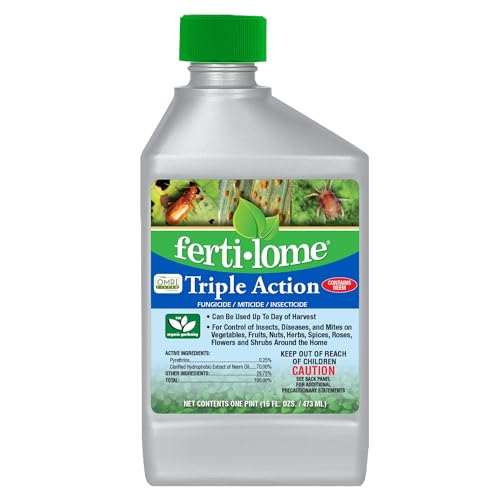
Three jobs in one liquid — aphids and mites on the underside, mildew on the top.
If your crepe myrtle problem is not only the white powder but also the curled, sticky new growth that aphids and spider mites leave behind, this is the bottle designed for that exact combination. It is an insecticide, a miticide, and a fungicide in one liquid. The label covers aphids, spider mites, leafminers, leafrollers, and armyworms on the insect side, and prevents or protects against powdery mildew, rust, and leaf spot on the disease side. For a shrub that attracts both, that saves you mixing two tanks.
The reapplication rule is the one to write down: the maker recommends reapplying on a 7–14 day schedule. That is a tighter drumbeat than you might expect, and it matters most in humid stretches when mildew spreads between passes. On coverage, it is listed for fruits, herbs, nuts, spices, vegetables, roses, flowers, and shrubs — the shrub line is the one that applies to crepe myrtle. It comes as a 16-fluid-ounce liquid concentrate, so you measure and mix rather than spray neat.
Be realistic about the cost-per-application. This jug holds 16 fluid ounces, while a 32-ounce bottle like the Bonide Orchard Spray gives you roughly twice the volume for the same kind of multi-purpose job. If insects are not actually a problem on your tree, you are paying for a capability you will not use. It is also a broad-spectrum product, so it is not the gentle biological route — for a pollinator-friendly garden, read the label carefully before you spray flowers.
Why it earns a slot
- Handles insects, mites, and disease in a single mix
- Names powdery mildew, rust, and leaf spot
- Reapplication interval is spelled out at 7–14 days
What to weigh first
- 16 fluid ounces means it runs out faster than a 32-ounce jug
- Broad-spectrum, so take care around open flowers
- You pay for the insect coverage even if you only need disease control
Matches your yard if: you want one jug that cleans up insects and mildew together on a fixed spray calendar.
Look elsewhere if: your only issue is powdery mildew on one shrub and you would rather buy twice the volume.
5. Quali-Pro 83013366 Propiconazole 14.4 Fungicide, 32oz

The pro-grade systemic built to stay inside the plant and outlast a rain shower.
Propiconazole is the active ingredient, and it works systemically — meaning the plant absorbs it and moves it a short distance into the treated tissue, so the protection sits inside the leaf rather than waiting on the surface to be washed off. That is the structural advantage over a contact spray, and it is why this bottle is aimed at nursery, landscape, and tree-injection use rather than casual home spraying. The disease list on the label includes powdery mildew, rust, anthracnose, gray leaf spot, dollar spot, brown patch, and summer patch. For a crepe myrtle fighting mildew through a wet summer, that locally systemic behavior is exactly the property you want.
The formulation itself is a microemulsion — an oil-based concentrate that mixes into water — and that is chosen for less odor, better stability in the tank, and better coverage on the leaf. It also plays well in a tank mix with most other fungicides, so if you rotate products to keep the fungus from adapting, this one slots in easily. The bottle holds 32 fluid ounces, the largest volume on this list alongside the Bonide Orchard Spray, which makes it a long-term supply rather than a one-season purchase.
The one thing to plan for is cost and handling. This sits at the top of the range on price, and it is a serious agricultural-style concentrate, so read the label and wear the protective gear it asks for. It is also overkill for a single small tree — if you have one crepe myrtle and a light case of mildew, a simpler jug will do the job. For a row of them, or a tree that has fought mildew for years, the systemic action earns its keep.
What the pros buy it for: a locally systemic active ingredient that moves into the leaf tissue, a microemulsion that stays stable in the tank, and a label packed with disease names.
The honest cost: a pro-grade price and a label that expects real protective gear — worthwhile on multiple trees, heavy on a single one.
Choose it when: you have several crepe myrtles, a long-running mildew battle, or you want a systemic you can rotate.
Not for you if: you have one small tree and want something simple and budget-level.
Know the Specs
Concentrate vs ready-to-spray
A concentrate is a bottle of active ingredient you dilute in water yourself. The benefit is coverage: a small bottle makes many gallons of usable spray, so one jug lasts a whole season. A ready-to-spray bottle is pre-mixed, convenient, and expensive per pass. For crepe myrtle, where a single shrub can take a full sprayer, a concentrate is usually the smarter buy — you mix only what you need and never carry a half-empty bottle around.
Locally systemic vs contact
A contact fungicide sits on the leaf surface and does its work there; rain can wash it off. A locally systemic one is taken up into the leaf tissue and moved a short distance, so it keeps working after the surface dries. The label will usually say “systemic” if this is the case. On a crepe myrtle that gets rained on weekly in summer, the systemic kind holds its ground longer between passes.
Biological active ingredients
Some fungicides use a living bacterium rather than a chemical. The bacterium settles on the leaf or root and multiplies, which is why the label usually asks you to begin before disease sets in and to repeat. These are the gentler choice around a mixed garden, but they are not fast knockdowns — they build a protective population over time rather than erasing an infection on contact.
Mix rate and reapplication timing
Mix rate is how much concentrate goes into a gallon of water; it is printed on the label and it matters. Too weak and the disease walks right past it, too strong and you risk the plant. Reapplication timing is the other half — powdery mildew returns, so a spray that works is one you repeat on schedule, often every 7 to 14 days, and reapply after rain if the label calls for it.
Common Questions
What causes powdery mildew on crepe myrtle?
Can I use an orchard fruit fungicide on my crepe myrtle?
How often should I spray for crepe myrtle mildew?
Is a biological fungicide better than a chemical one?
Will a fungicide stop mildew that is already on the leaves?
Can I mix a fungicide with an insecticide in the same sprayer?
Does rain wash off a crepe myrtle fungicide?
Are these fungicides safe to use around kids and pets?
How long will one bottle of concentrate last?
Should I rotate between different fungicides?
The Bottom Line
The Bonide Captain Jack’s Orchard Spray is the pick I would hand most crepe myrtle owners, because it names powdery mildew directly, stretches one pint into up to 6.4 gallons of mixed spray, and takes care of the insects nibbling the same shrub at the same time. If you want to spray organically and hit the mildew from the leaves, the Bonide Revitalize is the biological bottle that actually lists crepe myrtle’s disease. And for a row of trees or a mildew battle that keeps returning, the systemic action of the Quali-Pro Propiconazole 14.4 is the heavy-hitting option. Whichever one you pick, the sprayer pass you repeat on time beats the stronger bottle you leave in the garage.
How we choose
We do not accept paid placement. Every pick is matched to a real buyer and a real use-case; we do not hands-on test units.
Sources
Specifications: manufacturer listings and product documentation. Review insights: verified customer reviews, as of October 2026. Pricing: not shown on this page (it changes often); check the current price via the retailer link.
As an Amazon Associate, Aappliancez earns from qualifying purchases. This does not affect which products we feature.