Disclosure: Some links in this post are affiliate links. As an Amazon Associate I earn from qualifying purchases, at no extra cost to you. Learn more
Specs are compiled from manufacturer listings and verified buyer reviews and can change over time — please confirm the key details on the product page before buying.
If your bike stumbles off idle, hesitates when you crack the throttle, or idles rough after sitting all winter, you are almost certainly looking at carbon and varnish gumming up the carburetor jets or fuel injectors. The fix is not a rebuild — it is a concentrated cleaner poured into the tank that dissolves that buildup as you ride. This guide covers the five fuel system cleaners that keep motorcycle and small-engine fuel systems clean, with the strengths and the honest trade-offs of each.
This guide is built by comparing the manufacturers’ published specifications and the patterns across verified customer reviews, so you get each pick’s real strengths and trade-offs instead of marketing spin.
Motorcycles are harder on fuel than cars: small tanks, seasonal storage, and carbureted bikes that sit for months all speed up deposit formation. Below you will find the dosing math, which formulas also stabilize fuel, and how to pick the right cleaner for your engine. These are the best fuel system cleaner for motorcycles options that actually do the job.
Top Picks


How To Choose The Best Fuel System Cleaner for Motorcycles
The mistake most riders make is treating every bottle on the shelf as the same thing. They are not. A cleaner dissolves existing carbon and varnish; a stabilizer slows fuel breakdown during storage. Some products do one job, some do both, and the label usually tells you which.
Match the cleaner to your fuel system
A carbureted bike with a clogged pilot jet needs a strong solvent that attacks carbon in the carburetor body. A fuel-injected bike mostly needs something that keeps injectors and the fuel pump lubricated and clean. Read the “about this item” text on the bottle and look for the words carburetor, injectors, intake valves, or piston crowns. If those are listed, the product is aimed at deposit removal rather than pure lubrication.
Check the dosing ratio before you buy
Small tanks make dosing math matter. A cleaner that treats five gallons per ounce is easy to measure into a four-gallon motorcycle tank. A product dosed by the full bottle into a large automotive tank is harder to scale down accurately. Always read the treat rate on the label first, because pouring a full car-sized dose into a small bike tank can be wasteful and expensive.
Decide if you need a stabilizer too
If your bike sits for months over winter, a cleaner alone will not stop the fuel from going stale. Several products here explicitly do not contain fuel stabilizers, which means you need a separate stabilizer for long storage. Plan for that on the shelf before the season ends, since buying one bottle that does both is the simpler path for a bike that sits.
Side-by-Side Comparison
| Model | Best For | Volume | Treat Rate | Fuel Stabilizer Included | Amazon |
|---|---|---|---|---|---|
| Quicksilver Quickleen Engine and Fuel System Cleaner★ Best Overall | All-round carburetor and injector cleaning | 12 fluid ounces | 1 ounce per 5 gallons | No | Amazon |
| Lucas Oil 16 Oz. Diesel Deep CleanDiesel Specialist | Diesel engines and DPF recovery | 16 ounces | — | — | Amazon |
| Mercury 8M0047931 Quickleen | Seasonal maintenance on carbureted bikes | 12 ounces | 1 ounce per 5 gallons | No | Amazon |
| Berryman 7516 High Mileage Fuel System Rejuvenator | High-mileage and stored engines | 15 fluid ounces | — | Stabilizes gasoline | Amazon |
| Lucas Oil Fuel Injector Cleaner 5.25 oz | Injector and pump protection | 5.25 ounces | — | — | Amazon |
Detailed Reviews
1. Quicksilver Quickleen Engine and Fuel System Cleaner
Our pick — 4.5+★ from 950+ verified ratings; the strongest balance of quality and price.
One 12-ounce bottle that reaches across 60 gallons of fuel and cleans carbon from the carburetor outward.
The single most useful number here is the treat rate: 1 ounce per 5 gallons of gasoline. The dose is easy to eyeball accurately, and it is a big reason so many owners keep this bottle in the garage for regular maintenance rather than treating it as a one-time rescue.
What the cleaner actually targets is a long list — carbon deposits on carburetors, injectors, intake valves, spark plugs, piston crowns, and cylinder heads. It is listed for use with all grades of gasoline and ethanol-blend fuel, which matters on a bike that sees pump ethanol. The bottle also claims to prevent engine knocking and piston seize-up, so it is pitched as engine protection as well as cleaning. Where it lands strongest is carbureted bikes and marine-adjacent small engines, which is the same world this formula was originally built for.
The main decision you face with this cleaner, and it is worth stating clearly, is the missing fuel stabilizer. If your motorcycle sits through a wet or cold season, you will need a separate stabilizer alongside it. Buy those as a pair and you have a complete fuel-care routine. The other habit to plan for is measuring carefully — since the formula is a 12-ounce bottle for 60 gallons, overpouring into a small tank is easy to avoid once you own a small measure.
What earns its keep
- Treat rate of 1 ounce per 5 gallons makes small-bike dosing simple.
- Covers carbon on carburetors, injectors, intake valves, spark plugs, piston crowns, and cylinder heads.
- Safe across all grades of gasoline and ethanol-blend fuel.
What to plan around
- Contains no fuel stabilizer, so long storage needs a separate product.
- Requires a measuring method for precise small-tank doses.
Best fit: a carbureted or small-engine bike that needs a cleaning routine you can repeat every fill-up.
Worth knowing: you will need a separate bottle for winter fuel storage.
2. Lucas Oil 16 Oz. Diesel Deep Clean
A diesel-only formula built to clear soot from DPF filters and wake up a plugged truck.
If your bike runs on diesel — rare, but it happens — this bottle is not built for it. The label and typical use case are truck and tank diesel, so check before you pour. The Lucas 16-ounce bottle is dosed heavier than the gasoline cleaners here: many owners pour in 16 ounces every fourth fill-up on a diesel truck. The stated gains are lower soot in filters, cleaner injectors, restored power, and improved acceleration.
The strongest real-world story attached to this bottle is DPF recovery. Buyers report a DPF Full fault and limp mode clearing within 30 minutes of adding the 16 ounces, with one noting fuel economy on the same trip rising from 17.8 to 20.2. It is a targeted product for a diesel exhaust problem, not a general bike-tank helper. Another report describes a DPF gauge falling to zero percent after a stationary regen plus a short highway drive.
The honest catch: the bottle cap has been called out as leak-prone even when tightened, so store it upright and wipe the neck after pouring. It is also a diesel-only product, so a gasoline motorcycle should not be using this bottle at all. This is the right pick for a diesel-engined small vehicle, not for a petrol bike.
Where it belongs: in a diesel truck or diesel-engined vehicle’s fuel routine, not a motorcycle tank.
Cap-side risk: store upright and check the seal before each use — the neck is the weak point.
This is for you if: you run a diesel and want a bottle that addresses soot and DPF alarms directly.
Pass it up if: you are shopping for a gasoline motorcycle — the formula is diesel-targeted.
3. Mercury 8M0047931 Quickleen Engine & Fuel System Cleaner
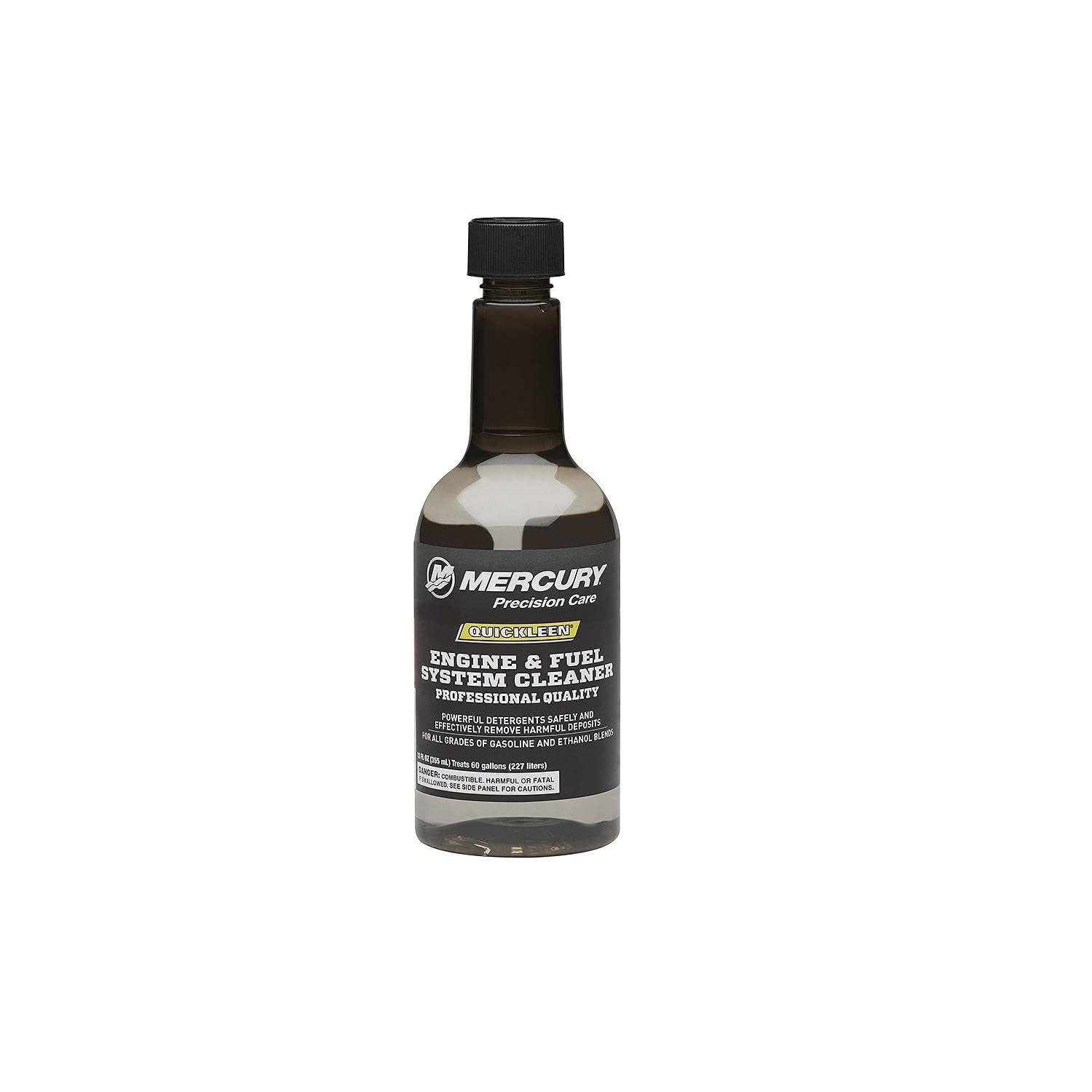
The maintenance-grade Quickleen built for the occasional season dose, one ounce per five gallons.
This Quickleen lands at a 12-ounce bottle, and the label calls for use “occasionally throughout the season” at 1 ounce per 5 gallons. Where the formula differs from the standard gas treatment is the same line as the shop-floor product: no fuel stabilizer, so a separate Quickare bottle handles the storage side. The stated purpose is the familiar one — carbon from carburetors, injectors, intake valves, spark plugs, piston crowns, and cylinder heads — plus knock and seize-up protection, backed by a one-year manufacturer warranty.
Motorcycle owners are exactly the audience that turns up in the review pages, and the recurring experience is a carburetor that comes back to smooth operation after a dose. The bottle’s own note about 175 EFI Outboards starting and idling better sums up the pattern: it is a maintenance cleaner, not a rebuild in a can. Buyers who work in professional shops also report the formula has stood up against other well-known treatments.
Compare this to the standard Quickleen treatment and you get the same ownership cautions — a stabilizer has to be added separately, and the bottle needs a measuring method for a small tank. The other difference is the OEM angle: Mercury Marine builds this to its own specification, which many riders value when they want the bottle that matches a dealer-maintained engine.
Why riders keep it: an OEM-spec bottle at a 1-ounce-per-5-gallon dose that slots into an occasional maintenance routine.
One more purchase: budget for a stabilizer alongside it, since the formula carries none.
Pick this one when: you want an OEM-grade cleaning bottle for a seasonal dose on a carbureted bike.
Reconsider if: you need one bottle that cleans and stabilizes in the same pour.
4. Berryman 7516 High Mileage Fuel System Rejuvenator

A high-energy solvent in a pour can that attacks carbon on stored and high-mileage bikes.
Berryman’s difference is HEST — High Energy Solvent Technology — which in plain words means it uses strong solvents instead of the weak carriers and diluents (thinning liquids) like mineral spirits or kerosene that other bottles use. That single design choice is the pitch: stronger solvents should mean faster breakdown of the carbon and varnish that cause rough idle and hesitation. The spec sheet lists a 425 ml capacity and gasoline as the fuel type.
The formula earns its keep on bikes that sat too long. A Victory Hammer that had been parked for three years developed hesitation and no power on throttle, and a shop quoted a costly fuel filter job. After a dose at 1 ounce per gallon, a 30-minute run, and a ride, the hesitation was reportedly gone. It is that stored-bike scenario — a carburetor slowly clogging while the bike sits — that makes this bottle grab attention. Buyers describe similar results on high-mileage V8 trucks.
The important difference between this and the other gas cleaners here is that the Berryman formula also stabilizes gasoline and disperses moisture. That means it covers storage and cleaning in one can, which is the practical advantage if you are the rider who parks a bike for months. The trade-off is the pour-can format: it takes a funnel or a steady hand, and the metal can is unforgiving if you tip it quickly.
The reasons it stands out
- HEST solvent formula targets carbon and fuel residue in the entire fuel system.
- Also stabilizes gasoline and disperses moisture, so one can covers cleaning and storage.
- Great for all 2-stroke and 4-stroke marine and small gas engines.
What you are signing up for
- Pour-can format needs a funnel or a careful hand into a small tank.
- The strong solvent smell is real at the pour point.
Best for: a bike that sat for a season or a high-mileage engine showing hesitation.
The one limitation: a metal can and a small motorcycle fill neck call for a funnel.
5. Lucas Oil Fuel Injector Cleaner 5.25 oz

A pocket-sized injector bottle that focuses on pump and injector life rather than heavy carbon removal.
At 5.25 ounces, this is the bottle that fits in a tank bag or under a seat and pours into a motorcycle fill neck in about a minute. The focus is different from the other cleaners on this list — Lucas specifies cleaning and lubricating the fuel system, increasing the life of pumps and injectors, and neutralizing low-sulfur fuel problems. That last line is the one that matters on modern gasoline, where low-sulfur blends can be hard on injector seals and pumps.
The size changes how you run it, and that is part of the value. A full bottle is a convenient single-fill dose on a smaller tank, and the long neck makes it easy to pour into a bike’s filler without splashing. One owner of a 7.3L gasoline engine added it every other fill-up and noted 14 MPG versus 11 MPG — a single report, so treat it as a scenario rather than a guarantee. Owners of a tuned BMW M2 add one bottle every four fill-ups as a routine additive.
The clearest caution is storage rather than performance. This bottle’s cap can drip when it is stored on its side or rattled around in a bike’s trunk bag. Keep it upright in a sealed bag and it is fine; store it loose in a tank bag and you may find residue on the next trip. The other caveat is that the bottle is a lighter cleaner than the concentrated carbon solvents here, so a badly gummed carburetor will want something stronger first.
The strongest card: a 5.25-ounce bottle that cleans and lubricates injectors and pumps as part of a regular fill-up routine.
Keep it upright: the cap drips when the bottle lies sideways in a tank bag.
Best sealed deal for: a fuel-injected bike where you want a small maintenance dose at every fill-up.
Not the rescue tool: a badly clogged carburetor needs a concentrated carbon solvent first.
Know the Specs
Treat Rate (Ounces per Gallon)
The treat rate tells you how much cleaner to pour for a given amount of fuel. A rating of 1 ounce per 5 gallons means a 12-ounce bottle covers 60 gallons of gasoline, so a small bike tank takes a fraction of an ounce. Checking this number first is always the right move, because a product dosed by the full automotive bottle is harder to scale to a motorcycle. Measure with a small cup or a marked bottle rather than eyeballing a splash.
Carbon Removal Coverage
Deposits build on several surfaces inside an engine, and the labels tell you which ones the formula targets. Look for the words carburetors, injectors, intake valves, spark plugs, piston crowns, and cylinder heads. A cleaner that names the carburetor and intake valves is built for deposit removal; a cleaner that only names injectors and pumps is a lubrication product. For a carbureted bike that stumbles off idle, you want the broader coverage, not the narrower one.
Common Questions
How much fuel system cleaner do I put in a small motorcycle tank?
Will a fuel system cleaner clear a clogged carburetor jet?
Do these cleaners include a fuel stabilizer for winter storage?
Is a diesel fuel cleaner safe to use in a gasoline motorcycle?
How often should I add fuel system cleaner to my motorcycle?
Does fuel system cleaner fix a rough idle or hesitation?
Can I use fuel system cleaner on a two-stroke motorcycle?
What is the difference between a cleaner and a fuel stabilizer?
Will a fuel system cleaner damage my fuel pump or injectors?
The Bottom Line
For most riders, the simplest answer is the Quicksilver Quickleen Engine and Fuel System Cleaner, because its 1 ounce per 5 gallons treat rate makes small-bike dosing easy and its carbon coverage spans carburetors, injectors, intake valves, spark plugs, piston crowns, and cylinder heads. If you need one can to clean a stored bike and stabilize the fuel for the off-season, the Berryman 7516 does both in a single pour. And if your focus is a fuel-injected bike where you want a maintenance dose in a small injector bottle, the Lucas Fuel Injector Cleaner 5.25 oz keeps pumps and injectors in the routine. Grab the bottle that matches how your bike is used, add a measuring cup, and dose it by the label — that small habit is what keeps the carburetors and injectors clean over a full riding season.
How we choose
We do not accept paid placement. Every pick is matched to a real buyer and a real use-case; we do not hands-on test units.
Sources
Specifications: manufacturer listings and product documentation. Review insights: verified customer reviews, as of October 2026. Pricing: not shown on this page (it changes often); check the current price via the retailer link.
As an Amazon Associate, Aappliancez earns from qualifying purchases. This does not affect which products we feature.