Disclosure: Some links in this post are affiliate links. As an Amazon Associate I earn from qualifying purchases, at no extra cost to you. Learn more
Specs are compiled from manufacturer listings and verified buyer reviews and can change over time — please confirm the key details on the product page before buying.
Buying a fuel can sounds simple until you are standing in a garage holding a dripping jug over your mower or a spare-tire rack. The short answer: match the can to the fuel and the job. A flat, mountable pack suits off-road and overland use, a marine tank suits a small outboard, and a racing jug suits quick refills in a pit or shop. A can rated for the wrong fuel, or fitted with the wrong spout, turns every fill into a wrestling match.
This guide is built by comparing the manufacturers’ published specifications and the patterns across verified customer reviews, so you get each pick’s real strengths and trade-offs instead of marketing spin.
What follows is a plain-spoken breakdown of six containers, grouped by how you will actually use them. It covers capacity, fuel compatibility, spout design, and the honest gripes that show up again and again. If you want the safest bet for weekend trail duty, this is the best fuel cans shortlist to start from.
Top Picks

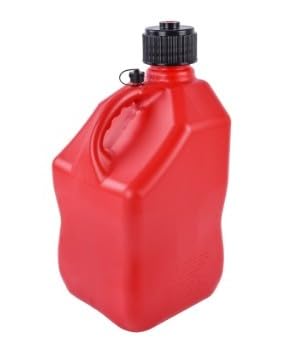
How To Choose The Best Fuel Cans
The first decision is not brand or size — it is fuel type. A can built for gasoline should not carry diesel, and a container sold for non-fuel liquids should never see gasoline at all. Getting this wrong is the number one reason buyers end up with a leaking or mislabeled jug.
Match the fuel first, then the spout
Gasoline containers need a spout that seals and vents correctly. Diesel cans are often yellow and come with a wider, slower-filling mouth. Racing jugs use a large open mouth that fills fast from a hose. A marine tank uses a pickup tube and a fuel-line fitting instead of a hand spout, so it feeds an engine directly. Pick the style that matches how you will pour or plumb it.
Capacity in gallons is about refill intervals
Two gallons covers most push mowers and chainsaws. Three gallons is a day-trip reserve for an ATV or a small boat. Five gallons is yard-work and generator territory. A full five-gallon can weighs roughly 40 pounds with gasoline, so size it to whoever lifts it and how far they carry it.
Where it lives decides the shape
A thin rectangular pack mounts flat against a rack or spare tire. A square jug stands on a shelf and stacks. A marine tank slides under a boat seat, which is why its profile is wide and low. Measure the shelf, rack, or locker first — a can that does not fit its spot tends to stay empty.
Side-by-Side Comparison
| Model | Best For | Capacity | Fuel Type | Weight | Amazon |
|---|---|---|---|---|---|
| RotopaX 3 Gallon Gasoline Pack★ Best Overall | Off-road and overland mounting | 3 gallons | Gasoline | 5.2 pounds | Amazon |
| Square 5-Gallon Utility Jug RedBest For Fluids | Non-fuel fluids and feed storage | 5 gallons | Non-fuel use | 3.1 pounds | Amazon |
| Scepter 5G SmartControl Diesel Can | Yard tools and diesel equipment | 5 gallons | Diesel | — | Amazon |
| Surecan 2 Gallon Type-II | Clean, controlled small-engine fills | 2 gallons | Gasoline | 16 ounces | Amazon |
| Scepter 3 Gallon Portable Marine Tank | Small boats and outboard engines | 3 gallons | Gasoline | 3.9 pounds | Amazon |
| VP Racing 5.5-Gallon Square Jug (3 Pack) | Pit crews and fast refills | 5.5 gallons | Non-fuel use | 23 pounds | Amazon |
Detailed Reviews
1. RotopaX 3 Gallon Gasoline Pack
Our pick — 4.5+★ from 600+ verified ratings; the strongest balance of quality and price.
The flat pack that bolts to your rig instead of rattling around the bed.
Mounting is the whole point here, and it is where this can leaves conventional jerry cans behind. The body measures 4.5″W x 16″H in its flat profile, so it hugs a roof rack, bed rack, tailgate, or UTV roll cage instead of standing out and sliding. Compare that to the Surecan’s 14″W x 12.12″H footprint and you can see the difference in how much wall space each one takes. It holds 3 gallons — against 5 gallons in the Scepter diesel can — which is a day-trip reserve rather than a week’s worth of yard work.
The build is what wins people over. Three-layer rotational molding gives it a crush-resistant shell, and owners put it through real punishment without complaint. A planted review sums it up: it “Survived 3-day Panama Jungle trip with heavy shaking, no spills; fits spare rack without hitting Jeep body.” The twist-and-lock base lets you pull the pack off when you need to carry it and lock it back down in one motion. You can bolt several packs into a single stack on one base mount, which is why overland rigs end up running two.
The honest catch is the spout. It is a safety-style design that has to be pulled to flow, and pouring into an awkward filler neck — a Jeep YJ port, for instance — takes patience. Fuel also stays trapped in the spout and drips onto your hands when you pull the end cap. Mount hardware sells separately too, so budget for a base before you can use it the way it was meant to be used.
- Three-layer rotational molding makes the shell crush-resistant on rough trails
- Thin rectangular body mounts flat against racks, tailgates, and roll cages
- Twist-and-lock base lets you pop it off and reseat it in one motion
- Multiple packs bolt together into one stack on a single mount
- The safety spout demands a hard pull and pours slowly into tight filler necks
- Fuel left in the spout drips when you remove the cap
- Mount sold separately
Reach for this if: you run an ATV, overland rig, or truck and want reserve fuel locked down and out of the way — this is the off-road crowd favorite at 4.5+ stars across 600+ ratings.
Look elsewhere if: you want a big open pour into a mower or generator; a wide-mouth jug gets fuel in faster.
2. Square 5-Gallon Utility Jug Red
A thick-walled workhorse jug — just don’t fill it with gasoline.
Start with the label, because this is the one pick people get wrong. It is sold for non-fuel liquids: recyclable automotive fluids, non-potable water, animal feed, deer corn, oats, birdseed, rock salt, oil, and liquid absorbents. It is explicitly not built for gasoline or kerosene. For oil, water, feed, or shop fluids, the thick walls and level markings do the job well. Fill it with gas and you are outside what it was designed for.
What you get is a genuinely thick tub. The plastic is heavier than standard cans, and at 3.1 pounds empty it is far lighter than the 5.2-pound RotopaX while holding 5 gallons against the RotopaX’s 3. It carries an unbreakable cap, exterior fluid-level markings so you can see how much is inside, and a contoured handle with a wide bottom grip for tipping. Owners routinely report more capacity in hand than the sticker suggests — as one puts it, it “holds 5.5 gallons,” which is the kind of headroom people like for mixing and dispensing.
Here is the trade-off to plan around: the mouth is large and there is no spout in the box, so you order a hose or funnel separately. The filling process also wants a funnel-friendly approach. Neither is a defect — it is a bare-bones utility jug built to pour on your terms — but it is not the can to hand someone expecting a one-piece gas can.
Where it earns its keep: feed, oil, water, and shop fluids in a thick-walled jug with level markings and a cap that holds up. Buyers clearly value the build quality most, and the price-to-quality mix is the reason it keeps landing in garages and barns.
The right call for: farm, shop, and motorsport fluid duty where gasoline is not involved.
Not the one for: fueling a car or mower — get a can rated for gasoline instead.
3. Scepter 5G Gas Can with SmartControl Spout, Diesel Only

Yellow, diesel-only, and built to move fuel at up to 3 gallons a minute.
The number to know is 3 gallons per minute. An integrated air vent in the spout lets diesel flow fast so you are not standing over a tractor for ten minutes. The 12″W x 16″H body has a rear handle in addition to the top one, which makes tipping a full can easier on your wrists. Five-layer construction is there to stop vapor leaks and keep the fuel fresh longer, and a flame mitigation device sits inside to help prevent vapor ignition. It is EPA and CARB compliant and built for diesel only, so keep it away from your gasoline tools.
The SmartControl spout is the part that splits opinions. A thumb-press lock and a green dispensing button with its own safety catch are easier than hard-twisting a cap, and the ergonomic handles help when the can is heavy. But the fill side frustrates people. Station diesel nozzles do not seat into the mouth — they only mate against it — so fueling at the pump has to go slowly or it bubbles back out. Fuel also gets trapped in the spout and lands on your hands when you pull the end cap.
Buy it for the equipment it was made for: a lawn tractor, a diesel generator, a kerosene heater. Owners who run it that way tend to love the design and come back for more. Just go in expecting a deliberate, two-handed fill at the pump rather than a quick splash.
What works in its favor
- Integrated air vent pushes flow up to 3 gallons per minute
- Rear and top handles make a full 5-gallon can easier to tip
- Flame mitigation device and five-layer shell for safer storage
- Thumb-press spout lock is easier than twisting a cap
What to expect going in
- Pump nozzles only mate with the mouth, so filling is slow and can bubble out
- Fuel trapped in the spout drips onto your hands at cap removal
- Diesel only — never use it for gasoline
Built for: anyone fueling a diesel tractor, generator, or kerosene heater who wants fast flow and a real safety catch.
Skip if: you need to top off quickly at a busy pump station — that fill mouth will slow you down.
4. Surecan 2 Gallon Type-II Safety Container

Two gallons and a thumb trigger that starts and stops the flow on command.
This is the can for anyone who has ever glugged gas down the side of a mower deck. A thumb-trigger system lets you start and stop the pour smoothly, and a 9-inch hose with a downward-rotating spout reaches where you aim it. The self-venting Type II design keeps the flow steady and cuts splashing. At 2 gallons it stays light enough to lift with one hand, and the HDPE body takes regular garage life without fuss. A 3-year limited warranty backs it up.
Owners notice the handling more than anything. The size is what people praise most — small enough to balance on a mower deck and fill without spilling, yet enough for a full mow. Ease of use runs a close second. One landscaper sums up the daily reality: “We use gas cans a lot in the landscaping industry. Best can yet by far very easy to use. No mess no fuss!” A 65-year-old owner found the 2-gallon size easy to lift and balance, which tells you who this fits.
The trade-off is the fill cap. It is a lever-and-spring flap that some find stiff for one-handed filling, and a few have modified it to unscrew. There is also a learning curve on overfilling — let off the trigger and fuel left in the hose can dribble out. Ease off the trigger for the last few seconds and the hose drains without a dribble.
Why it sells: a trigger you can stop mid-pour, a swivel spout, and a 2-gallon body that is genuinely easy to lift make small-engine refills mess-free.
Pick it for: mowers, chainsaws, and blowers where a clean, stop-on-demand pour matters more than maximum capacity.
Think twice if: you need a large reserve — at 2 gallons this is a refill can, not a bulk tank.
5. Scepter 3 Gallon Portable Marine Gas Tank

An under-seat tank that feeds an outboard and shows you the fuel level at a glance.
This one is a fuel system, not a hand can. A combination fuel pick-up and sight gauge is built into the tank, so you can check the level without opening anything. A 2-way vented cap allows air in while refueling and releases pressure above 5 PSI to prevent vapor buildup. The fuel line sells separately and attaches to the side, which accepts standard 1/4 NPT marine tank fittings. The low, wide 19.3″L x 12.2″W x 6.8″H shape slides under a boat seat, and molded-in feet keep it off the floor for ventilation.
The shell is a one-piece, five-layer crush-resistant HDPE build that resists rust, corrosion, and UV damage. Owners rate functionality highly — the gauge, cap, and vent all work as intended — and the looks get a warm reception too. For a small outboard, 3 gallons is a sensible day on the water. The catch that keeps showing up is leakage and venting: fuel can work past the plug hole until a twist-lock check-valve connector is fitted, and expansion has nowhere to go when the pickup is unrestricted. One owner also had to splice extra line because the pickup left the bottom couple of inches of fuel unreachable.
Those quirks aside, it remains the default tank for small outboards because the gauge, vent, and low profile all work. It just wants a proper check-valve connector and a check of the pickup length before you trust it on the water.
The details that deliver
- Built-in fuel gauge and pick-up in one unit
- 2-way vented cap releases pressure above 5 PSI
- Low profile sits under a boat seat with molded-in feet
- Accepts standard 1/4 NPT marine tank fittings
The details that need care
- Fuel can seep at the plug hole until a check-valve connector is fitted
- The pickup can leave the bottom of the tank partly unusable
- Fuel line and fittings sold separately
Made for: small fishing boats, dinghies, and outboards where you want a proper plumbed tank with a visible gauge.
Pass on it if: you just need a hand can to top things off — this is designed to feed an engine.
6. VP Racing 5.5-Gallon Square Jug (3 Pack)

Three 5.5-gallon squares with hoses — bulk capacity for a crew that burns fuel fast.
This is the racing-jug format, and it is made for speed and volume. The listing itself specifies non-fuel use for recyclable automotive fluids, non-potable water, feed, and outdoor materials. Each jug holds 5.5 gallons, so three of them give a pit or farm crew a serious buffer. The plastic is molded with 30% more material than conventional motorsport jugs, with reinforced corners in high-stress areas to resist cracking. A super-wide handgrip at the base helps you carry a heavy load steadily. Each jug comes with a 14-inch deluxe hose, and the closely trimmed cap and neck give a tight seal.
What owners value most is the return on buying the pack — three jugs and hoses together beat one-off purchases over time. The big mouth fills fast from a hose, and the flow is far better than a standard can. Build quality holds up and the translucent white body makes the fuel level visible in any light. “Works out good 5.5 gallons of gas. Worth the price when u get 3,” reads a typical verdict.
The thing to watch is the air-lock design. Fill past the airlock level and a jug can drip unexpectedly while pouring, so skilled hands stop short and let it settle. A full three-pack also weighs 23 pounds on the scale, so this is a store-it-at-base setup rather than something to lug up a hill.
The honest read: fast-fill racing jugs with hoses and tough molding reward buyers who pour a lot of fuel at a fixed spot — and punish anyone who overfills mid-pour.
The fit for: pit crews, farms, and workshops moving fuel in volume who want three tough jugs with hoses ready to go.
The wrong fit for: anyone who wants a single lightweight can for a mower — start with the Surecan instead.
Know the Specs
Capacity in Gallons
Capacity tells you how often you refill, not how good the can is. Two gallons covers most push mowers and chainsaws. Three gallons is a trail-trip reserve or a small boat’s day tank. Five gallons and up belongs to yard work, generators, and bulk fuel runs. Remember that a full can gets heavy — a 5-gallon load is a two-handed lift for most people, so match the size to who carries it and how far.
Spout and Vent Design
The spout decides whether a fill is clean or a mess. A safety-style spout with a pull-to-flow trigger stops fuel on command but pours slowly. A self-venting design keeps the flow steady and cuts splashing, while an air vent lets fuel move fast. A large open mouth fills quickest from a hose but has no trigger. A vented marine cap releases pressure so the tank does not swell in heat.
Fuel Compatibility
Gasoline, diesel, and kerosene each want their own can, and some containers are sold for non-fuel liquids like water, oil, or feed. Using a non-fuel jug for gasoline is outside its design, and using a diesel can for gas is a real safety risk. Check the listing’s stated fuel type before you fill — the cap color and label are there to stop mix-ups.
Construction Material
Most of these cans are high-density polyethylene, a tough plastic that resists rust and corrosion. Thicker walls and reinforced corners resist cracking when a can is dropped or bounced on a rack. Multi-layer shells help stop vapor leaks and keep fuel fresher longer. Weight in pounds when empty hints at wall thickness — a heavier empty shell usually means more plastic.
Common Questions
Can I put gasoline in a jug sold for non-fuel use?
Should I buy a 2-gallon or a 5-gallon fuel can?
Why does my fuel can drip when I remove the spout cap?
What does the 5 PSI vent on a marine tank actually do?
Do these containers come with a mounting bracket?
Is a diesel can safe for gasoline in an emergency?
How do I stop a racing jug from dripping while I pour?
Can I use a marine fuel tank for a generator?
What is the difference between a jerry can and a flat pack?
The Bottom Line
For most buyers, the fuel cans winner is the RotopaX 3 Gallon Gasoline Pack because its flat, crush-resistant body mounts cleanly to a rack and locks down in one motion. If your job is a clean, stop-on-demand pour into small engines, grab the Surecan 2 Gallon Type-II. And if you feed a small boat, the Scepter 3 Gallon Marine Tank is the one to reach for. Confirm the fuel type on the label, then pick the capacity the person lifting it can handle full.
How we choose
We do not accept paid placement. Every pick is matched to a real buyer and a real use-case; we do not hands-on test units.
Sources
Specifications: manufacturer listings and product documentation. Review insights: verified customer reviews, as of October 2026. Pricing: not shown on this page (it changes often); check the current price via the retailer link.
As an Amazon Associate, Aappliancez earns from qualifying purchases. This does not affect which products we feature.