Disclosure: Some links in this post are affiliate links. As an Amazon Associate I earn from qualifying purchases, at no extra cost to you. Learn more
Specs are compiled from manufacturer listings and verified buyer reviews and can change over time — please confirm the key details on the product page before buying.
If your frozen thin crust keeps coming out with a pale, limp center, the pizza is usually not the problem — the pan is. A solid baking sheet traps steam under the dough, and that steam is what turns a cracker-thin base into something closer to damp cardboard. The three picks below fix that in three different ways: a perforated pan (a pan with holes that let hot air straight through), a box that keeps a finished pie crisp on the way to a friend’s house, and a crust mix that lets you build a thin base from scratch. Start with what you actually want to fix.
This guide is built by comparing the manufacturers’ published specifications and the patterns across verified customer reviews, so you get each pick’s real strengths and trade-offs instead of marketing spin.
Thin crust lives or dies on airflow and heat, so every pick here earns its place on one of those two. The shortlist below covers the three fixes for a frozen pizza thin crust: airflow, transport, and a base you press yourself.
Top Picks

How To Choose The Best Frozen Pizza Thin Crust Setup
A frozen thin crust is already par-baked, which means you are not really cooking the dough — you are driving moisture out of it and browning the bottom before the toppings dry out. Everything that matters in this category comes back to that one job. Here is what to weigh before you buy anything.
Airflow beats oven temperature
Cranking the dial higher does not fix a soggy middle. Hot air has to reach the underside of the dough, and on a flat solid tray it cannot. A perforated pan — one with small punched holes across the base — lets that air through so the base browns at the same rate as the top. Without holes, the trapped steam softens the crust from below no matter how long you leave it in.
Measure your oven before your appetite
A pan’s stated size is not the space it takes up. A 12 inch pan can carry an outer rim closer to 14 inches, and that rim is what collides with oven walls and rack edges. If you cook in a countertop oven or an air fryer oven, measure the interior first and compare it to the outside diameter, not the pizza diameter.
Decide if you want to bake, build, or transport
These are three separate jobs. A pan bakes. A crust mix builds the base from flour so you control thickness. A box carries the finished pie without crushing it. Matching the tool to the job is where most people go wrong — a perforated pan will not carry a pizza across town, and a cardboard box will not crisp a soggy base.
Coating and material decide how long it lasts
Nonstick coatings vary widely in how they handle heat and washing. Check the stated heat-resistance temperature and whether the maker backs the coating against peeling. Carbon steel holds heat evenly and survives high oven heat; thin cardboard-style board does not tolerate moisture at all.
Side-by-Side Comparison
| Model | Best For | Size | Material | Heat Rating | Amazon |
|---|---|---|---|---|---|
| HONGBAKE 2 Pack Pizza Pan with Holes★ Best Overall | Crisping a frozen thin crust | 12″ diameter | Carbon steel | 450℉ | Amazon |
| MT Products White-Red Pizza Box, 10 Pack | Carrying a finished pie to a party | 12″ x 12″ x 2″ | Clay coated cardboard | — | Amazon |
| Martha White Pizza Crust, Thin & Crispy Mix | Building a thin base from scratch | 6.5 oz pouch | Dry baking mix | — | Amazon |
Detailed Reviews
1. HONGBAKE 2 Pack Pizza Pan with Holes 12 Inch
Our pick — 4.5+★ from 550+ verified ratings; the strongest balance of quality and price.
Two perforated pans that let oven air straight through to the base of your pizza.
The perforated base is the reason to buy this pan over a solid tray. A 12 inch perforated center (a 12 inch middle section punched with holes) lets hot air rise through the base of the dough instead of sitting trapped beneath it. That is what makes the difference between a frozen thin crust that browns on the bottom and one that only looks done on top — so the underside crisps while the top stays golden. The maker states it plainly: the perforated design is the better option specifically for heating frozen pizza. Buyers back that up, with crust quality showing up as among the most-discussed strengths in the reviews.
What wins people over beyond the holes is the build. The pan uses carbon steel that the maker describes as 27% thicker than standard, which gives you even heat spread and a tray that does not flex under a loaded pizza. The stated heat-resistance ceiling is 450℉, so it suits standard oven baking.
The honest catch is the nibs. Because small raised points sit across the base to lift the pizza above grease, you need to transfer the pie onto something else to cut it cleanly. Also plan your oven space carefully: the outer diameter is around 14.2 inches with a 12.2 inch inner surface, and it fits a Ninja air fryer oven but not every air fryer. Some buyers also wish it came larger. With 550+ ratings behind it, it is the most-reviewed pick here.
Crispness Mechanics
- Perforated center lets air reach the base so a thin frozen crust browns instead of steaming
- Heavy-gauge carbon steel at a stated 27% thicker than standard spreads heat evenly
- 450℉ heat-resistance covers standard oven baking
- Wide reinforced handles give a firm grip with an oven mitt
- Two-layer Whitford-backed coating is stated as free of PFOA, BPA and PTFE
- Comes as a two-pack, so one can bake while the other cools
Fit Notes Worth Knowing
- Raised nibs mean you must move the pizza elsewhere to cut it
- Outer rim runs around 14.2 inches, so check your oven interior first
- Hand-washing in warm soapy water is recommended over the dishwasher for best results
- Some buyers wished the pan came in a larger diameter
Reach for this if: you cook frozen thin crust in a full-size oven and want the base properly browned.
Look elsewhere if: your oven cavity is tight — measure the outside rim before ordering.
2. MT Products White-Red Pizza Box 12″ x 12″ x 2″, 10 Pack

A ten-pack of printed boxes for getting a finished thin crust out of your kitchen intact.
Think of this as the delivery half of a pizza night, not the baking half. The box measures 12 inches long, 12 inches wide and 2 inches deep, so it holds a personal-size pie — the review pages repeatedly describe the fit as right for 10 inch pizzas, which leaves a little breathing room around the edge so nothing gets crushed against the lid. The shallow 2 inch depth suits a thin crust specifically; a deep-dish base would press against the top.
It earns its place at parties, where guests can take their own pie home. Guests can take their own pie home, and the printed top has topping checkboxes so people can mark what is on their pizza. Buyers have used them for everything from a family wood-fired oven gathering to a pumpkin pizza pie for a themed party, which tells you the format is versatile well beyond pepperoni. The red-and-white design also reads convincingly like a takeout box, and the board is stated as food grade and free of BPA and phthalates.
The trade-off is real and worth saying plainly: this board is thin. The sturdiness of these boxes is by far the most-discussed point across the listings, and it is not a compliment — the recurring verdict is that they are flimsy once folded up. One frustrated review sums up the extreme end of it: “There is no way one of these “boxes” would support a slice of bread, much less an entire pizza.” For dry goods, cookies, cheesecake or a light personal pie carried flat with a hand underneath, they do their job. For a heavy, saucy takeaway-size pizza hauled in one hand, they are the wrong tool. The clay coated cardboard is also stated to resist tearing, so folding does take a couple of tries the first time.
Who it genuinely suits: parents, teachers and party hosts who need cheap, cute containers to hand out individual portions — that is where this box is a strong, functional buy, and the size consistency is what people come back for.
The catch to hold in mind: treat it as a lightweight carrier, keep a flat palm underneath, and do not expect it to survive a car ride stacked with anything on top.
Suited to: pizza parties, classroom events and single-serve dessert packaging.
Not the job for it: carrying a fully loaded large pizza in one hand.
3. Martha White Pizza Crust Mix
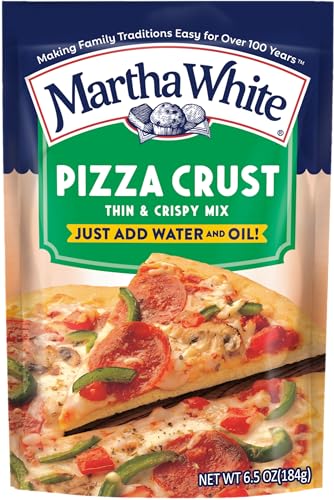
Six pouches of dry mix that turn water and oil into a thin, crisp base you control.
The pitch is short: one pouch, water, and vegetable oil. You add water and vegetable oil to one 6.5 ounce pouch, stir, and you have dough for a single 12 to 14 inch crust. No rising overnight, no yeast packet to babysit. You keep the speed of a frozen crust but swap the mass-produced base for one you pressed to your own thickness. Crust quality is the thing buyers praise most about this mix, well ahead of every other point raised about it.
It also addresses the underbaked center that sends most people hunting for a different pan. Underbaked centers are the classic thin crust failure, and the fix here is a short pre-bake before the toppings go on. One 5-star review puts the whole routine in a sentence: “I did forget to bake it for 5 minutes before adding my toppings so it was a little undone in the center but still tasted quite good.” Do the pre-bake and you get the crisp base; skip it and you get a soft middle. Buyers also note keeping the mixing water from being too hot.
Six pouches stack up as roughly six pizza nights, and the mix is stated Kosher. It is a versatile base too — beyond a standard pie, the box invites breakfast pizza, pizza rolls and calzones. One quirk worth flagging: a reviewer who normally cooks with a rival boxed mix uses two packs for a single pizza to get a thicker result, so one pouch may read as thin for a bigger appetite. Sizes are stated per pouch, so being short is a real possibility if you stretch it.
Where it earns its keep: family pizza night where somebody wants to press their own base and control exactly how thin it goes — a level of control no frozen base can offer.
The small friction: it is not open-and-bake. You need a bowl, a fork, ten minutes of resting and a short pre-bake before the sauce goes on.
Grab this if: you would rather build the thin crust than buy one pre-made.
Pass if: you want zero prep steps between the freezer and the oven.
Know the Specs
Perforation and Airflow
The holes punched through a pizza pan are not decoration. They let hot air rise up into the underside of the dough, which is what browns a thin frozen crust instead of letting it steam in its own moisture. A pan with a perforated center and raised nibs also lifts the base slightly above any grease that renders out, which keeps the bottom from going soft. This is the single spec that separates a crisping pan from a plain baking sheet.
Outer Diameter vs Pizza Diameter
A 12 inch pan does not mean 12 inches of oven space. The usable inner surface can sit near 12.2 inches while the outer rim reaches about 14.2 inches. That rim is what hits an oven wall or a rack edge. If you are baking in a compact or countertop oven, compare your interior clearance to the outside measurement, not the pizza size.
Heat-Resistance Temperature
Nonstick coatings have a stated ceiling, and going past it is what causes peeling and flaking over time. A stated 450℉ covers normal pizza baking comfortably. Treat that number as the limit for the coating, not a target to chase — a hotter oven does not crisp a thin crust faster, airflow does.
Box Depth and Board Weight
A pizza box listed as 2 inches deep tells you exactly what it can hold: a thin or personal pie that sits below the lid line. Board thickness is less visible than depth but matters more for carrying. Thin clay coated cardboard keeps the box light and cheap but flexes when you grip it one-handed, so a flat hand underneath is the safe way to move it.
Common Questions
Will a perforated pan really make a frozen thin crust crispier?
What size pan do I need for a standard frozen pizza?
Does the HONGBAKE pan fit in an air fryer?
Can I cut my pizza directly on the HONGBAKE pan?
Is the HONGBAKE pan dishwasher safe?
How sturdy is the MT Products pizza box?
Will the MT Products box hold a 10 inch pizza?
How many pizzas does one Martha White pouch make?
Why did my Martha White crust come out doughy in the middle?
Is a crust mix better than a frozen thin crust?
The Bottom Line
For most people chasing a crisp frozen thin crust, the winner is the HONGBAKE 2 Pack Pizza Pan with Holes — the perforated base does the one job that actually fixes a soggy bottom, and the thick carbon steel holds up to repeat oven use. If your pizza night ends with guests carrying pies home, the MT Products pizza boxes handle the handoff, as long as you keep a flat hand underneath. And when you would rather press your own base to your exact thickness, the Martha White Thin & Crispy Mix is the one to reach for.
If you are only buying one thing and your complaint is a pale, soft center, start with the pan. It is the only pick here that changes how the heat behaves during the bake itself — the other two come into play before and after.
How we choose
We do not accept paid placement. Every pick is matched to a real buyer and a real use-case; we do not hands-on test units.
Sources
Specifications: manufacturer listings and product documentation. Review insights: verified customer reviews, as of October 2026. Pricing: not shown on this page (it changes often); check the current price via the retailer link.
As an Amazon Associate, Aappliancez earns from qualifying purchases. This does not affect which products we feature.