Disclosure: Some links in this post are affiliate links. As an Amazon Associate I earn from qualifying purchases, at no extra cost to you. Learn more
Specs are compiled from manufacturer listings and verified buyer reviews and can change over time — please confirm the key details on the product page before buying.
If your lettuce turns to slime by Thursday and your strawberries grow fuzz before you finish the carton, the problem is usually not your supermarket. It is ethylene gas (a natural ripening gas produce releases) plus trapped moisture inside your crisper drawer. The picks below are sorted by what they actually do: absorb the gas, wick the water away, or seal the air out.
This guide is built by comparing the manufacturers’ published specifications and the patterns across verified customer reviews, so you get each pick’s real strengths and trade-offs instead of marketing spin.
You can stop guessing which fridge to keep vegetables fresh setup is right for you. Below are eleven products, from mesh bags that let your greens breathe to a vented container with a built-in filter that never needs replacing. Each one is matched to a specific kind of produce.
Top Picks

How To Choose The Best Fridge to Keep Vegetables Fresh
Most vegetable spoilage comes from two things: ethylene gas (a natural ripening gas that produce releases) and too much moisture sitting on the surface of the food. Every storage product on this list solves one or both in a different way. The right pick depends on what you buy most, how much fridge space you can spare, and if you want an active absorber or a passive container.
Ethylene absorption versus airflow
Ethylene absorbers like Frigidaire FRUFVS and Bluapple use a packet or filter to neutralise the gas that speeds ripening. Airflow-based designs like mesh bags or vented containers let the gas drift away naturally. Absorbers suit enclosed drawers and sealed containers; mesh suits anything that needs to breathe. Neither approach helps if the vegetable is already wet when it goes in.
Match the container to the produce
Berries want airflow and no washing until you eat them. Leafy greens want moisture without soaking. Herbs want a little water at the stem and air around the leaves. Root vegetables want to stay dry and dark. No single product excels at all four, so each pick here targets one category.
Side-by-Side Comparison
| Model | Best For | Capacity | Material | Closure | Amazon |
|---|---|---|---|---|---|
| Debbie Meyer GreenBags 20-Pack★ Best Overall | Everyday produce storage | 1 gallon | BPA-free plastic | Slide | Amazon |
| FRESHPAPER 8 Reusable SheetsBest for Berries | Berries and small containers | 19.87 g | Paper with organic botanicals | Clip-On | Amazon |
| Ziploc Food Storage Produce BagsBest Everyday Value | Bulk produce storage | 1 gallon | Plastic | Zipper | Amazon |
| MAQIHAN 12-Piece Mesh Bags | Fridge organisation | 11 pounds | Polyester mesh | Drawstring | Amazon |
| Winb Set of 4 Fruit Savers | Halved avocados and onions | 1 cup | ABS plastic with silicone film | Rotating lid | Amazon |
| Frigidaire FRUFVS Ethylene Absorber | Crisper drawer gas control | 1 filter | Plastic | N/A | Amazon |
| PrepSolutions Fresh Keeper | Compact shelf storage | 7.5 cups | Plastic | Snap | Amazon |
| SILIVO 3-Pack 1.5L Containers | Drain-tray storage | 1.5 liters | BPA-free polypropylene | Snap | Amazon |
| Bluapple 2-Pack Absorber | Fridge and fruit bowl | 9 g active packet | BPA-free plastic | Snap | Amazon |
| Cole & Mason Herb Keeper | Cilantro and parsley | 0.94 liters | Plastic | Flip & Slide | Amazon |
| Rubbermaid FreshWorks 8-Piece | Full crisper overhaul | 41.2 cups | BPA-free plastic | Lid | Amazon |
Detailed Reviews
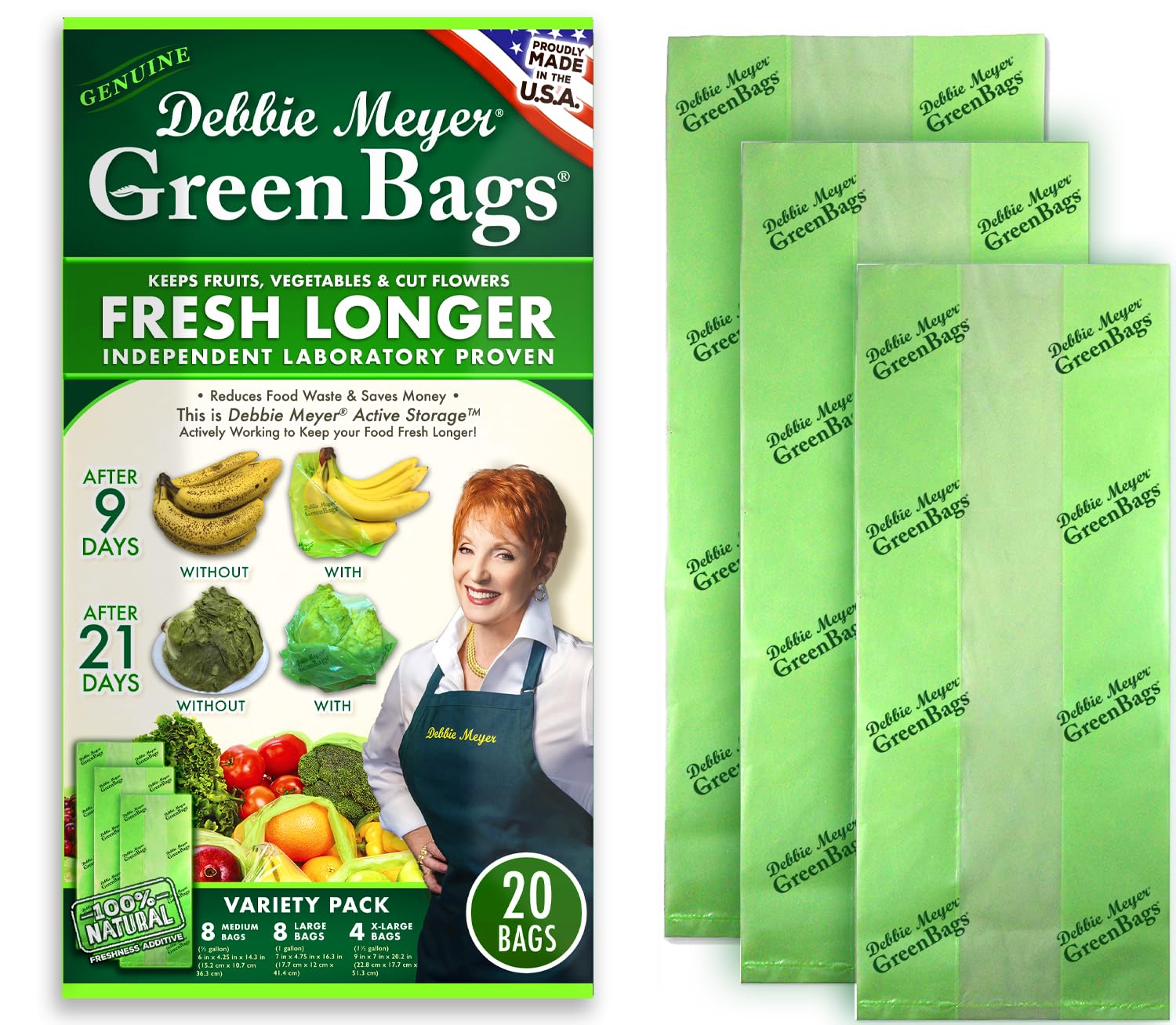
1. Debbie Meyer GreenBags, 20-Pack (8M, 8L, 4XL)
Our pick — 4.5+★ from 28,000+ verified ratings; the strongest balance of quality and price.
Twenty bags in three sizes that fight the ripening gas before it shrinks your greens.
You get a straightforward storage system: each bag has a mineral coating on the inside walls designed to manage ethylene gas (the natural ripening agent that makes bananas turn brown and lettuce go limp). The bags arrive in an 8 Medium, 8 Large and 4 Extra-Large split, so you can match the bag to the load. Each one can be rinsed, dried and used 8-10 times, which is the practical reason this pack has become the household default for people who shop fresh weekly.
That ethylene-management angle is why this one leads the list. It works in the fridge, the pantry and on the counter, so you are not buying a crisper-drawer-only solution. The slide closure (a plastic zip-like strip at the top) keeps the bag sealed without a fiddly press-fit, and the gusseted design expands to hold broccoli heads or a whole head of lettuce without forcing the bag.
Buyers report the reusability clearly: “Each bag can be rinsed, dried, and reused 8-10 times, making these reusable produce bags a practical alternative to single-use storage bags.” That reuse number matters — it means a 20-pack easily covers a year of weekly shopping trips. The honest trade-off is that a bag is only as good as the produce you seal inside it; anything already wet going in will still spoil faster, so pat greens dry before they go in the bag.
The case for the 20-pack
- Three sizes — 8 Medium, 8 Large, 4 Extra-Large — cover grapes through broccoli
- Reusable 8-10 times per bag, so one pack lasts well past a year
- Works in the fridge, pantry, or on the counter, not drawer-only
- BPA-free materials with FDA GRAS components, made in the USA
What to keep in mind
- Slide closures need a clean, dry seal or the bag gives up its advantage
- Wet produce sealed inside will still spoil — dryness is on you
- Twenty bags means real storage space when not in use
Reach for this if: you shop produce fresh every week and want one storage system that walks from fridge to pantry to counter without thinking about it.
Look elsewhere if: you only ever buy herbs — the Cole & Mason keeper below is the more focused tool for that job.
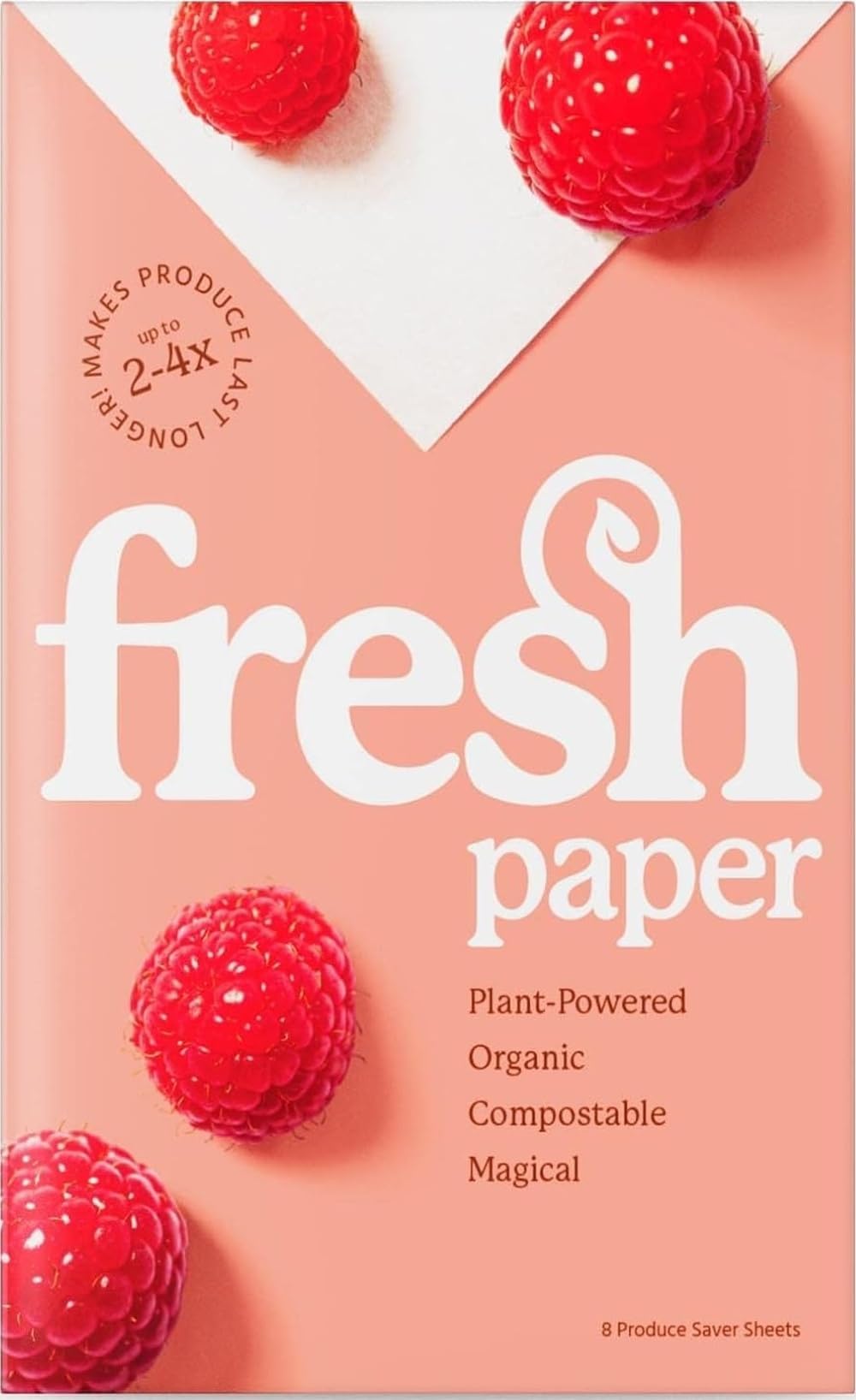
2. FRESHPAPER 8 Reusable Sheets
A slim paper square that keeps a container of strawberries from going furry in days.
The defining detail here is size. Each FRESHPAPER sheet measures 4.5″L x 0.25″W x 5.5″H and weighs just 2 ounces per pack, so it slides into a berry clamshell or a small container without stealing any of your produce space. Compare that to the Debbie Meyer GreenBags at 7.2 ounces per pack and you can see the design intent clearly — this is the smallest, most insertable option here, made to tuck into containers you already own. You get eight sheets per pack, and each one keeps working for about a month, or until the maple-like scent fades completely.
The sheets are made from paper infused with organic botanicals, are BPA-free, plastic-free and chemical-free, and are biodegradable, compostable and recyclable. The stated claim is that they extend produce life for up to 2-4 times longer, which is the pitch you should hold them to. That berry performance is where the paper does its best work.
The mixed-value caveat: the sheets last roughly a month per piece and cost more per-use than a reusable bag or container. Some buyers find the value reasonable; others say the per-use cost is high for everyday produce. If you mostly buy berries and delicate fruit, the trade-off works. If you are managing a full crisper of root vegetables, a container will pull more weight for the same spend.
Built for: the berry shopper who wants a container-sized fix that adds no bulk.
Not the pick for: anyone hoping a single sheet will handle a whole crisper drawer — that job belongs to the larger containers below.
3. Ziploc Food Storage Produce Bags, 15 Bags
The pantry-aisle workhorse that regulates moisture instead of sealing it in.
Ziploc’s produce bags take a different approach from the sealed-bag crowd. They are designed to regulate the moisture inside the bag rather than trap it, so a washed bunch of celery can go in wet and still come out crisp. Each bag holds up to 1 gallon of produce, and the zipper closure is the familiar press-and-slide top that takes one hand. Fifteen bags come in the pack, and the bags are intended to be used and reused.
This one shines for bulk buying. If you buy a large bunch of leafy greens or bell peppers at the market and need to split them up for the fridge shelf, a gallon bag does the job without a rigid container. The breathable design also helps leafy greens that want to breathe a little but still need protection from the drawer wall. One point worth holding: the length of these bags is 2.5″ and the width 11.31″, so the neck of the bag is wider than it is deep — which makes it easy to load a floppy bunch of greens without tearing.
The one frustration worth naming: because the bag is breathing, it is not airtight. Anything with a strong odour will share it with the whole drawer. Keep the bag resealed firmly and you will get the best result. Buyers value the bag’s size above all — it comes up as the most-mentioned strength — which tells you this is a bag people use for actual bulk rather than a small handful.
Best for the weekly shop: a stack of these handles a market run with greens, peppers, tomatoes and carrots. The breathable design extends crispness in washed carrots and celery stalks, so you get vegetables for cooking rather than a fridge drawer full of limp stems.
Worth grabbing if: you want a low-commitment, flexible bag that handles a full pound of peppers one day and a bunch of kale the next.
Keep looking if: you want airtight containment for something strong-smelling — these bags breathe by design.
4. MAQIHAN 12-Piece Reusable Produce Bags

Twelve mesh bags that let your produce breathe instead of sweating in a drawer.
At 16″L x 12″W, these are the largest bags on this list by a wide margin — the FRESHPAPER sheets, by contrast, run just 0.25″W. That extra room is what lets you load a whole bunch of bananas or a bag of oranges at once. And the MAQIHAN set carries 11 pounds per bag, so weight is not the limiting factor; volume is. A drawstring closure (a hemmed, cord-tightened top) lets you cinch the bag down so a single apple does not roll free.
The mesh itself is polyester, which is the practical choice over cotton for a fridge environment: it is washable and dries fast, so unlike a cotton bag it will not stay damp and grow a smell. The mesh lets ethylene gas drift out and air flow through, which is what makes it the best option for mushrooms, bananas and anything else that goes slimy when trapped in moisture. Twelve bags per pack at a budget price means you can commit whole drawers to the system without thinking about it.
Users report the bags keep fruit and vegetables fresh for up to a week in the refrigerator and that they help eliminate fruit fly problems — a mesh bag lets the fruit breathe while denying the flies direct access to skin. That is the strongest case for mesh over plastic for the countertop fruit bowl.
Where it pulls ahead
- Twelve bags per set — enough to dedicate to fruit, veg and pantry items
- Polyester mesh washes and dries fast, unlike cotton
- 11-pound capacity per bag handles a full market run of oranges
Where it stops short
- Mesh does not protect delicate produce from being crushed by heavier items
- Because air flows through, strong-smelling items will scent the drawer
- Not a container — it will not stand up on its own inside a crisper
A natural fit for: anyone who wants to ditch plastic bags without giving up capacity — mesh does the job without the chemistry.
Think twice if: you are storing berries that want crush protection, where a rigid container is the better tool.
5. Winb Set of 4 Reusable Fruit and Veggie Savers

Four cute little airtight pods that stop a half-eaten avocado from turning grey.
Each container holds 1 cup and measures 4.9″L x 4.9″W x 1″H, so it is designed for a half avocado, a half tomato, half an onion, or a handful of grapes. The seal is the point: a rotating lid with a soft, highly elastic food-grade silicone film presses down onto the produce and creates an airtight barrier. That silicone film also means the lid should keep its seal after plenty of open-close cycles — the ABS body (a hard, food-safe plastic) does the structural work, and the silicone handles the seal itself.
These suit the specific problem of a fruit or veg that is too big to eat in one go. Owners mention the containers keep sliced fruits and vegetables fresh for up to two days, with tomatoes and avocados called out as the standout uses. If you split an avocado on Monday and eat the other half on Tuesday, that window is exactly what these deliver — the silicone seal keeps air off the cut face and prevents browning.
Where they earn a spot: a fridge drawer holding four of these organised by shape — apple, orange, avocado, onion — makes it easy to spot what needs eating next. That visible-organisation benefit is real and hard to replace with an opaque container.
The real caveat: a 1-cup capacity is a tight window. It is not going to hold a whole head of lettuce or a full bunch of celery, and the two-day window is shorter than a vented container or an ethylene absorber will give you. These are a specialist tool, not a whole-crisper solution.
The right call for: households that regularly have half a tomato, half an avocado or half an onion left over at the end of a meal.
Not the upgrade for: someone whose problem is a full drawer of greens — this is a tidy-up tool, not a bulk saver.
6. Frigidaire FRUFVS Pure Fresh Fruit and Veggie Saver

A small plastic disc that quietly removes the ripening gas from your crisper drawer.
The design is barely visible in your fridge: it measures 4 x 4 x 1 inches and weighs 9.1 ounces, so it tucks against the back of a crisper and disappears. Inside is a filter that absorbs ethylene gas — the natural ripening agent that produce releases and that makes a head of lettuce turn yellow in five days. A punch-out card lets you mark the month you installed it, because the filter needs replacing every 6 months.
This one earns its place for the pick-it-and-forget-it buyer. No loading bags, no sealing lids, no fuss. It works inside any food storage area — crisper drawer, storage bin, or on a shelf — and the design is deliberately compact so it does not push your produce into the wrong shelf. There is no airtight seal to fail and no bag to dry out.
One good result: salads and vegetables stayed fresh for three to four days in the drawer. Those extra three to four days are often enough to finish the bag of greens before it turns. Worth knowing: effectiveness is a mixed picture across the reviews. Some buyers find it works beautifully, others find it does not match the advertised result.
Read on the value: this is the cheapest way to add ethylene control to a whole drawer rather than a single container. If your lettuce goes limp faster than the milk, the filter pays attention to the one variable most storage systems ignore — the air inside the drawer itself.
Set aside space for this if: you want a whole-drawer fix that requires zero thought once it is in place.
Consider a different tool if: you prefer controlled results and a product you can see working — a rigid container is easier to judge day to day.
7. PrepSolutions Fresh Fruit & Vegetable Keeper

The vented 7.5-cup box that gets how much air and moisture your favourite veg actually needs.
Two things separate this from a plain container. First, it has an adjustable vent that lets you dial air circulation up or down, so a damp bunch of kale and a dry bag of carrots can both live in the same box. Second, it has a water reservoir that supplies moisture to produce that wants humidity — this is the double-act that makes a vented container work, since air flow alone would dry greens out.
The 7.5-cup capacity and compact 10″L x 6″W x 4.5″H body fit on a fridge shelf or a door shelf, which is the practical advantage over a full crisper box. It is dishwasher-safe on the top rack, so cleanup is a matter of pulling it apart and letting the machine do the work. For herbs or small vegetables that would otherwise turn limp in a drawer, this is the format that fits.
One honest note: the 7.5-cup size is on the small side of what some buyers expect, so measure your shelf before you buy if you plan to fill it three-quarters of the way. Durability is the second thing to think about — the bottom cover is thin, and there are reports of cracking after a couple of months of use. It is a container that rewards gentle handling and top-rack washing.
The pick for: apartments and smaller fridges where a full crisper drawer is not available and a compact keeper on the door is.
Only if you handle it gently: the thin base is the one weakness a buyer should know about going in.
8. SILIVO 3-Pack 1.5L Fruit Storage Containers

A removable drip tray that keeps washed produce out of its own wetness — simple, and it works.
Each of the three containers holds 1.5 liters and measures 11.5″L x 4.7″W x 2.8″H. The design element worth paying attention to is the removable drain tray at the bottom. Wash a bunch of berries or a bag of green beans, drop them in, and any water drips down into the tray instead of soaking the food. That is the difference between a container full of crisp grapes and a container full of soggy ones.
The body is BPA-free polypropylene (the everyday food container plastic) with a snap closure, which is why it survives dishwasher temperatures with a caveat noted by the maker: high dishwasher heat may damage the containers. Hand-wash or use a low-temperature cycle to keep the walls intact. The three-pack stacks neatly and fits in a crisper, since the 11.5″ length matches a standard drawer depth.
What it is built to solve: the moisture problem that other containers ignore. Washed lettuce, celery, berries and asparagus all hold water on their surface; the drain tray moves it down and away, which extends how long your greens stay crisp and how long your berries last before turning.
Sizing the trade-off: three containers is enough for one drawer, but not a whole fridge. And the snap closure is the point of failure across more than one pick in this category — close the lid evenly, or the seal will let air in.
Throws its weight behind: the shopper whose produce is always a little too wet and turns slimy before its time.
Where someone else wins: if your problem is ethylene, an absorber like the Bluapple below is the tool for that job instead.
9. Bluapple Produce Saver Ethylene Gas Absorber, 2-Pack
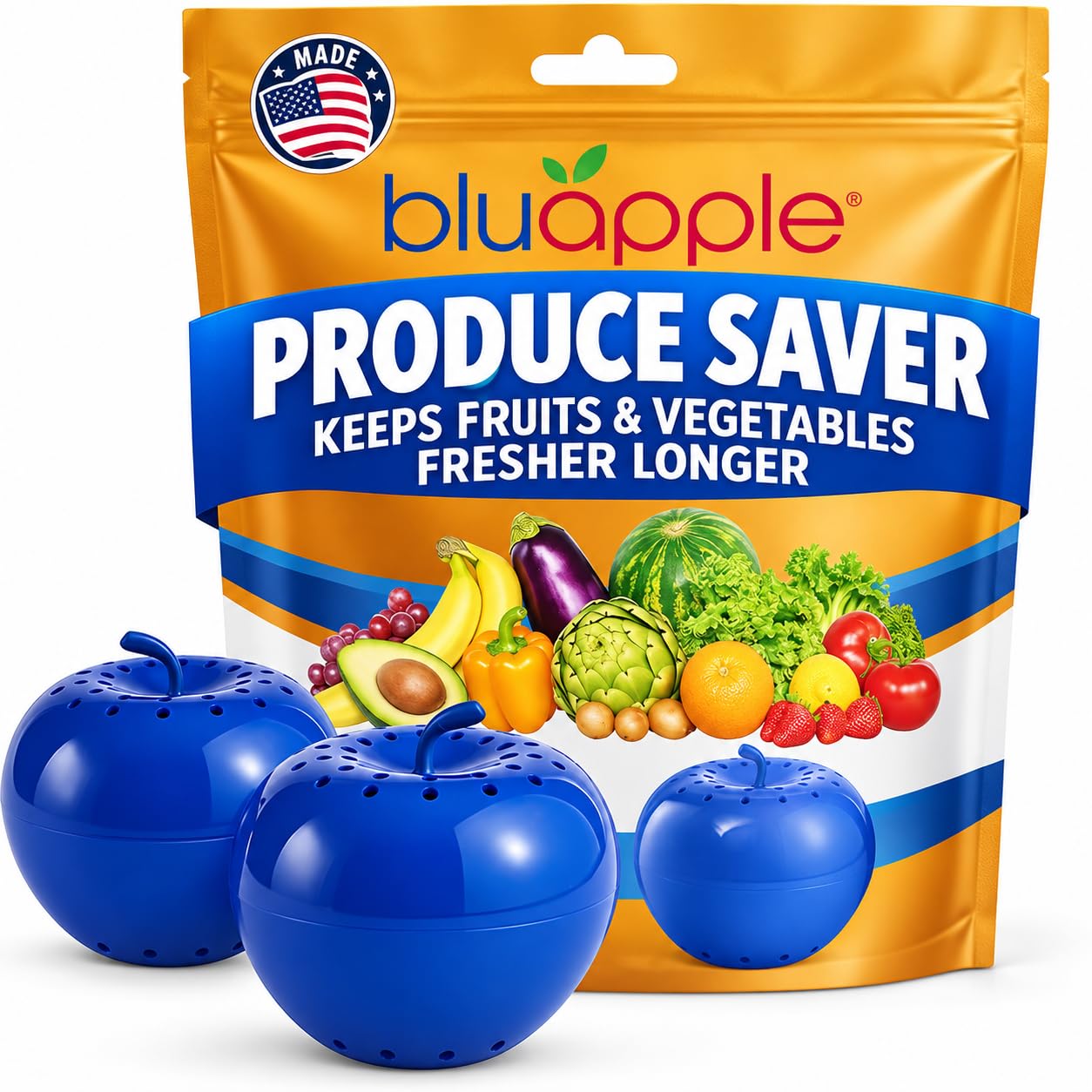
A refillable plastic egg that quietly sops up ripening gas for a whole quarter.
Each Bluapple contains a 9 g active ingredient packet that lasts up to 3 months, and the plastic shell is refillable — you snap a new packet in and keep the ball. That shell longevity is the design point that separates this from a disposable absorber: once you own the balls, you are buying packets, not new products. The count in the pack is two, so you can cover both a fruit bowl and a crisper drawer from one purchase.
Placement is flexible. Put one inside each Bluapple bottom, snap the top on, and toss the ball in the crisper drawer, onto a fridge shelf, or into the fruit bowl on the counter. That cross-fridge applicability is what makes this the go-anywhere absorber rather than a drawer-only tool. The technology inside has been used in commercial shipping for decades, which is the interesting provenance — commercial produce logistics spend real money on ethylene control, because it is the single biggest cause of premature spoilage.
Users report the saver keeps produce fresh for up to three weeks and adds about 10 days to shelf life. That extra time is why 21,000+ owners keep buying refill packets. Bear in mind the 3-month packet window is not a suggestion — once it is spent, the ball stops working and needs a fresh packet to keep pulling its weight.
Suits you if: you want one add-on that helps both the countertop fruit bowl and the fridge drawer at the same time.
Different route if: you would rather never buy refills — a filter that lasts a lifetime is the Rubbermaid container below.
10. Cole & Mason Herb Storage Container for Refrigerator

The only container on the list that treats a bunch of cilantro like a bunch of cut flowers.
Herbs fail differently from vegetables — they wilt from the cut stem down if they dry out, and they rot if they stay soaked. Cole & Mason solves this with a 0.94-liter vented body (about 17.6 fluid ounces), a Flip & Slide lid, and a water level window at the base. You stand the herb stems in a little water, the window tells you when to top up, and the vented lid keeps the leaves from condensing their own moisture.
Inside there are removable dividers, which is the practical detail: you can separate parsley from basil or cilantro from dill in the same keeper, rather than dedicating a whole container to one bunch. The body is rectangular at 4.72″L x 7.28″W x 9.06″H, and weighs 1.1 pounds — tall enough to keep stems upright without bending the leaves. Customers note the keeper extends herb freshness for up to two weeks and works well for garden cuttings, which is the hardest case for a herb keeper to pass: garden herbs are often wetter and thicker-stemmed than supermarket ones.
The unexpected bonus: the clear body and tidy lines mean this one is presentable enough to sit on the counter rather than hide in a drawer. Herbs you can see are herbs you actually use.
The fiddly part: the Flip & Slide lid is the one recurring complaint. Some find it easy, others find the slide stiff. Ease of cleaning is also mixed — the tall, narrow body is harder to scrub than a short, wide bin.
An easy recommendation: anyone who buys fresh herbs and ends up with a slimy bunch every fortnight will get the full value from this one.
Not worth adding to a full cupboard: if you rarely buy herbs, a general produce container handles more variety for the same shelf space.
11. Rubbermaid FreshWorks Produce Saver, 8-Piece Set
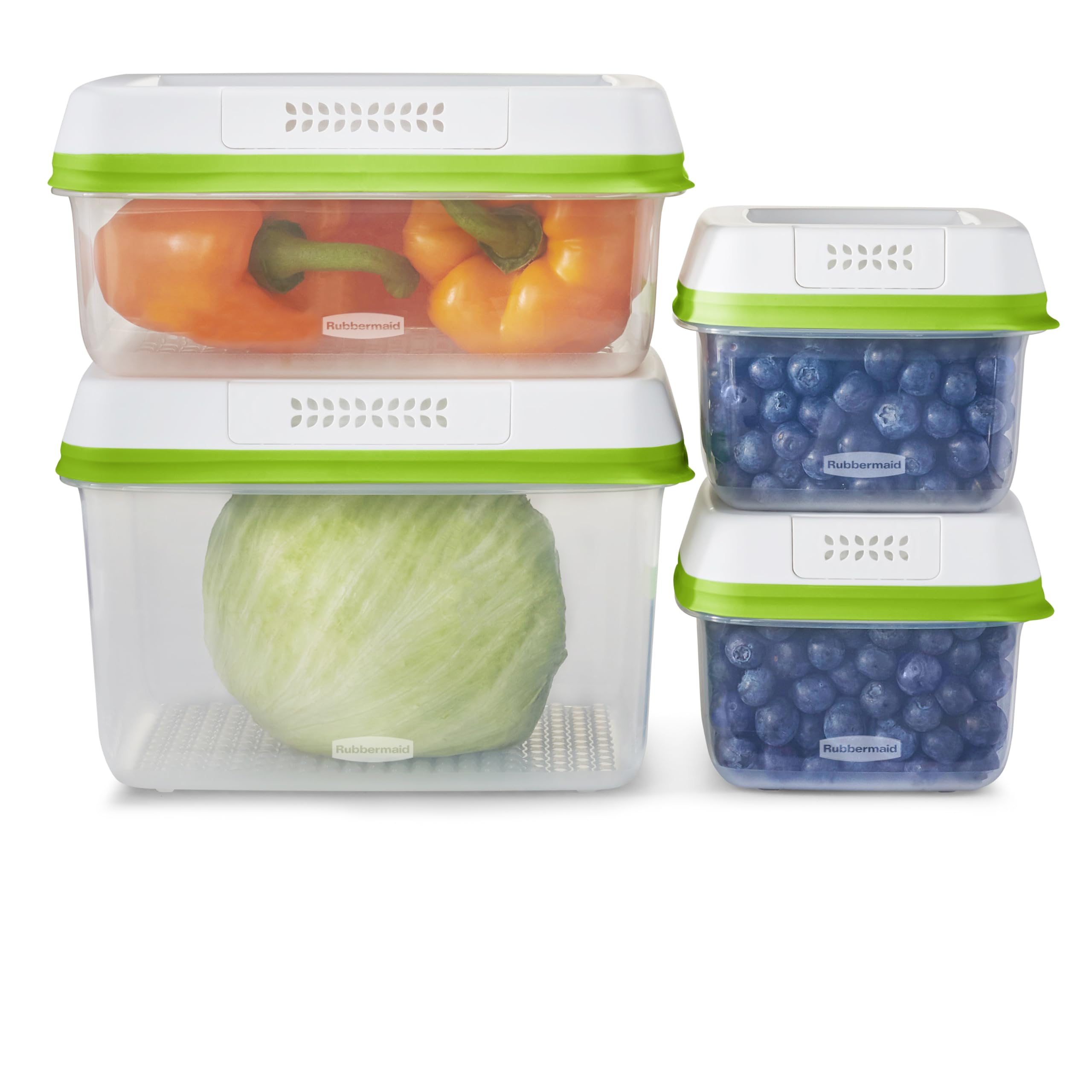
A four-container kit with a filter that never needs replacing — the closest thing to a whole-drawer reset.
The headline is the FreshVent filter: a built-in system that regulates airflow to control the flow of oxygen and carbon dioxide so produce sits in a steadier environment. Unlike the Bluapple, it does not need a refill packet every 3 months — the filter lasts a lifetime. That single fact changes the running cost of this container versus every absorber-based system here.
Four containers add up to 41.2 cups of storage: two 4.6-cup medium shorts, one 11.3-cup large short, and one 18.1-cup large container, plus their lids, for eight pieces in total. Each piece is designed around a specific produce type — blueberries in the medium short, broccoli or bell peppers in the large short, iceberg lettuce and spinach in the full-size large. The improve base lifts produce away from any moisture, and the modular design means bases nest together and one lid fits multiple bases, which is the space-saving property that lets this kit drop into a single crisper drawer without chaos.
What buyers get from it is convincing: strawberries come out of the container fresh up to 2 weeks after they go in, and fruits like strawberries and peeled apples stay fresh for a solid week. Celery, chopped peppers and diced onions all earn a specific callout. Rubbermaid recommends placing unwashed, uncut produce in the container and using one type per container for the best result — which is the rule that makes the four-piece kit genuinely useful rather than a nuisance.
The strengths across the four sizes
- FreshVent filter lasts a lifetime, with no replacement packets to buy
- 41.2 cups of total capacity — enough for a full crisper drawer
- improve base keeps produce out of the moisture that spoils it
- BPA-free and dishwasher-safe pieces
The considerations
- Best performance comes from one produce type per container, so you need four kinds to fill it
- The size of the containers is a draw for some, tight for others
- Nested bases save space but make clear what is in each container harder
The upgrade that beats the rest: this is the strongest whole-drawer kit on the list — no refills, four matched sizes, and the longevity that comes with a Rubbermaid build.
Think hard before buying: if you rarely have four kinds of produce in the fridge at once, the smaller vented containers above cover the same ground with less commitment.
Know the Specs
Ethylene gas and why it matters
Ethylene is the invisible ripening gas every fruit and vegetable releases. It is what makes a banana ripen and a head of lettuce turn yellow. Absorbers like the Frigidaire filter and Bluapple packets neutralise it inside a drawer; mesh bags and vented containers let it drift out into the fridge air. Neither approach helps if you seal wet produce in an airtight container — moisture plus ethylene is what causes the slime.
Airflow and moisture control
Airflow and moisture are two sides of the same coin. A mesh bag lets air through so moisture evaporates, which is why it is the best choice for mushrooms and bananas. An airtight container holds moisture, which suits a halved avocado or a bunch of grapes. A vented container sits between the two — adjustable vents and water reservoirs let you dial the environment up or down to match the produce. Match the tool to the produce and you get weeks of crispness.
Common Questions
Do ethylene absorbers really extend shelf life?
Should I wash vegetables before storing them in the fridge?
Will mesh produce bags keep my lettuce crisp?
How long do Bluapple refill packets last?
Can I put these containers in the dishwasher?
Is a moisture-control bag better than an airtight container?
Why does my produce go slimy in a sealed container?
How much fridge space do these products actually take?
Do I need more than one produce saver in my fridge?
Which produce storage works best for fresh herbs?
The Bottom Line
For most fridges, the winner is the Debbie Meyer GreenBags 20-Pack — it manages ethylene on any shelf, holds a full market run, and each bag earns its keep across 8-10 reuses. If your real enemy is a drawer full of greens that pales too fast, the Rubbermaid FreshWorks 8-Piece Set gives you a whole-drawer overhaul with a FreshVent filter that never needs a refill. And if herbs are the thing you throw out most, the Cole & Mason Herb Keeper is the specialist tool that finally stops that waste. Whichever produce you buy most, match the tool to it and the slime and limp leaves stop showing up in your crisper.
How we choose
We do not accept paid placement. Every pick is matched to a real buyer and a real use-case; we do not hands-on test units.
Sources
Specifications: manufacturer listings and product documentation. Review insights: verified customer reviews, as of October 2026. Pricing: not shown on this page (it changes often); check the current price via the retailer link.
As an Amazon Associate, Aappliancez earns from qualifying purchases. This does not affect which products we feature.