Disclosure: Some links in this post are affiliate links. As an Amazon Associate I earn from qualifying purchases, at no extra cost to you. Learn more
Specs are compiled from manufacturer listings and verified buyer reviews and can change over time — please confirm the key details on the product page before buying.
Progressive lenses only work as well as the frame holding them. A frame that sits too low, slides down your nose, or leaves too little lens height forces you to tilt your chin up to find the reading zone — and that is the real reason so many people give up on progressives. The right frame gives the lens enough vertical depth for all three zones and grips steadily so each zone lands where your eyes look.
This guide is built by comparing the manufacturers’ published specifications and the patterns across verified customer reviews, so you get each pick’s real strengths and trade-offs instead of marketing spin.
Below you will find nine frames that accept progressive lenses, sorted by what they actually do well — deep lens channels for the reading zone, lightweight builds that stay put, and adjustable fits for hard-to-fit faces. For most people, the strongest all-round pick is the Oakley Tincup: a rectangular full frame with a deep lens channel and straight arms that hold their position.
Top Picks


How To Choose The Best Frames for Progressive Lenses
Progressive lenses are one lens with three prescriptions ground into it, stacked top to bottom. The top band is for distance, the middle is for mid-range (a computer screen, a car dashboard), and the bottom is for close reading. Each band is a narrow strip. If the frame opening is shallow, those strips get compressed and you spend the day hunting for the balance with your chin. If the frame is deep enough and sits level on your face, the zones land where your eyes naturally look.
Start with lens height, not lens width
Lens height is the vertical measurement of the frame opening. A deeper opening gives the lens maker room to spread the three zones out, so the transition between them feels less abrupt. Shallow, narrow “cat-eye” or slim rectangular shapes can physically fit a progressive lens, but the reading zone at the bottom becomes a thin sliver. If you read books, labels, or your phone for long stretches, a deeper opening is the safer shape.
Frame material decides whether the glasses stay put
A titanium frame is metal, and it tends to be the lightest option on this list — the Aist Optics trial frame is listed at 50g. Light frames are comfortable, but very light frames with loose temples can slide forward when you look down, which drags the reading zone out of position. Acetate (the plastic-looking material used on several designer frames here) grips the sides of your head better but weighs more. Metal frames with adjustable nose pads let you fine-tune the height, and that matters more with progressives than with single-vision lenses.
Check the fit you can actually adjust
Three adjustments change how a progressive lens performs. Nose pad width sets how high the frame sits — too low and you lose the reading zone. Temple length sets how far back the arms reach, which controls grip. Pantoscopic tilt is the slight downward angle of the lens in front of your eye, and the wrong tilt shifts every zone. A frame with adjustable nose pads and bendable temples gives an optician room to correct all three. A rigid frame with fixed pads gives them almost nothing to work with.
Side-by-Side Comparison
| Model | Best For | Frame Shape | Department | Material / Build | Amazon |
|---|---|---|---|---|---|
| Oakley OX3184 Tincup★ Best Overall | Most people, all-day wear | Rectangular full frame | Mens | Plastic frame, rubber comfort tubes | Amazon |
| LOOK OPTIC Laurel Progressive ReaderReady-Made Pick | Ready-made progressive readers | Retro large shape | Unisex | CR39 lenses, Italian spring hinges | Amazon |
| Aist Optics Adjustable Trial FrameFit-First Pick | Finding your exact fit first | Round trial frame | Optometric | Titanium, 50g | Amazon |
| eyebobs Kvetcher | Bold statement style | Wide traditional | Unisex | Blue light filtering | Amazon |
| Michael Kors MK4110U Avila | Large-face, feminine fit | Square | Womens | Mixed materials | Amazon |
| Persol PO3050V | Classic Italian styling | Rectangular | Unisex | Meflecto temples | Amazon |
| Oakley OX5038 Metal Plate Titanium | Durability with a sporty look | Rectangular | Mens | Titanium | Amazon |
| Swarovski SK2020 | Dressy, decorative frames | Square | Womens | Acetate with crystal detail | Amazon |
| Persol PO3189V | Lightweight designer square | Square | Unisex | Meflecto temples | Amazon |
Detailed Reviews
1. Oakley Ox3184 Tincup
Our pick — 4.5+★ from 90+ verified ratings; the strongest balance of quality and price.
A deep rectangular window that gives a progressive lens room to breathe.
For a progressive lens with no fuss, the Tincup is the one to beat. It is a rectangular full frame in Oakley’s mens line, which means the lens opening is tall and squared off rather than narrow and swept — exactly the shape a lens grinder wants when they have to stack a distance zone, a mid zone, and a reading zone into one lens. Owners consistently describe the shape as attractive and the fit as secure, and the overall look is the thing that wins people over here; appearance is the most-praised trait in this frame’s feedback.
The straight-arm design is what separates it from a typical ear-hook frame. Instead of curving down behind your ear, the arms run mostly straight back and grip along the side of your head, and the rubber comfort tubes at the ends are replaceable. That grip is why the frame stays put when you look down at a page — and with progressives, staying put is half the battle. There is no carbon fiber on the arms, just those rubber tubes, so if you were expecting a technical composite build you will not find it here.
The catch is long-day comfort. A few wearers find the flat, sharp temple arms dig in above the ears after several hours, and the frame grips tightly around the head — comfortable if you like a locked-in feel, less so if you are used to a loose frame. Nose pads are another small point: the push-in pads differ from the screw-in style in the product photos, and the gummy texture is not for everyone. The long-term picture is genuinely reassuring, though. One owner reported wearing a pair for over 7 years before replacing it.
What earns its place
- Tall rectangular opening gives a progressive lens a deep reading zone at the bottom.
- Straight-arm grip with replaceable rubber comfort tubes holds the frame steady when you look down.
- Straight-arm design noted as more comfortable than ear-hook frames for wearers who tried both.
- One owner reported over 7 years of wear before replacement.
Where it asks for patience
- Flat, sharp temple arms can leave marks above the ears after long days.
- Tight head grip takes getting used to if you prefer a looser frame.
- Push-in nose pads differ from the screw-in style shown in the listing photos.
Buy this one if: you wear your glasses from morning to night and want a full frame that refuses to slide while you read.
Try something else if: you need a loose, barely-there fit or you are sensitive to pressure above the ears.
2. LOOK OPTIC Laurel Progressive Reader
The option that skips the eye doctor and hands you progressives already installed.
Here is the shortcut for anyone who wants the smooth near-to-far switch without a trip to the optician. The Laurel is a finished progressive reader, not a bare frame — the lens is already in it, built in CR39 (the standard optical plastic used for prescription lenses) with a range of magnifications to pick from. It also brings Italian spring hinges and wire core temples, which are the metal stiffeners inside the arms that let an optician shape the fit. If you have been squinting over the top of drugstore readers to see the TV, this is the frame class that fixes that.
Practical touches add up: the lenses are large, which gives you more viewing area than a slim reader, and each pair comes with a protective felt case and a microfiber cloth. The big retro shape is the point, though — the whole design is built to read as a fashionable frame rather than a medical device, and it is unisex, so it works on a range of faces. What the review pages sum up, roughly, is a split down the middle: people who adapt to the progressive corridor love the freedom of not swapping glasses, and people who cannot find the reading zone call the whole thing a letdown. That divergence is worth taking seriously, because progressive readers do require an adjustment period.
The pragmatic advice is to expect a break-in week. Several wearers say it took time to get used to the corridor, and the frame often arrives slightly large and needs a quick adjustment at the temples. Fit complaints cluster around the sheer bulk of the shape — the blue colorway in particular reads thicker and darker in person than in the model shots, and the nose bridge can press on anyone who already wears readers all day. Treat it as a fashion-first progressive reader, not a precision optical instrument.
Why it earns a slot: it removes the fitting step entirely — you get progressive magnification from the start, in a frame built with CR39 lenses and spring hinges rather than a flimsy drugstore build.
The part to weigh: adjustments are always part of the deal with a ready-made progressive, and the bold shape is not subtle on a smaller face.
Worth grabbing if: you want the reading-to-distance switch without a prescription order or an optician appointment.
Look elsewhere if: you demand a precise, made-to-measure progressive fit or you dislike a large, bold frame on your face.
3. Aist Optics Adjustable Trial Lens Frame
The fitting tool that tells you your exact numbers before you commit to a frame.
This is a different animal from the rest of the list, and that is the point. The Aist Optics is a trial frame — the adjustable rig an optometrist uses to hold test lenses in front of your eyes — built in titanium at 50g and able to hold five lenses at once, three in front and two at the back. For a progressive-lens buyer, it is genuinely useful in two ways: it lets you dial in the exact pupil distance and pupil height you need, and it shows you how stack lenses feel at different positions before you order real ones. The adjustable interpupillary range runs 48 to 80 mm, with 24 to 40 mm per eye and a 1 mm maximum scale, so the numbers are fine enough to matter.
The adjustment set goes further than a typical frame can. The anterograde angle (the tilt of the lens plane) is adjustable to suit different face shapes, temple length is adjustable, and there is an inter-eye distance ruler marked right on the frame so you can measure the distance from the innermost lens to the corneal vertex. If you are doing subjective refraction work or just want a precise read on your own fit, this is the tool that delivers it. What wins people over is the weight — it is the lightness that people notice and praise most, with the quality of the build a close second. Lenses at 38mm drop straight in.
One caveat comes with the territory: ultralight has a trade-off. At least one buyer found the frame so light that it tipped when lenses went in and did not hold as well on the patient’s ears, and the top knob used for adjusting the pupil distance sits in the way when you are loading lenses. On a trial bench that means a second hand to steady it. It also is not a corrective frame you would wear out of the house — it is a measuring and fitting tool.
Where the value lands: a professional-grade adjustment range including interpupillary distance, pupil height, temple length, and lens tilt — with a ruler built into the frame so you or your optician can read fit off the numbers, not a guess.
Set expectations: it is a working tool, not an everyday pair, and the ultralight build wants a steady hand while the lenses go in.
Reach for this if: you want to measure your own fit precisely or you do optometric testing and want a titanium rig that stays manageable.
Not for you if: you are shopping for a wear-out-of-the-house prescription frame.
4. eyebobs Kvetcher

Reading glasses that look like a deliberate fashion choice, not an afterthought.
Not every progressive shopper wants a plain black rectangle, and the eyebobs Kvetcher leans hard into that. It is a wide traditional shape built with blue light filtering, and the whole pitch is about breaking out of the same old spec shelf. The wide cut gives more horizontal coverage across the eye — useful when you are reading a book held flat or scanning a barcode on a shelf — and the blue light filtering speaks to anyone who stares at a screen for a living.
The style side is what carries it. The feedback on this frame is thin, but what is there points one direction: a wearer in her mid-60s with short silver hair describes the Kvetcher as cute, funky, on trend, and high quality, bought the green pair, and planned another color. That is the whole audience for this frame — people who want their glasses to look like a choice they made on purpose. It comes in unisex sizing, so it is not locked to one face type.
The trade-off is that a wide traditional shape and blue light filtering are not the same as a tall progressive channel. Blue light filtering helps with screen glare rather than adding lens depth, and wide is not the same as deep — if you are fitting true three-zone progressives rather than a blue-filter reading pair, check the vertical opening with your lens fitter before ordering. This is a frame for the reader who wants style first.
The case for it: a wide traditional cut with blue light filtering and a genuinely distinctive look, for people who are done with plain readers.
The honest limit: wide coverage is not the same as a deep progressive channel, so confirm the vertical lens height with your optician.
Choose it if: you want a reader with personality and spend hours in front of a screen.
Pass if: you specifically need a tall lens channel for full three-zone progressives.
5. Michael Kors Mk4110u Avila

A square, generous lens area for a progressive with a full-width reading zone.
The Avila is the pick for a medium-to-large face that wants a square frame with real lens real estate. The “universal fit” label is Michael Kors’s way of saying the fit is engineered to suit a broad range of face shapes, and the mixed-material temple design keeps the look modern without going purely metal or purely plastic. The square shape is the practical part: a squared-off opening runs deeper through the middle than a curved cat-eye, which gives a progressive lens a wider, flatter reading band across the bottom.
The look pulls compliments, and the branding stays understated — the logo sits small enough to be discrete, so the frame reads as design rather than advertisement. Owners describe them as light for their size, nicely large, and true to the advertisement, with fast delivery and secure packaging noted more than once. It runs as a women’s frame, and the delicate color palette is the intended draw.
Two fit points are worth knowing before you commit. Several wearers note the frame runs large, so try the width against your current pair. And the lenses on some units arrive as plain clear “demo” lenses rather than prescription-ready, occasionally with scratches — that is a display-frame detail, not a defect in the frame itself, but check yours on arrival. There are no spring hinges on this model, so if you like an arm that flexes outward as you put them on, know that up front. The “do not sit on them” rule applies here more than usual, as a couple of buyers found out.
Where it shines: a large square opening, light for its size, with a design clean enough to pull compliments and a logo small enough to stay quiet.
The catch: no spring hinges and a generous width — check the fit against your current frames and confirm the demo lenses are swapped for your prescription.
Worth considering if: you have a medium-to-large face and want a bold square frame with plenty of room for a progressive.
Might not suit if: you wear a narrow frame or depend on spring hinges for an easy on-off.
6. Swarovski womens Sk2020 Square Prescription Eyewear Frames

The frame you buy because the glasses should look like jewelry, not a compromise.
You would buy this frame for an occasion, not for the gym. The SK2020 is a women’s square from Swarovski, and the square opening gives a progressive lens a usable height while the decorative detailing does the talking. The one consistent note running through the feedback is the finish — the glasses are described repeatedly as gorgeous, very pretty, and true to the photo, and the gold surround of the crystal detail is the visual anchor. It arrives with strong packaging and the quality reads better than expected.
The practical read is straightforward. If you need a pair for a wedding, a work event, or just want a frame that feels like a deliberate piece of your outfit, the square shape and shallow-but-real lens opening keep a progressive workable. The fit draws praise too, especially for a face that suits a square shape, and the picture-to-product match holds up.
The honest catch is material feel. One wearer describes the frame as plasticky and cheap-feeling despite being extremely cute, and notes the gold in person is very light — paler than the product image. Treat that as a styling note rather than a flaw: decorative crystal detailing often reads more theatrical in a photo than on the face, and the square opening is on the smaller side for a full three-zone progressive, so confirm the height with your lens fitter.
Why it works: a square women’s frame with decorative crystal detailing, described as gorgeous and true to the photo, with fit praise and solid packaging.
What to know: the gold reads paler in person than in the photos, and the material feel divides opinion — try it on with the decoration in mind.
Best pick for: a dressy occasion or a wearer who wants a decorative square frame rather than a technical-looking one.
Keep looking if: you need the deepest possible lens channel for a demanding progressive prescription.
7. Persol Po3050v
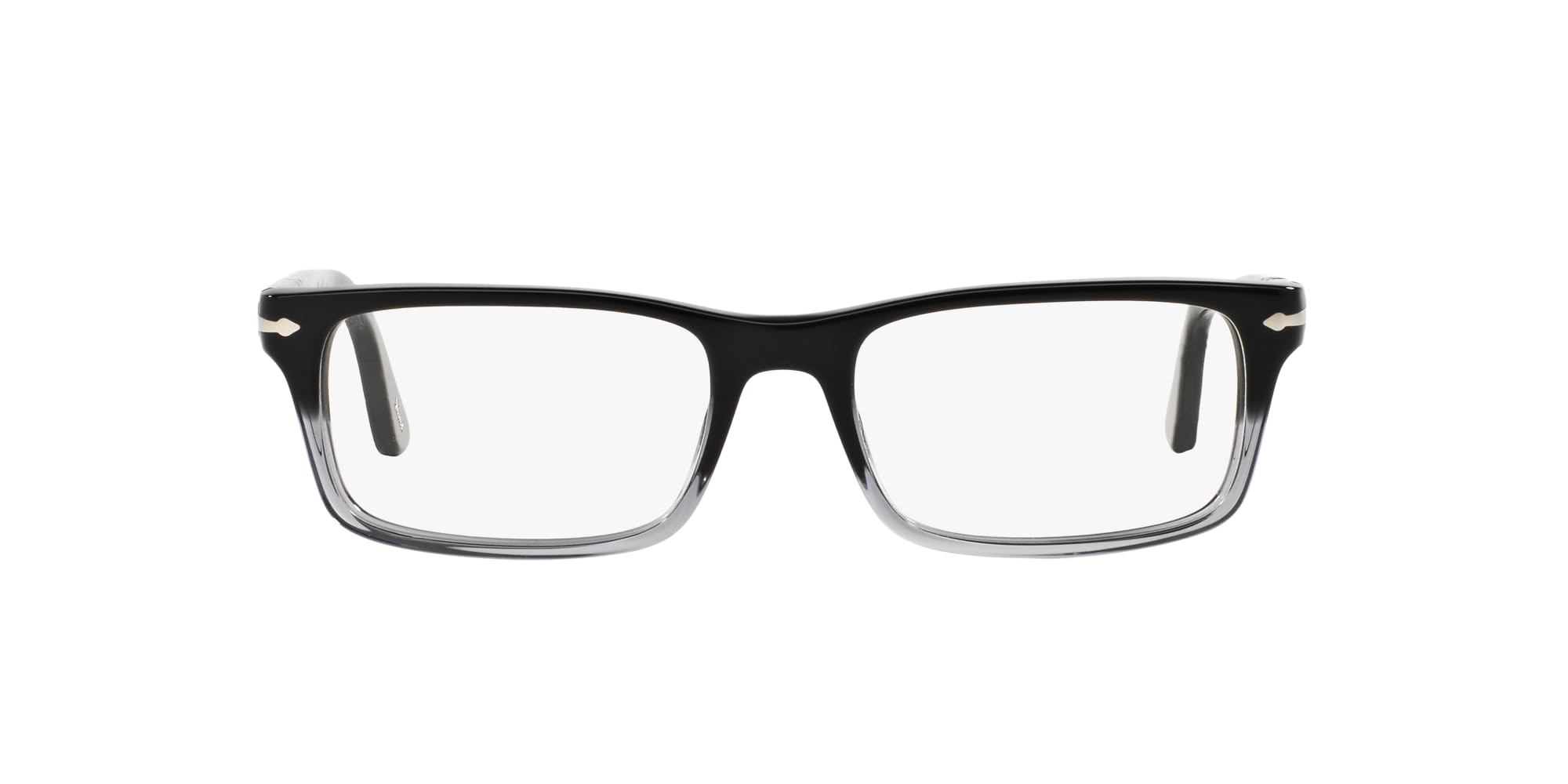
The Italian rectangle with a temple mechanism that does the gripping for you.
The PO3050V is the frame the rest of the list gets compared to on style. It is designed and crafted in Italy, and the shape is a clean rectangular opening — the geometry a progressive wants. The standout mechanical feature is the patented Meflecto temple, a flexible metal joint in the arm that lets the frame bend and hold rather than press and slip. With a progressive lens, that flex matters: the frame sits at the same angle on your face all day, so the reading zone stays where the lens maker put it. Style is what people praise most across the feedback, and after carrying a rectangle this iconic for years, Persol’s reputation for the shape is well earned.
It also has a long-standing following. Owners who have gone through Tom Ford, Versace, and Prada describe coming back to Persol for the fit, the durability, and the “edgy-classic” look — a picture that other frames on this list do not offer. One pair was bought as a replacement for a cracked Persol, found in the exact same model, and it matched the original on fit at the temples and behind the ears. That is the sort of continuity you want in a frame you plan to keep for years.
The one honest area is quality control across sellers. A number of buyers question authenticity, and a few report frames arriving slightly twisted or out of alignment at the nose piece — one pair had to be straightened when the lenses went in, and another arrived with the lens plane visibly off. If you buy, check the frame is level on a flat surface the moment it arrives.
What puts it on the list: the Meflecto temples hold the frame at a steady angle — the exact stability a progressive needs — in a rectangle that has earned a loyal following.
The variable to watch: alignment can arrive off, so level the frame on a flat surface when it lands and return it if it will not sit straight.
It suits you if: you want a classic rectangle with a self-adjusting temple and you are willing to check the frame on arrival.
Look past it if: you want to avoid any authenticity or alignment uncertainty with a reseller.
8. Oakley Ox5038 Metal Plate

A titanium rectangle built for daily abuse, with a full-thickness lens window.
The Metal Plate name is the whole story — a titanium rectangle that shrugs off daily wear. Oakley says the frame can be fit with single vision, bifocal, and progressive lenses, so there is no compatibility question. The rectangular opening is deep through the center, which keeps the three progressive zones spread out instead of bunched. Build quality is where the praise lands: it is described as solid, durable, and good enough that an optometrist signed off on it, and one owner with a larger head reports it fits well.
The everyday experience holds up. Wearers describe putting them on every day and finding them comfortable and durable, and a repeat buyer on their second pair says the frame is beautifully made and fits the face. Another long-run owner rates it the favorite of many Oakley frames owned — “very solid” is the summary. It is the pick for the person who wants one frame, worn hard, for years.
One failure mode is worth flagging on a titanium frame at this end of the market: hinge quality. A single wearer on a replacement pair reports the hinges felt sloppy, as though they might give out. It is not a pattern, but it does tell you to inspect the hinge action on arrival. The other point is simply that this is an Oakley — the metal-on-metal sports look is not for everyone, and if you want a delicate office frame, this is the wrong direction.
The strong point: a titanium rectangular frame rated for single vision, bifocal, and progressive lenses, with durability reported by daily wearers and an optometrist’s sign-off.
Worth flagging: one replacement pair showed sloppy hinge feel, so check the hinge action the day it lands.
Reach for it if: you want a sturdy titanium rectangle you can wear every day and fit with any lens type.
Skip if: you prefer a soft, dressy look — this one reads sporty.
9. Persol Unisex Po3189v Square Prescription Eyewear Frames

The lighter square Persol, shaped to carry a progressive without the bulk.
If the PO3050V feels too boxy, the PO3189V is the same Italian lineage in a softer square. It uses the same Meflecto temple design — the flexible joint in the arm that keeps the frame seated — but in a square opening that gives a progressive lens a deep center. It is also notably light on the face, and for a progressive wearer, light matters: a heavy frame creeps down the nose through the day, dragging the reading zone with it. Style is the most-praised trait here, with repeated praise for the trendy look, the deep color, and the overall fit.
The comfort reports back that up. Wearers describe the fit and look as a match and say they would buy again, and the weight is a recurring bright spot — one buyer uses the word lightweight as the headline. The unisex sizing means it does not narrow to one face type, and the deep color in particular reads as distinctive rather than generic.
The recurring snag is the frame-to-frame finishing. Some units arrive slightly crooked — one wearer reports the frame face and one arm came slightly asymmetrical — and a lens can arrive half-seated from the start. Treat the unboxing as a fit check: level it on a flat surface and confirm the lens is fully seated before you call the optician. Small alignment issues can usually be corrected during lens fitting.
The case for it: a light square Persol with Meflecto temples, praised for style and a deep, tended color, with fit reports that keep buyers coming back.
The thing to check: some frames arrive slightly crooked, so level it on a flat surface and reseat any loose lens at the fitting.
Best for: a wearer who wants a designer square that feels barely there on the face and holds a progressive steadily.
Think twice if: you want a perfectly aligned frame straight from the start with nothing to correct.
Know the Specs
Lens height and the progressive channel
Lens height is the vertical opening of the frame — the space a lens maker has to stack the distance, mid, and reading zones. The three zones need room; squeeze them into a shallow opening and the reading band at the bottom becomes a sliver you have to hunt for. That is why a rectangular or square frame runs deeper through the middle than a curved cat-eye shape. Before you buy any frame for a progressive, measure the vertical opening and compare it to your last comfortable pair — if you are switching from a shallow frame, do not go narrower.
Interpupillary distance and fit adjustment
Intel — sorry, interpupillary distance (often called PD) is the gap between your two pupils, measured in millimeters. The lens maker uses it to align each lens to the center of your eye, and if it is off, your eyes fight the lens all day. The Aist Optics trial frame lists a 48 to 80 mm adjustable range, with 24 to 40 mm per eye and a 1 mm scale, which is fine enough to get close. On an everyday frame, PD is set at the optician’s bench, but a frame with adjustable nose pads and bendable temples gives them room to correct it — a rigid frame with fixed pads gives them almost nothing.
Common Questions
Can any frame hold progressive lenses?
How much lens height does a progressive lens need?
Are titanium frames better for progressive lenses than plastic frames?
Do progressive readers work as well as prescription progressives?
Why do my progressive glasses make me look over the top of them?
What is pantoscopic tilt and does it matter?
Can I use spring hinges with a progressive lens frame?
My Persol frames arrived crooked — is that normal?
How do I know if a frame fits my face shape?
The Bottom Line
For most people buying frames for progressive lenses, the safe pick is the Oakley Tincup — a deep rectangular opening, a grippy straight-arm design, and a service life owners describe in years, not months. If you want a made-to-measure fit before you order, the Aist Optics trial frame is the tool that gives you your exact numbers. And if you want the smooth near-to-far switch without a prescription run, the LOOK OPTIC Laurel hands you progressives already installed in a frame with Italian spring hinges.
The pattern across the strong picks: the deepest vertical lens opening plus a frame that stays put all day is what makes progressives feel natural. The Persol and Swarovski picks bring style, but fit comes first — good looks cannot fix a frame that drops the reading zone below your line of sight.
How we choose
We do not accept paid placement. Every pick is matched to a real buyer and a real use-case; we do not hands-on test units.
Sources
Specifications: manufacturer listings and product documentation. Review insights: verified customer reviews, as of October 2026. Pricing: not shown on this page (it changes often); check the current price via the retailer link.
As an Amazon Associate, Aappliancez earns from qualifying purchases. This does not affect which products we feature.