Disclosure: Some links in this post are affiliate links. As an Amazon Associate I earn from qualifying purchases, at no extra cost to you. Learn more
Specs are compiled from manufacturer listings and verified buyer reviews and can change over time — please confirm the key details on the product page before buying.
If your baby brings up most of a feed minutes after finishing it, the formula itself may be the thing working against you. Regular milk-based powder is thin and digests fast, so it sloshes back up an immature valve at the top of the stomach. Thickened, sensitive, or broken-down formulas are built to change that. This guide sorts the real options by what they do, who they suit, and where each one falls short.
This guide is built by comparing the manufacturers’ published specifications and the patterns across verified customer reviews, so you get each pick’s real strengths and trade-offs instead of marketing spin.
You will see which powders thicken with rice starch, which drop the lactose, and which split proteins into pieces small enough to settle a troubled tummy. Every pick below earns its place on ingredient design and on verified owner reports of how babies respond. Here is the practical shortlist of the best formula for spitting up.
Top Picks


How To Choose The Best Formula for Spitting Up
Spit-up is mostly mechanics plus what is in the bottle. A loose valve at the top of the stomach lets thin liquid ride back up, and a fast, airy feed makes it worse. The formula you pick can either add thickness, calm the tummy, or remove the ingredient that is causing trouble. Start by asking which of those three problems you actually have.
Start with the thickener, not the brand
If your baby is comfortable and gaining well but keeps losing volume after feeds, a rice-starch thickened formula is the first thing to try. Rice starch makes the liquid heavier in the stomach, so it is harder for it to travel back up the food pipe. Enfamil A.R. is built on exactly this idea — iron and rice starch in one powder. One thing to expect: the bottle looks foamy right after you shake it, and that froth is normal for an added-rice product.
Then look at the protein
If your baby is also gassy, fussy, or straining, the protein structure matters as much as the thickness. Casein protein curdles in the stomach, and curds are harder to move along. A 100% whey recipe — like the Good Start Soothe Pro — is made to avoid that curdling. A hydrolyzed recipe takes it further by breaking the protein into smaller fragments before it ever reaches your baby.
When the problem is lactose or milk protein
A lactose-sensitivity formula cuts the sugar that some tummies struggle with — Amazon Basics Sensitivity runs with dramatically less lactose than a standard milk-based powder. A hypoallergenic formula goes after the protein itself. Similac Alimentum uses milk protein broken into tiny pieces, which is the route for babies reacting to cow’s milk protein rather than to volume. If you are unsure which of these two you are dealing with, that is a conversation for your baby’s doctor before you switch.
Size, scoop, and how far one can goes
A bigger can is not just a bulk buy — it means fewer reorders and less chance of running dry mid-week. Good Start Soothe Pro comes as a 30.6 Ounce can, while the Bobbie Organic Gentle tub is 14.1 Ounce. If your baby takes several bottles a day, that difference adds up fast. Also check whether the lid has a spot to park the scoop; it sounds small until you are doing it at 3 a.m.
Side-by-Side Comparison
| Model | Best For | Protein / Base | Thickener | Can Size | Amazon |
|---|---|---|---|---|---|
| Good Start Dr. Brown’s Soothe Pro★ Best Overall | Everyday gassy, spitty babies | 100% whey, advanced hydrolysis | — | 30.6 Ounce | Amazon |
| Bobbie Organic GentlePremium Pick | Organic, breast-milk-close feeding | Smaller milk proteins, 100% lactose | — | 14.1 Ounce | Amazon |
| Amazon Basics Sensitivity | Lactose-sensitive tummies on a budget | Milk-based, 99% less lactose | — | 2.07 Pound | Amazon |
| Enfamil A.R. (19.5 oz tub) | Frequent spit-up, reusable tub | Milk-based with iron | Rice starch | 19.5 oz | Amazon |
| Mama Bear Gentle Premium | Gentle daily feeding on a budget | Gentle blend, DHA, 2’FL HMO | — | 21.5 Ounce | Amazon |
| Enfamil A.R. (27.4 oz) | Reflux-heavy babies, bigger can | Milk-based with iron | Rice starch | 27.4 oz | Amazon |
| Similac Alimentum | Milk protein allergy and colic | Hypoallergenic, broken-down protein | — | 19.8-oz | Amazon |
Detailed Reviews
1. Good Start Dr. Brown’s Soothe Pro Formula
Our pick — 4.5+★ from 4,500+ verified ratings; the strongest balance of quality and price.
A 100% whey recipe built for the baby who burps up half of every bottle.
The reason this one tops the chart is the protein. Soothe Pro is 100% whey, which means it does not form the hard curds that casein-heavy powders can leave in a small stomach. It is also put through an advanced two-step hydrolysis process, and it carries the probiotic L. Reuteri. That combination targets the fussiness side and the spit-up side at the same time, which is unusual at this price level.
Owners describe a genuinely calmer baby on this can — less gas, easier burping, and a marked drop in how much comes back up after a feed. The formula itself is what wins people over, with effectiveness and consistency close behind in what buyers talk about. And there is one line that sums up the whole appeal for a spit-up parent, as the review pages put it: “My granddaughter isn’t spitting up like she was!!!”
What you give up is convenience in the mixing bowl. This powder is tougher to dissolve than some — expect clumps and air bubbles if you stir fast, so shake it harder or use a whisk. The iron also darkens and scents the stools, which is normal and not a sign anything is wrong. Its 30.6 Ounce can is more than double the size of the 14.1 Ounce Bobbie tub, so you are restocking far less often. It also carries DHA, HMOs and probiotics in one blend for ages 0 to 12 months.
Why It Earns The Top Spot
- 100% whey protein designed to avoid stomach curdling
- Advanced two-step hydrolysis breaks the protein down before it hits the tummy
- Probiotic L. Reuteri included in the powder
- 30.6 Ounce can means fewer reorders
- DHA, HMOs and probiotics in one formula for 0-12 months
What To Expect
- Mixes with clumps and air bubbles if you are not patient
- Darker, stronger-smelling iron stools
- Some babies still get constipated on it
The verdict here: this is the pick for the gassy, burpy baby who is otherwise comfortable and growing on schedule.
One honest caution: if your baby’s problem is a true milk protein allergy rather than volume, this is not the can for you.
2. Bobbie Organic Gentle Formula
The organic can for parents who want the ingredient list to read like breast milk.
Bobbie builds this one on lactose — the carbohydrate babies get from breast milk — and leaves out corn syrup, maltodextrin, and sucrose entirely. The milk protein is milled smaller to ease digestion, and the powder is USDA Organic, EU Organic, and Clean Label Project Certified. Each batch passes 2,000+ quality checks before shipping.
For a spit-up baby being supplemented rather than fully formula-fed, that gentleness is the whole point. Parents topping up breastfeeds describe far less coming back up and a baby who settles instead of straining. One parent of a gassy baby put it plainly: “My gassy baby tolerates this so well! And I love that it’s organic.” Other caregivers who had cycled through multiple cans call it the only one that worked for supplementing, with the rest bringing vomit back.
You’ll run out faster than you might expect: at 14.1 Ounce this is the smallest can in the lineup, so a baby on several bottles a day will burn through it quickly. The tub measures 8.78 x 6.3 x 4.84 inches, which looks bigger than the amount of formula inside. Several parents also find the “Gentle” label confusing, because the ingredient panel looks close to the regular Bobbie. Green, stronger-smelling diapers are a normal side effect here, not a warning sign.
Best paired with breastfeeding: this is a supplementing formula, and it behaves best when it is one or two bottles a day rather than the entire diet.
The real limit: a small 14.1 Ounce tub plus premium positioning means you will be ordering often.
Reach for this if: you are combo feeding and want an organic, lactose-based powder that goes down gently.
Look elsewhere if: you need a big can that stretches across a week of full formula feeding.
3. Amazon Basics Sensitivity Formula

Store-brand pricing with a lactose load cut down to almost nothing.
Sensitivity takes the lactose route: it carries 99% less lactose than a standard milk-based formula, which is the lever for babies who get gassy, fussy, or uncomfortable specifically from that sugar. It backs that up with dual HMOs — 2′-FL and LNnT — plus DHA, Lutein, Vitamin E and Choline. Non-GMO, no artificial growth hormones, no palm olein oil.
What buyers keep coming back to is how easily it dissolves. It mixes better than the national brands for many households, and babies who normally drink a sensitive name-brand formula take to it without a fuss. The value angle is real too — households switching from a premium sensitive powder describe staying on it right up to the first birthday. It is also SNAP eligible and meets the same FDA and quality standards as the big brands.
Be honest about the profile, though. This is a heavier tub at 2.36 pounds against Bobbie’s 1.59 pounds, so it is a bigger commitment sitting in the cupboard. And the sensitivity route does not suit a baby whose issue is milk protein rather than lactose — for that you want the broken-down protein of something like Similac Alimentum. Constipation is the trade-off a few families run into.
The mixing advantage: dissolves clean, which matters when you are shaking a bottle one-handed at night.
Know your problem first: lactose sensitivity is not the same as milk protein allergy, and this can only solve the first.
Pick this when: your baby is lactose-sensitive and you want to stop paying name-brand prices for a sensitive powder.
Pass on it if: the diagnosis is a protein allergy rather than lactose trouble.
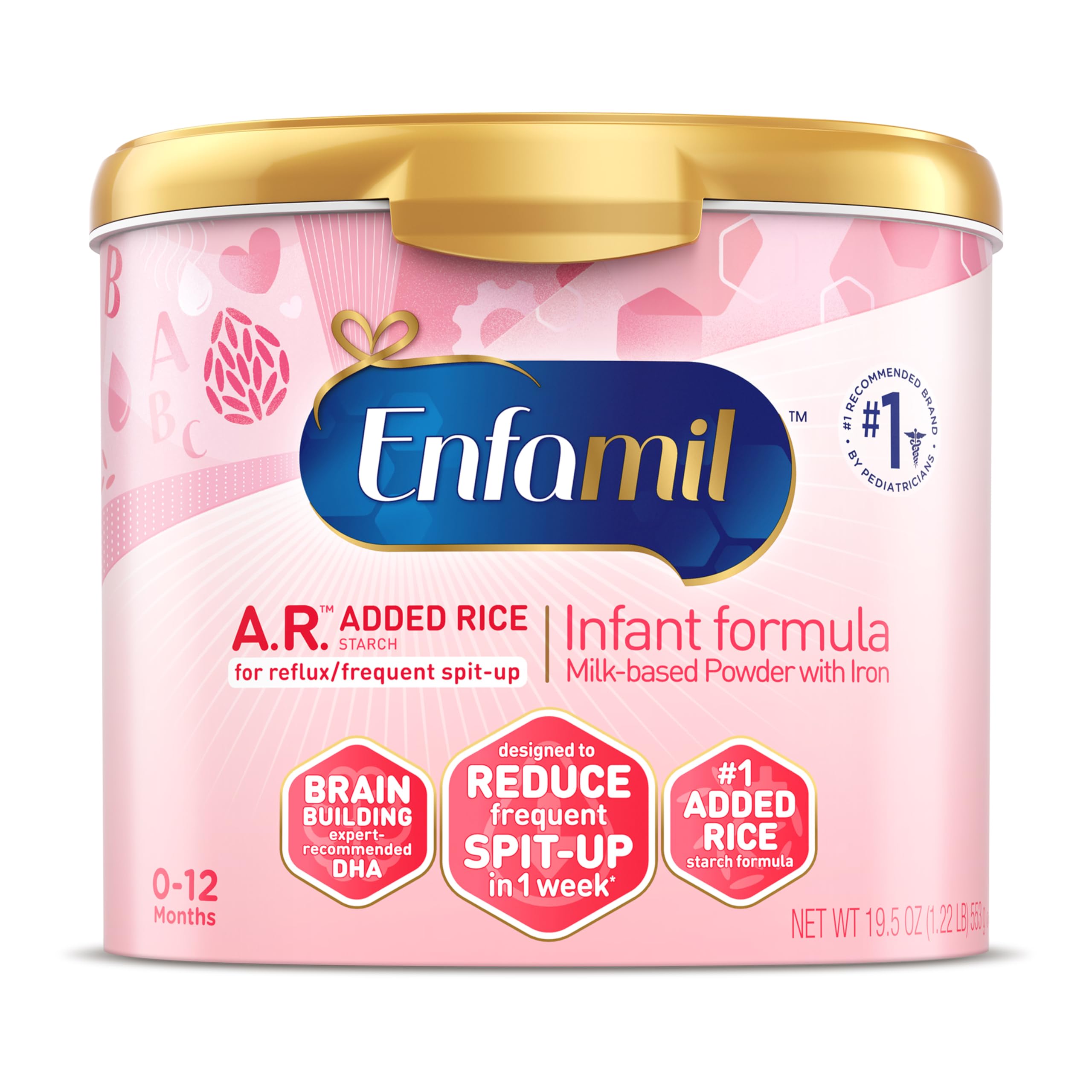
4. Enfamil A.R. Infant Formula – Reusable Powder Tub, 19.5 oz
Rice starch does the work here — the bottle sits heavier and stays put.
Enfamil A.R. is the thickened option: iron and rice starch in one powder, formulated to meet the American Academy of Pediatrics reflux reduction guidelines. It carries DHA for brain and eye development, plus a dual prebiotic blend and essential vitamins for the first 12 months. For a baby who is comfortable but loses volume after every single feed, thickness is the fix that matters.
Two things to know before you order. First, this tub is a 19.5 oz pour, and the listing has been inconsistent about it — some buyers expected a larger can based on the imagery. Second, the formula froths up right after mixing, which is normal for an added-rice product and not a sign of spoilage. Give the bottle a minute to settle before the feed.
This is the smaller of the two A.R. cans in this lineup, at 19.5 oz against the 27.4 oz version further down. That makes it the sensible entry point if you want to test whether thickening helps your baby at all before committing to the bigger tub. It is also SNAP eligible and works with Subscribe and Save.
The mechanism: rice starch thickens the feed so it is harder for a small stomach to push back up.
Check the fill level: listing imagery and actual can size have not always matched on this one.
Worth trying when: your baby is comfortable and gaining but regularly loses a chunk of each feed.
Think twice if: you go through formula quickly and would rather buy the bigger A.R. can once.
5. Mama Bear Gentle Formula

A gentle daily powder that undercuts the name brands without cutting the ingredient list.
Mama Bear Gentle is built for tiny, tender tummies — the fussy, gassy, crying kind rather than the projectile kind. It carries DHA for brain support, choline, and a gentle immune blend with 2’FL HMO, plus vitamins and minerals for immunity. The nutrition is modeled on Enfamil NEUROPRO Gentlease. It is non-GMO, gluten free, made without artificial growth hormones, and certified kosher.
Households that use it tend to stay on it. One family ran it on subscription every two weeks for a full year with no trouble at all, and a WIC parent found it lasted longer than a smaller name-brand can while keeping their baby’s tummy settled. The lid has a dedicated spot for the scoop, which sounds trivial until you have lost one down a drain at midnight.
Where it can trip you up is the stool. A share of babies on gentle formulas end up constipated, and this one is no exception — if your baby is already prone to straining, watch the first week closely. It is also a gentle formula, not a thickened one, so it does nothing about the mechanical spit-up that rice starch addresses. What it does do is give you a 21.5 Ounce can of complete nutrition for newborn to 12 months at a budget-friendly tier.
Built for daily volume: a 21.5 Ounce can of complete 0-12 month nutrition at the entry tier.
Not a thickener: if the issue is volume coming back up rather than gas and fussiness, look at the A.R. cans instead.
Best fit for: a gassy, fussy baby who needs a gentle everyday powder without the premium price.
Skip the switch if: constipation has already been an issue on gentle formulas.
6. Enfamil A.R. Baby Formula Proven to Reduce Spit-Up, 27.4 oz

The reflux workhorse in the bigger can, for the baby who brings up feed after feed.
Same rice-starch and iron formula as the smaller A.R. tub, now in a 27.4 oz can. That means the same rice-starch thickened feed meeting the American Academy of Pediatrics reflux reduction guidelines, the same DHA, and the same dual prebiotic blend for the first 12 months. It is SNAP eligible and set up for Subscribe and Save.
What wins people over here is reflux relief specifically — that is the thing this can is bought for, and it is what the formula does best. Babies with severe, colicky reflux that survived medication, tongue and lip tie releases, goat milk, and breast milk are described as turning a corner almost immediately after the switch. A parent of a reflux baby put it bluntly: “It is expensive but it works wonders for baby with reflux.”
Here is the honest part. The frothy head that forms after mixing is normal for an added-rice formula, so do not read it as a bad batch. And this is a thickened formula, which means a thicker nipple flow often helps the feed go down smoothly. Compared with the Amazon Basics Sensitivity pick, this one treats the mechanics of spit-up rather than the lactose content — the two solve different problems.
Where It Delivers
- Rice starch thickens the feed to help it stay down
- Meets AAP reflux reduction guidelines
- 27.4 oz can reduces how often you reorder
- DHA plus a dual prebiotic blend for 0-12 months
- Fits Subscribe and Save for steady supply
The Cost Of Thickness
- Frothy after mixing — expected, not a defect
- Premium positioning puts it at the top of the range
- A thicker nipple flow is usually needed
The standout spec: rice starch, backed by AAP reflux reduction guidelines, in a can big enough to last.
The trade-off: you pay premium money and you need a faster-flow nipple to make it work.
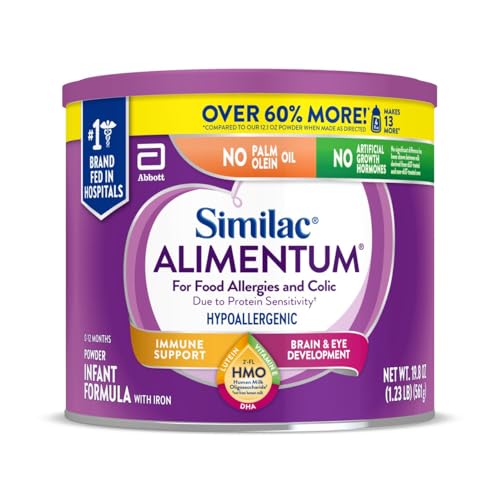
7. Similac Alimentum Formula
For the baby who is not just spitty but reacting to the protein itself.
Alimentum takes a different route from every other can here. The milk protein is broken down into tiny pieces, which is designed to head off allergic reactions in most babies reacting to cow’s milk protein. It also adds 2′-FL HMO, an immune-nourishing prebiotic, to a hypoallergenic base. The manufacturer states it reduces colic symptoms from protein sensitivity within 24 hours in most infants.
Households dealing with genuine protein trouble describe a dramatic shift — feeds staying down where they used to come straight back, and a colicky baby settling in a way nothing else managed. The protein being pre-broken means the stomach has almost nothing left to do, which is exactly why it works when standard powders do not. It also helps with cow’s milk allergy specifically, not just general fussiness.
Two real drawbacks: this is the most expensive option in the group, and some babies genuinely resist the taste. The smell is distinctive too. A few parents have also flagged the HMO (human milk oligosaccharide, a prebiotic component) labeling in reviews. What you do get is a 19.8-oz value can, reliable stock on Subscribe and Save, and the confidence of a formula your doctor may have pointed you toward in the first place.
Why it works: the protein arrives already broken into tiny pieces, so a reactive tummy is not asked to do the work itself.
The honest cost: premium pricing and a taste some babies refuse at first.
This one is for: babies with a diagnosed or strongly suspected cow’s milk protein allergy, or colic driven by protein sensitivity.
Do not start here if: your baby is comfortable and simply losing volume — you would be paying premium for a problem you do not have.
Know the Specs
Rice Starch (The Thickener)
Rice starch is added to a formula so the liquid sits heavier in the stomach, which makes it harder for a small baby to push back up the food pipe. It is the ingredient behind Enfamil A.R.’s spit-up approach. The trade-off is texture: these powders froth and foam after mixing, and that head is normal rather than a sign of spoilage. Thickened formula also tends to need a faster-flow nipple so the feed does not stall.
Whey vs Casein Protein
Milk protein comes in two broad types, and they behave differently in a baby’s stomach. Casein forms curds, which can be harder to move along and is often linked to gassiness. A 100% whey recipe like Good Start Soothe Pro is built specifically to avoid that curdling. Hydrolysis is the next step up — the protein is broken into smaller fragments before it ever reaches your baby, which is the approach in formulas aimed at sensitive tummies.
Lactose Content
Lactose is the natural sugar in milk, and it is the primary carbohydrate in breast milk. Some babies struggle with it and get gassy or uncomfortable after feeds. A lactose-reduced formula like Amazon Basics Sensitivity cuts that sugar down sharply while still delivering complete nutrition. The key distinction: lactose sensitivity is about the sugar, while a milk protein allergy is about the protein — and only a hypoallergenic formula like Similac Alimentum addresses the second one.
HMOs and Prebiotics
HMOs are prebiotics — food for the good bacteria in a baby’s gut — and they occur naturally in breast milk. Dual HMOs such as 2′-FL and LNnT show up in formulas like Amazon Basics Sensitivity, while 2′-FL HMO appears in Mama Bear Gentle and Similac Alimentum. They are there to support the digestive tract and immune system rather than to thicken the feed, so treat them as a supporting ingredient rather than a spit-up fix on their own.
Common Questions
Will a thickened formula actually stop my baby spitting up?
Do I need a different nipple if I switch to a rice starch formula?
How can I tell lactose sensitivity from a milk protein allergy?
Why is my thickened formula foamy after I shake it?
Is it safe to switch formulas suddenly?
Which formula is best for a breastfed baby who spits up when supplemented?
Does a hypoallergenic formula taste different?
How long does an opened can of powder formula last?
Are store-brand formulas as complete as the name brands?
Can I use a sensitive formula and a thickened formula together?
The Bottom Line
For most babies, the best formula for spitting up is the Good Start Dr. Brown’s Soothe Pro. Its 100% whey recipe and two-step hydrolysis (a process that pre-breaks down milk proteins) tackle curdling and gas at the same time, and the 30.6 Ounce can lasts longer between reorders. If your baby is losing volume after feeds rather than reacting to the ingredients, the Enfamil A.R. 27.4 oz brings rice starch and AAP reflux reduction guidelines to the table. And when the real problem is milk protein, the Similac Alimentum is the can built for that job. One last thing worth knowing: the Soothe Pro holds the higher crowd score at 4.5+ stars across 4,500+ owners, so it is the safer first bet if you are not yet sure which category your baby falls into.
How we choose
We do not accept paid placement. Every pick is matched to a real buyer and a real use-case; we do not hands-on test units.
Sources
Specifications: manufacturer listings and product documentation. Review insights: verified customer reviews, as of October 2026. Pricing: not shown on this page (it changes often); check the current price via the retailer link.
As an Amazon Associate, Aappliancez earns from qualifying purchases. This does not affect which products we feature.