Disclosure: Some links in this post are affiliate links. As an Amazon Associate I earn from qualifying purchases, at no extra cost to you. Learn more
Specs are compiled from manufacturer listings and verified buyer reviews and can change over time — please confirm the key details on the product page before buying.
If your ankles and calves swell by mid-afternoon, a footless compression stocking does the squeezing work while your toes stay free to breathe in sandals or work shoes. The pick that stands out first is the CHARMKING Compression Socks 8-pair set — it holds 4.5 stars across 90,000+ ratings and gives you a fresh pair every day of the week. Below you’ll find that set plus four other footless options sorted by what each one actually solves, from a single-pair open-toe sock to a copper-infused calf sleeve.
This guide is built by comparing the manufacturers’ published specifications and the patterns across verified customer reviews, so you get each pick’s real strengths and trade-offs instead of marketing spin.
If your compression stocking ends up in a drawer, the culprit is usually the wrong pressure level or a calf size that doesn’t fit. Below are five solid options for Best Footless Compression Stockings, each with its real mmHg (millimeters of mercury, the standard unit for measuring compression pressure) rating and fit notes, so you can pick the right pair the first time.
Top Picks

How To Choose The Best Footless Compression Stockings
Two numbers decide whether you’ll actually wear your compression stockings every day: the pressure level in mmHg and the calf circumference the size chart lists. Get both right and you forget you’re wearing them. Get either wrong and they roll down, dig in, or end up in a drawer by day three.
Pressure Level — 15-20 mmHg vs 20-30 mmHg
The mmHg figure is the pressure the stocking applies to your leg, measured in millimeters of mercury. A 15-20 mmHg stocking is the everyday range — firm enough to feel supported on a long flight or a standing shift, gentle enough for all-day wear. A 20-30 mmHg stocking squeezes harder and is typically chosen for more demanding support needs.
Calf Width Beats Shoe Size
Compression stockings are sized to your calf circumference, not your shoe size. A sock that’s too narrow digs in at the top band and slides down within an hour; one that’s too wide provides no graduated pressure at all. Measure your calf at its widest point before ordering.
Open Toe vs Closed Toe
A footless or open-toe design leaves your toes free — better airflow for sweaty feet, no toe seam irritation, and it works with sandals. A closed-toe sock covers more surface but can bunch at the toes, especially in narrow shoes.
Side-by-Side Comparison
| Model | Best For | Compression | Pack Size | Style | Amazon |
|---|---|---|---|---|---|
| CHARMKING Compression Socks 8 Pairs★ Best Overall | Daily all-day wear, best value per pair | 15-20 mmHg | 8 Pairs | Calf, closed toe | Amazon |
| Doc Miller Open Toe Compression SocksLightweight Open Toe | Wide calf fit, layered under other socks | 15-20 mmHg | 1 Pair | Open toe | Amazon |
| BSERA Calf Compression Sleeve 2 Pairs | Calf-only support, footless wear with any shoe | 15-20 mmHg | 2 Pairs | Calf sleeve, footless | Amazon |
| NEWZILL Open Toe Compression Socks | Firmer 20-30 mmHg support | 20-30 mmHg | 1 Pair | Open toe, cotton blend | Amazon |
| ITHW Copper Calf Compression Sleeves | Gym-to-office wear, anti-slip grip | Graduated | 2 Sleeves | Calf sleeve, footless | Amazon |
Detailed Reviews
1. CHARMKING Compression Socks 8 Pairs
Our pick — 4.5★ from 90,000+ verified ratings; the strongest balance of quality and price.
The eight-pair workhorse that carries a 15-20 mmHg squeeze all week without a wash-cycle panic
If you’ve been putting off buying compression because a single pair costs enough to make you hesitate, this set removes that problem. Eight pairs at 15-20 mmHg means fresh socks Monday through Sunday — wash day never leaves you wearing a damp pair. And unlike the BSERA sleeve, which comes as just two pieces, this set gives you the breathing room that most people actually need to build a habit.
The 15-20 mmHg graduated pressure is the everyday tier. It’s firm enough to feel like support, not tight enough to leave marks after eight hours. The unisex fit is cut for broad sizing, and buyers report pulling them up easily — no fighting a thigh-high. What wins people over is the quality-to-stretch balance: buyers consistently note they hold their shape and stay put without constant tugging.
An honest catch: a few pairs have shown up with a small hole in the heel that turned into a run, and the colored patterns run tighter and warmer than the solid colors. Sticking to solid colors means fewer surprises. There’s also no open-toe version here — if you specifically want your toes free, look at the Doc Miller or the NEWZILL instead.
Where these earn their keep
- Eight pairs at 15-20 mmHg means daily rotation without mid-week laundry
- Pull-on ease that first-timers notice immediately — no wrestling a tight sock up over the calf
- Solid colors hold up famously — the ones buyers reorder after the first week
- Breathable enough for long shifts and compatible with most sneakers and work shoes
The honest trade-offs
- Patterned pairs run tighter and can leave indentations — the solid-color pairs are the safer bet
- Closed toe only — no footless option in this set
- Occasional heel hole reported on the individual colored pairs arriving with loose stitching
Best for: Anyone building a daily compression habit who wants a fresh pair for every weekday and doesn’t want to wash every night.
Look elsewhere if: Toes free is a must, or you specifically need 20-30 mmHg support — the NEWZILL is the firmer option.
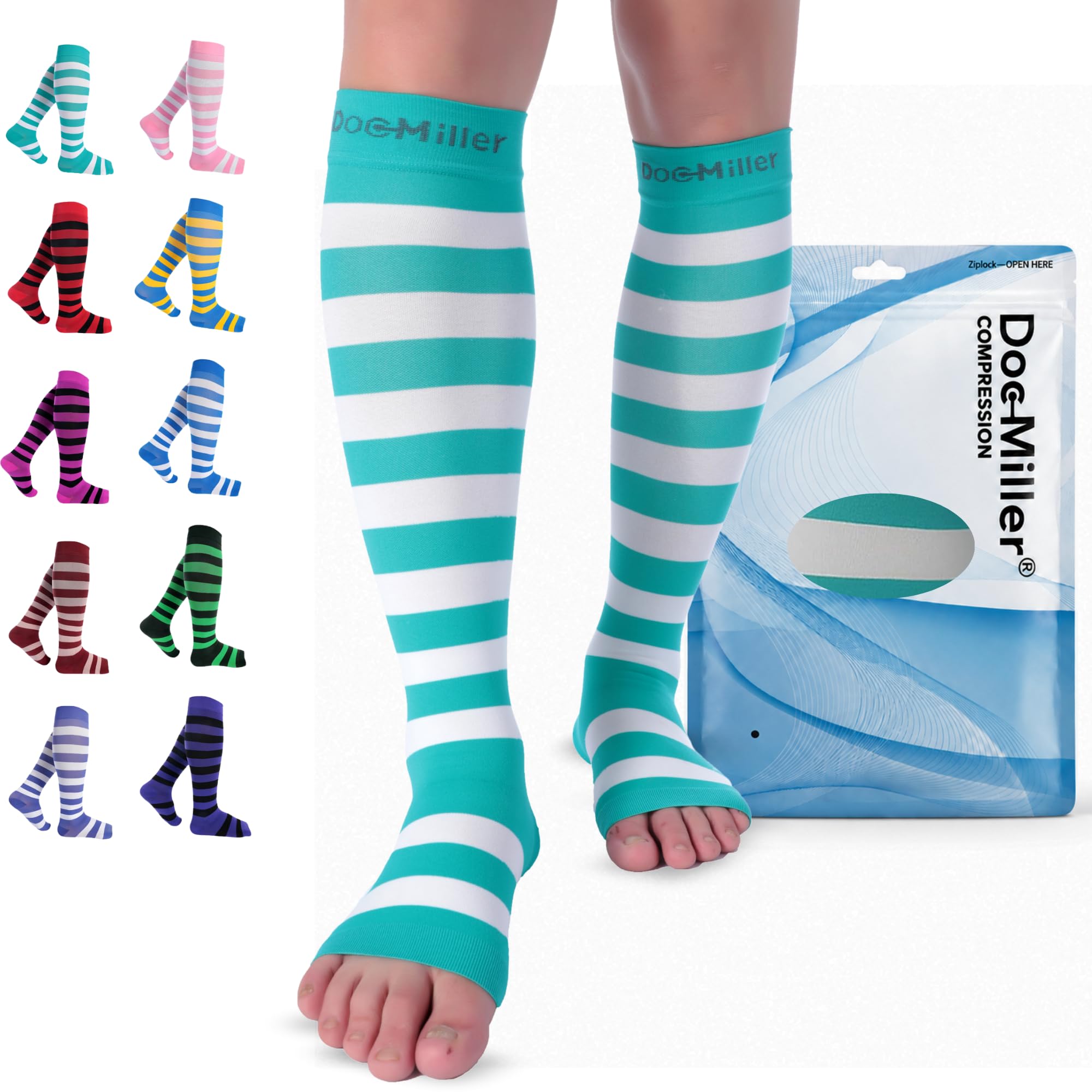
2. Doc Miller Open Toe Compression Socks 15-20 mmHg, 1 Pair
A thin, stylish open-toe sock that layers quietly under boots and sandals alike
The Doc Miller at 2.4 ounces is the lightest piece in this lineup — and the BSERA sleeve is a fairly heavy 3.53 ounces by comparison. That lightness matters most in the summer: it’s thin enough to layer under another sock or slide into a boot without any bunching. The 15-20 mmHg graduated pressure reaches the knee and delivers support from ankle to calf while your toes breathe freely underneath.
The standout here is how it handles look and feel. The striped nylon-spandex blend reads more like a fashion accessory than a medical sock — buyers mention wearing them with skirts and shorts without feeling like they’re in rehab. Compression is what people consistently rave about, followed closely by the build quality.
The trade-off is sizing. Doc Miller runs small, and buyers on the wider side of the calf range report the top band feels snug. If you’re between sizes, size up. The single-pair packaging also means you’ll want two if you plan to wear daily. Buyers do wish the pair were slightly more affordable for what you get.
The real story: Ultra-light at 2.4 ounces; striped look that doesn’t scream “medical sock”; open-toe cut that keeps toes cool under boots and sandals. Wide-calf base sizing gives larger calves a realistic option that most one-size brands skip.
What to watch for: Sizing runs small — go up if your calf is near the top of the range. The single-pair count is a rotation issue if you wear daily.
Reach for this if: You want an open-toe sock that reads as normal clothing and can layer under anything.
Hold off if: Your calf is on the larger side and you’d rather skip the size-guessing game.
3. BSERA Calf Compression Sleeve, 2 Pairs 15-20 mmHg
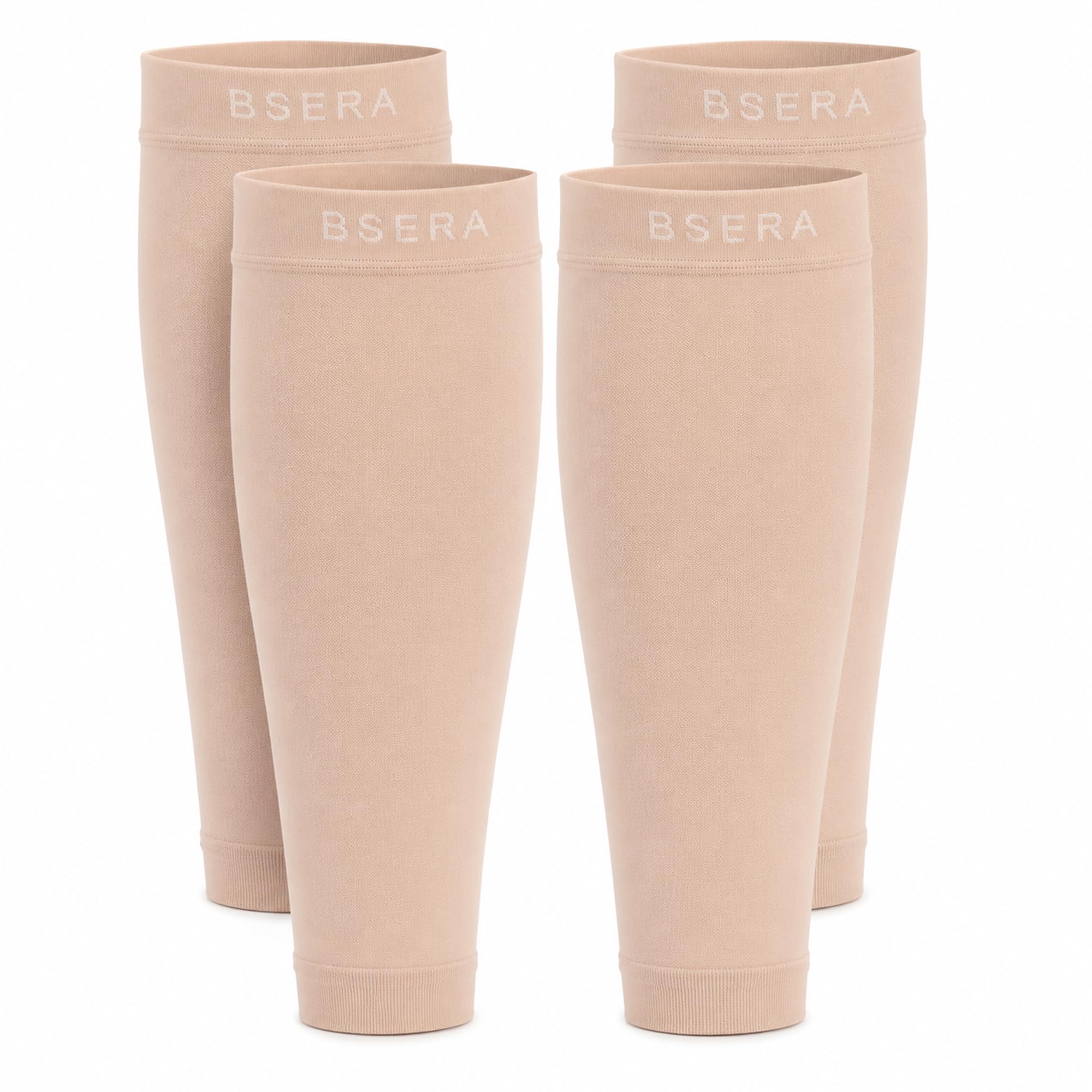
A pure calf sleeve — no sock, no toe, just targeted pressure where your calf needs it
If the idea of a full sock turns you off, this is the cleanest entry point. It’s a calf sleeve, not a stocking — no foot, no toe, no ankle seam. You wear it with whatever shoe you like, from a running shoe to a dress loafer, and nothing else changes. The 77% nylon / 23% spandex blend is what does the squeezing: 15-20 mmHg of graduated pressure that stretches to fit a real calf without grinding in.
What owners mention most warmly about is how light the pressure feels. The overwhelming note is that they forget they’re wearing them — no cutting off circulation, no itch, no slackening by afternoon. Comfort and quality rank right behind compression in what people call out. The “camouflage” finish is also a quiet favorite — it disappears under almost any outfit.
The honest caveat: sizing. Some find the medium runs tight, and the calf-width chart is stricter here than on a full sock. If your calf falls anywhere near the boundary, size up. Two pairs per pack also means one on, one in the wash — a practical rotation that keeps you from over-washing the elastic.
Standout feature: Pure calf sleeve form factor — no toe seam, no heel seam, wear with any shoe. The 77/23 nylon-spandex blend is snug but forgiving.
Fit-check note: Runs small — the size chart is unforgiving at the boundaries. Camouflage finish stays invisible under most clothes, but solid colors are what most people settle on.
Suits you if: You want targeted calf pressure that disappears under any outfit and works with every shoe in your closet.
Not your pick if: You need ankle and foot coverage — this stops at the calf, so a full sock like the CHARMKING serves that need.
4. NEWZILL Open Toe Compression Socks 20-30 mmHg
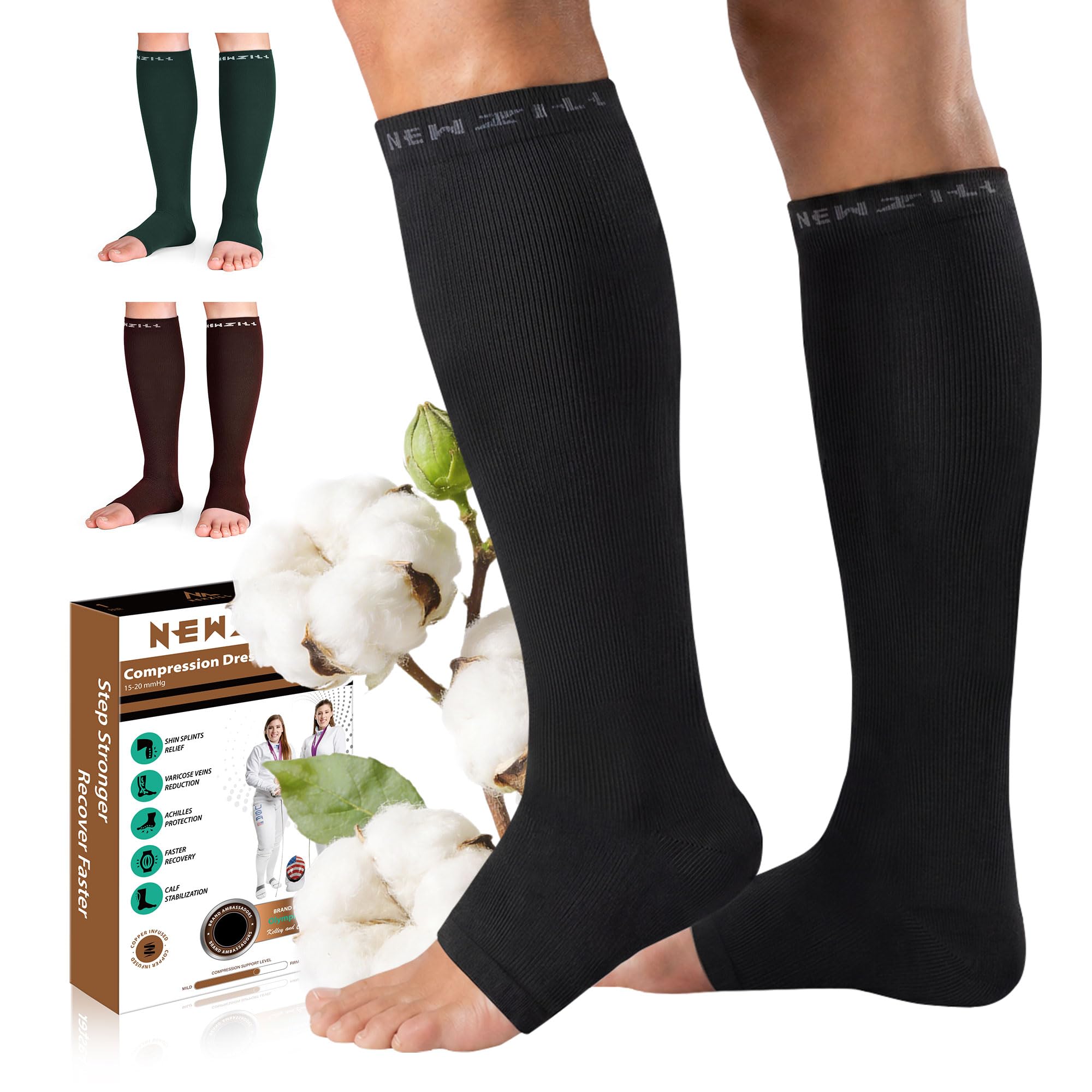
The firmer 20-30 mmHg open-toe sock — noticeably more squeeze than the CHARMKING pairing
If 15-20 mmHg feels like a light hug and you want something the leg actually notices, this is the one. NEWZILL runs 20-30 mmHg, a measurable step above the CHARMKING’s 15-20 mmHg — the difference is easy to feel after an hour on your feet. The open toe is the other half of the story: no seam across the toes, no irritation on long days, and it sits well under sandals and sneakers. The black cotton blend is gentle on sensitive skin and breathes better than a slicker synthetic.
NEWZILL earns its spot because customers note wearing it through a full workday without it rolling or pinching. Multiple buyers wear it in the office, in the car, at yoga, and even overnight. The compression is firm without strangling — a hard-to-find balance at this pressure level. Users also note it’s far easier to put on and take off than a comparable medical-grade sock, largely because the cotton blend stretches.
The real caveats come down to two things. First, the cotton pills and fuzzes with repeated washing — air-drying and washing in a mesh bag slows that down. Second, sizing runs narrow at the top of the range; buyers with 21-inch calves have had trouble getting the sleeve past the shin. Size up if you’re near the boundary. The open-toe construction can also feel strange for the first few wears if you’re coming from a closed-toe sock.
Why it earns the firmer slot: 20-30 mmHg delivers a real pressure step above the CHARMKING’s 15-20. Open toe keeps seams off your toes, and the cotton blend is forgiving on sensitive skin and easy to slide on.
Worth knowing: Cotton pilling is the recurring laundry complaint — wash in a bag and air dry. Runs narrow at the top size range; size up if your calf is near the max.
The right call when: You want open-toe freedom with 20-30 mmHg of real pressure, and softness matters as much as support.
Pass if: You wash regularly in a hot machine cycle — the cotton blend needs gentler care to keep its shape.
5. ITHW Copper Calf Compression Sleeves, 2 Sleeves
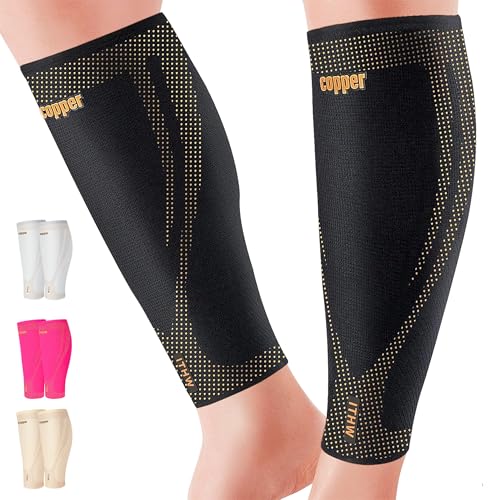
The copper-infused sleeve with a stay-put grip for people who move all day
Slipping and rolling are the small daily annoyances that ruin the compression habit — this sleeve attacks that problem directly. The elastic band is engineered to hold firm while you’re sweaty, whether you’re running, jumping, or moving through a shift. The copper-infused fabric is the other headline: it wicks sweat quickly and the smooth lining is kind to sensitive skin. If your previous sleeve stuck to your leg and stank after a workout, this is the fix.
The graduated construction — firmer low, softer high — matches the medical pattern and supports the calf without the tight band cheaper sleeves leave behind. Reviewers point out it eases calf strain and post-workout soreness. No marks, no indentations, even after all-day wear. Light and stretchy enough to fit a wide range of calf sizes without feeling either loose or tight.
Before you order, know that sizing runs small on the “Medium.” Multiple buyers suggest going up a size, and the small size is noted to fit snug at the calf but looser near the ankle — which is fine, since the ankle isn’t the compression zone. This is a targeted sleeve, so you get no ankle or foot coverage; pair it with a compression sock if you want both.
Strengths that surface fast
- Anti-slip elastic band holds through running, jumping, and HIIT — no mid-workout adjustment dance
- Copper-infused nylon wicks sweat and resists the stale-sleeve smell that plagues cheaper fabrics
- Graduated compression (firmer low, softer high) — the standard medical pattern for calf support
- Smooth lining is gentle on sensitive skin for full-day wear under almost any pant or sock
Where it has limits
- Medium runs small — most buyers go up a size for a true fit
- Calf-only, so you get no ankle or foot coverage
- One pair per pack, so daily wearers rotate frequently
Best for: Athletes and on-your-feet workers who move a lot and want a sleeve that stays put no matter how sweaty the day gets.
Think twice if: You want one product covering ankle to calf — check the Doc Miller or NEWZILL instead.
Know the Specs
mmHg Pressure Rating
mmHg (millimeters of mercury) is the unit that tells you how much pressure the stocking applies. A 15-20 mmHg sock is the everyday tier — firm enough for long flights, standing shifts, and mild swelling, gentle enough to wear all day without marks. A 20-30 mmHg sock squeezes noticeably harder and is chosen when you want more support. Graduated compression means pressure is highest at the ankle and drops as it climbs the calf, which is what pushes blood upward.
Calf Width and Sizing
Compression stockings are sized to your calf circumference, not your shoe size. Measure your calf at its widest point — usually a few inches below the back of the knee. If you’re between sizes, always go up: a sock that’s too tight digs in and rolls, while one that’s too loose applies uneven pressure. In this lineup, Doc Miller and BSERA both run small, so ordering one size up is the safer move for most people.
Fabric Blend and Durability
Nylon-spandex blends hold elastic shape longer; cotton blends breathe and feel softer but pill with repeated washing. A 77% nylon / 23% spandex blend — like the BSERA sleeve — is a very common balance. Fabric blend affects how the stocking handles heat, how it wears under shoes, and how it survives laundry. Hand washing in a mesh bag and air-drying preserves the elastic far longer than a hot machine cycle.
Open Toe vs Calf Sleeve
An “open-toe” sock still runs ankle-to-calf but leaves the toes exposed — good for sandals, sweaty feet, and toe-seam irritation. A “calf sleeve” drops the sock entirely and covers only the calf — even more versatile with shoes, but with no ankle or foot coverage. Neither is strictly better; the right pick depends on if you want pressure on the ankle and foot, or just the calf.
Common Questions
What is the difference between 15-20 mmHg and 20-30 mmHg footless compression stockings?
Do footless compression stockings actually help with swollen ankles?
How do I measure my calf for the right size?
Can I wear footless compression stockings under regular shoes?
How long do compression stockings stay elastic?
Are calf sleeves better than full compression socks?
Should I sleep in my footless compression stockings?
What’s the best way to put on footless compression stockings without a fight?
Do copper-infused calf sleeves work differently from nylon ones?
The Bottom Line
The footless compression stockings worth starting with is the CHARMKING Compression Socks 8-Pair Set — 15-20 mmHg, eight fresh pairs, and enough solid-color consistency to build a daily habit without a mid-week wash panic. If you specifically want your toes free and a thinner layering sock, pick up the Doc Miller Open Toe. And for a firmer squeeze that keeps its softness through a full workday, the NEWZILL Open Toe at 20-30 mmHg is the one to reach for.
If your day is split between the gym and the office and slipping is your pet peeve, the anti-slip grip on the ITHW Copper Calf Sleeves is the fix — just size up. The BSERA Calf Sleeve is the lowest-key option when you want calf support under any shoe without a sock in the equation.
How we choose
We do not accept paid placement. Every pick is matched to a real buyer and a real use-case; we do not hands-on test units.
Sources
Specifications: manufacturer listings and product documentation. Review insights: verified customer reviews, as of October 2026. Pricing: not shown on this page (it changes often); check the current price via the retailer link.
As an Amazon Associate, Aappliancez earns from qualifying purchases. This does not affect which products we feature.