Disclosure: Some links in this post are affiliate links. As an Amazon Associate I earn from qualifying purchases, at no extra cost to you. Learn more
Specs are compiled from manufacturer listings and verified buyer reviews and can change over time — please confirm the key details on the product page before buying.
If your heels have gone hard enough to snag a sock, you need a foot cream built around urea — a humectant that draws water into thick, rough skin instead of just coating it. The O’Keeffe’s 3 oz two-pack is the one most people should start with, because it holds the highest score of the group at 4.5+ stars and the biggest following. Below you’ll find that pick plus four other creams, each matched to a different kind of dry foot.
This guide is built by comparing the manufacturers’ published specifications and the patterns across verified customer reviews, so you get each pick’s real strengths and trade-offs instead of marketing spin.
A thick balm, a light lotion and a peppermint-scented cream each suit a different kind of dryness, and the wrong texture is why so many jars end up half-used in a drawer. This breakdown of the best foot softening cream shows you exactly which formula suits cracked heels, which suits daily upkeep, and which one simply feels good.
Top Picks

How To Choose The Best Foot Softening Cream
Buying a foot cream is not like buying hand lotion. The skin on your heels is the thickest on your body, and a light body lotion often disappears before it does anything. What you want is a formula that either pulls water into that thick skin or breaks down the hard outer layer so the softer skin underneath can show.
Start with the active ingredient, not the smell
The single most useful thing on the label is urea — a naturally occurring humectant, meaning it draws water into the skin and holds it there. Higher urea percentages tend to work harder on callus and roughness, while a modest percentage in a rich base is gentler for daily use. A cream with urea plus lactic acid adds a mild exfoliating step, lifting dead surface skin so the moisturizer gets further in.
Match the texture to your cracks
Deep, splitting heel cracks want something concentrated that stays put — apply it at bedtime and pull a cotton sock over it. Fine, flaky dryness responds better to a lighter cream you will actually reapply through the day. If a cream feels heavy and greasy, you will use it less, and consistency is what actually softens feet.
Think about the container as well as the cream
A tube travels in a gym bag or suitcase without your fingers going into the product. A jar gives you easier access to the last bit at the bottom. Neither is better, but a tube tends to win if the cream lives in a bag rather than on a nightstand.
Side-by-Side Comparison
| Model | Best For | Urea / Active | Size | Format | Amazon |
|---|---|---|---|---|---|
| O’Keeffe’s for Healthy Feet★ Best Overall | Cracked heels and heavy daily dryness | Concentrated cream | 3 oz tube, 2-pack | Tube | Amazon |
| Eucerin UreaRepair PlusBest for Sensitive Skin | Sensitive skin and fragrance-free routines | 10% urea | 100 ml | Tube | Amazon |
| Nordic Care Intensive Repair | Deep fissures and quick visible change | Urea, glycerin, lactic acid | 3.6 oz | Tube | Amazon |
| Dermatonics Hard Skin Removing Balm | Callus removal with a pleasant scent | 10% urea | 70 ml | Balm | Amazon |
| Natural Escapes Peppermint Cream | Tired feet that want a cooling finish | 5% lactic acid, aloe first | 4 oz | Jar | Amazon |
Detailed Reviews
1. O’Keeffe’s for Healthy Feet Foot Cream 2-Pack
Our pick — 4.5+★ from 44,500+ verified ratings; the strongest balance of quality and price.
A concentrated, unscented cream for heels rough enough to snag a sock — and the highest-rated pick here at 4.5+ stars.
The reason this one leads is simple: it is the most-used foot cream in the group by a wide margin, sitting at 4.5+ stars across 44,000+ owners. What people come back to again and again is how well it works — by far the most-discussed strength in the listing, with moisturizing a distant second. That pairing is exactly what you want from a heel cream: it does the job and it does not leave your feet slick.
You get two 3 oz tubes, and each one is built around a concentrated formula that forms a protective layer on the skin’s surface to hold moisture in. That is the mechanism behind the crack relief people talk about — the cream stays with your heel overnight instead of evaporating off it. The tubes also solve the hygiene and travel problem, since you never have to dip fingers into a jar. Put it on at bedtime and after a bath, when skin is soft and most receptive.
For the weight comparison, the twin pack ships at 6.4 ounces total, and the box measures 3 inches by 2.53 inches by 6.25 inches. Two tubes at half the size of the Nordic Care box means one stays in the bathroom and one rides in your gym bag without taking up real space. The one honest wrinkle: it needs steady, consistent use to keep results, and the brand’s own guidance makes clear the times of day you apply it matter. If you want a cream you can dab on once and forget, this is not that product.
What makes it the default pick
- The highest score in this lineup at 4.5+ stars, with the deepest roster of real-world use behind it
- Two 3 oz tubes mean one for the bathroom and one for a bag
- Unscented and formulated to be non-greasy, so you can walk around after applying
- Creates a protective layer that keeps working long after you rub it in
Where it asks more of you
- Relief depends on applying it consistently, ideally at bedtime and after bathing
- If you have diabetes, the brand’s own reviews flag that the protective seal can be hard to wash off — check with your doctor first
Go for this if: your heels have cracked, split or gone hard, and you want the pick with the strongest track record of turning that around.
Hold off if: you want a light cream to swipe on mid-day with no bedtime routine — this formula rewards a settled nightly habit.
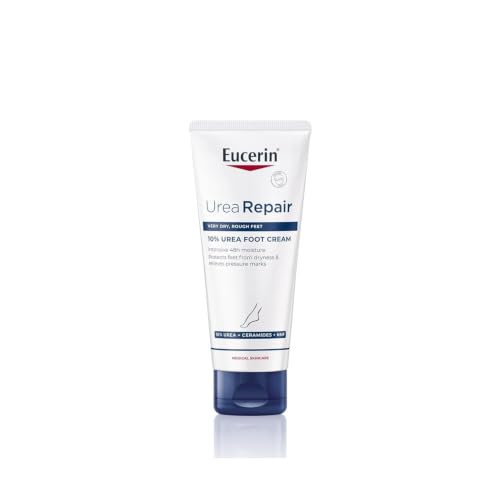
2. Eucerin UreaRepair Plus Foot Cream 10% Urea 100ml
A fragrance-free, colourant-free formula for feet that react to everything else.
Here is the number that sets the Eucerin apart: the listing names it a 10% urea formula in the product title, and the ingredient list calls out natural moisturising factor urea. Urea is a humectant: it draws water into thick heel skin and holds it there, so a 10% formula like this one softens roughness faster than a plain lotion. It is also free of fragrance and colourant, so there is less in the tube for reactive skin to argue with.
Against the O’Keeffe’s, the trade is straightforward. The O’Keeffe’s is the better-known name with a bigger following, but the Eucerin gives you a stated 10% urea percentage on the label and no scent at all. The two are the same class of cream, and the Eucerin gives a buyer with sensitive feet something specific to point to.
There is a quirk worth knowing before you order. The spec sheet lists the item weight as 0.35 ounces while the title says 100 ml, so the tube is small — think handbag size, not family size. Nordic Care’s box runs 6.25 inches tall against Eucerin’s 5.63 inches, which confirms the Eucerin is the more compact of the two. Non-greasy, it absorbs cleanly enough to be worn with regular shoes. If your feet flare up when scented products touch them, this is the one to try first.
Plain-language read: a compact tube of urea-rich cream with no fragrance or colourant in it, which is exactly what a sensitive-foot buyer is hunting for.
The honest caveat: the small tube means you will be reordering sooner than you would with a larger format, so it suits regular, targeted use rather than whole-family slathering.
Choose it when: scented creams leave your feet irritated and you want a stated 10% urea formula with nothing extra in it.
Weigh it against: the O’Keeffe’s if you would rather have two full tubes and a cream with a longer following behind it.
3. Nordic Care Foot Care Cream

Built for the deep heel split that catches on a sock — and it answers quick.
This cream is for the buyer with a real fissure, not a bit of dry skin. The blend brings urea and glycerin together with lactic acid, beeswax and eucalyptus oil — urea and glycerin pull moisture in, lactic acid gently lifts dead surface skin, and beeswax helps seal it. The eucalyptus gives it a fresh scent rather than a medicinal one.
Reviewers describe a deep heel fissure that was roughly half better after 3 days and fully closed after a week. That is the kind of turnaround someone with a painful splitting heel is actually looking for. It is easy to work in, too — about 30 seconds of rubbing, then socks, and it disappears. Pre-filing dead skin before applying is the tip that shows up repeatedly, and it makes the cream go further.
Set against the Eucerin, the Nordic Care is the larger physical package — 6.25 inches tall versus 5.63 inches — so you get more tube for a similar spot in your drawer. The catch is the size of the evidence: this one has a smaller pool of reviews than the O’Keeffe’s, and at least one buyer with only minor dryness found no visible change after a week of nightly use. If your heels are already painful and split, it is worth a try; if your feet are barely dry, save it.
Where it shines: a genuine fissure that needs to close, handled with urea, glycerin and lactic acid working in the same tube.
What to expect: you need to use it day and night for results to build, and a deeper crack responds better than a light flake.
Pick this one for: a heel that has genuinely split open and needs visible repair within days, not weeks.
Look past it for: everyday maintenance of skin that is only slightly dry — the effort-to-reward math does not favor you there.
4. Dermatonics Hard Skin Removing Balm for Feet, 70ml

A 10% urea balm that smells like cherry blossom and counts shea butter among its ingredients.
Not everyone wants a clinical-smelling cream. This one leads with a potent 10% urea formula and backs it with shea butter and Swedish oat lipids, then finishes with what the listing calls Sakura Blossom Aromas. It is plant-based, paraben and sulfate free, and it is built to work on heels, hands and elbows — so the jar earns its shelf space beyond just your feet.
Texture is where it separates from the pack. It is a balm rather than a cream, and buyers report it is creamier and easier to spread than the thick 40% urea creams, so it goes on without the drag. That makes it a decent first balm if you have never used one. The softer texture, though, is also the honest limit: the same buyer who praised the smell and spread found that after a month of twice-daily use it softened skin temporarily but did not break down genuinely rough patches. This is a balm for maintenance and light roughness, not a heavy-duty callus remover.
Volume-wise, the 70 ml balm is smaller than the Eucerin’s 100 ml tube, so you are paying for scent and a richer base rather than sheer quantity. If you want something you enjoy reaching for, the blossom aroma is the point. If your goal is the most softening per ounce, look elsewhere in this list.
The pleasure angle: a rich, spreadable 10% urea balm with shea butter and a floral scent, for feet-care routines you look forward to.
Fair warning: treat it as maintenance for mild roughness — deep callus wants something more aggressive.
It’s the right call when: you want a scented balm you enjoy using on feet, hands and elbows, and your dryness is mild.
It’s not the right call when: a thick callus needs real breaking down — this one softens pleasantly but does not dig in.
5. Natural Escapes Peppermint Foot Cream 4 oz

A cooling peppermint cream for feet that ache at the end of a long shift.
Aloe vera juice is the first ingredient here, followed by 5% vegan lactic acid to lift dry surface skin, with olive oil, coconut oil and vitamin E to hold moisture in. Four essential oils — peppermint, tea tree, rosemary and eucalyptus — give it the cooling, spa-like feel that has made this jar a favorite among people who are on their feet all day. If you are a nurse, teacher, runner or walker, the scent and the cool hit arrive before the softening does.
What draws people in is that peppermint scent; it is far and away the most-discussed strength in the listing, with moisturizing second. A small dab spreads a long way, and the cream sinks in without leaving the sticky film that turns people off thicker balms. With nightly use, reviewers saw rough patches on the big toe and heels visibly smoother within a week, and tough heel skin clearly improved by three weeks.
The formula was handcrafted in small batches in Colorado since 1997 and is vegan and cruelty free, made without petroleum or mineral oil. At 4 ounces it is the largest jar in the group, which suits someone who uses it on hands and knees as well as heels. The tension is that the 5% lactic acid puts it in a different lane than the 10% urea formulas here — great for texture and freshness, less focused on breaking up a hard callus. skip it if a genuinely split heel is your problem.
Where it wins you over
- The most-mentioned draw is that peppermint and tea tree scent, with the cooling sensation a close companion
- Aloe-first base and 5% lactic acid, so it exfoliates as it moisturizes
- 4 oz jar covers feet, then hands and elbows without running out fast
- Absorbs without a greasy film, so it works under socks or bare feet
Where it asks for patience
- The 5% lactic acid focus means it softens texture more than it repairs a real crack
- The strong mint scent is part of the appeal, but not everyone wants their feet to smell like eucalyptus
Made for: long days on your feet, where the cooling peppermint and lactic acid softening make the routine something you look forward to.
Consider another pick if: your heel has split — you want the urea depth of the O’Keeffe’s or Nordic Care instead.
Know the Specs
Urea Percentage
Urea is a humectant — an ingredient that attracts water into the skin and holds it there. A higher percentage tends to do more for thick, hard, callused skin, while a modest amount in a rich base suits daily upkeep. It is the number to look for when a cream claims to soften heels.
Lactic Acid
Lactic acid is a mild exfoliant, and it works by loosening the dead cells on the surface so the fresh skin underneath is softer to the touch. A cream with both urea and lactic acid both exfoliates and moisturizes, which is why the two often pair.
Glycerin
Glycerin is another water-binding ingredient. It draws moisture in from the air and from lower layers of skin, and it tends to make a cream feel less greasy as it absorbs. Look for it alongside urea when a formula promises deep hydration.
Balm vs Cream vs Lotion
A balm is oil-rich and stays put, which is what you want overnight in a sock. A cream is thinner and spreads and absorbs quickly for daytime use. A lotion is the lightest of the three and is best for mild dryness — a split heel usually wants the heavier formats.
Common Questions
How long does it take to soften cracked heels with a urea cream?
Can I use foot softening cream on my hands and elbows too?
Is a 10% urea cream too strong for sensitive skin?
What is the difference between a urea foot cream and a lactic acid foot cream?
Should I put socks on after applying foot cream at bedtime?
Is O’Keeffe’s for Healthy Feet safe if I have diabetes?
How much foot cream should I use per application?
How is the O’Keeffe’s two-pack different from the Eucerin UreaRepair tube?
Will a peppermint foot cream sting if my heels are cracked?
Do I still need a pumice stone if I use a softening cream?
The Bottom Line
For most people, the foot softening cream worth starting with is the O’Keeffe’s for Healthy Feet two-pack, because it leads this lineup at 4.5+ stars and its concentrated, protective formula is the one most reliably built for cracked, thick heels. If your feet react to scent and you want a stated 10% urea formula with nothing added, reach for the Eucerin UreaRepair Plus. And if you spend all day on your feet and want a cooling peppermint cream to look forward to, the Natural Escapes earns its place. One nudge: with 44,000+ reviews behind the top pick, the odds are strong you will land on a cream that already works for thousands of dry-heeled feet — apply at bedtime, pull on a sock, and give any formula a week before you judge it.
How we choose
We do not accept paid placement. Every pick is matched to a real buyer and a real use-case; we do not hands-on test units.
Sources
Specifications: manufacturer listings and product documentation. Review insights: verified customer reviews, as of October 2026. Pricing: not shown on this page (it changes often); check the current price via the retailer link.
As an Amazon Associate, Aappliancez earns from qualifying purchases. This does not affect which products we feature.