Disclosure: Some links in this post are affiliate links. As an Amazon Associate I earn from qualifying purchases, at no extra cost to you. Learn more
Specs are compiled from manufacturer listings and verified buyer reviews and can change over time — please confirm the key details on the product page before buying.
If your toes drop and catch the floor mid-step, the right brace has to do two jobs at once: lift the toe and still slide into your normal shoes. The picks below split into two camps. Soft fabric braces strap to your shoe with adjustable tension. Rigid plastic AFOs (ankle-foot orthoses — a molded shell that runs up the back of your calf) hold a firmer line. Start with the FootFlexor if you want a flexible brace that stays hidden under trousers, and read on for the firm-support options.
This guide is built by comparing the manufacturers’ published specifications and the patterns across verified customer reviews, so you get each pick’s real strengths and trade-offs instead of marketing spin.
A brace that lifts your toe clear of the floor and still fits inside your own shoes is the one you will actually wear. This list covers soft shoe-strap braces, rigid AFOs, night-wear options, and picks for wide ankles.
Top Picks


How To Choose The Best Foot Drop Brace
How much lift you need, and when you wear it, decides between a soft brace and a rigid one. A soft brace ties to your shoelaces with a stretchy cord and pulls the toe up while you walk. A rigid AFO is a molded plastic shell that holds the ankle at a set angle all day.
Soft shoe-strap brace or rigid plastic AFO
Soft braces like the FootFlexor and the FootScientific use flexible tubing or a BOA dial to lift the toe, so your ankle can still flex naturally. They suit people with mild to moderate drop who want to keep wearing their own shoes. Rigid AFOs like the Ossur or the AliMed hold the foot in a fixed position and add lateral stability, which helps if your ankle rolls or your drop is more pronounced.
Get the right foot and the right size
Several braces here are sold as a left or right unit, so order the correct side or you will be sending it back. Sizing splits two ways: some are one-size and rely on adjustable straps, while the FootFlexor fits a 12–15 inch ankle circumference in its Medium/Large size. Measure your ankle around the bony point before you order.
Check it fits your shoes before anything else
Check shoe fit before anything else, because a brace that will not go into your daily shoes stays in the drawer. Soft shoe-strap braces generally work with lace-up shoes, while heel-less designs like the Ossur fit inside athletic and walking shoes. If you want to go barefoot or wear the brace to bed, look for a design that says it supports night wear, since rigid shell braces are built for walking.
Side-by-Side Comparison
| Model | Best For | Brace Type | Foot / Size | Weight | Amazon |
|---|---|---|---|---|---|
| FootFlexor Adjustable Dorsiflexion Brace★ Best Overall | All-day walking, hidden under trousers | Soft shoe-strap | M/L, 12–15 in ankle | — | Amazon |
| Omeer AFO Brace (Right)Most Versatile | Barefoot and at-home support | Soft neoprene AFO | Right, one size | 0.3 kg | Amazon |
| Dosh AFO Brace (Right) | Light, discreet day and night wear | Soft neoprene AFO | Right, one size | 3.75 oz | Amazon |
| AliMed FREEDOM Swedish AFO | Trim-to-fit rigid support for women | Rigid polypropylene | Women’s Right | 3.84 oz | Amazon |
| Össur AFO Leaf Spring | Mild to moderate drop, shoe-only wear | Rigid leaf spring | Small/Medium, Right | 4 oz | Amazon |
| FootScientific BOA Brace | Dial-adjustable fit across shoe types | Soft BOA-dial | One size | 5.6 oz | Amazon |
| Healsmile AFO Brace (Medium-Left) | Stroke and hemiplegia support, barefoot or shod | Medical polyethylene AFO | Medium, Left | 90 g | Amazon |
Detailed Reviews
1. FootFlexor Foot Drop Brace M/L
Our pick — 4.0+★ from 450+ verified ratings; the strongest balance of quality and price.
Four dialed-in tension levels and a soft strap that hides under any trouser leg.
This is the brace to buy if your drop is mild enough that you still want your ankle to move. Instead of a plastic shell, it uses flexible tubing clipped between your shoe laces and your ankle, lifting the toe during the swing phase of your step. You pick from 4 levels of tubing tension, so you can dial the lift up for a hike and ease it back for a short walk to the shop.
What wins people over is how little it interferes with the shoe you already own: it slips into lace-ups on either foot and stays hidden under trousers. The brace is low-profile and nearly invisible under clothing, and it slips into lace-up shoes on either the right or left foot, so a workday or a night out does not mean switching footwear. Owners describe the spring loading as making walking feel lighter, letting the ankle flex naturally instead of locking it straight, and they credit it with keeping the toe from catching the floor. One condensed review sums up the appeal of getting away from a rigid shell: easier to put on, no fight with shoe fit, comfortable all day.
The Medium/Large size fits a 12–15 inch ankle circumference, so measure around the bony part of your ankle first — this is not a one-size piece. The honest trade-off is wear. A buyer notes that “Durability was about 14-15 months with elastic and Velcro reaching end of service life,” which is the pattern across the flexible parts here, and the fit can run loose for slimmer ankles. For a flexible, discreet brace you replace when the straps give out, this is the strongest all-rounder on the list.
Why it earns the top spot
- 4 adjustable tension levels let you tune the toe lift to your own walk
- Nearly invisible under clothing and fits lace-up shoes on either foot
- Assembly in Wisconsin, USA with globally sourced components
- Helps prevent the toe catching and tripping while keeping natural ankle flex
Where it asks a little patience
- Elastic and Velcro reach end of service life after roughly a year of continuous use
- Fit can run loose for slimmer ankles, and the M/L size tops out at 15 inches
Reach for this if: you want a soft brace that disappears under trousers and works with the shoes you already own.
Weigh the trade-off if: you need a rigid shell for a pronounced drop, or you want a brace that holds the ankle firmly rather than flexibly.
2. Omeer AFO Foot Drop Brace for Walking (Right)
The brace that works barefoot, in socks, and in shoes — no laces required.
Where the FootFlexor needs a lace-up shoe to anchor to, this neoprene brace works on its own. You wear it with shoes, in socks, or bare, and a non-slip sole lets you walk safely on hard floors — that is the detail that makes it useful around the house and even for sleeping. A 4-strap design and one-size fit let you tighten it to your own ankle, and it is machine washable on cold, so it stays fresh with a quick wash and air dry.
Effectiveness is what carries this one: reviewers credit it with walking without dragging the foot, and they rate build quality and all-day comfort close behind. It is easy to get on and off, and buyers point to a rubber bottom that keeps them steady on hard surfaces, which a lot of braces skip.
The recurring gripe is the Velcro — it weakens over time, and some wearers end up ordering a second brace for safety. A few also find the brace not quite strong enough to hold the toe up inside a shoe, so if your drop is pronounced, a firmer brace higher up this list may suit you better. It comes as a right-foot unit, so check your side before you buy.
Best at home: You can walk barefoot and wear it in bed, which separates it from shoe-strap braces. The non-slip sole means you can move around the house safely without lacing anything up.
Pick this if: you want one brace for barefoot, sock, and shoe wear and you value easy at-home support.
Look elsewhere if: your foot drop is strong enough that you need a rigid brace to keep the toe up inside a shoe.
3. Dosh AFO Foot Drop Brace (Right, One Size)
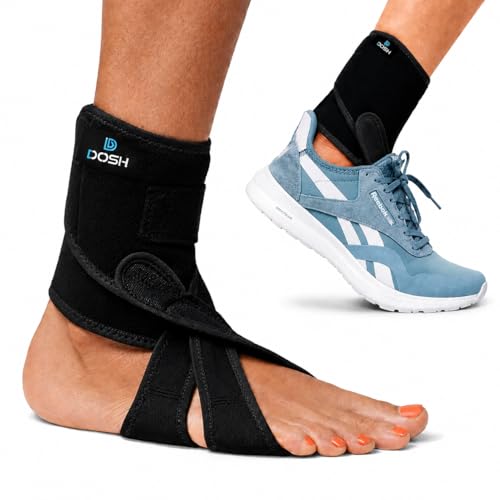
A 3.75-ounce soft brace light enough to forget you put on.
This neoprene brace is built around being worn for long stretches — with or without socks, inside a variety of shoes, and even in bed. The soft material and hook-and-loop closure let you adjust it to your ankle, and at 3.75 ounces it adds very little heft to your foot. It is one-size and sold as a right-foot unit, and a versatile design means it works as a foot drop brace for sleeping as well as walking.
At 3.75 ounces, it is light enough for overnight wear and soft enough that former rigid-brace wearers keep it on. A condensed review from an ALS patient who struggled with a stiff AFO, especially on stairs, called this one comfortable and safe to walk in and said they own two plus other Dosh products. Others describe the soft lift as letting them forget they have a foot problem while walking and fitting their regular shoes without a fight.
Wear is where you should set your expectations. Some owners find the fastener loosens after a couple of months and the brace wears out faster than they would like, so this is not a buy-once-keep-for-years piece. A few also note it runs uncomfortable for all-day use and can leave skin marks. If you want a light night brace and a soft daytime option, it earns its place; if you need rigid lateral support, the Ossur or AliMed below is the better route.
The night-wear case: Soft neoprene, a hook-and-loop closure, and a 3.75-ounce weight make this one of the easiest braces to keep on overnight.
One watch point: The fastener can loosen and the unit can wear out faster than owners expect, so treat it as a soft brace to replace rather than a rigid shell.
Best fit for: a light, soft brace for night wear and gentle daytime support in your own shoes.
Think twice if: you need firm lateral stability or a brace that will not need replacing within months.
4. AliMed FREEDOM Swedish AFO (Women’s Right)

Rigid support you can reshape with a pair of kitchen scissors.
This is a molded polypropylene shell that gives static dorsiflexion — a fixed toe-up angle — plus lateral stability for the foot and ankle. The clever bit is the thinner footplate: it can be trimmed with ordinary scissors, so you can cut it back if the plate digs into your toe or instep. Injection molding lets the calf section be thicker where it needs strength while the footplate stays slim. It comes as a women’s right-foot unit in black or white, with left and men’s sizes also offered.
Owners who trim and adjust it tend to be pleased. A condensed review from a wearer who cut the foot base down to a half-palm in about 45 seconds solved toe pain that a pricier brace had caused, and described the calf section as flexible rather than board-stiff. The brace weighs 3.84 ounces, so it stays light on the foot while giving a firm line up the back of the leg.
The fit is where you should think carefully. The calf opening is narrow and needs pulling and snapping on, and it tends to be a squeeze for larger calves. The plastic can rub against the calf if a sock slips, so a sock or a soft cover helps. A buyer who found it too narrow called it unstable, so if you have wide feet or a fuller calf, measure before committing.
The trim advantage: A footplate you can cut with ordinary scissors lets you fine-tune the fit at home rather than live with a pressure point.
Good match for: a wearer who wants rigid support and does not mind trimming the footplate to suit their own toe and shoe.
Be cautious if: you have a wide foot or a larger calf — the narrow shell may feel tight.
5. Össur AFO Leaf Spring (Small/Medium, Right)

An open heel that slides into athletic and walking shoes without bulk.
The leaf-spring AFO is a semi-rigid polypropylene shell for mild to moderate drop, and its selling point is the heel-less build. Leaving the heel open cuts bulk and improves how the brace sits inside a shoe, so it fits into most athletic, casual, and walking shoes for everyday wear. A variable-thickness footplate gives strength where you need it and flex where you do not, and it can be trimmed for a custom fit. It weighs 4 ounces and comes as a small/medium right.
Össur is a well-known orthopedic bracing name, and the brace is built to assist toe clearance through the walking cycle. Owners with neuropathy who wear it every day report a normal walking pace without a cane, no added weight, and no pain, and one talks about a design that flexes yet holds its support. A condensed review from a wearer who, after 6 months, found it comfortable in shoes and boots and easier to fit than a prescribed carbon-fiber brace points to where this shell is built to shine.
The heel cut-out is the dividing line. It digs into bony heels for some wearers, and the brace only works inside a shoe — it is not a barefoot or at-home brace. A calf foam backing can degrade over time, and the fit can run small at the heel. If you have a sensitive heel or want something to wear around the house, one of the soft braces above is the smoother choice.
Why the shoe fit stands out
- Open heel keeps bulk down so it slides into most athletic and walking shoes
- Variable-thickness footplate balances strength and flex
- Trimmable for a custom fit, at 4 ounces on the foot
What to know before ordering
- The heel cut-out can dig into bony heels
- It works inside a shoe only — not a barefoot or night brace
- The thin calf foam backing can wear and need replacing
Choose it for: mild to moderate drop where you want a firm, low-profile brace that lives inside your walking shoes.
skip it if: your heel is sensitive to pressure or you need a brace you can wear barefoot or in bed.
6. FootScientific Foot Drop Brace with BOA Fit System
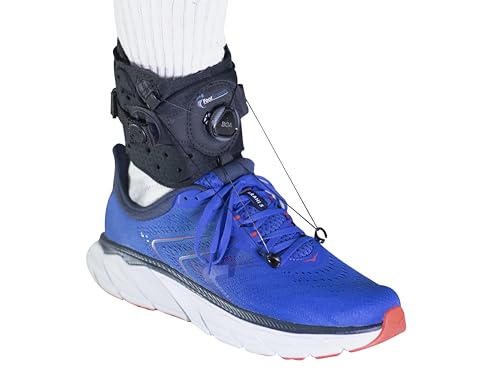
A click dial instead of Velcro — tighten the lift with one twist.
This is the premium option, and it earns the price with a BOA fit system: a dial you twist to tighten and release, giving consistent dorsiflexion support and a secure fit every time. Instead of fighting with straps, you twist to set the lift, which is a real advantage if dexterity is an issue. It is built from memory foam, weighs 5.6 ounces, and is designed to work with most shoe styles — even sandals — while preventing toe drag.
Comfort is what carries it: memory foam, a dial instead of straps, and all-day wear without pressure points. Owners describe wearing it all day without trouble, and the setup is straightforward — you install two hooks in your sneaker eyelets and dial in the tension. It is adjustable enough to fit small and large users, and it comes with two sets of shoe anchors. One wearer who had avoided braces that reach up the leg called it a lifesaver for walking without tripping, and another noted the accessible dial made daily wear easy.
The honest catch is durability and cost. The cords can fray and the hooks can need rechecking, and the brace asks a higher outlay than the others here. Some also mention that switching the hooks between shoe pairs is fiddly, so it pays to settle on one pair of daily shoes. It only comes in black, which matters if you want it to blend with a lighter outfit.
The dial’s real-world win: Twist-to-tighten beats pulling straps when your hands are stiff, and it holds a consistent tension instead of loosening through the day.
The honest catch: Cords can fray and the hooks need occasional rechecking, so this is a brace to inspect now and then rather than fit and forget.
Worth it for: a wearer who wants dial-in adjustment, sandal compatibility, and all-day comfort from one brace.
Consider the cost if: you want a simple, cheap brace, or you switch between many shoe pairs and would rather not re-hook it.
7. Healsmile AFO Drop Foot Brace (Medium-Left)
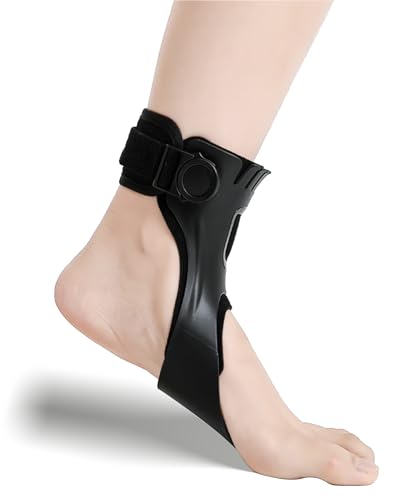
A 90-gram shell with buckles you can open one-handed.
If getting a brace on by yourself is the daily struggle, this one is built for that. The buckles open with one hand, so a person with a weaker side can put it on without help. The mixed medical-polyethylene and composite-fabric shell keeps the weight to 90 grams — lighter than a phone in the hand. A breathable build is designed to cut sweat during all-day wear. The half-length footplate and wide heel are shaped to fit most shoe sizes while staying low under trousers.
It is built for stroke and hemiplegia-related drop: a firm shell stabilizes the ankle for a secure heel strike, and it works both in shoes and barefoot. A user with a paralyzed left leg and loose ankle tendons found the foot fits snugly without skin pressure and used it daily for ankle support. The breathable material is the other draw, since a shell that traps heat is the usual reason people stop wearing a rigid brace.
The fit is where opinions split. One buyer found it “not comfortable, barely fits in shoe,” and it arrived without an insert or instructions — so set aside time to work out the fit yourself. Another wearer finds it fine for going outside but says longer indoor stretches make the foot sore. This is a newer listing with fewer ratings than the others, so treat the fit as the thing to test carefully early on.
Who it suits: A one-hand buckle and a 90-gram shell make this a smart pick if you dress your own foot without help.
The thing to check: Shoe fit is the reported weak point and no instructions come in the box, so budget time to dial it in.
Reach for this if: you want a lightweight rigid shell with one-handed buckles for stroke or hemiplegia-related drop.
Think it over if: you want clear setup guidance, or you need it to fit straight into a snug shoe without adjustment.
Know the Specs
Dorsiflexion support and tension levels
Dorsiflexion just means lifting your toes up toward your shin. In a soft brace, that lift comes from adjustable tubing or a BOA dial, and the number of tension settings tells you how finely you can tune it. The FootFlexor offers 4 levels of flexible tubing tension, so you can set more lift for a workout and less for a short trip out. A fixed shell holds one angle, which is firmer but less adjustable.
Weight and ankle circumference
Weight matters because you are lifting this brace with every step. A 90-gram shell or a 3.75-ounce soft brace adds little to the foot, while a heavier unit drags. Fit is the other number to check: the FootFlexor’s Medium/Large fits a 12–15 inch ankle circumference, while one-size braces rely on adjustable straps. Always confirm left or right and measure around the bony part of your ankle before you order.
Common Questions
Can a foot drop brace be worn barefoot or only in shoes?
How do I know if I need a soft brace or a rigid AFO?
How long do these braces typically last?
Will a foot drop brace fit inside my regular shoes?
Do these braces come in left and right versions?
Can I wear a foot drop brace at night in bed?
My ankle is wide — which brace has the best chance of fitting?
Is a one-size brace as good as a sized one?
The Bottom Line
The winner is the FootFlexor Adjustable Dorsiflexion Brace. It pairs 4 adjustable tension levels with a low-profile build that hides under trousers and works with lace-up shoes on either foot. That makes it the flexible, discreet choice most mild-to-moderate drop wearers want. If you would rather walk barefoot or wear it to bed, grab the Omeer AFO for its non-slip sole and machine-washable neoprene. And if getting the brace on without help is the daily hurdle, the one-hand buckles and 90-gram shell of the Healsmile AFO are the reason to reach for it.
How we choose
We do not accept paid placement. Every pick is matched to a real buyer and a real use-case; we do not hands-on test units.
Sources
Specifications: manufacturer listings and product documentation. Review insights: verified customer reviews, as of October 2026. Pricing: not shown on this page (it changes often); check the current price via the retailer link.
As an Amazon Associate, Aappliancez earns from qualifying purchases. This does not affect which products we feature.