Disclosure: Some links in this post are affiliate links. As an Amazon Associate I earn from qualifying purchases, at no extra cost to you. Learn more
Specs are compiled from manufacturer listings and verified buyer reviews and can change over time — please confirm the key details on the product page before buying.
You want a panel that folds into a backpack and still pushes real watts into your power station — and the honest answer is that almost every foldable panel is rated under lab sun it will rarely see. A 100W label means 100W in perfect conditions, not on your campsite at 4pm. That is why the panels below are ranked by what people actually get outdoors, not by what the box promises. Every pick here is worth buying — they just do different jobs.
This guide is built by comparing the manufacturers’ published specifications and the patterns across verified customer reviews, so you get each pick’s real strengths and trade-offs instead of marketing spin.
Before you buy, check your power station’s maximum solar input: a 60W-limited station will only draw 60W no matter how big the panel is. Below you will find how each panel folds, what its cells are rated at, and which one fits your setup — all covered in this breakdown of the foldable solar panels worth carrying. Whether you camp, overland or want home backup power, each pick below is matched to a specific setup.
Top Picks


How To Choose The Best Foldable Solar Panels
The first thing to understand is that panel wattage and delivered wattage are two different things. A panel’s rated power assumes direct overhead sun, a cool cell surface and no shade at all. Move that panel into a campsite with tree cover and output falls hard. What separates a good panel from a disappointing one is how well it converts the sun it actually gets, which is why cell efficiency matters as much as raw wattage.
Check your power station’s input limit first
Your panel can only push as much as your power station will accept. A station with a 60W input ceiling will draw 60W from a 100W panel all day long. Match the panel’s rated output to the station you own, and look at the connectors in the box before you buy. A 5-in-1 or multi-adapter cable covers more stations; a bare MC4 output usually needs a separate adapter.
Decide between a 100W and a 200W panel
Bigger panels fold larger and get heavier. A 100W foldable usually packs into a daypack or the back of an SUV. A 200W folds roughly suitcase-sized and asks for a two-hand carry. Buy the 100W for hiking and the 200W for an RV roof, truck bed or base camp where the panel stays put.
Look past the waterproof badge
IP67 means the panel tolerates splashes and rain longer than IP65 in the same weather. That rating covers the panel surface — not the cable pocket or the junction box. Keep a zippered pouch dry and you will dodge most moisture problems.
Side-by-Side Comparison
| Model | Best For | Rated Power | Efficiency | Weight | Amazon |
|---|---|---|---|---|---|
| ZOUPW 100W Portable Solar Panel★ Best Overall | Plug-and-play camping | 100W | 23.5% | 9.5 lb | Amazon |
| Jackery SolarSaga 100W AirBest for Travel | Lightweight off-grid travel | 100W | 23% | 7 lb | Amazon |
| Anker SOLIX PS100Anker Match | Anker Solix owners | 100W | 23% | 9.7 lb | Amazon |
| ALLPOWERS 100W SE100 | Budget-conscious campers | 100W | 25% | 4 kg | Amazon |
| Luvknit 100W Portable Solar Panel | Remote livestream and rigs | 100W | 24% | 8.2 lb | Amazon |
| EBL Solar Apollo 100W | CPAP and fridge setups | 100W | 23% | — | Amazon |
| Renogy 100W Portable Solar Panel | Shade tolerance | 100W | 25% | 7.3 lb | Amazon |
| ELECOM NESTOUT 28W | Backpacking phones only | 28W | High Efficiency | 771 g | Amazon |
| Renogy 200W Portable Solar Panel | Base camp and RV use | 200W | 25% | 13.9 lb | Amazon |
Detailed Reviews
1. ZOUPW 100W Portable Solar Panel
Our pick — 4.5+★ from 700+ verified ratings; the strongest balance of quality and price.
The panel that already speaks to five power-station brands straight from the box.
What sells this one is the cable. ZOUPW ships a 10ft solar connector that splits into five plug styles — DC8020 for Jackery Explorer 1000V2, 2000 and 1500 Pro and Plus, XT60 for EcoFlow DELTA and RIVER plus Anker C300 and Bluetti Elite 30V2, Anderson for the original Jackery 1000, DC7909 for Jackery 240/300/500 and Bluetti EB3A/EB70, and DC5521 for generic lithium batteries. That means you plug in and go, with no adapter shopping. Sitting inside those panels is the highest cell quality in this lineup, rated at 23.5% conversion efficiency on Grade A+ monocrystalline silicon.
Buyers keep it running on real trips. The review pages sum it up with a camper charging a Jackery 300 from dead to full in 3-4 hours of direct sun. Others report 60W-plus in late-afternoon light and one owner hit 60W in clouds where their older panel managed 25W. Expected output sits near 50-60W under full sun for a 100W-label panel, and about 10W in heavy cloud still beats most rivals. What wins the most people over is the build quality — a magnetic carry handle, nylon backing and a stitched zippered pocket for the controller give this panel a solid, finished feel at 9.5 lb.
The honest catch is weight. At 9.48 lb fully unfolded, carrying it any real distance gets old fast, and the kickstands only offer a single 45° angle. The USB-C port is capped around 45W (15V/3A), so a laptop will trickle rather than sprint. A buyer with a 60W-limited station will also never see more than 60W here.
What makes it the default pick
- Five connectors cover most power stations without an adapter
- 23.5% monocrystalline cells outperform the Jackery panel’s 23%
- IP67 with ETFE coating handles rain and splashes
- Charge phones directly via USB-C and dual USB-A without any power station
The trade-offs it carries
- 9.49 lb is heavy for anything but a car-based trip
- Kickstands offer one 45° angle only
- USB-C PD tops out around 45W
Reach for this if: you own a Jackery, EcoFlow, Anker or Bluetti station and want a panel that connects without extra parts.
Look elsewhere if: you plan to hike miles with the panel — the 7 lb Jackery below carries far easier.
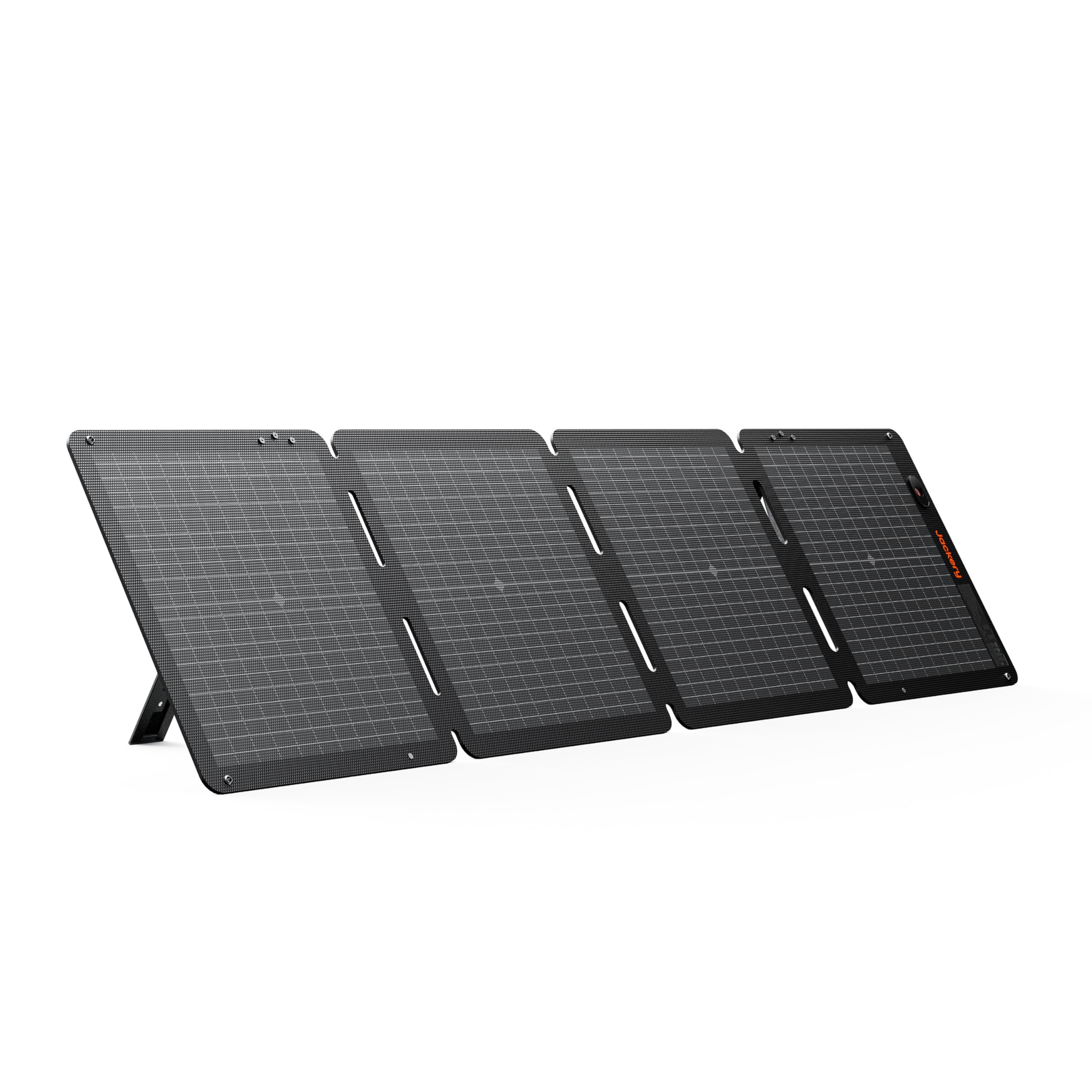
2. Jackery SolarSaga 100W Air Solar Panel
Lighter than most 100W panels by a wide margin, and it collects sun from both sides.
At 7 lb, this is the panel you will actually carry. Jackery claims it runs 27% lighter than standard 100W panels, and the compact W-fold design stores smaller than A2 paper inside the included carrying bag. The bigger story is what those cells do — advanced PERC cells rated at 23% efficiency, and they generate from both faces, so light bouncing off sand, snow or water adds to the harvest. Compared with the ZOUPW’s 23.5%, this one sits a whisker lower on efficiency, but if portability is your pain point, 7 lb versus 9.5 lb decides it.
The build feels substantial despite the low weight, and the IP68 waterproof and dust rating alongside a -4℉ to 149℉ operating range means cold mornings and desert afternoons both stay in bounds. Setup takes about 60 seconds thanks to the integrated aluminum stand, and ground stake holes keep it planted when the breeze picks up. One owner paired two of these on a concrete deck and watched the input settle between 194 and 200 watts.
The exclusion list matters here. Jackery states this 100W Air panel is not compatible with the Explorer 300 or 300 v2, where the voltage mismatch can throw an F7 error. One buyer also had to buy a separate dongle to link it to their Explorer battery, and charging speed drew split opinions — some find it fast, others slow for the size.
Where it earns its place: a genuinely lightweight 7 lb panel with bifacial PERC cells, IP68 protection and a stand that sets up in about a minute — ideal for hiking, motorcycle camping and overland trips where every pound counted.
Who should skip the Air: Explorer 300 and 300 v2 owners need a different panel entirely, and anyone wanting the fastest possible charge should look at a larger 200W option.
Your move if lightness wins: the 7 lb frame and bifacial cells make this the backpacker’s Jackery.
Check compatibility first: Explorer 300 and 300 v2 owners are explicitly excluded from this panel’s supported list.
3. Anker SOLIX PS100 Solar Panel
Four preset tilt angles so you can chase the sun without propping it on a rock.
Most foldable panels give you one leg position and hope. Anker fits four — 30°, 40°, 50° and 80° — so you can change the tilt as the sun swings from dawn to late afternoon. The cells are monocrystalline and rated at 23%, and the ETFE coating keeps scratches and splashes off the surface. An MC4 connection holds conductivity with minimal loss compared to XT-60, and the box carries two 9.8 ft MC4 cables, a 1.6 ft MC4-to-XT-60 cable, plus an XT60-to-7909 adapter — so most Anker Solix stations plug in directly.
Owners of Anker Solix gear are the happiest here. Pairing this with a C300, C300DC or C1000 turns the panel into a straightforward top-up station, and the folding halves the footprint for storage. What people comment on most is that it simply functions as promised across those Anker setups. Expect around 90W or better in bright sun and 60-70W in average conditions, with 10-15W on cloudy winter days.
Build feel is the weak point. The panels bend more easily than pricier rivals, there is no strap to hold the fold closed, and the kickstands are on the light side — stake it down on windy days. The included MC4-to-XT-60 adapter covers XT-60 stations, but charging speed opinions split, one power bank filling in under an hour while another crept from 6% to 50% over about six hours. At 9.7 lb it is also no featherweight.
The adjustable-angle case: four tilt settings and IP67 protection give this panel a real advantage in open ground where you can track the sun, and the MC4 cables and adapters in the box make Anker Solix pairing plug-and-play.
The reasonable hesitation: the panel flexes more than you would like and the fold has no securing strap, so treat it as a fixed-camp panel rather than something to sling around daily.
Built for: Anker Solix owners who want matched connectors and four tilt positions.
One honest limit: this panel flexes readily and lacks a fold strap, so pack it flat rather than crammed.
4. ALLPOWERS 100W SE100 Foldable Solar Panel
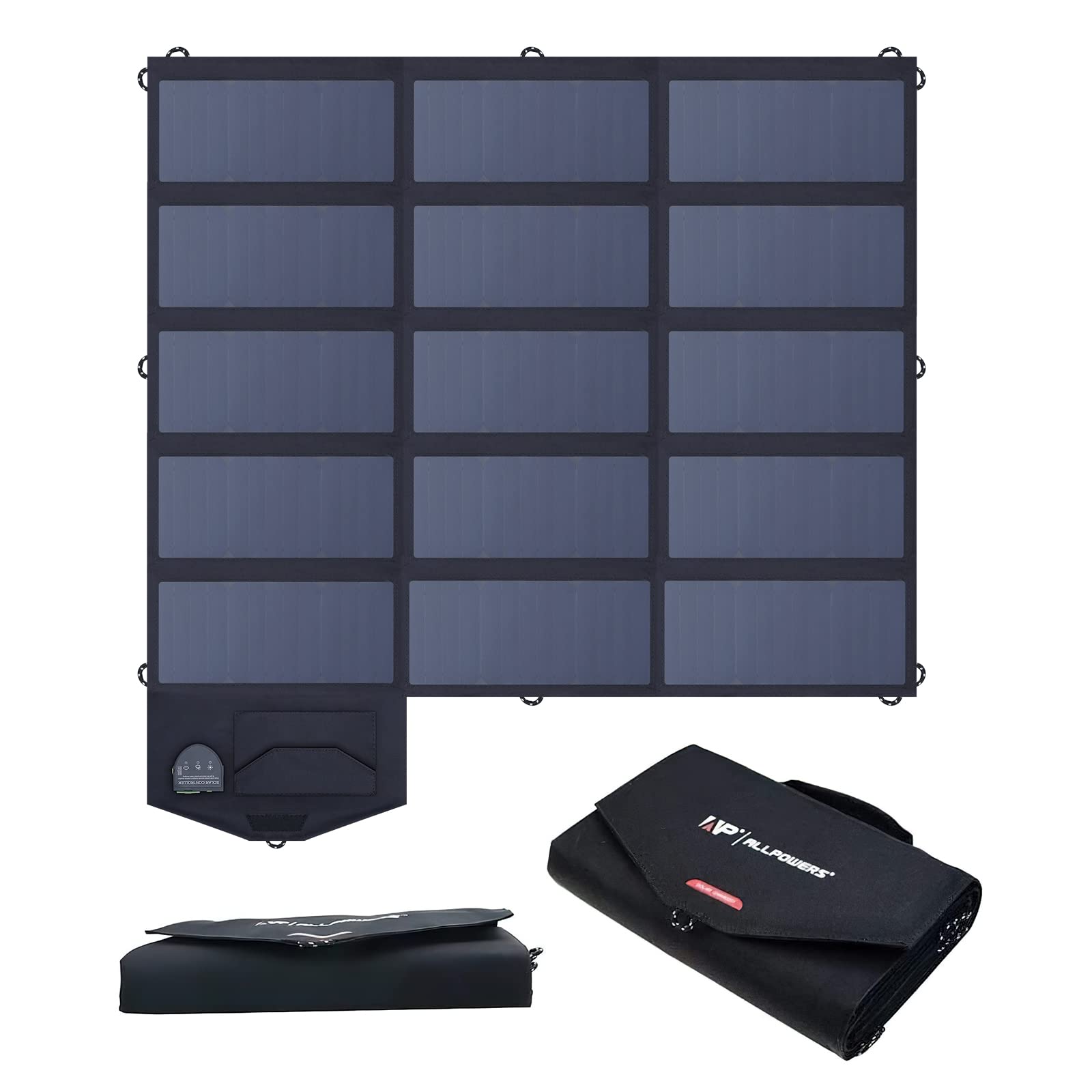
The value pick that pairs a 25% cell rating with the longest warranty here.
Three numbers define this panel. The monocrystalline cells carry a 25% conversion rate, which matches the Renogy panels above and beats the ZOUPW’s 23.5%. It weighs 4 kg and folds into its own carry bag. And ALLPOWERS backs it with a 36-month warranty — the longest of any panel on this list. The ETFE film handles weather and the panel meets the IP68 waterproof standard, so a sudden shower does not end your charging session.
Owners put it to work in tight spots. A South African safari trip charged a CPAP battery and a USB-C power bank across four winter nights at roughly 50W. Another owner paired it with a Renogy power pack and filled it in four hours on an overcast day. Campers running drone batteries off a power station kept four flights a day topped up, and the compact fold packs neatly into a backpack. There is a parallel port for adding a second panel, and with adapters from the box it fits XT60-equipped generators.
Cables are the sticking point. No MC4 connectors come included — you get solar generator plugs, mostly — so check what your station needs before ordering. The DC-out connection feels loose and can drop out at the slightest nudge, sometimes needing tape. Fold it with patience the first few times, and the pouch has room for roughly one accessory before the Velcro stops closing. The cells also crack if bent or stood on, so treat the panel with care.
Why value hunters circle this one
- 25% conversion rate on monocrystalline cells
- 36-month warranty — the longest on this list
- IP68 waterproof with ETFE film protection
- Folds compactly into a backpack-friendly carry bag
Where it asks patience
- No MC4 connectors in the box
- DC-out port can disconnect with movement
- Accessory pouch fills fast
Best fit: campers and preppers who value a long warranty and a high cell rating over bundled cables.
Plan ahead: budget for the adapters your power station needs, because MC4 does not ship in the box.
5. Luvknit 100W Portable Solar Panel

An eight-connector cable and a power controller make this the kit-completeness pick.
Open the box and the adapter set does the talking — DC5521, 5525, DC7909, 8020, XT60, Anderson, USB-A and USB-C all meet one cable, with a power controller and four DC5521 adapters thrown in. The monocrystalline cells are rated up to 24% efficiency, halfway between the ZOUPW’s 23.5% and the Renogy 25% panels. IP65 water resistance handles dust and light rain, and the reinforced fabric plus strong zippers survive regular folding. The kickstand sets your angle, and an 8.2 lb carry weight stays manageable from trunk to campsite.
Campers running a busy base camp get on well with it. One rig kept four phones, an iPad, battery packs and fans going around the clock on a Jackery 300 for ten days straight, topping off through cloudy spells. A livestream setup powered a laptop, camcorder and fans for 7-8 hours while holding its power station at 99-100%, even in heavy cloud. It reached 96W where a competing 100W panel managed 50-60W, and the zippered cable pouch is liked enough that owners stash a microfiber cloth inside to wipe the panels clean.
Temper your expectations on the label. Real-world output runs closer to 55W in full sun for this panel, and heavy shade can cut output hard. The stand legs are flimsy enough that a 10 mph wind tips them, so weights or stakes are wise. One USB 3.0 port failed early, though the seller replaced the unit. Some power stations behave erratically with a long extension cable, cutting off at 90% or flickering at low wattage.
The all-in-one pitch: near-universal connector coverage and a 24% cell rating mean the Luvknit reaches most devices without another purchase, and its fabric-backed build survives repeated setup.
Weather the caveat: IP65 is splash resistance, not a soaking rating — and those light kickstand legs need weight on windy days.
Worth grabbing when: you want one cable that fits almost anything and a panel that survives daily folding.
Be ready for: roughly half the rated wattage in real sun, and a stand that needs weighing down in wind.
6. EBL Solar Apollo 100W Portable Solar Panel
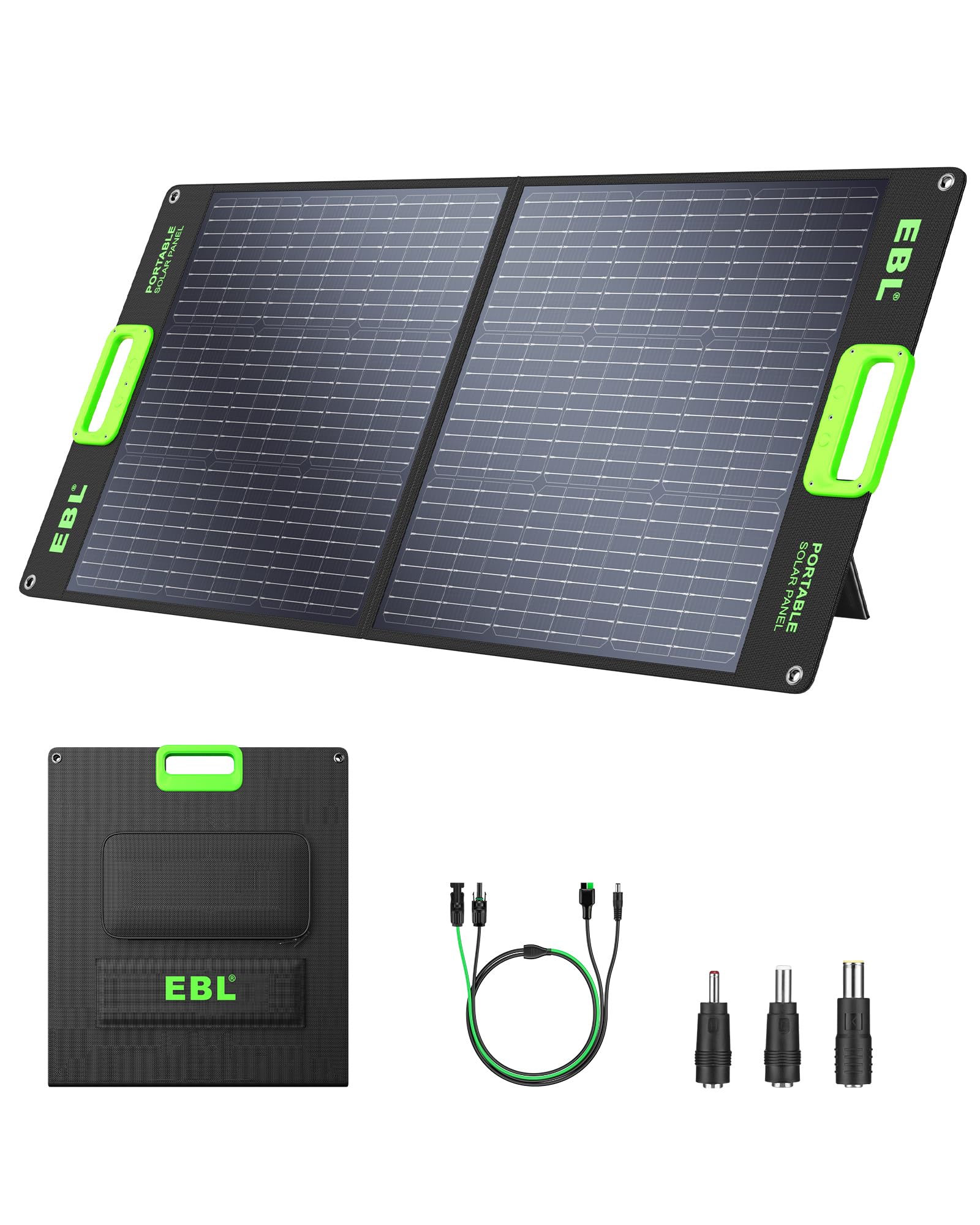
The camping-trip workhorse that keeps a CPAP battery and a fridge fed.
Cell efficiency lands at 23% on upgraded monocrystalline cells with a Smart IC that guards against overcharging, overheating and short circuits. Two kickstands angle the panel at 45°, which EBL says gathers 20% more sunlight than flat laying. A magnetic handle holds the fold shut, and the ETFE-coated surface is rated IP65 against splashing — EBL spells out the big caveat plainly: do not leave it in the rain or soak it. In the box sit MC4-to-Anderson and MC4-to-DC5521 cables plus three barrel adapters.
Real users stretch this panel across multi-day trips. Nine days off-grid recharged a CPAP battery in about three hours each sunny morning. A two-day run charged a fan, a CPAP and a phone while keeping 69% in reserve on a 1kW station. Midday sun in an Ohio summer pushed one owner to 148 watts consistently at 4pm, enough that they bought a second. Output can also underdeliver — one buyer got roughly 65W on a clear day at a perfect angle, and just 1-2W in cloud or shade.
The frame is a plastic build that flexes less than thin competitors, so it stands its ground rather than flapping in a breeze. It is also not fully waterproof, so treat it as a fair-weather panel. The efficiency claim does not always match real output, and the 6ft cable limits where you place the panel relative to the station.
Why CPAP campers favour it
- Reliable for overnight CPAP battery recharge
- 23% monocrystalline cells with Smart IC protection
- 45° kickstands lift output over flat laying
- Firm frame resists tipping
Keep in mind
- IP65 only — not for rain or soaking
- Real output can fall well below the rating
- Short 6ft cable limits placement
Ideal for: CPAP users and campers who want a proven overnight charger for a medical battery pack.
Keep it dry: rain will get through the IP65 splash rating, so pack up when clouds look serious.
7. Renogy 100W Portable Solar Panel

N-Type cells at 25% and 7.3 lb — this is the efficiency leader you can still carry.
Renogy uses 16BB N-Type cells to hit 25% conversion efficiency, a step above the ZOUPW’s 23.5% and the Jackery’s 23%. That same cell tech works harder in dim light, and Renogy wires the panel in parallel so a single shadow on one section does not drag the whole array down. The package weighs 7.3 lb — Renogy claims 19% lighter than standard portable panels — and folds to a space-saving shape with a magnetic handle. An IP67 waterproof rating and hail-resistant ETFE coating cover temperatures from -40°F to 185°F.
Direct device charging is built in: one USB-C PD port with a 45W max plus two USB-A ports at 18W and 15W. Owners put those to work charging power banks, laptops and cameras alongside an Anker C1000X. Output runs near 90% efficiency on a hot sunny day and close to full in colder weather, with one Reno owner watching a paired set recover a CPAP’s nightly draw in under two hours of sunlight. Grommets at the corners and legs let you stake it down, and the fold shuts with a magnet.
Two things to plan around. Renogy ships the panel with MC4 output cables only — the 4-in-1 adapter for XT60 or Anderson stations is sold separately, and several owners hit that delay. The back legs are the recurring gripe: fiddly to set and shaky in wind or on uneven ground, so staking matters. Panels also warm up and lose a little output through the day.
High-efficiency reasoning: 25% N-Type cells and parallel wiring make this the best pick for shaded, tree-heavy campsites where efficiency beats raw wattage.
Adapter reality: without the separately sold 4-in-1 cable, this panel will not connect to XT60 stations, so factor that into your setup.
Pick this if: you want the strongest efficiency and shade tolerance in the 100W class.
Buy alongside: the separately sold Renogy 4-in-1 adapter if your station uses XT60 or Anderson plugs.
8. ELECOM NESTOUT Portable Solar Panel 28W

A phone-first panel light enough to hang off a backpack while you walk.
This is not a power-station panel. At 28W it targets phones, tablets, earbuds and USB power banks, using SunPower MAXEON cells that ELECOM says deliver up to a 24% efficiency increase over traditional cells. It weighs 771 g and folds into a ripstop nylon bag with a water-resistant finish. Two adjustable stands and three exterior loops let you hang it from a tree, tent or cable. The built-in current checker shows LED power output so you can angle it for the best reading, and the bag hides two mesh pouches for cables and small gear.
Where it shines is on the move. It attaches to a backpack while walking, and buyers report charging from 40% to 80% in about 1 hour and 35 minutes even in mild overcast. On a jungle backpacking trip it kept a phone alive and a NESTOUT battery topped up. The red LED output display makes it easy to find the sunny spot; clip it to a belt with a power bank and cord and you have a walking charging station. Build quality lands near the top of the category — it feels rugged in the hand and packs down thin.
Two limits shape daily use. There is no USB-C port, so newer phones need a USB-A cable. And there is no battery inside, so you are charging a bank or a phone, never storing sun for later. The instruction sheet is in non-English languages only, which left some owners guessing at first. It is also strictly a small-device charger — do not expect it to feed a Jackery.
Backpack-ready by design: 771 g, exterior hanging loops and a bright output display mean this panel earns its place on multi-day hikes where weight is everything.
Not a station panel: 28W and USB-A only — if you own a Jackery or EcoFlow, look up this list.
Tailor-made for: backpackers and thru-hikers charging phones and earbuds on the trail.
Not your tool: power station owners and USB-C-only phones will find the single 28W output and USB-A ports limiting.
9. Renogy 200W Portable Solar Panel

Twice the wattage of everything else here, folded into a suitcase you can still lift.
If you feed a big power station, this is the panel that stops the wait. The same 16BB N-Type cells rated at 25% conversion efficiency are doubled up to deliver 200W of rated output. It weighs 13.89 lb and folds to 23.72 x 22.99 x 1.97 in with a magnetic closure, so it stores vehicle-sized rather than pack-sized. Four kickstands at 40°, 50° and 60° let you angle it on an RV, a tent or a windy site, and it carries UL 61730 certification along with CE, RoHS, FCC, CA65, PSE and ISO 9001 claims. Direct charging gives you USB-C PD at 45W plus dual USB-A ports for phones, cameras and laptops.
Owners running a van or campsite see the difference. Doubling up with a second panel lifted a van’s input from roughly 225Wh to around 450Wh over a 46ft cable run. Adding this alongside an Anker Solix C1000 Gen 2 kept a laptop running a 60W workload while the battery held at 99-100%, and it recovered a CPAP’s nightly use in under two hours of sunlight. Folded, it carries like a suitcase with its magnetic handles, and the shielded zipper pocket keeps the controller clean.
Two setup details need attention. The MC4 output only means you buy the 4-in-1 adapter separately for XT60 or Anderson stations. And the legs, again, are the weak spot — staking it is the fix when the wind picks up. At 13.9 lb this is not a panel you carry far; plan for a vehicle near it.
Where the 200W pays off
- 200W of rated output on 25% N-Type cells
- Four kickstands at 40°, 50° and 60°
- UL 61730 certified with ETFE and magnetic closure
- USB-C PD 45W plus dual USB-A for direct charging
Plan for these
- 13.9 lb is a two-hand carry, not a backpack load
- MC4 only — adapter for XT60/Anderson sold separately
- Legs need staking in wind
Right for: RVers, vanlifers and base-camp setups feeding a large power station that needs real wattage fast.
Not a trail pick: at 13.9 lb, leave it by the vehicle and bring the 28W ELECOM if you plan to hike.
Know the Specs
Conversion efficiency
Efficiency is the percentage of sunlight a panel turns into usable power, so a 25% panel gets more out of the same sunshine than a 22.5% one. Higher efficiency matters most in shade, cloud and low sun, when every photon counts. That is why two panels with identical 100W labels can deliver noticeably different output on an overcast afternoon.
Rated wattage vs delivered watts
The wattage on the box is a lab figure under direct overhead sun with cool cells. Outdoors you will see less — sometimes far less in cloud or partial shade. Always check your power station’s maximum input limit too, because it caps what any panel can push in. A 60W-limited station draws 60W from a 100W panel.
Common Questions
Will a 100W foldable panel charge a Jackery Explorer 300?
Why is my 100W panel only putting out 50 to 60 watts?
Do I need an adapter to connect a foldable panel to my power station?
Can a foldable solar panel be rained on?
Does shade really kill the output of a foldable panel?
How long does a foldable solar panel last?
Is a 200W panel better than two 100W panels?
Can I charge my phone directly from a foldable solar panel without a power station?
Is a higher efficiency rating always worth it?
The Bottom Line
The foldable solar panels that works for the widest range of people is the ZOUPW 100W, because its 5-in-1 cable fits most power stations from the start and its 23.5% cells deliver real output. If you want to shed weight for trail camping, grab the Jackery SolarSaga 100W Air at 7 lb. And for an RV or base camp feeding a large station, the Renogy 200W is the one to reach for. If you are still deciding, buy the panel that plugs into the power station you already own — the ZOUPW’s 5-in-1 cable comes closest to that on day one.
How we choose
We do not accept paid placement. Every pick is matched to a real buyer and a real use-case; we do not hands-on test units.
Sources
Specifications: manufacturer listings and product documentation. Review insights: verified customer reviews, as of October 2026. Pricing: not shown on this page (it changes often); check the current price via the retailer link.
As an Amazon Associate, Aappliancez earns from qualifying purchases. This does not affect which products we feature.