Disclosure: Some links in this post are affiliate links. As an Amazon Associate I earn from qualifying purchases, at no extra cost to you. Learn more
Specs are compiled from manufacturer listings and verified buyer reviews and can change over time — please confirm the key details on the product page before buying.
If you have ever felt that hot line of pain run from your lower back down through your glute and into your leg, you already know that not every foam roller is built for this job. Here is the short answer before you scroll any further: the Amazon Basics 36-inch high-density roller is the one to buy first, because a long, firm surface lets you roll your glutes and outer thigh in one controlled pass without wobbling. The smaller textured rollers earn their place as backup tools for travel or spot work, not as your main recovery device.
This guide is built by comparing the manufacturers’ published specifications and the patterns across verified customer reviews, so you get each pick’s real strengths and trade-offs instead of marketing spin.
Sciatic pain usually starts where the glute meets the hip, which is why roller length and firmness matter more than bump pattern. The right pick depends on your leg width and how deep a pressure you can tolerate, and this rundown of the best foam roller for sciatica shows exactly which one fits that job.
Top Picks


How To Choose The Best Foam Roller for Sciatica
Sciatica changes the shopping list. You are not just buying something to loosen muscles after a run — you are buying a tool to work the glutes, the outer hip, and the outer thigh without pinching the nerve that is already complaining. That shifts the priorities toward length, density control, and a surface you can trust to stay put.
Start with length, not lumps
A long roller lets you lie sideways with your full thigh supported, so you can roll the hip and glute in one steady pass instead of sliding off the end. The Amazon Basics roller runs 36 inches long, while the 321 STRONG roller comes in at 12.7 inches — a gap that matters the moment you try to stabilize a wide rolling line. Short rollers are excellent for a single tight spot, but they ask more of your core and your balance.
Firmness decides whether you actually keep using it
Too soft and the roller never reaches the tight band of muscle; too hard and you flinch off it within seconds, which is the wrong move when a nerve is already irritated. Medium-density foam, like the 321 STRONG or the Teeter’s gentler blue option, gives you a firm push with some give. A fully firm roller like the Teeter gray is a tool for someone who already knows they can handle deep pressure.
The textured surface question
Bumps and ridges act like fingertips pressing into a knot — they concentrate pressure into a smaller area. That is useful for the glute and outer thigh, where the tissue is thick. Directly over the lower back, a flatter surface is the friendlier choice, because a ridge pressed into a spine or a nerve path can feel sharp rather than helpful.
Half rollers and spinal support
A flat-bottomed half roller lets you lie back over it and let your spine settle, and it will not roll away from you mid-move. The Yes4All half roller measures 36 x 6 x 3 inches, which gives a wide, stable platform for lying back. This is a support-and-stretch tool, not a rolling tool — do not expect to travel up and down your leg with it.
Portability versus a stable base
If your recovery routine happens in a gym, a hotel room, or an office, weight and length count. The Pro-Tec mini roller comes in at 5.76 ounces and 8 inches in total length, so it disappears into a bag. The Amazon Basics roller weighs 4.32 ounces but stretches 36 inches across the floor — light enough to move around the room, long enough to stay put under your leg.
Side-by-Side Comparison
| Model | Best For | Length | Weight | Firmness | Amazon |
|---|---|---|---|---|---|
| Amazon Basics High-Density Foam Roller★ Best Overall | Main home recovery roller | 36 inches | 4.32 ounces | High-density / firm polypropylene | Amazon |
| 321 STRONG 3-Zone Massage RollerMost Versatile Texture | Textured spot work on glutes | 12.7 inches | 11.2 ounces | Medium, three projection zones | Amazon |
| Pro-Tec Athletics RM Extreme Mini | Travel and hard-to-reach spots | 8 inches total | 5.76 ounces | Soft-to-firm EVA with handle | Amazon |
| Teeter Massage Foam Roller | Deep tissue pressure work | 26 inches | 4.5 pounds | Firm gray bumpy surface | Amazon |
| Yes4All EVA Firm Half Foam Roller | Lying back for spinal support | 36 inches (half round) | 10.58 ounces | Firm, 35 kg/m³ density | Amazon |
Detailed Reviews
1. Amazon Basics Foam Roller 36 Inches
Our pick — 4.5+★ from 31,500+ verified ratings; the strongest balance of quality and price.
A full three-foot rolling surface that lets you work a whole hip line in one steady move.
The number doing the heavy lifting here is 36 inches. That length means you can lie on your side with your hip and thigh fully supported, so you roll through the glute and outer thigh without the roller slipping out from under you. That full-length support is why this roller takes the top spot for sciatic-area tightness.
The material is high-density polypropylene, which is a firm plastic-style foam. It is designed to maintain its shape under body weight, and the molded edges soften the transition as the roller turns under you. Weighing 4.32 ounces, it is light enough to lift and reposition mid-set — a real advantage when you want to shift from your glute to your outer thigh and back again.
Buyers consistently rate the build quality above its lower-tier price. Buyers report that it works just as well as the pricier rollers, and plenty of them take it into their exercise routines rather than just using it for recovery. One buyer used it daily for four months alongside rehab for a long-standing back injury and reported feeling closer to peak fitness than ever. It holds 4.5+ stars across 31,000+ ratings.
Where the length pays off
- 36 inches supports a whole thigh so you can roll a glute line without wobbling
- Firm polypropylene holds its shape under body weight instead of squashing flat
- At 4.32 ounces it is easy to reposition mid-session
- Wipes clean with a cloth, so it does not become a dusty gym relic
Before you commit
- The foam is genuinely firm — some buyers find it too hard for tender areas
- One buyer notes they wish it were softer, then adds it still works
- No texture, so deep pinpoint work on a single knot takes more body effort
Go for this one: if you want a long, firm surface at home for daily hip and glute rolling.
Hold off: if you already know your lower back cannot take firm foam, because this is one of the harder surfaces in the lineup.
2. 321 STRONG 3-Zone Massage Roller
Three different projection sizes on one roller, so you dial pressure up or down as you move.
The clever part of this roller is its three massage zones. The smallest projections act like fingertips, the larger ones mimic thumbs, and the biggest feel like the base of a palm. That lets you shift from gentle glute pressure to a deeper dig by simply rolling to a different part of the surface, without switching tools. The whole thing is wrapped in BPA-free closed-cell EVA foam, so the outer skin is a rubber-like foam that holds its shape without hard plastic anywhere in the shell.
Compare it directly to the Amazon Basics roller and the trade-off is clear. The 321 STRONG runs 12.7 inches long against the Amazon Basics 36 inches, and it weighs 11.2 ounces against 4.32 ounces. The length is the point: it is small enough to sit under one glute or one calf, but you will be stabilizing it with your hands rather than letting it guide your thigh.
What buyers keep coming back to is the medium-density push. The recurring honest caveat is durability under very heavy load. Owners mention that a heavier user felt it start to feel like it was going flat during ground work on the upper back. That is real, and it is worth knowing if you are a large build, but the shape otherwise holds up across normal use, and the size fits neatly into a duffle or travel bag.
Where it really shines: the medium density gives you firm-enough pressure on tight glutes and hamstrings without the sharp sting of a hard roller. It is also small and light enough to travel with, and the three zones mean you do not need a second tool for spot work.
The honest trade-off: at 12.7 inches you get a compact spot tool, not a stable full-leg roller. Heavier users may notice the foam softening under sustained pressure.
Choose it for: targeted work on a single tight glute or calf, plus packing it for travel.
Look past it if: you need one long pass from hip to knee, which a three-foot surface handles far better.
3. Pro-Tec Athletics RM Extreme Mini Handheld Contoured Roller

A handled roller you grip with one hand, built for the spots a floor roller cannot reach.
This one solves a different problem: the glute and hip can be hard to reach on the floor when you are already in pain. The handlebar lets you guide the roller toward the back and hip while you steer with one hand, and the textured surface is designed to stop it sliding out of your grip. The whole tool is 8 inches in total length and weighs 5.76 ounces, so it fits in a carry-on or desk drawer.
Here is the sharpest contrast in the lineup. The Pro-Tec body measures 11.25 inches wide against 5.3 inches on the 321 STRONG, and 3.4 inches tall versus 6 inches on the Amazon Basics. That wider, lower handle shape is why this one sits in your hand rather than rolling under a thigh.
Some buyers find it a specialist rather than a daily driver. One describes finding it useful only on a specific ankle spot using the palm on the wide part for pressure. Others love the very rubberized handle, saying it never slips out of their hand. The firmness splits opinion too — some find it soft, some firm — so treat it as a targeted tool rather than a deep-pressure roller. Customers note that rolling the outer feet and heels hard for three days brought relief that icing and supports had not.
Why it earns a spot: the handle gives you hands-on control over pressure, and the compact 8-inch body goes anywhere. For a tightly targeted heel, arch, or hip point, that control beats a big flat roller.
Where it falls short: you cannot get a long rolling sweep out of 8 inches, and the softness lands in the wrong place for people chasing deep pressure.
Reach for this if: you travel, or you need to work a small spot with fine control of pressure.
Look elsewhere if: you want a firm, deep squeeze across a wide muscle group.
4. Teeter Massage Foam Roller
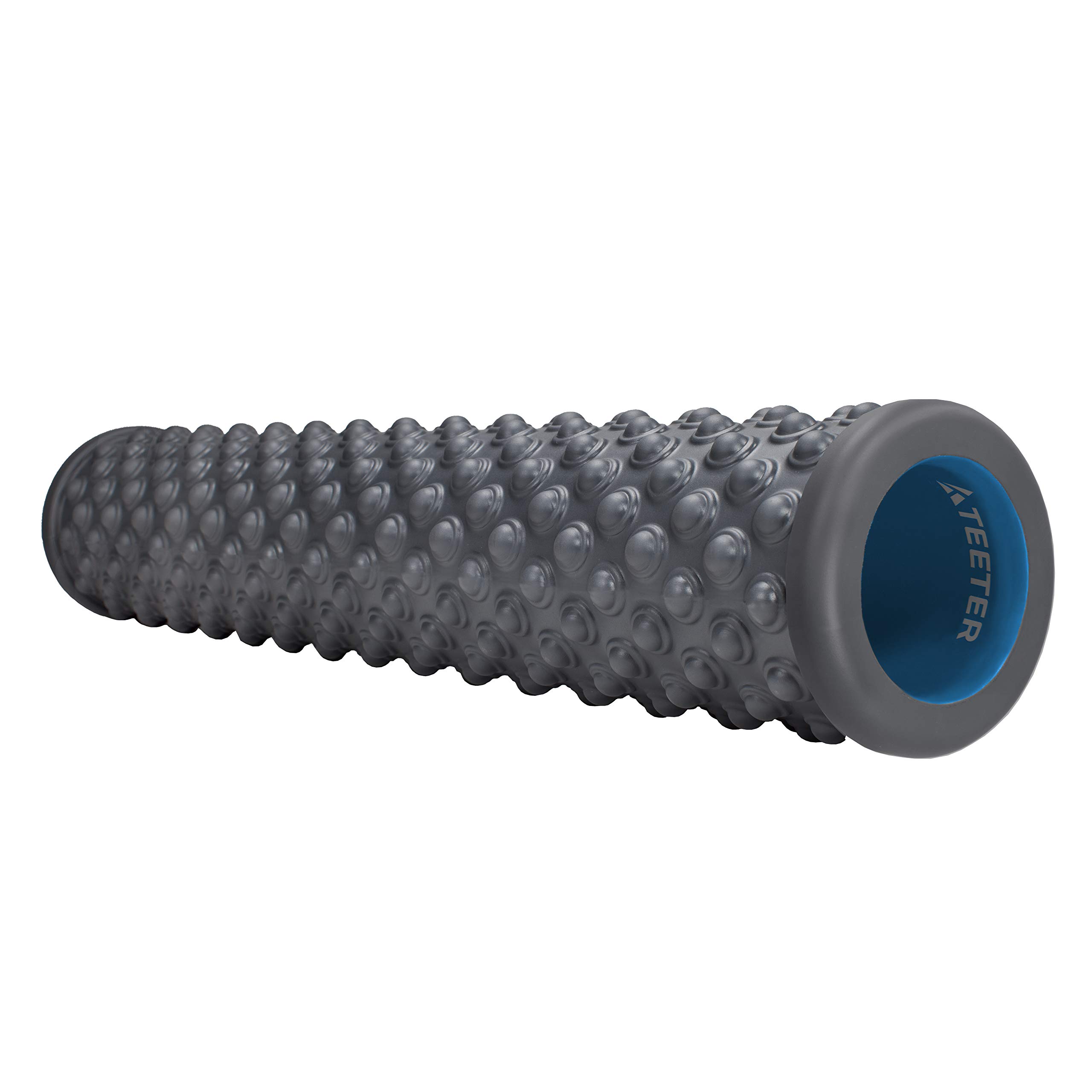
Firm ridges that mimic fingertips, for people who want deep pressure and nothing gentle.
Teeter sells this roller in two personalities, and the one you want to understand is the gray. The gray version is the firmer of the two, with a bumpy design that mimics fingertips for focused pressure-point work. The blue version is the gentler one, with subtle wavy ridges and slightly less firm foam. Both sit on a firm plastic hollow core wrapped in coated PU foam, so the outer skin is a polyurethane foam bonded over a rigid tube.
Smoothness is the quality that stands out most in owner feedback, and it is easy to see why. A hard surface only earns its keep if it turns cleanly under you, and the coated foam here glides rather than catching. It measures 26 inches long and 5 inches in diameter, so it supports both legs at once on the widest part of your back, and it weighs 4.5 pounds.
The catch is the firmness, and it is a real one. This is a hard-side roller, and people who dislike deep tissue work will not enjoy it. Reviewers point out one user who came to it after both a flat roller and a medium TriggerPoint grid roller stopped being enough, and who now advises starting with a flat roller and moving to a textured, hard one only when your body signals it is ready. If you are early in your rolling habit, that is a smart sequence to copy.
The case for the gray version
- Firm bumpy ridges deliver focused pressure-point work on glutes and quads
- Coated PU foam over a hollow core keeps its shape and firmness
- 26-inch surface supports both legs at once on the widest part of the back
- Backed by a 1-year warranty and a user guide
The part that will not suit everyone
- This is a hard roller — some buyers find it too hard for the lower back
- At 4.5 pounds it is not the one you toss into a gym bag
- Firmness leaves little margin if you are new to rolling
Made for: experienced rollers who want fingertip-style pressure on thick muscle.
Not the first buy: if your back is tender or you are new to rolling, start softer and work up to this.
5. Yes4All EVA Foam Roller 36 Inches

A flat-bottomed half roller that stays put while you lie back and let your spine settle.
The flat bottom is the whole idea. Because this is a half roller, it does not roll away when you lie on it — you get a stable platform to rest your spine against instead of a moving cylinder. It measures 36 x 6 x 3 inches and weighs 10.58 ounces, and it is cut from EVA foam, a firm rubber-like foam used in mats and supports. The hexagon bumps on the curved surface add friction and stop you sliding around.
Its density is 35 kg/m³, which is how the manufacturer rates the foam’s firmness — it matches full rollers for muscle massage and tension release. That makes the half shape a support tool and a stretch tool at once. There is one buyer who bought it precisely because a whole roller felt too tall to lie on, and reports it is working out well for several different exercises.
Two things come up honestly. First, it runs firm — described by some as very hard, and not the right pick if you have arthritis in the neck or shoulders. Second, the size surprises people. The 36-inch length is the long version here, but shoppers say that it feels smaller than they pictured, so check the numbers before ordering. For back support and stretching, though, it does the job it was built for.
The stability advantage: a flat bottom means no chasing the roller across the floor, which is exactly what you want when your back is the thing you are trying to relax. The hexagon texture keeps you planted, and the EVA foam holds together well over time.
What to expect: firm foam and a fairly compact footprint. If you need wide coverage or a gentle surface, this one will not suit you.
Best fit for: lying back to stretch the spine and open the chest, without a roller rolling away.
Think twice if: hard foam against the neck or shoulders is a problem for you — this one is unapologetically firm.
Know the Specs
Length — the stability number
Roller length tells you how much of your body you can support at once. A 36-inch roller like the Amazon Basics lets you lie sideways with the whole thigh on the surface, so you are not balancing on a narrow strip. A 12.7-inch roller like the 321 STRONG is a spot tool — you guide it with your hands. For sciatic-area work, where the glute and outer hip need a long, controlled pass, the longer surface asks less of your core.
Density — how hard the foam pushes back
Density is how firmly the foam resists your weight. A firm polypropylene roller like the Amazon Basics holds its shape under you and pushes back hard. A medium-density EVA roller like the 321 STRONG gives a softer push with some give. The Teeter gray is the firm end of the scale, and the Yes4All rates its foam at 35 kg/m³. Softer surfaces suit tender areas; firmer surfaces reach thick muscle, but only if you can tolerate the pressure.
Texture — pressure-point control
Bumps, ridges, and three-zone projection patterns concentrate pressure into smaller spots, which is the point when working a thick glute or a tight band along the outer thigh. The 321 STRONG uses three projection sizes so you can shift intensity by moving to a different zone. A flat surface spreads the pressure over a wider area, which is friendlier near the spine.
Half rollers and handle tools
A half roller has a flat base, so it stays put and becomes a stable prop for lying back and stretching. A handheld roller like the Pro-Tec uses a handlebar and a contoured surface so you can steer pressure with one hand, which helps reach the back and hip without a floor setup. These two shapes do different jobs from a full cylinder.
Common Questions
Should I roll directly on the sciatic nerve?
Is a long roller or a short textured roller better for glute tension?
How firm should the foam be if my back is already sore?
Can I use a foam roller on my lower back directly?
How long is a foam rolling session?
Does a textured roller hurt more than a smooth one?
Will a half roller work for rolling my leg?
Can I travel with a foam roller?
How much weight can a foam roller take?
Is a firmer roller better for muscle knots?
The Bottom Line
For most people dealing with sciatic-area tightness, the foam roller for sciatica winner is the Amazon Basics 36-Inch High-Density Roller, because its three-foot, firm surface lets you work a whole hip line without wobbling — and it holds up to daily use without turning soft. If you want focused pressure on a single tight glute, grab the 321 STRONG 3-Zone Massage Roller. And for lying back to stretch and support the spine while you recover, the Yes4All Half Foam Roller is the one to reach for.
The Amazon Basics pick earns its 4.5+ stars with a firmness that stays consistent session after session. Start with the long, flat roller to build the habit, then add a textured or handled tool once you know how much pressure your body tolerates.
How we choose
We do not accept paid placement. Every pick is matched to a real buyer and a real use-case; we do not hands-on test units.
Sources
Specifications: manufacturer listings and product documentation. Review insights: verified customer reviews, as of October 2026. Pricing: not shown on this page (it changes often); check the current price via the retailer link.
As an Amazon Associate, Aappliancez earns from qualifying purchases. This does not affect which products we feature.