Disclosure: Some links in this post are affiliate links. As an Amazon Associate I earn from qualifying purchases, at no extra cost to you. Learn more
Specs are compiled from manufacturer listings and verified buyer reviews and can change over time — please confirm the key details on the product page before buying.
A foam plyo box exists for one reason: to let you jump, step and squat at height without the wooden edge that tears your shins open when you come up short. If you have ever hesitated mid-jump on a hard box, the fix is not more courage — it is a soft-sided box with a dense foam core and a grippy cover. Below are the seven worth owning, sorted by how you train.
This guide is built by comparing the manufacturers’ published specifications and the patterns across verified customer reviews, so you get each pick’s real strengths and trade-offs instead of marketing spin.
Some boxes suit heavy lifters, others are built for kids or for step-ups in a small spare room. Pick by bodyweight, ceiling height and whether you jump or step. best foam plyo boxes here are ranked by what the box actually does on day one and whether it stays put on week one hundred.
Top Picks


How To Choose The Best Foam Plyo Boxes
Start with the height you actually train at, not the tallest number on the product title. A 3-in-1 box gives you three faces, and you will spend most of your time on one or two of them. The third is a bonus for later.
Match the height to your body, then the box to the height
A 16” face works for step-ups, box squats and learning to land. A 20” face suits most regular jumpers. A 24” or 30” face is where confidence drops and stability problems start to show. Buy a box that reaches your working height comfortably, not one that maxes out at it.
Weigh the capacity against who is standing on it
The stated weight capacity — 150 lb, 300 lb, 400 lb, 550 lb — is the number to check before anything else if you are a heavier lifter. A low-capacity box is designed for lighter users and will feel soft underfoot. Choose a capacity above your bodyweight and treat the top figure as a ceiling, not a target.
Understand firmness: soft edge, firm landing, no bounce
Foam boxes come in two personalities. Some are dense and firm, built to hold shape; others are softer and more forgiving but compress under load. The better ones use high-density foam inside with a PVC or vinyl cover so the foam holds and the surface resists slipping. Never buy a soft box for rebound drills — soft foam absorbs your landing instead of returning it.
Side-by-Side Comparison
| Model | Best For | Height Options | Weight Capacity | Box Weight | Amazon |
|---|---|---|---|---|---|
| RitFit 3-in-1 Extra Firm★ Best Overall | Firm, soft-edged all-rounder | 16 / 18 / 20 in (small) | 200 / 300 / 440 lbs by size | 26 / 35 / 60 lbs by size | Amazon |
| Sunny Health & Fitness No. 072Heaviest Capacity | Highest weight capacity | 20 / 24 / 28 in | 550 lbs | 11 lbs | Amazon |
| Fitvids 3-in-1 | Lightest foam option | 16 / 20 / 24 in | 150 lbs | 10 lbs | Amazon |
| CAP Barbell 3-in-1 | Wood-box alternative with handles | 16 / 18 / 20 in | 300 lbs | 29.1 lbs | Amazon |
| Titan Fitness Heavy Foam | Youth training and hip thrusts | 12 / 14 / 16 in | 120 lbs | 66 lbs | Amazon |
| REP Soft Plyo Box | Joint-friendly | 16 / 18 / 20 in | 400 lbs | — | Amazon |
| Epic Fitness 3-in-1 EPE | Tallest jumps | 20 / 24 / 30 in | — | 16 lbs | Amazon |
Detailed Reviews
1. RitFit 3 in 1 Extra Firm Soft Plyo Box
Our pick — 4.5+★ from 500+ verified ratings; the strongest balance of quality and price.
A firm foam box with a wipe-clean zip cover that takes a hit without biting back.
The word that defines this box is “extra firm.” The foam fills the whole body of the box and holds its shape, so a landing feels solid rather than spongy. That matters most on a missed jump: the cover is soft enough that your shin meets foam and PVC, not a sharp corner. Three faces give you 16-inch, 18-inch and 20-inch heights on the small size, and the box simply rotates — nothing to assemble, nothing to bolt on.
Three sizes exist, each with its own bodyweight ceiling. The small is 16”x18”x20” with a 200 lb capacity, the medium is 16”x20”x24” at 300 lb, and the large is 20”x24”x30” at 440 lb. Note the jump in heft as you climb: the small weighs 26 lbs, the medium 35 lbs, and the large hits 60 lbs. That is the honest trade-off here — a firm foam box and a portable foam box are different objects. The medium and large stay put because they are heavy; the small is the one you move around.
Buyers talk most about the build: the foam quality and the durable PVC shell (a tough plastic outer layer). The wipe-clean zip cover means it does not soak up sweat. Stability is mixed. The box holds on carpet and rubber matting, but a few owners say it rocks when you land hard on the tallest face. That is a fit note, not a flaw: jump on the lower two faces, land in the middle, and it behaves. The 4.5+ star rating across 500+ ratings shows most people get that balance right.
Why owners keep this one
- Firm high-density foam that holds shape under repeated landings
- Removable zipped PVC cover wipes clean instead of trapping sweat
- Three heights in one with no assembly at all
- Soft edges that forgive a missed jump
Where it pushes back
- The large size weighs 60 lbs — you will not casually carry it between rooms
- Tallest face can rock on hard, quick landings
- Capacity is tied to size, so the small caps at 200 lbs
Best fit: Mixed HIIT and strength work at home, where you want a firm landing and shin-friendly edges in one box.
Skip the small size if: You are anywhere near 200 lbs — step up to the medium or large, where the 300 lb and 440 lb capacities live.
2. Sunny Health & Fitness Foam Plyo Box No. 072
The box that says 550 lbs on the label and still weighs 11 lbs in your hands.
That pairing is the whole story. A 550 lb weight capacity on a box that weighs 11 lbs is unusual for foam, and it is why this one suits heavier lifters who still want to drag the box into place by one hand. The dense foam interior gives you a landing surface that protects your joints, and the PVC vinyl cover is tear-resistant so it survives continuous jump sessions. Three heights come from rotating the box: 28, 24 and 20 inches. No tools, no assembly.
Compare it to its closest rival by the numbers. The Sunny holds 550 lbs, well beyond the 150 lb ceiling on the Fitvids box above — enough that the capacity question stops being your problem. Its footprint is also bigger, at 27.95″L x 24.02″W x 20.08″H, against the Fitvids at 20″L x 16″W x 24″H. More surface underfoot means more room for a centered landing, which is exactly what you want when you are coming down from 24 inches.
The honest catch is stability at the top. As buyers report, it is “Not as stable on the 36 height but works for me as all I need for now is 20 and 24.” In plain terms, the tallest and narrowest face is the one to respect, and several owners brace it against a wall for harder sessions. The 4.0+ star rating across 100+ ratings reflects that split honestly: great for the lower two heights, careful work on the third. Lightness cuts both ways, since a box this easy to move can also shift if you land off-center.
Capacity that ends the debate: At 550 lbs it will not be the limiting factor in your workout, and the 11 lb shell keeps it genuinely movable.
The wall habit: For tall jumps, put it against something solid — the light build is a feature until you are landing hard on the narrowest side.
Reach for this if: You want one light box you can reposition mid-session and never think about a weight limit.
Look elsewhere if: Your training lives on the tallest face and you want zero bracing — a heavier box holds that line better.
3. Fitvids 3-in-1 Foam Plyometric Jump Box

Ten pounds of foam for step-ups, kids’ drills and anyone who moves the box daily.
At 10 lbs this is the lightest box in the group, and that changes what it is good at. It is a step-up platform, a warm-up tool, a youth training block and a travel-friendly box you can shift with one hand. The non-slip PVC cover gives your feet a textured surface to grip, and the high-density foam is soft but resilient so a missed jump meets padding instead of a corner. The three faces rotate between 16, 20 and 24 inches.
Set it beside the heavyweight option. The Fitvids supports up to 150 lbs, while the Sunny box holds 550 lbs — the Fitvids is built for lighter loads and lighter users by design. Its footprint of 20″L x 16″W x 24″H is the most compact here, which is why it fits under a desk or into a closet between sessions. The stable configuration for most of what you will do is the step face, and that is exactly how owners use it.
The catch is honest and worth stating plainly: as owners mention, “Stable for steps, I wouldnt jump up on the high side, as it could become unstable.” Treat the 24-inch face with respect or skip it. A heavier user also found the foam too soft under load, which lines up with the 150 lb capacity. For a beginner, a teenager, or someone whose workout is step-ups and lunges, that trade is worth it — the 4.5+ star score across a modest set of ratings reflects a box that does its job in its lane.
What it does best: Step-ups, box squats and light jump drills where a heavy box would just be in the way.
Who should pass: Anyone north of 150 lbs who wants to jump, or anyone planning to slam down on the tall face regularly.
Made for: Small spaces, beginners, teens and anyone who wants a box they can lift with two fingers.
Step up in weight if: You need real jump capacity — the 150 lb ceiling is the hard line on this one.
4. CAP Barbell 3-in-1 Plyometric Box
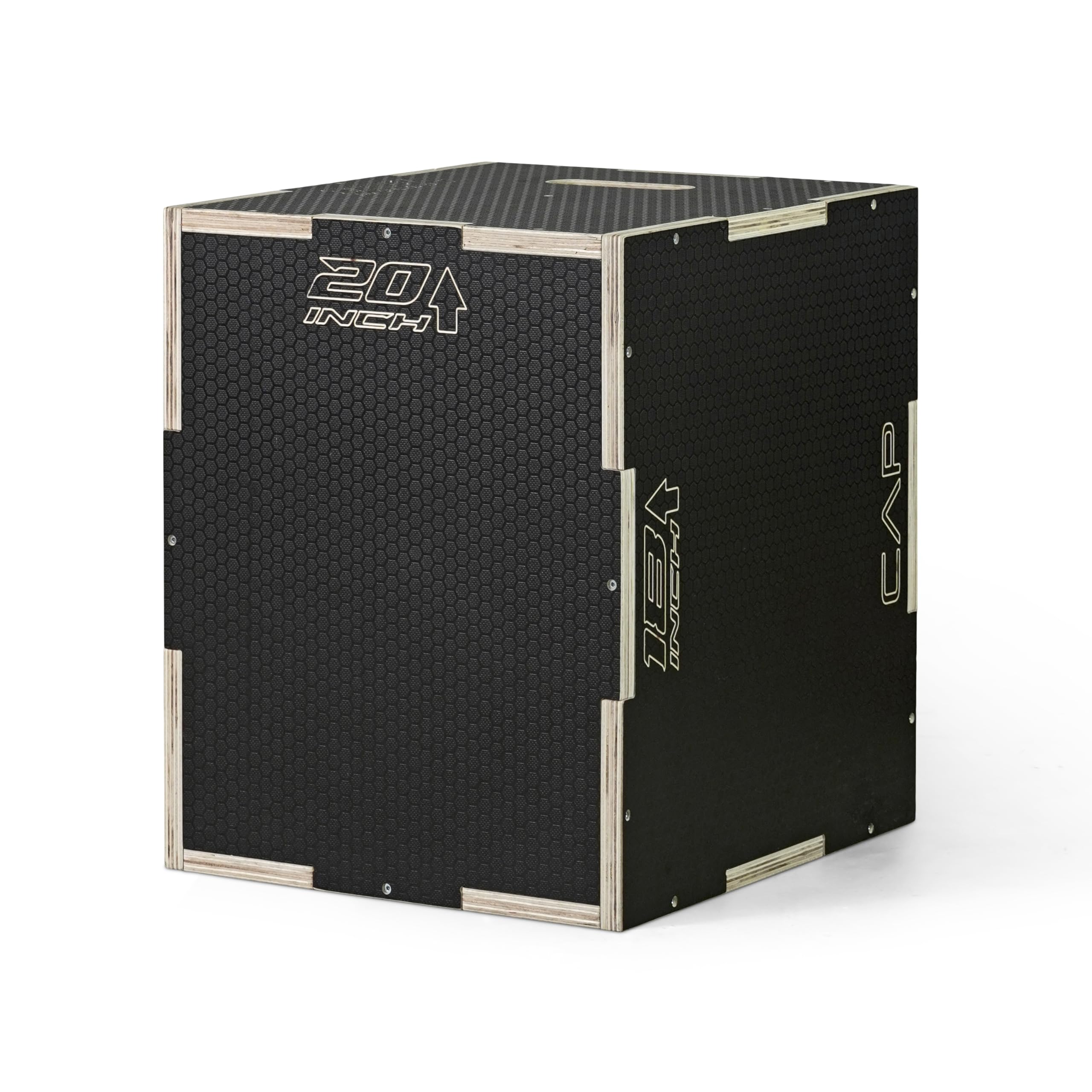
A rigid wood box for the lifter who wants zero give underfoot.
This one is the exception in a foam-box roundup, and it earns its spot. The CAP is engineered wood with interlocking panels and countersunk screws, which means the platform is rigid by construction — no foam compressing under your landing, no soft edge sagging over time. The 300 lb weight recommendation and the textured non-slip surface keep it planted, and the wide built-in handles make it easy to move between exercises despite its 29.1 lb heft. Three heights: 20, 18 and 16 inches.
Its advantage over the foam boxes is durability and feedback. The CAP does not get softer, does not develop a dip in the middle, and the countersunk hardware means no screw heads snag your shoe. Owners describe it as extremely strong with no wobble during jumps and step-ups, and the grip surface holds. Assembly is the one cost of that rigidity — the panels interlock and then need screws driven, which takes a while and occasionally needs a little persuasion at the edges.
The trade-off is real: rigid wood is unforgiving. A missed jump on a wooden box is the exact scenario that pushes people to foam in the first place, so if shin protection is your priority, look at the RitFit or REP picks instead. The edges are smooth-finished and the hardware sits recessed, which softens the risk somewhat, but it is still wood. For a lifter who wants a solid, plantable platform for step-ups, squats and dumbbell work, the 4.5+ star quality and the value equation are compelling.
What you get for the outlay
- Rigid engineered wood — no foam compression, no soft spots
- Interlocking panels plus countersunk screws for a stable platform
- Textured non-slip surface and wide carry handles
- Three heights that suit beginner to intermediate work
What you give up
- No forgiveness on a missed jump — wood is wood
- Assembly takes time, with many screws to drive
- Heavier to reposition than any foam box here
Best fit: Step-ups, box squats and dumbbell work where a rock-solid, non-compressing surface is the goal.
Not for you if: You are learning to jump and want a soft landing — foam protects shins in a way wood never will.
5. Titan Fitness 3-in-1 Heavy Foam Plyometric Jump Box

A short, low box for hip thrusts, step-ups and young athletes learning the movement.
The heights tell you who this is for: 12, 14 and 16 inches. That is beginner territory, and the EPE foam core with a textured vinyl exterior is designed to be forgiving. It supports up to 120 lbs, which makes it a natural fit for youth training and light accessory work. What it does very well is serve as a support for hip thrusts, where the soft edge meets your upper back and the box does not dig in. It also handles step-ups cleanly and needs no assembly — it arrives ready.
Here is where it differs from the taller boxes on this list. A 12-inch face is genuinely useful for reverse lunges and hip thrusts, but it is not a jumping platform in the competitive sense. The soft edge where the foam panels meet dips underfoot, so centered landings are the rule rather than the suggestion. The 4.0+ star rating across a large body of ratings reflects that: people love the function, and the stability picture is more nuanced.
Size is the honest sticking point. As customers note, it is “Smaller than I expected, even though the dimensions are on it” — so believe the listed 14″L x 12″W x 16″H footprint before you buy. That compact size is also the point: it tucks into a garage corner and does not dominate a room. If your training is hip thrusts, step-ups and low box work, this does the job. If you want to jump at 24 inches, look at the EPIC Fitness or the RitFit instead.
Its niche: Hip thrust support, step-ups and youth drills where a low, soft-edged box is exactly what you need.
Mind the scale: It is a genuinely small box — check the footprint against your setup before you order.
Fits: Parents training young athletes, and lifters who want a hip-thrust support that will not bruise their upper back.
Wrong pick if: You want to box jump for height — the 16-inch maximum and 120 lb capacity put a ceiling on that.
6. REP Soft Plyo Box

Foam with a 400 lb ceiling and a vinyl shell that grips instead of sliding.
REP builds this one around a dense foam core wrapped in a textured vinyl cover. The capacity is the headline: 400 lbs on a foam box is serious, and it means the box stays stable under a heavy lifter rather than compressing. The cover resists tipping and sliding during box jumps and step-ups, and the 16, 20 and 24 inch heights cover a full progression from beginner to athlete. It is a single solid piece, so no assembly and no joints to loosen.
What people notice first is the density. As reviewers point out, the box is “heavier and sturdier” than expected, which is the right trade for a jump platform. The foam does not bottom out under a knee or a back, so it doubles as a surface for hip thrusts and Bulgarian split squats without digging in. The 4.5+ star rating across a couple hundred ratings is a strong signal for a foam box at this capacity.
The one thing to plan for is travel. It is heavier than a basic foam box, so it stays where you put it. A few owners set a plate on the back to stop it sliding on smooth floors, a small habit that solves a common issue. Compared to the Fitvids, the capacity is the clear difference: 400 lbs against 150 lbs, and the foam feels correspondingly firmer. If you jump at home and want a box that does not shift when you land, this is the one that holds the line.
The 400 lb ceiling: Rare for foam, and it is why the box feels planted rather than squishy under a full landing.
Small practical caveat: On a smooth floor, put something behind it or under it — the dense foam can slide on hard surfaces.
Go for it if: You want foam forgiveness and a capacity that handles serious loads without the give.
Look at the EPIC instead if: You need a 30-inch face — REP tops out at 24 inches.
7. Epic Fitness 3-in-1 Foam Plyometric Jump Box

The tall option: a 30-inch face for the jumper who has outgrown 24.
This is the only box on the list that reaches 30 inches, and that alone decides it for some buyers. The three faces give you 20, 24 and 30 inches, all built around a high-density EPE foam core wrapped in an easy-to-clean PVC leather cover. With no wood or hard corners, it is far less intimidating on a missed jump than a wooden box. It weighs 16 lbs, so one person can reposition it without help, and it handles HIIT, MMA and CrossFit style work.
Where it shines is as a training tool for a broad range of people. The 20-inch face suits step-ups and knee touches, the 24-inch face handles standard box jumps, and the 30-inch face is where advanced jumpers go. Because the foam is firm and the cover is thick, a missed jump is a scuff rather than a wound — the injury-safety angle is the reason many people move away from wood in the first place. The 4.5+ star rating across a very large pool of ratings is a strong showing for a box this tall.
The honesty sits at the top end. The foam compresses under load, so a hard landing on the 30-inch face with forward momentum can make the leading edge feel less settled than on a lower height. That is a trade for the height itself — a tall foam box is always going to be softer at the top than a rigid wooden one. The cover is durable and easy to wipe down, but on rough concrete a towel underneath is worth the effort. If you are chasing a 30-inch jump, this is the tool for it.
Reasons to take the tall one
- Only box here that reaches a 30-inch face
- High-density EPE foam that eases the fear of a missed jump
- 16 lb build that one person can move
- Easy-to-clean PVC leather cover
The real limits
- Foam compresses on the tallest face, so lead-edge feel softens
- Rough or concrete floors need a mat or towel underneath
- Not a rigid rebound surface — it absorbs jumps rather than returning them
Pick this if: You are ready for 30-inch jumps and want foam between you and the floor.
Stay with 24 inches if: The taller face is just for occasional drills — you will get better stability from a lower box.
Know the Specs
Height options (3-in-1 faces)
A 3-in-1 box gives you three working heights from three faces, so you rotate rather than buy three boxes. The listing usually shows all three in inches — 16”x18”x20” means the faces are 16, 18 and 20 inches tall. Taller faces are also narrower, which makes them less stable, so a tall jump always wants a centered landing. Match the top face to your working height and treat the third face as a bonus.
Foam density and firmness
High-density foam holds its shape and gives you a firm landing; softer foam cushions more but compresses under load. EPE foam is the common core material, and the cover — PVC, vinyl or faux leather — seals it against sweat and wear. A soft edge on a firm core is the ideal: it protects a missed jump while still supporting a real landing. A box that feels spongy will absorb your jump instead of returning it.
Weight capacity vs. box weight
The capacity number (150 lb, 300 lb, 400 lb, 550 lb) is the user-load ceiling; the box weight is how heavy the box itself is. These often pull in opposite directions — a heavy box tends to be stable, a light box tends to be movable. Buy a capacity above your bodyweight with room to spare, and expect a light box to need bracing on its tallest face.
Cover material and surface grip
The cover does two jobs: it grips your feet and it keeps sweat out of the foam. A textured PVC or vinyl surface is the common choice, and a zip-off cover can be removed and wiped. A smooth cover is easier to clean but slicker underfoot. If the box will sit on concrete or a smooth garage floor, plan on a mat or something behind it to stop it sliding.
Common Questions
Is a foam plyo box safe to jump on?
What height plyo box should a beginner buy?
Will a foam plyo box slide on a garage floor?
How much weight can a foam plyo box hold?
Do I need a 30 inch plyo box or is 24 enough?
Can I use a foam plyo box for hip thrusts?
How do I clean a foam plyo box?
Is a wood plyo box better than a foam one?
Why does my plyo box wobble on the tall side?
Does a foam plyo box come assembled?
The Bottom Line
For most home gyms, the best overall pick is the RitFit 3-in-1 Extra Firm. It combines a firm high-density foam core, a wipe-clean zip-off cover and three heights in one box, with 4.5+ stars across 500+ ratings. If you want raw load capacity, the Sunny Health & Fitness No. 072 holds 550 lbs on an 11 lb frame. And for anyone chasing a taller jump, the Epic Fitness is the only box here that reaches 30 inches. Its 30-inch face is the only one here, and that is the reason to choose it.
How we choose
We do not accept paid placement. Every pick is matched to a real buyer and a real use-case; we do not hands-on test units.
Sources
Specifications: manufacturer listings and product documentation. Review insights: verified customer reviews, as of October 2026. Pricing: not shown on this page (it changes often); check the current price via the retailer link.
As an Amazon Associate, Aappliancez earns from qualifying purchases. This does not affect which products we feature.