Disclosure: Some links in this post are affiliate links. As an Amazon Associate I earn from qualifying purchases, at no extra cost to you. Learn more
Specs are compiled from manufacturer listings and verified buyer reviews and can change over time — please confirm the key details on the product page before buying.
If you want the shortest answer: buy for the insect, not the label. A spray that flattens mosquitoes in seconds can bounce right off a hardy housefly, and the strongest outdoor fogger in the world does nothing for the fruit flies breeding in your kitchen drain. This guide sorts eleven real options by what they actually knock down, how they smell, and what they leave behind on your surfaces.
This guide is built by comparing the manufacturers’ published specifications and the patterns across verified customer reviews, so you get each pick’s real strengths and trade-offs instead of marketing spin.
The key is matching the active ingredient to the bug, the room, and the surface you are spraying — and that logic runs through every pick in this flying insect spray comparison.
Top Picks


How To Choose The Best Flying Insect Spray
Most people buy the same can for a mosquito on the patio, a fly circling the kitchen, and a wasp nest under the eave. Those are three different jobs. Get the job right and you use a fraction of the spray.
Contact kill versus residual protection
A contact killer has to hit the insect to work — you spray the bug, not the room. A residual formula leaves a film on a non-porous surface that keeps killing for a set window afterward. If you want a fly dead this second, you want contact. If you want the patio to stay clear for a few days, you want residual.
Read the active ingredient, not the picture on the can
Pyrethrin-based cans hit fast and clear out quickly. Permethrin and tetramethrin blends tend to linger on surfaces. Plant-oil formulas built on cornmint, clove, rosemary, or geraniol are the ones you reach for around kids and pets. None of them are interchangeable, and the label percentage is the honest signal of how much you are getting.
Nozzle and can size decide real-world reach
A fogger that sprays a wide cone covers a deck fast. A pinpoint nozzle is what you need for a crack in the siding. Can size matters too — a gallon jug means repeat applications without a store run, while a small aerosol is easy to keep under the sink but runs dry in a season of heavy use.
Know what you are spraying on
Plant oils can leave an oily film that needs a wipe-down on hard surfaces. Some formulas can mark walls or flooring. Before you spray anything indoors, think about what the overspray will land on — counters, upholstery, plants, and pets included.
Side-by-Side Comparison
| Model | Best For | Form | Size | Key Active | Amazon |
|---|---|---|---|---|---|
| Raid Flying Insect Killer★ Best Overall | Fast indoor knockdown | Aerosol | 15 oz (2-pack) | — | Amazon |
| STEM Kills Ants, Roaches and FliesPlant-Powered Pick | Plant-based all-rounder | Spray | 12 fl oz | Botanical extracts | Amazon |
| EcoLogic Flying Insect KillerFruit Fly Specialist | Fruit flies and gnats | Aerosol | 14 fl oz | Cornmint, cinnamon, clove oil | Amazon |
| Cutter Backyard Bug Control Fogger | Patio and deck coverage | Fogger | 16 oz (2-pack) | Tetramethrin, phenothrin | Amazon |
| Safer Home Indoor Pest Control | Indoor family homes | Spray | 24 fl oz | Cottonseed, clove oil | Amazon |
| Wondercide Mosquito and Fly Aerosol | Homes with pets and kids | Aerosol | 10 oz (2-pack) | Lemongrass, geraniol | Amazon |
| EcoVenger All Purpose Insect Control | Broad household coverage | Spray | 16 oz | Geraniol, cedarwood, citronella | Amazon |
| Hot Shot Flying Insect Killer | Up to 4 weeks of residue | Aerosol | 15 oz (3-pack) | Permethrin, tetramethrin | Amazon |
| Stryker 54 Contact Insect Spray | Wasps and yellow jackets | Aerosol | 15 oz | 0.5% pyrethrin, 4% PBO | Amazon |
| Zevo Flying Insect Bug Aerosol | Kitchen fruit flies | Aerosol | 30 fl oz (3 bottles) | Rosemary, cornmint oil | Amazon |
| Harris Home Insect Killer | Long residual indoor use | Liquid spray | 1 gallon | — | Amazon |
Detailed Reviews
1. Raid Flying Insect Killer 15 Ounce Pack of 2
Our pick — 4.5+★ from 4,500+ verified ratings; the strongest balance of quality and price.
The two-can workhorse most kitchens end up buying twice
Two 15-ounce cans that kill houseflies, mosquitoes, non-biting gnats, and small flying moths on contact — that is the whole promise, and it holds up. The can handles both indoor and outdoor chores, so the same bottle that clears the kitchen can clean up the porch.
The instructions ask you to hold the spray about 3 feet from interior walls, fabrics, and furniture before you fire. That distance is what keeps you from soaking the wallpaper when a fly lands somewhere inconvenient. What wins people over is straightforward: this spray kills what it hits, and the Fresh scent does not hang around like a heavy chemical cloud. Mosquito duty is where it earns its reputation — the review pages sum it up as a mosquito-killer first and a fly-killer second.
One honest gap: the spray mechanism is not perfect across every can. A can that will not spray at all can show up in a multi-pack, so check each one the day it arrives rather than the day you need it. The value verdict, in turn, splits along that line — the formula is a bargain, the occasional dead can is the risk you accept.
Why it takes the top slot
- Kills flies, mosquitoes, gnats, and small flying moths by contact
- Two 15-ounce cans, so one lives in the kitchen and one lives outdoors
- Fresh scent keeps the post-spray air breathable in a small room
- Works indoors and outdoors with the same can
The small print worth knowing
- Keep about 3 feet from walls and fabrics so you do not soak them
- A can in the pack can arrive unable to spray, so test both early
- Scent is a matter of taste rather than a defect
Reach for this if: you want one dependable can that covers mosquitoes, flies, and gnats in the house and out on the deck.
Check first: test both cans spray on arrival — a dead nozzle is the only recurring risk here.
2. STEM Bug Spray 12 fl oz
The one certified as gentler on pets and people while still dropping flies
You get a 12-fluid-ounce bottle built around botanical extracts, with a fresh scent and no added dye or fragrance. That makes it the natural choice for a home with cats, dogs, or a toddler crawling on the same floor. Safety is the second-most-talked-about thing in the review pages, right after whether it kills — which tells you a lot about who buys it.
Serious knockdown comes from the concentration, not the can. Spray a fly directly and a few good hits finish it; ants and roaches go down on contact with a barrier that holds them back. A little goes far, which stretches the bottle longer than the size on the label suggests. The trade-off is that this plant formula leaves an oily film that has to be wiped off, and the lemongrass-forward smell is strong enough that some find it pleasing and some find it overpowering. Floors need a quick pass rather than a soak.
Placement matters. Spraying near a stained tile or a delicate finish can mark it permanently, so test a corner first if your floor is anything other than plain stone or linoleum. Used on solid, wipeable surfaces with a cloth nearby, it is one of the hardest-working plant sprays you can buy, and the value holds genuine respect — plenty of buyers report the same bottle outlasts full-size aerosols.
Where it shines: a 12-fluid-ounce bottle that kills ants, roaches, and flies while staying labeled safe for use around pets and people — the pick for a house that needs a gentler can in the cabinet.
Where it asks something back: the oily residue and the strong lemongrass scent are the price of going plant-based, so keep a rag nearby and test a small patch before you spray a whole floor.
Fits households with animals first, surfaces second: the label and the results both line up for pet owners.
Look at the Cutter or Harris if: you need a heavy infestation handled on carpets and bare floors without a wipe-down afterward.
3. EcoLogic Flying Insect Killer Aerosol 14 Oz
A 14-ounce can that turns a fruit-fly cloud into a floor full of dead ones
What you get is a 14-fluid-ounce aerosol built on three plant oils — cornmint at 3.50%, cinnamon at 1.20%, and clove at 0.75% — with the rest of the can made up of other ingredients. That mix kills houseflies, mosquitoes, moths, fruit flies, gnats, and wasps by direct contact. You have to hit the insect; there is no lingering action afterward, so a second pass may be needed on a swarm.
Where this really earns its keep is a kitchen fruit-fly problem. The review pages read like a swarm-turned-corpses story: spray a knot of gnats and fruit flies near an old onion and only one or two escape. A pleasant scent is the other thing people keep mentioning, and it is strong enough that some find it lovely and others find it sharp in a small room.
Hardy houseflies are the honest limit. A big, tough fly may need several sprays or a direct drench before it drops, and one or two reviewers who hit a stubborn NYC housefly found it shrugged the spray off. The oily residue means a paper towel and a quick wipe on hard surfaces. For gnats and fruit flies, though, the can does exactly what you paid for.
The angle that stands out: a bug-by-bug contact killer that reads like it was formulated for the kitchen counter, not the patio.
Grab it for the indoor swarm: gnats, fruit flies, and moths get cleaned up fast, and it stays labeled safe for people and pets when used as directed.
Know going in: it has no residual, so a stubborn housefly may take more than one hit — this is a contact tool, not a bug-proofing spray.
4. Cutter Backyard Bug Control Outdoor Fogger 16 Oz, 2 Pack

Enough fog to clear a balcony before the guests sit down
A 16-ounce fogger with a coverage claim that means something: each can treats up to 1,200 cubic feet, or an area roughly 8 feet by 10 feet by 15 feet. For a deck, patio, or picnic spot, that is the actual size of the space you want cleared. The formula kills mosquitoes on contact, plus gnats, flies, wasps, flying moths, and ants — though not carpenter, fire, pharaoh, or harvester ants.
What the reviews circle back to is how long the effect holds. Some report the bugs stay gone for 2 to 3 days, and a heavier application stretched that to about 4 days. That is the honest window for outdoor fogging — it is a knockdown, not a season-long barrier. Reapply as needed, but not more than once per day. The active ingredients are tetramethrin at 0.20% and phenothrin at 0.20%.
The catch is the fog itself. This has a strong chemical odor that hangs in the air for minutes, and it is toxic to bees and aquatic life. Gloves, eyewear, a mask, and long clothing are the smart kit, and you want a windbreak or a still day. This is a tool for a small open space, not a living room.
What earns it a place on the patio
- Each can covers up to 1,200 cu ft — a real balcony or deck in one pass
- Kills mosquitoes, gnats, flies, wasps, and some ants on contact
- Bugs stay away for 2 to 3 days per application in typical reports
What you accept for the power
- Strong chemical odor that lingers for minutes
- Hazardous to bees and aquatic life, so avoid wind and flowering plants
- Not for severe ant colonies or indoor use
Suits the outdoor host: a deck, patio, or picnic table where the bugs arrive right as the grill fires up.
Not for the living room: keep this one outside — the fog wants air and protective gear.
5. Safer Home Indoor Pest Control Multi-Insect Spray, 24 fl oz

Kills on contact and leaves no mess to clean up afterwards
A 24-fluid-ounce bottle built on cottonseed and clove oil, and it is the indoor spritz that handles the whole house list: ants, flies, roaches, spiders, silverfish, and fleas. Its label claims 100% kill of ants, flies, and roaches within 3 minutes. It is also the one that dries without residue, so you do not have to chase a film off the counters after every spray.
The scent is the detail people notice first — it has a mint-and-clove smell that fades fast, and it does not hang around like a harsh chemical spray. That is why reviewers with small kids and pets keep it in the rotation. Its cottonseed and clove oils are labeled nontoxic to cats and dogs when used as directed, and it carries a Parent Tested Parent Approved seal.
There is a real caution on surfaces. A reviewer found it badly stained the walls, and the stain held even after washing, so test an out-of-the-way spot first. A heavy, roaring ant infestation under a heat wave can also outlast it — the formula is meant for spot work, not exterminating a colony. For the everyday fly on the kitchen window or the silverfish in the bathroom, it does the job in seconds.
The everyday win: a 24-fluid-ounce bottle that kills ants, flies, and roaches in about 3 minutes and dries clean, which makes it the least fussy spray to keep on a kitchen shelf.
The one caution: walls and painted surfaces deserve a spot test first — one complaint about staining is enough to justify the extra second.
Perfect for the busy kitchen: families with kids and pets get a fast, low-odor spray that leaves nothing to wipe down.
Look elsewhere for: a deep ant colony inside the walls — this handles surface bugs, not the nest behind the plaster.
6. Wondercide – Mosquito and Fly Aerosol Spray – 10 oz, 2-Pack

Two 10-ounce cans for the pet household that wants the plant route
Two 10-ounce cans, each built on lemongrass and geraniol, a plant extract that gives the formula its bug-killing power. The maker lists over 20 flying insects it kills, including house flies, fruit flies, drain flies, bottle flies, gnats, and mosquitoes. It is made in the USA with plant-based active ingredients and no artificial colors or fragrances, and it is labeled safe to use around kids and pets when used as directed.
Where this spray earns loyalty is on surfaces more than in the air. Spritzed on sills, in trash areas, and around a porch, it keeps working for days without a respray, which is more than most contact aerosols manage. The caution is right there on the can: it is not built to be sprayed into open air. Aim at the surface the fly lands on, not the ceiling.
The honest weak point is the delivery. The spray can dump a puddle of liquid on floors and carpet, and the essential oils leave an oily film on counters, screens, and anything nearby. That means a mop or a wipe-down after each use in tight spaces. For a porch or a sill, that is a fair trade for a nontoxic formula. For a dining table, it is more cleanup than most people want.
The canine-friendly angle: a plant-based aerosol with lemongrass and geraniol that is meant for the places a pet lives, not a fogger for the whole house.
The right choice for a dog or cat on the floor: spray the sills, the trash, the porch, and it does the rest daily.
Not the one for a high ceiling fly: it is a surface tool, not a room fog, and the oily film needs a cloth.
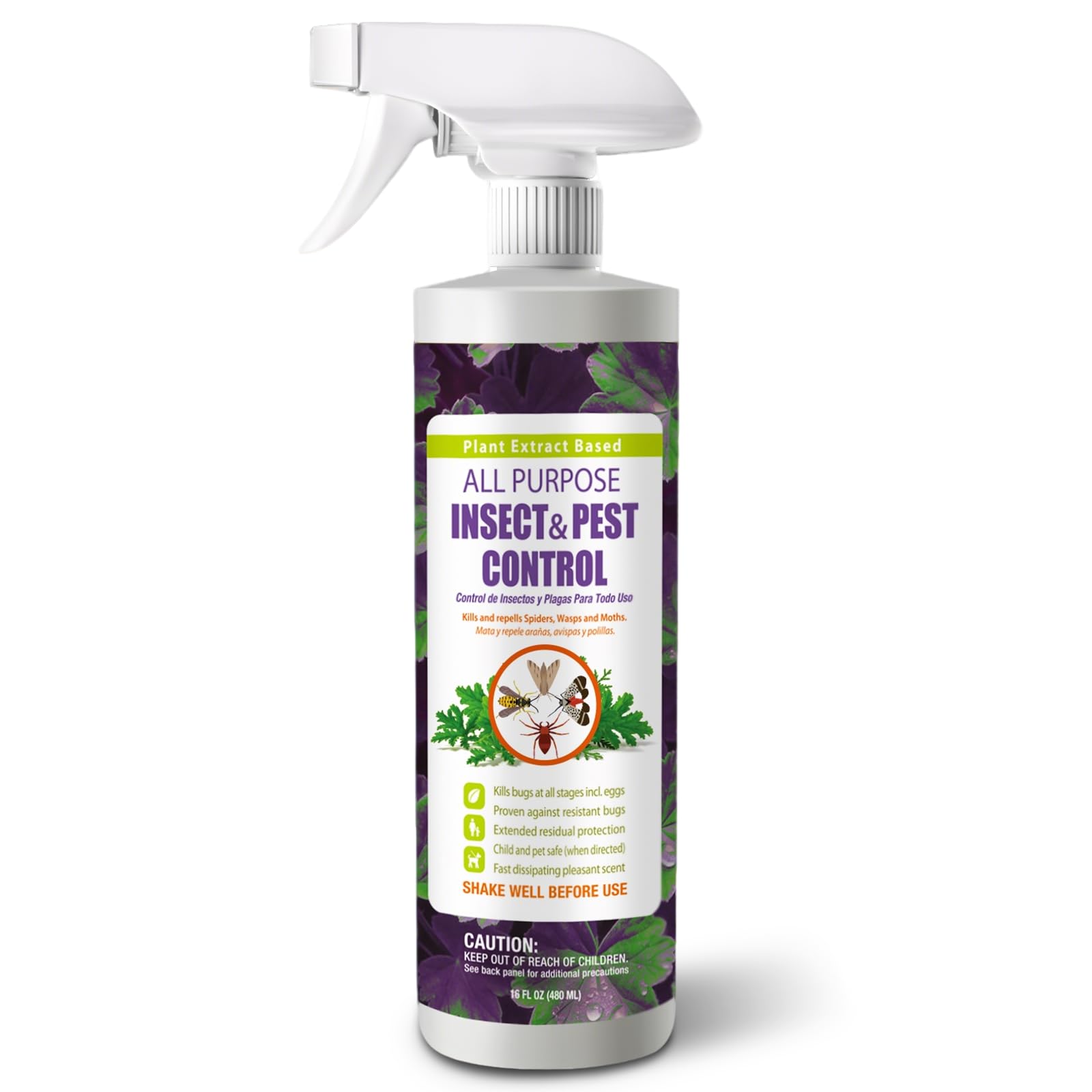
7. EcoVenger by EcoRaider All Purpose Insect Control 16 oz
A 16-ounce bottle that goes after the eggs, not just the fly
A 16-fluid-ounce spray built on geraniol, cedarwood oil, citronella oil, and sodium lauryl sulfate. The pitch is that it kills on contact and also targets insect eggs, which is the reason it gets reached for when moths have moved into a pantry or a wool rug. The bottle is sold on a broad-pest list — ants, beetles, fleas, flies, fruit flies, gnats, moths, roaches, silverfish, spiders, and more.
How it performs depends heavily on how you aim. A direct hit works fast; as a room spray it is far less convincing. The customers-say summary is honestly mixed on effectiveness, and the recurring criticism is that it only kills when you actually hit the bug. That is a real tool, not a miracle — treat it as contact-first.
Two more things to plan around. The scent is unpleasant to some and fades in roughly 45 to 60 minutes with a window and airflow, and the nozzle is noted for breaking in transit. The company offers a free replacement for a damaged nozzle, which softens that risk. It also is not a plant spray — overspray near houseplants can kill them, so keep it away from anything leafy.
Why it earns a cleaner’s respect
- Kills on contact and targets insect eggs to interrupt the cycle
- Plant-extract formula with geraniol, cedarwood, and citronella oils
- One 16-ounce bottle covered a 700 sq ft apartment twice in light coats.
What you manage around it
- Contact-only for many users — a room mist is not enough on its own
- The nozzle can arrive damaged, though it is easily replaced
- Keep it off houseplants and expect a brief, strong odor
The pantry-moth and rug-bug answer: reach for the egg-killing angle when the breeding is somewhere you cannot see.
Not a set-and-forget room spray: aim at the bug for the kill, and leave the leafy plants alone.
8. Hot Shot Flying Insect Killer Aerosol 15 Oz 3 Pack

Three cans that keep killing for weeks on a hard surface
The headline here is not the knockdown, it is what happens after. On non-porous surfaces, this spray continues to kill mosquitoes and houseflies for up to 4 weeks. The active formula is permethrin at 0.15% and tetramethrin at 0.15%, a pair that both drops on contact and hangs around on a windowsill or a patio wall. So the can covers 15 fluid ounces at 3 bottles — 45 ounces total — and evaporates far slower than a pure contact spray.
That residual is why it shines against wasps. Spritzed into a recurring wasp nest and its approach, the wasps were gone within a day and did not return or rebuild, which is a far better outcome than most peppermint sprays manage. It is also strong against mosquitoes, and it drops gnats and other small fliers without much trouble.
Two honest limits. Hardy flies can take longer to die than the label would suggest, and one buyer found it poor against a closet moth problem. The other is cleanup — it leaves an oily residue on hardwoods that wants a quick mop or a Swiffer pass afterward. For the whole-house summer backup, though, a 3-pack is hard to argue with.
What makes it different: the only can here whose label promises up to 4 weeks of residual kill on a non-porous surface, which turns a single pass into a season-long barrier.
The trade-off: oily film on hard floors means a wipe-down, and the residual is a surface feature — it does not help a fly crossing open air.
Best for the wasp-household and the windowsill: a 3-pack that keeps working on surfaces for up to 4 weeks between passes.
Look at the faster contact tools if: you need a fly dead mid-air this second — this one is a barrier first.
9. Stryker 54 Contact Insect Spray 15 Ounce

The can that finally cleared the yellow jackets other sprays just annoyed
A 15-ounce aerosol with 0.5% natural pyrethrin and 4% piperonyl butoxide — a pair that hits fast and, on direct contact, can put a yellow jacket down within seconds. The flip-up nozzle is the small design detail that makes it usable in the crack behind the siding where the nest actually lives. It can be used indoors, outdoors, on mattresses, and in spaces like food handling establishments.
The reviews are unusually consistent for a wasp product. Direct hits drop the yellow jacket quickly, and treating a nest entry at night with a few short puffs per opening often ends the problem by the next morning. That is the pattern that keeps the can in the rotation for anyone with an eave or soffit full of yellow jackets.
What you accept for that reach: the odor is strong and the space needs airing before you walk back in. The spray range is short, only about a foot, so you have to get close to the nest opening. The propellant can also burn houseplants, and there is no long residual to prevent a return visit. One can still lasts multiple seasons, which offsets the higher price.
What wins people over: a pyrethrin-plus-PBO contact formula that ends a yellow jacket nest in roughly 3 seconds of spray per entry.
Buy it for the nest behind the siding: the flip-up nozzle and fast pyrethrin knockdown are built for tight, high-risk spots.
Plan for: a close approach — the spray range is short, and the strong odor wants a window open after.
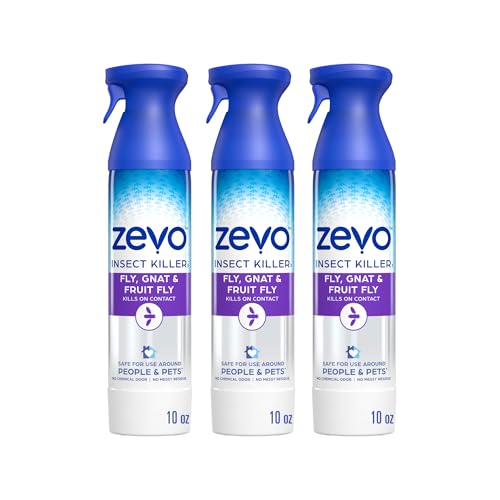
10. Zevo Flying Insect Bug Aerosol Spray 3 Bottles
Three bottles for the kitchen counter fly war
Three bottles totaling 30 fluid ounces, made with rosemary oil and cornmint oil instead of the harsher chemicals. The maker targets common flying pests — fruit flies, gnats, house flies, and mosquitoes — and you use it for the small, airborne stuff that gathers on kitchen floors and bathroom tiles. It is designed to be used directly on the insect, with no messy residue if you wipe up after.
Where this spray shines is the smell. It leans on rosemary and cornmint, and the general read is genuinely pleasant, close to a mint spray. That is a fine reason to keep one bottle by the sink and another by the trash. It is also labeled for home use around pets and people, which matters when you spray it by the sink.
The real complaints come from frustration, not chemistry. The bottles hide their level — one buyer found each one only about 75% full and ran out fast. The direct-spray approach means you must hit the fly itself, not just mist the room, and that gets old with a swarm. Some bottles also arrive with a nozzle that will not spray at all. Treat it as a direct-hit kitchen tool and it earns its shelf space.
Why it lands on a kitchen shelf
- Rosemary and cornmint oil formula that smells like mint, not chemicals
- Kills fruit flies, gnats, house flies, and mosquitoes on contact
- Three bottles across 30 fluid ounces keep a backup on hand
The reality of ownership
- Must aim directly at the fly — a room mist will not do it
- Opaque bottles hide how much is left, and they run out faster than expected
- A nozzle can arrive dead — check all three bottles on delivery
Made for the countertop and the trash can: a trio of mint-scented bottles that handle flies, gnats, and fruit flies where they actually show up.
Go with EcoLogic instead if: you want a stronger knockdown on a swarm and are fine with a heavier plant scent.
11. Harris Home Insect Killer Liquid Gallon Spray

A full gallon of odorless residual, meant for repeat passes
You get a full gallon of liquid spray with a long residual that keeps killing German roaches, ants, moths, Asian lady beetles, and more for weeks after the pass. The included extended trigger sprayer reaches the cracks and corners where the bugs hide, which is the entire logic of a gallon jug: you go after the source, not the one fly on the wall.
The formula is odorless and non-staining, and it will not damage fabrics, so it is the least socially awkward spray to use in a kitchen or a closet. It is EPA-registered for indoor residential use but not sold in California, Connecticut, or New York — check before you order.
Results are honest but uneven. Stinkbugs go down; a food-ant infestation can clear in hours and stay gone for months. Crawling spiders and Asian lady beetles respond too. It is not instant, though — the insects die shortly after a hit rather than on contact, and a hard-set population may need a second application. The only mechanical weak point is the trigger, which can fail; a spare sprayer is cheap insurance.
One number that matters: a full gallon, which means enough liquid for repeated applications to the same problem rather than a single can that leaves you short.
The honest catch: it is a residual, not a contact killer, so a bug hit this second may still be walking for a minute — and the trigger can give out.
The pick for treating the whole house: reach for the gallon when the problem is in the walls, under the sill, and across the baseboards.
skip it if: you live in California, Connecticut, or New York — it is not sold there.
Know the Specs
Contact versus residual kill
A contact killer has to hit the insect, so it is a bug-by-bug tool. A residual formula leaves a film on a non-porous surface and keeps working for a set window. The can size on the label tells you nothing about which you have, so read the active ingredient and the promise — “kills on contact” versus “kills for up to X weeks.”
Active ingredient percentages
Pyrethrin, permethrin, tetramethrin, geraniol, cornmint, clove, and rosemary oils are the common actives. A higher percentage generally means more punch per hit and a longer hang time, and a lower percentage in a plant formula often means a gentler smell but a faster evaporation. None of these numbers tell you the whole story without the surface they land on.
Coverage in cubic feet
Outdoor foggers often list coverage in cubic feet — a measure of how much volume one can treats. If your deck is larger than the listed number, you will need a second pass. This is the honest way to compare foggers without guessing.
Nozzle and spray pattern
The nozzle decides whether you get a pinpoint stream into a crack or a wide mist across a porch. A short spray range means you have to get close, which matters with a wasp nest. A wide cone covers more area but is harder to aim precisely. A can with a dead nozzle is worthless whatever the formula says.
Common Questions
Does flying insect spray kill mosquitoes as well as it kills flies?
Is a contact spray or a residual spray better for a kitchen?
Can I use these sprays around my dog or cat?
How close should I stand to a wasp or yellow jacket nest?
Will these sprays stain my walls, floors, or furniture?
How long will one can or bottle actually last?
Do these sprays leave a strong chemical smell in the room?
Can I use outdoor foggers like Cutter inside the house?
What should I do if the spray nozzle will not work?
Is a plant-based spray as effective as a chemical one?
The Bottom Line
For most homes, the flying insect spray worth buying is the Raid Flying Insect Killer. It drops mosquitoes, flies, gnats, and small flying moths on contact (the moment the spray hits them), so you can clear a room fast. It works indoors and outdoors, and it comes as a two-pack, so you keep one can in the kitchen and one in the garage. It holds 4.5+ stars across 4,500+ ratings. The Fresh scent keeps a small kitchen breathable after a spray.
If you want to keep harsh chemicals away from kids and pets, pick the STEM plant-based bottle. It kills ants, roaches, and flies, and its label clears it for use around people and pets when used as directed. For a full-gallon problem that lives in the walls and baseboards, the Harris Home Insect Killer gives you odorless residual coverage (it keeps killing after it dries) across repeated applications.
If wasps are the target, the Stryker 54 earns the spot with its pyrethrin-plus-PBO formula and flip-up nozzle. And if you want a patio cleared before guests arrive, the Cutter Fogger treats up to 1,200 cubic feet per can — enough to cover a real deck without guessing.
Whichever you choose, buy for the insect and the surface. That one decision does more for your results than any label claim on the shelf.
How we choose
We do not accept paid placement. Every pick is matched to a real buyer and a real use-case; we do not hands-on test units.
Sources
Specifications: manufacturer listings and product documentation. Review insights: verified customer reviews, as of October 2026. Pricing: not shown on this page (it changes often); check the current price via the retailer link.
As an Amazon Associate, Aappliancez earns from qualifying purchases. This does not affect which products we feature.