Disclosure: Some links in this post are affiliate links. As an Amazon Associate I earn from qualifying purchases, at no extra cost to you. Learn more
Specs are compiled from manufacturer listings and verified buyer reviews and can change over time — please confirm the key details on the product page before buying.
You know the sound. You snip a head pin, flip it over to inspect the end, and there it is — a tiny burr of metal jutting out where you needed a smooth finish. That little ledge means picking up a file, losing your rhythm, and hoping you do not mar the surface of a piece you just spent twenty minutes on. The cutter you pick decides whether your wire ends land flat on the first pass or send you back to the bench. A true flush cutter leaves a smooth, flat wire end on the first pass; a semi-flush or dull blade leaves a ledge you have to file down.
This guide is built by comparing the manufacturers’ published specifications and the patterns across verified customer reviews, so you get each pick’s real strengths and trade-offs instead of marketing spin.
A cutter that leaves glassy ends instead of chewed wire depends on three things: blade hardness, bevel geometry (the angle the cutting edge is ground to), and how much hand fatigue you can tolerate over a long session. Below is the honest breakdown of the best flush cutters for jewelry making, sorted by how cleanly each one finishes a head pin.
Top Picks


How To Choose The Best Flush Cutters for Jewelry Making
Buying a jewelry cutter is not the same as buying a pair of wire snips for the garage. The difference lives in the blade face. A true flush cutter has one flat side that sits right against the wire, so the cut end lands smooth instead of angled with a sharp point. That flat finish is what lets you skip filing on findings and head pins. A semi-flush or dull blade leaves a burr on every cut, and each one costs you a filing pass.
Match the blade to the wire you actually use
Sterling, copper, brass, and memory wire all behave differently under a blade. Softer copper cuts clean at almost any hardness. Sterling and steel wire push back harder and will dull the edge faster if the blade is not hardened well. Know your heaviest gauge before you commit. A cutter rated up to 16-gauge craft wire will serve most earring and bracelet work; the moment you push a 14-gauge silver through it, the tip loses its edge. Soft-metal cutters stay sharp longer on the light gauges they are designed for.
Look at blade hardness, not just the price tag
Hardness ratings tell you how long an edge holds up. Lower numbers like 56 RC suit soft copper and silver work. Higher numbers like 60 HRC or above take more abuse on harder wire and steel. Induction-hardened blades usually keep their alignment longer under repeated cuts. The trade-off is that harder steel is more brittle — a hard blade used beyond its gauge rating will chip faster than a softer one. Read the maker’s gauge limit and stick to it.
Hand fatigue is a real bench problem
You will make hundreds of cuts in an afternoon. That recurring squeeze adds up fast. Ergonomic handles and a coil return spring reduce the effort of every squeeze. A wide, flat handle profile lets your fingers rest with more control. Weight matters too: a cutter heavier than a couple of ounces starts to drag after an hour. If you wire-wrap daily, a lighter pair with comfortable grips will keep your hand steadier than a heavy-duty pair.
Side-by-Side Comparison
| Model | Best For | Cut Type | Rated Wire Range | Weight | Amazon |
|---|---|---|---|---|---|
| Xuron Micro-Shear 170-II★ Best Overall | Fine precision work | Flush & straight blade | Soft copper and light wire | 1.9 ounces | Amazon |
| The Beadsmith Vintaj Semi-FlushBest for Head Pins | Head pins and chain work | Semi-flush | Up to 16-gauge craft wire (1.3mm) | 3.2 ounces | Amazon |
| TEKTON Mini End Cutting Pliers | Small jobs and tight spots | Semi-flush | 14–38 AWG soft metal wire | 3.04 ounces | Amazon |
| Engineer NP-05 | Precision specialty cuts | Mini nipper | Copper wire up to 2.0mm | 65g | Amazon |
| Knipex 68 01 160 | Heavy wire and rivets | End cutter | Soft and hard wire | 7.36 ounces | Amazon |
Detailed Reviews
1. Cutters – Xuron Micro-Shear® Flush Cutter 170-II
Our pick — 4.5+★ from 700+ verified ratings; the strongest balance of quality and price.
The featherweight that slips into tight spaces where a bulky cutter simply will not reach.
At 1.9 ounces, this is the lightest pair in the whole lineup — noticeably lighter than the Beadsmith Vintaj at 3.2 ounces. That weight difference matters when you are holding a cutter for an hour of chain work. The long, thin shape lets the tip slide into tight spots between jump rings and clasp barrels where a wide-headed end cutter cannot go. The blades are cut from 2.14mm high-grade alloy steel, heat treated to 56 RC hardness for a long blade life (the RC number is a steel-hardness scale, and higher means the edge holds up longer).
Buyers keep coming back for the overall build quality, with cutting performance a close second. Owners describe cuts that are clean and consistent, and the grips stay comfortable through long sessions. A wire-wrap artist who uses a cutter daily says, “I’m extremely hard on my tools and use them daily as a wire wrap artist.” That lines up with the review-page consensus: people who put the miles on this tool buy it again and again.
The honest catch is edge wear. The blades are not permanent — after a few years of steady work they lose their bite and need replacing. Some owners also find the sharpness varies out of the pack; a few call it razor-sharp while others say theirs arrived less than fierce. This is a cutter built for soft copper, silver, and light wire, not the heaviest gauges. If your bench is soft copper, silver, and light chain, this is the lightest pair on the hand in this list.
Where it earns its keep
- At 1.9 ounces it is the lightest cutter here, so long sessions stay comfortable.
- The long and thin profile reaches into tight clasps and jump rings.
- Blades hardened to 56 RC for a long blade life on soft wire.
- Trusted by wire-wrap artists who use a cutter daily.
The trade-offs to know
- Blades wear out after a few years and need replacing.
- Sharpness varies from unit to unit.
- Best kept to lighter soft wire; not built for heavy gauge.
Grab it if: you want the lowest hand fatigue and the tightest reach in soft copper, silver, and chain work.
Pass if: your daily bench stream is 14-gauge silver or steel — look at the Knipex below for that weight.
2. The Beadsmith Vintaj Semi-Flush Cutter – 5-Inches (127mm)
A five-inch bench companion for head pins, eye pins, and chain that fits the hand from day one.
The Beadsmith Vintaj sits right at the desk of the hobby jeweler. It is a semi-flush cutter, which means the blade face has a slight angle instead of a perfectly flat edge (so cuts on heavier wire leave a small ledge you may need to file). It is rated for head pins, eye pins, rivets, chain, and filigree up to 16-gauge craft wire at 1.3mm. The 5-inch (127mm) overall length and ergonomic handles are built around the idea that jewelry work is close-up and slow — you are not swinging these, you are guiding the tip into delicate placements.
The comfort story is what keeps this one off the shelf. The reviewers describe the grip as comfortable and easy to hold, and one owner told the page “Works Great and Comfortable for your Hands to Grip. Nice and Sharp. Good Price.” A travel-and-workroom setup is common with this pair — people buy a second set so one can live in a bag and one at the bench. On sterling wire up to 18-gauge it cuts clean; on 16-gauge, expect the ledge and grab a file. Pushing past 16-gauge into 14-grade wire degrades the tip quickly.
That 3.2-ounce weight is the other half of the story. Compared with the Xuron above at 1.9 ounces, the Vintaj is a heftier hold, which some people like for the extra control on slow cuts and others find heavy for long sessions. It is best treated as a dedicated fine-detail tool for head pins and chain, not a heavy-workhorse. Buy it if your daily work is 18- to 24-gauge wire and you want a comfortable, dependable second pair.
Comfort meets price: the handles and grip do a lot of the work here, and the 5-inch length keeps the tip in the small zones where jewelry cuts actually happen.
Know the wire limit: 16-gauge craft wire is the ceiling. Beyond it, the cut turns into a filing job.
This is your pair: for head pins, eye pins, and chain on 16-gauge-and-lighter wire, where grip comfort matters more than raw cutting force.
Skip if: you regularly work memory wire or heavy silver — the ledge left by a semi-flush blade will be a constant frustration.
3. TEKTON Mini End Cutting Pliers | PMN64001

A four-inch bench hand that punches well above its size on soft wire and tight jobs.
At 4.1 inches long, this is the shortest cutter in the group — 25% shorter than the 5.11-inch Xuron, which is why it slips into places those long blades cannot. The blade geometry is what sells it: a fine, shallow bevel gives a semi-flush cut, and the edge is induction hardened to 60–63 HRC (a hard-steel scale, so the edge stays put under repeated cuts). The steel body itself reaches 44–48 HRC in final hardened form. It cuts copper, aluminum, brass, and silver across a wide 14–38 AWG span, and trims plastic parts and zip ties cleanly.
Buyers report it handles bigger wire than its mini size suggests. “Very small, ideal for small jobs; clean edge cuts through 12-gauge wire easily,” one buyer wrote — which is a surprise for a tool this compact. The recessed coil spring gently opens the pliers between cuts to reduce hand fatigue. The wide, flat handles let your fingertips rest across a large contact area for precise control. Tekton also backs it with a no-time-limit, no-receipt warranty through their site, which is worth knowing for a tool you will use often.
The one area to size carefully is the grip. It earns mixed feedback — some find it easy to handle, others note it requires a firm squeeze. The factory edge grind also runs a little rough out of the pack; a few people reflatten the face for true-flush results. For a bench that moves between head pins and light assembly work, this is the most adaptable pair here.
The good
- Short 4.1-inch length reaches into tight spots.
- Cuts 14–38 AWG soft metal wire, including 12-gauge at a push.
- Induction-hardened edge at 60–63 HRC.
- No-time-limit, no-receipt warranty through the maker.
Worth weighing
- Grip feedback is mixed — a firm hold is required.
- Factory edge can need a light reflatten for true-flush cuts.
- Not designed to be modified for solid wire.
The one to reach for: when you want one compact cutter that can handle both fine jewelry wire and light assembly work.
Look elsewhere: if you want a comfortable resting grip for hours of delicate chain work — the wider handles here want a firmer hold.
4. ENGINEER NP-05 123mm Plastic Cutting Mini Model Nippers
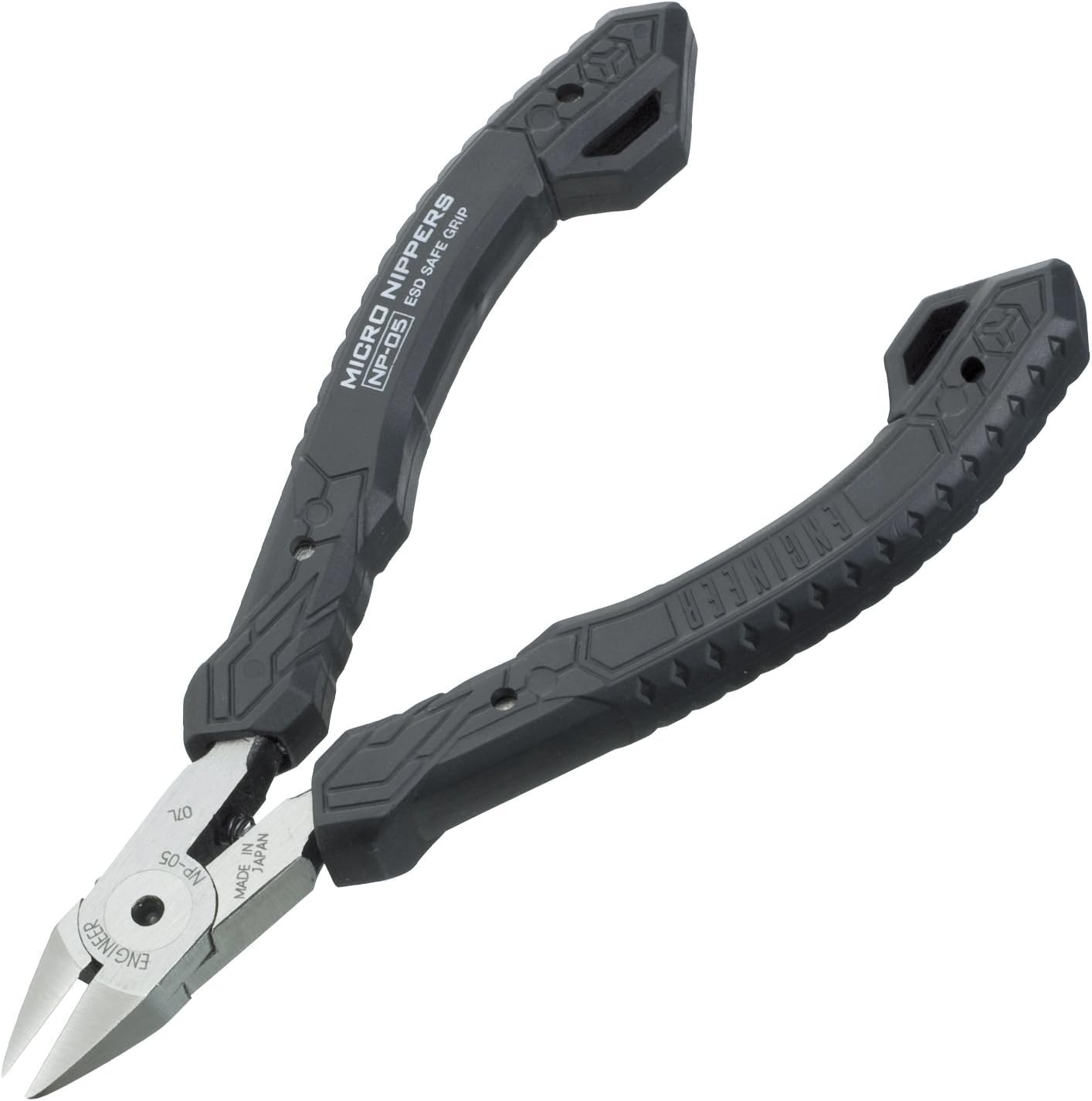
Japanese-made miniature nippers built for gates and flush plastic trims, with a wire cross-over that surprises people.
The NP-05 is the precision specialist of the group. It weighs 65g and measures 123mm, with ESD-safe handles made of thermoplastic rubber (TPS-rubber grips that dissipate static, so the tool is safe around sensitive components). The surface resistivity sits at 1×10⁶–10⁷Ω across the grip. The blade is high carbon steel, and the headline capability is plastic gates and thin wire: copper solid wire up to φ2.0mm, copper stranded up to φ3.5mm², and brass wire up to φ1.6mm. If you 3D print and also make jewelry, this is the one-piece crossover tool that earns its place on the bench.
What owners keep coming back to is the edge retention. The review pages describe cutters that cut dead flush on zip ties and filament with a smooth finish and stay sharp past what the maker recommends. One buyer says these are “the first nippers of this size I’ve tested that can cut steel wire without losing their edge.” The side stopper and coiled spring are built to reduce hand fatigue on long trim sessions. For trimming 3D-printer filament and cutting copper wire up to φ2.0mm, its high carbon steel edge sits near the top of the class.
The catch is long-term durability at the pivot (the joint the two halves hinge on). After long light use, one long-term owner reports the rivet loosened and the grips began to slide off, and the maker does not offer a hand-tool warranty. So treat this as a precision tool, not a shop beater — keep it for careful trim work, not heavy leverage cuts. If your work is mostly 3D-print gate and filament trimming plus copper wire up to φ2.0mm, the NP-05 is tough to top.
Edge that lasts: the high carbon steel blade matches the Japanese-made reputation, cutting flush on filament and wire without needing constant re-dressing.
The honest caveat: the pivot and grip are the wear points over years of use, and there is no hand-tool warranty — so keep it in precision rotation, not heavy-duty abuse.
For the multi-craft bench: a 3D printer and jewelry table in one room, where the same tool needs to trim filament and cut copper.
Not the ideal match: if you plan to use it as a daily heavy cutter on steel wire — the pivot is the part that gives first.
5. KNIPEX 68 01 160 End Cutters

The heavyweight that bites through memory wire and copper rivets without flinching.
Knipex built this one for the hard stuff. The cutting edges are induction hardened to roughly 61 HRC (a hardness scale where higher means a tougher edge) and rated for both soft and hard wire. That is why it can sink through memory wire (steel), copper and brass rivets up to 1/4 inch, and binding wire without chewing up the blade face. At 7.36 ounces and 6.33 inches long, it is easily the heaviest and largest cutter here — a deliberate heft that gives it the leverage to cut nails and small fasteners with less effort than lighter tools. For a jeweler who also does chainmail or heavy rivet work, this is the locker it earns.
The mechanical feel is what owners talk about most: jaws meet with no daylight, the edges stay aligned under load, and there is no flex, twisting, or hinge play. The leverage is excellent for a 160mm tool. It is covered by a limited lifetime warranty, which is why it makes sense to keep as the sturdy cutter that saves your lighter flush pairs from abuse. For a pair of flush cutters, though, its end-cutter geometry is the caveat — it is not a true flush face, so the cut ends come off flat but not glassy.
Size is the other thing to weigh. This Knipex is a compact tool, and some buyers find it too small for their hands or for crimping tasks beyond its purpose. The right buyer here is someone who needs a strong cutter for memory wire and rivets and wants a tool that will not flex under a hard squeeze. If your whole bench is delicate 20-gauge chain, the 1.9-ounce Xuron above will feel far more at home.
Muscle where it counts
- 61 HRC edges cut memory wire, 1/4-inch copper rivets, and hard wire.
- Jaws meet with no daylight — no hinge play under load.
- Limited lifetime warranty from the maker.
- Handles 7.36 ounces with leverage that saves effort.
Not the dainty choice
- End-cutter style leaves a flat end, not a glass-smooth flush finish.
- Heavy 7.36-ounce body is a handful on long delicate sessions.
- Compact size runs small for some hands.
The right fit: for memory wire, copper rivets, and heavier findings where you need raw cutting force and edge alignment that stays put.
Think twice if: you want glass-smooth head pin ends on every cut — this pair is a cutter, not a finisher.
Know the Specs
Flush vs Semi-Flush Cut
A flush cutter has one flat blade face that sits against the wire so the cut end lands smooth. A semi-flush blade has a slight bevel, so cuts land almost flat but can leave a small ledge on thicker wire. Semi-flush suits delicate 16-gauge-and-lighter work; a true flush face means less filing on head pins and findings.
Blade Hardness (RC / HRC)
RC and HRC are hardness scales for steel — the higher the number, the longer the edge resists dulling. A 56 RC blade handles soft copper and silver well. A 60 HRC blade or above stays sharp through harder wire and steel. Harder steel is more brittle, so match the blade to your gauge ceiling rather than pushing it beyond the rating.
Wire Gauge and Capacity
Gauge matters as much as hardness. A cutter rated to 16-gauge craft wire will handle head pins and chain, but pushing 14-gauge or heavier degrades the tip. Check the maker’s stated range (for example 14–38 AWG or φ2.0mm copper) and stay inside it to keep the edge working.
Grip, Weight, and Spring
Hand fatigue is the hidden cost of jewelry work. Coil and recessed springs help re-open the tool between squeezes. Wide flat grips give your fingertips a rest. And weight is real — a 1.9-ounce cutter is far easier on extended sessions than a 7.36-ounce one, though the heavy tool brings more leverage when you need it.
Common Questions
Will flush cutters cut memory wire for bracelet making?
What is the difference between flush and semi-flush cutters for jewelry work?
Do these cutters work on sterling silver wire?
How long do the blades on a flush cutter last?
Can I use flush cutters on 14-gauge wire?
Why do the ends of my head pins look jagged after cutting?
Are spring-loaded handles worth it for long jewelry sessions?
Do these cutters have a warranty?
Can I use a mini fl?
The Bottom Line
For most jewelry benches, the best flush cutters for jewelry making choice is the Xuron Micro-Shear 170-II because its 1.9-ounce body, 56 RC blade, and long thin profile reach tight clasps with the least hand fatigue. If your daily work is head pins and chain up to 16-gauge, grab the The Beadsmith Vintaj for its comfortable ergonomic grip. And for heavy memory wire and copper rivets that need real leverage, the Knipex 68 01 160 is the workhorse worth owning. Match the blade to your wire: a flush face for smooth head pin ends, a harder edge for memory wire and rivets.
How we choose
We do not accept paid placement. Every pick is matched to a real buyer and a real use-case; we do not hands-on test units.
Sources
Specifications: manufacturer listings and product documentation. Review insights: verified customer reviews, as of October 2026. Pricing: not shown on this page (it changes often); check the current price via the retailer link.
As an Amazon Associate, Aappliancez earns from qualifying purchases. This does not affect which products we feature.