Disclosure: Some links in this post are affiliate links. As an Amazon Associate I earn from qualifying purchases, at no extra cost to you. Learn more
Specs are compiled from manufacturer listings and verified buyer reviews and can change over time — please confirm the key details on the product page before buying.
You are about to spend real money on a floor, so here is the short answer: for most people doing cardio, weights and floor work in a garage or spare room, the GXMMAT Large Exercise Mat is the safest all-round buy. Its textured PVC surface grips under shoes through sweat and jumping, and it rolls up for storage. If your space is a full garage bay or a basement corner, an interlocking tile set covers more ground for less. The guide below matches thickness and material to each workout type.
This guide is built by comparing the manufacturers’ published specifications and the patterns across verified customer reviews, so you get each pick’s real strengths and trade-offs instead of marketing spin.
Thickness, material and grip decide whether a floor survives dropped dumbbells or dents under your rack, and the picks below span budget foam tiles to rubber-topped sets. Use this breakdown of the flooring for home gym market to match a surface to your exact workout style.
Top Picks


How To Choose The Best Flooring for Home Gym
Most first-time buyers shop by look instead of by weight load, and that is where floors fail. A soft, springy tile feels wonderful under bare feet for yoga. Put a loaded barbell rack on that same tile and it dents, shifts, or tears at the seam within weeks. So start with the heaviest thing that will sit or land on the floor, not with which surface feels softest.
Match the thickness to what you drop
Thickness in foam and rubber flooring is measured in millimetres or inches, and it is the number that decides how much impact the surface swallows. A 7mm mat is roughly a quarter inch of dense foam, which is enough to cushion jumping, sit-ups and kettlebell work. A 0.4 inch tile is a little thicker and adds a shock-absorbing layer, which suits floor exercises and lighter weights. Neither of those is built to catch a dropped loaded barbell, so if you plan on Olympic lifting, plan your expectations around that.
Foam tile versus a rolled mat
Interlocking tiles let you cover an odd-shaped room wall to wall and stay put as one big surface. A rolled mat is one continuous piece you can roll up and lean against a wall when the car needs the garage back. Tiles win on coverage and price per square foot; a roll wins on grip underfoot and portability. Pick tiles for a permanent wall-to-wall floor, and a roll if the space doubles as a garage.
Grip, and why the backing matters
A textured top keeps your hands and feet from sliding mid-rep. The underside matters just as much, because a mat that creeps across a hardwood floor is worse than no mat at all. Look for a grooved or matrix-circle base on a roll, or puzzle edges plus a textured top on tiles. On carpet, most foam tiles shift unless you tape them or add a rug liner underneath.
Side-by-Side Comparison
| Model | Best For | Thickness | Coverage | Material | Amazon |
|---|---|---|---|---|---|
| GXMMAT Large Exercise Mat★ Best Overall | Shoe-on cardio and weights | 0.28″ (7mm) | 72″L x 60″W | PVC | Amazon |
| Our Modern Space 12 PackBudget Champion | Budget gym corner | 0.4″ | 48 sq ft | EVA foam | Amazon |
| VEVOR Diamond-Plate Rubber RollMost Hard-Wearing | Hard-wearing garage bay | 0.12″ (3mm) | 4 ft x 6 ft | SBR rubber | Amazon |
| GWT Interlocking EVA Tiles | Quiet apartment workouts | 0.4″ | 48 sq ft | EVA foam | Amazon |
| Uniboho Drainage Mat | Wet or sweaty areas | 0.31″ | 59.06″ x 35.43″ | Rubber | Amazon |
| ProsourceFit Weaved Puzzle Mat | Room-filling coverage | 0.75″ | 24 sq ft | EVA foam | Amazon |
| Sivan Fitness Rubber Top Tiles | Racks and benches | 0.5″ | 48 sq ft | EVA + rubber | Amazon |
| GymCope Large Exercise Mat | Kettlebells and barefoot work | 0.27″ (7mm) | 72″L x 48″W | PVC | Amazon |
| SUPERJARE Rubber Top Mats | Heavy equipment base | 0.4″ | 48 sq ft | EVA + rubber | Amazon |
| Our Modern Space 24 Pack | Whole-room coverage | 0.4″ | 96 sq ft | EVA foam | Amazon |
| Forest Floor Printed Foam Tiles | Gym that doubles as a room | 0.63″ | 100 sq ft | EVA foam | Amazon |
Detailed Reviews
1. GXMMAT Large Exercise Mat 6’x4’/6’x5’/6’x6′(7mm)
Our pick — 4.5+★ from 950+ verified ratings; the strongest balance of quality and price.
The oversized roll-up that handles jumping, weights and shoes without wandering across the floor.
This is the floor for the person who does a bit of everything in one spot — P90X-style cardio one day, dumbbells the next, a stretch session after that. It measures 72″L x 60″W at 0.28″ thick, which in plain terms is a 6-foot by 5-foot sheet about a quarter inch deep. That is a real exercise zone rather than a yoga-mat strip, so you are not shuffling back and forth to stay on it during mountain climbers.
What wins people over is the grip. The surface is textured to stop hands and feet sliding out, and the grooved, matrix-circle underside is built to lock the mat to the floor so it does not creep while you move. Buyers put that to work: “6×5 mat works for stretching/yoga/HIIT on hardwood; no sliding, stable.” The 7mm (about 0.28 inches) high-density foam strikes a balance between cushion and stability, so it soaks up jumping impact without turning into a wobbly sponge under a squat.
The honest catch is portability and width. At 7.5 kg (about 16.5 pounds) it is a genuinely heavy piece of kit to unroll and shift, and the 60-inch width feels tight to taller users doing wide-footed work — sizing up to the longer options is the sensible move if you are near six foot. It also may arrive with curled corners and needs a day under some weights to lie perfectly flat, and you do have to check the box for which side faces down.
What earns it the top spot
- 72″ x 60″ gives a true workout zone, not a narrow strip
- Double-sided grip holds on hardwood and concrete
- Shoe-friendly — survives cardio and weights alike
- Ships with gloves, three Velcro straps and a carry bag
Where it asks you to compromise
- 7.5 kg is heavy to move around regularly
- 60-inch width is snug for very tall users
- Can arrive curled and needs weights to flatten
Buy this if: you want one durable surface for cardio, weights and floor work, and the mat can stay down most of the time.
Think again if: you are tall enough that 60 inches of width feels cramped, or you need to pack the floor away daily.
2. 12 Pack 48 SQFT Floor Exercise Mat
Twelve snap-together squares that turn 48 square feet of hard floor into a cushioned training corner.
If your gym lives in a spare-room corner, this is the cheapest way to make the whole area comfortable underfoot. Twelve tiles at 24″ x 24″ each give you 48 square feet of coverage, and the pieces slot together with a puzzle edge so you are not taping anything down. Each tile is 0.4″ thick — about the depth of a thick book cover — and the half-inch listing thickness in the name is worth reading carefully against the spec sheet, since the measured figure is the 0.4.
The EVA foam (a soft, shock-absorbing foam) takes the sting out of floor work, and owners happily kneel straight on it instead of reaching for an extra yoga mat. It is PVC, lead, BPA and phthalate free (no common plastic additives), so a playroom and a gym room are the same purchase. One practical note straight from buyers: “Not sure about durability, it’s been on my floor for about 2 weeks.” That is the fair read — it is a light-to-moderate-use floor, happy under a squat rack for storage but not designed for dropping loaded bars.
On glossy hardwood the tiles can slide unless you lay a rug liner beneath, and the softer foam takes an imprint under very heavy equipment. For stretching, floor abs, light dumbbells and kids running around, it does the job at entry-level money.
The value case: 48 square feet of cushioned, non-toxic interlocking foam for a small footprint price makes this the easy first floor for a starter home gym.
What to plan for: buy a rug liner if your floor is smooth wood, and treat denting and sliding as normal for a soft foam tile rather than a fault.
Reach for this if: you need instant floor cushioning on a tight budget and your training stays in the light-to-moderate range.
Look elsewhere if: heavy barbells and dropped weights are part of the plan, where you want a rubber-topped tile instead.
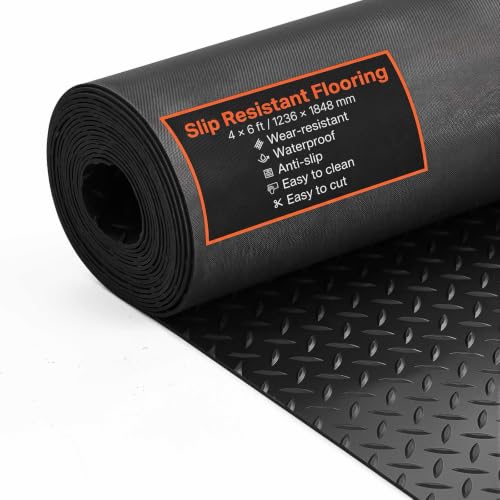
3. VEVOR Diamond-Plate Rubber Flooring Roll
A solid slab of SBR rubber with a diamond tread that shrugs off grit, spills and foot traffic.
Think of this less as a workout mat and more as an armour plate for the floor beneath your equipment. It is a single 4 ft x 6 ft roll of styrene butadiene rubber — the same hard-wearing family of rubber used in commercial settings — at 0.12 inches, or 3mm, thick. That is thin in cushioning terms, but it is not there to be soft. It is there to stop a concrete floor getting scuffed, stained or chewed up under a bench or a rack.
The diamond-plate texture gives a professional look and traction, and the 3D pattern on the backing is built to handle water and spills without letting them soak through. Functionality and durability are what most owners talk about, with a wide re-use from boats to barbell areas. It cuts cleanly to size with scissors, so fitting it around posts and odd corners is genuinely easy.
Be ready for the smell. The rubber arrives with a strong odour that fades over days rather than hours. It is also a thin, flexible sheet, so a hard tug on it along a rough edge can tear it, and it has no adhesive of its own — plan on tacking or weighing the edges down if you need it locked in place.
Where it shines: a waterproof, cut-to-fit rubber barrier that protects concrete and stands up to heavy equipment standing on it.
The trade-off: expect a strong rubber smell for the first few days and a sheet thin enough that you should not drag it over sharp edges.
Built for: under-the-bench and under-the-rack protection in a garage where the floor takes a beating.
Not the one for: barefoot floor work, because 3mm of rubber gives you grip and protection but very little cushion.
4. GWT Interlocking EVA Foam Floor Tiles
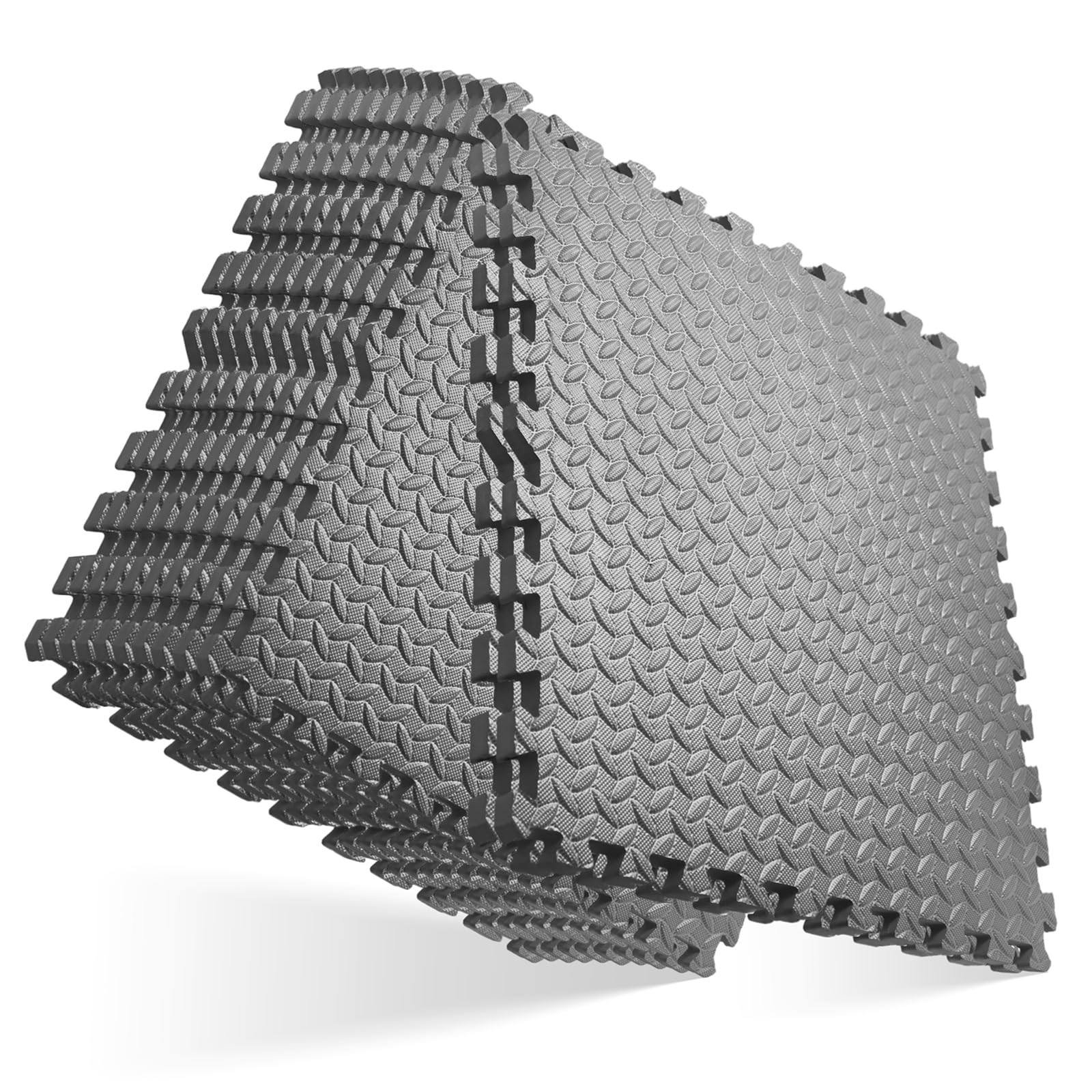
Puzzle-edge tiles that go down in minutes and quiet the room for anyone living above or below you.
For an apartment dweller with a spare corner and a set of dumbbells, the noise question matters as much as the cushion. This 12-pack of 24″ x 24″ tiles covers 48 square feet at 0.4 inches thick, and the high-density foam is built to soak up dropped-weight thuds and general workout clatter. The manufacturer is specific that it is made to dampen noise in apartments and multi-level homes.
Assembly is the easy part — the puzzle edges interlock with no adhesive, tape or tools, and a utility knife scores through the foam to fit around posts and walls. There is a textured side for grip and a smooth side down to protect the floor underneath, and it is reversible between the two. The foam is phthalate-free with minimal smell from day one, which matters in a basement with no window.
Honesty time: the foam is soft, so the interlocking joins can work loose under constant heavy load or fast lateral movement, and a few heavier users find the tiles separate over time. It is at its best for a home workout, a machine base and general floor protection, not for Olympic lifting.
Why apartment lifters like it
- Noise-dampening foam keeps the peace with neighbours
- Snaps together with no tools or adhesive
- Minimal odour straight from the start
- Reversible — grip up or smooth up
Where it will let you down
- Soft foam joins can separate under heavy, fast use
- Not built to catch dropped weights
Pick it for: a machine or cardio corner in a shared building where sound carries.
Skip the gamble if: you will be dropping loaded weight onto it — that is beyond what soft foam is asked to do.
5. Outside Rubber Floor Mats Anti Slip Commercial Drainage Mat

A holed rubber mat that lets sweat and spills fall straight through instead of pooling under your feet.
If your training involves a lot of sweat, a wet sauna corner, or an area the garden hose can reach, a solid mat just traps the moisture. This one is the opposite — a 59.06″ x 35.43″ sheet at 0.31 inches thick, punched with large hexagonal holes that drain water, sweat and grit away. The rubber and polyester build keeps it flat and grips vinyl, wood, tile and cement.
The non-slip traction is what most people bring up, and it does its main job well — no sliding, and rain passes straight through so nothing pools on top. It is heavy enough to stay put and easy to hose down or sweep clean. As a gym-floor problem solver it is a wet-area specialist rather than a broad mat.
The catch is the smell. Rubber in a warm room takes a good while to stop smelling, so give it a few days of airing before it settles in a closed space. It is also a drainage mat first, so cushioning is not its strength — treat it as a grippy wet surface, not a landing pad.
What it solves: a drainage surface that keeps a wet, sweaty or outdoor training zone safe underfoot.
Worth knowing: if the space is enclosed and warm, plan for that rubber smell to hang around for the first several days.
It suits: garage doors, sauna floors, entry areas and any spot where liquid needs somewhere to go.
It does not suit: a cozy barefoot lifting corner, where a full foam tile gives far more comfort.
6. ProsourceFit Weaved Exercise Puzzle Mat

Three-quarter-inch thick tiles with a huge owner base, built for the floor-work and light-weight crowd.
When the priority is comfort under knees and feet, this 6-tile set is hard to look past. Each tile measures 24″ x 24″ x 3/4″ thick, covering 24 square feet across the set, with 12 end borders for a finished edge. The high-density EVA foam compresses to give support and cushion, and owners assembling a basement workout zone cover their square footage in minutes with no tools.
What stands out is how widely it is used and praised — this is the most-reviewed floor set on the list by a wide margin, and the consistency is notable. It serves a kids’ play area, a home gym, a garage bay and stretching sessions with the same tile. The textured surface is water-resistant and noise-reducing, and it stays flat under a yoga mat or kettlebell.
The softness is the caveat. Under heavy equipment or fast lateral movement the foam compresses and the tiles can shift or separate at the joins. It is a cushion, not a weight platform, so if there is a loaded rack going down, this is the wrong tool.
Why it is a crowd favorite
- 3/4″ thick tile cushions knees and feet on hard floors
- Fast, tool-free puzzle assembly and easy to disassemble
- Includes end borders for a clean finished edge
- Backed by a limited lifetime warranty
Where heavy lifters hit a wall
- Foam compresses and tiles separate under heavy loading
- Cutting to fit takes several passes of a utility knife
Ideal if: your training is floor work, light weights and cardio, and comfort under knees is the priority.
Better to look at a rubber-top tile: when a loaded barbell or a heavy bench is going to sit on it full time.
7. Sivan Fitness EVA Foam Gym Flooring

A rubber skin over a foam base — the top layer is what keeps a loaded bench from chewing up the surface.
Six interlocking tiles make 48 square feet at 0.5 inches thick, and the construction is the point: an EVA foam base topped with a genuine rubber layer. That rubber top gives the floor a firm, non-sweat-absorbing surface that resists staining and stands up better under a bench, a dumbbell rack or a leg press than plain foam. Buyers report panels that stay together without wobble under exactly that kind of equipment.
Assembly is simple enough to be done thoughtfully, with extra border edges so you can lay out corners and mid-pieces to suit the room. It cleans with a wipe and keeps its speckled black-and-blue finish looking sharp. If you compare it to the GWT foam tiles above, this is the step up you buy for a rack with real weight on it.
The trade-off is what a rubber top can and cannot survive. It handles a bench and a standing bar; it is not armour against a spinning barbell dropped from height, and a heavy drop can tear the rubber skin even though ordinary use does not. Some earlier buyers also report tiles separating under intense exercise, so heavy impact work is best kept off it.
The real strength: a rubber-topped tile that stays firm and stable under a loaded bench while keeping the cushioning of its foam core.
The real limit: it is not a crash pad, so heavy barbell drops from height should go on a dedicated platform instead.
For you if: you are setting up a rack, a bench or a machine and want a surface that stays rigid under load.
Not the answer for: Olympic lifting or any routine where a loaded bar is being dropped.
8. GymCope Large Exercise Mat for Home Workouts

A heavy-duty PVC roll for kettlebell and strength sessions that you can also pick up and take with you.
GymCope offers this in six sizes from 6′ x 4′ up to 12′ x 6′, so a solo lifter and a couple training together can both find a footprint. This entry size measures 72″L x 48″W at 0.27″ thick, and the high-density PVC is built to resist abrasion and scratches from shoes and weights. The double-sided anti-slip surface is meant to grip tile, carpet, concrete and hardwood — a wider surface claim than some mats on this list.
Kettlebell and Turkish get-up work is where it feels most at home — the mat stays put and gives a firm footing without slipping. It comes with a carry bag, three hook-and-loop straps and a 27″ x 16″ microfiber towel. Several sizes and the included bag make it a flexible choice if you train in more than one spot.
The honest note is stability on carpet. On soft, deep-pile carpet it can move around, so a hard floor or a grippy rug pad is where it behaves best. A firm but not-too-cushiony surface also means it is not a sink-into-it comfort mat for long floor sessions.
What makes it flexible: six size options, a carry bag and a surface built for shoes make it a take-anywhere strength mat.
The thing to watch: on plush carpet it drifts, so plan on hard flooring or add a rug pad underneath.
Best matched to: kettlebell, dumbbell and strength work on a hard floor where a firm, grippy surface matters.
Look to an interlocking tile set instead: if the mat will live permanently on carpet.
9. SUPERJARE 12 Pcs Exercise Equipment Mats

A high-density foam core with an EPDM rubber cap, made to hold up under standing gym equipment.
This is a 12-tile set covering 48 square feet at 0.4 inches thick, where each 24″ x 24″ tile pairs a foam base with a sturdy EPDM rubber top. That rubber skin is what gives it the traction to keep a bench or a treadmill from wandering, and the foam core underneath absorbs shock and cuts noise. It is modular, with two detachable border pieces per tile so you can build a neat rectangle to fit the room.
The rubber surface holds grip well under landmine presses while still being cushioned enough for deadlifts and general equipment. It comes with less of the rubber odour than some competitors ship with, and the tiles cut and assemble easily with spare edge pieces included. Set it in a garage or a family fitness room and it just reads as a tidy, purposeful floor.
Be realistic about loads. It is designed for equipment sitting on it and for moderate lifting — it is not the floor to drop a loaded bar onto, and the foam layer shows imprints under rolling or very heavy equipment. Some tiles are also not perfectly slip-free against every subfloor.
Why it suits a home setup
- EPDM rubber top keeps equipment stable underfoot
- Foam core soaks up noise and impact
- Modular borders let you shape the footprint
- Cuts easily around corners and posts
Keep in mind
- Not rated for dropping loaded weights from height
- Heavy equipment can leave an imprint in the foam
This is your floor if: a rack, bench or cardio machine is going to sit on it and you want grip without a hard rubber slab.
Better to scale down the ambition: if any part of your training is dropping a loaded barbell.
10. 24 Pack 96 SQFT Floor Exercise Mat
The double pack of the budget tiles — 96 square feet to take a full garage bay or basement room wall to wall.
Same foam family as the 12-pack above, doubled. Twenty-four tiles at 24″ x 24″ x 0.4″ give you 96 square feet, which covers a one-car garage footprint or a good-sized basement workout area. It interlocks with the same puzzle edge, so assembly and cutting to fit corners take minutes. The foam is high density EVA that cushions floor exercises and survives supporting furniture, weights and workout equipment.
The value story here is straightforward — you get the comfortable, non-toxic foam floor across twice the area. It fits a room neatly, and it does not slide around once laid. If the space is bigger again than 96 square feet, buy two packs and butt them together.
Same caveats as any all-foam tile: soft under heavy loads, dents under pinned equipment, and it wants a rug liner on shiny hardwood. It is a comfort-and-protection floor, not a barbell platform.
Why it earns a spot: 96 square feet of cushioned EVA for a whole room is the simple, sensible coverage play.
Where it stops: soft foam does not like heavy dropped loads, so keep the big weights on a sturdier surface.
Great for anyone wanting: to floor an entire room in one order without a fitting crew.
Not what to count on: impact protection for a heavy barbell setup — go to a rubber-top tile for that.
11. Forest Floor Printed Foam Tiles
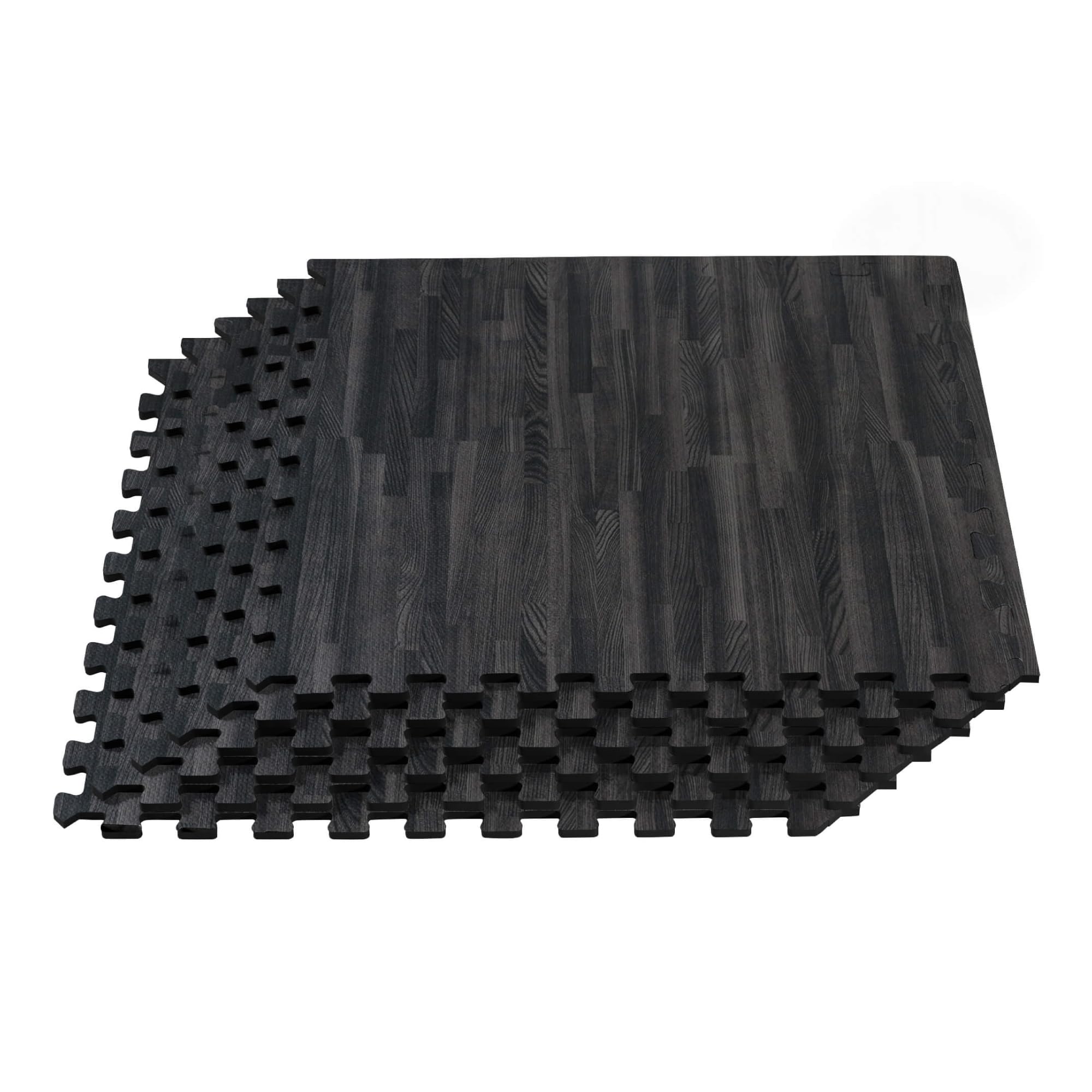
Foam tiles printed to look like wood, for the home gym that has to pass as a proper room.
If the gym shares space with the rest of the house, this is the pick that does not announce itself as gym flooring. These are 24″ x 24″ x 5/8 inch thick EVA foam tiles with a printed carbon wood-grain finish, and 100 square feet of the set covers a large room. Each tile has two detachable border pieces for a finished edge, and the interlocking system snaps together with no adhesive.
The anti-fatigue cushion is real — that 5/8 inch depth is generous for standing and floor work on concrete or hardwood, and it holds up as a light personal fitness and yoga surface. It is also the most attractive option on this list by a distance, and the printed grain blends into a basement or playroom rather than clashing with it.
The important honesty is durability. This is a soft printed foam, so it handles light fitness and floor work, but it is not a weight-lifting floor, and the printed surface can show wear with heavy traffic over time. Tiles can also vary slightly in thickness, which shows up as a small lip at the joins. And it is a décor-forward floor — if bare-bone strength training is the whole point, a rubber-top tile serves you better.
What you are really buying
- 5/8″ thick foam with anti-fatigue cushioning
- Printed wood grain makes a gym blend into the room
- 100 square feet covers a large space
- Tool-free snap-together install with border pieces
The compromises
- Soft printed foam is not built for heavy weights
- Small thickness variation between tiles shows at the edges
Right for you if: the gym doubles as a living space and the floor needs to look intentional.
Wrong tool for: a dedicated heavy-lifting room, where you want rubber under the bar.
Know the Specs
Thickness in millimetres and inches
Thickness is the number that decides how much impact the floor soaks up — and it is often listed two ways. GXMMAT gives 7mm, its spec sheet says 0.28 inches, and those describe the same mat. Use the number as a guide, not a promise: a 7mm foam roll cushions cardio but is not built to catch a dropped bar, and a 3/4-inch tile is comfier under knees but still compresses under a loaded rack. Choose the height of the mat by the weight and impact you actually plan to throw at it.
Coverage in square feet
Square feet is simply length times width of the area you need to cover, and it tells you what a pack will actually floor. A 12-tile pack of 24″ x 24″ tiles covers 48 square feet; a 24-tile pack doubles that to 96. Measure your room’s length by width to get your square footage, then buy the pack that meets or slightly exceeds it. Always order a little more than you measure — you will lose some to cutting around posts and edges.
Rubber top versus all-foam
A rubber top layer over a foam base is what separates a floor that survives a loaded bench from one that dents. All-foam tiles are softer and cheaper, great for yoga, floor work and play areas. A rubber-topped tile adds firmness and stain resistance where equipment stands, at a higher price and slightly more weight. Match the build to the load: rubber top for racks and machines, foam for stretching and bodyweight work.
Grip and stability
Grip comes from two places — a textured top surface that holds your hands and feet, and a backing that grips the subfloor so the mat does not creep. Rolls use grooved or matrix-circle undersides; tiles rely on puzzle edges and, on slick wood, a rug liner or double-sided tape. If you train barefoot on carpet or hard floor and your mat keeps sliding, the fix is usually the underlay, not the mat.
Common Questions
How thick should home gym flooring be for weightlifting?
Can I put foam tiles under a squat rack or treadmill?
Will interlocking foam tiles slide on hardwood floors?
How many square feet of flooring do I need for a one-car garage gym?
Is a rubber-top tile better than an all-foam tile for a home gym?
Do these mats have a chemical or rubber smell when new?
Can I cut interlocking tiles to fit around walls and posts?
Are foam gym tiles safe for kids and pets?
How do I clean home gym flooring after a sweaty session?
Can I use outdoor-grade rubber mats inside my home gym?
Will a rolled mat or interlocking tiles hold up better over time?
The Bottom Line
For most people setting up a flooring for home gym, the winner is the GXMMAT Large Exercise Mat because its 72″ x 60″ surface of double-sided non-slip 7mm foam handles cardio, weights and shoes without sliding, and it rolls up when the space needs to be something else. If your training is built around a rack or a bench, the rubber-topped Sivan Fitness set gives you a firm, stain-resistant surface that stays stable under load. And for a full garage bay or basement room, the Our Modern Space 24 Pack covers 96 square feet of cushioned space in one order. Whichever you pick, size it for the heaviest load it will take — a dropped barbell needs rubber, not foam.
How we choose
We do not accept paid placement. Every pick is matched to a real buyer and a real use-case; we do not hands-on test units.
Sources
Specifications: manufacturer listings and product documentation. Review insights: verified customer reviews, as of October 2026. Pricing: not shown on this page (it changes often); check the current price via the retailer link.
As an Amazon Associate, Aappliancez earns from qualifying purchases. This does not affect which products we feature.