Disclosure: Some links in this post are affiliate links. As an Amazon Associate I earn from qualifying purchases, at no extra cost to you. Learn more
Specs are compiled from manufacturer listings and verified buyer reviews and can change over time — please confirm the key details on the product page before buying.
You want a basement bathroom floor that survives a chilly, damp concrete slab without turning into a rippled, lifting mess. That is the whole test here. Every pick below is a peel-and-stick vinyl system, because vinyl is the practical material for gluing straight onto a basement slab with no grout lines to soak up moisture. The differences that matter are thickness, coverage per box, and how honestly the adhesive holds over concrete.
This guide is built by comparing the manufacturers’ published specifications and the patterns across verified customer reviews, so you get each pick’s real strengths and trade-offs instead of marketing spin.
The five options here span a 54 sq.ft plank pack, a thicker 12 x 12 tile, and a budget square tile — and the right one depends on your slab and your patience for prep. Read on for the straightforward breakdown of flooring for basement bathroom over concrete.
Top Picks


How To Choose Flooring for a Basement Bathroom Over Concrete
A basement bathroom is the hardest room in the house for a floor. The slab below stays cool, it wicks moisture up from the ground, and steam from a shower has nowhere to escape. Peel-and-stick vinyl is a genuinely sensible answer — but only when you match the tile to the slab and prep it right. Here are the four things that decide whether your install lasts.
Get the slab flat, dry, and dust-free first
Concrete throws off a fine dust that kills adhesive. Sweep, vacuum, then wipe with a damp cloth and let it finish drying. Fill deep grout lines or cracks and screw down any loose areas, because a tile laid over a dip will rock and eventually lift. Each product here says roughly the same thing: clean, flat, and dry before you peel.
Match thickness to how much comfort and quiet you want
Thicker vinyl feels firmer underfoot and hides small slab imperfections better. Thinner planks are easier to cut and slip under doors without shaving the bottom. A 0.08-inch tile is the beefiest here; a very thin roll plank is the easiest to work with but shows a heavy dropped object.
Do the coverage math before you buy
Every box or roll states a square-foot figure — 24, 30, 54 sq.ft and so on. Measure your floor, then add roughly a tenth extra for cuts and corners. Buy one box more than you think you need; matching a dye lot later is a gamble.
Read the water and slip claims carefully
Every option here calls itself waterproof, but that means the vinyl won’t swell — not that the seams between tiles are sealed. In a low-splash basement bathroom, run a bead of caulk or sealer around the tub and toilet base to keep moisture off the seams.
Side-by-Side Comparison
| Model | Best For | Coverage | Thickness | Style | Amazon |
|---|---|---|---|---|---|
| INMOZATA 36 Pack Peel and Stick Vinyl Plank★ Best Overall | Whole-room basement install | 54 sq.ft | 0.08 inches | Deep gray wood plank | Amazon |
| Art3d 30-Pack Peel and Stick Vinyl TilesEasy Transform | Easy room transformation | 30 tiles (12 x 12 in) | 0.06 inches | Slate square tile | Amazon |
| VIVIDCOZYTILE 1.8mm Thick Marble Tiles | Firm underfoot feel | 24 sq.ft | 0.07 inches | Beige-brown marble | Amazon |
| VallisCo 30-Piece Peel and Stick Tiles | Budget DIY starter | 30 sq.ft | 0.05 inches | Beige-brown square | Amazon |
| Lareko Peel and Stick Vinyl Wood Plank | Big rooms, fast rooms | 54 sq.ft roll | 0.02 inches | Nature gray wood | Amazon |
Detailed Reviews
1. INMOZATA 36 Pack Peel and Stick Floor Tile
Our pick — 4.0+★ from 550+ verified ratings; the strongest balance of quality and price.
The beefiest plank here — a thick slab of vinyl that takes a damp concrete floor seriously.
The headline number is the thickness: each tile is 0.08 inches thick, the heaviest plank in this lineup. That extra material does two things over a cold basement slab. It feels firmer underfoot, and it spans small dips and roughness in the concrete instead of telegraphing every bump up through the surface. Thirty-six pieces at 6 inches by 36 inches add up to 54 sq.ft of coverage — enough to do a full small bathroom in one pack.
The build is a rigid-core vinyl with a wood-grain texture and a self-adhesive backing, sold as 100% waterproof, scratch-resistant, and abrasion-resistant. The gray finish reads as real wood rather than printed plastic. What wins people over most is the overall build quality of the plank — it feels like a finished floor, not a sticker. The look of it is the close second, with the grain reading cleanly against concrete-gray basement light.
The honest catch sits in the same material that makes it durable. At 31 pounds for the pack, it is the heaviest option to haul downstairs and shift around mid-install. And a thick plank still needs a genuinely clean, flat slab underneath — the wood grain does not excuse a dusty floor. Line your pieces up before you peel, because repositioning a stiff 36-inch plank on fresh adhesive is more work than nudging a square tile.
What holds up on a slab
- 0.08-inch thickness is the most substantial here, so it shrugs off small slab imperfections rather than showing them.
- 36 planks deliver 54 sq.ft from a single pack — room for cuts and corners without a second order.
- Wood-grain texture in deep gray reads as genuine timber, not a printed sticker.
- The rigid, waterproof core resists the expanding and warping that softer vinyl tiles can show.
Where it asks more of you
- 31 pounds per pack makes it the heaviest box to carry and lay in a tight basement bathroom.
- Finish quality is what it sells on, so a rushed, dusty install wastes that edge.
Reach for this if: you want a finished, warm-to-the-eye floor and you’re willing to prep the concrete properly first.
Look elsewhere if: you have a very short doorway clearance or you want the lightest box to carry downstairs.
2. Art3d 30-Pack Peel and Stick Vinyl Floor Tiles
Square slate tiles that turn a grubby slab into a proper floor in an afternoon.
Start with the shape. Each tile is 12 x 12 inches, a manageable square you can trim with a utility knife and place without wrestling a long plank around a toilet base. Thirty of them come per pack. The slate finish is the crowd-pleaser — these look like a pricier hard tile than they are, and that appearance is what gets talked about most, with the easy cut-and-place install coming in close behind. The cut itself is simple: a utility knife scores and snaps a cleaner line than scissors.
Another concrete detail: the tiles are thicker than a lot of peel-and-stick products, which helps them lie flat and resist flex over concrete. They are also stain-resistant and waterproof, so a splash near the shower is not a crisis. Cleaning is a damp wipe.
Here is where you have to be honest with yourself. The adhesive is genuinely hit or miss — plenty stick hard and stay put for weeks, but some buyers report theirs never grabbed at all. That makes slab prep the whole ballgame: vacuum, wipe, and let the concrete dry completely. Do that and this tiles onto a basement floor cleanly; skip it and you are gambling. Push each tile down hard and use a measuring tool so the grid stays straight.
Slate looks costly: the charcoal-leaning finish hides dust and reads like real stone against the pale concrete lighting of a basement.
The adhesive is the risk: prep the slab well and this behaves; leave dust behind and any peel-and-stick tile, this one included, struggles.
Best for: the DIYer who wants a square tile for fussy corners and a slate look that flatters a low-light basement.
Choose another if: you have a damp slab you can’t fully dry out — this one leans on a clean, dry surface to stick.
3. 1.8mm Thick Peel and Stick Floor Tiles
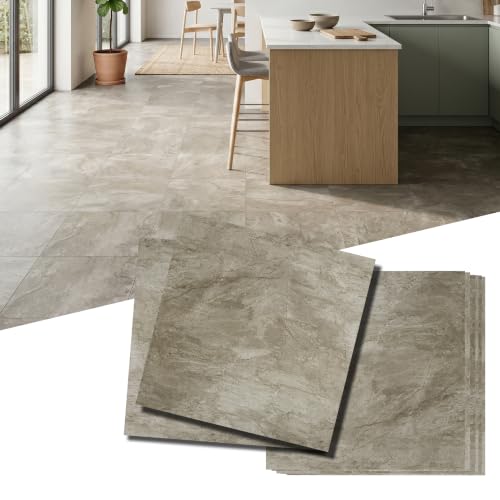
A warm travertine-marble look in a rigid core that feels solid, not spongy, on a cold floor.
What you feel first is how rigid it is. Each tile runs 0.07 inches thick with a high-density PVC core (a stiff plastic center that holds its shape), so it stays flat and doesn’t curl at the edges. That matters on a basement slab, where a cheap, floppy tile can peel itself up. The beige-brown travertine pattern warms up an echoey, gray-lit basement bathroom better than concrete or slate. The textured matte surface adds grip underfoot, so it stays less slick when the floor gets damp.
Cutting is genuinely simple: score the face with a knife and it snaps clean. As one buyer put it in the install notes, “I just used an exacto knife and level for straight lines.” That clean snap makes the 12 x 12 squares easy to line up around a toilet or floor drain. Twenty-four pieces cover 24 sq.ft, so do your math and buy a little extra for cuts. The heat-removable adhesive (glue that softens when warmed) is a nice touch for a rental — soften it with a hairdryer and the tile lifts back up.
Set expectations on the look and the seams. This is a convincing imitation of stone, not the real thing, and the tiles butt together edge to edge, so an eagle eye will catch the seams. A few units show up with a chipped corner. In a damp basement, a bead of mild caulk around high-splash areas keeps moisture off those joints. The matte surface also keeps its grip when wet.
Solid-core payoff: the 0.07-inch rigid core resists the telegraphing you get when a thin tile presses down over every bump in the concrete.
Read the seams: the finish is realistic up close but tile-joint lines remain visible — fine in a basement bathroom, a tell-up-close anywhere fussy.
Suits: anyone who wants a warmer, stone-look floor with a firm feel and a renter-friendly removable adhesive.
Think twice if: you need scores of coverage in one box — this set covers a compact floor, so measure carefully.
4. VallisCo 30-Piece Peel and Stick Floor Tiles
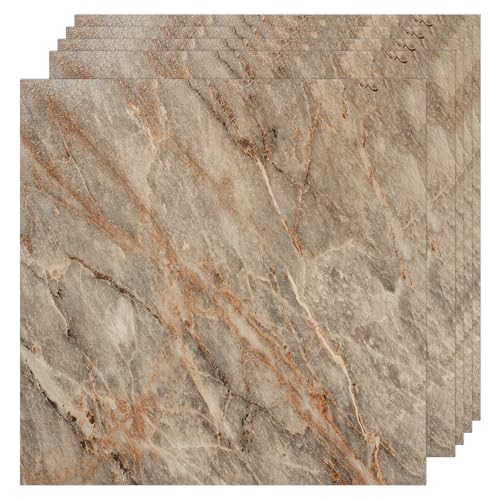
A thin, beginner-friendly square tile that gets a first-timer across the finish line.
If you have never laid a floor before, this is the forgiving entry point. Thirty 12 x 12 squares cover 30 sq.ft, and the build is deliberately thin at 0.05 inches — the easiest of the bunch to cut with a utility knife and slip under a door without trimming it. The soft beige tone is what owners single out for praise, and the general look and build quality carry the positive side of the ledger.
The textured surface adds slip resistance and the tile is waterproof, so brief dampness and a bathroom splash won’t damage it. Designed for high-traffic rooms and moisture-prone spaces, the wear layer wipes clean with a damp cloth — no waxing, no fuss.
Now the real talk, because a budget tile asks for honesty. The adhesive and durability draw the most mixed word of mouth, with some saying it sticks hard and cleans up well, and others finding it lifts or chips over time. That means prep is not optional: dust-free, dry, and flat, or it will show. And the thin profile that makes cutting easy also means it hides almost nothing — a rough slab will read right through it. It suits a small, dry-ish basement bathroom used lightly; it is not the tile to build a long-term wet-room around.
The beginner-friendly case
- The 0.05-inch thickness cuts fast with a knife and slips under door gaps that other tiles wouldn’t.
- 30 sq.ft of textured, slip-resistant waterproof squares per set.
- Soft beige tone and clean finish — it looks far better than what it costs.
- No glue, no tools, no underlayment — peel and stick in an afternoon.
What to prep for
- Adhesion is the swing factor — report is mixed, so bet on careful surface prep, not luck.
- Thin material hides zero slab imperfections; a smooth, dry base is the price of entry.
Pick it for: a quick, low-cost refresh on a small, dry basement bathroom floor you clean up carefully first.
Pass over it if: your slab is rougher or damper than you can smooth and dry — the thin profile here won’t mask it.
5. Lareko Peel and Stick Floor Tile

The fast, forgiving plank roll that finishes a whole bathroom in an afternoon.
Where the other picks come as tiles, this arrives as a roll of planks: 36 pieces per roll covering 54 sq.ft, or 12 pieces covering 18 sq.ft if you order the smaller set. The real appeal is the forgiving install — you can lift and reposition during placement for perfect alignment, and an entire room comes together in 1-2 hours. That forgiveness is what the bulk of owners rave about most, with the authentic wood appearance a close second.
Get the order of operations right and it pays off. The planks come off the roll slightly wavy, so lay them flat under a heavy object for a day, or at least a quarter hour, before you peel. Then apply them in the packaged order. The embossed wood grain reads like real timber, and the gray finish adds depth without looking plasticky — a nice touch when a basement bathroom feels cold and hollow.
The trade-off is thickness. This is a thin plank at 0.02 inches, and that is the note that keeps coming back in reviews — it’s fine underfoot and thin enough to clear a door, but a heavy dropped object can mark it. So don’t baby it. Used as a low-use basement bathroom floor, it delivers a warm, wood-look result for very little outlay.
Speed written into the design: repositionable placement plus 54 sq.ft per roll means a whole bathroom in one session, not a weekend.
Thin is the catch: at 0.02 inches it forgives handling but not neglect — keep heavy things off it and respect that flat-slab prep.
Go with it when: you want a wood-look floor done fast and cheaply across a roomy basement bathroom with a flat slab.
Hold off if: you need a tactile, thick floor that shrugs off dropped tools — this one wants a gentler life.
Know the Specs
Thickness (millimeters or inches)
Thickness is the thickness of the vinyl itself. A thicker tile, like a 0.08-inch plank, feels firmer underfoot and covers small dents and trowel marks in the concrete. A thinner tile, nearer 0.02 inches, cuts easily and slips under a door with no trimming, but it shows every bump beneath it. In a basement, the trade-off is comfort and forgiveness versus easy cutting.
Coverage per box or roll
Coverage is the floor area one pack will finish, given in square feet. Measure your floor’s length times width, then add extra for cuts, corners, and pattern matching. Buying one extra box beats hunting a matching dye lot later. A pack that covers 54 sq.ft finishes most small bathrooms; one that covers 24 sq.ft suits a compact space.
Waterproof versus water-resistant
Waterproof here means the vinyl won’t soak up water and swell or warp. It does not mean the seams between tiles are sealed against water. In a basement bathroom, run a bead of caulk or sealer around the tub, shower, and toilet base to keep splashes moving away from the joints — the tiles themselves are fine with moisture.
Slip resistance
A textured matte surface gives more grip underfoot than a slick, glossy finish. Look for wording like anti-slip or slip-resistant if the bathroom sees bare feet and steam. Smooth tiles can get slick when wet, so a textured top face is a real safety consideration in a basement bathroom.
Common Questions
Can peel and stick vinyl tile go directly on a concrete basement slab?
What thickness is best for a basement bathroom floor?
How much extra flooring should I buy for cuts and corners?
Will these tiles warp from basement dampness?
Can I remove peel and stick flooring if I am renting?
Do I need underlayment over concrete before sticking tiles down?
How do I cut vinyl plank or tile around a toilet base?
Are peel and stick tiles slippery when wet in a bathroom?
How long do peel and stick vinyl floors last on a basement slab?
Can I put these tiles over an old vinyl or ceramic floor instead of the concrete?
The Bottom Line
For the flooring for basement bathroom over concrete, the winner is the INMOZATA 36 Pack Peel and Stick Vinyl Plank. Its 0.08-inch rigid plank is the thickest and most forgiving over a cold, imperfect slab, so bumps and dips in the concrete show less. One pack brings 54 sq.ft of wood-look coverage. If you want a manageable square tile for fussy corners and a slate finish, grab the Art3d 30-Pack Slate Tiles. And for a fast, forgiving wood-look floor across a roomy bathroom in a single session, the Lareko Peel and Stick Plank Roll is the one to reach for.
How we choose
We do not accept paid placement. Every pick is matched to a real buyer and a real use-case; we do not hands-on test units.
Sources
Specifications: manufacturer listings and product documentation. Review insights: verified customer reviews, as of October 2026. Pricing: not shown on this page (it changes often); check the current price via the retailer link.
As an Amazon Associate, Aappliancez earns from qualifying purchases. This does not affect which products we feature.