Disclosure: Some links in this post are affiliate links. As an Amazon Associate I earn from qualifying purchases, at no extra cost to you. Learn more
Specs are compiled from manufacturer listings and verified buyer reviews and can change over time — please confirm the key details on the product page before buying.
If you want a floor mounted mini split, the short answer is this: buy one sized for your actual square footage, not the biggest BTU number you can afford. An oversized unit short-cycles: it cools the room before it dehumidifies, leaving you clammy in July. The picks below are ranked on real capacity-to-room math, cold-weather heating limits, and how quietly the indoor head actually runs.
This guide is built by comparing the manufacturers’ published specifications and the patterns across verified customer reviews, so you get each pick’s real strengths and trade-offs instead of marketing spin.
A floor-mounted head sits at ankle height, so warm air lands where you stand instead of pooling at the ceiling — a real difference under tall windows or over a cold crawlspace. Here is how each option handles that job: best floor mounted mini split.
Top Picks

How To Choose The Best Floor Mounted Mini Split
Almost every unit sold as a “floor mounted mini split” is really a floor-or-ceiling console, a low-profile head you can sit under a window or hang from the ceiling plate. That placement is the whole point. Heat leaves the top louver and spreads at hip level instead of collecting near the ceiling.
Match the BTU number to the room, not the listing
A 12,000 BTU system (about 1 ton) suits a bedroom up to roughly 550-750 sq ft. A 24,000 BTU system (2 tons) is the workhorse size for an open living area of 1,000-1,500 sq ft or a converted garage. Put a 24,000 BTU unit in a 200 sq ft bedroom and the compressor hits setpoint in minutes, then shuts off before it has pulled much moisture out of the air.
Your real numbers to check are floor area in square feet and the heating capacity figure printed next to the cooling figure. A unit can be rated at 24,000 BTU cooling and only 24,000 BTU heating — or lower. In a cold climate, the heating number is the one you live with in January.
SEER2 is a running-cost label, HSPF2 is a heating label
SEER2 is the efficiency score for cooling — higher means less electricity per unit of cooling. HSPF2 is the equivalent score for heating. A unit with a strong SEER2 and a weak heating side will still cost you money in February.
Voltage, line set, and the install crew
Most 12,000 BTU units run on 115V, which often means a dedicated breaker from a standard panel. Step up to 24,000 BTU and you are generally in 208-230V territory, and that means hiring an electrician. Check the included line-set length before you commit — a 15 ft or 16 ft kit is common, and a long run across a garage will burn through it.
Cold-weather floor: the real cutoff
Heating capacity falls as outdoor temperature drops. Some units in this list are documented to work down to 5°F, others to -4°F or -22°F. Below the rated floor you need a backup heat source, and that is a planning decision, not a defect.
Side-by-Side Comparison
| Model | Best For | Cooling BTU | Floor Area | Efficiency | Amazon |
|---|---|---|---|---|---|
| Senville AURA 24000 BTU★ Best Overall | Whole-home anchor room | 24,000 BTU | 1,250 sq ft | 21.5 SEER | Amazon |
| YITAHOME 12000 BTU 115VBest Value | Bedroom or small layout | 12,000 BTU | 750 sq ft | 20 SEER2 | Amazon |
| Albott 24,000 BTUBiggest Coverage | Big open space on a budget | 24,000 BTU | 1,550 sq ft | SEER2 18 | Amazon |
| Temprium 24000 BTU 230V | Quiet bedrooms and nurseries | 24,000 BTU | 1,500 sq ft | 19 SEER2 | Amazon |
| SereneLife 24,000 BTU | Large family rooms | 24,000 BTU | 1,400 sq ft | — | Amazon |
| COSTWAY 24000 BTU | Energy Star shoppers | 24,000 BTU | 1,500 sq ft | 21 SEER2 | Amazon |
| ROVSUN 24000 BTU | Budget 2-ton coverage | 24,000 BTU | 1,500 sq ft | 20 SEER | Amazon |
| Daikin Entra 12,000 BTU | Small rooms, brand pedigree | 12,000 BTU | 550 sq ft | 18 SEER2 | Amazon |
| DELLA Vario 24000 BTU | Whole-shop cooling | 24,000 BTU | 1,500 sq ft | 21 SEER2 | Amazon |
| MRCOOL Easy Pro 12000 BTU | DIY-friendly small room | 12,000 BTU | 550 sq ft | — | Amazon |
| Senville Floor/Ceiling 18000 BTU | True floor-console placement | 18,000 BTU | — | Energy Star | Amazon |
| MRCOOL 24000 BTU Inverter | Garage and shop conversions | 24,000 BTU | 1,050 sq ft | — | Amazon |
| Cooper & Hunter 28,000 BTU 2-Zone | Two rooms, one condenser | 28,000 BTU | — | 25 SEER2 | Amazon |
Detailed Reviews
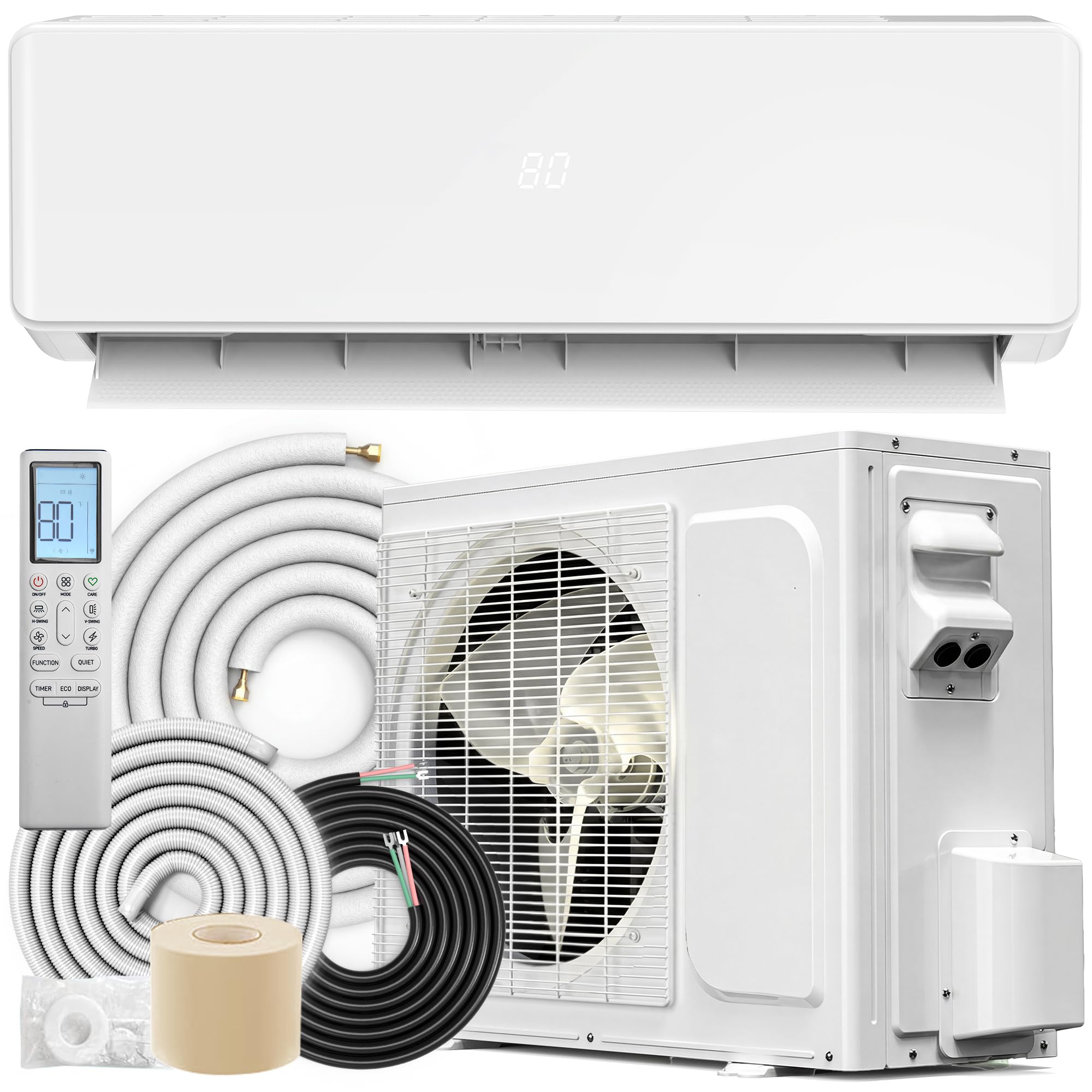
1. Senville AURA Mini Split 24000 BTU
Our pick — 4.5+★ from 550+ verified ratings; the strongest balance of quality and price.
A 2-ton workhorse rated to keep heating at -22°F, which is a number most of this list cannot touch.
Start with the cold-weather claim, because that is where the AURA pulls ahead. It is documented to deliver dependable cooling and heating down to -22°F (-30°C) on a 208-230V DC inverter. If you live somewhere the winter actually bites, that single figure changes what you can heat without a backup furnace.
This unit heats and cools a big space: 24,000 BTU (British thermal units, the standard measure of cooling power) across 1,250 sq ft. It runs on a 21.5 SEER rating (Seasonal Energy Efficiency Ratio, where higher means cheaper to run) and a documented 3,973 kilowatt hours per year. Compare that to the YITAHOME 12,000 BTU unit at 600 kilowatt hours per year and the size gap is clear. The AURA covers 1,250 sq ft against the YITAHOME’s 750 sq ft, and it draws 2 tons against 1 ton. Bigger room, bigger draw — that is the honest trade.
Performance is what wins people over — it is the most-discussed positive in its own review set, with cooling performance right behind it. Buyers with a hunting cabin in the cold report the 24,000 BTU system taking a 1,000 sq ft space from 84°F down to 68°F in about two hours. Others run it through a phone or Alexa to pre-cool before they arrive. The recurring gripe is the manual, not the machine: instructions have caused damage on more than one install. The condensate slip connection (the drain joint) can also weep, so keep a bit of silicone sealant on hand for that joint.
Where it earns the top slot
- Heating documented down to -22°F (-30°C) — a genuine cold-climate floor
- 21.5 SEER on a 208-230V DC inverter for low running cost
- 1,250 sq ft of coverage from 24,000 BTU and 2 tons of capacity
- Alexa and app control so you can cool the place before you walk in
What to plan around
- Not a DIY system — professional installation is stated as required
- The 16 ft line set is fixed; a longer run means buying extra
- The manual is thin, and one common slip-joint leak needs sealant
Top of the pile if: you need one system to carry a large room through a real winter, and you are hiring the install out anyway.
Think twice if: your space is under about 700 sq ft — 24,000 BTU will cycle hard and you are paying for capacity you cannot use.
2. YITAHOME 20 SEER2 12000BTU Mini Split AC/Heating System 115V
The small-room pick that runs on standard 115V and sips 600 kilowatt hours a year.
Six hundred kilowatt hours per year. That is the whole argument for this unit, and it is a fair one — the Senville AURA above logs 3,973 kilowatt hours per year while covering a bigger space. The YITAHOME trades raw capacity for a light running load: 12,000 BTU, 1 ton, 750 sq ft, 20 SEER2.
It means you are not automatically in 208-230V territory, which keeps the electrical work simpler on a bedroom or basement retrofit. Noise is rated below 41 decibels, and the remote covers a 60°F to 90°F range. Airflow is listed at a 50 ft throw with 4D circulation — though the spec sheet notes the left-and-right swing mode is excluded, which is worth knowing before you picture it sweeping the whole room.
The pattern across its reviews is efficiency and quiet, with buyers running it in 100°F-plus heat on ECO mode and finding it holds temperature cheaply. One recurring behavior worth sizing up front: the blower does not always shut off at the setpoint, and a couple of owners have seen it overshoot — a setpoint of 65°F drifting toward 51°F. The straightforward fix is to size it for the room rather than buying oversized. Setup runs a couple of hours for a handy buyer, but it still needs a vacuum pump and a compatible flaring tool.
Running-cost headline: 600 kilowatt hours per year on 20 SEER2, which is the lowest annual draw in this group.
The caveat to size around: the blower can overshoot your setpoint, so a modest room beats a big open one here.
Reach for this if: you are cooling one bedroom or a small open layout and want a 115V unit that barely shows up on the bill.
Look elsewhere if: you need one head to carry an 1,100 sq ft house — buyers who pushed it that far had to accept uneven temperatures at the far end.
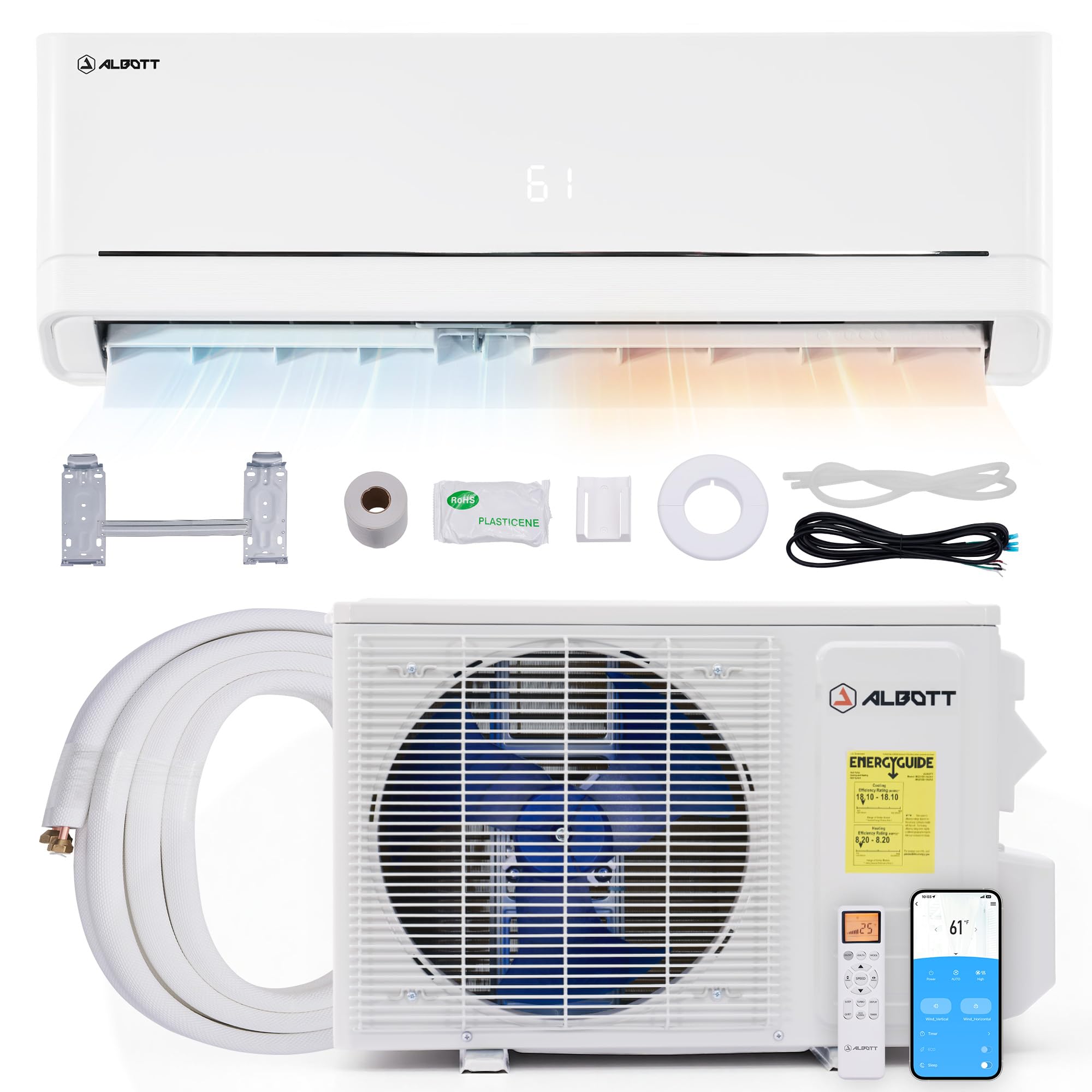
3. Albott Mini Split 24,000 BTU
1,550 square feet of rated coverage from a 24,000 BTU head that runs below 29 decibels.
That 29 dB figure is the one to hold onto. It is quieter than a library whisper, and it comes attached to the largest floor-area rating in this entire list at 1,550 sq ft. For a shop, a converted barn, or a big open-plan ground floor where the indoor head has to disappear into the background, that pairing is unusual.
Heating capacity matches the cooling figure at 24,000 BTU, and the operating window runs 5°F to 122°F. Efficiency lands at SEER2 18 with 1,450 kilowatt hours per year — not the leanest number here, but you are moving a lot of air for it. The 208-230V requirement means a real electrician call. Extras include a self-cleaning cycle, removable filters and air blades, plus a 5-year compressor and 7-year parts warranty.
Quality takes the most praise in its review history, with value for money close behind. The solar-cabin crowd is loudest: one setup runs it on roughly 200W off a solar system in a 2,100 sq ft dome, cooling the whole space. Sample size is the caveat here — this is a newer listing with a modest review base, so its long-term track record is thinner than the Senville or DELLA units. The app has also been a struggle for some, though the remote covers the job either way.
Quiet-and-huge combo: below 29 dB with 1,550 sq ft of coverage is the pairing no other unit here offers.
Honest counterweight: the review base is small, so you are buying on specs and warranty rather than a long proven history.
Suits you if: a single quiet head has to cover a very large open space and the warranty terms are what sell you.
Skip the app dependency if: smart control is a must — the remote is the reliable path on this one.
4. 24000 BTU Mini Split 230V
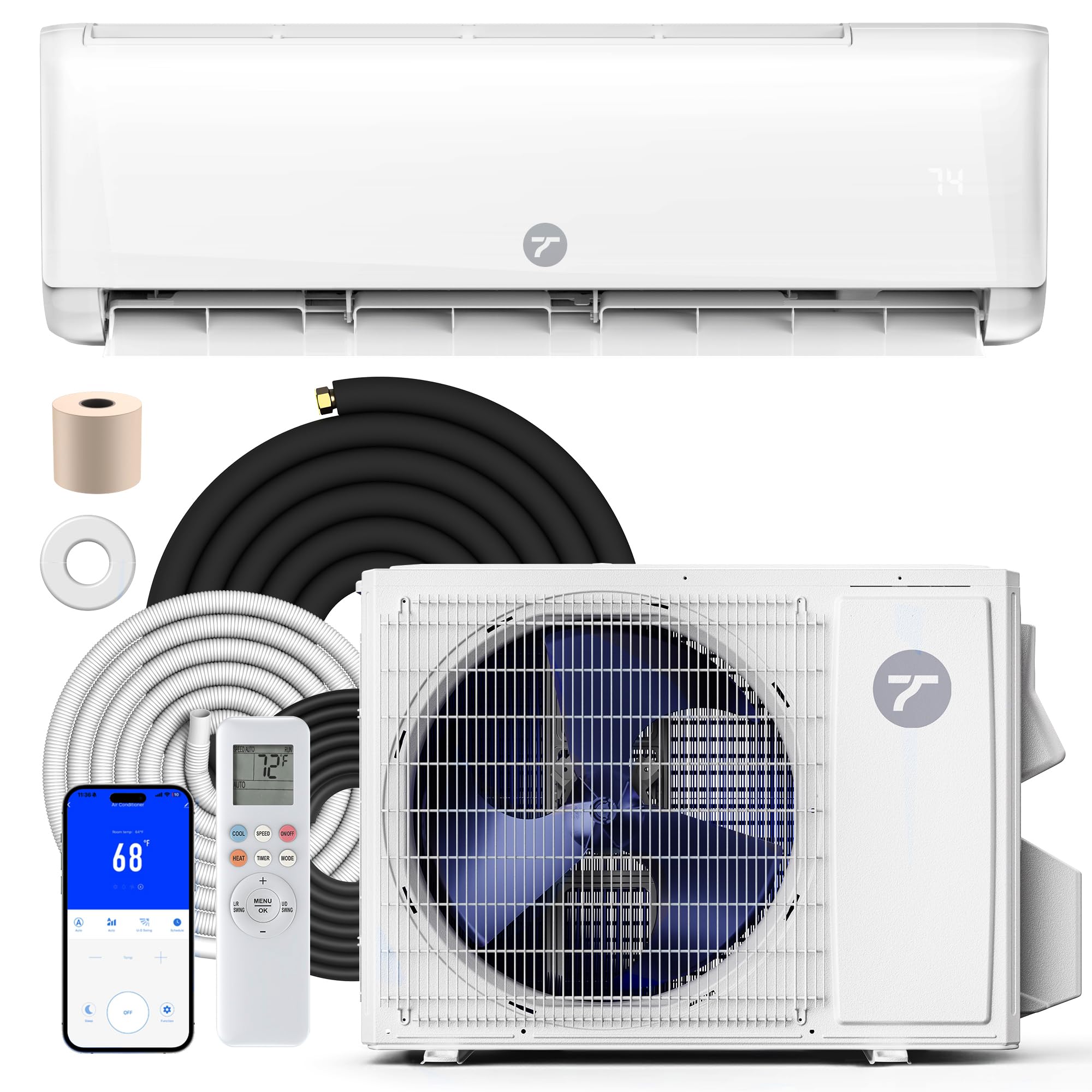
Built for the room you sleep in, with a 30 dB floor and a sleep mode that dims the display.
Noise is the feature here, and the number is 30 decibels — quiet enough that the display dimming in sleep mode becomes the more noticeable event. It pairs with 24,000 BTU of cooling and 24,000 BTU of heating across 1,500 sq ft, so you are not sacrificing output for the silence. The 19 SEER2 rating and R32 refrigerant round out the efficiency side.
Control is unusually complete for this tier. You get the app, voice through Alexa or Google Assistant, and a backlit remote with 7 operating modes and 7 fan speeds. There is a 4D auto swing, a Turbo setting, and a Follow-Me function that reads temperature at the remote instead of the wall unit. Hot-weather performance is documented to 119°F cooling, and heating runs down to 5°F.
Quality and value carry the most weight with owners, and the quiet operation gets its own share of the praise. The honest wrinkle is WiFi — connectivity earns mixed feedback, and buyers have reported the app refusing to pair while the remote works fine with good reach. One other detail worth knowing: remote documentation advertises left-and-right swing, and at least one install found only up-and-down sweep present. Treat the remote as the primary control and the app as a bonus.
Bedroom logic: 30 dB plus display dimming is a combination aimed squarely at light sleepers.
Set expectations on smart control: the app is the weak link judging by owner experience; the backlit remote is not.
Best fit for: a bedroom, nursery, or home office where a hum at night is the thing you are trying to escape.
Choose differently if: app-based scheduling is central to how you want to run it.
5. SereneLife 24,000 BTU Mini Split
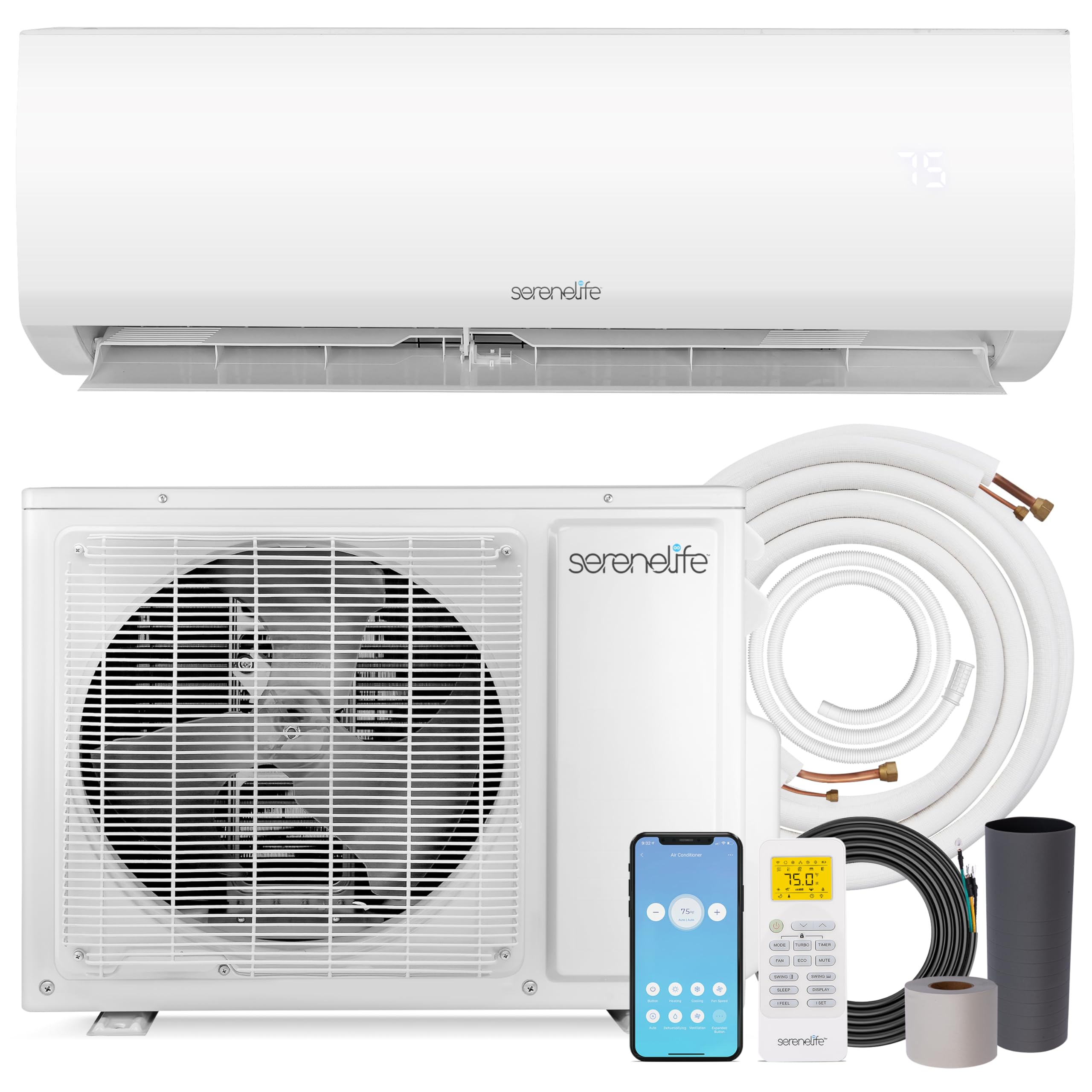
The volume leader of the group, with the largest owner base of any pick on this page.
When you want to know how a mini split behaves after a few summers, volume of owner experience counts for something. This SereneLife has it in bulk — thousands of ratings and a cooling record that owners describe as consistent. The hardware spec is 24,000 BTU of cooling over up to 1,400 sq ft, noise as low as 36 dB, and five modes (auto, cool, dry, fan, heat) with a programmable timer.
Control runs through the app plus a remote, and there is an auto-restart that picks the unit back up after a power cut — genuinely useful if your area gets brownouts. The installation kit is included, with a 5-meter copper pipe, remote, and AC power cord. Annual energy consumption is listed at 2,409 kWh, so it is a mid-tier runner rather than the leanest on this page.
Here is the honest shape of the owner record. Performance and cooling are overwhelmingly the strengths, and the unit handles real rooms — a 12×20 family room comes up repeatedly as comfortable territory. But noise sits on the mixed side, with a high-pitched whirring from compressor resonance showing up in enough reports to be a pattern rather than a fluke. Durability is also listed as mixed. If the indoor unit lands next to a bed, plan for that whir; in a family room or open kitchen it fades into the background. Packaging has also been a weak point, with more than one unit arriving with a coolant leak and needing replacement.
Why people keep buying it
- Deep owner base with a consistent cooling record across large rooms
- Auto-restart resumes after a power cut without input from you
- Five modes plus WiFi and a programmable timer in the box
- 36 dB rating keeps the indoor head out of the way in a living space
The honest counterpoints
- Noise is a mixed record — compressor whir shows up in enough reports to plan around
- 2,409 kWh per year is higher than several rivals here
- Shipping damage and coolant leaks have hit more than one delivery
Made for: a family room or open kitchen where a 24,000 BTU head has to keep a big space steady.
Not the pick if: the unit is going directly over the head of a light sleeper.
6. COSTWAY 24000 BTU Mini Split Air Conditioner, Energy Star

An Energy Star Most Efficient badge with 21 SEER2, 10 HSPF2, and a heating record that warms a house in ten minutes.
The badge is the reason to start here. Energy Star Most Efficient is a step above plain Energy Star, and it comes attached to 21 SEER2 (the updated efficiency score for cooling) along with 10 HSPF2 (the heating score). That second figure is the one that separates a year-round machine from a summer-only one. Cooling capacity is 22,000 BTU with 23,000 BTU of heating from a 2-ton heat pump, rated for 1,500 sq ft.
Build details are practical rather than flashy. Self-cleaning runs at 135°F to dry the coil, the filters pull out and rinse under water, and you get a 26 ft remote with a child lock. Control comes through the app or the remote. The operating window is 5°F to 125.6°F, and airflow is listed at 353 CFM with a 4D pattern. A 13 ft copper line set and communication wire ship in the box.
What wins people over is performance, with installation close behind — the install side of this unit gets described as simpler than expected for a first-timer, provided you have a vacuum pump and avoid kinking the lines. The heating side earns its own notice: buyers report the house warming in under ten minutes. Two recurring notes are worth carrying in. The remote runs in Celsius and takes some learning, and the horizontal swing vane arm has snapped on at least one unit. Treat the louver arm gently and the rest holds up.
Efficiency where it counts: 21 SEER2 paired with 10 HSPF2 means both the cooling and the heating season are covered.
One part to baby: the horizontal swing vane arm is the known weak point — move the louver by hand, not by force.
Pick this for: year-round use where the heating bill matters as much as the cooling one.
Avoid if: you want a Fahrenheit remote and no learning curve.
7. ROVSUN 24000 BTU Mini Split

Steps into 2-ton territory at entry-level money, with a 35-51 dBa noise range you should read carefully.
That noise range is the tell. 35 dBa at the low end is genuinely quiet; 51 dBa at the high end is a fan you will notice. Other 24,000 BTU units on this page quote a single low figure, so ROVSUN is being more forthcoming about what happens on Turbo. The rest of the sheet is 20 SEER at 230V/60Hz, 24,000 BTU over 1,500 sq ft, a 61°F to 88°F remote range, and a washable filter.
Annual energy consumption is 2,940 kilowatt hours per year — the heaviest draw of the 24,000 BTU group here, which is the cost of the lower efficiency rating. Modes are complete: fan speed selection, sleep, a 24-hour timer, ECO, Turbo, and Mute, all from the remote. There is a 4-way swing and auto-defrost for winter operation.
The owner record is genuinely mixed and worth reading plainly. Long-run reports are positive — one unit held a large living room at 70°F through 108°F humidity in North Carolina for a year with no issues and about a day on the bill. The counter-reports matter though: a unit that only blew warm air, and another that leaked its refrigerant charge right as the warranty window closed. For a shop or a garage where downtime is annoying rather than disastrous, that risk profile is tolerable. For a primary living space, weigh it.
The spec you should note: 35-51 dBa is an honest range, not a best-case single number.
The efficiency cost: 2,940 kWh per year is the highest annual draw among the 24,000 BTU picks reviewed here.
Works for: a workshop, garage, or storage space where a budget 2-ton unit does the job and downtime is survivable.
Not for: a primary living room where reliability carries more weight than the entry-level outlay.
8. Daikin Entra R32 Mini Split

The brand a working HVAC contractor puts in their own truck, in a compact 550 sq ft package.
Daikin builds the compressors that other brands buy, so the Entra carries a name with real weight behind it. The numbers are modest by the standards of this list: 12,000 BTU of cooling, 11,300 BTU of heating, 18 SEER2, 9 HSPF2, 8.5 EER2, and a 3.30 COP. Coverage is 550 sq ft, which makes this a bedroom, sunroom, or garage office unit rather than a whole-home system.
What is genuinely strong is the operating envelope. Cooling runs from 50°F to 115°F, and heating holds from 5°F to 65°F. Extras include a Titanium Apatite Photocatalytic air purifying filter, Blue Fin coil protection, ECO+ mode, and cold-draft prevention. The kit is complete: indoor fan coil, pre-charged condenser, remote, a 15 ft refrigerant line with interconnect cables, and a wall bracket.
Owner feedback centers on two things — how quiet it runs and how simple the controls are. Quiet, compact, unobtrusive, with a programmable on/off timer. The installation reality is the catch and it is a big one. Reflaring the factory flare fittings is a known requirement on these units; factory flares have leaked within days and needed a service call plus added refrigerant. The first unit arriving without a charge has also happened. This is a machine that wants a real technician with gauges and an R32 adapter, not a weekend project.
Why the badge matters
- Heat pump brand with compressor manufacturing behind it, not a rebadged generic
- Heating holds down to 5°F and cooling up to 115°F
- Whisper-quiet indoor head that owners consistently call unobtrusive
- Complete kit with 15 ft line set and wall bracket included
The install reality
- Factory flares need reflaring — leaks within days are a known failure mode
- 550 sq ft is the ceiling, so it is one room, not a whole floor
- Needs a tech with gauges and an R32 adapter, not a DIY kit
Buy it for: a small room where brand pedigree and a small footprint matter and you have a technician lined up.
Steer clear if: you were planning to install it yourself — the flare fittings will fight you.
9. DELLA Vario Series 24000 BTU

21 SEER2, a -4°F heating floor, and the largest satisfied owner base of any 2-ton unit here.
It beats the Senville AURA on efficiency and loses on cold-weather reach. DELLA’s 21 SEER2 goes slightly past the AURA’s 21.5 SEER when you account for the different rating standard, and both cover 1,500 sq ft (the AURA rates 1,250 sq ft). The AURA holds heating to -22°F; DELLA holds to -4°F (-20°C). Both are real cold-climate machines, but the Senville goes further. Pick DELLA for a milder winter or a shop you only use in shoulder season.
Heating capacity is listed slightly above cooling at 24,600 BTU/h, and the unit runs 208-230V with a 25A maximum fuse. There is a smart sensor that reads room temperature at the remote instead of at the indoor head — a genuinely useful trick in a big open space where the wall sensor sits in a dead zone. Noise is 36 dBa. The kit includes a 16.4 ft line set, and you do not need a refrigerant adjustment below 25 ft of run.
Cooling performance carries the most praise by a wide margin, with quiet operation right behind. The pattern is people cooling spaces that should not work: a 2,200 sq ft shop in Nebraska humidity, a 21×40 ft shop with 13 ft ceilings on a 98°F day, a whole house on a 100°F day with a fan helping. The honest counterweight is maintenance. Reviewers mention yearly mold cleaning on the vertical blades, and the blades on this model do not remove easily. Budget for that chore if you are in a humid climate.
The trade against the top pick: DELLA reaches -4°F, the Senville AURA reaches -22°F. If your winter regularly goes below zero, the AURA is the safer bet.
The chore nobody mentions: those vertical blades need a yearly vinegar clean and they do not pull out easily.
The pick for: a big shop or open floor where you want proven cooling volume and the widest install support.
Reconsider if: you are in a deep-freeze climate — the AURA’s lower heating floor is worth the trade.
10. MRCOOL Easy Pro 12000 BTU
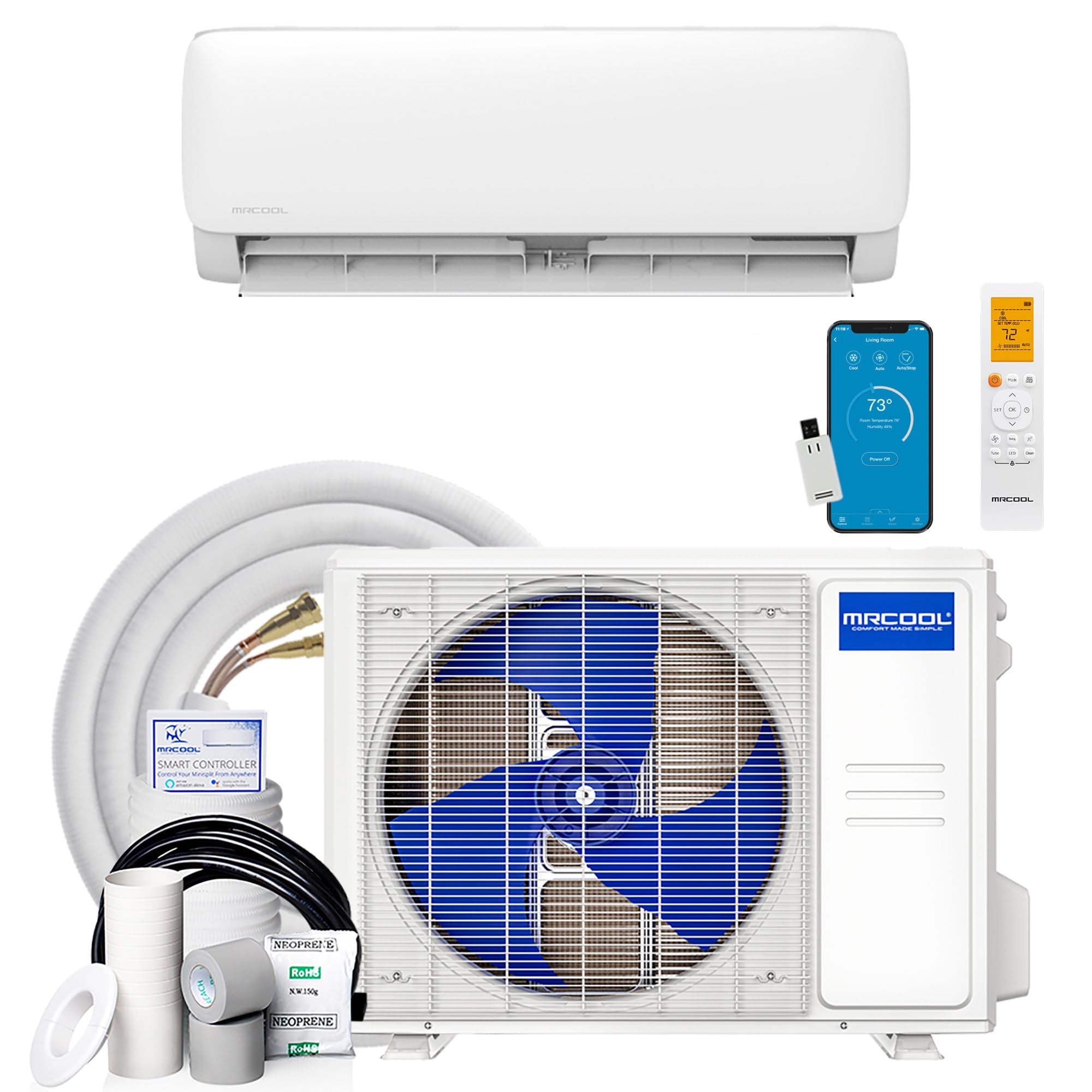
The 115V unit you can actually put in yourself, for a bedroom or a small office up to 550 sq ft.
Most of this list says “professional installation required” in bold. This one says the opposite — the listing states no special tools, equipment, or expertise are needed for the 115V wall-mounted setup. The capacity earns that simplicity: 12,000 BTU of cooling and heating for rooms up to 550 sq ft, which keeps the electrical work and the line run modest.
The rest of the spec sheet is consumer-friendly. Washable filters rinse under the tap. Google Assistant and Amazon Alexa handle voice control, and there is a sleep function that adjusts the overnight temperature. Noise is described as whisper-quiet, and both the indoor and outdoor units have a reputation for staying out of earshot. Annual energy consumption is listed at 20 kWh per year — the lightest draw on this page.
Effectiveness is the most-praised quality, and the DIY story is consistent. A 320 sq ft insulated shed office, a one-bedroom apartment, a 540 sq ft kitchen and living area — all cases where the install went in with a wrench and a spray bottle for leak-checking. The practical snags are small but real. The included 5 ft drain hose is often too short and needs a 10 ft replacement. Standard torque wrench kits top out at 19mm, while this needs 21mm, 24mm and 27mm fittings. Durability is the one mixed signal, with a report of a Freon line cracking at a weld point. Line up the hose and the wrenches before you start.
What makes it different: a genuine DIY proposition on 115V, unlike almost everything else on this page.
Small tools detail that bites: buy the drain hose extension and the larger torque fittings before install day.
For the hands-on buyer: a single room, a shed office, or a garage apartment, and you want to do the work yourself.
Not it if: you need more than 550 sq ft of coverage from one head.
11. Senville Floor Ceiling Mount 18000 BTU
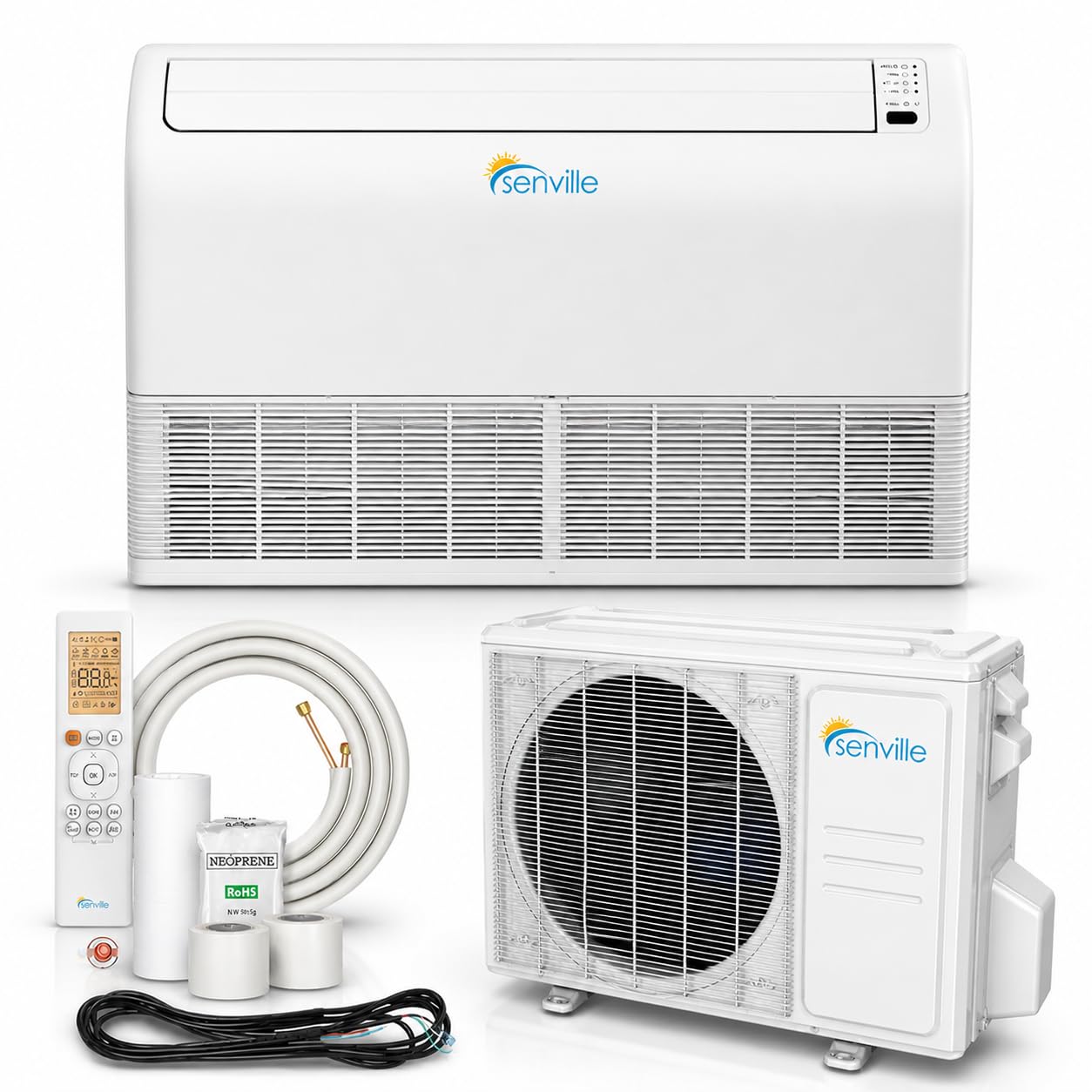
The literal answer to this keyword: a genuine floor console you can also hang from the ceiling.
Most of the units on this page are wall heads that people call floor mounted because of where the airflow lands. This one is an actual floor console — a 1.5-ton, 18,000 BTU head designed to sit on the floor or mount overhead, with the DC inverter and Energy Star badge behind it. If the point of your search is a unit that lives at floor level, start here.
Coverage sits between the 12,000 and 24,000 BTU picks, which makes it a good fit for a long living room, a basement, or a converted garage where a wall head has nowhere to go. Copper core, UL Listed, AHRI Certified, and a 208-230V requirement. The package is complete with the indoor handler, outdoor condenser, and a 16 ft line set and communication wire. It is stated plainly that this is not a DIY unit.
Quiet is the standout from the owner side — the phrase “surprisingly quiet even at full fan” keeps recurring in slightly different ways, and one owner heats a closed-in outdoor patio with it year-round. Two things are worth planning around. There is no scheduling in the remote, which is a real gap for a flagship unit. And warranty coverage depends on professional installation, so the DIY path would cost you the coverage. Below roughly 5°F ambient you need an alternate heat source.
Why it stands out: a real floor-or-ceiling console form factor, not a wall unit with a marketing label.
The gap to know about: no scheduling in the remote, so you will be setting the temperature by hand.
Pick this if: you have no wall space and want the head at floor level where the heat actually lands.
Look past it if: remote scheduling is part of how you want to run the system.
12. MRCOOL 24000 BTU Mini Split
24,000 BTU of cooling aimed at a 1,050 sq ft garage, with an install a confident DIYer can finish in a day.
This is the big sibling to the Easy Pro above, and the spec shift is clear. It jumps to 24,000 BTU and a 1,050 sq ft coverage figure, which puts it squarely in garage, shop, and converted-garage territory rather than bedroom duty. The listing bills installation as streamlined, with reduced mess and lower cost, and the controller ships in the box.
Control runs through the remote or voice, and the unit is built as a wall-mounted split system. It handles both heating and cooling, so shoulder-season use is not an afterthought. The electric side is where the DIY promise thins out — a 240V circuit is standard for this class, so plan for an electrician even if you mount the hardware yourself. Buyers have paid for licensed install and still come out ahead of a big-box quote on comparable capacity.
The install story is the most-praised thing about it, and the practical detail is consistent: about 3 hours with a drill for the simplest path, roughly 6 hours for a seasoned DIYer doing a full first-floor renovation. Tools buyers actually needed were a 3.5 inch hole saw and two adjustable wrenches, with an optional compressor stand. The unit cools a 1,050 sq ft garage in Florida heat and stays quiet doing it. Durability has been an occasional bump — more than one delivery arrived damaged, and at least one unit ran heat-only. If a delivery shows up battered, inspect it before the carrier leaves.
The volume math: 24,000 BTU across 1,050 sq ft is the garage-and-shop balance in this lineup.
Check the truck, not the box: damaged deliveries come up more than once here, so unwrap it before you sign.
Reach for it when: you are converting a garage or shop and want a large-capacity head you can mostly install yourself.
Think twice if: you are not prepared to bring in an electrician for the circuit.
13. Cooper & Hunter 28,000 BTU 2-Zone Mini Split
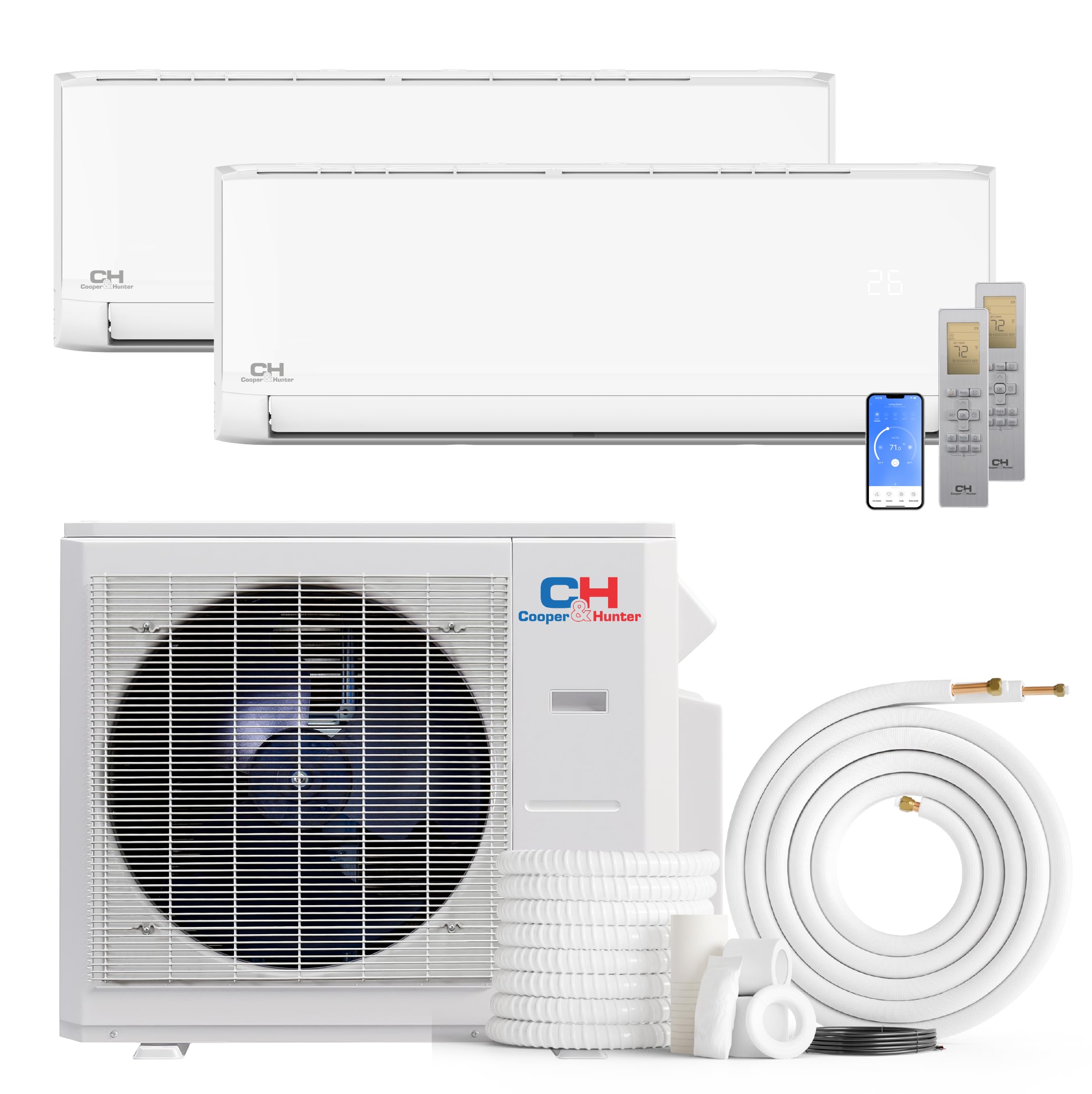
One condenser, two indoor heads, 25 SEER2 — the pick when two rooms need separate temperatures.
25 SEER2 is the highest efficiency figure in this entire article, and it comes on a 2-zone system. That means one 28,000 BTU (2.3 ton) outdoor condenser feeds two wall-mounted indoor units rated at 12,000 BTU and 18,000 BTU. You set each room independently, which is the whole reason to buy a multi-zone rather than two singles.
The kit is genuinely complete for a multi-zone install. Each air handler gets its own installation kit with a 25 ft pre-flared and insulated copper line set, 25 ft of communication wire, and accessories, plus a 16 ft drain extension. There is a decorative, paintable line-set cover kit at 3 inches wide and 12 ft long so the run does not look like an afterthought. Smart kits control it from your phone. The 230V requirement and the freight shipping are both real considerations — it ships by freight and arrives at the nearest accessible point outside your home.
Cooper & Hunter states plainly that this is not a DIY system and that professional installation is required by the manufacturer. That lines up with the hardware: two refrigerant runs, two drain paths, and a single outdoor unit that has to be sited for both rooms. This is the pick for a master suite plus an office, or an upstairs and downstairs zone, where one condenser covers both without duplicating the outdoor hardware. It comes with US-based technical support, which matters more on a two-zone install than a single-head one.
Where the money goes
- 25 SEER2 — the highest efficiency rating in this article
- Two indoor heads (12,000 + 18,000 BTU) on one 2.3 ton condenser
- Independent temperature control per room from a single outdoor unit
- Full kit with 25 ft line sets, wiring, and a paintable line cover per zone
What it asks of you
- Manufacturer states professional installation is required — not a DIY system
- 230V circuit plus freight delivery to the nearest accessible point
- Two zones means twice the line work and twice the drain routing
The one to take if: you need two rooms at different temperatures and want the best efficiency figure here doing it.
Pick a single-head instead if: you only have one space to condition — you would be paying for a second zone you never use.
Know the Specs
BTU and What It Cools
BTU (British thermal units) is how much heat the system can move in an hour, and it is the number that sets your room size. A 12,000 BTU unit is about 1 ton and handles a bedroom or small office. A 24,000 BTU unit is 2 tons and takes a large living area or a shop. Going bigger than the room needs is not free — the compressor hits the setpoint fast, shuts off, and never runs long enough to pull humidity out of the air.
SEER2 vs HSPF2
SEER2 is the cooling efficiency score — higher means fewer kilowatt hours per unit of cooling. HSPF2 is the same idea for heating. A unit with a strong SEER2 and no HSPF2 figure is a cooling-first machine. If you plan to heat with it through winter, the HSPF2 number is the one that shows up on your bill in February. Look for both figures before you assume a unit is year-round capable.
The Floor Console Form Factor
A floor console sits at ankle height and pushes warm air out at low level, which matters in a room with tall windows or a cold crawlspace where ceiling heat never reaches you. It can also be hung from the ceiling plate. That flexibility is why floor-or-ceiling units suit basements and garages where a wall head has nowhere sensible to go.
Voltage and the Install Barrier
12,000 BTU units are commonly 115V, which keeps the electrical work closer to standard household territory. Step into 24,000 BTU and above and you are looking at 208-230V, which means a dedicated circuit and an electrician. Many of these systems also require professional installation to keep the warranty valid, and the line-set length in the box (15 ft, 16 ft, or 25 ft) sets how far the indoor head can sit from the condenser.
Common Questions
Can a floor mounted mini split really heat a room in winter?
What size mini split do I need for a 1,000 square foot space?
Do I need a licensed HVAC technician to install one of these?
What is the difference between SEER2 and HSPF2 on a mini split?
Can I install a floor mounted mini split myself to save money?
How long should the included line set be for my install?
Does a mini split need a dedicated electrical circuit?
Why does my mini split blow warm air in cooling mode?
Is a two-zone mini split better than two separate units?
How often does a mini split need cleaning?
The Bottom Line
For most buyers, the best floor mounted mini split is the Senville AURA 24000 BTU. It gives you 21.5 SEER, 1,250 sq ft of coverage, and heating documented down to -22°F — a cold-weather floor nothing else on this page matches. If your space is smaller and you want the leanest running cost, the YITAHOME 12000 BTU does 750 sq ft on 600 kilowatt hours per year. And if you genuinely need the head at floor level rather than on a wall, the Senville Floor Ceiling Mount 18000 BTU is the only true floor console here.
One last thought worth weighing: the AURA is the crowd favorite at 4.5+ stars across 500+ ratings, and that consistency at its size is why it takes the top slot.
How we choose
We do not accept paid placement. Every pick is matched to a real buyer and a real use-case; we do not hands-on test units.
Sources
Specifications: manufacturer listings and product documentation. Review insights: verified customer reviews, as of October 2026. Pricing: not shown on this page (it changes often); check the current price via the retailer link.
As an Amazon Associate, Aappliancez earns from qualifying purchases. This does not affect which products we feature.