Disclosure: Some links in this post are affiliate links. As an Amazon Associate I earn from qualifying purchases, at no extra cost to you. Learn more
Specs are compiled from manufacturer listings and verified buyer reviews and can change over time — please confirm the key details on the product page before buying.
Bare concrete drinks oil, turns slick in winter and throws dust onto everything you store. The right garage floor covering depends on what your slab actually suffers from. If those are your problems, you want either a roll-out mat for fast coverage or a snap-together tile system that lifts spills off the surface. Start with how much square footage you are covering and if you want something you can wipe, rinse or sweep.
This guide is built by comparing the manufacturers’ published specifications and the patterns across verified customer reviews, so you get each pick’s real strengths and trade-offs instead of marketing spin.
A slab that stays dry, grips wet tires and wipes clean fast changes how a garage feels day to day — here is the spec-led shortlist of the best floor covering for garage spaces.
Top Picks
How to Choose the Best Floor Covering for Garage Spaces
Two garages can look identical and need opposite floors. A daily-driven truck that drags in snow and road salt wants a surface that lets water run away or wipes up in seconds. A garage used as a workshop or gym wants a surface that cushions a dropped weight and keeps a jack from tearing through. Decide whether your garage is the wet-weather parking type or the workshop-and-gym type before you shop.
Tiles versus rolls: the first real fork in the road
Interlocking tiles arrive as a box of squares that snap together by hand — no glue, no tools, no drying time. You can replace one damaged square instead of the whole floor. That makes tiles the better fit if your floor has drains, drains need to stay clear, or you want to pull a section up later.
A roll-out mat unrolls as one continuous sheet and covers a large area in minutes. It is the faster answer when you want a clean surface across a parking bay today. The trade-off is that a tear or a permanently creased fold sits in the middle of the sheet, not in a replaceable square.
Thickness, pins and what sits under your feet
On tiles, thickness and support pins decide two things: how much the surface gives underfoot, and how much water can pass underneath. A drainage tile with tall support pins lifts the walking surface off the slab so water flows below and air dries the gap.
On rubber and foam tiles, a thicker tile spreads the weight of a rack or a dropped dumbbell over more area. That means fewer dents and less noise passing into the room above. A thin mat, by contrast, hides stains and catches drips but will not cushion an impact.
The oil question, and the winter question
Concrete soaks oil and holds the stain. An absorbent mat traps drips on top and, on some designs, has a waterproof backing so nothing reaches the slab. A PVC mat does the opposite — it stays impervious, so a drip sits on the surface and wipes straight up. Neither is wrong; they just ask different amounts of upkeep from you.
For winter, grip matters more than anything. A diamond-plate texture or a coin pattern gives wet boots and wet tires something to bite into. Smooth rubber gets slick once it is wet.
Do the coverage math before you click buy
Multiply your garage length by its width to get square feet. Then buy slightly more than that figure, because cuts around door tracks, columns and walls eat material. A tile pack that covers a set square footage is easy to add to; a single roll is not.
Side-by-Side Comparison
| Model | Best For | Coverage | Thickness | Material | Amazon |
|---|---|---|---|---|---|
| VEVOR Interlocking Drainage Tiles 55PCS★ Best Overall | Wet areas and wash-down zones | 55 tiles at 12″ x 12″ | 0.6 inches | PVC | Amazon |
| SnapLock GarageDeck Coin Tiles 48 PackShowroom Look | Showroom-look parking bay | 48 square feet | 0.5 inches | High-impact copolymer | Amazon |
| SUPERJARE Extra-Thick 18 Pcs Mats | Garage gym with heavy weights | 72 square feet | 0.79 inches | EVA foam with EPDM rubber | Amazon |
| Rubber King 10 Piece Interlocking Tiles | Home gym and utility rooms | 23.5 square feet | 0.24 inches | Recycled rubber | Amazon |
| TUFFIOM 7.5 x 20 FT Garage Floor Mat | Large SUVs, MPVs and pickups | 7.5 x 20 ft roll | 0.08 inches | PVC | Amazon |
| Grandroad auto 8×20 FT Garage Floor Mat | Long single parking bays | 8 x 20 ft (160 square feet) | 2.8 millimeters | PVC rubber | Amazon |
| Golener Heavy Duty Garage Floor Mat 17′ x 7’4″ | Oil changes and drip catching | 17 x 7.33 ft sheet | 4 millimeters | Polyester with rubber backing | Amazon |
Detailed Reviews
1. VEVOR Interlocking Tile 55PCS Black
Our pick — 4.5+★ from 900+ verified ratings; the strongest balance of quality and price.
The tile set that lets water and melting snow drain straight through instead of pooling under your car.
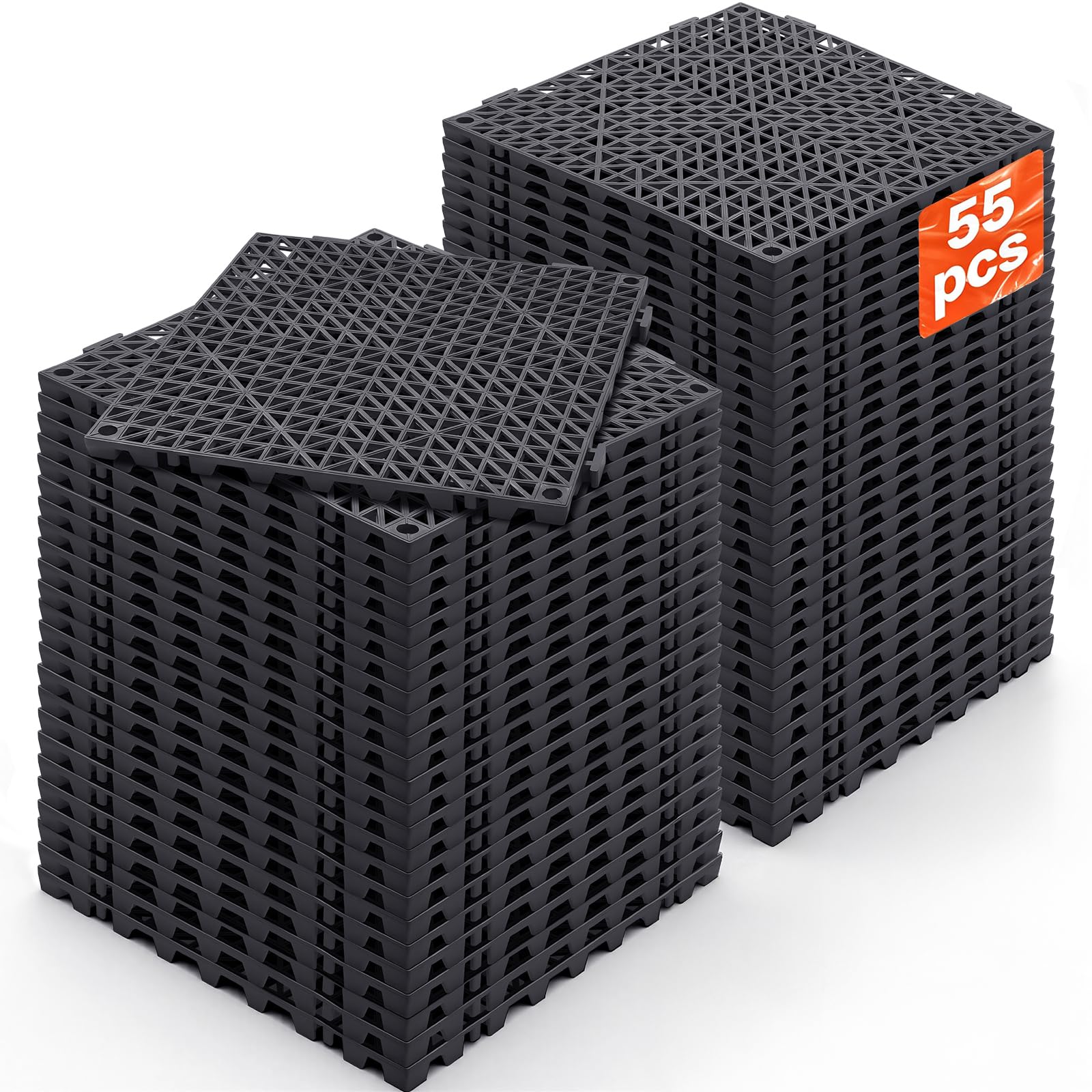
VEVOR’s set is the one to look at when your garage floor’s real enemy is water — melting snow off the tires, a floor drain that keeps clogging, or a wash-down corner that never dries. You get 55 tiles, each 12″ x 12″, and every one sits on 0.6-inch (15 mm) support pins. Those pins lift the walking surface off the concrete so water runs underneath and air gets into the gap to dry it. You are not standing in a puddle; you are standing on a grating.
The material is soft PVC, and that word soft matters here. Underfoot it feels springy rather than rock-hard, which is why this pattern turns up in garages that double as a dog-washing or boot-shaking zone. It is also the only pick here that openly resists hair and oil and rinses clean with a hose — you do not scrub, you flush. As owners put it: “Simple to install and not too hard to trim.” The tiles cut with ordinary scissors, so corners, poles and the odd awkward wall all get handled with a utility pair in one evening.
What sets this tile system apart
- 0.6-inch support pins keep water off the surface and let it drain away
- 55 tiles at 12″ x 12″ cover a real work zone, not just a doorway
- Cuttable with scissors around poles, posts and edges
- Rinses clean — oil and hair wipe away with water, not elbow grease
- Soft PVC gives underfoot without losing its shape
Before you commit
- There is no matching front trim ramp, so a car rolling onto the edge meets a lip
- A strong rubber scent from the start needs a day or two of airing
- The black finish hides grime, but a light drip running over the pins can pool if a drain sits far away
The honest caveat is the trim. A tile this tall creates a step at the garage threshold, and there is no matching ramp offered alongside it, so a lowered car or a wheeled jack will want a shim at the leading edge. Plan for that once and it stops mattering.
Best fit: Wash bays, wet-weather parking, pet or mud zones, and any garage where a floor drain needs to keep flowing.
Find another shape if: You want a flush, smooth surface with no lip at the door.
2. SnapLock GarageDeck 12″x12″ Coin Garage Tiles, 48 Pack
Park on it and the garage stops looking like a slab and starts looking like a showroom.
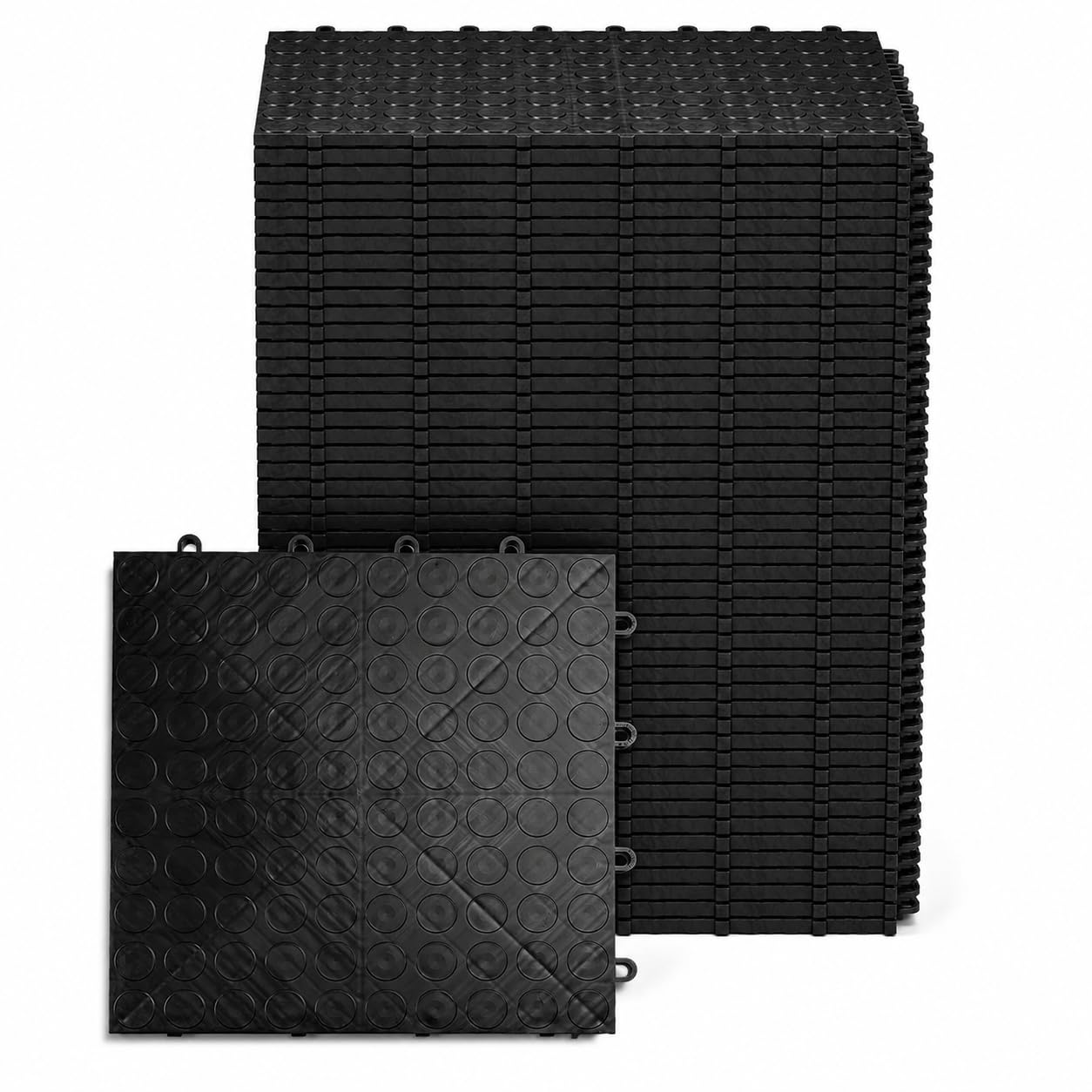
Wet boots and wet tires get something to grip on this coin-pattern top, and a mop or shop vac lifts crumbs and dust in one pass. The 48-pack covers 48 square feet. The spec that earns it a spot here is rolled-load handling: Big Floors puts it at 40,000 lb of rolling load capacity. That is the number you care about when a car, a loaded tool cart or a trailer on dollies rolls over the tile and you worry it will crack under a wheel.
You can cover the floor over a weekend, because the patented PowerLock edges snap together with no glue, no tools and no second pair of hands, and once set they stay engaged. That is why it comes up more often than epoxy in this category. Pick black and graphite or any mix you like, then pull a single square up and replace it later. What wins people over is how fast the whole thing assembles, and how the finished floor reads as a deliberate design choice rather than a sheet of rubber rolled over concrete.
The honest trade: these are ultra-sound thin — under 0.5 inches — so expect a hollow note when you walk over them. The material is a high-impact copolymer resin, and it reads as a hard plastic tile with some spring rather than a soft rubber mat that absorbs sound. If your garage shares a wall with a bedroom above, layer something soft on top.
Who this is for: an owner who wants a sharp-looking parking bay done in a weekend, can use a rubber mallet and a circular saw with a wood blade, and is happy to walk on a hard surface. It is not a gym floor and it does not claim to be.
It also shrugs off oil, grease, antifreeze and most household chemicals, so drips from a daily driver are a wipe rather than a stain. The one thing to do at the start: keep the first course square with a chalk line, and buy the edging because the square edges leave a visible raw edge at the door.
Reach for this if: you want to cover a bay quickly, replace tiles one at a time when they scuff, and have the space looking sharp before the weekend is out.
Think twice if: a hollow footstep over a suspended slab or a room above would bother you.
3. SUPERJARE 0.79” Extra-Thick 18 Pcs 72 Sq Ft Exercise Mats
Three-quarters of an inch of foam and rubber between a dropped weight and your slab.
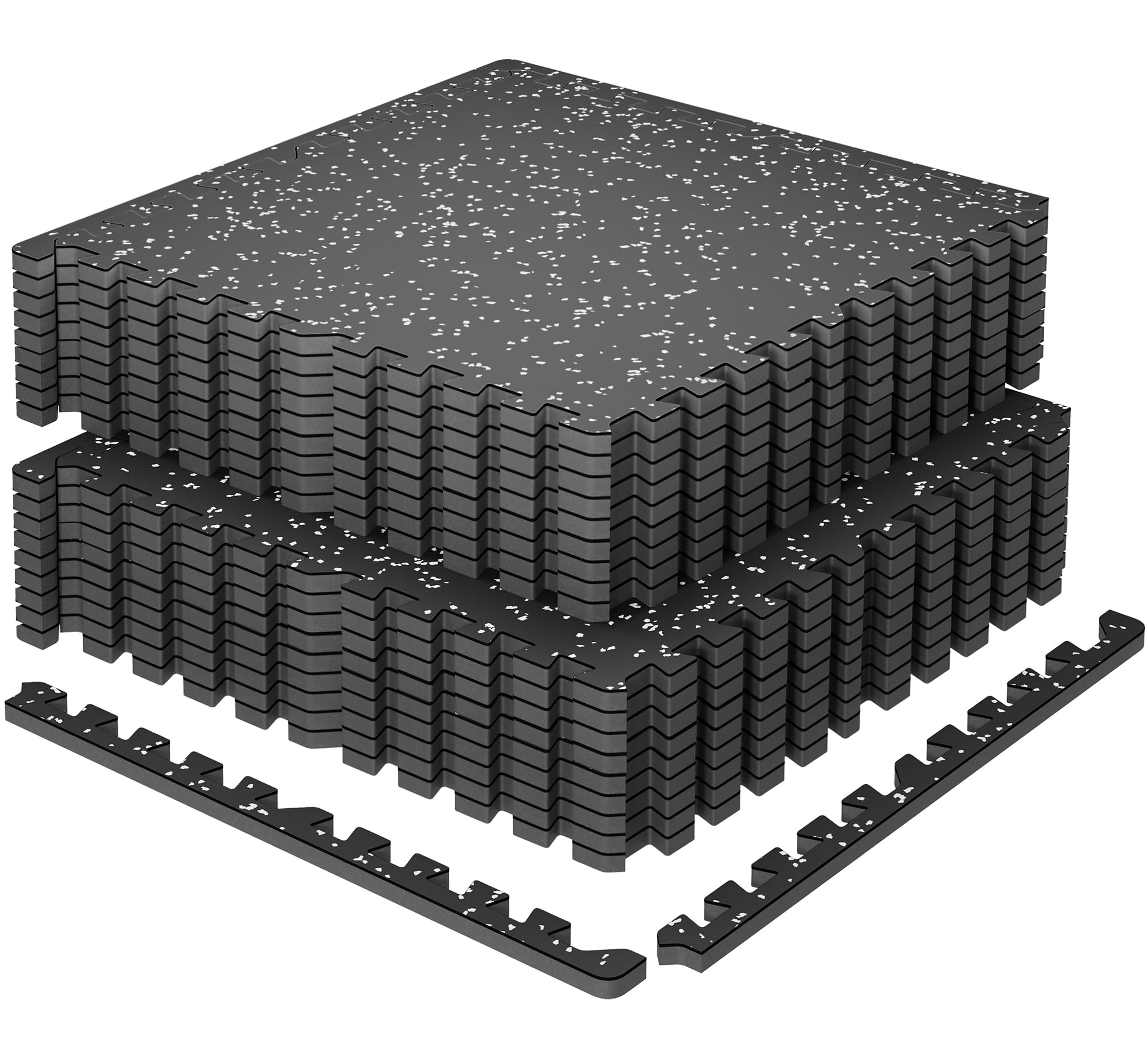
The number that matters here is 0.79 inches. That is the thickness of each 24″ x 24″ tile, which is a lot of cushion for a garage floor. The build layers a high-density EVA foam base under a sturdy EPDM rubber top, so the foam swallows impact and the rubber face takes the abrasion. Drop a kettlebell, land a box jump, set down a loaded barbell and the tile spreads that load sideways instead of dinting the floor.
You snap it into a neat square or rectangle and put it wherever the gym lives — gym, family fitness room, garage or playroom. It comes as 18 tiles for 72 square feet, each with two detachable border pieces. The grid holds firm: the pieces interlock snugly and the surface has enough grip to plant your hands on a landmine press. The soft layer also cuts noise and vibration, which is the quiet reason to buy it — a home gym on a bare slab thuds into the rest of the house.
What the cushion can and cannot do: it is a firm, cushioned surface, not a deep crash mat. For deadlifts and treadmill bases it does exactly what you want; a full-power overhead slam would still reach the concrete. Pick your spot on that spectrum.
The known smell: strong rubber smell from the start, and it can take the better part of a week of airing. Unbox it in the garage with the doors open, and set it up after it has had a few days to settle. That is the trade for foam this dense.
For a garage gym with dropped weights, the 0.79-inch build is why you would choose it over the 0.24-inch Rubber King tiles in this list.
Strongest pick for: garage gyms with weights, machines or HIIT work where the floor has to shrug off impact and keep the noise down.
Skip if: you are covering a parking bay and just want a wipeable surface under tires.
4. Rubber King 10 Piece Interlocking Tiles 19″ x 19″
Rubber recycled from old tires, cut into big 19-inch squares that feel like a real gym floor.
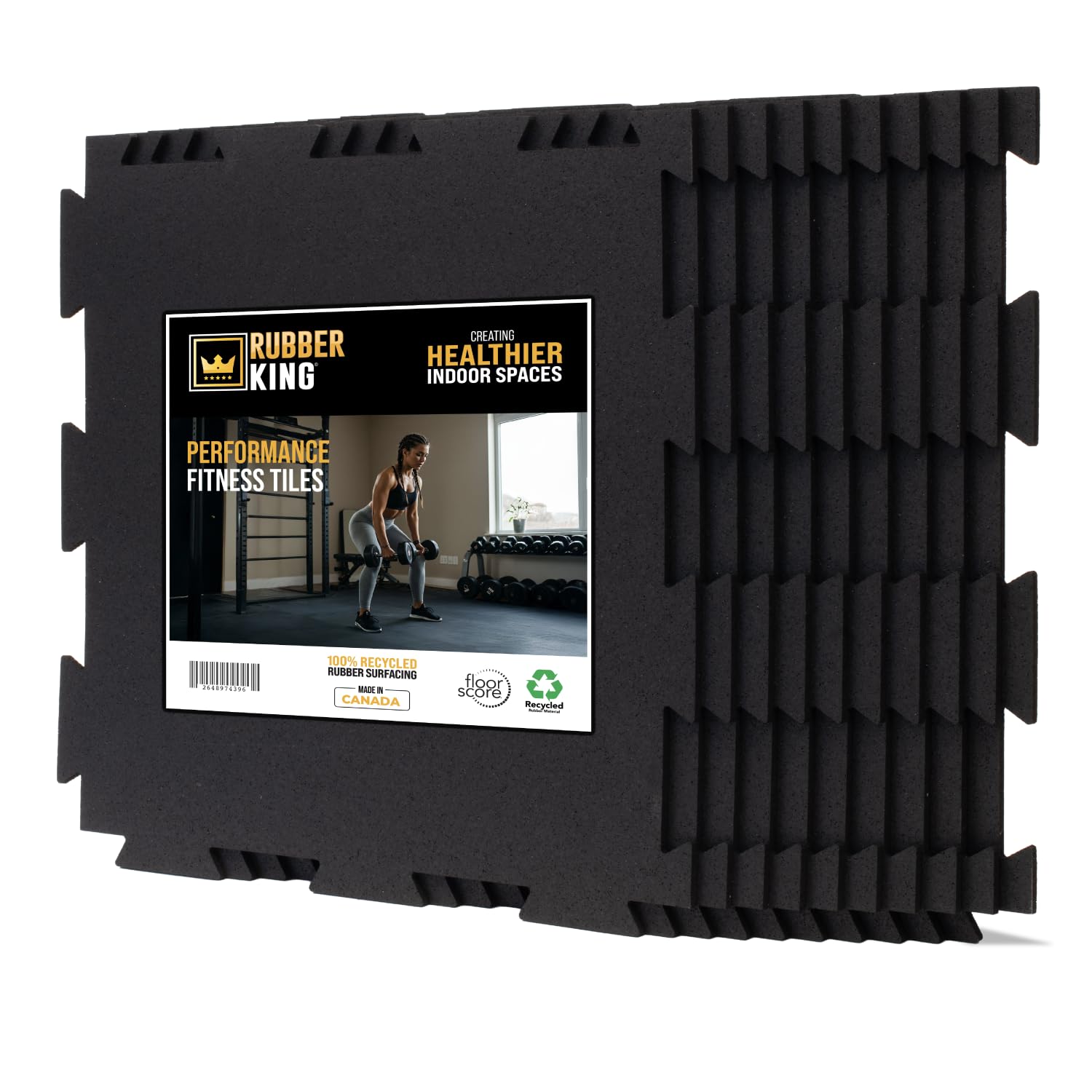
Fewer seams for a dumbbell to catch on and a faster lay-down are the reasons to pick this over the smaller puzzle mats. Each tile is 19″ x 19″ at 0.24 inches thick, and ten of them cover 23.5 square feet. The material is 100% recycled rubber from tires, non-vulcanized, and it is FloorScore certified by a third party — that is an indoor air quality test a third party carries out, which matters when the gym shares air with the rest of the house.
The firmer rubber gives underfoot without feeling like a mattress, and dropped weights get a surface that takes hits and keeps its shape. It is anti-slip and water-resistant too, so sweat and a spilled bottle wipe up instead of soaking in. Made in North America by a maker that has been at it for more than 30 years, with a 5-year limited warranty backing the tiles. For garage, basement, gym or utility duty, it is a straightforward buy — and there is real latitude here because the tiles swap with other colors for a pattern.
Where it earns its keep: a floor that feels solid underfoot, connects and reconnects easily when you rearrange, and hides the seam line between tiles. Clean it with a broom or a damp mop and it comes back to life.
The catch: the fit takes some care. Align the arrow on each square the same way and they snap tight; get one out of line and you will feel it. Cutting is doable with a straight edge and a utility knife, but a full room’s worth of edges is slow work. Also check the top face before you lay it — the label adhesive on the top tile can leave a sticky spot, so that one goes face down.
If you expect to rearrange your gym, the 19-inch format and easy disconnect is a real advantage. If you are covering one big rectangle and never moving it again, the SnapLock above puts down more square feet per box.
Best for: a garage gym, basement workout room or utility corner where you want a rubber floor you can rearrange and mop.
Not ideal if: you are covering a whole bay in one go — 23.5 square feet per set means ordering a few sets.
5. TUFFIOM 7.5 x 20 FT Garage Floor Mat

A 20-foot roll that runs the length of a pickup and takes the oil drips instead of your concrete.
This one exists for the long vehicles. The roll measures 7.5 by 20 feet, which is sized for large SUVs, MPVs, pickups and RVs, and the diamond-plate texture on top gives wet tires and wet boots a grip surface. The PVC is thickened for wear resistance and is meant to hold up under prolonged pressure from heavy vehicles without deforming. It is waterproof, resists dirt, mud, auto fluids and chemicals, and cleans with a vacuum, broom, cloth or dry mop. Roll it out and you are done — no glue, no snaps, no drying time.
An oil spill sits on top for a wipe instead of soaking in, which is the whole reason to put it under a car — the surface is impervious. Scissors or a utility knife trim it to a shorter bay, a trailer footprint, or a work area. Owners have pushed it beyond parking: one ran it under a backyard trailer to starve out weeds, another used two rolls plus seam tape as a 12×12 horse stall mat that wipes clean with a muck fork. A dog room owner reported that “even digging like weirdos, it has held up.”
Why it works under a vehicle
- 7.5 x 20 ft covers the full footprint of a large SUV, MPV or pickup
- Diamond-plate texture adds grip for wet tires and boots
- Impervious PVC keeps oil and mud on the surface, not in the slab
- Rolls out flat with no adhesive and trims with scissors
- Thickened PVC built to take weight from trailers, trucks and SUVs
Where it asks for care
- It is a thin covering by design — 0.08 inches — so it will not cushion an impact
- The leading edge can curl up until it warms on the concrete; a strip of tape settles it
- Black hides tire marks but also hides where oil has landed
At 0.08 inches, the thinness cuts both ways. It is the easiest roll here to lay and to trim, and the least likely to trip a lowered car at the threshold. But it is a barrier, not a cushion — if you wanted a mat that softens a dropped tool, go back to the foam or rubber tiles above.
Pick it for: a long parking bay, a truck or RV, or anywhere you want a dry, wipeable surface under a vehicle in an afternoon.
Look elsewhere if: you need padding or a floor that strips out under its own weight without tape.
6. Grandroad auto 8×20 FT Garage Floor Mat

The widest roll in this lineup, with the tape already in the box to stop it sliding.
A full-size parking bay gets covered edge to edge without stitching two sheets together, because this roll is eight feet wide and twenty feet long — 160 square feet in one piece. That width separates it from the narrower roll above. Thickness is 2.8 millimeters, thickened for heavy-duty duty and a comfortable walking surface, and the diamond-plate rubber face gives the slip resistance you want for foot traffic and parked vehicles when everything is damp.
The engineering answer to a sliding mat is already in the box: 20 pieces of double-sided tape to run down all four sides. That is a small job and it is why this mat stays put once it is down. The PVC rubber wipes with a damp cloth, shrugs off daily wear, and works across garages, gyms, warehouses, basements and trailers. If you have laid a mat before and spent weeks kicking it back into place, this is the fix.
The thickness question, stated plainly: 2.8 millimeters is a barrier, not a cushion. It protects the slab from spills and marks and it gives a clean walking surface — it will not soften a dropped wrench. Judge it against that job.
Two things to know: PVC this thin can tear if you drag a jack stand or something rough across it, so a thicker tile underneath heavy metal work is the safer call. And in cold weather it lays stubbornly, so let it sit indoors at room temperature for a few days before you unroll and tape it down — a slight bulge settles the same way.
Mess control is the strong suit. Oil, road grime and spills sit on the surface and wipe away with a damp cloth rather than soaking into the concrete, and the black finish hides tire marks between cleanings. It is the pick for an owner who wants a wide bay covered in one 8 x 20 ft sheet, taped down and done.
Good match for: a wide single bay or a workshop where the entire floor should read as one continuous surface.
Better choice elsewhere if: you expect to drag heavy metal equipment across the floor or lay it down in freezing weather.
7. Golener Heavy Duty Garage Floor Mat, 17’x7’4″
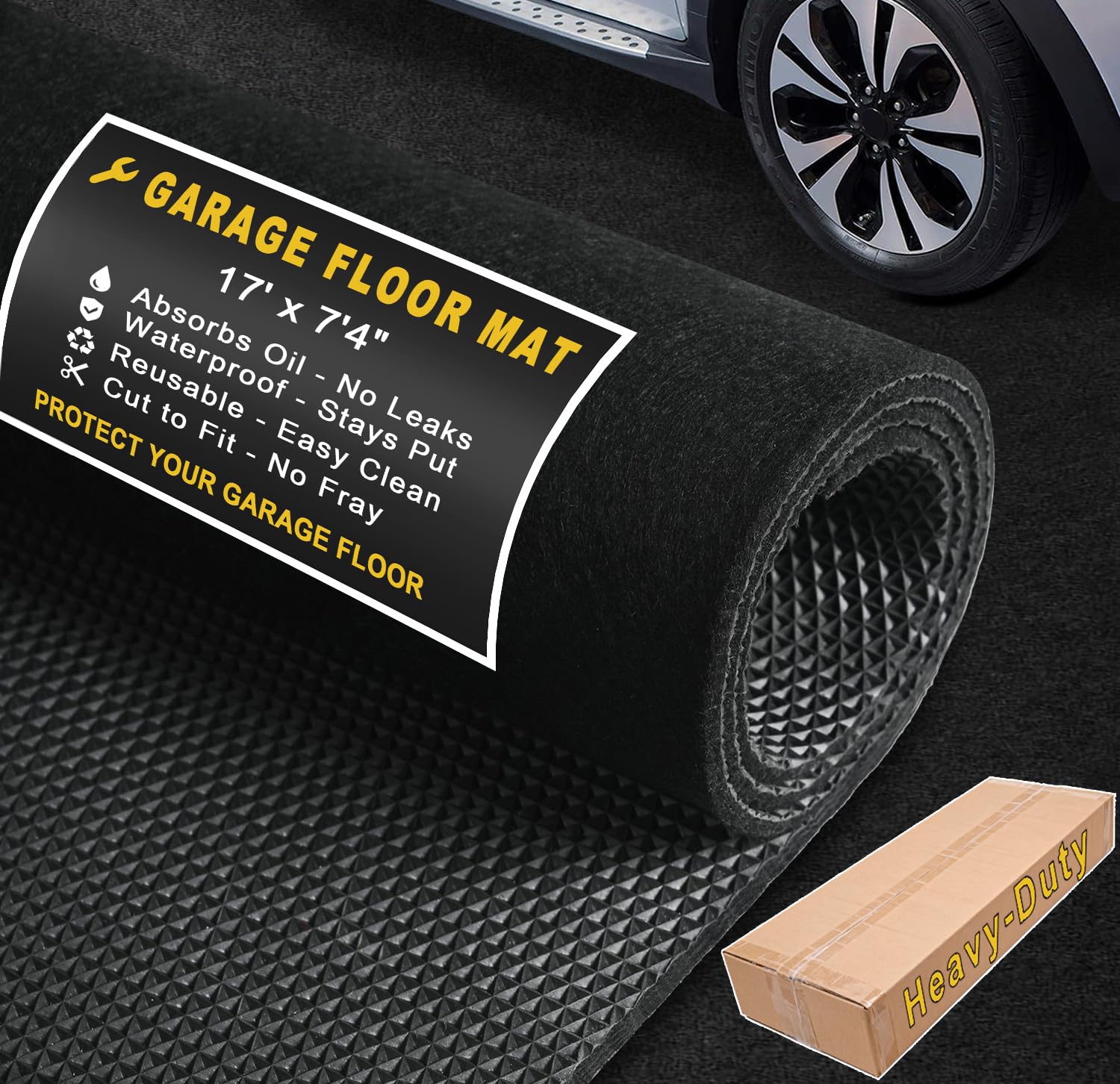
The only mat here that drinks the drip instead of wiping it — with a rubber backing that stops it reaching concrete.
Every other pick in this list repels liquid. This one absorbs it. The top is a polyester fiber that traps oil, brake fluid and general spills, and the waterproof rubber backing stops anything from soaking through to the slab. It measures 17 feet by 7 feet 4 inches and is 4 millimeters thick, so it sits as a proper layered mat rather than a thin sheet. Under a car, a motorcycle or a truck, that combination means the drip lands on the mat and stays there.
Cleaning is the practical part: scrub with mild soap, rinse with a hose, hang it to dry. Reuse it instead of tossing disposable pads and trays every oil change. It is made BPA- and phthalate-free with no harsh odors, which is why it turns up indoors too — one owner used it under a porch deck to catch raccoon food and water falling through the cracks. Cut it with scissors to fit corners, tool areas or a wall edge without fraying.
The smart way to use it: the top face holds what it catches until you wash it, and a black face hides saturation. Flip it if your aim is to see when it needs a wash — a lighter face would show the oil line sooner. Around the edges, a corner can flip up until it settles.
Folds, not rolls: it ships folded into squares and the creases take a few warm days on a flat floor to lie down. If you park on it, give it that settling time first.
For a daily driver that drips oil, absorbing the drip on the polyester top beats mopping it off PVC. This is the one to choose if your problem is the stain rather than the surface feel. An owner with a fresh garage paint job put it down to catch the grime and keep tire marks off the new floor, reporting that it “looks very neat.”
The right mat when: oil, brake fluid or winter grime is landing on your floor and you want it caught on the mat, not soaked into concrete.
Choose a tile or PVC roll instead if: you need a firm surface, a grip texture, or something under a heavy jack and stand.
Know the Specs
Coverage in square feet
Buy slightly more than your floor figure so cuts around door tracks and posts do not leave you short. Coverage is length times width of your garage floor. Tiles are sold by the square foot or count: 48 tiles at 12″ x 12″ gives 48 square feet, 18 tiles at 24″ x 24″ gives 72 square feet, and 55 tiles at 12″ x 12″ gives 55 square feet. A roll gives one big number: 8 by 20 feet is 160 square feet.
Thickness and pins
Thickness controls cushioning and, on drainage tiles, the air gap that lets water dry. A 0.79-inch foam-and-rubber tile cushions heavy drops; a 0.08-inch PVC roll is a barrier that protects the slab but will not absorb a blow. On a drainage tile, 0.6-inch support pins lift the surface off the concrete so water drains below and air dries the gap.
Rolling load and material
Rolling load is how much weight a tile can take rolling over it — the SnapLock tiles are rated for 40,000 lb of it, which is what lets a car sit on them without cracking. Material tells you how it behaves: recycled rubber feels solid underfoot, copolymer snaps hard and thin, PVC wipes clean and stays impervious, and foam under rubber adds cushion and noise absorption.
Grip, waterproofing and odor
Diamond-plate and coin textures are raised patterns that bite into a wet boot or tire. Waterproofing means liquid will not pass through, but it does not mean the top is dry — an absorbent mat catches drips, an impervious one lets you wipe them up. Odor is the other spec to check: density-built foam and rubber can carry a strong scent for a day or two, while 3rd-party FloorScore testing on the Rubber King tiles backs indoor air quality.
Common Questions
Can I park a car on drainage tiles with support pins?
Do I need to glue the tiles down?
How much square footage does the 48-pack of tiles cover?
Will an absorbent mat allow oil to soak through to the concrete?
Which option is better for a garage gym — rubber tiles or foam tiles?
How do I cut these floor coverings to fit corners?
Why does my new floor covering smell strongly at first?
Do roll mats slide under a parked car?
Can these mats handle winter road salt and snow melt?
Will heavy weights dent the Rubber King tiles?
The Bottom Line
For most garages, the best floor covering for garage depends on what hits your slab. If it is water, the VEVOR drainage tiles let it run away under 0.6-inch pins and rinse clean — the crowd favorite here, holding 4.5+ stars across 900+ ratings. If you want a sharp parking bay laid in a weekend, the SnapLock GarageDeck tiles snap together with no glue and take a 40,000-lb rolling load. And for a gym built around heavy weights, the SUPERJARE 0.79-inch mats put real cushion between a dropped bar and the concrete. Pick the one that matches your biggest daily headache, and buy extra tiles or a couple of extra feet of roll for cuts — that is the difference between a finished floor and a frustrating one.
How we choose
We do not accept paid placement. Every pick is matched to a real buyer and a real use-case; we do not hands-on test units.
Sources
Specifications: manufacturer listings and product documentation. Review insights: verified customer reviews, as of October 2026. Pricing: not shown on this page (it changes often); check the current price via the retailer link.
As an Amazon Associate, Aappliancez earns from qualifying purchases. This does not affect which products we feature.