Disclosure: Some links in this post are affiliate links. As an Amazon Associate I earn from qualifying purchases, at no extra cost to you. Learn more
Specs are compiled from manufacturer listings and verified buyer reviews and can change over time — please confirm the key details on the product page before buying.
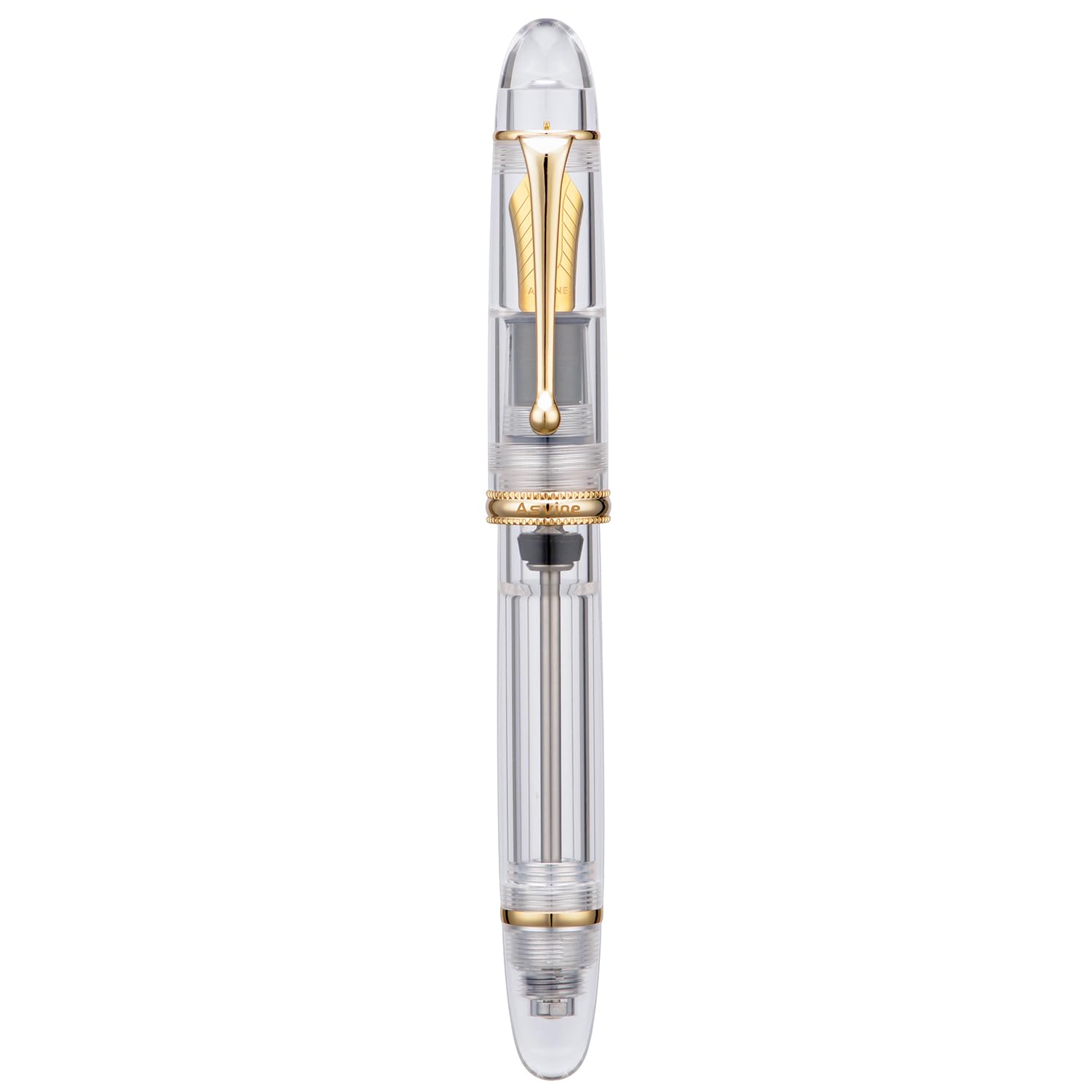
A flex nib pen only earns its money if the tines (the split halves of the nib tip) actually spread when you press. Otherwise you have paid extra for a stiff fountain pen. The Asvine V800 is the one most buyers should start with: its number 8 nib (a large, wide nib) is the smoothest all-round package here, and its vacuum filler pulls ink straight from a bottle.
This guide is built by comparing the manufacturers’ published specifications and the patterns across verified customer reviews, so you get each pick’s real strengths and trade-offs instead of marketing spin.
Flex writing is a physical skill as much as a purchase. So the pens below split by how much patience they expect: a set-and-go nib for newcomers, a tinkerer’s canvas for the patient, and a titanium piston filler for daily carry. Each tier gets its own strongest option.
Top Picks

How To Choose The Best Flex Nib Fountain Pen
One question decides your purchase: does this nib give you visible thick-to-thin line variation from ordinary hand pressure, or does it stay a stiff steel line? Everything else — filler, material, weight — comes second. A pen whose nib won’t spread is a fountain pen, not a flex pen.
Start with the nib, not the barrel
A flex nib has two tines (the split halves of the tip) that bend apart under pressure and spring back when you lift. That spread is what turns a 0.4 mm line into a 2 mm one. The FPR Ambassador set states a 0.4 mm to 2 mm range, which shows the idea clearly: a hairline that blooms into a broad downstroke.
Steel nibs dominate here, and that is fine — modern stainless steel flex can feel springy and responsive. But “flex” on a spec sheet is loose. Some pens labelled flex need firm, deliberate pressure to open at all, and one review of the Conklin noted exactly that. Read flex claims with a suspicious eye, and favor pens whose described nib does the work at normal writing pressure.
Match the filler to how you write
Your filling system decides ink capacity and your refill ritual. A vacuum filler draws ink by pulling a piston rod up and pushing it down — the Asvine V800 does this, and its large capacity shows in how long the reservoir runs between fills. A piston filler works much the same way with a knob at the back. A cartridge converter means swapping small plastic cartridges or drawing from a bottle through a twist converter.
For flex writing, capacity matters more than usual. Wide strokes lay down more ink, so a pen that holds a lot means fewer refills mid-project. If you only journal a paragraph a day, how clean and quick the fill is matters more than capacity.
Know how much tinkering you want
Flex nibs are not always perfect from the start. Some arrive slightly scratchy, some need a break-in period, and some pens are built for owners who enjoy swapping nibs and tuning feeds. Want pure write-and-go? Lean toward a pen whose reviews describe smooth delivery with no fiddling. If you actually like adjusting things, a swappable nib unit is a feature, not a flaw — the Asvine J16 accepts standard Jowo #6 nib units, so you can change the whole writing experience.
Weight and posting
A heavier pen can feel planted, but flex writing is a light touch, so weight is personal. Full-size and lightweight are not opposites — the FPR Jaipur V2 measures 5.5 inches capped and weighs 0.6 oz empty. Many flex pens also have blind caps or long tail knobs that make posting (capping the pen on the back end) less secure. If you write unposted, that is a non-issue; if you post, check the notes.
Ink and paper matter as much as the pen
A wet flex pen can feather (spread into fuzzy edges) on cheap paper. Reviewers of several of these pens mention this directly. Budget for decent paper and an ink you trust, and expect the occasional railroad — a dry break in the line on a fast, wide stroke — if the feed runs short on supply.
Side-by-Side Comparison
| Model | Best For | Nib Point | Filling System | Weight | Amazon |
|---|---|---|---|---|---|
| Asvine V800★ Best Overall | All-round flex writing | Medium (#8) | Vacuum | 33 g | Amazon |
| Noodler’s AhabThe Tinkerer’s Canvas | Tinkerers | Fine | Pull-piston / eyedropper | — | Amazon |
| Conklin Duragraph | Expressive line flair | Ultra Fine | Cartridge / converter | — | Amazon |
| Asvine J16 | Daily carry flex | Fine | Piston | 35.3 g | Amazon |
| FPR Ambassador | Ultra flex variety | Ultra Flex | Converter / cartridge | 0.01 kg | Amazon |
| FPR Jaipur V2 | Calligraphy practice | Ultra Fine | Piston | 0.02 kg | Amazon |
| Conklin Mark Twain | Collectors | Ultra Fine | Crescent filler | 0.22 kg | Amazon |
Detailed Reviews
1. Asvine V800 Fountain Pen
Our pick — 4.0+★ from 500+ verified ratings; the strongest balance of quality and price.
A big number 8 nib and a bottle-filling vacuum system at a modest outlay.
A #8 stainless steel nib (a large, wide nib that gives your flex strokes room to breathe) is why the V800 takes the top spot. It lays down a 0.7 millimeter line, and the maker bills it as a smooth, gliding writer for journaling and calligraphy. A bigger nib is not automatically more flexible, but its longer tines have more room to spread. Buyers report the well-tuned nib is where this pen shines, and build quality draws just as much praise as writing performance.
The vacuum filler is the second reason. Untwist the end cap, pull the piston rod up, push it down, and the pen draws ink straight from the bottle with no converter needed. Owners mention a fill of about 3 ml and a broad reservoir that runs for dozens of pages. One catch: the nib must sit deep enough to submerge, so a shallow or near-empty bottle gets awkward — you can eyedropper-fill instead. For long sessions, that capacity means no stopping every few pages to refill.
Size is where it divides people. The hand-turned clear-gold acrylic body measures 5.91 inches long, so this is a large, substantial pen — not one for small hands. You do get a comfortable diameter, an ambidextrous grip, and a slightly more compact footprint than the Noodler’s Ahab’s 6 x 1 x 1 inches, at 5.91 x 0.63 x 0.67 inches. Owners also flag a bit of cap play and shallow posting, so write it unposted if that bothers you.
Where it earns its keep
- Large #8 stainless steel nib for a wide, controlled flex line — 0.7 mm line size.
- Vacuum filler pulls from the bottle, with roughly a 3 ml capacity on a full fill.
- Hand-turned acrylic body, wrench and spare gaskets in the gift box — the maker includes two sets of gaskets.
- Nearly rivals far pricier nibs; the smooth, wet line is the consistent note in reviews.
What to weigh before you buy
- A large pen at 5.91 inches and 33 g — some owners find it too big for small hands.
- Cap play and shallow posting are the recurring cosmetics gripes.
- The piston can jam over time; parts and a wrench are included for that repair.
Go here first if: you want a big-nibbed flex writer with a bottle-drawn ink supply and don’t want to spend premium money.
Think again if: your hands are on the small side, or you want to post the cap firmly.
2. Noodler’s Ink Ahab Flex Nib Ivory Darkness
The flex pen you tune to your own hand — if you enjoy the tuning.
No other pen here drinks as much ink as the Ahab: customers note an eyedropper fill of a full 6 ml, the deepest reservoir on this list. Its pull-piston filler also works well straight from bottles. The 1950s round body shape stays comfortable over long sessions, and the fine point under a snap cap opens fast. What reviews repeat is that some tinkering is expected — the feed and nib come out easily for cleaning, and a scratchy nib smooths out with a little patience. Treat the Ahab as a starting point rather than a finished product, and the tuning pays off.
Consistency is the honest sticking point. Customer consensus is genuinely split — a superb pen for some, a letdown for others — and the recurring complaint is ink flooding out of the nib when the feed isn’t in the mood. You will also hear about fit and finish: the Ahab’s clip can spin, and some find the cap sealing weak enough that an unused pen dries out. A strong rubbery smell inside the cap is noticeable at first. Anyone who expects out-of-box perfection should look past this one.
For the patient, the payoff is real flex on a tight budget, with a body that fits bigger hands comfortably. Compare the size: at 6 x 1 x 1 inches the Ahab is the larger pen next to the Asvine V800’s 5.91 x 0.63 x 0.67 inches. If you have neither the time nor the inclination to fiddle, the Asvine V800 is the easier start.
A fair read: this is an entry point into flex, with the deepest ink capacity of any pen here at a 6 ml eyedropper fill — but you are paying with setup time, not cash.
The flip side: reports of flooding and a spinning clip show why it scores lower than the Asvine picks. It is best read as a project pen.
Worth the effort for: hands-on writers who like pulling a nib, smoothing it and tuning a feed to taste.
Best left alone by: anyone who expects a perfect first fill and no complaints from day one.
3. Conklin Duragraph Forest Green Flex Nib

A JoWo flex nib for expressive line variation in a green resin that stands out.
An elegant forest-green resin body wrapped around a JoWo flex nib (a German-made nib designed to change line width as you press) makes the Duragraph the looker of this group. The snap cap opens fast, the converter is included, and the pen takes standard international cartridges, so refills are easy to find. The green finish is the sort you notice across a desk. At 5.51 x 0.79 x 0.79 inches it is noticeably more compact than the Noodler’s Ahab’s 6 x 1 x 1 inches.
Here is the honest tension. Flexibility is the aspect that divides people most: several find it very flexible, others report no flex at all, and nib quality itself draws negative notes. One written review put it bluntly — the nib can be stiffer than expected and flexes mostly under firm, deliberate pressure rather than a natural hand. That does not make it a bad pen; it means the flex is modest and comes on gradually. A break-in period helps, and an alcohol wipe on the nib first can clear the residue that blocks flow.
Where the Duragraph consistently wins is everything around the nib. Construction and appearance land well, the weight feels right, and the ergonomic grip suits long sessions. Support earns a nod too — one owner’s long session ended with a nib issue that Conklin resolved in short order. If you chase a thin-to-thick line and elegant looks, this is your fit; expect gentle flex rather than dramatic spread. For a first flex pen bought purely on line variation, the FPR Ambassador gives you far more.
Pick it for: the writer who values appearance and comfort and wants mild, tasteful line variation from a known JoWo nib.
Pass if: you expect a dramatic, high-contrast flex like the FPR ultra-flex nibs; this one does its work more gently.
4. Asvine J16 Brushed Titanium Fountain Pen

Grade-five titanium, a Jowo flex nib and a piston that just works.
Durability is the reason to look twice here: the J16’s body is high-grade titanium, a metal known for toughness at low weight, and it tips the scale at 35.3 g. The brushed finish feels warm in reviews and not too slippery. Its Jowo flexible fine nib is smooth and well built, and the piston filler holds far more ink than a cartridge. Write it unposted for a nice balance. The maker includes a wrench, a pen case and an instruction manual.
Expect movement rather than dramatic spread from this flex fine nib. In practice the flex gives a juicy, wet line without bleed-through. One detail lifts the J16 above the rest of this list: its nib unit swaps for a standard Jowo #6, so you can fit a specialty nib without buying a new pen. The included clip is removable, a small thing that matters if you pocket-carry. If you want more line variation than the flex fine delivers, that swappable unit is your upgrade path.
The honest trade-off is where the value lands. The pen feels premium in the hand, but reviews split on whether it justifies its price — some say well worth it, a few feel it is overpriced. It is a daily writer that behaves like a more expensive pen, not a flex showcase. If spread is your goal, the Asvine V800’s larger #8 nib gives more of it for less money.
In hand: the titanium body is the star — durable, warm to the touch, and substantial without being heavy at 35.3 g.
What to know: the flex fine nib is tame, and the cap does not post well on some units. If you like to post, plan to write uncapped.
Choose this when: you want a metal-bodied flex pen to carry daily and like the idea of swapping nibs later.
Skip it for: expressive calligraphy where you need a big spread — the flex fine here is subtle.
5. FPR Ambassador Ultra Flex Fountain Pen Set

An ultra-flex nib that pulls a 0.4 mm line out to 2 mm.
Widest spread on this list: the Ambassador’s ultra-flex nib does the kind of work you normally need a dip pen for. Its published range runs 0.4 mm to 2 mm strokes, so a single letter holds both a hairline and a broad downstroke. The nib is stainless steel on a durable metal body, the set ships with two long cartridges and a bottle converter, and the glossy black finish does catch fingerprints. For calligraphy and expressive journaling, this is where the flex actually breaks out of the ordinary.
Consistency is what you pay for that. Ink flow is the recurring weak spot: some love it, others find it railroads (breaks into a dry gap) on fast, thick strokes with a less-wet ink. It rewards technique rather than forgiving it: slow down or keep strokes inside the feed’s comfort zone and the line holds. Durability is the other honest caveat: some units have failed at the threaded nib section, and it is not the smoothest pen for a first-timer.
One upside a spec sheet doesn’t capture: when it is running well, the line quality holds its own against far pricier flex pens. The glossy black body keeps it looking tidy, and the two-cartridge-plus-converter bundle covers both filling routes. Experienced flex hands who want more drama will like it. Never used a flex nib? Start with the Asvine V800 instead.
Its best case
- Ultra-flex nib with 0.4 mm to 2 mm strokes — vivid thick-to-thin contrast.
- Set includes two long cartridges and a bottle converter.
- Line quality that holds up against much pricier flex pens.
Its worst case
- Ink flow can railroad on fast, thick strokes with a dry ink.
- Some units show a durability issue at the threaded nib section.
Best match for: writers and calligraphers who want maximum line variation and have some flex experience.
Not for: total newcomers — the flow demands a steady hand and a slower pace.
6. FPR Jaipur V2 Brown Ebonite Piston Fill

A full-size ebonite piston filler built around one superb ultra-flex nib.
One nib carries this pen: the maker states the Jaipur V2’s stainless steel ultra-flex nib lays a 0.4 mm stroke without pressure and a 2 mm downward stroke with pressure. That range makes it a real calligraphy tool. It sits on an ebonite feed (a hard rubber channel that feeds ink more steadily for line variation). The cracked-ice acrylic body and matching blind cap look distinctive, and the piston filler stores ink right in the barrel. It measures 5.5 inches capped and 6.5 inches posted with a 0.4-inch section diameter, and weighs 0.6 oz empty — full-size reach without the heft.
The rest of the pen is where it wobbles. Reviewers praise the flex broadly, but durability and reliability take hits: some units have cracked through paper or broken inside a week, and ink flow divides buyers into those who love it and those whose feeds drip onto the page. One buyer’s plane experience sums up the tension — a smooth, easy flex nib with the occasional glob after filling that just needs a wipe. The light build also reads as cheap to some; it lacks the heft of a pricier pen.
Think of the Jaipur as a nib platform with a shell around it. Seven swappable #6 nib units — EF, F, M, B, Stub, Steel Flex and Steel Ultra Flex — let you move the writing feel around without changing bodies. This is not a pen to toss in a pocket and forget. It is a canvas for experimenting with lines, and the mid-range price buys a nib that punches above it.
Where it delivers
- Ultra-flex nib with a stated 0.4 mm to 2 mm stroke range and snappy spring-back.
- Seven swappable #6 nib options for changing the writing feel.
- Piston fill stores ink in the barrel; ebonite feed gives steady delivery.
- Light at 0.6 oz empty for long practice sessions.
Where it wobbles
- Ink flow can drip or burp, especially after a fresh fill.
- Build quality varies; there are reports of units breaking within days.
- The lightweight body feels less premium than the nib deserves.
Reach for it if: your goal is experimenting with dramatic flex lines and you don’t mind the occasional clean-up after refilling.
Look elsewhere if: you want a sturdy daily writer — the body here is the weak link, not the nib.
7. Conklin Mark Twain Crescent Filler Flex Nib
A reissued American classic with a crescent filler and a JoWo flex nib.
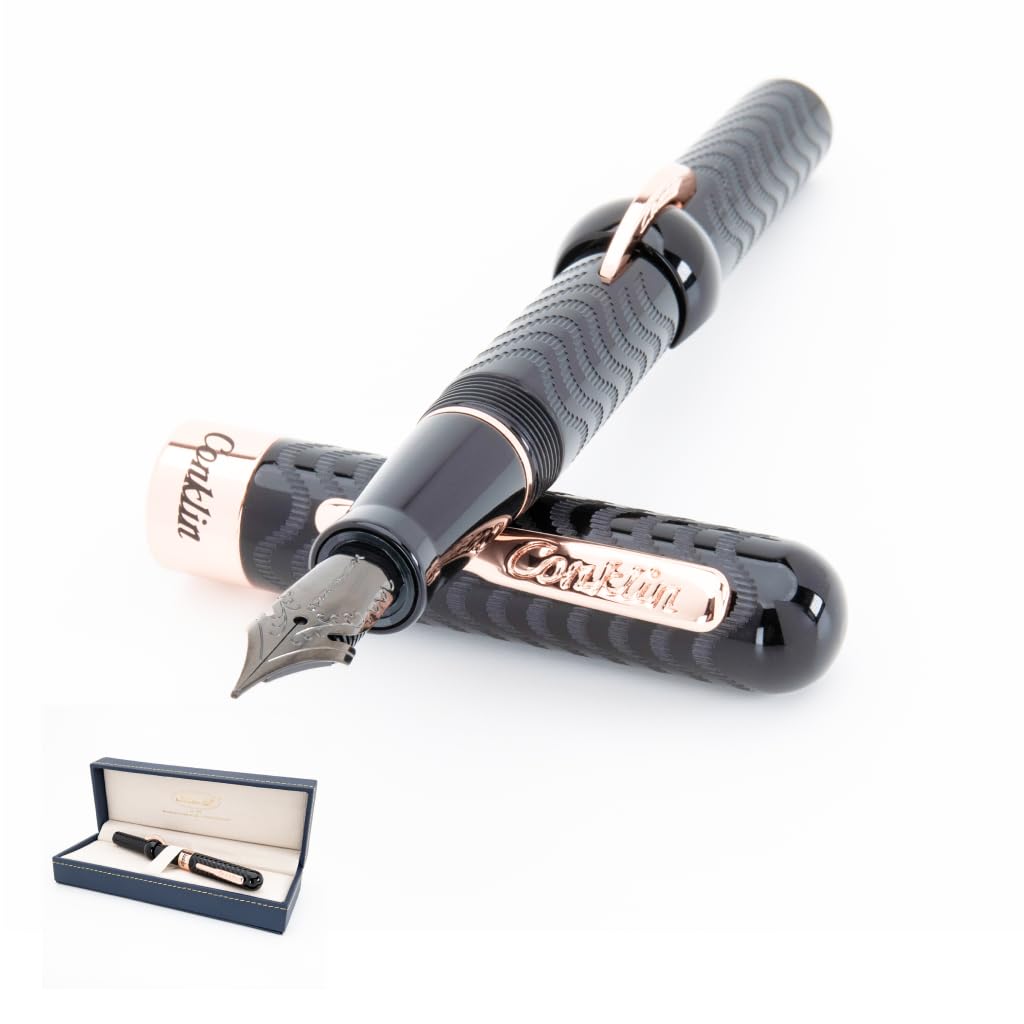
A piece of pen history is what you buy here: the Mark Twain revives Conklin’s original crescent filler (a historic self-filling mechanism with a metal crescent squeezed to draw ink), finished in black chase with 18 karat rose-gold trim. The nib is a JoWo flex nib made in Germany, and the fit in the hand is substantial at 0.22 kg. The presentation is premium and gift-boxed, with ink cartridge or converter included. The retro mechanism and the history are the draw, more than pure flex performance.
The flex itself is a gentle flex. At a 0.3 mm line size it is a fine nib with some give, not a dramatic spreader. The mechanism has a learning curve of its own — one review mentions a messy first fill before dialing in the technique — but that is part of the heritage experience. It rewards patience and a sense of occasion.
Build and price are the honest caution. Reviews swing both harsh and enthusiastic: some find it feels less crafted than the finish suggests, and the price bracket is high for what the pen does. A few units have arrived flawed from the factory. If you love the crescent design and want a pen with a story, it earns its place as a conversation piece. As a first flex pen or a daily writer, the lower-cost Asvine picks are the safer call.
The collector’s case: the crescent filler and rose-gold trim give it a presence no other pen here has, and the JoWo nib is genuinely flexible.
The buyer’s reality: the build and price add up to a purchase you make for the design, not for raw writing value.
Built for: the collector drawn to the crescent mechanism and the Mark Twain name.
Not built for: the buyer who needs dependable flex on a modest outlay.
Know the Specs
Nib point and line size
“Nib point” names the tip width — Fine, Medium, Ultra Fine or Ultra Flex — and “line size” is the actual stroke in millimeters. A 0.7 mm line size (the Asvine V800) suits medium daily writing, while a 0.4 mm to 2 mm flex range (FPR Jaipur V2) covers the widest spread on this list. Choose by how wide your downstrokes need to be, not by the label alone.
Filling systems
Vacuum and piston fillers draw ink from a bottle and hold more than a cartridge — the Asvine V800 uses a vacuum and the Asvine J16 and FPR Jaipur use pistons. Cartridge converters (the Conklin Duragraph and FPR Ambassador) are simpler to swap but hold less. A crescent filler (Conklin Mark Twain) is the historic screw-free design. Pick by how often you refill and how clean the fill needs to be.
Nib weight and body material
Spec sheet weight is in grams. The Asvine J16’s titanium body tips the scale at 35.3 g, giving a planted feel. The FPR Jaipur at 0.6 oz empty is noticeably lighter, and weight affects balance whether you write posted or unposted. Flex writing favors a light hand, so a heavy pen isn’t automatically better.
Feed and ink compatibility
The feed is the channel behind the nib that controls ink delivery; ebonite feeds like the FPR Jaipur’s are chosen to handle flex runs of ink, while plastic feeds can starve on wide strokes. Several of these pens (Conklin, FPR, Asvine) accept multiple ink brands, and wet pens like the FPR Safari and Asvine V800 will feather on cheap paper. Match flow to the ink you use.
Common Questions
Can a flex nib pen be used for everyday note-taking?
Are these flex nib pens suitable for a beginner?
Will the flex nib wear out or break if I use it daily?
Do I need special paper for a flex nib?
What is the difference between a vacuum filler and a piston filler?
Which of these flex nib pens holds the most ink?
Can I swap the nib on these flex pens?
Do flex nib fountain pens leak in a bag?
Can I use bottled ink or only cartridges?
Is the titanium body on the Asvine J16 worth it over plastic?
The Bottom Line
For most writers hunting a flex nib fountain pen, the Asvine V800 is the pick to beat — a large #8 nib, a true vacuum fill and enough ink to run a long session without chasing a refill. If you want dramatic line variation and are comfortable managing flow, the FPR Ambassador’s 0.4 mm to 2 mm ultra-flex is the stronger statement. And for a metal-bodied daily writer where you can swap nibs later, the titanium Asvine J16 earns its spot as the premium alternative. Pair your first flex pen with smooth, heavier paper and a wet ink, and it will earn a place in your daily rotation.
How we choose
We do not accept paid placement. Every pick is matched to a real buyer and a real use-case; we do not hands-on test units.
Sources
Specifications: manufacturer listings and product documentation. Review insights: verified customer reviews, as of October 2026. Pricing: not shown on this page (it changes often); check the current price via the retailer link.
As an Amazon Associate, Aappliancez earns from qualifying purchases. This does not affect which products we feature.