Disclosure: Some links in this post are affiliate links. As an Amazon Associate I earn from qualifying purchases, at no extra cost to you. Learn more
Specs are compiled from manufacturer listings and verified buyer reviews and can change over time — please confirm the key details on the product page before buying.
A flat bar road bike pairs road-bike steering and 700c tires with a flat handlebar that keeps your back at a gentler angle than a drop-bar racer. That upright position is the point: your head stays up in traffic, your neck and shoulders carry less load, and your hands rest on the brake levers. The catch most buyers hit is that plenty of so-called flat bar bikes are really hybrids with heavy frames and wide knobby tires. This guide separates the genuine road-speed builds from the lookalikes, using frame material, weight, gearing and brake type as the tests that matter.
This guide is built by comparing the manufacturers’ published specifications and the patterns across verified customer reviews, so you get each pick’s real strengths and trade-offs instead of marketing spin.
Frame material decides how the bike climbs and how much you feel in your wrists, while the gear count tells you what hills you can actually sit through. Weight and brake style finish the picture. Below is a shortlist of flat bar road bikes for pavement riding, sorted by frame material, gear count and brake type.
Top Picks

How To Choose The Best Flat Bar Road Bike
Start with where you actually ride. Smooth pavement, a bike path with the odd rough patch, and a commute through town all ask for different things. The three questions below settle most of the decision before you look at a single product name.
Frame weight you can feel on the first hill
A carbon fiber frame and wheelset bring a complete bike down toward the 19-pound range, and you notice it every time you lift the bike onto a rack or push off from a red light. An aluminum frame sits a step heavier but survives being locked to a rack post without the careful handling carbon prefers. Carbon steel is the heaviest of the three, and it is the reason a budget build can feel sluggish climbing — the material itself is doing the work, not the shape.
Gears: 24-speed versus 21-speed versus 20-speed
Gear count tells you how fine the steps are between easy and hard. A 24-speed setup paired with a wide cassette lets you keep a comfortable pedaling rhythm on a long climb. A 21-speed system covers the same hills with slightly bigger jumps between gears. Fewer, well-spaced gears are fine for flat commuting and casual fitness rides, and a simpler drivetrain needs less attention over the years.
Brakes that match your weather
Hydraulic disc brakes push fluid through a line to squeeze the rotor, and they hold their power when the rims are wet. Caliper brakes squeeze the rim from above and are light and simple, but wet rims lengthen stopping distance. Linear pull brakes, common on hybrids, sit in between. Ride year-round in a damp city and the disc setup earns its keep; ride dry pavement on weekends and a caliper build is genuinely enough.
Fit before anything else
A flat bar bike puts your hands roughly shoulder width apart and your back at a gentler angle than a drop bar racer. Frame size still rules your comfort: a too-long top tube leaves you stretched and sore in the shoulders, and a too-short one crowds your knees. Check the size chart against your height and inseam before you order, and confirm the seatpost and handlebar allow the adjustment range you need.
Side-by-Side Comparison
| Model | Best For | Frame Material | Speeds | Brake Style | Amazon |
|---|---|---|---|---|---|
| SAVADECK Carbon Fiber Road Bike SR7.1★ Best Overall | Fast pavement riding with a full carbon build | Carbon Fiber | 24 (2×12) | Hydraulic Disc | Amazon |
| Schwinn GTX Comfort HybridMost Versatile | Mixed pavement and light trail use | Aluminum | 21 | Linear Pull | Amazon |
| VEVOR 700C Racing Bike | Entry-level urban commuting | Carbon Steel | 21 (3×7) | Caliper | Amazon |
| Tommaso La Forma | Fitness riding and commuting | Aluminum with carbon fork | 27 (3×9) | Cantilever Rim | Amazon |
| Schwinn Twinn Tandem | Two riders on flat paved paths | Aluminum | 21 | Mechanical Disc | Amazon |
| SAVADECK A7L Carbon Road Bike | First carbon road bike | Carbon Fiber | 24 | Hydraulic Disc | Amazon |
| Hearts Bio Model H Carbon | Custom-look carbon on a budget frame | Carbon Fiber (Toray T800) | 20 (2×10) | Rim Brakes | Amazon |
Detailed Reviews
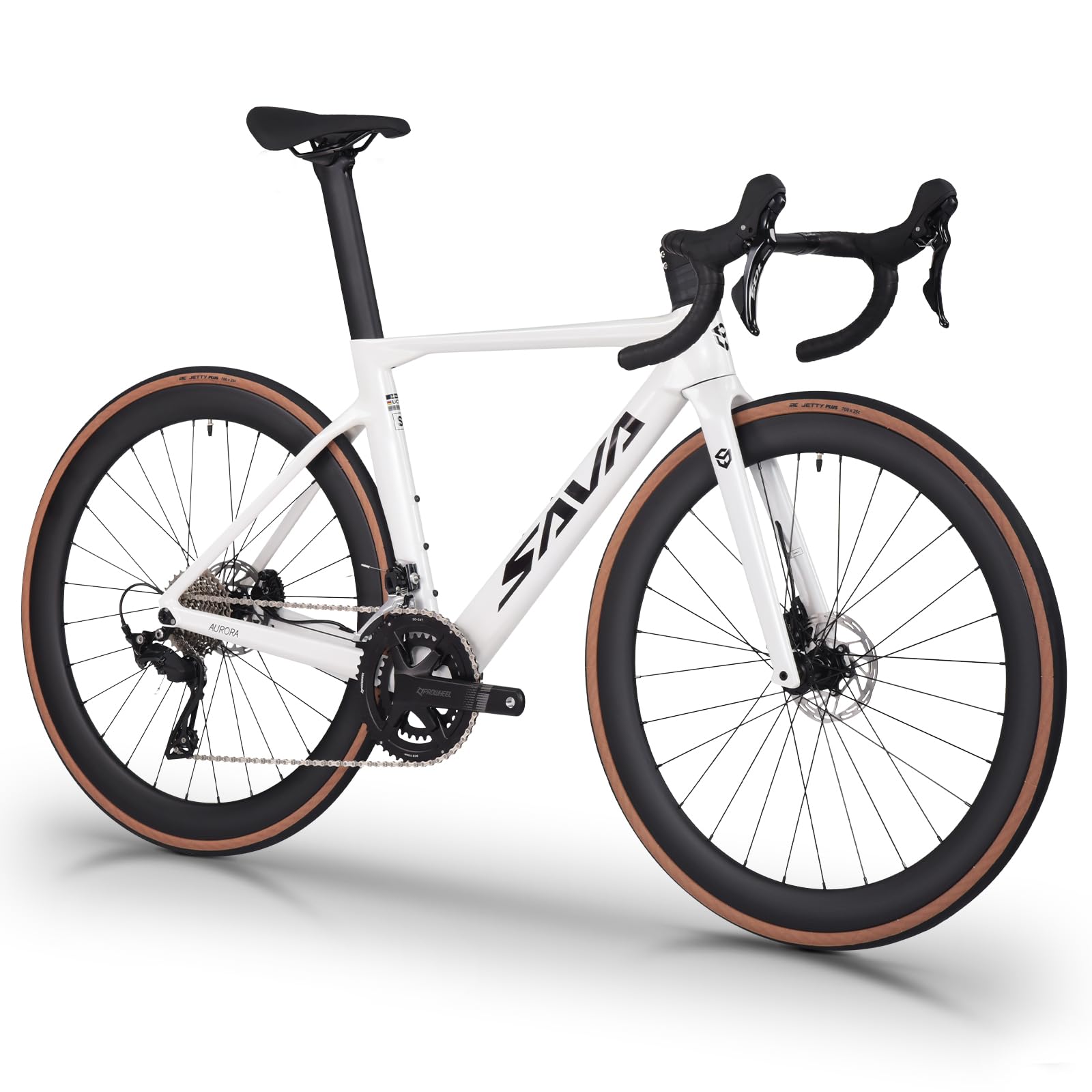
1. SAVADECK Carbon Fiber Road Bike
Our pick — 4.5+★ from 70+ verified ratings; the strongest balance of quality and price.
Nineteen pounds of carbon that climbs like it read the hill and decided not to care.
If you want the full carbon experience — frame, fork, seatpost and wheelset all in T800 carbon fiber — this is the build that delivers it. The complete bike weighs 8.8kg (19.4 lb), which is the number you feel every time you shoulder it up a flight of stairs or launch off a stoplight. SAVADECK also claims the material’s hardness runs 5 times higher than an aluminum alloy frame at the same volume, which translates into a stiff pedaling platform rather than a flexy one that loses your effort.
The gearing comes from a Shimano 105-level R7120 group with 24 speeds (2 front, 12 rear), shifted from the bars with R7100 derailleurs at both ends. That is the widest spread of the flat-bar-capable picks here — the Schwinn GTX tops out at 21 speeds, a 14% gap in total ratios. The R7120 hydraulic disc levers pair with R7170 calipers for stopping power that stays consistent on a wet descent. Cables run fully inside the frame, which keeps airflow clean over the tubes and the whole bike looking tidy.
Where the bike earns its following is build quality — it is the thing riders talk about most, and it shows in details like the tapered head tube that stiffens the front end for confident cornering. The 700x25C JETTY PLUS tires carry an anti-skid pattern on both sides for grip in fast turns, and a pair of clipless pedals comes in the box. Assembly is roughly 90% done before shipping. As owners put it: “430+ miles no issues; would buy again.”
Expect to supply your own torque wrench. The stem spacer install trips people up without one, and the factory saddle draws complaints — budget for a swap if you ride long distances. The stock 25c tires are tubed, and stepping to 28c tubeless is a common first upgrade for comfort and puncture resistance.
Where the money goes
- Full carbon frame, fork, seatpost and wheelset at 8.8kg (19.4 lb)
- Shimano R7120 24-speed group with hydraulic R7170 calipers
- Fully internal cable routing for clean airflow
- 700x25C JETTY PLUS tires with anti-skid side grip
- About 90% pre-assembled from the start
Where it asks more of you
- Saddle is the weakest part of the build — plan a replacement
- Stem and spacer install wants a torque wrench
- Supplied tires are tubed, so a tubeless swap means extra cost
Built for: riders who want a genuine carbon race platform for pavement and are willing to swap the saddle.
Think twice if: you want something that rolls off a trail or handles a rough canal towpath — the 25c tires and road-only geometry belong on smooth tarmac.
2. Schwinn GTX Hybrid Bike
The one that forgives a gravel shortcut and still rolls fast on the way home.
Here is the pick for a rider who wants flat bars and quick pavement manners but cannot guarantee the surface will stay smooth. The aluminum dual-sport frame carries a suspension fork for bump absorption, and the 700c multi-use tires hold traction both on the road and on packed dirt. Riders between 5’2″ and 5’9″ fit the sizing the manufacturer lists. It is a hybrid rather than a pure road bike, so treat the upright position as the trade: more comfort and visibility, slightly more wind drag at speed.
Gearing runs through 21-speed twist shifters, which means you rotate your wrist to change gear rather than click a trigger. Riders who grew up on twist grips find it natural; riders used to trigger shifters sometimes find it fussy. Braking comes from front and rear alloy linear pull brakes, and the alloy double wall rims keep the wheels stiff without piling on weight.
What wins people over is how quickly it goes together — assembly is the single most-praised thing about this bike, and the matte finish draws its share of compliments. Mountain bike and off-road capability extends to light trails, so a family ride that leaves the pavement does not end your day. The honest note is quality: it is the most-discussed topic and it splits opinion, with buyers either delighted by the components or disappointed in them. Some report the rear bearings failing early and the front derailleur limit screws arriving overtightened. Treat it as a bike that benefits from a professional tune-up after assembly, and those issues mostly vanish.
An honest read: a budget-friendly hybrid that rewards a little mechanical diligence with a genuinely versatile ride. Fit the size chart carefully — a mismatched frame is where most of the disappointment starts.
Cost of entry: the stock saddle is firm, and replacing it is a near-universal first move for anyone riding more than a few miles at a stretch.
Reach for this if: your riding mixes pavement, park paths and packed dirt, and you want 700c speed with suspension comfort.
Look elsewhere if: you want a race-bred road geometry and are not prepared to have a shop check the shifting and brakes after delivery.
3. VEVOR Road Bike 700C

A budget commuter that looks the part and asks you to know your way around a hex key.
The entry-level option here is built on a carbon steel frame and carbon steel front fork, with 700x25C tires and a 21-speed (3×7) Shimano drivetrain running through front and rear derailleurs. Caliper brakes handle stopping, and cables run internally through the frame for a cleaner look. At 31.5 pounds it is the heaviest bike on this list by a clear margin — the steel is doing that, so expect to work harder on a climb than you would on the carbon SAVADECK above.
Assembly is 85% complete, and the parts that remain are specific: the front wheel, saddle, pedals, front brake and reflectors. There is a step people miss — the front fork needs rotating 180 degrees before you fit the handlebar and front wheel — and the pedals are marked L and R. Set aside an evening if this is your first build.
Appearance is what buyers respond to most, and the drop-bar shape cuts wind drag for a more efficient position on open road. Beyond the looks, quality and design are the live topics, and they do not all land well. Some find the seat uncomfortable and the ride heavy. As one four-star summary of the flaws puts it, the bike works but the shifting can go goofy and a clicking noise can develop at the rear wheel. Customer service does step in when assembly goes wrong, which helps.
What you get for the outlay
- 21-speed (3×7) Shimano drivetrain with front and rear derailleurs
- Internal cable routing for a tidy frame
- 85% pre-assembled with basic tools in the box
- Drop-bar aerodynamics at the entry tier
What you should know going in
- 31.5 pounds — heavy on climbs and when lifting onto a rack
- Fork must be rotated 180 degrees before assembly
- Shifting and wheel noise can need adjusting after the first rides
Suits: a handy rider after a low-cost pavement commuter who does not mind spending an evening with tools.
Not for: anyone who wants to unbox and ride without adjustment, or who faces real elevation on the daily route.
4. Tommaso La Forma Aluminum & Carbon Mens Hybrid Bike

The mid-range flat bar with more gears than anything else on this list.
Twenty-seven speeds is the headline, and it is a real advantage. The Shimano Acera drivetrain runs 3×9, giving you finer steps between gears than the 21-speed Schwinn GTX, so you can find a rhythm on a rolling route instead of jumping over it. The frame is aluminum with a carbon steel fork, the handlebar is flat, and tires are 700x32c — wider than the 25c rubber on the carbon race bikes, which means more cushion and more grip on a patched-up street.
Cantilever rim brakes keep the build simple and light, and pedals come included. Craftsmanship is the quality that carries this bike: it is the most-discussed strength by a wide margin, with the look and the value close behind. Buyers describe the shifts as smooth and the ride as comfortable, and one owner praised it as lighter and faster than their previous bike. For fitness riding and commuting, the geometry sits you upright without making you a sail.
Two gripes repeat. Assembly experiences vary — some bikes arrive nearly fully built and others frustrate, and there are unorthodox steps in the build worth reading twice. Durability is the other: several buyers report bottom bracket failures after 18 months of use, so budget for a service interval on the crank bearings. There are no kickstand mounts outfitted from the factory, and a Greenfield 285mm unit is the fix.
The case for 27 speeds: the widest gear spread of any flat bar here, paired with 700x32c tires that soak up rough lanes without giving away speed.
The reminder: bottom bracket wear is the recurring long-term cost, and the fit range runs off the frame size you pick rather than a one-size adjustment.
Best fit: commuters and fitness riders who want maximum gearing flexibility, flat bars, and a frame that feels quicker than its price tier suggests.
Consider another pick if: you want a factory kickstand or expect zero maintenance on the crank after a year and a half.
5. Schwinn Twinn Tandem Bike

A different brief entirely: two riders, one frame, 26-inch wheels, flat paved paths only.
This one earns a place for the specific buyer who wants to ride with a partner rather than alone. It is a tandem, and the sizing is fixed by position: the front captain fits from 5’11” to 6’2″ and the rear rider from 5’3″ to 5’10”. The aluminum frame keeps it manageable, and mechanical disc brakes provide all-weather stopping power and speed control.
Gearing is a 21-speed setup with trigger shifters and a rear derailleur. A suspension fork sits up front and a second set of handlebars gives the rear rider something to hold. Plush fitness seats sit at different heights to accommodate both riders. The manufacturer is direct that this is built for smooth, flat terrain — not off-road, not steep climbs.
Owners value the quality and the ride most, and it assembles easily. The frame itself holds up: one builder with 40 years in the trade called the aluminum frame light, stiff and strong, and good for an easy 15 MPH on flats. The honest caveats are real but specific. The rear bars can foul on the front rider’s knees, the fork spring runs soft and compresses deep enough to strike pedals, and the brakes are sized for casual speed rather than a fast descent. There is a combined rider limit around 330 pounds, which will rule out some pairs.
Why couples buy it: an aluminum tandem with disc brakes, trigger shifting, and two seats at different heights — a genuine two-person machine rather than a long single.
Where it stops: tight turns are awkward because the pedals can strike, and the seating position does not adjust much between riders.
Choose it for: flat rail trails and beach paths with a riding partner, where conversation matters more than pace.
Choose something else for: hills, off-road routes, or pairs whose combined weight sits near or above the stated limit.
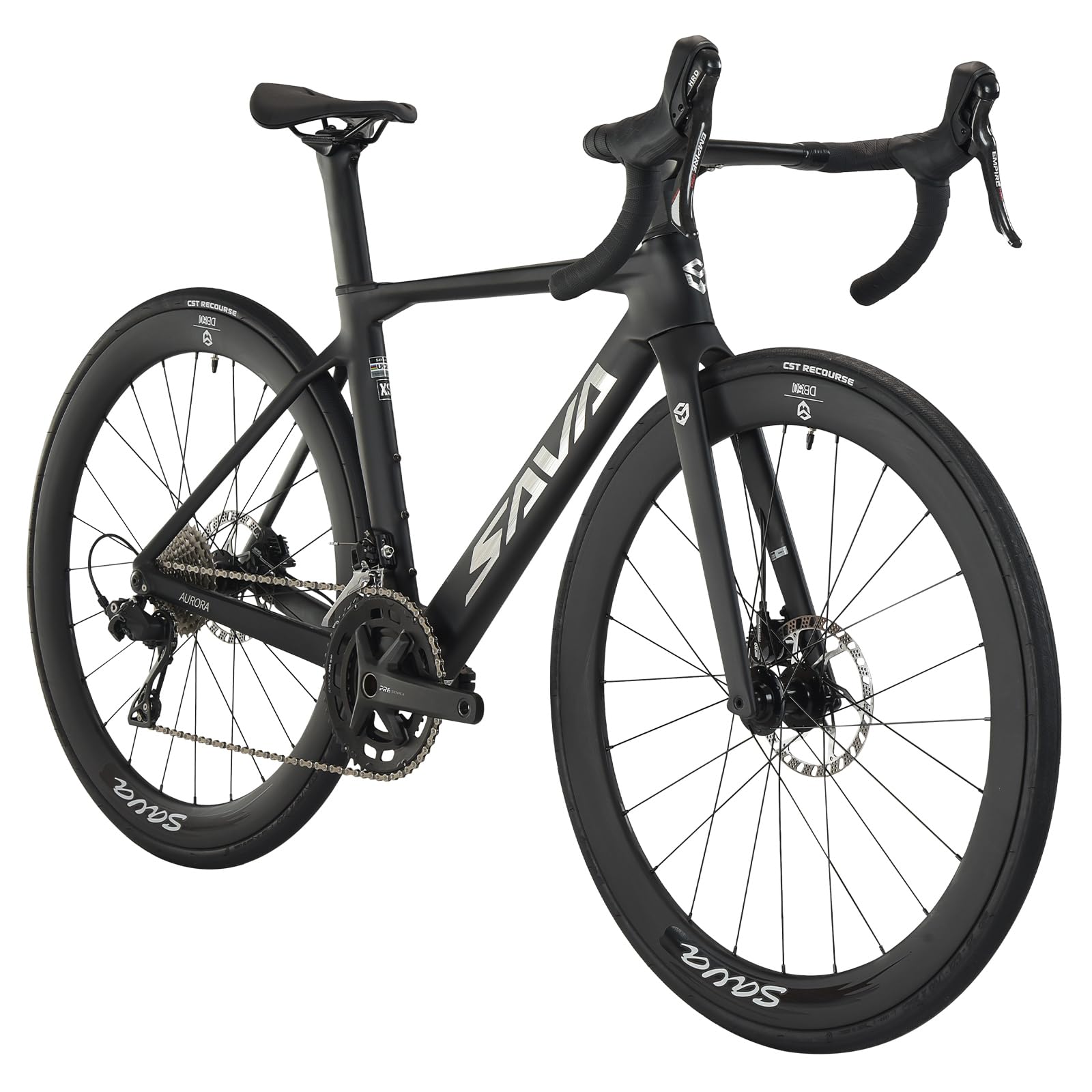
6. SAVADECK A7L Carbon Road Bike
The starter carbon bike that finishes a triathlon and still gets a shop’s nod of approval.
SAVADECK’s second carbon build here trims the weight to 8.9 kg (19.6 lbs) with a T800 carbon frame, carbon fork, carbon seatpost and carbon rims. That is a hair heavier than the SR7.1 above at 8.8kg (19.4 lb), and the two share the hydraulic disc brake system and 700x25C wheelset. The difference shows up in the shifting: this one runs the Shimano 105 R7100 24-speed group. Aerodynamics are shaped into the frame, wheelset and handlebars to cut drag.
What surprises owners is the smoothness of the drivetrain. The 105 shifts cleanly, and the saddle gets more praise than most stock saddles do. The freewheel is loud, which is a matter of taste rather than a fault. Setup is about 30 minutes for the front wheel, handlebars and seat post, and a bike shop that inspected an assembled A7L approved the work.
Quality is what owners point to most, and it holds. One rider finished a 27-mile triathlon after six months with no issues. Another noted the left brake lever rears the rear brake rather than the front, and the serial number is painted rather than engraved. The bigger reality is upgrade appetite: the stock build suits casual riding, but someone chasing performance may find themselves replacing the groupset, bottom bracket, crankset, wheels and handlebar — and a few hundred dollars’ worth of those swaps is where the value of buying a frame and building up starts to look attractive.
Why the A7L makes sense
- 8.9 kg (19.6 lbs) with carbon frame, fork, seatpost and rims
- Shimano 105 R7100 24-speed drivetrain shifts smoothly
- Hydraulic disc brakes with short stopping distances
- About 15-minute assembly from 85% pre-built
- Comfortable stock saddle and a clipless pedal pair included
The upgrade math
- Brake levers ship reversed — left controls the rear
- Serial number is painted, not engraved
- Loud freewheel is noticeable on quiet paths
- Performance riders end up replacing drivetrain and wheels
Your bike if: this is your first carbon road bike and you want 105 shifting with hydraulic brakes without the build-it-yourself route.
Pass if: you already know you will swap the groupset and wheels — you are better off buying a bare frame and building it.
7. Hearts Bio Carbon Road Bike Model H, 18.7 lb

The lightest frame on the list, in Celeste or Blue, with your club logo on it.
At 18.7 pounds the Model H is the lightest bike reviewed here, built on a Toray T800 supreme carbon fiber frame with a Shimano Tiagra 20-speed drivetrain (10 rear, 2 front). Rim brakes keep it simple and shave grams. The minimalist design takes a custom club logo, which is a rare touch — you can ride a bike that matches your team rather than one that matches the catalog. A limited lifetime warranty covers the carbon frame, with one year on mechanical parts.
What owners describe again and again is speed and lightness in the same breath — a light frame that still feels strong after years of riding. Assembly is straightforward and takes about an hour, and the company is the other half of the story: fast shipping, immediate accurate answers, and staff who will text and call to walk you through details. One first-time online bike buyer said the whole experience, from color to ride quality, left them recommending it without reservation.
The 20-speed Tiagra gearing is the smallest count here, so if you face serious climbs and want fine steps between gears, the 24-speed SAVADECK pair or the 27-speed Tommaso will suit you better. Casual riders find 20 gears more than enough. Hearts Bio recommends a service every six months to check the drivetrain, brakes and bolts.
The standout number: 18.7 pounds — the lightest complete bike on this list, and you feel it the moment you lift it onto a rack.
What you give up: rim brakes instead of discs, and 20 speeds rather than 24 or 27, so it favors dry pavement and rolling routes over steep wet descents.
Made for: riders who want the lightest build here, a custom look, and customer service that actually picks up the phone.
Better off elsewhere if: you need disc braking for wet weather or a wide gear range for long climbs.
Know the Specs
Frame material and what it does for you
Carbon fiber is laid up in sheets and shaped into tubes, and it can be tuned to be stiff where you pedal and forgiving where you sit. That is why a carbon build like the SAVADECK SR7.1 can weigh 8.8kg (19.4 lb) and still feel solid under power. Aluminum is welded tubing — a touch heavier but tough and inexpensive to make. Carbon steel is the heaviest of the three and the springiest, so a steel bike like the VEVOR at 31.5 pounds takes more effort on a climb.
Gear count and the hills you can ride
Speeds are counted as front chainrings multiplied by rear cassette cogs. A 3×9 setup equals 27 speeds and 2×12 equals 24. More gears mean smaller jumps between them, so you can hold a comfortable pedaling rhythm as the gradient changes. Fewer gears on a flat commute is not a problem. More gears do not make you faster, but they give you smaller steps between ratios so you can hold cadence on a climb.
Brake systems in plain terms
Hydraulic disc brakes push fluid to squeeze a metal rotor at the wheel hub, so stopping power stays consistent when the rim is wet. Caliper brakes clamp the rim from above — light and simple, with longer stops in the rain. Linear pull brakes, the kind on the Schwinn GTX, work the rim from the side with more leverage than a caliper. Mechanical disc brakes use a cable instead of fluid and sit between the two in feel.
Weight, tires and the surface you ride
Bike weight matters most when you accelerate, climb and carry. Thinner tires like 700x25C roll fast on smooth pavement, while 700x32c tires on the Tommaso soak up rough lanes. Wider multi-use tires on the Schwinn GTX handle packed dirt and pavement both — the trade is a little more rolling resistance on clean tarmac.
Common Questions
Can I swap flat bars onto a drop-bar road bike?
How much difference does bike weight actually make?
Are hydraulic disc brakes worth it for city commuting?
What size flat bar road bike do I need for my height?
Is 21-speed enough for a flat bar road bike?
Do these bikes come fully assembled?
Can I ride a flat bar road bike on gravel?
What should I check after the first few rides?
How often does a carbon frame need servicing?
Should I pick a tandem or two separate bikes?
The Bottom Line
For most riders the flat bar road bike that earns the spot is the SAVADECK Carbon Fiber Road Bike SR7.1, because it brings a full carbon frame and wheelset at 8.8kg (19.4 lb), 24-speed Shimano R7120 shifting and hydraulic R7170 calipers in one package. If you mix pavement with packed dirt and want suspension comfort, the Schwinn GTX Comfort Hybrid is the versatile choice. And if you want the lightest frame on the list with a custom club logo and service that answers the phone, the Hearts Bio Model H at 18.7 pounds is the one to reach for. Pick your surface and your hills first; frame material and gear count then narrow the list to one bike.
The Schwinn Twinn tandem carries 4.0+ stars across 555+ ratings, but it is a two-rider bike — choose it only if you ride with a partner on flat pavement.
How we choose
We do not accept paid placement. Every pick is matched to a real buyer and a real use-case; we do not hands-on test units.
Sources
Specifications: manufacturer listings and product documentation. Review insights: verified customer reviews, as of October 2026. Pricing: not shown on this page (it changes often); check the current price via the retailer link.
As an Amazon Associate, Aappliancez earns from qualifying purchases. This does not affect which products we feature.