Disclosure: Some links in this post are affiliate links. As an Amazon Associate I earn from qualifying purchases, at no extra cost to you. Learn more
Specs are compiled from manufacturer listings and verified buyer reviews and can change over time — please confirm the key details on the product page before buying.
Dull knives are frustrating when you cannot hold a steady angle by hand. A fixed angle knife sharpener holds the abrasive at one exact bevel (the angled edge of the blade), so every stroke grinds the same angle the factory did. The picks below run from a pocket-sized angle guide up to a German-built roller and a bench system with a digital angle readout. The KME Precision Knife Sharpener System with 4 Gold Series Diamond Hones takes the top spot. This bench kit adjusts from 17 to 30 degrees and has the strongest owner satisfaction in this group at 4.5+ stars across 600+ ratings.
This guide is built by comparing the manufacturers’ published specifications and the patterns across verified customer reviews, so you get each pick’s real strengths and trade-offs instead of marketing spin.
You will see the angles each tool offers, the hones it ships with, and how the blade is clamped or held. That last detail decides whether you get a clean bevel or a wobble that rounds the edge. The list below ranks each fixed angle knife sharpener by how well it matches a specific kind of blade.
Top Picks


How To Choose The Best Fixed Angle Knife Sharpener
The angle number decides which knives a sharpener can actually serve. A fixed angle knife sharpener removes the guesswork from holding a steep or shallow bevel by hand, so you need to know what your knives are actually ground at before you buy. Most kitchen blades sit around 15 or 20 degrees per side, while outdoor and heavier working knives often want 20 to 25 degrees.
Match the angle range to your knife drawer
If you own Japanese or Damascus blades, you want a sharpener that reaches 15 degrees or lower. If most of your knives are European chef knives or pocket folders, look for 20 to 25 degrees, or a system that dials through the full range. The KME kit adjusts from 17 to 30 degrees in 1-degree steps, which covers the useful middle without a fixed single setting.
Decide how the blade gets held
Three designs dominate here. Rod-and-hone systems clamp the blade and guide the stone at a set angle, rolling sharpeners hold the blade on a tilted magnetic block and you roll the disc, and electric machines pull the knife through guided slots. A clamp gives you the most repeatable bevel but adds setup time; a rolling sharpener is faster to start but slows down as you grind. Electric units are quickest of all, but the angle is set by the guides rather than by you.
Look at the abrasives, not the marketing
Diamond cuts fast and stays flat, which matters when you are reprofiling a chipped edge. Ceramic hones refine and polish once the bevel is set. And a leather strop, where it is included, removes the burr left behind by the stones. A sharpener that ships with a full grit ladder — coarse through extra-fine — saves you from buying add-ons later.
Weigh portability against bench stability
A 4-ounce angle-guided tool drops in a pack for camp use. A 7.5 lb weighted bench base stays planted on a counter while you make long, even strokes. If you sharpen at home most of the time and only occasionally on the trail, a heavier base with a solid clamp is the safer choice for edge consistency.
Side-by-Side Comparison
| Model | Best For | Angle Range | Abrasives Included | Weight | Amazon |
|---|---|---|---|---|---|
| KME Precision with 4 Gold Series Hones★ Best Overall | Repeatable bevels at home | 17° to 30° | 4 diamond hones | 12 oz | Amazon |
| Work Sharp WSBCHAGS Ken Onion EditionMost Angles | Five-angle rod sharpening | 15°, 17.5°, 20°, 22.5°, 25° | Tri-abrasive rods plus ceramic | 1.3 lb | Amazon |
| Lansky QuadSharp QSHARPPocket Pick | Pocket and field touch-ups | 17°, 20°, 25°, 30° | Carbide plus ceramic | 0.12 kg | Amazon |
| Rolling Knife Sharpener Kit by EDOVEN | Beginners wanting a strop | 15° and 20° | Diamond disc, ceramic disc, strop | — | Amazon |
| RUIXIN PRO RX-008 | Ten-stone variety | Adjustable fixed angle | 10 whetstones | 16 oz | Amazon |
| Wicked Edge Venture WE20 | Sharpening on the trail | 20° standard | 500-grit diamond, ceramic, strop | 4 oz | Amazon |
| Lansky Deluxe LKCLX | Learning a clamped system | Fixed angle, multi-hone | 5 stones plus honing oil | 1.1 lb | Amazon |
| Presto 08800 EverSharp | Fast kitchen touch-ups | Guided two-stage | Sapphirite wheels | 3 lb | Amazon |
| Work Sharp Precision Adjust | All-round home sharpening | 15° to 30° | Tri-brasive stone, ceramic | 215 g | Amazon |
| Warthog V-Sharp Curve | Quick two-sided passes | 25° constant | 325-grit diamond rods | 0.18 kg | Amazon |
| Work Sharp Rolling Knife Sharpener | One angle for the whole block | 4 preset angles | Diamond abrasives | 0.77 kg | Amazon |
| HORL 2 Walnut | Kitchen-counter looks | 15° and 20° | Diamond and ceramic discs | 1.74 lb | Amazon |
| Chef’sChoice 15XV EdgeSelect | Serrated and straight blades | 15° Trizor XV | 100% diamond, 3 stages | 4.2 lb | Amazon |
| Work Sharp Ken Onion Mk2 | Speed plus variable control | 15° to 30° | Flexible belts | 2 lb | Amazon |
| Work Sharp Professional Precision Adjust | Digital angle accuracy | 15° to 30°, ±0.25° | 220–800 grit diamond plus ceramic and strop | 3.43 kg | Amazon |
Detailed Reviews
1. KME Precision Knife Sharpener System
Our pick — 4.5+★ from 650+ verified ratings; the strongest balance of quality and price.
A clamped guide that grinds the same bevel on every single stroke.
The KME is the pick for someone who owns a handful of good knives and wants one repeatable edge instead of a drawer of gadgets. It adjusts through a continuous 17 to 30 degrees, marked in 1-degree steps, so you can match the factory grind on a Japanese blade at the shallow end and a heavy outdoor knife at the deep end. That 1-degree control is why it takes the top spot: you can dial in 18 or 22 degrees instead of settling for a preset.
Four Gold Series diamond hones ship in the box — 140 extra-coarse, 300 coarse, 600 fine and 1500 extra-fine. In plain terms, that is a full ladder from repairing a nicked edge to polishing it bright. The 140 extra-coarse stone does the heavy lifting on chipped blades, then you step up through the finer grits to finish. A spherical bearing rod guide keeps the stone rod smooth and holds zero angle deviation while you stroke, which is what keeps the bevel flat from heel to tip.
The whole kit folds into an included hard carry case and weighs 12 ounces, so it travels without taking over your bag. Sharpening performance is the thing that wins people over here — owners describe consistent razor-sharp results and diamonds that cut without much effort. Durability holds up too, with the hones surviving repeated use rather than wearing flat. The honest catch is the learning curve on setup and the mixed notes on stone quality and stability at the base, so budget a session to dial it in before you judge the edge.
What earns the top spot
- Continuous 17 to 30 degree adjustment in 1-degree steps covers kitchen and outdoor blades
- Four diamond hones from 140 extra-coarse to 1500 extra-fine handle repair through polish
- Spherical bearing rod guide keeps angle deviation at zero for a flat, even bevel
- Hard carry case and 12-ounce build make it genuinely portable
Where it asks more of you
- Setup takes a real learning curve before the first clean edge
- Base and stone-quality notes come up as mixed in owner feedback
Worth it for: anyone who wants one clamped system that can match the exact grind of several different knives.
Think twice if: you want a sharpener you can pull out and use with zero setup — a rolling or electric unit gets you sharp faster.
2. Work Sharp WSBCHAGS Knife Sharpener
Five click-stop angles and a rod set that teaches your hands the right stroke.
Five angles in one benchtop tool is the pitch here, and it delivers: 15, 17.5, 20, 22.5 and 25 degrees, changed by rotating the rod assembly. That spread lets you keep a thin kitchen blade at 15 and a thicker outdoor knife at 25 without buying a second sharpener. The tri-abrasive design puts medium and fine diamond grits plus an extra-fine ceramic on quick rotation, so you move from shaping to refining by turning the rod rather than swapping parts.
There is a tapered ceramic honing rod in the box as well, and it works on serrations of all sizes — both everyday-carry folders and kitchen knives. That is a detail most sharpeners in this group skip. The storage case doubles as a hand guard, with removable lids you can hold over the stones while you work, and the whole thing stows in a gear bag or on a bench.
Owners keep praising two things: how it works and how easy it is to use. The adjustable angles let you actually learn what a proper angle feels like. Size is the big difference from the pocket-sized Lansky QuadSharp. This unit measures 10.54 by 5.42 by 1.39 inches, against the QuadSharp’s 1.67 by 0.2 by 0.89 inches, so it is a benchtop tool rather than a keyring one. Stability gets mixed notes, with the mounting of the stones raised as the weak point. Set it on a solid surface and hold the base steady.
My read: the five-angle spread and lifetime warranty make this the strongest choice for a household that sharpens both kitchen and outdoor blades from one spot.
The trade-off: it is a station, not a pocket tool — you sharpen at a bench, and a slightly loose stone mount means you keep a hand on the base.
Reach for this if: you keep a mixed set of kitchen and field knives and want one bench tool covering five angles.
Look elsewhere if: you need something that rides in a pocket or packs into a small camp kit.
3. Lansky QuadSharp QSHARP
A tiny four-angle sharpener that brings a dull blade back in a few strokes.
The QuadSharp is the one you clip to a keyring or drop in a tackle box. It offers four sharpening angles — 17, 20, 25 and 30 degrees — in a body that measures 1.67 by 0.2 by 0.89 inches, which makes the Work Sharp benchtop unit look enormous by comparison. Carbide slots do the quick shaping in 3-4 strokes, and a ceramic benchstone handles fine polishing once the edge is there.
What it does not do is refine. The carbide slots cut fast rather than gently, so this is a field touch-up tool, not the machine you use to reprofile a chipped blade. It is 100 percent compatible with all Lansky kits and accessories, though, so it can sit in the same drawer as a clamped system and handle the quick jobs that system is too much hassle for.
The compact size is the whole appeal here — it fits in a pocket and balances well enough for even strokes. The main limitation is the carbide bits, which buyers report wear out after months of daily use, and replacement parts are not sold. Treat it as a sharpening accessory for the field rather than a lifelong bench tool.
Best use case: keeping pocket knives and work blades cutting well when you are away from your bench.
Fair warning: the carbide bits are consumable — once they wear flat, the sharpener is done.
Built for: the glovebox, the tackle box, and the pocket of anyone who carries a knife daily.
Not the pick for: a chef’s knife that needs a fresh bevel — this is for touch-ups, not reprofiling.
4. Rolling Knife Sharpener Kit
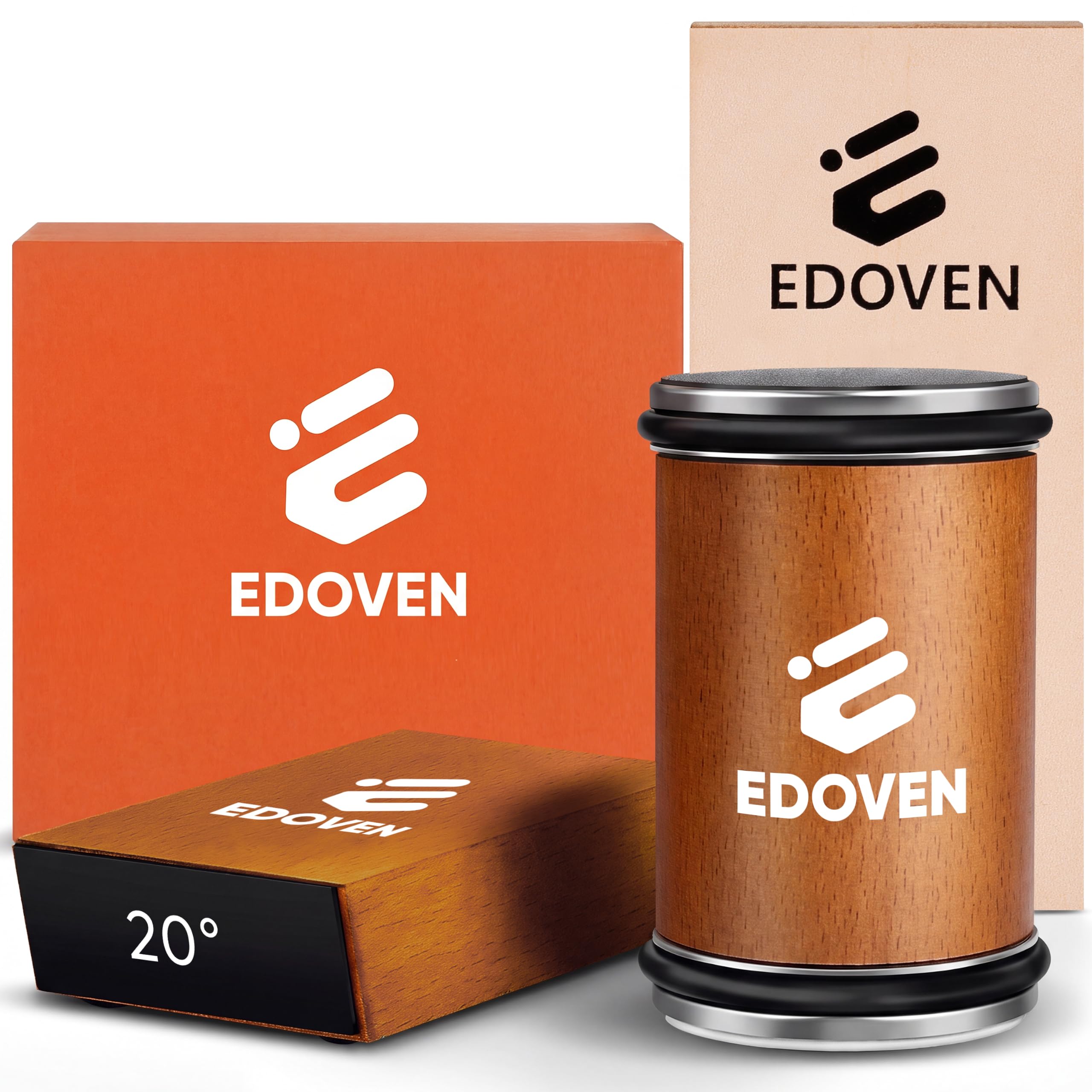
A magnetic block and a rolling disc that makes the 15 degree edge hard to get wrong.
If freehand whetstones have never worked for you, this kit is the shortcut. The magnetic angle guide holds your blade at either 15 degrees for delicate edges or 20 for tougher kitchen work, so you do not estimate the angle by hand. You roll the sharpening cylinder along the blade and the guide keeps the contact geometry consistent from the first pass to the last.
The kit ships as three pieces: the roller, the magnetic knife holder and a natural wood body with a diamond grinding disc and a 400-grit diamond plus 6000-grit ceramic disc. The included leather strop is the step most home kits skip — a few passes align the microscopic edge and clear the burr left by sharpening. That strop step is what separates a merely sharp edge from a properly finished one.
Owners describe a dull chef’s knife returning to tomato-slicing sharpness in under 5 minutes, and the build quality earns the most praise of any aspect here. There is a mixed note on the magnet: some find it strong enough, others find it too weak to hold a heavier blade in place. The other honest catch is speed — one buyer put it plainly: “It’s not that fast but it is effective.” Plan on a little patience rather than a few seconds per knife.
Where it shines: the angle is held for you, and the strop finishes the job most rolling kits leave half-done.
Who should pass: anyone sharpening heavy cleavers or long blades, where the magnetic hold may not be strong enough.
The match for: a home cook who wants consistent 15 or 20 degree edges without learning a whetstone.
Skip past: if you sharpen for speed — rolling takes longer than pulling a knife through a slot.
5. RUIXIN PRO RX-008 Knife Sharpener

Ten stones, a table clamp, and a flip fixture for both sides of the blade.
Ten whetstones in one kit is unusual, and the grit spread is wide: 180, 400, 800, 1500, 2000, 3000, 120, 320, 600 and 1500. The low numbers grind a chipped edge back into shape, and the high numbers polish it smooth. That gives you a full repair-to-refinish sequence without buying stones separately.
The frame is mostly stainless steel, and a G-clamp locks the whole unit to a table, stool or stove so it does not shift mid-stroke. The 360-degree flip fixture lets you turn the blade over and sharpen the other side with a deviation of plus or minus 2 degrees. The handle sits above the knife blade, which keeps your hand clear of the stone while you work back and forth.
Sharpening performance is the headline strength. There is a real learning curve and the setup is described as finicky, with stone holders that can shift and stock stones that are soft enough to break if dropped. Work over a table, keep the stones dry and unclamped when not in use, and this becomes a lot of sharpening for the money.
Stronger than it looks
- Ten whetstones cover everything from 120 to 3000 grit in one kit
- G-clamp keeps the rig planted on a table, stool or stove
- Stainless steel frame holds a firm blade while you work
The honest frictions
- Setup is finicky and the angle needs checking before you start
- Stock stones are soft and will break if dropped
A smart buy for: the tinkerer who wants a wide grit range and does not mind a little setup ritual.
Not ideal for: someone who wants a tool they can pull out and use cold — the clamp and angle check take time.
6. Wicked Edge Venture WE20 Knife Sharpener
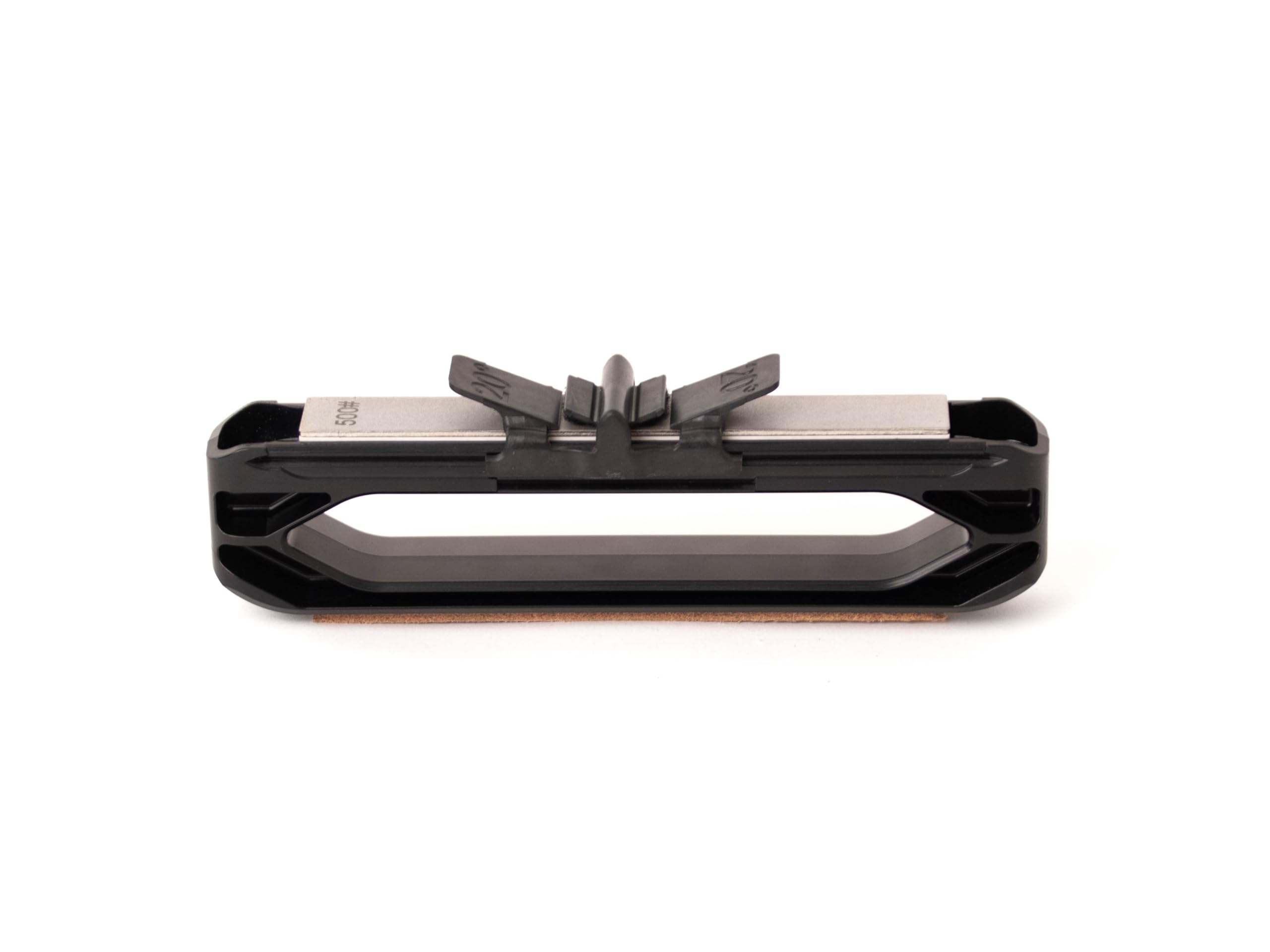
A 4-ounce angle guide that sharpens on a rock at camp as easily as on a counter.
Portability sets this one apart from everything else here. It weighs 4 ounces and measures 7 by 1.38 by 1.75 inches, so it slides into a pack, a toolbox or a glove compartment without a second thought. The angle guide holds a consistent 20 degrees, and you can add 15, 17 or 25 degree guides sold separately if you want a different bevel.
The stone is dual-sided: a 500-grit diamond for shaping on one face and a fine ceramic hone for refining on the other. A leather strop is included for the final polish, and the whole thing is made in the USA with a 5-year warranty. For a knife that lives in a pack or on a belt, that combination covers shaping, refining and finishing in one small tool.
Owners describe a pocket knife coming back sharp, and the guided system takes the guesswork out of matching an angle by hand. Build quality is the aspect that earns the most praise. The caveat is the bevel guide, which some owners mention can pop off during use — so keep a firm grip and don’t rush the stroke. Extra angles and grits are also sold separately, which adds up if you want the full range.
What you’re buying: a USA-made angle guide with a diamond-and-ceramic stone and a 5-year warranty in a 4-ounce package.
The catch: the guide can pop loose mid-stroke, and every extra angle or grit is a separate purchase.
Fits best: the hiker, camper or tradesperson who needs a sharp edge far from a bench.
Pass on it: if you want one purchase to cover every angle — this covers 20 degrees and the rest cost extra.
7. Lansky Deluxe Knife Sharpening System LKCLX

The clamped five-stone kit that has taught a generation of cooks to sharpen.
You get a full sharpening sequence in one case: five color-coded stones — extra-coarse, coarse, medium, fine alumina oxide and extra-fine ceramic. Each stone sits in a finger-grooved holder, so you do not slice a thumb while swapping. The kit weighs 1.1 pounds and packs into a custom-molded carrying case, so it stores cleanly rather than leaving loose stones in a drawer.
A precision knife clamp holds the blade while guide rods set the angle, and specially formulated honing oil is included. The clamp plus guide rods make the setup worth it: the stone travels the same path on every stroke, so the bevel stays consistent. Owners sharpen everything from a CIVIVI Elementum at 25 degrees to a Henckels at 30 degrees and get clean cuts from both.
Setup and blade length are the honest friction points. Getting the knife seated in the clamp correctly takes care. The system only properly sharpens about 3 to 4 inches of blade at a time, so a long chef’s knife needs remounting and can show a visible transition. The parts are adequate rather than premium, and the guide rods are aluminum. It rewards the patient owner who marks the rods and checks the angle before starting.
What it does well
- Five color-coded stones from extra-coarse through extra-fine ceramic cover the full sequence
- Custom-molded case keeps all the pieces organized
- Owners sharpen CIVIVI and Henckels blades to clean cuts at 25 and 30 degrees
Where it needs care
- Setup is fiddly, and the clamp needs retightening as you go
- Only sharpens about 3 to 4 inches of blade at a time, so long blades need remounting
- Guide rods are aluminum and can loosen
Choose this if: you want a clamped kit with a full stone ladder and do not mind a careful setup each time.
Better to look at: a bench system if you regularly sharpen long chef’s knives in one pass.
8. Presto 08800 EverSharp Electric Knife Sharpener

Two labeled slots and about two minutes turn a tired knife into a working edge.
The 08800 is the pick for people who want sharp knives without learning an angle. It runs a two-stage system with labeled slots: stage 1 grinds a precisely angled edge on Sapphirite wheels, then stage 2 hones and polishes for a razor finish. Precision blade guides position the knife at the sharpening angle, so you simply draw the blade through each slot a few times.
Sapphirite is the same ultra-hard material used in professional sharpening shops, and the unit weighs 3 pounds with suction cups that hold it to the counter. Setup takes about 2 minutes and a dull knife comes back in 1 to 2 minutes. It handles most non-serrated blades and a one-sided serrated knife, so it covers the full kitchen drawer.
Quality is the most-discussed point here by a wide margin, and owners get blades that stay sharp for a long stretch. One reported six months of edge life from just two sharpenings, and another two years with infrequent use. A knife collector found that multiple passes on a dull set and a Benchmade folder did not pass the paper test, so treat this as a fast touch-up tool rather than a reprofiler (a tool that reshapes a worn edge). The cord is also on the short side at about 30 inches.
Where it wins: speed and simplicity — slot the knife, draw it through, done in minutes.
Keep in mind: it is not built to fix chips or reset a badly worn bevel, so a damaged blade needs a guided system first.
A natural fit for: busy kitchens where a few seconds of sharpening beats learning to hold an angle.
Not for you if: you want a polish-grade finish or need to repair a chipped edge.
9. Work Sharp Precision Adjust Knife Sharpener

Dial the angle once and this kit repeats it on every knife in the block.
The Precision Adjust is the practical middle ground for a home cook who wants a fixed bevel without a bench full of separate stones. The angle adjustment runs from 15 to 30 degrees, so you can match the maker’s grind on pocket, hunting, chef and paring blades. That range covers the useful part of the family with one setup.
The kit ships with a tri-brasive stone at 320 and 600 grit, diamond and fine ceramic, mounted on an angle-adjustable chassis with a benchtop base. You can take a chipped blade from damaged to polished without swapping tools. It weighs 215 grams and folds down to store in a drawer — no cords, no batteries, so it works on a counter, a workbench or at camp.
Performance is the aspect owners come back to, and the edge it puts on a blade is what earns the loyalty. The magnetic clamp is the weak link: some owners find it strong enough, others say it does not hold knives properly, and there are notes about the abrasives wearing and gouging. That is a real limitation on thick-spined blades, so keep your clamp lined up and use light pressure.
Best part: the 15 to 30 degree dial and the 3-year warranty back a manual system you can repeat.
The honest limit: the magnetic clamp and abrasive durability are the weak points, so heavy or thick blades need extra care in the clamp.
For the buyer who: wants one manual kit covering kitchen cutlery, pocket folders and a fillet knife.
Not the one for: thick-spined knives that may slip in a magnetic clamp.
10. Warthog V-Sharp Curve Knife Sharpener

Two diamond rods grind both edges at once, with no angle to set.
The Curve uses a spring-loaded V-Sharp system that sharpens both sides of the blade at the same time and keeps equal pressure on each. There is no angle to adjust — the parabolic diamond rods hold a constant 25 degrees through the whole blade. A single setting like that sounds limiting, but 25 degrees is where most kitchen and pocket knives hold an edge longest.
The rods are 325-grit diamond, and a few quick strokes pull a dull blade through the V. At 0.18 kg it is compact enough to store in a drawer and light enough to carry to a backyard grill or a camp. It handles smooth and serrated knives, so a bread knife and a chef’s knife both get a pass.
Sharpening performance is what owners notice, and the simplicity is the point — you pull the knife through and it comes out cutting better. The honest caveat: the plastic base is not sturdy enough to sit still firmly, so brace it with one hand while you pull. It is also a maintenance tool, not a reprofiler — it keeps a working edge but is not the tool to establish a new bevel on a badly worn blade.
Where the value is: a few strokes, both sides done, no angle to think about.
The real limit: it maintains an edge you have rather than cutting a new one, and the base needs steadying.
The fit for: a grill cook or camper who wants a fast edge with zero setup.
A miss for: anyone with a dull, chipped blade that needs a fresh bevel cut from scratch.
11. Work Sharp Rolling Knife Sharpener
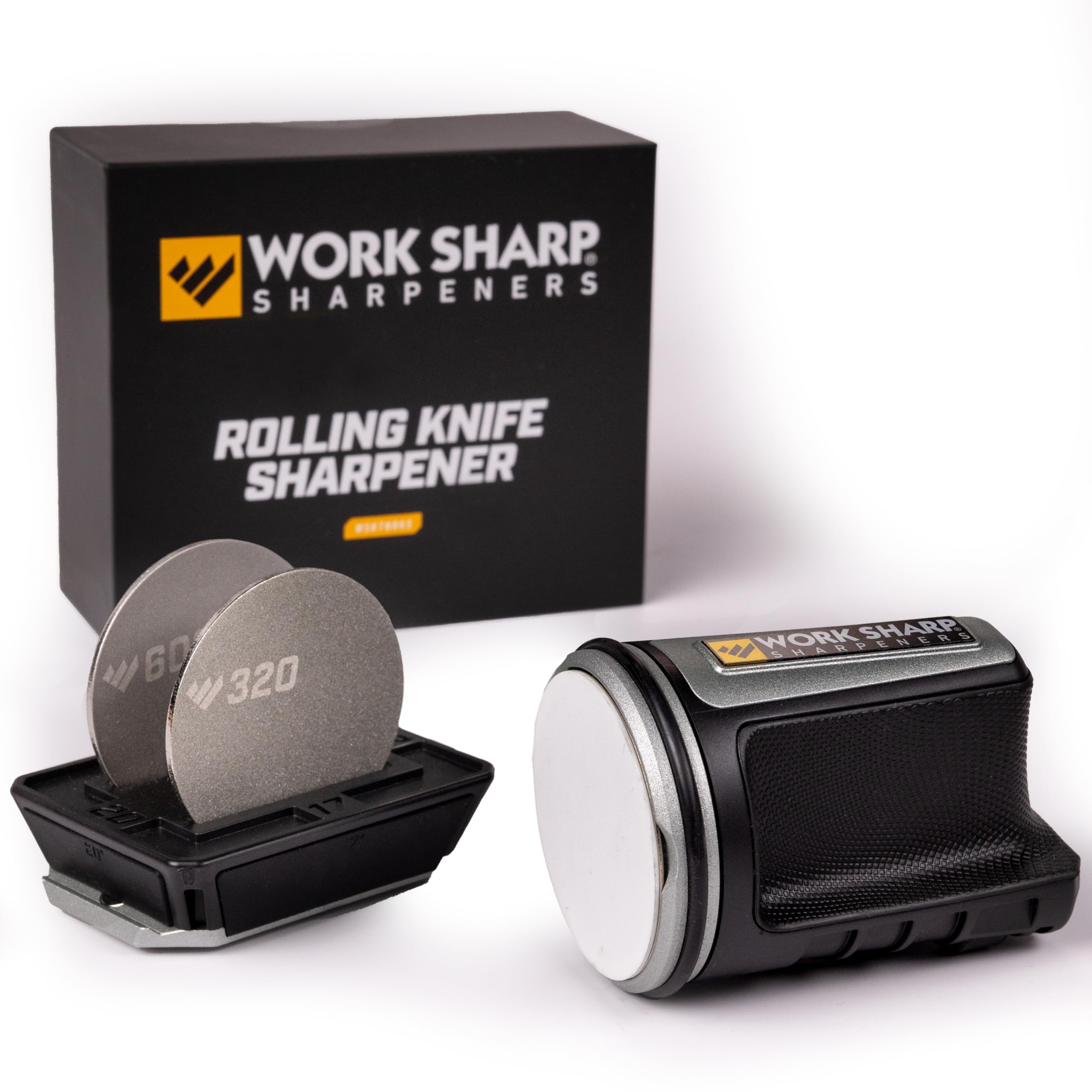
Four preset angles and a roller that brings a whole knife block to the same edge.
Choose from four preset angles to match your blades, then let the magnetic guide hold the angle while the roller does the work. That means a chef knife, a santoku, a paring knife and a utility knife all get the geometry they need, and you get a consistent edge without freehand guesswork. The appeal is repeatability: every blade in the drawer comes out cutting the same way.
Diamond abrasives rebuild and refine the edge quickly, bringing a dull knife back to slicing-sharp in a short session. The unit is compact at 3.75 by 2.6 by 2.6 inches and built from metal. One thing worth knowing in this category: unlike the cheaper rolling kits, this one uses readily available genuine Work Sharp replacement abrasives, so when the discs wear you can refresh them rather than replace the tool.
The magnetic guide is the part that keeps your fingers clear, and owners find it a fast way to keep a kitchen set sharp. The honest limit is that it is a kitchen sharpener — it works on medium to large knives rather than delicate pocket blades. It is also heavier than the pocket options here, so it stays on the counter rather than in a bag.
Why it’s here: genuine replacement abrasives keep the tool alive, which is not true of every rolling sharpener.
Size up before buying: it is a counter tool at 0.77 kg, and it is aimed at kitchen knives rather than small pocket blades.
Well suited to: a cook who wants every kitchen blade at the same consistent edge and expects to keep the tool for years.
Not the right tool for: someone who needs a sharpener that goes in a pocket.
12. HORL 2 Walnut Rolling Knife Sharpener

German walnut, magnetic angle support, and a diamond disc that never needs replacing.
The HORL 2 is the pick for someone who wants the sharpener to look good sitting on the counter as well as work well. The body is natural walnut from kiln-dried wood, handcrafted in the Black Forest near Freiburg, and the roller runs on precision ball bearings for smooth rolling without play. It weighs 1.74 pounds and measures 5.31 by 4.72 by 2.56 inches.
Two angles cover most kitchens: 15 degrees for Japanese and Damascus blades and 20 degrees for durable everyday edges on European chef knives and santoku. The discs are a professional-grade diamond disc and a ceramic honing disc, and the industrial monocrystalline diamonds are described as never needing replacement. You roll the disc along a bladeheld on the magnetic angle support — no whetstone skills required.
The thing owners rave about is sharpness, and the kit gets there fast: most blades come back sharp in less than 10 minutes. The strong magnet holds the knife at the correct angle, and owners find it well-made and versatile for everyday kitchen use. Where opinions split is value — the tool earns praise for its build and results, but some owners question whether the price matches what they get. It is a gift-grade kitchen object as much as a sharpening tool, so buy it for the experience and the craftsmanship, not just the edge.
What you get: a handcrafted walnut roller with ball bearings, a magnetic angle support, and a diamond disc paired with a ceramic hone.
Fair caveat: value for money is the mixed point here — this is a premium object, and the sharpening result is what you are really paying for.
Reach for it when: you want a sharpener attractive enough to leave on the counter and forgiving enough for a beginner’s hands.
Look elsewhere if: you want maximum grit range for the money — this covers 15 and 20 degrees, not a full ladder.
13. Chef’sChoice 15XV Knife Sharpener
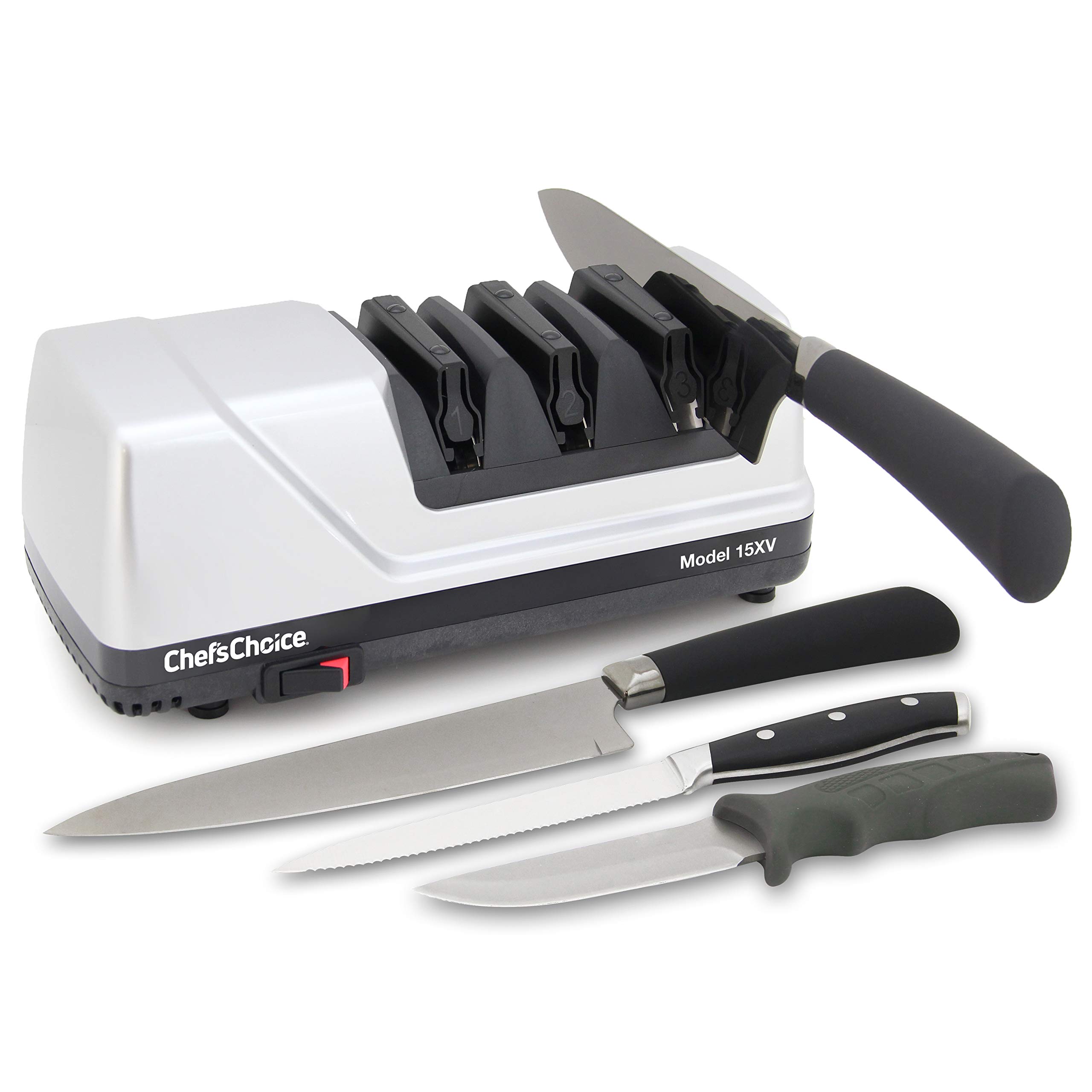
A three-stage electric that resets a 20 degree factory edge to a 15 degree Trizor XV bevel.
Most household knives leave the factory at 20 degrees. This machine converts them to a 15 degree Trizor XV edge, which is thinner and cuts with less effort. Stage 1 and stage 2 use 100 percent diamond abrasives to sharpen and hone, and stage 3 runs a patented flexible abrasive system to polish and help prolong the life of serrated knives. That third stage is why straight-edge and serrated blades both get a turn here.
The flexible spring guides adjust automatically and hold the sharpening angle accurate, so there is no angle to set yourself. First-time sharpening takes about 1 minute, and resharpening takes about 10 seconds. It measures roughly 10 by 4.25 by 4.25 inches, weighs 4.2 pounds, and carries a 3-year limited warranty.
Owners describe a wicked edge and blades cutting through paper with ease, with clear instructions for different knife types in the box. The catch worth planning for is the bevel change: once you convert a knife to 15 degrees, going back to 20 is not a quick switch, so decide before you start. It is also a countertop machine rather than a travel tool.
Why it earns a slot
- Converts 20 degree factory edges to a 15 degree Trizor XV bevel for easier cutting
- Three stages handle straight-edge and serrated blades
- Resharpening takes about 10 seconds once the edge is set
Plan around this
- The bevel conversion is a commitment — 15 degrees is not easily reversed
- It is a countertop unit, not something you carry to camp
Made for: the household with a bread knife, a chef’s knife and a drawer of mixed blades that all need a consistent edge.
Better to skip if: you are happy with your current 20 degree bevels and do not want to change them.
14. Work Sharp Ken Onion Mk2 Knife Sharpener

A motorized belt that reshapes a bevel in minutes and slows down for the fine finish.
Here is the machine for the person with a pile of dull tools and no patience for stones. A powered flexible belt sharpens and hones in a single guided pass, restoring a factory-keen edge in minutes. The sharpening guide dials from 15 to 30 degrees, so a fine kitchen knife and a thick hunting blade each get the bevel they were designed for.
Variable speed control is the feature that separates it from a fixed-speed electric. You run slower for delicate finishing and faster to reprofile a damaged edge, which gives you command over how hard each pass bites. Quick-change abrasive belts swap in seconds when you move from coarse repair to a polished finish, and it weighs 2 pounds with a 3-year warranty. Scissors, shears, serrated blades and garden tools are all in scope — one machine clears out the single-use sharpeners in the drawer.
Performance is the thing owners mention most, and it shows on axes as well as kitchen knives — blades come back razor sharp in short order. The learning curve is short, the adjustable angle guide earns praise, and the machine is versatile enough to justify the space. Durability is the mixed point, so a light touch and the variable speed keep you from burning through belts and steel.
The draw: motorized belt speed plus a 15 to 30 degree guide means fast repair and a controlled finish in one machine.
Keep in mind: it is a powered tool, so a few practice passes on a cheap knife are worth it before you touch your best blade.
A fit for: the household with axes, shears, garden tools and kitchen knives all needing attention from one countertop machine.
Not the pick for: someone who wants a quiet, no-power setup they can pack away.
15. Work Sharp Professional Precision Adjust Knife Sharpener Kit

A digital angle readout, a weighted base, and every grit from 220 to 800 in one frame.
This is the bench system for someone who wants to know the angle, not guess it. The digital angle indicator is accurate to within 0.25 degrees, and the range runs from 15 to 30 degrees. That repeatability matters when matching an existing bevel: a fraction of a degree off cuts a second facet into the edge.
The frame is rigid metal with a secure V Block clamp and a clamp stabilizer, and the base is weighted at 7.5 lb so the unit stays planted through long strokes. Five diamond abrasives come included at 220, 320, 400, 600 and 800 grit, then a fine ceramic and a leather strop finish the edge. A small knife table handles pen knives, the main clamp covers pocket, hunting, fillet and kitchen blades, and the setup accommodates blades up to a quarter-inch thick and 15 inches long.
Quality is what owners praise most, and the platform is stable enough to keep the bevel consistent stroke after stroke. Assembly takes less than 90 seconds, and the digital angle finder gets consistent angles without the eyeball check. The two honest catches: the angle below 15 degrees on the larger setup is not usable, and the blade clamp draws negative notes, so a thick spine needs extra care in the clamp.
Where it earns the premium: digital angle accuracy to within 0.25 degrees on a 7.5 lb base that does not move while you sharpen.
The trade-offs: the sub-15-degree range on the big setup is out of reach, and the clamp is the part that draws complaints.
Built for: the knife owner who wants lab-grade repeatability and a bench rig that does not shift.
Hard to justify if: you sharpen a few kitchen knives a month and want to keep it simple.
Know the Specs
Angle Range and Degrees
The degree number is the angle of each bevel (the angled edge) measured from the blade’s centerline. A 15-degree edge is thin and slices cleanly, while a 20 to 25 degree edge holds up better against impact. A fixed angle knife sharpener that covers the full range from 15 to 30 degrees lets you match whatever your knife was ground at. A system that also tells you the exact number — like the Work Sharp Professional Precision Adjust with its 0.25-degree readout — takes the guesswork out entirely.
Grit Ratings Explained
Grit is a measure of how coarse an abrasive is. A 140 to 400 grit stone cuts fast and reshapes, while 800 to 3000 grit refines and polishes. You move from low grit to high, not the other way around. Diamond grit cuts faster than ceramic and stays flat longer, which matters when you are reprofiling a chipped edge; ceramic and leather strops then finish the edge and remove the burr left by the coarser stones.
Clamps, Magnets and Stability
Every fixed angle system has one job: hold the blade still while the abrasive travels at a set angle. A G-clamp or V-Block clamp holds the blade directly, a magnetic angle guide holds it at the desired tilt, and a weighted base keeps the whole rig planted. When a clamp slips or a magnet is weak, the bevel wobbles, and a wobbly bevel means a dull edge even after a long sharpening session.
Manual vs Electric Sharpening
Manual systems give you control and never burn an edge; electric systems give you speed and remove the learning curve. A rolling or clamped manual works best for keeping an edge sharp regularly at home. An electric belt or wheel machine is the tool for repair work and a drawer full of neglected blades. The sharpener that fits you depends on if you want to learn the motion or just want a sharp knife in the next two minutes.
Common Questions
What does a fixed angle knife sharpener actually do that a whetstone doesn’t?
What angle should I sharpen my kitchen knives at?
Will a fixed angle sharpener work on serrated knives?
How long does it take to sharpen one knife at a fixed angle?
Do the stones wear out, and can I replace them?
Is a magnetic blade holder strong enough to hold my knife still?
Can I carry a fixed angle sharpener camping or to work?
What grit should I start with on a chipped or badly dull blade?
Do I need a leather strop, or is sharpening enough?
Will a fixed angle sharpener work on pocket knives and outdoor blades?
The Bottom Line
For most households, the fixed angle knife sharpener that earns the spot is the KME Precision Knife Sharpener System. Its 17 to 30 degree range and four diamond hones handle kitchen and outdoor blades in one clamped kit. If quick touch-ups matter more, the Presto 08800 brings a dull knife back in a couple of minutes with no angle to learn. For a counter piece that looks as good as it sharpens, the HORL 2 Walnut is the one. And if digital repeatability is the goal, the Work Sharp Professional Precision Adjust reads the angle to within a quarter degree.
Start with the angle your knives were ground at, then pick the tool that holds it consistently — everything else is preference. If you want one sharpener that covers the full range and will keep earning its place, the KME is the one to reach for first.
How we choose
We do not accept paid placement. Every pick is matched to a real buyer and a real use-case; we do not hands-on test units.
Sources
Specifications: manufacturer listings and product documentation. Review insights: verified customer reviews, as of October 2026. Pricing: not shown on this page (it changes often); check the current price via the retailer link.
As an Amazon Associate, Aappliancez earns from qualifying purchases. This does not affect which products we feature.