Disclosure: Some links in this post are affiliate links. As an Amazon Associate I earn from qualifying purchases, at no extra cost to you. Learn more
Specs are compiled from manufacturer listings and verified buyer reviews and can change over time — please confirm the key details on the product page before buying.
The quick answer: you do not have to pay a monthly fee to get accurate GPS, heart-rate tracking, and long battery life. A handful of watches and rings track your runs, sleep, and stress with no subscription attached — you buy the device once and every core feature stays open up. This guide covers five of them, ranked and explained in plain English.
This guide is built by comparing the manufacturers’ published specifications and the patterns across verified customer reviews, so you get each pick’s real strengths and trade-offs instead of marketing spin.
You want a tracker that counts your steps and your sleep without adding a monthly bill. The fitness tracker without subscription picks below are the ones worth your wrist space, and each one is judged on battery life, GPS accuracy, and screen quality.
Top Picks


How To Choose The Best Fitness Tracker Without Subscription
Start with the one question that ends most buyer’s remorse: does every feature you care about actually work after you stop paying? A tracker that needs a paid plan for GPS routes or sleep reports is not really subscription-free — it is a free trial that never quite ends. Every pick below keeps its core tracking free.
Battery Life Should Match Your Training Week
Battery specs vary wildly in this category. A ring that runs 3-5 days suits someone who charges it on a nightstand, while a GPS watch claiming 20 days of non-stop use handles a full training block without a charger. Match that number to how often you are willing to charge.
GPS Accuracy Depends On The Chip, Not The Price Tag
Dual-frequency GPS locks onto two satellite signals at once, which keeps your route steady between tall buildings and under tree cover. A watch with an all-new satellite chipset will hold a cleaner line on city streets than an older single-band model, and that matters more than screen size for anyone who reviews their pace data.
Screen And Weight Decide Whether You Wear It 24/7
An AMOLED display (a bright, colorful screen type that stays readable in direct sun) matters both for daylight visibility and overnight wear. Weight counts too — a 32 g watch disappears on the wrist, while a heavier 49 g body reminds you it is there. A 32 g watch stays on your wrist overnight; a 49 g one usually comes off before bed.
Side-by-Side Comparison
| Model | Best For | Battery Life | Display | Weight | Amazon |
|---|---|---|---|---|---|
| COROS PACE Pro★ Best Overall | Runners wanting dual-frequency GPS | 20 days (31 hrs GPS) | 1.3″ AMOLED | 49 g | Amazon |
| Amazfit Active 2Best Everyday | All-day wearers wanting a round steel watch | Up to 10 days | 1.32″ AMOLED | — | Amazon |
| prxxhri Smart Health Ring | Sleep and stress tracking without a watch | 3-5 days | No Display | — | Amazon |
| Garmin vívoactive 5 | Beginners wanting guided workouts | Up to 11 days | AMOLED | — | Amazon |
| COROS PACE 4 | Runners wanting an ultralight training watch | 19 days (41 hrs GPS) | 1.2″ AMOLED | 32 g | Amazon |
Detailed Reviews
1. COROS PACE Pro GPS Sport Watch
Our pick — 4.5+★ from 850+ verified ratings; the strongest balance of quality and price.
The dual-frequency GPS workhorse that holds its line between skyscrapers.
If your training log lives and dies by route accuracy, this is the one to beat. The PACE Pro runs dual-frequency GPS, meaning it pulls two satellite signals at once so your pace line stays steady on city streets and remote trails. It holds a 4.5+ star rating across 800+ reviews, and what wins those runners over is quality and battery life above all. That 1500-nit AMOLED screen sits bright enough to read on a glare-heavy morning run.
The battery story is genuinely the headline here. A single charge gives 38 hours of outdoor activity, or 20 days of non-stop use, and six days when you leave the Always-On display running. Charging runs through USB-C, so one cable covers it and your phone. The silicone band is 22 mm wide and fits wrists from 130-220 mm, so both slim and large-wristed runners can wear it comfortably.
Here is where it lands versus its stablemate: the PACE Pro carries a 1.3-inch AMOLED while the PACE 4 uses a 1.2-inch screen, so the Pro gets a fraction more real estate for maps and metrics. It also weighs 49 g versus the PACE 4’s 32 g, which is the trade-off — you pay for the bigger display and extra features in wrist presence. Buyers report “Coros Pace Pro chosen over Garmin/Coros Pace for running, rowing, strength training,” praising its strength rep and weight tracking, HR/EKG, and customizable watch faces.
What It Does Brilliantly
- Dual-frequency GPS locks accuracy for trail and city running alike
- 38 hours outdoor GPS / 20 days everyday battery takes the charger anxiety away
- 1500-nit AMOLED stays readable from bright daylight to pre-dawn
Where It Asks For Patience
- The 49 g body is heavier on the wrist than ultralight rivals
- Display brightness draws mixed reactions from some runners who find it dim in certain conditions
Reach for this if: you want serious GPS accuracy and marathon-grade battery for road and trail training.
Step past it if: you need the lightest possible wearable or play podcasts straight from your wrist.
2. Amazfit Active 2 Premium Smart Watch
A stainless-steel round watch that looks dressy and tracks like a trainer.
Most smartwatches look like gadgets. This one looks like a watch — a stainless steel body with a leather strap and a bright 1.32-inch AMOLED face that reads clearly in direct sun. The premium trim pairs sapphire glass with a leather band, and Amazfit tosses in a second silicone sport band so you can swap to something sweat-proof before a workout. It works with both iPhone and Android, and the Zepp app carries no mandatory subscription fee, which is exactly why it lands here.
You get up to 10 days of use on a typical day from the 270 mAh battery (a measure of battery capacity), so you charge it about once a week instead of every night. A full charge takes about 2 hours on the magnetic charging base. The COROS PACE Pro above stretches to 20 days, so the Amazfit trades some endurance for its round, dressy design and its 160-plus workout modes, including HYROX Race, strength training, running, padel, and yoga.
Under the hood, Amazfit’s BioTracker handles heart rate and sleep, and five satellite systems speed up GPS lock for running, walking, cycling, or hiking. It is also 50 m water-resistant with a barometer, so swimming and skiing are fair game. What wins people over most is sheer quality and value — this watch outpaces even the flagship Garmins in review volume despite costing a fraction. The recurring note is just that the leather strap is not a gym strap; swap to the included silicone band for workouts and you sidestep it entirely.
Why it lands here: the round stainless build and 10-day battery make it the pick for someone who wants one watch for the office and the trail — no subscription, no daily charging.
One honest limit: sapphire glass handles scratches well, but the leather strap is the wrong material for sweaty training sessions, so keep the spare silicone band handy.
Fits best: buyers who want a good-looking everyday watch with solid battery and no app fees.
Think twice if: you need ultra-long expedition battery or podcast playback from the wrist.
3. Smart Health Ring Fitness Tracker
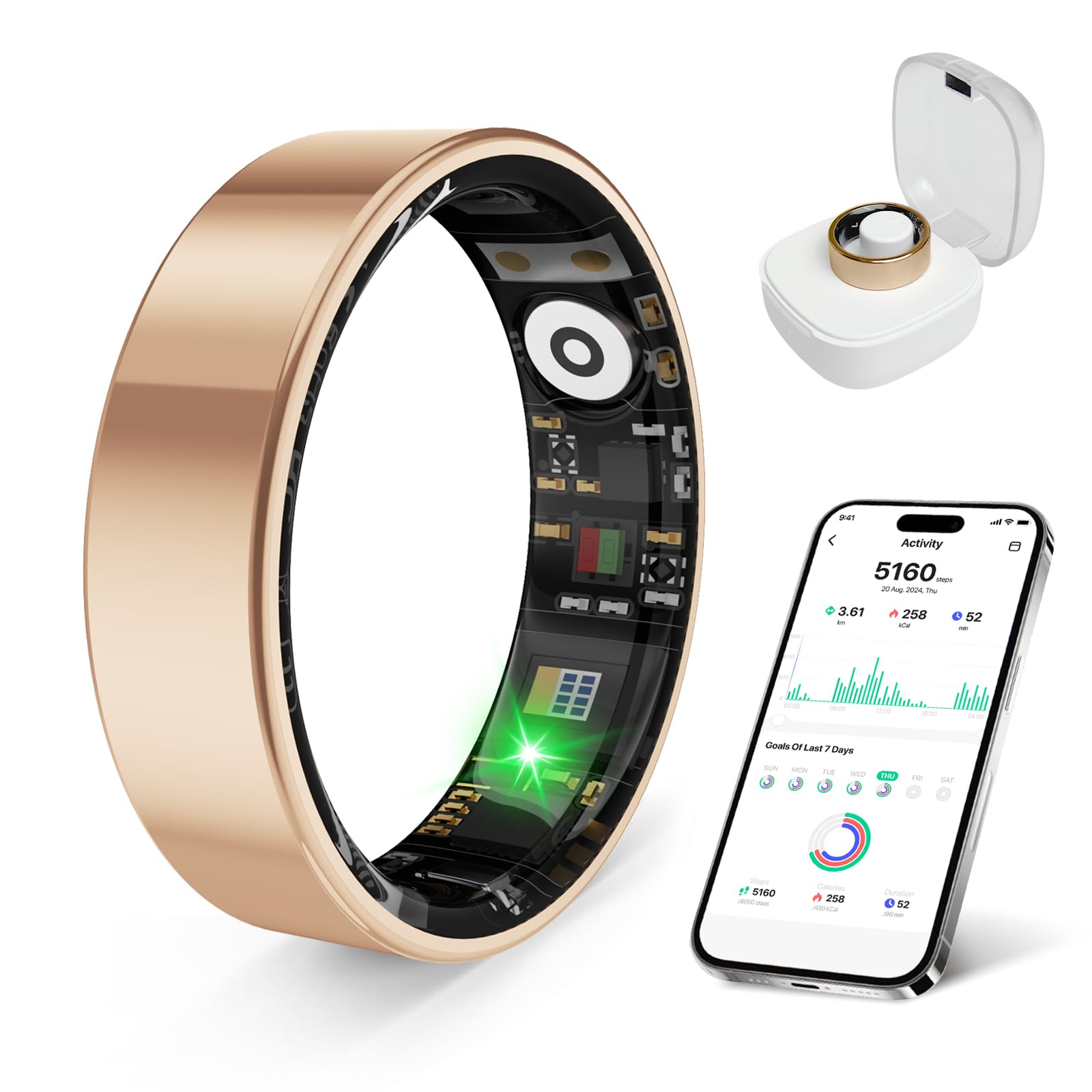
A featherweight ring that monitors sleep and stress with nothing to charge nightly.
For anyone who cannot stand wearing a watch to bed, this ring is the answer. It is a smart ring — a wearable that slips over your finger like a plain band but packs sensors that track sleep cycles, heart rate, and stress. There is no display to light up the bedroom, just Bluetooth to your phone. The rose-gold finish reads as jewelry rather than fitness gear, so it reads as jewelry, not fitness gear.
The battery math works in its favor. You get 3-5 days per charge, and the included charging case stretches total use past 20 days, so a long trip needs only the case. The 80-meter waterproof rating handles swimming, showering, and sweaty workouts without complaint. It is compatible with both iOS and Android, and — the key selling point — it requires no app subscription at all.
Size it carefully, because that is the one thing that trips people up. The manufacturer strongly suggests measuring your finger circumference against the size chart before ordering. One buyer normally a size 7 found the chart pointed them toward a size 12, then settled into a 9 after two exchanges — so when in doubt, measure twice against the provided chart. Weighing that against the positives, a ring that does not fit gets returned, no matter how good the sensors are.
The standout: heart-rate and blood-pressure-style readings every 30 minutes, with no recurring bill.
Buy it with eyes open: ring sizing is unforgiving, so the measurement step is not optional.
Choose this to: track sleep and stress without wearing a watch, at entry-level cost.
Look elsewhere if: you want on-device screen readouts or built-in GPS.
4. Garmin vívoactive 5 GPS Smartwatch

The coach-on-your-wrist pick for anyone starting from zero.
If you are new to tracking and want guidance built in, this is the watch to start with. The vívoactive 5 runs an AMOLED display and up to 11 days of battery in smartwatch mode. This renewed unit — a professionally restored device — carries an Orchid colorway with a 20 mm resin band. It pairs with all current iPhone and Android models, so compatibility is not a worry.
The coaching layer is what separates it. Body Battery energy monitoring shows when you are charged up or need rest, based on sleep, naps, stress, and workouts. A sleep score and personalized coaching tell you how much rest you need and how to improve it, including HRV status (heart rate variability, a measure of how ready you are to recover). More than 30 built-in indoor and GPS sports apps cover walking, running, cycling, HIIT, swimming, and golf. A wheelchair mode tracks pushes rather than steps, with push and handcycle activities and preloaded strength, cardio, HIIT, Pilates, and yoga workouts.
This is described as one of the cheaper Garmin options, yet buyers rate it as great for fitness with particularly accurate pace tracking. One review put it plainly for a very different buyer: “Ditched my Apple Watch for this one.” The catch is wrist fit — the large durable screen suits most people but runs too big for smaller wrists, and it notifies you of calls without full text messaging. If you want the deepest GPS data, the COROS PACE Pro above goes further; the vívoactive 5 is lighter on raw GPS sophistication but far richer on coaching.
Strengths Worth Paying For
- Body Battery and sleep coaching give beginners a clear daily read on rest and readiness
- 30-plus built-in sports apps plus a wheelchair mode with dedicated push tracking
- 11-day battery keeps charging off the daily checklist
Worth Knowing First
- Large case can feel oversized on smaller wrists
- Call notifications only, no full text messaging
Best suited to: fitness newcomers who want guided workouts and recovery coaching built in.
Better to skip if: you have small wrists or want on-watch text replies.
5. COROS PACE 4 Sport GPS Watch
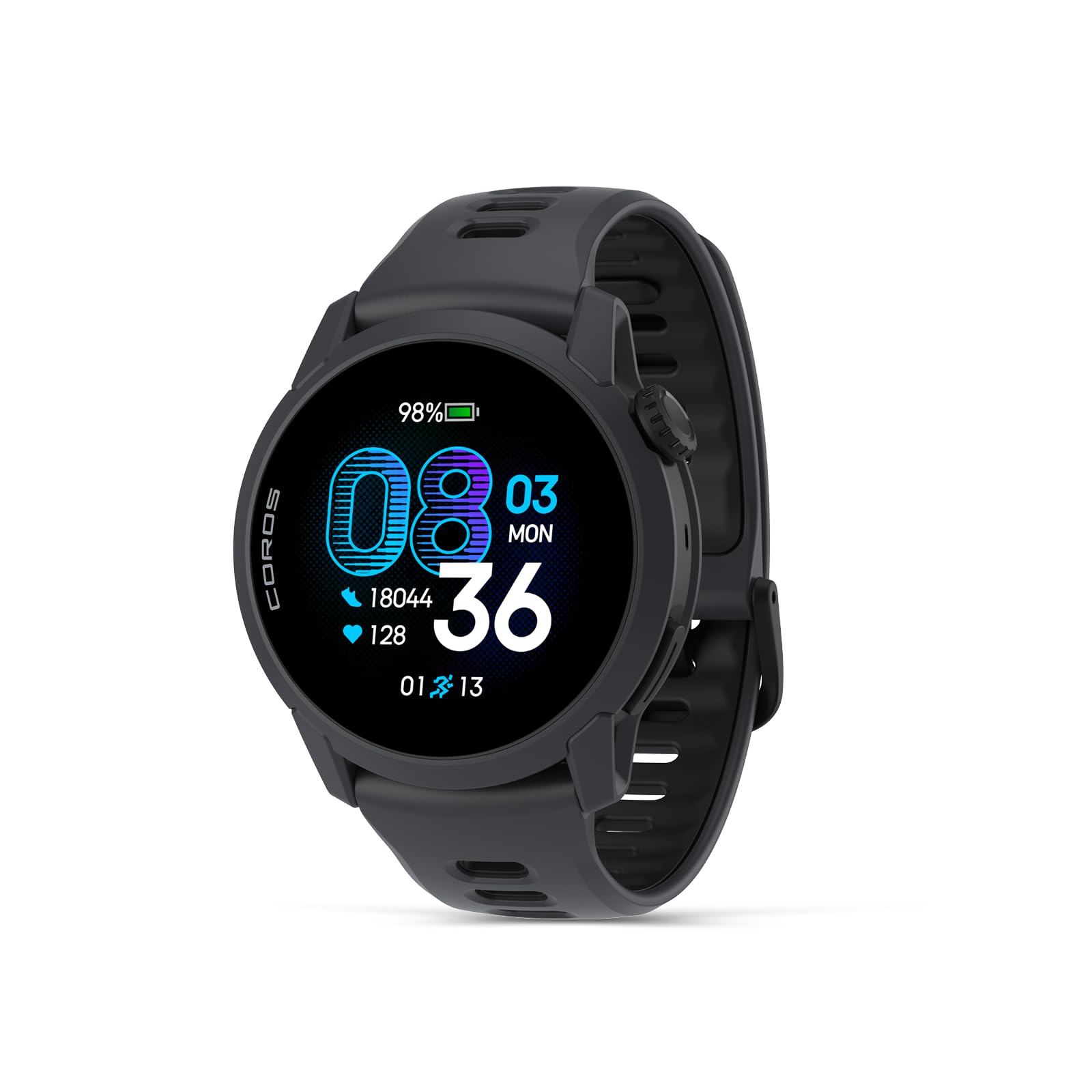
At 32 g, this watch vanishes on the wrist and still logs 41 hours of GPS.
Weight is the whole pitch here, and it delivers. The PACE 4 comes in at 32 g with the nylon band and just 11.8 mm thin — lighter than an energy gel, as the maker puts it, so it stays unnoticeable over 26.2 miles. The 1.2-inch AMOLED touchscreen auto-adjusts brightness so the screen stays readable in any environment, and it packs 164% higher resolution than the PACE 3 it replaces. The 22 mm silicone band suits a wide range of wrists.
You get 41 hours of continuous GPS use and up to 19 days of daily battery, so a week of runs and nights of sleep tracking fit between charges. That is more GPS runtime than the PACE Pro’s 31 hours, though the Pro edges it on overall everyday endurance at 20 days. Voice features let you record training logs, set alarms, or create a target workout by talking to the watch. A tactile digital crown, two buttons, and a customizable Action Button handle one-tap media controls, breadcrumb navigation, and Voice Pins.
Real runners keep praising one thing above all: functionality. It earns the highest aspect count in its review set, and the second most-cited strength is battery life. One college athlete noted ditching a decade of Garmin for it, calling it “lighter than Garmin,” with a cleaner app and dual GPS accuracy. The one tweak worth planning for is a screen protector — the ultralight build is not armored, so guard the AMOLED before you take it out.
The can’t-miss spec: 32 g on the wrist with 41 hours of GPS — the rare combo of a watch you forget you are wearing that outlasts a full ultra.
The trade-off readers should note: no on-watch podcast support and notifications that do not allow message replies or voice assistant.
Made for: distance runners and triathletes who want the lightest GPS watch with the longest GPS runtime.
Not the pick if: you need an armored screen or hands-free messaging from the wrist.
Know the Specs
GPS Modes: Single-Band vs Dual-Frequency
Single-band GPS grabs one satellite signal. Dual-frequency GPS locks onto two at once, which is what keeps your pace line accurate on city streets lined with tall buildings or under dense tree cover. If you only run open roads, single-band is fine — but trail runners and city runners will notice the difference in their route maps.
Battery Specs: GPS Hours vs Daily Days
Two battery numbers are quoted for most of these watches, and they measure different things. “GPS hours” is how long the watch lasts while actively recording a run — the number that matters for a marathon or ultra. “Days” is everyday smartwatch use with notifications and health tracking. A watch can excel at one and merely be good at the other, so check both against your actual weekly training volume.
AMOLED Displays Explained
AMOLED is a screen type that produces vivid color and deep contrast, and brightness is measured in nits — higher nits means better visibility in direct sunlight. A 1500-nit screen stays clear on a bright morning run. The trade-off is that AMOLED draws more power than an always-on low-power screen, which is why some watches quote a shorter battery figure when you leave the Always-On mode enabled.
Smart Ring Sizing And Water Rating
Rings cannot be adjusted the way a watch band can, so fit is everything. Always measure your finger against the manufacturer’s size chart before ordering — a mismatch is the main reason rings get returned. A water rating like 80 meters means the ring handles swimming and showering, while a watch at 50 m covers pool swims and skiing. Neither needs to leave your finger or wrist to dry off.
Common Questions
Do these fitness trackers really have no monthly fee?
Is a smart ring as accurate as a GPS watch for running?
How do I pick the right smart ring size?
How long does the battery actually last on a GPS watch?
Can I swim with these trackers?
What is dual-frequency GPS and do I need it?
Will these watches work with my iPhone or Android phone?
Is a renewed Garmin watch a good idea?
Do I need GPS if I only walk indoors?
Which tracker is lightest for wearing overnight?
The Bottom Line
For most runners, the fitness tracker without subscription winner is the COROS PACE Pro because dual-frequency GPS, 20-day battery, and a 1500-nit AMOLED screen deliver serious training data with no recurring fee. If you want a good-looking everyday watch you can wear to the office, grab the Amazfit Active 2. And for sleep and stress tracking without a watch on your wrist, the prxxhri Smart Health Ring is the one to reach for.
One honest nudge before you buy: the pick here that pairs serious hardware with the highest owner satisfaction is the COROS PACE Pro. It is the crowd favorite among runners who refuse to pay monthly, so if your training data matters and you want it to stay free, start there.
How we choose
We do not accept paid placement. Every pick is matched to a real buyer and a real use-case; we do not hands-on test units.
Sources
Specifications: manufacturer listings and product documentation. Review insights: verified customer reviews, as of October 2026. Pricing: not shown on this page (it changes often); check the current price via the retailer link.
As an Amazon Associate, Aappliancez earns from qualifying purchases. This does not affect which products we feature.