Disclosure: Some links in this post are affiliate links. As an Amazon Associate I earn from qualifying purchases, at no extra cost to you. Learn more
Specs are compiled from manufacturer listings and verified buyer reviews and can change over time — please confirm the key details on the product page before buying.
If you are tired of charging your watch every night, buy a tracker rated for weeks per charge rather than days. The picks below all stretch time between charges, and each one has a different reason to exist. Some give you a big, bright screen and GPS maps. Others skip the screen entirely so you can wear them to bed without even noticing. This guide matches each pick to a wrist size and a routine.
This guide is built by comparing the manufacturers’ published specifications and the patterns across verified customer reviews, so you get each pick’s real strengths and trade-offs instead of marketing spin.
What follows is a plain-English walkthrough of battery claims, screen brightness, GPS accuracy, and the small annoyances that only show up after weeks on the wrist, so you can land on the right fitness tracker with longest battery life for your own routine.
Top Picks

How To Choose The Best Fitness Tracker With Longest Battery Life
The battery number on the box is a best-case figure. It usually assumes the screen stays off most of the day and GPS runs rarely. Your real wear time depends on three settings you control: the display, the GPS, and the notifications. Turning off always-on display, limiting GPS, and trimming notifications can roughly double the days you get per charge.
Read the battery claim as a range, not a promise
A watch sold as “up to 25 days” is quoting smartwatch mode, not GPS mode. In GPS mode the same watch may only last hours. Look for both numbers — everyday use and GPS use — because that gap tells you which one you are actually buying. If you run three times a week with GPS on, plan for the lower end of the range.
Bigger screens cost you charge
An AMOLED display (a screen where each pixel makes its own light) looks brilliant but drinks power when it stays lit. A 1.97-inch panel pulls more than a 1.5-inch one. If battery life comes first, a smaller screen or a screenless tracker gains you days between charges for less money. Turn off the always-on setting and you get part of that back.
Match the water rating to your workout
Pool swimmers need a watch rated 5 ATM (a water-pressure rating that covers surface swimming) or IP69K (a dust-and-jet-water rating from the industrial world). Shower wear and sweaty gym sessions need far less. Check the ATM or IP69K rating before you buy, because a tracker that fogs up in the pool gets left in a drawer.
Side-by-Side Comparison
| Model | Best For | Battery Life (claimed) | Battery Capacity | Screen Size | Amazon |
|---|---|---|---|---|---|
| Amazfit Active Max★ Best Overall | All-round long-life smartwatch | 24 days | 200 mAh | 1.5″ AMOLED | Amazon |
| Amazfit Bip 6Biggest Screen | Big screen on a budget | 14 days | 340 mAh | 1.97″ AMOLED | Amazon |
| Fitbit Inspire 3 | Simple everyday step and sleep tracking | 10 days | — | Slim band display | Amazon |
| Google Fitbit Air | Sleep and all-day wear without a screen | 5 days | 168 mAh | None (screenless) | Amazon |
| KOSPET Tank T4C | Rugged outdoor and job-site use | 50 days | 500 mAh | 1.5″ AMOLED | Amazon |
| Garmin Venu 3S Bundle | Premium training with full coaching tools | 10 days | — | AMOLED | Amazon |
Detailed Reviews
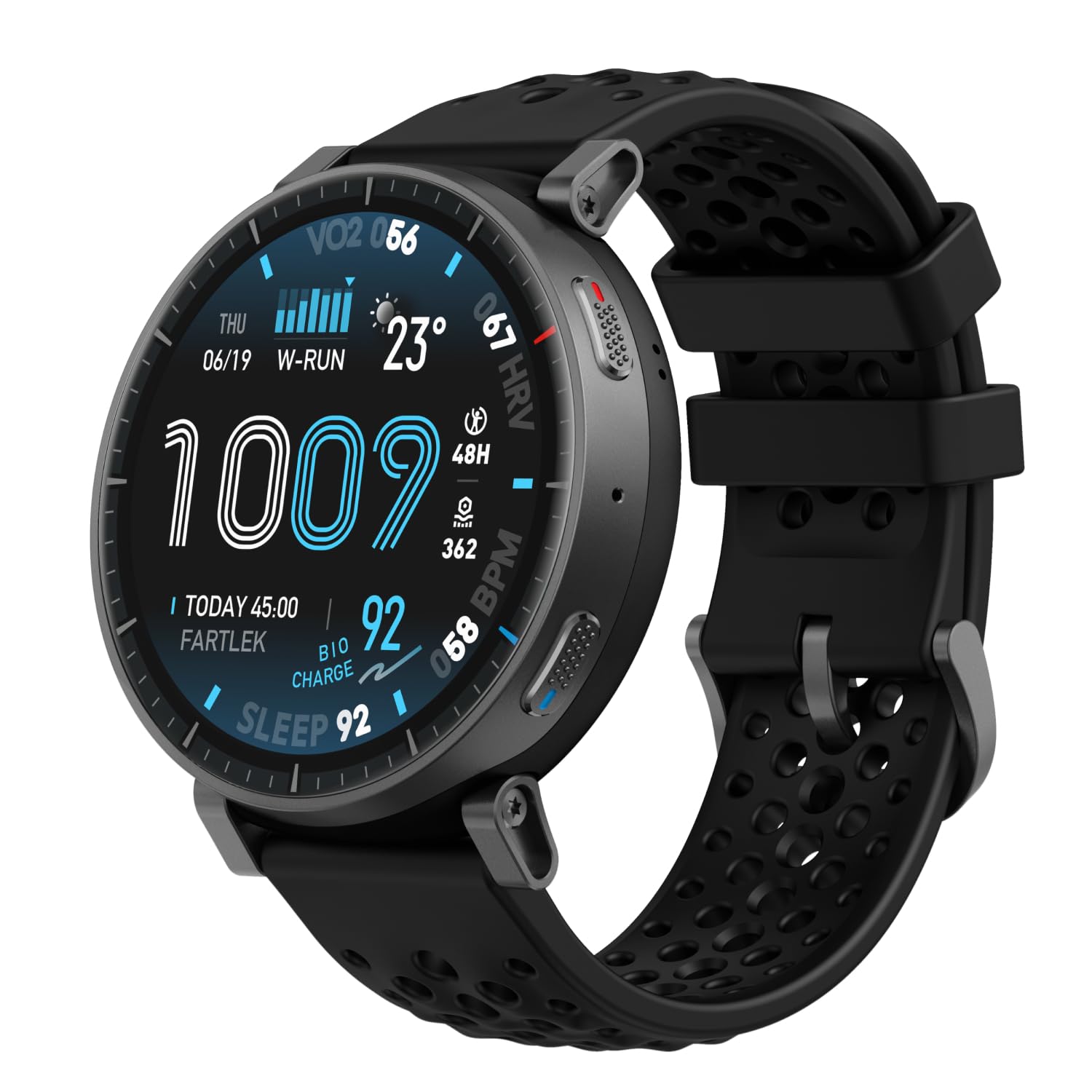
1. Amazfit Active Max Smart Watch
Our pick — 4.5+★ from 1,000+ verified ratings; the strongest balance of quality and price.
A month between charges, a screen you can read in full sun, and maps stored on your wrist.
The headline here is endurance. Amazfit lists up to 24 days of battery life for the Active Max, and that figure is the reason it sits at the top of this list. Compare it with the Bip 6 further down, which is rated for 14 days — the Active Max claims 24 versus 14, so you are trading a smaller screen for noticeably more time away from the charger. A 1.5-inch AMOLED panel keeps the display bright at a claimed 3,000 nits (a brightness measure — roughly what you need to read a screen in direct midday sun), so your pace and heart rate stay legible on an open run.
Where this watch earns its keep is GPS. It locks onto five satellite systems and stores maps internally, with 4GB of onboard storage for downloaded terrain and ski maps plus music. Turn-by-turn directions work with no phone signal at all, which matters on a trail where your phone has already given up. Training depth is real too: 170+ workout modes and Zepp Coach plans for everything from a 3K to a full marathon. The BioCharge score adjusts with your workouts and stress levels, so you get a daily read on when to push and when to back off.
What wins people over is how it looks on the wrist — the styling draws by far the most praise, with battery life close behind. Owners describe charging roughly once or twice a month and watching the gauge barely move: buyers report “battery 70%→45% after 5 days with 5 GPS walks, 3 elliptical workouts, nightly sleep tracking.” GPS accuracy for walks draws consistent praise, and the bright screen holds up outdoors. Two honest notes: the app ecosystem is thinner than Garmin or Apple, and the large case reads better on bigger wrists — it can look oversized on smaller ones.
Why the endurance claim holds up
- Up to 24 days per charge — the longest smartwatch-mode figure in this lineup
- 3,000-nit 1.5″ AMOLED screen stays readable in harsh sunlight
- 4GB storage for offline maps and music plus five-satellite GPS
- 170+ workout modes with adaptive Zepp Coach plans
Where it asks you to compromise
- App selection is narrower than the big-name platforms
- The large case can look oversized on smaller wrists
- Some advanced health metrics drift during very intense workouts
Reach for this if: you want one watch that handles trail GPS, structured training, and calls without a charger in your bag.
Look elsewhere if: you need a deep third-party app store or have a very small wrist.
2. Amazfit Bip 6 Smart Watch
The biggest display in this bunch, wrapped in a lightweight aluminum case you forget about.
Numbers first, because the Bip 6 wins the size contest outright. Its screen measures 1.97 inches against the Active Max’s 1.5 inches, and it packs a 340 mAh battery cell against the Active Max’s 200 mAh. A larger panel plus a larger cell is a sensible pairing: the extra capacity feeds the extra pixels. Amazfit rates this one at up to 14 days of typical use — fewer days than the Active Max claims, but you are buying a genuinely roomy face that is easy to read mid-stride.
The build is light — aluminum with a silicone band — and the 1.97-inch AMOLED panel stays vivid under bright sun. There are 140+ workout modes including strength training and race-style events, personalized AI coaching, and 50m water resistance, so pool laps are fine but scuba is not. Free downloadable maps and turn-by-turn directions run off five satellite systems, and heart rate, sleep, blood-oxygen, and stress tracking all run continuously. It also takes calls and texts over Bluetooth.
Appearance is what buyers fixate on here, and day-to-day function comes right behind it. Several describe it doing everything their pricier watch did. Battery expectations should stay realistic, though — with notifications on and worn night and day, a week is the honest figure, and owners mention “Later updates: calls/texts, phone finder, swimming/hot tub use, max 17–19 days battery.” The recurring gripes are steady connectivity and long-term reliability, so treat Bluetooth pairing as the thing to test in your first week. The watch-face selection skews masculine too, which a few women buyers found limiting.
What the screen buys you: a 1.97-inch AMOLED face is the easiest read here, and the 340 mAh cell behind it is the largest of the two Amazfit models on this list.
The honest catch: a big bright panel is a big drain, so the 14-day rating is a best case — plan on roughly weekly charging with notifications left on.
Suits you well: if readability beats everything and you want pool-safe tracking without spending big.
Think twice: if you want a set-and-forget connection that never drops, or a smaller, more feminine design.
3. Google Fitbit Inspire 3
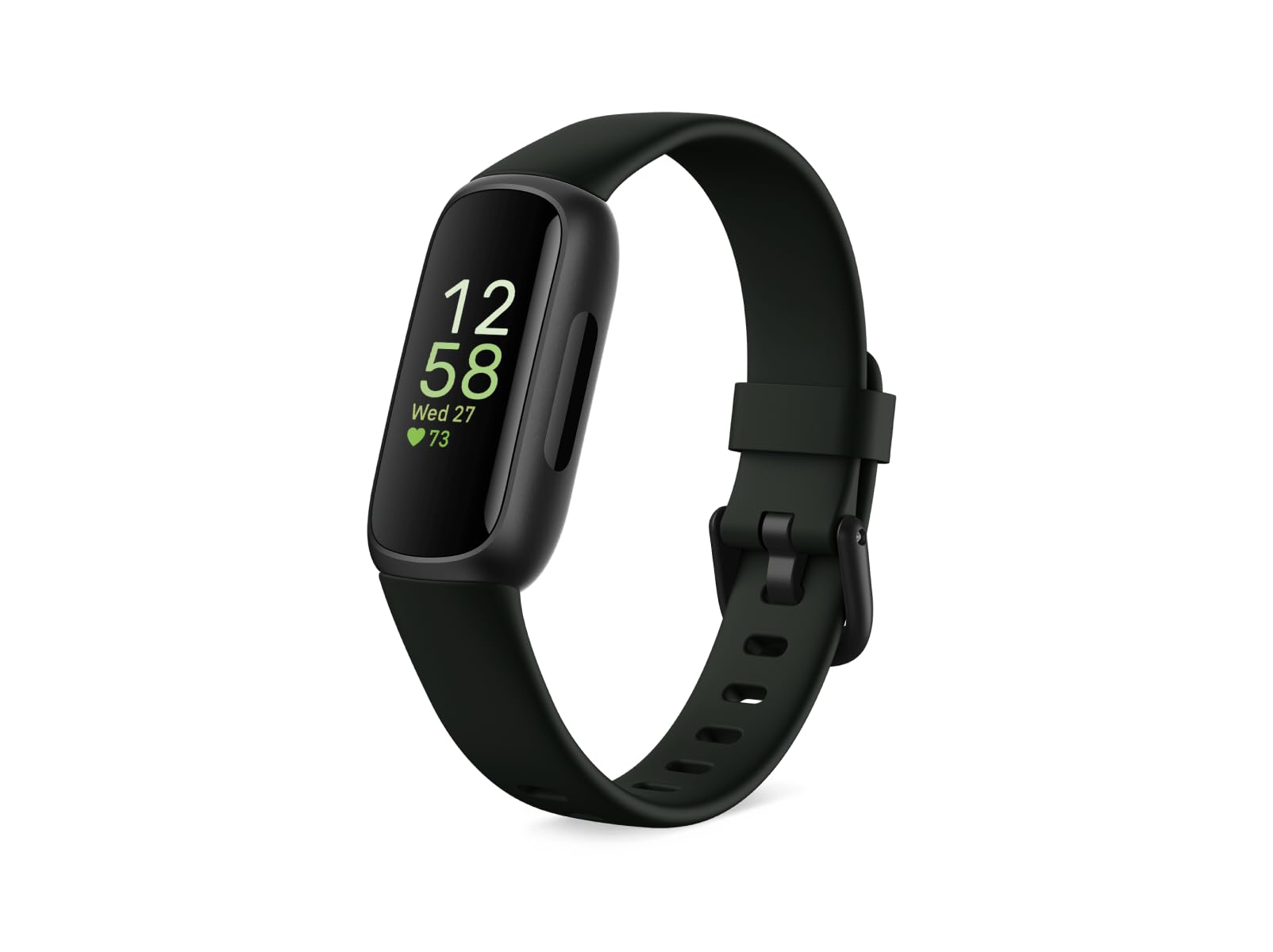
A thin band that tracks steps and sleep for a full working week without fuss.
Not everyone wants a big glowing wrist computer. The Inspire 3 is a slim black band built for people who mostly want steps, heart rate, and a morning sleep score. Fitbit rates it at 10 days of battery life, and it charges in 2 hours — a quick top-up while you shower covers most of it. There are 40+ exercise modes with automatic exercise tracking, a Daily Readiness Score, Active Zone Minutes, and reminders to move, so the basics are all accounted for.
Health tracking leans useful rather than overwhelming: a daily Stress Management Score, guided breathing and mindfulness sessions, SpO2 readings (blood-oxygen), resting heart rate, irregular heart rhythm notifications, and menstrual health tracking. Sleep gets real attention too, with automatic sleep tracking, a detailed Sleep Score, and a silent vibrating alarm that wakes you without sound. It pairs with iOS 16.4 or higher and Android 11.0 or higher.
In daily wear it earns its keep as a step counter and sleep logger, and the small profile means it disappears under a sleeve. Battery life is the honest split point. Turn the always-on display off and owners reach 8–9 days; leave it on and you are closer to 3 days before the gauge slides under 20%. Owners who value it most are the ones who want step counting without a wrist — it will even tally steps from a pocket, which matters if your job keeps a device off your arm. The strap hinge is the weak spot, with plastic hairline fractures showing up after many months of continuous wear.
The battery math: 10 days claimed, 8–9 realistic with the always-on setting off, 2 hours to recharge, roughly 3 days if you leave the screen awake.
Where it gets thin: the tiny screen is fiddly for large fingers, and the strap hinge is a long-term wear item rather than a permanent part.
Pick this one if: you want a low-profile band that counts steps and reads sleep, and you will actually turn the display off.
Give it a miss if: you need GPS built in or a screen big enough to read at arm’s length while running.
4. Google Fitbit Air – Screenless Activity Tracker, Obsidian
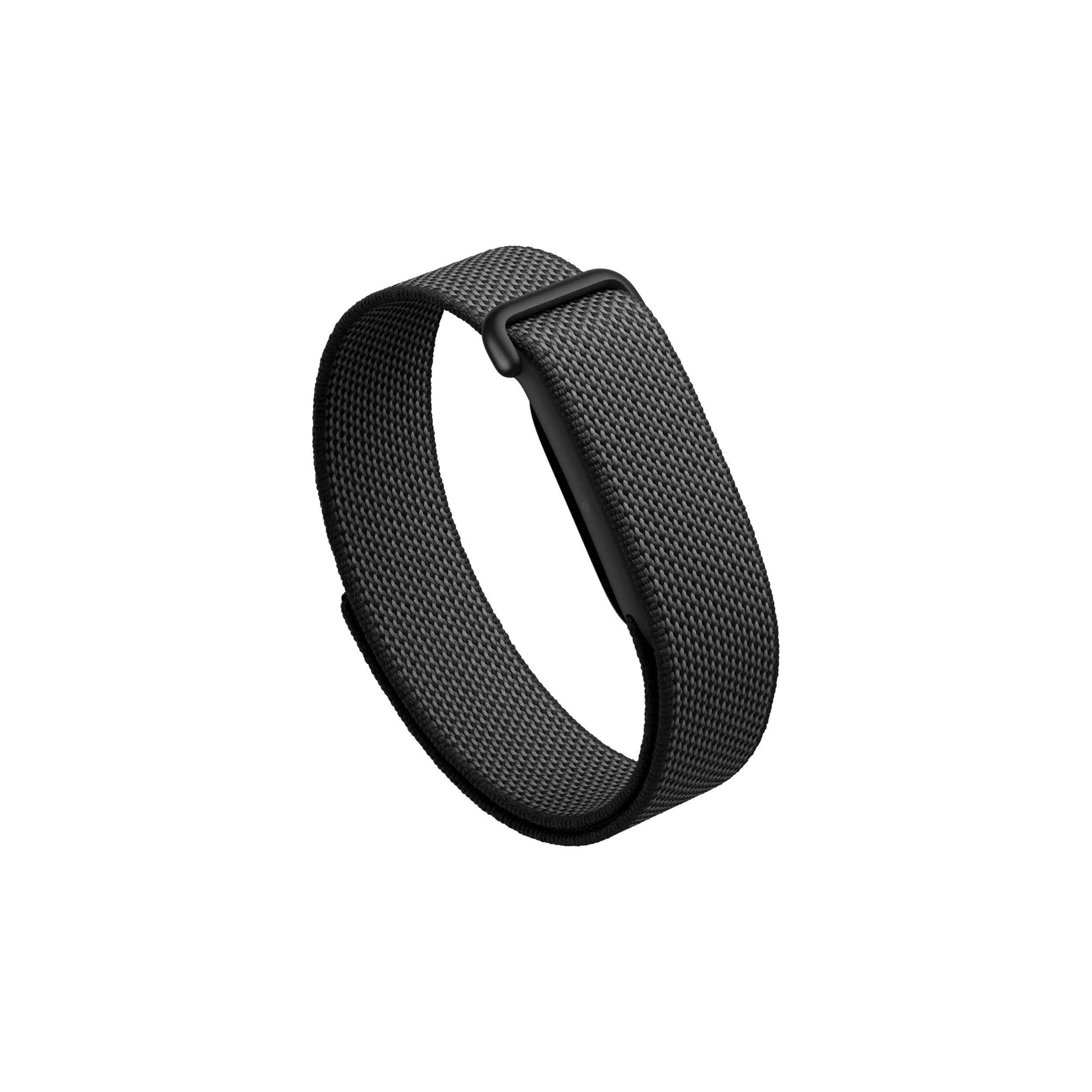
No screen to light up your bedroom at 3 a.m., and a five-minute charge buys you a full day.
This is the pick for people who want tracking without a glowing rectangle on their wrist. The Fitbit Air has no display at all — just a small pebble housing a 168 mAh battery and an optical heart rate sensor. Google rates it at up to a week of use, with 5-day average life, and the fast-charge claim is the standout: five minutes on the charger gets you a day of tracking back. That five-minute top-up covers the night you notice at bedtime that the tracker is dead.
The point of a screenless tracker is that you forget it is on. One size fits 130–210 mm wrists, the micro-adjustable band sits quietly through work, sleep, and training, and the pebble presses into different bands — bracelet, workout band, sleep band — in seconds. It is water resistant up to 50 meters and works with Android 11.0 or higher and Apple iOS 16.4 or higher. Google Health brings the tracking and coaching together, and a Google Health Premium membership adds personalized coaching built with Gemini that adapts over time, sold separately with a 3-month trial included.
Build quality is what the praise centers on, with comfort not far behind. Owners describe wearing it for sleep without noticing it, and count on it to log heart rate and steps through the day; the review pages sum it up: “Great product overall. Comfortable to wear, lightweight, and easy to use.” Sleep tracking and cardio load readings are the mixed spots — a light walk has been scored harder than a swim — and the blood-oxygen figure can read low compared with a dedicated meter. It also presses into the wrist for some sleepers. Those quirks sit in the sensors and sleep scoring, not the battery, which is why this pick made the list.
What makes it wearable
- Screenless design — nothing glares at you during sleep
- Five minutes of charging returns a full day of battery
- Up to a week between full charges, 168 mAh cell
- 50-meter water resistance and swappable bands
The trade-offs to accept
- No screen means no glanceable time, pace, or stats mid-run
- Some advanced readings, like cardio load and blood oxygen, are inconsistent
- Premium coaching sits behind a separate subscription
Best match for: sleep-focused trackers who want a week of data and a five-minute refuel.
Not for you if: you need to see your pace and heart rate on your wrist while you move.
5. KOSPET Tank T4C Smart Watch
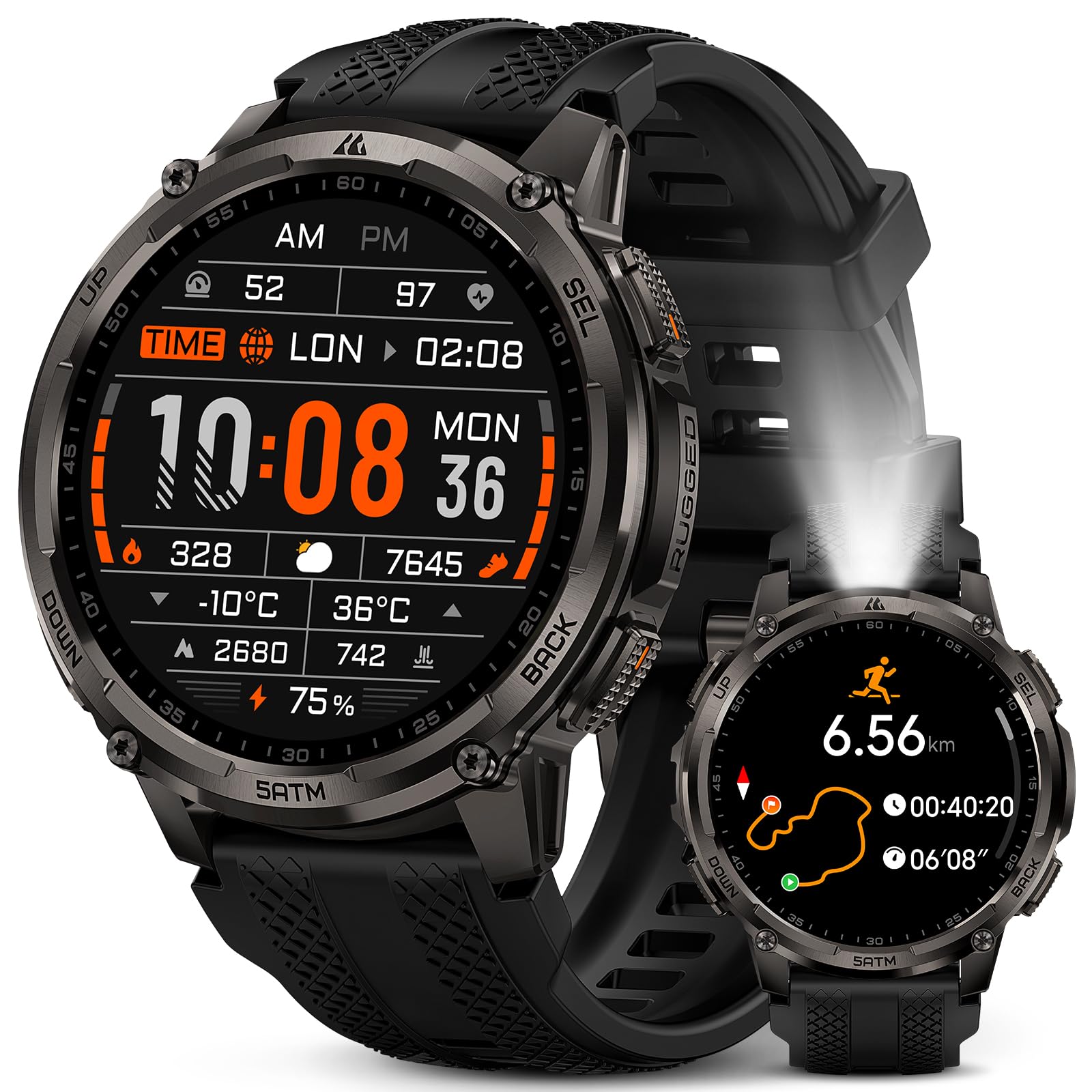
A 500 mAh cell in a steel-and-zinc shell built to survive the job site.
If battery capacity alone decides it for you, this one carries the largest cell on the list: 500 mAh, well clear of the Bip 6’s 340 mAh and the Active Max’s 200 mAh. KOSPET rates it for up to 15 days of typical use, up to 21 hours in GPS mode, and up to 5 hours of continuous flashlight use. That last figure matters because there is a real five-level LED flashlight built into the case — a genuinely practical feature for late shifts, power cuts, or pitching a tent after dark.
The case is reinforced stainless steel around a zinc alloy body, and it has passed 15 U.S. MIL-STD-810H test standards (a military durability protocol covering temperature, shock, and vibration). Gorilla Glass 3 covers the 1.5-inch AMOLED display. Water resistance comes in at IP69K and 5 ATM, which covers swimming, surfing, and running in heavy rain. Dual-band GNSS across six satellite systems handles route and distance tracking, and a built-in walkie-talkie links up to 4 people at up to 40 metres with no cellular signal. Health tracking runs 24/7 through a 4PD sensor, plus 170+ training modes with automatic recognition of 6 activities.
Watch quality is the thing buyers single out most, and value lands close behind. Owners who wear it hard report only charging a few times in about five weeks, and it has survived a four-foot drop onto tile. The weak spots are honest ones: the bundle-out magnetic charger is fiddly and one failed early, though the vendor replaced it promptly and then sent a whole new watch. The stock band is a sticky rubber that most people swap for a 22mm alternative, and the software is thinner than the big names — the app needs to stay open in the background, and iOS limits message replies.
The endurance case: a 500 mAh cell, 15 days typical, 21 hours in GPS mode, and five hours of flashlight on one charge — the largest battery in this lineup.
Worth knowing up front: this is a large, heavy watch with basic software, so it suits outdoor and trade work better than a polished daily smartwatch.
Built for you if: you work outdoors or off-grid and want a big battery plus a flashlight on your wrist.
Better to pass if: you want a light, slim watch with a polished app ecosystem.
6. Garmin Venu 3S GPS Smartwatch

The training-first pick: a bright AMOLED face, deep recovery data, and a power bundle in the box.
It ships with the Venu 3S, a Signature Series watch stand with charging cable, and a 5000 mAh portable power bank with wall and car adapters — so you can top up on the road without hunting for an outlet. The watch itself runs up to 10 days in smartwatch mode on a bright AMOLED display, which is a different proposition from the multi-week endurance of the Amazfit models. You are paying for depth, not maximum days.
That depth is substantial. Body Battery energy monitoring gauges when you are ready to push and when to rest, drawing on sleep and stress data. Sleep tracking adds a tailored sleep score, HRV status (heart-rate variability, a recovery signal), and automatic nap detection that feeds back into your energy reading. There are 30+ built-in indoor and GPS sports apps covering walking, cycling, golf, and HIIT, plus preloaded workouts, exercise animations, and custom routines built in the Garmin Connect app. Paired to a compatible phone, it takes calls, sends texts, and reaches voice assistants.
Appearance draws the most appreciation, with battery life right behind it. The people who love it most are converts from the daily-charge habit — reviewers report the difference plainly: “Stays charged over a week, Apple Watches need almost daily charging.” Another long-time Apple Watch owner calls the battery life incredible and the functions and app better. Two things to weigh: the accessory bundle has arrived used and scratched for at least one buyer, and a Venu 3S can develop a sudden battery decline — one owner saw charge drop to roughly 50% within hours after workouts. Both are worth checking inside the return window.
What the premium buys: a 5000 mAh power bank bundled in, 30+ sports apps, HRV status, nap detection, and Body Battery — a training toolkit rather than a step counter.
The fair caveat: at 10 days in smartwatch mode it gives up weeks of endurance for that depth, and the delivered accessories have occasionally shown up used.
Worth it for: runners and multi-sport athletes who want recovery data and phone-free calling on the wrist.
Skip the upgrade if: you mainly want weeks of charge and do not need coaching depth.
Know the Specs
Battery capacity in mAh
Milliamp-hours (mAh) measure how much charge a battery holds — think of it as the size of the fuel tank. A 500 mAh cell holds more than a 340 mAh cell, which holds more than a 200 mAh cell. That does not guarantee more days, because a large bright screen can drain a big battery fast. Use it as a starting point, then check the claimed days in smartwatch mode to see how efficiently that capacity is used.
Smartwatch mode versus GPS mode
The days-of-battery figure usually refers to smartwatch mode: screen off most of the time, GPS rarely used. Turn GPS on for a run and the numbers shrink to hours. One watch on this list is rated for 21 hours in GPS mode, which tells you the everyday figure is doing a lot of the work. If you train outdoors often, check the GPS-mode number too, not just the headline.
AMOLED brightness in nits
Nits measure screen brightness — how hard the display pushes light at your eyes. Higher nits mean better readability in direct sun. A 3,000-nit panel is bright enough to stay legible on a midday run. Brightness has a cost: a panel running hot on nits drains faster, so always-on display settings and auto-brightness both change your real-world days between charges.
Water ratings: ATM and IP69K
5 ATM is a pressure rating that covers surface swimming and shower use. IP69K is an industrial dust-and-jet-water rating, tougher against high-pressure spray than a basic splash rating. Both appear on this list. Neither covers scuba diving. Match the rating to what you actually do: pool laps need one of these; a sweaty gym session does not.
Common Questions
Why does my tracker die faster than the box claims?
Can I swim with these trackers?
How long does a full charge actually take?
Do I need a phone signal for GPS tracking?
Is a screenless tracker better for sleep?
Will the KOSPET Tank T4C work with an iPhone?
What is the difference between IP69K and 5 ATM?
How much does an always-on display cost me?
Are the maps on the Amazfit models free?
The Bottom Line
For most people, the fitness tracker with longest battery life is the Amazfit Active Max, because its claimed 24 days of smartwatch-mode battery beats the Bip 6’s 14 days while still giving you offline maps, GPS, and voice calls. If a big readable screen matters more than maximum days, grab the Amazfit Bip 6. For sleep-focused wear without any glow, the Google Fitbit Air and its five-minute quick charge is the one to reach for. And if you want the largest cell here plus a flashlight, the KOSPET Tank T4C carries 500 mAh.
How we choose
We do not accept paid placement. Every pick is matched to a real buyer and a real use-case; we do not hands-on test units.
Sources
Specifications: manufacturer listings and product documentation. Review insights: verified customer reviews, as of October 2026. Pricing: not shown on this page (it changes often); check the current price via the retailer link.
As an Amazon Associate, Aappliancez earns from qualifying purchases. This does not affect which products we feature.