Disclosure: Some links in this post are affiliate links. As an Amazon Associate I earn from qualifying purchases, at no extra cost to you. Learn more
Specs are compiled from manufacturer listings and verified buyer reviews and can change over time — please confirm the key details on the product page before buying.
You already know the feeling: the cast lands where you wanted it, the line goes slack in the wrong way, and you reel back a bare hook because your sinker slid off into the rocks. Picking the right fishing sinker is less about brand loyalty and more about matching weight, shape, and material to the water you actually fish. A brass bullet with swivels behaves nothing like a round steel cannonball, and a tungsten flipping weight is a different tool from a bank sinker built for surf current. This guide breaks down five sinkers that each solve a specific problem, so you can grab the one that fits your rig instead of guessing.
This guide is built by comparing the manufacturers’ published specifications and the patterns across verified customer reviews, so you get each pick’s real strengths and trade-offs instead of marketing spin.
Below you will find rigging feel, sink rate, and material trade-offs laid out in plain terms across every option. Whether you cast from a jetty or flip a Texas rig into pads, the right sinker keeps your bait down and your line out of the retying cycle. Here is how the best fishing sinkers sort out for real anglers.
Top Picks


How To Choose The Best Fishing Sinkers
A sinker’s job sounds simple — get the bait down and keep it there. In practice, the shape decides whether it slides through rock, the material decides how fast it drops, and the attachment point decides whether you spend the afternoon retying. Start by naming the water you fish most, then pick the weight that matches it.
Match the shape to the bottom
A round cannonball rolls, so it works well on hard sand and rubble but tends to drift in a fast rip. A teardrop or bank sinker with flat sides digs in and holds. A bullet-shaped flipping weight punches through vegetation instead of draping over it. If you fish rocky structure, look for a streamlined profile that slides rather than catches.
Think about material before you think about size
Tungsten is denser than lead, so a smaller tungsten weight can match a larger lead one. That smaller profile casts into wind better and snags less. Brass sits in the middle — heavier than the same volume of lead, with a smooth nickel-plated finish that resists rust in saltwater. Lead remains the cheapest way to add bulk for deep bottom fishing.
Never overlook the attachment
A sinker that spins freely on a built-in swivel keeps your line from twisting into coils after a long troll. A line clip lets you change drop length without cutting and retying. A polished eye matters — a rough edge will fray your line over a full day on the water.
Side-by-Side Comparison
| Model | Best For | Material | Shape | Size / Count | Amazon |
|---|---|---|---|---|---|
| AMYSPORTS Saltwater Swivel Bullet Sinkers★ Best Overall | Saltwater trolling and deep drops | Brass | Bullet | 5/16 oz, 10 pcs | Amazon |
| ECOFT Lead Free Egg SinkersLead-Free Pick | Lead-free heavy structure and surf | Alloy Steel | Round | 60 g / 2.11 oz, 12 pcs | Amazon |
| Fishfun Tungsten Flipping Weights | Flipping and pitching heavy cover | Tungsten | Bullet | 1/8 oz, 12 pcs | Amazon |
| Reaction Tackle Tungsten Drop Shot Weights | Finesse drop shot and free rigging | Tungsten | Round / Teardrop / Skinny | 3/16 oz, 8 pcs | Amazon |
| BLUEWING Bank Sinkers | Surf and deep bottom fishing | Lead | Streamlined Teardrop | 10 oz, 5 pcs | Amazon |
Detailed Reviews
1. AMYSPORTS Saltwater Fishing Weights Swivel Bullet Sinkers
Our pick — 4.5+★ from 450+ verified ratings; the strongest balance of quality and price.
Two tools in one — a brass bullet that sinks fast and spins off line twist.
What you get here is a sinker with a rolling swivel fixed at each end, so you can tie your main line to one side and your lure or leader to the other. That means you skip buying separate swivels and skip the extra knot that comes with them. The swivels rotate smoothly, which is the whole point: after a long troll, your braided line stays flat instead of coiling into a spring.
The brass body makes it heavier for its size than lead, so a compact 5/16 oz weight still drops fast into a deep hole. The whole surface is nickel plated to keep rust off in saltwater, and the streamlined bullet shape cuts resistance on the way down. Fifteen sizes are offered, so you can fine-tune casting distance by swapping weight rather than changing rods.
Anglers like it because it works under a popping cork, on a bottom rig, and in the rocks. The darker brass finish also keeps fish from mistaking the sinker for bait. As the review pages put it: “Better than shinny silver for saltwater. Fish don’t mistake the sinker for bait and but the line.”
What earns it the top slot
- Swivels at both ends kill line twist without extra hardware
- Brass sinks faster than the same volume of lead
- Nickel plating holds up in saltwater
- Fifteen size options to dial in depth and distance
Where it asks more of you
- The swivel connection is the wear point — check it after a season of saltwater use
- Brass costs more per weight than plain lead
Reach for this if: you fish braid in saltwater or troll spinners and want one piece of tackle doing two jobs.
Look elsewhere if: you want the absolute cheapest way to add bulk for deep bottom fishing — the ECOFT or BLUEWING sets do that with more weight per package.
2. ECOFT Lead Free Fishing Weights Egg Sinkers
A lead-free cannonball that skips across rock instead of wedging into it.
If you fish heavy structure and want nothing to do with lead, this is the set that fits. The round body is alloy steel with a glaze finish that runs smoother than lead, so it slides over shipwrecks and rock ledges with less chance of locking up. Because it is round, it also bounces off snags rather than hooking them — a real benefit when you are dragging a chicken rig through rubble.
The size range is broad: single-weight bags run from 20g up to 200g, and an assortment box mixes 20g, 30g, 40g, and 50g five to a size. The 60g version packs 12 to a bag, which gives you a solid day’s worth of bottom rigging. Using the weights is not limited to fishing either — the smooth finish is why owners also use them as tablecloth and curtain weights, and even as a slingshot payload to hang ham radio antennas over trees.
The weak point is the eye, which can corrode during long submersion. The weight body is corrosion-proof, but the metal eye is a weaker spot in long submersion, so treat these as working sinkers rather than permanent fixtures. Weights this round also roll in a hard rip, which helps in snaggy rock and works against you in fast current.
Why anglers keep reaching for it: the round profile is the star — it rolls over rock rather than jamming, and the sky-blue colour stays visible in cloudy surf.
Worth knowing before you buy: pick a larger bag if you want plenty of weight in one size, since the assortment box leans to the lighter end.
Best fit: the angler who wants to keep lead out of the water and needs a bombproof-feeling ball weight for rocky bottom.
Think twice if: you fish fast rips and drifts where a rolling round shape will not hold — go for the BLUEWING bank sinker instead.
3. Fishfun Tungsten Flipping Fishing Weights
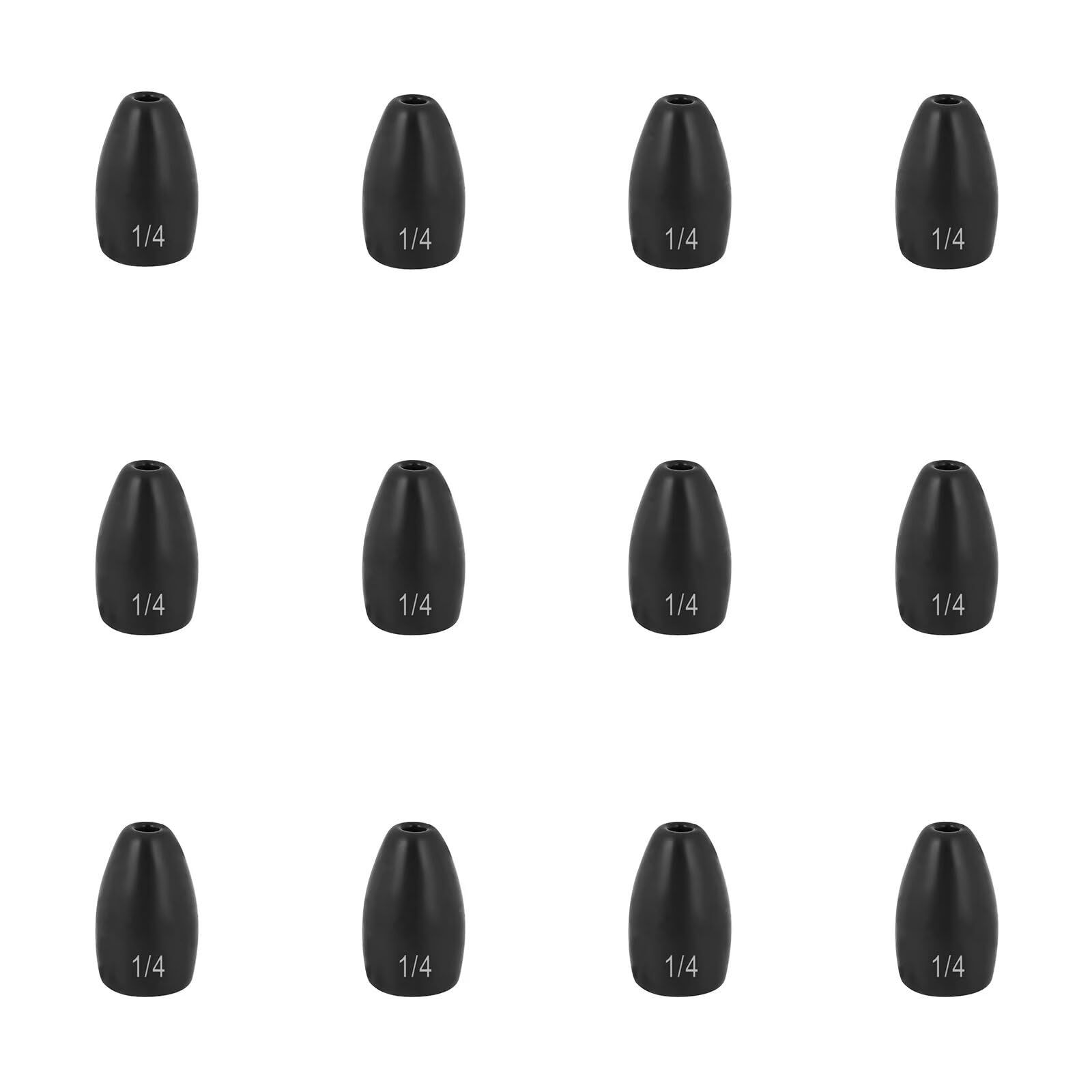
The short, fat tungsten weight built to punch a hole in the salad and drop through it.
Flipping into thick vegetation asks one thing of a sinker: get through the mat without dragging half of it down with you. The Fishfun weight uses a wider diameter and a shorter body than a standard tungsten worm weight, and that extra girth opens a clean hole in the surface cover. Your bait slips in instead of sitting on top of the weeds.
Tungsten does the rest. It is denser than lead, so a smaller weight matches what a fatter lead sinker would do, which keeps the profile compact and the casting more accurate. The insert-free design gives a direct line-to-weight connection that carries bottom detail up the line better than plastic inserts. Sizes are engraved right on the side, so you are not squinting over a tackle box trying to tell a 3/16 from a 1/4.
The matte black finish is genuinely tough — you can flip into rock all day and it holds. A note on accuracy: the 1/8 oz model here is the size to anchor your rigging around, and a few anglers have found pressed weights run light of their stamped number. Weigh your first one if exact size matters to your presentation.
The case for tungsten
- Wide, short body punches through matted vegetation
- Engraved sizes save time on the water
- Polished insert-free bore keeps line from fraying
- Matte black oxidation resists chipping and peeling
The honest trade-offs
- Tungsten costs more per weight than lead or brass
- A few weights run slightly light of their stamped size
Pick this one when: you flip and pitch Texas rigs into pads, grass, and heavy cover and need the bait to break the surface cleanly.
Pass if: your fishing is open water or deep bottom work, where a bank sinker or a swivel bullet covers you for less.
4. Reaction Tackle Tungsten Drop Shot Weights
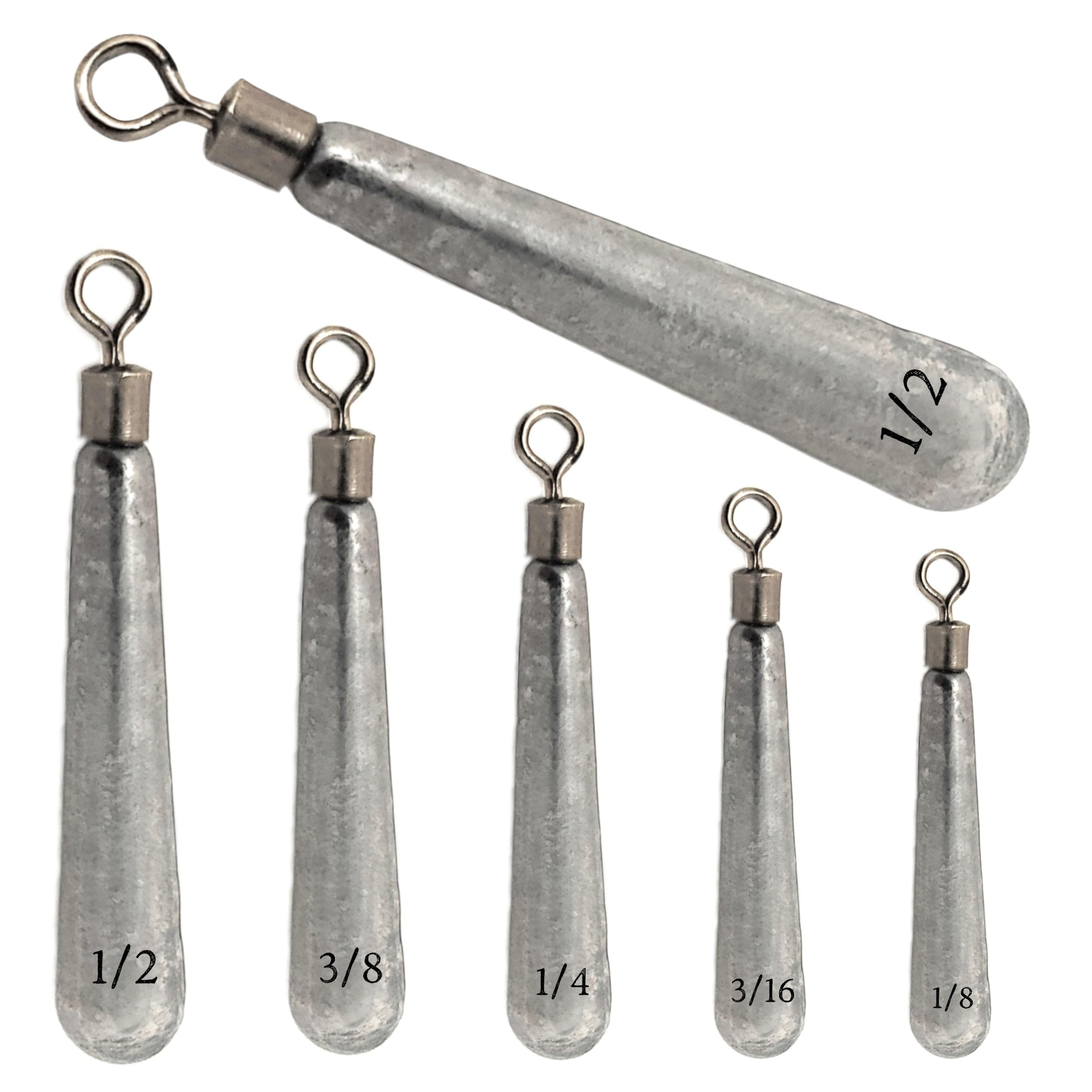
Dense tungsten with a line clip that lets you re-rig in seconds, not minutes.
Drop shotting rewards a sinker that sinks fast, sits compact, and lets you adjust your drop length without snipping line every time. The line clip on the skinny and teardrop styles does exactly that — you pinch it onto your line and slide it up or down to change depth. That is a real time saver when fish are holding at a different level than you guessed.
You get fewer snags in rock because tungsten packs more weight into a smaller body than lead, so the weight slips through gaps and sends bottom detail up the line. Three shapes cover different jobs: the skinny shape slides through rock, the teardrop holds bottom on hard spots, and the tie-on style lets you knot directly to line. That open eye is why free-rig anglers like the tie-on — the weight slides freely for a weedless plastic presentation. The 3/16 oz (about 5 g) silver tie-on version arrives as a set of 8.
This is a tight, finesse-focused set, so the numbers are smaller than the flipping weights — 8 pieces per pack, not 12. That is fair for a specialist tool. The one recurring complaint is a small one: the swivel eyes on the lighter weights can clog with bottom muck, which stops the line sliding freely. A quick rinse sorts it out.
What stands out: the combination of stamped sizes, a snap-on clip, and three shape options makes this the most flexible finesse weight of the five.
One thing to know: with 8 per pack you will go through a bag faster than a 12-count flipping set, so stock a couple if you fish drop shot often.
Made for: the finesse angler chasing bass, walleye, crappie, or perch on light spinning gear who wants fast re-rigging in deep or windy water.
Not the one for: heavy-cover flipping or surf bottom fishing, where the larger BLUEWING and Fishfun weights belong.
5. BLUEWING Bank Sinkers

Bulk lead that drops like a stone and stays put when the surf is churning.
When you need to reach the bottom in 150 to 200 feet of water with a hard current running, the answer is not finesse — it is mass. The BLUEWING bank sinker is a teardrop-shaped lead weight with flat hexagonal sides, and those flat faces are what stop it rolling once it lands. In deep saltwater, that is the difference between a bait sitting in the strike zone and a bait skipping along the deck.
The polished surface and filed eyelets are a good detail, because a rough eye chews through line over a long day of bottom fishing. The outer coating resists rust and corrosion, and the weight itself is stable and sinks easily. Sizes run from 3 oz up to 32 oz, so you can match the current rather than the other way around — pompano, croaker, halibut, catfish, and bass are all fair game. The 10 oz version comes in a 5-pack.
The trade-off is weight: at 10 oz these are built for surf and deep bottom, not a light finesse rod.
Choose it for: surf, jetty, and deep bottom fishing where you need a lot of weight fast and a shape that will hold.
Steer clear if: you are fishing shallow water or flipping cover — the density here is wasted and the cost of lead per piece runs higher.
Know the Specs
Weight and oz rating
A sinker’s oz figure tells you how much mass you are putting on the line. Heavier drops faster and holds bottom in current; lighter casts farther on light line and keeps the presentation subtle. Match the oz to depth and flow — a 5/16 oz bullet and a 10 oz bank sinker live in completely different water.
Material: tungsten, brass, steel, lead
Pick tungsten when you want the smallest weight that still does the job, since it is the densest material here and snags less. Brass weighs more than the same volume of lead and resists rust when nickel plated (a thin metal coating). Alloy steel with a glaze finish gives you a lead-free option. Lead is the cheapest way to add bulk. None is “best” — the right one depends on if you need compactness, cost, or a lead-free material.
Shape and snag resistance
Bullet shapes slip through vegetation; teardrop and flat-sided shapes hold on hard bottom; round shapes roll and bounce off rock. If your sinker is hanging up, the shape is usually the culprit, not the size.
Attachment: swivels and line clips
A swivel at each end of a sinker spins with your line and keeps twist out. A line clip grabs the line without a knot so you can change drop length fast. A polished, insert-free eye protects the line from fraying — cheap details that save you a re-tie.
Common Questions
Is tungsten actually better than lead for fishing sinkers?
Do the swivels on a sinker really stop line twist?
Which sinker is best for saltwater surf fishing?
Can I use a drop shot weight for flipping?
How many sinkers should I buy at once?
Do I need to worry about the sinker eye fraying my line?
What size sinker holds in strong current?
Are lead-free sinkers a good choice for fishing near wildlife?
Do the weights match their stamped size?
The Bottom Line
For most anglers fishing saltwater or trolling spinners, the fishing sinkers winner is the AMYSPORTS Swivel Bullet Sinkers, because the dual swivels save you from buying and tying separate swivels and the brass drops fast. If you want to keep lead out of the water and fish rocky structure, grab the ECOFT Lead Free Egg Sinkers. For flipping heavy cover, the Fishfun Tungsten Flipping Weights are the one to reach for. Whichever water you fish, match the shape to your bottom and the material to your priorities — that pairing keeps you fishing instead of retying.
How we choose
We do not accept paid placement. Every pick is matched to a real buyer and a real use-case; we do not hands-on test units.
Sources
Specifications: manufacturer listings and product documentation. Review insights: verified customer reviews, as of October 2026. Pricing: not shown on this page (it changes often); check the current price via the retailer link.
As an Amazon Associate, Aappliancez earns from qualifying purchases. This does not affect which products we feature.