Disclosure: Some links in this post are affiliate links. As an Amazon Associate I earn from qualifying purchases, at no extra cost to you. Learn more
Specs are compiled from manufacturer listings and verified buyer reviews and can change over time — please confirm the key details on the product page before buying.
Here is the short answer: for most spearfishing and kayak anglers, the float stringer wins. The SPEARFISHING WORLD Fish Stringer pairs a 33-inch coated stainless cable with a carabiner you can clip straight to your buoy or weight belt, and it is the one that holds the top score in this lineup at 4.5+ stars from 200+ buyers. If you want one clip that swallows big game fish whole, look at the Rogue Endeavor pair instead.
This guide is built by comparing the manufacturers’ published specifications and the patterns across verified customer reviews, so you get each pick’s real strengths and trade-offs instead of marketing spin.
You will see exactly how a stringer’s rod, cable and clip decide whether your catch stays on. The real divide is between a rod-and-cable stringer you clip to a belt and a clip-on lanyard you hang off a kayak. Below are five stringers that survive salt water, with the honest catch on each one. My goal for this best fish stringer guide is simple: get your catch back to the boat still attached.
Top Picks


How To Choose The Best Fish Stringer
A stringer never fails in the shop; it fails at the boat ramp with a fish on it and the clip sprung open. It fails at the boat ramp, with a fish on it and the clip sprung open. Match the cable and clip to the water you fish and the size of fish you bring up.
Cable, Wire And The Kink Problem
A plain thin wire stringer kinks the first time a fish spins on it, and a kinked wire is a wire that is about to snap. Coated cable resists that twisting. The SPEARFISHING WORLD and Calissa units both use a plastic-coated cable, and the coating also stops the cable fraying and tearing the fish while you drag it. The Foreverlast takes a different route with a 15-foot smooth rubber cord, which does not catch on gills the way a wire can.
The Clip Is The Weak Link
Look hard at what opens and closes. A stainless carabiner, like the one on the SPEARFISHING WORLD, is the simplest thing to trust. Plastic clips are lighter and cheaper to make, but they are the part that snaps when you take off with the stringer still trailing in the water. For big, toothy fish like pike and musky, a locking stainless clip matters more than cable length.
Length: Float, Kayak Or Bank
Short rods suit a weight belt or a float, where you want the catch tight against you. Long cords suit a kayak, where the fish trails behind and stays out of your paddle stroke. The catch is that a 15-foot cord is genuinely awkward from the bank. Pick the length for your main water: short for a belt or float, long for a kayak tow.
Side-by-Side Comparison
| Model | Best For | Length | Material | Clip Type | Amazon |
|---|---|---|---|---|---|
| SPEARFISHING WORLD Fish Stringer★ Best Overall | Weight belt or float setup | 33 inches | Coated stainless steel | Stainless carabiner | Amazon |
| Rogue Endeavor Large Spearfishing StringerBig Game Pick | Big game fish | 16 inches | 304 stainless steel | Locking clip | Amazon |
| Foreverlast Generation II Stringer System | Kayak and boat culling | 15 feet | Rubber cord | Quick-release cork end | Amazon |
| Calissa Offshore Stainless Fish Stringer Clip | Freedive and scuba trips | 16 inches | Stainless steel and steel | Curved quick-release clip | Amazon |
| Rogue Endeavor Fish Stringer Clip | Kayak fishing with leash control | 36-inch lanyard | 304 stainless steel | Quick-release buckle | Amazon |
Detailed Reviews
1. Fish Stringer with Coated Stainless Steel Cable
Our pick — 4.5+★ from 200+ verified ratings; the strongest balance of quality and price.
The no-drama belt and float stringer that has outlasted everything owners have thrown at it.
Clip it to your buoy or your weight belt and go. The whole design is a 33-inch coated stainless steel cable with a stainless carabiner on one end and a 7-inch by 1/4-inch stainless rod on the other. To unload, you disconnect the carabiner and the fish slide off the cable in one motion — no fumbling, no knots.
Those ridges machined into the rod are the quiet hero here. They bite into the fish as you push the rod through and again as you pull, so it does not slip out of your hand mid-thread. The tip is deliberately shaped to penetrate a fish without being so sharp it gashes you or punctures your float. Owners push these hard and they come back looking new, and one 6’1″, 215 lb spearfisherman reports wearing it “around my waste like a belt while spear fishing and it fits me perfect.”
The build numbers back up that reputation. It carries a 500-pound breaking strength and a 400-pound line weight rating, which is a lot of room for a fish to pull before the cable is the thing that gives. The plastic-coated cable also stops fraying and keeps the wire from sawing into your catch as you tow it.
Where it shines
- 33-inch length gives you room to thread and unload without dragging a long trailing cord
- Ridged 7-inch rod stops slipping on push and pull
- 500-pound breaking strength leaves headroom for a decent fish
- Stainless throughout, built to shrug off salt water
What to weigh up
- Short 33-inch cable suits a belt or float, not a long kayak tow
- No float of its own, so it relies on your buoy or belt for buoyancy
Reach for this if: you dive with a float or a weight belt and want one stringer that simply holds.
Look elsewhere if: you need a long trailing cord for a kayak — that is the Foreverlast’s job.
2. Rogue Endeavor Large Stainless Steel Spearfishing Stringer
Five millimeters of 304 stainless built to swallow fish that would snap a wire stringer.
If your catch runs big, this is the clip to own. The body is 5mm rugged 304 stainless steel with a mirror-polished finish that works in fresh or salt water alike. The large clip opening accommodates most game fish species, and the locking mechanism is tuned for the strength of a serious fish rather than a pan-sized trout.
What wins people over is plain reliability. Buyers report holding “100+ lbs. fish completely under control using this,” and the long-time crowd is just as convinced — a 66-year-old angler threw out a plastic-coated wire stringer after this one showed him a cable “that won’t get cut by pike teeth or get all kinked up.” That tooth resistance is why it keeps earning a spot on pike and musky waters.
Two things to know before you buy. It is a 16-inch stringer, so compare it against the 33-inch SPEARFISHING WORLD pick — this one is roughly half the working length, which you feel when threading a long fish. And it does not ship with a lanyard, so the advice to remember “the lanyard with the metal clip” is worth heeding. Check the edges for a burr when it arrives; one buyer filed a sharp spot down and moved on fine.
The honest read: superb clip for big, toothy fish — buy it for the lock and the 304 steel, not for length.
The catch: 16-inch cable is short for a kayak tow, and the lanyard is a separate purchase.
Who it beats: any wire stringer you are tired of untangling, on the strength of that locking clip.
Who should pass: paddlers who want a long cord trailing behind the boat.
3. Foreverlast Generation II Stringer System
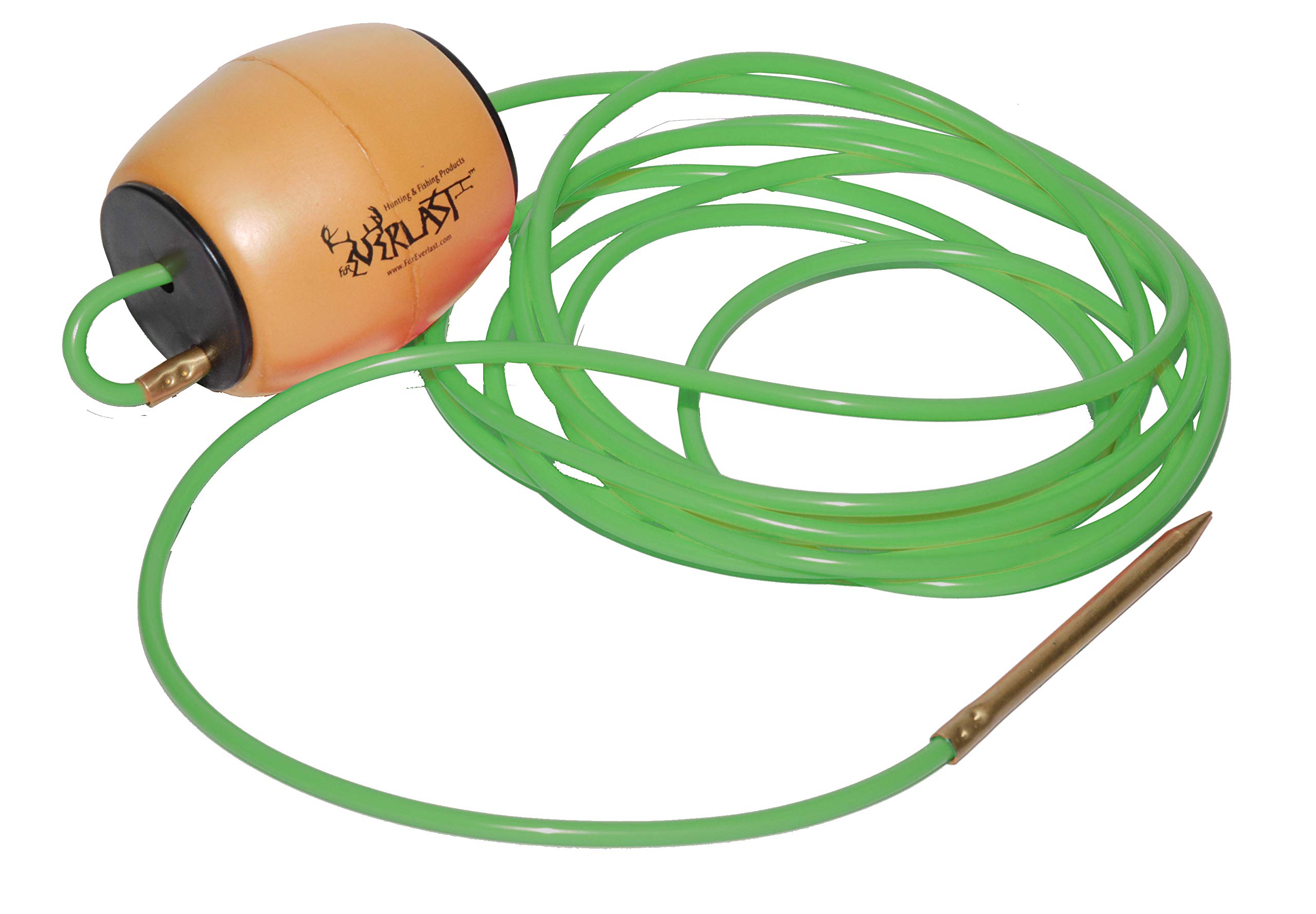
Fifteen feet of snag-free cord that keeps your catch trailing behind the kayak, not under it.
The number that defines this stringer is 15 feet. That is a 15-foot tangle-free cord of smooth rubber, which does not catch on gills the way a wire can and won’t snag on the boat either. Smooth brass junctions on both ends let you pull fish off from either side, and the quick-release system lives on the cork end.
The feature that wins people over is the float. It runs on an EVA float, a foam that keeps your catch from sinking too deep, and the float is removable. That removable float is the clever bit — you can pull a fish off without dragging the whole stringer through your other fish. The 15-foot length is the same pick that solves the tangling and metal-snap headaches that send people looking for a better cord in the first place.
The trade-off is durability, and it is worth being straight about. This stringer gets the most mixed feedback of anything here — some owners mention it coming apart quickly while plenty report good service. If you look after it, keep it out of the sun, and don’t leave it baked on a deck, it has a long life ahead of it. Bank anglers should also note that 15 feet is genuinely unwieldy from shore, which is why some wish for a shorter version.
Why paddlers gravitate to it: that 15-foot cord and removable float turn culling fish into a one-hand job behind the kayak.
Where it asks for care: treat the cord gently and store it out of direct sun to get the most years out of it.
Best matched to: kayak and boat anglers who want their catch well behind them.
Less suited to: bank fishing, where the long cord becomes a handful.
4. Calissa Offshore Stainless Steel Fish Stringer Clip

A stretch lanyard that snugs your catch close, then reaches out when you need it to.
This one solves the fumbling problem. Curved quick-release ends and an insertion clip let you lock a fish on one-handed while the school is still swimming past. The stainless body runs 16 inches long, 6.5 inches wide at the bottom and 2.5 inches wide at the top, and the maker rates it to handle several pounds of fish at a time.
The lanyard is where the clever engineering lives. A built-in steel wire sits inside a smooth TPU coating that starts at 12.2 inches and stretches out to 51 inches at full reach, snapping back like a rubber band on a retractile steel spring. That means the catch rides tight when you want it close and extends when you need working room. Salt-water divers also get the benefit of a plastic-coated cable that keeps the wire from fraying or tearing the fish.
The one honest caveat sits in the plastic pieces. Customers note the stainless clip and cable are sturdy and hold fish securely, but the plastic clip that fastens the whole thing has been the failure point for some — one walleye angler had it break within an hour clipped to waders. It also ships with a 12-month manufacturer warranty, which backs the confidence in the metal side of the build. If you want an all-metal connection, the Rogue Endeavor clip pick above leans further that way.
What earns its keep
- Stretch lanyard reaches from 12.2 inches out to 51 inches and retracts
- Curved quick-release ends keep fish handling one-handed
- Stainless and TPU-coated steel core built for dive trips
Where it gives
- Plastic clip is the weak point — the metal holds up far better than the plastic
- Several pounds per fish is the rated working load, so oversized catch suits another pick
Take this one diving: freedivers and scuba hunters who want a quick, organized clip on the belt.
Think twice if: you regularly land big game fish — the plastic clip is the part you’ll want more metal in.
5. Rogue Endeavor Fish Stringer Clip

A dual-leash clip that keeps your catch close for paddling and lets it drop when you stop.
The defining feature here is control over where your fish sits. The integrated TPU-coated steel core lanyard has a 360-degree swivel, a quick-release buckle and a clip end, and it extends up to 36 inches. That gives you two positions — a short webbing clip keeps the catch right against the boat to cut drag while you paddle, and unclipping it lets the catch drop on the coiled leash and fully submerge out of your way.
Quality is what owners talk about most, and the materials support it. The full-metal clip is rugged 304 corrosion-resistant stainless with a mirror-polish finish, and the sharp tip breaks through gills easily and then lets the fish slide along the smooth metal. Divers in the Mediterranean ran it two weeks in salt water with no rust at all.
Two honest notes. It is a large-fish tool, so it runs a little on the heavy side on the belt, and a few owners find it smaller in the hand than expected. The plastic clips are also the part to protect — take the stringer out of the water before you throttle up, or those clips are what snap. The metal, the swivel and the leash itself hold up well; it’s the plastic buckle end that wants your attention.
The standout: a 36-inch swivel lanyard with two carry positions is more control than any single-length stringer here offers.
The one to mind: that same plastic clip end is the part that snaps if left trailing behind a moving boat.
Ideal for: kayak and dive anglers who want to tuck the catch close and drop it deep on demand.
Not the first pick if: you want the lightest, simplest belt stringer you can find.
Know the Specs
Breaking Strength And Line Weight
Breaking strength is the load a cable can take before it fails. Line weight is usually the working rating the maker lists for normal use. A stringer with 500 pounds of breaking strength and a 400-pound line weight leaves you a wide margin before a fish pulls the cable apart. Think of it as the difference between the weight a bridge can hold and the weight you’d drive across it every day.
Cable Length And Towing
Length decides where your catch rides. A short cable, in the 16 to 33-inch range, keeps the fish tight to a belt or float. A long cord, like 15 feet, lets a kayak tow the catch well behind the paddle stroke. From the bank, a 15-foot cord turns into a tangle. Match length to your water: 16 to 33 inches for a belt or float, 15 feet for a kayak tow.
Why The Coating Matters
The plastic or TPU coating over a cable does two jobs. It stops the wire fraying and rusting from the inside, and it keeps the bare metal from sawing into a fish as you drag it. A coated cable also slides through gills cleanly and won’t catch on the rod. An uncoated wire kinks and cuts fish; a coated one lasts longer and treats your catch better.
The Clip And Quick Release
The clip is where a stringer actually fails, so it deserves the closest look. A stainless carabiner is the simplest, most trustable option. A plastic clip is lighter but is the piece that snaps if you tow it or overload it. Quick-release designs, like a curved insertion clip or a buckle, save you fumbling when a fish is on — but a quick release is only as good as the metal behind it.
Common Questions
Will a 33-inch fish stringer work on a kayak?
Why do plastic clips break on fish stringers?
What is the difference between a rod-and-cable stringer and a clip lanyard?
How long a cord do I need for bank fishing?
Is stainless steel enough for salt water use?
What does breaking strength mean on a stringer?
Will a stringer hold a large fish like a pike?
Can I use a spearfishing stringer for regular rod-and-reel fishing?
Does a stretchy lanyard aid fish retention?
How do I stop my stringer from cutting the fish?
The Bottom Line
The winner of this best fish stringer lineup is the SPEARFISHING WORLD Fish Stringer, because that 33-inch coated stainless cable, 500-pound breaking strength and ridged rod simply hold — whether you clip it to a float or a weight belt. If you chase big, toothy fish, grab the Rogue Endeavor Large Spearfishing Stringer for its 5mm 304 stainless locking clip. And for kayak towing and culling, the Foreverlast Generation II and its 15-foot cord are the one to reach for. Buy the one built for your water and your catch comes back attached.
How we choose
We do not accept paid placement. Every pick is matched to a real buyer and a real use-case; we do not hands-on test units.
Sources
Specifications: manufacturer listings and product documentation. Review insights: verified customer reviews, as of October 2026. Pricing: not shown on this page (it changes often); check the current price via the retailer link.
As an Amazon Associate, Aappliancez earns from qualifying purchases. This does not affect which products we feature.