Disclosure: Some links in this post are affiliate links. As an Amazon Associate I earn from qualifying purchases, at no extra cost to you. Learn more
Specs are compiled from manufacturer listings and verified buyer reviews and can change over time — please confirm the key details on the product page before buying.
If you own a charcuterie board, you already know the sinking feeling of watching a smear of soft cheese soak straight into raw wood. The fix is to finish the one you have with a board butter or wood wax. This guide breaks down five of the most trusted wood conditioners, what each one does differently, and which one actually keeps your board looking good through years of dinner-party use.
This guide is built by comparing the manufacturers’ published specifications and the patterns across verified customer reviews, so you get each pick’s real strengths and trade-offs instead of marketing spin.
Your board’s wood type, how often you wash it, and if you want a quick monthly touch-up or a deep annual restorer all decide which finish works. The crowd favorite holds 4.5+ stars across 900+ ratings, and these finish for charcuterie board picks cover bamboo, maple, walnut, and cherry.
Top Picks

How To Choose The Right Board Finish
Charcuterie boards get a workout that cutting boards rarely see. They hold wet fruit, oily cured meats, soft cheeses, and sticky jams all at once. That mix of moisture and fat is exactly what cracks unfinished wood. A good finish seals the grain so liquids bead on the surface instead of soaking in.
Beeswax vs. Mineral Oil — What Each Does
Mineral oil goes deep. It penetrates the dry wood fibers and rehydrates them from the inside, which stops the board from drying out and splitting. Beeswax stays near the surface and builds a moisture-resistant barrier on top. A finish that combines both — like a board butter or gel — does double duty: the oil conditions, and the wax protects. If you only apply oil, you condition the wood but leave it open to stains. If you only apply wax, you seal the surface but skip the deep conditioning the wood actually needs.
Plant-Based vs. Petroleum-Based Formulas
Mineral oil comes from petroleum but is widely considered food-safe once refined. Plant-based alternatives use coconut oil, flaxseed oil, ricebran wax, or essential oils instead. If you want to avoid petroleum products in your kitchen, look for a label that says “mineral oil free” or lists coconut oil, flaxseed, or ricebran wax as the base. Both types work on food-contact wood, so pick based on if you want to avoid petroleum-derived ingredients.
Side-by-Side Comparison
| Model | Best For | Size | Base Formula | Form | Amazon |
|---|---|---|---|---|---|
| Epicurean Board Butter★ Best Overall | Restoring older boards to like-new | 4.5 oz | Mineral oil + beeswax | Butter | Amazon |
| The Bearded Chef Wood ButterBest for Outdoors | Outdoor wood and butcher blocks | 7 oz | Mineral oil + beeswax | Butter | Amazon |
| Caron & Doucet Conditioning Wax | Plant-based sealing for bamboo and hardwood | 100 g | Refined coconut oil + ricebran wax | Wax | Amazon |
| Rowdy Rooster Cutting Board Gel | Easy all-in-one oil and seal | 8 fl. oz | Mineral oil + beeswax | Gel | Amazon |
| Ziruma Non-Toxic Wood Wax | Chemical-free care for boards and utensils | 7 oz | Beeswax + flaxseed + lemon oil | Paste wax | Amazon |
Detailed Reviews
1. Epicurean Board Butter 4.5 oz
Our pick — 4.5+★ from 900+ verified ratings; the strongest balance of quality and price.
The retro tin that brings a dried-out board back from the dead
The Epicurean Board Butter is what most people picture when they hear “board conditioner.” It comes in a 4.5-ounce retro-styled tin with a built-in sponge applicator — the sponge is the trick, because it lets you rub thin, even coats into the grain instead of splashing oil everywhere. The formula is a proprietary blend of mineral oil and beeswax. The mineral oil soaks deep into dried fibers to stop cracking, and the beeswax sits on top to keep moisture out and preserve the natural luster of the wood.
Stacked up against the other picks here, the Epicurean holds one clear advantage: real restoration power. Boards that have gone gray and dry over years of use come back looking like new after one overnight treatment. It’s a 6.4-ounce tin by shipping weight, which is the lighter of the two biggest conditioners in this guide. It’s also the highest-rated of the group at 4.5+ stars across 900+ ratings.
The thing buyers notice first is how professional the finish looks. The formula leaves no greasy film — unlike straight mineral oil, which can leave a board slick for hours — and it deepens the natural color of walnut, maple, and cherry. The trade-off is a specific one: after a few rinsings, the fine knife scratches that the butter initially hides can start showing through again. That’s not a defect; it’s just the honest reality of wood being wood. Plan to reapply every month or two with regular use, and the board stays in that restored state.
What buyers love
- Restores dried, gray boards to like-new appearance in one overnight treatment
- Beeswax and mineral oil blend conditions deep while sealing the surface
- Included sponge applicator makes even coverage easy — no mess
- Leaves no greasy film, unlike straight mineral oil
Where it falls short
- Fine knife scratches can show through again after a few rinsings; plan on monthly touch-ups
- The small sponge will wear out long before the butter does
Grab this if: you’re reviving a treasured board that’s gone dry and dull, or you want the most proven board butter on the shelf.
Think twice if: you prefer a plant-based formula with zero petroleum products in your kitchen.
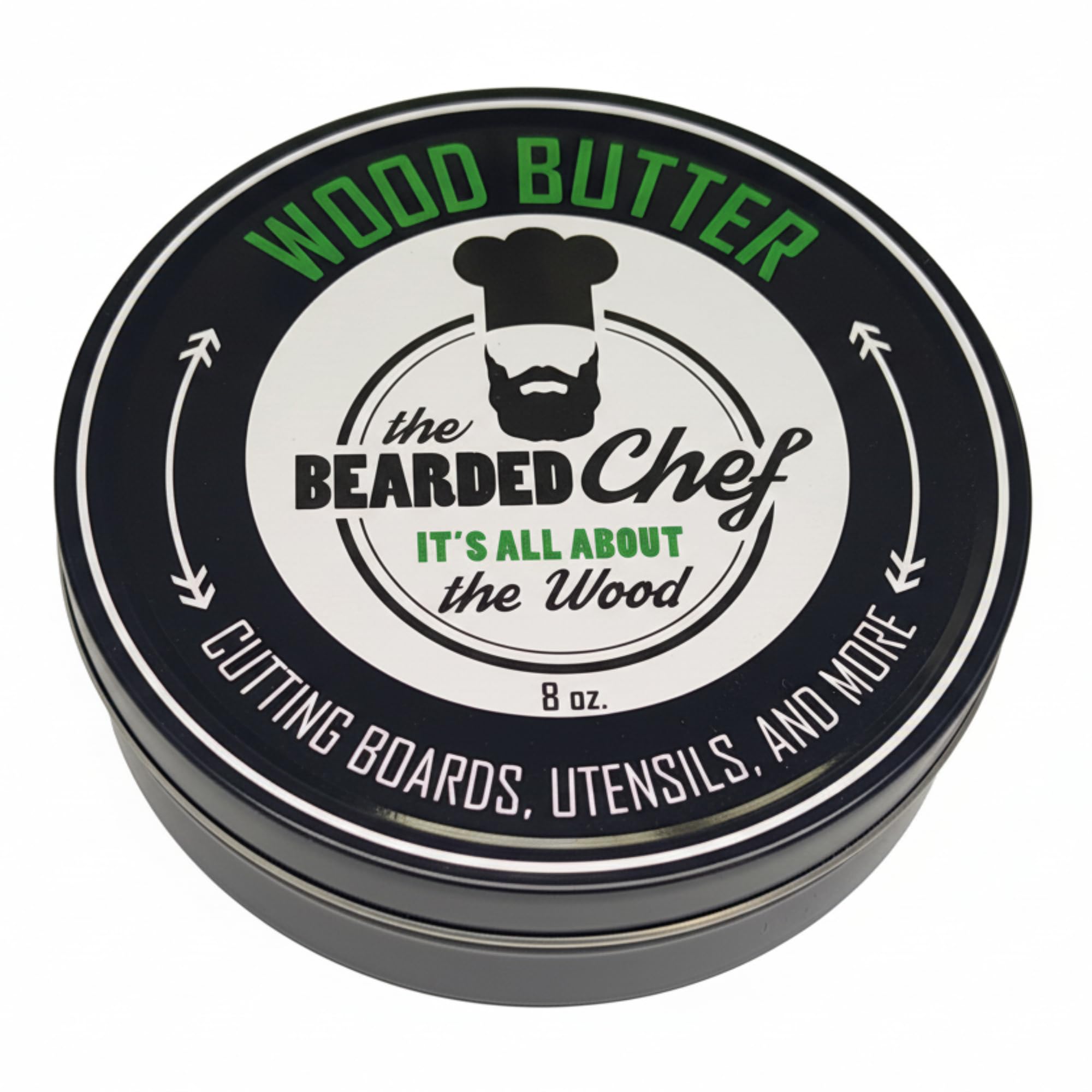
2. Wood Butter Cutting Board Wax 8oz
The veteran-owned tin that handles butcher blocks and patio furniture alike
Here’s the size difference that matters between the top two picks: the Bearded Chef tin weighs 7 ounces against the Epicurean’s 6.4 ounces. That’s a smaller tin than some competitors but a bigger one than the Epicurean, so you’re getting more product for roughly the same footprint on your shelf. The formula is food-grade mineral oil and beeswax, made in the USA by a veteran-owned company in Tallahassee. Recommended uses span butcher blocks, wood bowls, and wood utensils.
What sets this one apart from the other mineral-oil-based options here is how well it handles wood outside the kitchen. The most-praised quality is durability, and the reviews back that up in a very specific way — one notes it works on outdoor wood furniture and lasts through weather. That extra weather resistance makes it the pick for anyone who keeps a wooden set of grill tools, a serving tray that lives on a covered patio, or a board that travels between the kitchen and the yard.
What it does to a board is straightforward: softens to a honey-like consistency as you rub it in, spreads easily by hand or cloth, and leaves a finish that repels moisture and brings out the grain. A subtle rosemary-and-lemon scent lingers on the board for a short time after application — most people find it pleasant, but if you want a totally unscented finish, that’s the honest catch. Because it seals so well, it’s ideal for anyone who wants one tin that can cover kitchen boards, wooden spoons, cutting blocks, and outdoor wood all in one go.
Durability is the headline: the formula’s staying power on outdoor wood is what separates it from kitchen-only conditioners — a handful of reviews specifically mention it holding up through weather and repeated use.
Formula fit: mineral oil and beeswax is the classic combo for deep conditioning plus surface sealing. If you’re avoiding petroleum-derived ingredients, look at the Caron & Doucet or Ziruma options instead.
Reach for this if: you want one tin that covers kitchen boards and outdoor wood pieces, or you prefer buying from a small USA-based producer.
Look elsewhere if: you need a completely unscented finish — the rosemary and lemon notes stay on the board briefly after application.
3. Caron & Doucet – Cutting Board & Butcher Block Wood Conditioning & Finishing Wax | 100% Plant-Based & Vegan, Best for Wood & Bamboo Conditioning & Sealing | Does NOT Contain Mineral Oil!

No petroleum, no petroleum smell — just coconut oil and ricebran wax
Not everyone wants mineral oil on a surface that touches food, even when the oil is food-grade. The Caron & Doucet Conditioning Wax answers that concern directly: it’s made entirely from plant-based ingredients, contains no mineral oil at all, and is vegan-certified. The base is a solvent-less refined coconut oil that the brand removes the long-chain fatty acids from, so it doesn’t go rancid the way unrefined cooking oils can. The waterproof barrier comes from ricebran wax, which is a plant-derived wax that hardens on the wood surface.
What this means in practice: you get a smooth, water-resistant finish that keeps liquids from soaking in and stops food from drying and sticking to the wood. That last bit matters on a charcuterie board, because cheese and cured meat residue is the hardest thing to scrub off a stained board. A proprietary essential-oil blend helps eliminate odors without transferring flavor onto food. And here’s the practical advantage over the other picks — a very small amount covers a whole board. The jar is measured at 100 grams, and the reviews are unanimous that one tin lasts a long, long time on a single household’s boards.
The catch is the application method. The wax comes in a metal tin, and the packaging itself is hard to work with — the wax is dense and doesn’t spread as smoothly as a soft butter or gel. The verified recommendation from experienced users is to apply with a 3-inch putty knife for even, fast coverage, and to always apply a bamboo oil first if you’re treating bamboo. Darkening is a known effect of this formula: it deepens the wood tone noticeably, which most people love on walnut and cherry, but expect more color shift than with a mineral oil finish.
Why plant-based buyers pick it
- 100% plant-based and vegan — no mineral oil, no petroleum waxes
- Made with a refined coconut oil base that won’t go rancid
- Ricebran wax creates a water-resistant barrier that keeps water beading for days
- Tiny amount covers a whole board — the 100-gram jar lasts a long time
- Proprietary essential-oil blend helps eliminate odors without flavor transfer
What you should know first
- The dense wax is harder to spread than a soft butter — a 3-inch putty knife helps
- Noticeably darkens wood, which is great for cherry and walnut but a shock on pale maple if unexpected
The best fit here: anyone who’s ruled out mineral oil for ethical or dietary reasons, or who keeps a bamboo board that needs periodic sealing.
Consider skipping it if: you want glide-on application — the dense wax demands a little more elbow grease than a butter format.
4. Cutting Board Gel 8 fl.oz
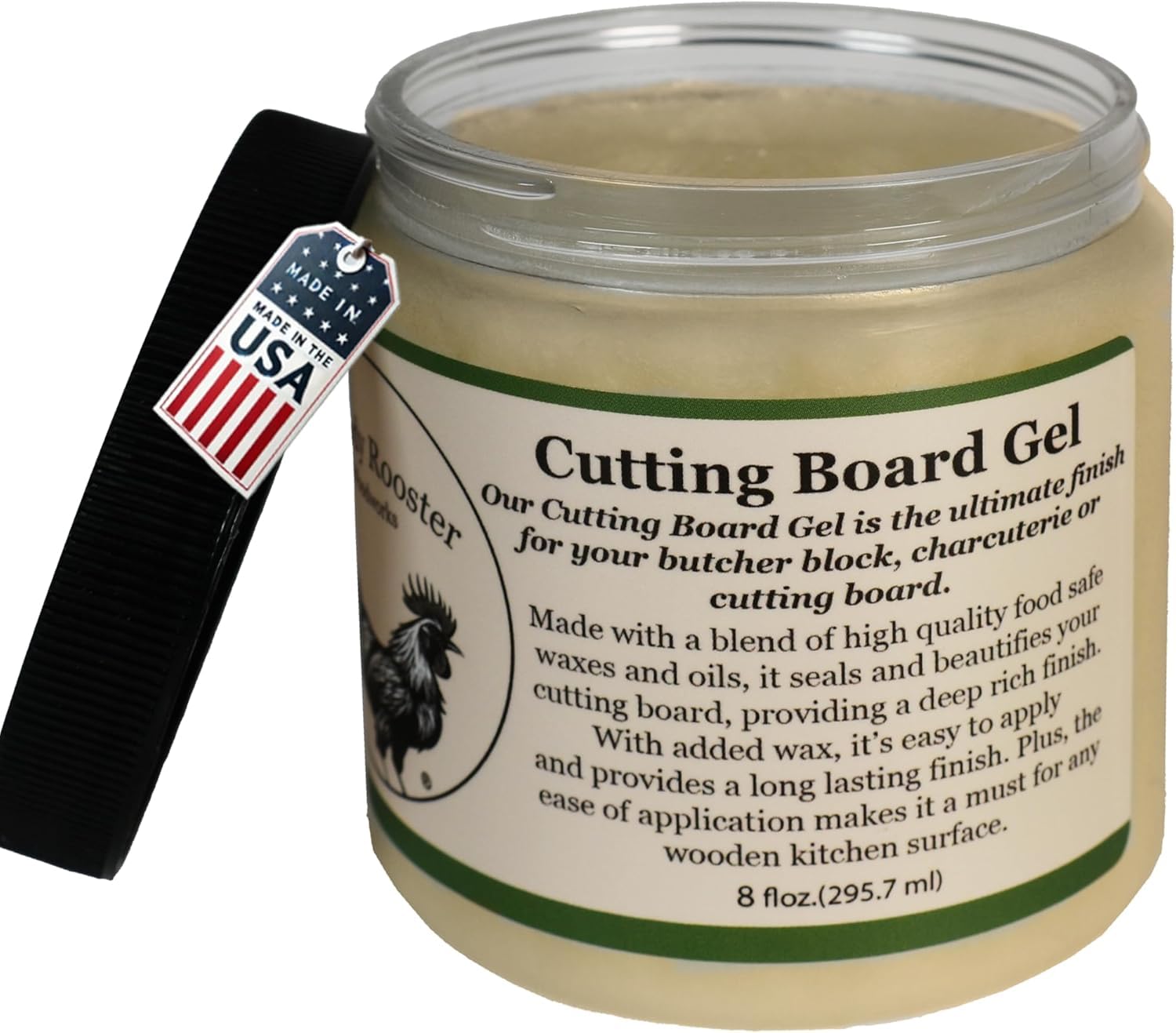
The two-in-one gel that skips the oil-then-wax two-step entirely
Most wood finishes make you do the same chore twice: oil the board, let it soak, then wax it for seal. The Rowdy Rooster Cutting Board Gel bundles the food-grade mineral oil and the beeswax into one thick gel, so you rub on one product and get conditioning and sealing at the same time. This is an 8-fluid-ounce container — the biggest by volume in this guide — and the squeeze-style tin is easier to control than a squeeze bottle of oil, which means less drips and less waste.
The application schedule that works is straightforward: rub the gel on with your hands or a cloth, let it sit overnight, buff it with a towel the next day. You get a smooth finish that brings out the grain — the review pages make a point of calling out how well it shows off cherry’s figure — without the glassy shine that heavy wax leaves. The citrus scent is noticeable during application and fades quickly, though it does linger on your hands for a bit after. A single jar of the 8-fluid-ounce gel handles several full-board treatments.
There’s a real advantage to the gel format for a charcuterie board specifically. Because the consistency is thick, it won’t run down a sloped edge or pool in the juice groove while you’re working. If you’ve ever chased a puddle of thin mineral oil across a tilted board, you’ll understand why this is the easiest of the group to work with for a first-timer. The one honest limitation is coverage on very large surfaces — reviews flag that one application doesn’t stretch as far on a big board as you’d hope, so use a generous amount and plan on a second pass.
Where it wins: the gel consistency makes even coverage simple on thick boards, spoons, and anything with a curved edge — the texture is not overly oily and spreads evenly without dripping.
One caveat worth knowing: on oversized boards, a single application goes faster than expected. Buyers who put it to work on a big butcher block recommend applying generously and doing a second coat.
Pick this if: you’re new to board care and want a single product that does the oiling and sealing without a two-step routine.
Skip it only if: you prefer a wax paste for the small-details work on engraved boards.
5. Non-Toxic Wood Wax 7 oz

Beeswax, flaxseed, and lemon oil in a paste that fills in fine scratches
Ziruma’s wood wax takes the “keep it natural” idea as far as it goes. The formula is beeswax, flaxseed oil, and lemon oil — no mineral oil, no petroleum-based solvents, no synthetic additives. The maker says it’s food-safe once applied and cured. It’s also biodegradable, which means once you’re done with it, it doesn’t leave chemicals behind. Nothing on the label relies on industrial ingredients — it’s kitchen-grade material you can feel comfortable putting on a board your family eats off of.
The standout feature is what the paste does to older wood. Because it’s a firm wax rather than a thin oil, it fills in small cracks and scratches as it works — the kind of wear that shows up on a board after a few years of heavy use. That restorative quality is why this is the pick for boards that are too far gone for a fresh-oil treatment but still structurally sound. The 7-ounce canister is on the larger side of this group, and because a thin layer is all you need per treatment, one can lasts a long time.
The lemon scent is the other signature. It’s a fresh, light aroma that comes from real lemon oil rather than fragrance, and it stays subtle — enough to make the act of conditioning a board feel pleasant, but not so much that it transfers onto the next cheese course. Reviews call it out as among the most-liked parts of the product, alongside how thoroughly it soaks into dry wood. The catch to know going in: the top layer of the wax can arrive with a hard waxy skin that you should cut away before the first use. Underneath, the wax is soft and easy to work with.
Effectiveness is the reason it ranks: reviews single out how completely this formula soaks into dry wood and restores it, with one buyer noting it also works on wooden utensils, spoons, and kitchen tools beyond just boards.
A note on the first open: the top surface sometimes arrives with a firm wax layer that should be trimmed off before use. The usable wax below is soft, easy to apply with a sponge or cloth, and doesn’t leave a sticky residue.
Choose this if: you want a fully natural, mineral-oil-free finish and you love a subtle lemon scent during the conditioning process.
Alternatives worth considering: if you dislike fragrance on food-contact wood, the unscented Epicurean Board Butter or the plant-based Caron & Doucet are better matches.
Know the Specs
Beeswax — The Protective Layer
Beeswax is the ingredient that keeps moisture out. When applied to wood, it hardens into a thin film on the surface that repels water and stops liquids from soaking in. That film is what makes a board look polished and keeps fruit juice from leaving stains. Beeswax alone, though, doesn’t condition dry wood — it sits on top rather than penetrating. That’s why the best board finishes pair beeswax with an oil.
Oil — The Conditioning Agent
Oil is what goes into the wood fibers to rehydrate them. Mineral oil, coconut oil, and flaxseed oil all do this job. The key difference is how they behave over time: mineral oil is inert and doesn’t go rancid, while some plant oils (especially unrefined coconut oil) can turn if left in the wood. Refined coconut oil with the long-chain fatty acids removed — like the base in Caron & Doucet — solves that problem. Either way, oil alone leaves a board slick; pairing it with wax is what gives a clean, dry finish.
Format — Butter, Wax, or Gel
The physical form of the product determines your application method. Butters and gels spread by hand or cloth and go on quickly, which suits large boards and first-timers. Firm paste waxes like Caron & Doucet and Ziruma demand more effort to spread evenly but deliver a denser seal and fill in fine scratches. The trade-off is elbow grease versus seal strength — the gentler formats give you speed, the harder waxes give you staying power.
Size and Coverage
Conditioner tins and jars range from 4.5 ounces up to 8 fluid ounces. A little goes a long way with every option here, and the way to judge value is not by price per ounce but by how many boards one container treats before it’s empty. Soft butters and gels tend to use more product per board because you can spread them heavier. Dense waxes like Caron & Doucet stretch noticeably further because a thin layer is all that’s needed for a full seal.
Common Questions
How often should I reapply finish to a charcuterie board?
Can I use a beeswax finish on a bamboo cutting board?
Is mineral oil or beeswax better for a charcuterie board?
Can I use coconut oil instead of a dedicated board finish?
How long should board conditioner sit before I wipe off the excess?
Will these finishes darken my charcuterie board?
Can I use these wood finishes on wooden utensils and spoons?
Is a beeswax and mineral oil finish safe on a board used for raw meat?
What’s the difference between board butter and board wax?
Should I apply finish on all sides of a charcuterie board?
The Bottom Line
The best finish for a charcuterie board depends on if you want a fast butter, a dense wax, or a one-step gel. If you want proven restoration power and the highest-rated formula in this guide, grab the Epicurean Board Butter — it brings dried-out boards back to life and holds 4.5+ stars across 900+ ratings. If you prefer a plant-based finish and seal that stretches across dozens of treatments, the Caron & Doucet Conditioning Wax is the right tin. And if you want a scent-free, one-step gel that’s easy to work with on a first board, the Rowdy Rooster Cutting Board Gel is the one to reach for.
How we choose
We do not accept paid placement. Every pick is matched to a real buyer and a real use-case; we do not hands-on test units.
Sources
Specifications: manufacturer listings and product documentation. Review insights: verified customer reviews, as of October 2026. Pricing: not shown on this page (it changes often); check the current price via the retailer link.
As an Amazon Associate, Aappliancez earns from qualifying purchases. This does not affect which products we feature.