Disclosure: Some links in this post are affiliate links. As an Amazon Associate I earn from qualifying purchases, at no extra cost to you. Learn more
Specs are compiled from manufacturer listings and verified buyer reviews and can change over time — please confirm the key details on the product page before buying.
You have a hairline crack running up the plaster, or a row of nail holes above the sofa, and you want it gone before the weekend. The honest answer is that most of these jobs do not need a contractor — they need the right filler and 20 minutes. Get the pairing wrong, though, and you get the two classic failures: paste that shrinks back into the crack after it dries, or a compound so thin it sags out of a hole before it sets. The five kits below cover both extremes, from a tube you squeeze straight into a hairline to a full bucket-and-tools set for bigger damage.
This guide is built by comparing the manufacturers’ published specifications and the patterns across verified customer reviews, so you get each pick’s real strengths and trade-offs instead of marketing spin.
A crack in plaster is really a depth question before it is a product question, and the right filler changes once the void runs deeper than an eighth of an inch. I built this shortlist around that split, so you can match the paste to the damage and pick the best filler for cracks in plaster walls without guessing at the shelf.
Top Picks

How To Choose The Best Filler for Cracks in Plaster Walls
Plaster is not drywall, and that changes what you buy. Plaster is dense and often slightly uneven, so a filler needs enough body to stay where you put it, and enough sandability to blend flat once it hardens. The single most useful number on any label is the maximum gap fill — the deepest crack the compound will close in one pass without shrinking back.
Match the paste to the depth, not to the hole’s width
A crack that is wider than it is deep usually closes in one pass with a standard spackle. A crack deeper than the stated maximum gap fill needs two or more thin layers with drying time between them. Applying one thick blob over a deep void is what causes the sunken line you see after painting.
Check what is actually in the box before you buy
A putty knife, a sanding pad, and a self-adhesive mesh patch are the three items you will otherwise buy separately. Several kits on this list bundle all three. Others give you paste and nothing else, which is fine if you already own a scraper and some fine paper.
Decide how fast you need to paint over it
Drying time decides whether this is a same-day job or a next-day job. One compound here reaches a full cure in 1 hour for repairs up to 1/8″ in depth. Others need a full day or two before you can sand and coat. Plan your painting around the slower one if you are working in a humid room.
Side-by-Side Comparison
| Model | Best For | Fill Amount | Drying Speed | Tools Included | Amazon |
|---|---|---|---|---|---|
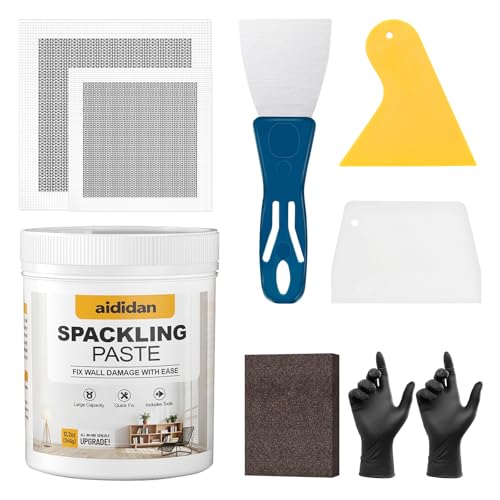
| Drywall Repair Kit 12.2 Oz Wall Mending Agent★ Best Overall | First-time patchers | 12.2 oz paste | Fast-setting paste | Patches, sanding block, scraper, squeegees, gloves | Amazon |
| DAP Alex Plus Spackling, White, 7 OzBest for Hairlines | Hairline cracks | 7 fl oz tube | 1 hour cure to 1/8″ | Tube only | Amazon |
| DIYSELF 9 Pack Drywall Repair Kit | Several small fixes | 2 × 3.53 oz paste | Quick-dry formula | Nozzles, scraper, 240-grit paper, tape, gloves | Amazon |
| 3M High Strength Small Hole Repair Kit | Holes up to 3″ | 8 fl oz spackling | Fast-drying compound | 4″ patch, 3″ putty knife, sanding pad | Amazon |
| YKF Drywall Repair Kit 18 oz | Bigger damage runs | 18 oz paste | Dries in minutes | Scraper, self-adhesive mesh | Amazon |
Detailed Reviews
1. Drywall Repair Kit 12.2 Oz
Our pick — 4.5+★ from 300+ verified ratings; the strongest balance of quality and price.
One can, every tool, and nothing else to buy before you start patching.
If you own no wall-repair tools at all, this is the pick that ends the problem in a single order. The box carries a 12.2 oz can of wall putty plus a 2-inch wall repair patch, a 4-inch wall repair patch, a sanding block, a scraper, two squeegees and a pair of gloves. You open it and start, which is why it takes the top spot for the whole category.
The paste arrives ready to use — no mixing, no measuring, no water. Squeeze it out, spread it with the scraper, smooth the edge with a squeegee. Owners consistently praise the compound itself and how little effort the whole job takes.
One can covers four surfaces — drywall, plaster, wood and stucco — so you can fix a plaster crack in the hallway and a dent in a wooden door frame with the same product. Buyers report: “Easy to use and patched the hole in the wall, no problem.” The limit is size: the two included patches are 2-inch and 4-inch, so a hole bigger than that needs a separate sheet of mesh. Treat this as the all-round starter kit, not a large-damage solution.
What earns it the top slot
- Twelve pieces in the box — paste, patches, scraper, sanding block, squeegees and gloves
- 12.2 oz of ready-to-use putty means several crack runs from one can
- Works on plaster, drywall, stucco and wood with the same compound
- No mixing step, so a first-time patcher cannot get the ratio wrong
Where it stops helping
- Patches top out at 4 inches, so bigger holes need extra mesh
- The can format dries out faster than a resealable tube once opened
Buy this if: you are patching plaster for the first time and want the whole job in one box.
Think twice if: the damage is a single hairline crack — a tube is less waste.
2. DAP Alex Plus Spackling, White, 7 Oz (7079818744)
A squeeze tube sized for a hairline crack and a row of old nail holes.
Here is the number that decides the job: this spackling reaches a full cure in 1 hour for repairs up to 1/8″ in depth. That is your morning crack, painted by lunchtime. Anything deeper than 1/8″ needs two or more thin layers with drying time in between, and skipping that step is what causes the sunken line everyone complains about.
The format is the real story. It is a sealable 7 fl oz tube weighing 1.44 ounces, and it applies like toothpaste — squeeze, smooth, done. Unlike the 12.2 oz can at the top of this list, the tube reseals, so the leftover compound does not skin over in the drawer between jobs. It is also small enough to work into a narrow crack without a patch. Owners mention: “The size was bigger than expected, it was easy to use and patched up the extra holes in I put in the wall when hanging a curtain rod.”
What wins people over is how little mess the tube makes — no tub to open, no knife to clean. It is paintable and sandable, takes paint like bare drywall, and wipes clean with water. The catch is real but small: at 7 fl oz you get a filler for touch-ups, not a whole room. And the last portion of the tube takes more thumb pressure to squeeze out, which matters if your hands are arthritic.
Exactly right for: hairline cracks, curtain-rod holes and paint chips where fumbling with a tub is more work than the repair itself.
Honest limit: 7 fl oz goes fast on a ceiling-wide crack run, and anything past 1/8″ deep needs a second layer anyway.
Reach for this if: the cracks are shallow and you want a resealable tube you can use again next month.
Look elsewhere if: you are filling a deep plaster void — you will need layers regardless, and a bigger can saves trips.
3. DIYSELF 9 Pack Drywall Repair Kit

Nine pieces of kit in a pouch small enough to keep on the shelf for the next ding.
The thing that makes this one worth a spot is the sanding paper. It ships with 5-inch 240-grit sheets, and 240-grit is fine enough to feather a patched plaster edge without scratching the surrounding wall. Coarser paper gouges the face around the repair and shows under paint. That detail alone puts this ahead of kits that hand you paste and wish you luck.
You get two 100g (3.53oz) tubes of repair paste, two extended nozzles, a scraper, the two sanding sheets, painter’s tape and disposable gloves. The nozzles are the useful part — they push paste directly into a narrow crack so you are not fighting it across the wall face. The white paste is a fast-dry, high-adhesion formula that blends toward most painted surfaces.
Height, width and length all sit compact — the pouch runs 6 x 4.68 x 2.1 inches, so it slides into a toolbox drawer and stays there until you need it. Compare that with the 7.65-inch height of the can at the top of this list and this is the one that lives quietly between jobs. The compound has body, but a few owners find it on the thin side for anything deep, and one tube can arrive less than brim-full.
Why DIYers keep it around
- 240-grit sanding sheets blend a patched edge without scuffing the surround
- Extended nozzles put paste straight into narrow cracks
- Two 3.53oz tubes plus tape and gloves — enough for scattered fixes
- Compact 6 x 4.68 x 2.1 inch pouch stores easily
Where it asks more of you
- Thin paste sags out of deeper holes unless you build it in layers
- Tubes may arrive with less than a full load, so plan for refills
Best matched to: a rental or new build with a scatter of small dings and cracks to clear before a walkthrough.
Note first: the paste runs thin, so deep plaster gaps want two passes rather than one.
4. 3M High Strength Small Hole Repair Kit

A patching kit confident enough to handle a hole up to 3 inches across.
A crack is easy; a hole is where most fillers give up. This kit covers repairs up to 3″ in diameter, which puts it in a different class from the paste-only options above. The package holds an 8 fl oz tub of primer-enhanced spackling, a 4-inch self-adhesive patch, a 3″ putty knife and a sanding pad. 3M claims the compound sets 3x faster than traditional spackling.
Effectiveness is the headline in reviews, and it is why this kit wins on bigger damage. The self-adhesive patch grabs and holds, the acrylic compound spreads without sagging, and the included sanding pad flattens the repair so it disappears under paint. The primer-enhanced compound lets the patch take a topcoat without a separate priming step.
The recurring gripe is drying time, and it is a fair one — some batches set fast, others sit tacky far longer than you would like. The other thing to know: 3M itself flags this as not suited to structural joints or stress cracks. On a plaster wall, that means it is your line of defence for a knocked-through section, but a crack that keeps reopening needs a different approach.
The real strength: it bridges a genuine hole with a mesh patch and compound in one kit, where the squeeze tubes below can only chase cracks.
Budget for patience: the compound can be slow to fully set, so do not plan on painting the same afternoon.
Choose this when: a doorknob or furniture leg has punched a hole and you need the mesh patch to rebuild the surface.
Not the one for: structural or stress cracks, which 3M explicitly excludes from this kit’s remit.
5. YKF Drywall Repair Kit 18 oz
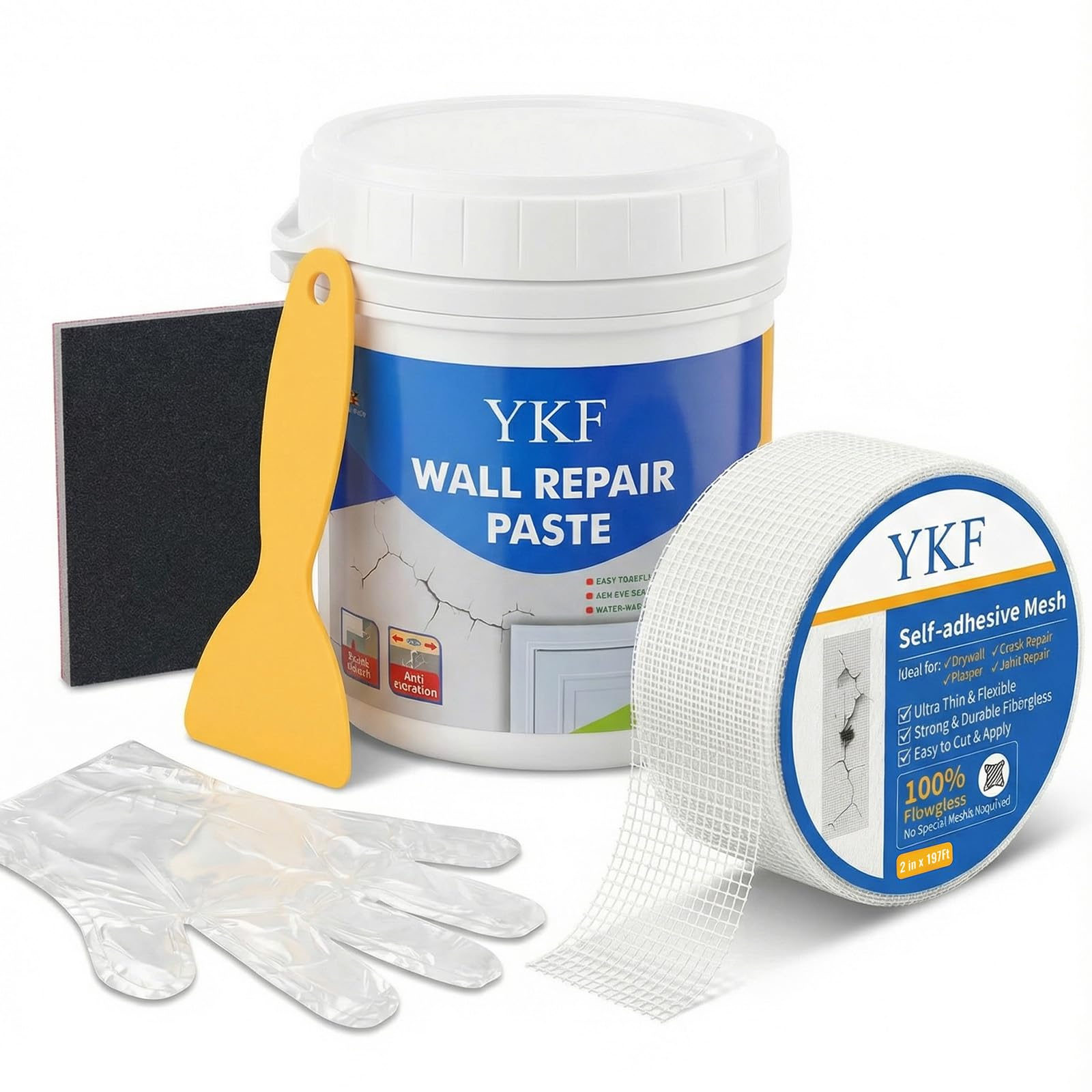
The biggest tub here — 18 oz of paste for walls that need more than a touch-up.
Eighteen ounces is the number to hold onto. You get 18 oz of premium spackle, a professional-grade scraper and a reinforcing self-adhesive mesh, and that volume is what lets you fill a whole run of cracks or a wall of screw holes without rationing the paste. The waterproof formula is aimed at bathrooms, kitchens and basements, where ordinary filler can crack or peel.
The mesh is the reason this handles bigger repairs. Lay the self-adhesive tape over a wider crack or a shallow dent, spread paste across it, and the mesh reinforces the patch so it holds together. The scraper spreads evenly, the compound smooths without bubbles or lumps, and it sands flat and accepts paint. It covers nail holes, screw holes, dents, cracks and chips on plaster, drywall, wood and stucco.
The honest catch is guidance. A few buyers found no printed instructions in the box, so you are left to work out the layer-and-sand rhythm yourself. The other point worth flagging is the tub — 18 oz of paste in a canister does not reseal the way a tube does, so use it on a run of jobs rather than a single crack.
Where the size pays off
- 18 oz of paste covers a full wall’s worth of cracks and holes
- Waterproof formula holds up in bathrooms, kitchens and basements
- Self-adhesive mesh reinforces wider cracks so they stay put
- Sands smooth and takes any paint type for a blended finish
What to plan around
- Some units ship without printed instructions
- The tub format does not reseal as snugly as a tube
Made for: a stack of repairs at once, or a damp room where the filler needs waterproofing.
Before you buy: be ready to figure out the application rhythm without step-by-step instructions in the box.
Know the Specs
Maximum gap fill
This is the deepest crack the compound will close in one pass without shrinking back. On a plaster wall, a hairline crack is well inside that limit, but a wider void usually needs two thin layers with drying time between them. One spackling here lists a maximum gap fill of 0.13 inches. Anything deeper needs layers.
Full cure time
Full cure is the point where the paste is hard enough to sand and paint. One compound here reaches it in 1 hour for shallow repairs. Others state a fast-dry formula without a precise hour, and some buyers find drying runs longer than expected. Plan the painting step around the slower number, not the label claim.
Sanding grit
Sanding grit counts the abrasive particles per square inch. A lower number is coarser and cuts faster; a higher number, like the 240-grit sheets in one kit, is fine enough to feather a patched plaster edge flat without scuffing the wall around it. Too coarse and you dig into the plaster face.
Shrink vs. sag
Shrinking is the paste pulling back from the crack as it dries, which leaves a visible line. Sagging is a thin paste sliding down out of a hole before it sets. Shrink-resistant paste holds its place; a thicker paste resists sag. You want both on a deep repair — otherwise it is two passes and a re-sand.
Common Questions
Will regular drywall filler work on a plaster wall?
How deep can one pass of filler go before I need layers?
How long before I can paint over patched plaster?
Do I need a mesh patch for a hairline plaster crack?
What sanding grit should I use on a patched wall?
Is a tub better than a tube for filling cracks?
How many places can one kit cover?
Does filler for plaster cracks shrink after it dries?
Can I use a plaster crack filler on structural or stress cracks?
The Bottom Line
You get everything in one box with the Drywall Repair Kit 12.2 Oz Wall Mending Agent — the paste, patches, scraper, sanding block and squeegees — so most people patching plaster cracks can skip the hardware store. For a single hairline, the resealable DAP Alex Plus Spackling tube wastes less and cures in 1 hour. When a hole has been knocked through, the 3M High Strength Small Hole Repair Kit uses a self-adhesive patch to cover repairs up to 3″ across. Match the format to the number of jobs you actually have, and you will not buy more paste than you need.
How we choose
We do not accept paid placement. Every pick is matched to a real buyer and a real use-case; we do not hands-on test units.
Sources
Specifications: manufacturer listings and product documentation. Review insights: verified customer reviews, as of October 2026. Pricing: not shown on this page (it changes often); check the current price via the retailer link.
As an Amazon Associate, Aappliancez earns from qualifying purchases. This does not affect which products we feature.