Disclosure: Some links in this post are affiliate links. As an Amazon Associate I earn from qualifying purchases, at no extra cost to you. Learn more
Specs are compiled from manufacturer listings and verified buyer reviews and can change over time — please confirm the key details on the product page before buying.
The short answer: if you want one bottle to try first, it’s the Physician’s Choice 60 Billion CFU. It’s the crowd favorite — 4.5+ stars across 145,000+ owners — and the bottle most people mean when they say a daily probiotic capsule settled their bloating and made their bathroom schedule predictable. Your gut does the unglamorous work of breaking down every meal, and a fiber or probiotic supplement is simply a support system for it. The trick is knowing which format fits your day: a swallow-it-and-go capsule, a soluble powder that vanishes in coffee, or a blend that combines fiber, probiotics, and enzymes in one shot.
This guide is built by comparing the manufacturers’ published specifications and the patterns across verified customer reviews, so you get each pick’s real strengths and trade-offs instead of marketing spin.
Below you’ll find the five bottles worth your shelf space, sorted from the best all-rounder to the gentle powder that hides in your morning coffee. Every pick earned its spot on CFU count, strain variety, fiber grams, or the sheer convenience of how it fits a real routine. If you’re tired of guessing which fiber and probiotic supplements actually fit your gut, this breakdown is built to settle it fast.
Top Picks


How To Choose The Best Fiber and Probiotic Supplements
You don’t need a degree to pick the right bottle, but three numbers on the label do most of the deciding for you: the CFU count, the strain count, and the grams of fiber. Everything else — capsule shape, shelf stability, added enzymes — is about whether you’ll keep taking it. Here’s what each one means in plain terms.
CFU Count — The Live-Culture Headcount
CFU stands for colony-forming units, which is simply the number of live bacteria the maker promises per capsule or serving. A 60 Billion CFU probiotic puts roughly 60 billion live cultures in each dose, while an 8 billion formula delivers a lighter daily load. Higher isn’t automatically better for everyone — a very potent formula can feel like a lot at first. If you’re brand new, a moderate count is often the calmer place to start.
Strain Variety — Different Bacteria, Different Jobs
A “strain” is a specific type of bacteria, and each one tends to specialize. A 10-strain formula spreads its support across several different types, which is why variety matters if your goal is general gut support rather than one narrow issue. Look for the strain count printed on the label and treat it as a diversity score.
Fiber vs. Probiotics — Two Halves of the Same Job
Prebiotic fiber (the type that feeds the good bacteria already in your gut) and probiotics (live cultures that add new bacteria) work in different ways. A synbiotic (a blend of both) feeds and seeds your gut in one step. That’s why some people pick a caplet with fiber and others want a powder they can stir into coffee — the best format is the one you’ll actually remember to take every day.
Side-by-Side Comparison
| Model | Best For | Live Cultures | Strains | Format | Amazon |
|---|---|---|---|---|---|
| Physician’s Choice Probiotics 60 Billion CFU★ Best Overall | Best overall daily probiotic | 60 Billion CFU | 10 | Capsule, 30ct | Amazon |
| Probiotic Prebiotic and Digestive Enzymes 3-in-1 ComplexMost Complete | All-in-one digestive support | 50 Billion CFU | 10 | Delayed-release capsule | Amazon |
| Garden of Life Dr Formulated Once Daily 3-in-1 | Gas and bloating support | 50 Billion CFU | 15 | Vegetarian capsule, 30 day | Amazon |
| Tomorrow’s Nutrition Sunfiber GI Prebiotic Fiber | Gentle powder for sensitive stomachs | 8 Billion probiotics | — | Powder, 30-day supply | Amazon |
| Benefiber Prebiotic Fiber Supplement Caplets | Convenient on-the-go fiber | — | — | Caplets, 84 count | Amazon |
Detailed Reviews
1. Physician’s CHOICE Probiotics 60 Billion CFU
Our pick — 4.5+★ from 145,000+ verified ratings; the strongest balance of quality and price.
The everyday capsule that most people mean when they say their gut finally settled down.
Start with the number that does the heavy lifting: 60 Billion CFU across 10 strains. CFU means live, colony-forming bacteria — the actual working cultures in each capsule — so 60 billion is a big, confident daily dose. Those 10 strains (ten different bacteria types, each doing its own job) are paired with organic prebiotics, which are the fibers that feed the good bacteria already living in your gut. The whole thing is shelf-stable, so there’s no refrigerator shelf to fight for.
What wins people over is how plainly it handles the day-to-day. Buyers report less bloating and more predictable bathroom trips, sometimes within the first week. One buyer put it bluntly: “After a week on these, my stomach shrunk and I am regular again!! Will definitely keep ordering these!!!” The formula also travels well — it’s acid-resistant, meaning the capsule is built to survive stomach acid and deliver cultures further down the tract instead of dissolving too early.
Here’s the honest trade-off. The bottle uses a non-refrigerated, shelf-stable design, which is convenient but means you should still keep it somewhere cool and dry rather than a hot car. The dimensions are 4.5 x 2.4 x 2.4 inches weighing 2.4 ounces — genuinely small next to a bulkier bottle like the Benefiber caplets at 4.45 ounces. It’s a one-month supply at one capsule a day. For a first-timer, that’s a clean, low-drama starting point with nothing exotic to figure out.
Why It Leads The List
- 60 Billion CFU across 10 strains — a big, broad daily dose
- Organic prebiotics included, so you’re feeding gut bacteria as well as seeding
- Acid-resistant capsules built to survive the stomach
- Shelf-stable with no refrigeration required
What To Weigh Before Buying
- One capsule a day means the bottle runs out in roughly a month
- Keep it cool and dry even though it doesn’t need the fridge
- A strong first dose can feel like a lot if you’re new to probiotics
Grab this one: if you want a proven, all-purpose daily probiotic with a high CFU count and no storage fuss.
Think twice if: you specifically want fiber grams in your dose — this bottle is a probiotic with prebiotics, not a fiber caplet.
2. Probiotic Prebiotic and Digestive Enzymes
Three jobs in one capsule: seed the gut, feed it, and help break food down.
If you want your whole digestive toolkit in one swallow, this is the pick. The 3-in-1 label is literal: you get 10 strains of probiotics (the live cultures), a prebiotic (the fiber that feeds them), and a digestive enzymes blend (proteins that help your body break down food), all in one delayed-release capsule. Delayed-release means the capsule is built to survive stomach acid and open lower down, so the cultures reach the area where they can do their work.
Quality is the headline here. Owners talk most about the clean build: no fillers like rice flour or magnesium stearate, third-party lab tested for purity and heavy metals, and made in cGMP-certified facilities in the United States. cGMP is a manufacturing standard that requires consistent, controlled production. Owners also say it works fast; one male buyer noted “The taste is negligible the pill size is palatable and I did lose some weight (I am a male).”
Compare it directly to the Physician’s Choice above and you can see the shape difference: this bottle runs 2 x 2 x 4.3 inches, while the Physician’s Choice stands 4.5 x 2.4 x 2.4 inches. Both weigh 2.4 ounces, so there’s no weight advantage either way. The choice depends on the extra enzymes and delayed-release delivery versus a higher 60 billion CFU count. Neither is wrong; they just solve slightly different problems.
Best for: anyone who wants probiotics, prebiotics, and digestive enzymes handled in one daily capsule without juggling three bottles.
Less ideal if: your priority is the highest possible live-culture count — the 60 Billion CFU pick edges ahead there.
3. Garden of Life Dr Formulated Once Daily 3-in-1
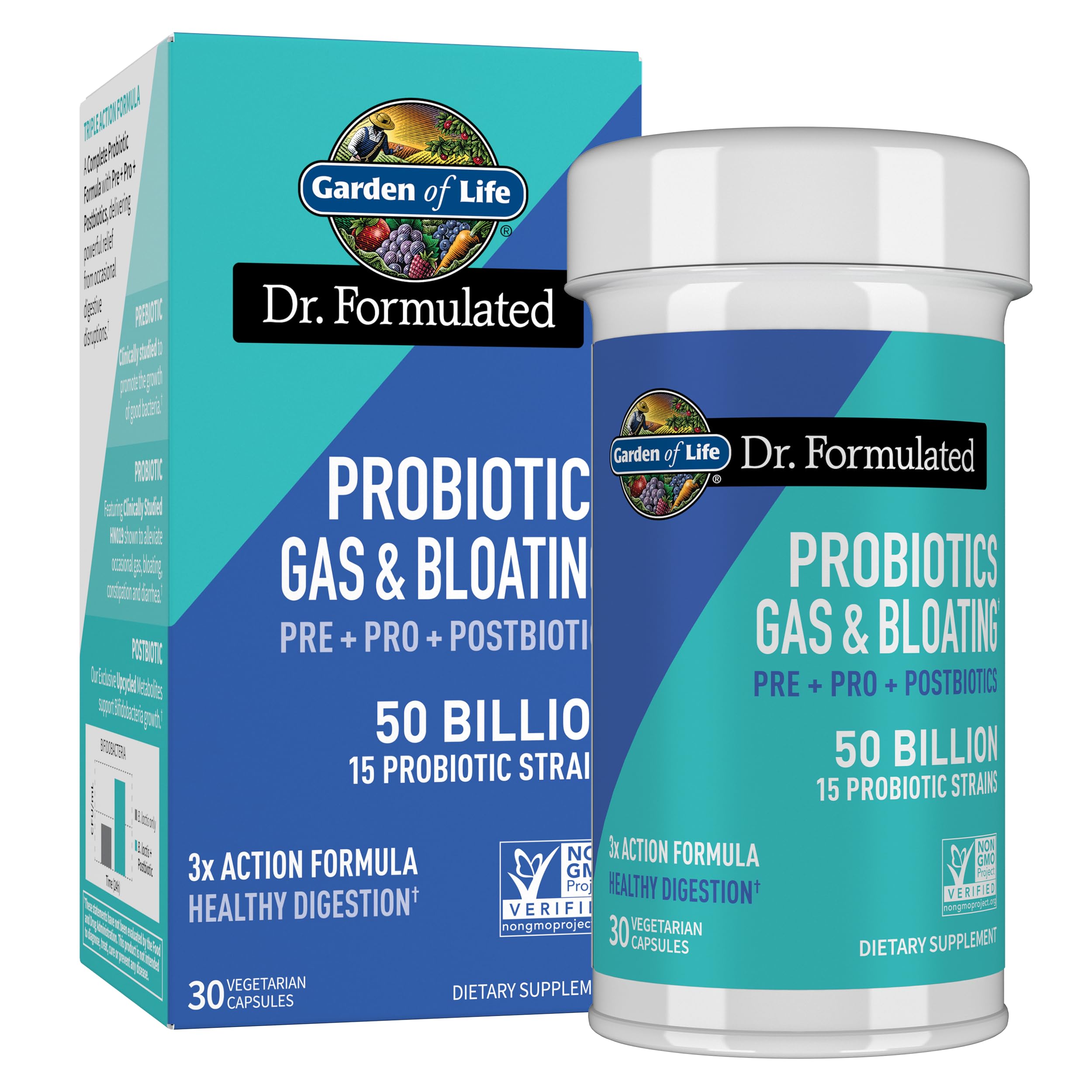
Fifteen strains and a triple-action formula aimed squarely at gas and bloating.
The largest strain lineup on this list — 15 different bacteria types at 50 Billion CFU — is the reason this one sits in the premium tier. It’s also a genuine triple-action formula: prebiotics (organic potato, acacia fiber, and PreforPro), probiotics, and postbiotics. Postbiotics are the beneficial compounds the bacteria produce as they work, so you’re getting the byproducts right alongside the cultures. The prebiotic blend is built to encourage the growth of good bacteria, and the whole thing comes in a shelf-stable, easy-to-swallow vegetarian capsule.
What draws people to this one is the gas-and-bloating focus. It’s formulated for occasional gas, bloating, constipation, and diarrhea, and includes HN019 in amounts the maker cites as clinically studied. Owners mention noticeably less bloating on this 15-strain formula, with several noting digestion and regularity improving together. For someone whose main complaint is that heavy, swollen feeling after meals, that’s the specific job this bottle was designed for.
The real-world catch is worth knowing up front: this is the one formula on the list where digestion feedback genuinely splits. Some owners feel lighter; a few find the opposite and say it took a full bottle to know for sure. If your gut is sensitive to a new high-strain blend, expect an adjustment window rather than a same-day answer. At 4.75 x 2.4 x 2.35 inches and 2.89 ounces, it’s straightforward to store — just don’t expect instant results your first morning.
Where the value sits: 15 strains and a prebiotic-plus-postbiotic blend at a once-daily dose is the broadest formula here — genuinely more for the same one-capsule routine.
The honest caveat: it’s built for gas and bloating, and some users need a few weeks to see whether it suits them — this isn’t a formula to judge in three days.
Worth it for: the buyer chasing maximum strain variety who wants a single daily capsule with prebiotic and postbiotic support built in.
Look elsewhere if: you want the lowest-commitment starting point or a guaranteed immediate response.
4. Tomorrow’s Nutrition Sunfiber GI Prebiotic Fiber
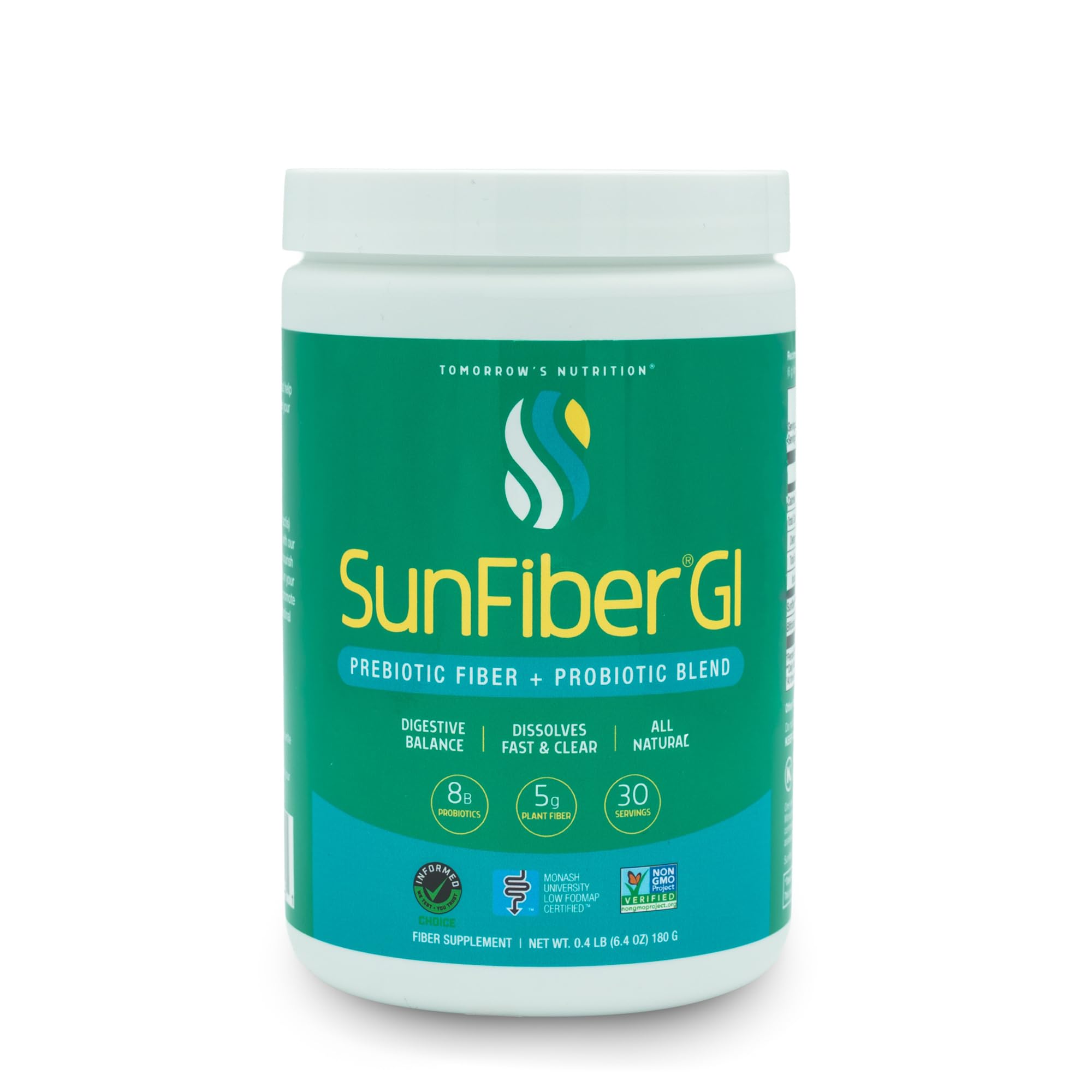
The tasteless powder that disappears into coffee without a trace or a gurgle.
Powder, not a pill — and that’s the entire point. Each serving delivers 5 grams of prebiotic fiber alongside 8 billion probiotics, with the active culture being bifidobacterium lactis working in tandem with the soluble fiber. This is a synbiotic, meaning it feeds your existing gut bacteria and adds live cultures at the same time. The 5g of soluble fiber is meant to ease occasional constipation and diarrhea by supporting regular bowel movements.
What makes this the gentle pick is how it ferments — slowly, in the gut, rather than all at once. That slow fermentation is the reason it tends to go easy on sensitive stomachs and skip the excess gas and bloating some fiber powders cause. It’s also low FODMAP-certified, which matters if you follow a low FODMAP plan for digestive comfort. Owners consistently praise two things about this powder: it dissolves completely without grit or residue, and it has essentially no taste. It mixes cleanly into coffee, tea, and protein smoothies, so it slots straight into a routine you already have.
Here’s the fit check. Weighing 7.76 ounces and measuring 5.88 x 3.75 x 5.88 inches, the tub is bigger than a caplet bottle — it’s a powder you scoop, not a pill you pop. That makes it less pocketable than the 4.45-ounce Benefiber caplets, but it’s a plus if you dislike swallowing large pills. If your habit is a morning mug, this is the smoother path to 5 grams of daily fiber.
The standout: 5g soluble fiber plus 8 billion probiotics, low FODMAP-certified, and designed to ferment slowly so sensitive stomachs get less of the gas and bloat.
What to weigh: it’s a scoop-and-stir routine, not a grab-and-go capsule, so it only works if you’ll actually mix it daily.
Suits you if: pills are a problem, you want fiber grams and a lighter 8 billion probiotic together, and you’d rather stir a tasteless powder into coffee.
Not for you if: you want a bottle you can drop in a bag and take dry on the move.
5. Benefiber Prebiotic Fiber Supplement Caplets, 84 count

Fiber in tablet form, made for the days when mixing powder simply isn’t happening.
This bottle skips the scoop entirely. It’s plant-based prebiotic fiber pressed into 84 caplets, and each one carries twice the fiber of the leading fiber capsule. Prebiotic fiber works differently from a probiotic — instead of adding bacteria, it nourishes the good bacteria already in your gut. That’s why caplets like this are often what people reach for when they’re eating high-protein meals and need to close a fiber gap in their day.
The convenience is the whole pitch, and owners back it up. One buyer taking these alongside a GLP-1 medication said two caplets daily help offset a common side effect of that medication. That’s the real-world case here: two tabs, swallowed with water, done — no scoop, no stirring, no timing. The plastic-free-of-hassle format means you can drop the bottle in a work bag or suitcase and take it anywhere without carrying a shaker.
Now the part you should know before buying. The caplets are large and have a four-faced, sharp-cornered shape that can stick a little on the way down — so if you have trouble swallowing pills, this isn’t the friendly option. It weighs 4.45 ounces, noticeably heavier than the 2.4-ounce probiotic capsules on this list, though still a compact bottle. For anyone who finds powder a chore and doesn’t mind a bigger pill, it’s a genuinely convenient way to keep daily fiber going.
Where it wins: 84 caplets, twice the fiber of the leading fiber capsule, and a format you can take on the go with nothing to mix.
The one snag: the large, four-faced caplets can stick for people who struggle with big pills — read the label if swallowing is ever a struggle.
Reach for these if: you want fiber you can swallow anywhere without powder or prep, especially alongside a high-protein diet.
Pass if: you find large, angular caplets hard to get down or you’d rather get your fiber in a drink.
Know the Specs
CFU (Colony-Forming Units)
A CFU is one live, viable bacterium capable of growing into a colony — in plain terms, it’s a headcount of the working cultures in your dose. A 60 Billion CFU capsule carries far more than an 8 billion one, but a bigger number isn’t automatically the right fit. If you’re new to probiotics, a moderate count can be the gentler place to start, then adjust upward as your gut gets used to it.
Prebiotic Fiber vs. Probiotics
Probiotics add new live cultures to your gut; prebiotic fiber feeds the good bacteria already living there. A synbiotic does both in one serving. That’s the real difference between a caplet like Benefiber, which is pure prebiotic fiber, and a capsule like Physician’s Choice, which pairs probiotics with organic prebiotics. Knowing which job you actually need is the whole decision.
Shelf-Stable vs. Refrigerated
Shelf-stable formulas are made to hold their potency at room temperature without a fridge. That matters for anyone who travels or doesn’t want to clear cabinet space. Even so, a cool, dry spot is the smarter storage for any of these bottles — heat is what shortens a live culture’s life, whether or not the label says refrigerate.
Capsule Shape and Swallowability
Two bottles can hold the same ingredients and feel completely different to take. A delayed-release or acid-resistant capsule is built to survive stomach acid and open lower in the tract. A larger, four-faced caplet can be harder to swallow even if it’s effective. Since you’ll take this daily, how easy it goes down matters as much as what’s inside.
Common Questions
How long does it take for a probiotic to show results?
Can I take a fiber caplet and a probiotic capsule on the same day?
Do these need to be refrigerated?
What is a synbiotic and do I need one?
Benefiber vs a probiotic capsule — which do I choose?
Are large fiber caplets hard to swallow?
What does delayed-release mean on a probiotic capsule?
Is a low FODMAP fiber supplement gentler on the stomach?
How should I store a shelf-stable probiotic to keep it potent?
Does a probiotic with more strains mean it works better?
The Bottom Line
For most people, the fiber and probiotic supplements winner is the Physician’s Choice Probiotics 60 Billion CFU, because it pairs a strong 60 Billion CFU dose and 10 strains with organic prebiotics in a shelf-stable capsule that’s easy to work into a daily routine. If you want the broadest formula with the most strain variety, the Garden of Life Dr Formulated 3-in-1 brings 15 strains plus prebiotics and postbiotics in one swallow. And if pills aren’t your thing, the Tomorrow’s Nutrition Sunfiber GI hides 5g of fiber and 8 billion probiotics in a tasteless powder that vanishes into your coffee. Whichever way you go, lean on the winning combination of a broad strain count and a format you’ll actually take every day.
How we choose
We do not accept paid placement. Every pick is matched to a real buyer and a real use-case; we do not hands-on test units.
Sources
Specifications: manufacturer listings and product documentation. Review insights: verified customer reviews, as of October 2026. Pricing: not shown on this page (it changes often); check the current price via the retailer link.
As an Amazon Associate, Aappliancez earns from qualifying purchases. This does not affect which products we feature.