Disclosure: Some links in this post are affiliate links. As an Amazon Associate I earn from qualifying purchases, at no extra cost to you. Learn more
Specs are compiled from manufacturer listings and verified buyer reviews and can change over time — please confirm the key details on the product page before buying.
If you have a live oak that looks tired, thin, or just slower than the one down the street, the fertilizer you pick matters far less than how you deliver it. Live oaks feed through roots that sit near the surface and spread wide, so the right pick is the one that gets nutrients down to those roots without burning them. This guide covers five real options and tells you plainly which tree, soil, and schedule each one suits.
This guide is built by comparing the manufacturers’ published specifications and the patterns across verified customer reviews, so you get each pick’s real strengths and trade-offs instead of marketing spin.
You will see which formulas suit acid-loving evergreens, which ones are slow-release spikes, and which are easy powders you mix in a watering can. The short answer: spikes win for low-effort feeding of an established live oak, and a soluble powder wins when you want fast greening on younger trees. Here is how to sort the fertilizer for live oak trees options you will actually find on the shelf.
Top Picks


How To Choose The Best Fertilizer for Live Oak Trees
A live oak is a long-lived shade tree, and feeding it is closer to landscaping than to houseplant care. You are not trying to push a quick burst of growth. You want steady nutrition that reaches the feeder roots without scorching them.
Match the form to the tree’s age
Young, recently planted oaks benefit from a water-soluble powder you can mix and pour, because you can control the dose and see a response quickly. An established oak with a wide canopy is easier to feed with slow-release spikes driven in around the drip line (the outer edge of the branches, where the feeder roots concentrate).
Read the NPK ratio first
Those three numbers on the bag are the percentage of nitrogen, phosphorus, and potassium by weight. A 16-4-4 spike leans heavily on nitrogen, which drives leafy green growth. A 4-3-4 organic blend is gentler and slower, feeding the soil as much as the tree.
Check for sulfur and acid support
Live oaks tolerate a range of soils but do well with a slightly acidic mix. Formulas built for acid-loving plants often carry added sulfur, which helps keep the root zone in that range over time.
Plan for two feeds a year
Most tree fertilizers are labeled for early spring and late fall. Spacing those two applications gives the tree nutrition across the growing season without dumping everything at once.
Side-by-Side Comparison
| Model | Best For | Form | NPK Ratio | Application | Amazon |
|---|---|---|---|---|---|
| Miracle-Gro Water Soluble Azalea, Camellia, Rhododendron Plant Food★ Best Overall | Fast greening on young or recovering trees | Powder | Not listed | Watering can or garden feeder | Amazon |
| Jobe’s Slow Release Tree and Shrub Fertilizer SpikesMost Popular | Low-effort feeding of established trees | Spikes | 16-4-4 | Insert into soil | Amazon |
| Espoma Organic Holly-Tone 4-3-4 | Organic feeding of acid-loving evergreens | Powder | 4-3-4 | Sprinkle over root zone and water in | Amazon |
| Jobe’s Tree Fertilizer Spikes, 16-4-4, 30 Count | Big yards with several trees | Spikes | 16-4-4 | Insert around each tree’s dripline | Amazon |
| Espoma Organic Evergreen-Tone 4-3-4 | Establishing or feeding broadleaf evergreens | Granules | 4-3-4 | Ready to use, no mixing | Amazon |
Detailed Reviews
1. Miracle-Gro Water Soluble Azalea Plant Food
Our pick — 4.5+★ from 700+ verified ratings; the strongest balance of quality and price.
Five pounds of water-soluble powder that greens up a struggling oak within a week of watering.
This is the crowd favorite of the group — 4.5+ stars across 700+ ratings — and it earns that spot by being the fastest-acting option here. You mix the powder with water and pour it over the root zone. Because the nitrogen is already dissolved, a young live oak or fresh transplant takes it up within days rather than waiting on slow breakdown.
The box lists a mixing ratio of 1:144 for indoor use and 1:18 for outdoor use, so you dilute it much more heavily for outdoor feeding. You apply it every 7-14 days with a watering can or a hose-end garden feeder. That regular schedule is the trade-off: this is not a set-and-forget spike, it is a routine you repeat. The upside is control — you decide how strong and how often, which makes it forgiving for a first feeding on a young tree.
The one recurring gripe is the new packaging, a single large plastic bag with a Velcro closure. Fertilizer coats the strip and the seal stops holding. Keep a clip or a separate container handy and it is a non-issue. What wins people over is simply that it works — as buyers report: “This truly helped our rhododendron to recover and look stunning this summer.” Same idea applies to greening up an oak.
Where it earns its keep
- Fast uptake for young or recovering trees
- 5 pounds of powder goes a long way at the 1:18 outdoor mix
- Labeled not to burn foliage at the listed outdoor dilution
- Works indoors and outdoors on acid-loving plants
What to plan around
- Needs repeat application every 7-14 days
- The Velcro bag closure stops sealing once powder coats it
- Requires mixing and measuring, not drop-and-go
Best for: a young live oak or a tree that needs visible greening fast, where you don’t mind mixing and re-dosing.
Think twice if: you want to feed twice a year and forget it — a spike suits that better.
2. Jobe’s Slow Release Tree and Shrub Fertilizer Spikes
Hammer-and-forget spikes that put the nutrients under the surface, right where an oak drinks.
For a live oak already in the ground and growing, this is the easiest way to feed. Each spike is pre-measured with a 16-4-4 NPK blend — high nitrogen for leaf and shoot growth, plus phosphorus and potassium for roots and overall vigor. You drive them into the soil around the tree’s drip line. The label asks for two applications a year, early spring and late fall, and there is no mixing, measuring, or chance of over-fertilizing.
What people value most is the simplicity and the price-to-effort ratio — 15 spikes for feeding several trees, and no runoff or mess. The big selling point for a live oak is that the nutrients release below the surface where the active roots are, not on top where rain washes them away. On small trees, owners mention several feet of new growth in a single season. Results on a mature oak are slower and steadier, which is the point.
The honest caveat is durability. A few spikes crumble if you hit a rock or hard dry ground, and the label is clear about inserting them into damp soil. Soak the ground first, or pre-drill with a metal rod, and they go in cleanly. Once they are down, they feed across the season on their own.
The real draw: pre-measured, no mixing, no over-feeding risk, and nutrients placed below the surface at the dripline where feeder roots sit.
What to know: in dry or rocky soil, spike breakage is the most common frustration — water first and they last.
Reach for this if: you have an established live oak and want to feed it twice a year with a hammer and nothing else.
Look elsewhere if: you want fast visible results on a struggling young tree — soluble powder acts quicker.
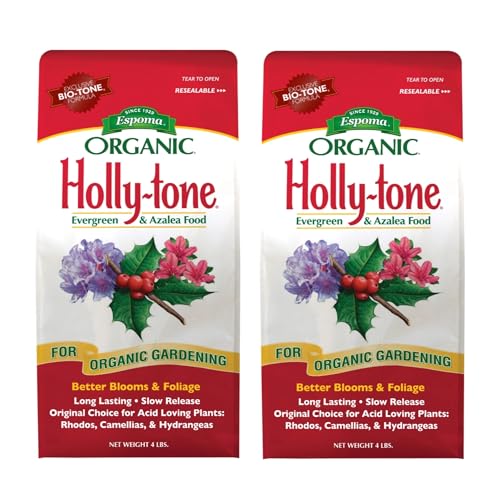
3. Espoma Organic Holly-Tone 4-3-4 2-Pack
The slow, soil-building organic option for anyone who wants to feed an oak the gentle way.
Holly-Tone is a 4-3-4 organic blend with 5% sulfur, and it is made for acid-loving plants. That sulfur is the reason it belongs in a live oak conversation — it helps hold the root zone in the slightly acidic range oaks prefer. The blend is natural and organic, approved for organic gardening, and contains no sludges or fillers. You get two 4 lb. bags, so 8 lbs. total.
Application is as simple as it gets: sprinkle it over the root zone at the drip line and water it in. The label points to spring and fall feeding for evergreen shrubs, and it is ready to use with no mixing. Because the organics break down slowly, this is a long, low-dose feed rather than a fast hit. Bloom and plant growth are what people notice most on their acid-loving shrubs, and the results build over a season rather than a week.
The trade-off here is smell. The blend includes feather meal, bone meal, and poultry manure, so it has a real earthy odor when you spread it, and it throws a little dust. Gloves and a mask make it pleasant. That is the price of an organic formula, and it fades after watering. For an oak you plan to feed for years, that is a fair exchange.
Why gardeners stick with it: a 4-3-4 organic blend with 5% sulfur that slowly feeds and improves the root zone over time — with a two-bag pack that spreads the cost across seasons.
The honest catch: it is smelly and dusty to apply, so plan for gloves and a still day.
The right fit: organic-minded gardeners feeding acid-loving trees and shrubs who prefer slow soil-building over a fast chemical hit.
skip it if: you cannot tolerate an earthy odor at application time.
4. Jobe’s Tree Fertilizer Spikes 30 Count

Thirty spikes and 8.3 pounds of product — enough for a whole yard of oaks in one box.
This is the value pack of the Jobe’s spike line, and the numbers tell the story. You get 30 spikes across two packs, weighing 8.3 pounds total. That is far more material than the 15-count single pack, and it is built for someone with several trees to feed, not just one. The 16-4-4 time-release formula feeds below the surface all season and will not burn the tree.
Where the smaller spike pack asks you to be careful, this one is about volume. It is ideal for all deciduous trees and shrubs, and the label says twice a year, spring and fall. There is no mixing or measuring — you drive them in around each tree’s dripline. For a live oak with a wide spread, that means a ring of spikes at the canopy edge, where the feeder roots live. Customers note trees greening up within a couple of weeks of driving the spikes in.
It is the priciest pick here, and the honest read is that you are paying for volume and convenience, not a different formula. If you have a single young oak, the 15-count pack covers it. If you have a row of oaks or a mix of trees and shrubs, the 30-count box is the smarter buy. Same insertion caveat applies: damp soil, or pre-drill the holes.
Why a big-yard owner picks it
- 30 spikes in one box — enough for multiple trees
- 16-4-4 time release feeds all season
- No mixing, no measuring, no runoff
- Labeled not to burn trees at the listed rate
Where it falls short
- The highest spend of the group
- Overkill if you only have one tree
- Still needs damp soil or a pre-drilled hole to seat cleanly
Built for: a yard with several oaks or a mix of trees and shrubs, where one big box covers the whole feeding job.
Not for: a single young tree — the 15-count pack does that job with less spend.
5. Espoma Organic Evergreen-Tone 4-3-4 18 lb.

One heavy 18-pound bag of organic granules that feeds a whole landscape of evergreens.
Evergreen-Tone is the big-bag organic option, aimed at needle-leaf and broadleaf evergreens — pines, firs, junipers, and also azaleas, rhododendrons, and camellias. It carries the same 4-3-4 analysis with 5% sulfur as the Holly-Tone above, plus Espoma’s Bio-tone blend, and contains no sludges or fillers. The difference is quantity: 18 pounds in a single bag instead of two small ones.
Application is as easy as it sounds — it is ready to use with no mixing. You scatter it when planting or when feeding established plants, and the label suggests twice a year, early spring and late fall. This bag also earns its reputation for effectiveness, with healthy growth and richer color the most-cited results. It is approved for organic gardening, made in the USA, and built for people feeding a real landscape rather than one tree.
Here is the fair side of the story: value is the divisive part. For a large property, an 18-pound bag spreads the cost across many trees. For one live oak, it is more product than you will use. Some find it could be cheaper; others call it money well spent. Weigh it against the size of your planting.
What it gives you: the largest organic bag in the group — 18 pounds of 4-3-4 granules with 5% sulfur for evergreens, ready to spread with no mixing.
The catch: it is a bigger spend, and value depends on how many trees you are feeding.
Choose it when: you are feeding a whole line of evergreens or a large property and want one bag that covers it.
Pass if: you have a single tree — a smaller organic pack fits that better.
Know the Specs
NPK Ratio (the Three Numbers)
NPK stands for nitrogen, phosphorus, and potassium — the three main nutrients a tree needs, listed as percentages by weight. A 16-4-4 spike is 16% nitrogen and drives leafy green growth. A 4-3-4 organic blend is gentler and slower. For a live oak, a higher-nitrogen formula pushes shoots and leaves, while a balanced organic feeds the soil steadily.
Slow-Release vs. Water-Soluble
Slow-release spikes sit in the ground and feed across the season with no runoff. Water-soluble powders mix into water and feed immediately, so you repeat every week or two. Spikes are lower effort for established trees; powders give more control for young or recovering trees that need a fast response.
Sulfur and Acid Support
Sulfur helps maintain a slightly acidic root zone, which suits live oaks and other acid-loving plants. Formulas built for evergreens and azaleas often list added sulfur, so check the label if your soil tends toward the alkaline side.
Application and Timing
Most formulas here call for two feeds a year, early spring and late fall. Spikes go in around the drip line (the outer edge of the canopy, where feeder roots concentrate). Powders and granules are sprinkled over the root zone and watered in. Feeding twice a year keeps nutrition steady across the growing season.
Common Questions
Can I use an azalea and rhododendron fertilizer on a live oak?
Are spikes or powder better for an established live oak?
How often should I fertilize a live oak?
Will tree fertilizer burn my live oak’s roots?
Where do I place fertilizer around a live oak?
Is an organic fertilizer like Holly-Tone worth it for a live oak?
Do I need to water after applying fertilizer?
Can I use the same fertilizer on shrubs and other trees?
What difference will I see in a single season?
Which NPK ratio should I look for?
The Bottom Line
For most live oaks, the winner is the Miracle-Gro Water Soluble Plant Food because it acts fast, you control the dose, and it greens up a struggling or young tree within a week of watering. If you want low-effort feeding of an established oak, grab the Jobe’s Slow Release Spikes — pre-measured, no mixing, nutrients delivered below the surface. And for a big yard with several evergreens to feed, the Espoma Evergreen-Tone 18-pound bag covers it in one go. Any of these five will feed a live oak well; the right one is the one that matches how much time you want to spend and how many trees you have.
How we choose
We do not accept paid placement. Every pick is matched to a real buyer and a real use-case; we do not hands-on test units.
Sources
Specifications: manufacturer listings and product documentation. Review insights: verified customer reviews, as of October 2026. Pricing: not shown on this page (it changes often); check the current price via the retailer link.
As an Amazon Associate, Aappliancez earns from qualifying purchases. This does not affect which products we feature.