Disclosure: Some links in this post are affiliate links. As an Amazon Associate I earn from qualifying purchases, at no extra cost to you. Learn more
Specs are compiled from manufacturer listings and verified buyer reviews and can change over time — please confirm the key details on the product page before buying.
Your pine, spruce or holly looks dull, and you are not sure whether to sprinkle granules, hammer spikes or mix a powder. The short answer: match the fertilizer to how your tree takes up water and how much time you want to spend. Evergreens are fussy about soil acidity (how sour or sweet the soil is), so the wrong product wastes your effort and can even push the soil the wrong way. This guide sorts the granule bags, the hammer-in spikes and the water-soluble powders into clear jobs, so you can pick the one that fits your yard instead of guessing.
This guide is built by comparing the manufacturers’ published specifications and the patterns across verified customer reviews, so you get each pick’s real strengths and trade-offs instead of marketing spin.
Evergreens hold their needles all year, which means they never get a true rest from feeding. The right product delivers nitrogen, phosphorus and potassium to the feeder roots at the drip line while its sulfur keeps soil pH in the acidic range pines and hollies need. Below you will find the full breakdown of the best fertilizer for evergreen trees, from bulk organic granules to no-mess spikes and a concentrated acid powder.
Top Picks
How To Choose The Best Fertilizer for Evergreen Trees
Evergreens grow in acidic soil, and that single fact drives every buying decision. A fertilizer built for tomatoes or lawn grass carries the wrong nutrient balance for a pine or a holly. The right product releases its nitrogen slowly at the drip line and carries sulfur to pull soil pH down toward the 5.0–6.0 range evergreens prefer. Here are the levers that actually change your outcome.
Read the NPK ratio and the sulfur line together
The three numbers on the bag — nitrogen, phosphorus and potassium — tell you the nutrient split. For evergreens, the sulfur content matters just as much, because sulfur is what lowers soil pH over time. A 4-3-4 analysis with 5% sulfur, like the Espoma lines, is formulated with acid-lovers in mind. A 10-10-10 all-purpose blend is a balanced general feed, not an acid-targeted one, so it suits a mixed garden better than a needle-leaf tree.
Pick the delivery format that matches your effort level
Granules are sprinkled around the drip line (the outer edge of the branches where feeder roots live) and watered in. Spikes are hammered into the ground and release nutrition for months. Water-soluble powder is mixed into a watering can and poured or sprayed. Granules mean a heavy bag and a watering-in; spikes mean hammering and months of release; powder means mixing a can before every feed.
Time your feeding to the tree’s energy cycle
Most evergreens do best with two feeds a year — one in early spring when new growth starts, and one in late fall before dormancy. Some spike products also allow a summer top-up for heat stress. Feeding at the wrong time, especially with a fast-release product in the heat of summer, is how people burn roots.
Side-by-Side Comparison
| Model | Best For | NPK Ratio | Form | Weight | Amazon |
|---|---|---|---|---|---|
| Espoma Organic Holly-Tone 4-3-4★ Best Overall | Acid-loving evergreens and hollies | 4-3-4 with 5% sulfur | Granules | 36 pounds | Amazon |
| SimplyGro Fertilizer SpikesFastest to Apply | Quick no-mix feeding | 12-3-3 | Sticks | 3 pounds | Amazon |
| Old Farmer’s Almanac Spikes | Magnesium-boosted evergreens | 10-4-10 with 6% magnesium | Sticks | 3 pounds | Amazon |
| Gardenera 10-10-10 | Mixed garden and lawn feeding | 10-10-10 | Granules | 16 ounces | Amazon |
| Jobe’s Tree Fertilizer Spikes 16-4-4 | Full-season tree and shrub feeding | 16-4-4 | Sticks | 8.3 pounds | Amazon |
| Espoma Organic Evergreen-Tone 4-3-4 | Pine, fir, spruce and juniper | 4-3-4 with 5% sulfur | Granules | 18 pounds | Amazon |
| Jack’s Classic 17-6-6 Acid Special | Acid-loving plants via liquid feed | 17-6-6 | Powder | 4 pounds | Amazon |
Detailed Reviews
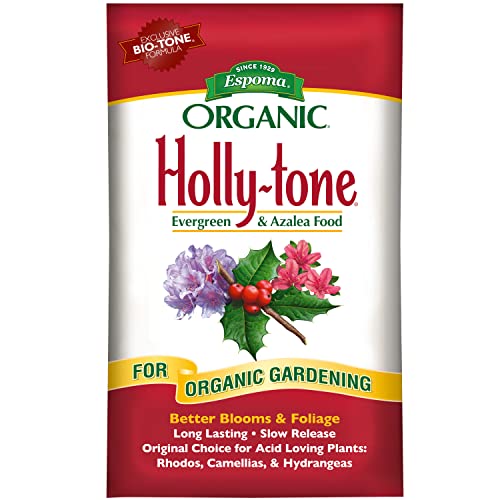
1. Espoma Organic Holly-Tone 4-3-4 36 lb. Bag
Our pick — 4.5+★ from 950+ verified ratings; the strongest balance of quality and price.
The big-bag original that acid-loving evergreens were practically named for.
A 36-pound bag of slow-breaking organic granules gives you a deep nutrient reservoir for the whole season. The 4-3-4 analysis means 4% nitrogen, 3% phosphorus and 4% potassium, and that 5% sulfur is what slowly drops the soil pH toward where hollies, azaleas, rhododendrons and evergreens prefer to live. Because the organics break down gradually, you get a feed that releases over weeks instead of a single jolt — far gentler on shallow evergreen roots than a fast-release blend.
Application is as simple as it gets: no mixing, no measuring cups. You sprinkle the granules around the drip line of the plant, then water thoroughly so the nutrients soak into the root zone. The bag is heavy at 36 pounds, which is the trade-off — this is a lug-from-the-shed product, not a pocket-size one. Against the SimplyGro spikes, the weight gap is enormous at 36 pounds versus 3 pounds, but you are buying volume and organic slow release in exchange for the lifting.
The organic content has one real consequence that a few dog owners flagged: the smell and the organic matter can attract pets, and one reviewer noted the dog tore the bag open. If your backyard is a free-roaming dog zone, use this in the front yard and spikes out back. Otherwise, the recurring praise lands on quality and value — the bag stretches across spring and fall feedings, and blooms get noticeably fuller.
What earns its keep
- 36-pound bag covers both spring and fall feeds from one purchase
- 4-3-4 with 5% sulfur is built for acid-loving evergreens and hollies
- Orgranic slow release feeds for weeks without a mixing step
- Approved for organic gardening as a registered Organic Input Material
Where it asks for patience
- 36 pounds is heavy to haul and store
- Organic content and odor can draw dogs that tear into the bag
The right tree for it: Acid-loving hollies, azaleas, rhododendrons and evergreens that you plan to feed twice a year.
Look past it if: Your yard is shared with dogs that dig, or you want zero-lift application.
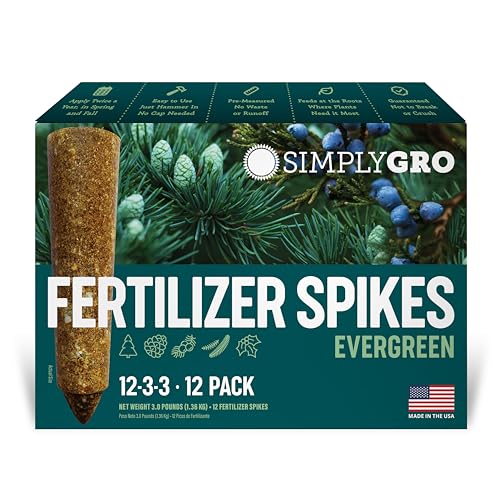
2. SimplyGro Fertilizer Spikes 12 Spikes
Twelve pre-measured spikes that hammer in without a cap or any mixing.
The 12-3-3 ratio — 12% nitrogen, 3% phosphorus, 3% potassium — leans hard on nitrogen, which is exactly what pushes green needle growth on pines, firs and conifers. Each 5-inch TruSpike releases nutrition for up to 3 months, so a spring and fall application covers the feeding calendar with no measuring. Because they are pre-measured, you are far less likely to over-feed and there is less nutrient runoff washing toward local waterways.
Setup is the selling point: just hammer the spike into the ground at the root zone and move on. The TruSpike is built to resist crushing, and several buyers report these stay solid where other eggs-crate spikes crumble into dust. The application is easy enough that a whole privacy screen or hedge row gets done in a single session. That is a very different experience from hauling a 36-pound bag around the yard, which is why this format wins on speed.
The honest caveat is on effectiveness, which many owners describe as mixed — some report conifers growing fast while others find it hard to tell whether the spikes are working at all. Poor, sandy soil seems to tip the scale toward success. A few spikes also arrived broken in transit despite the no-break claim, so inspect the bag before planting. Treat these as a low-effort feeder for young or transplanted trees, not a rescue for a failing mature evergreen.
The sandy-soil angle: Fast-draining, nitrogen-poor soil is where these earn their reputation — the time-release nitrogen stays put through repeated waterings.
The thing to verify: Effectiveness divides feedback, so give them a full season before you judge and check the bag for crushed spikes on arrival.
Reach for these if: You want to fertilize a treeline in minutes without mixing or hauling heavy bags.
Think twice if: You expect a visible overnight turnaround on tired, established trees.
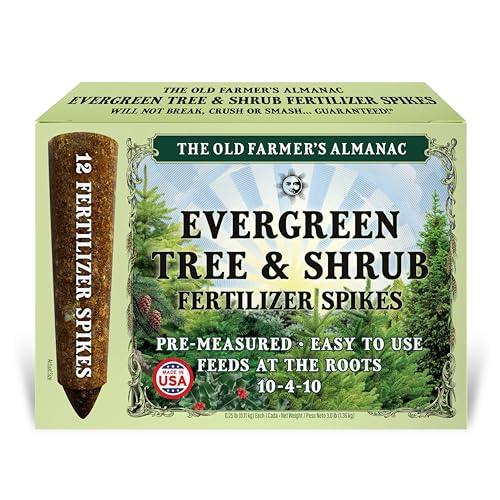
3. The Old Farmer’s Almanac Evergreen Tree & Shrub Fertilizer Spikes, 10-4-10 (12 Spikes – 3.0 Lbs)
The spike that brings magnesium to the party for richer needle color.
Most evergreen fertilizers stop at the NPK three. This one adds 6% magnesium on top of a 10-4-10 split — 10% nitrogen for colorful needles and leaves, 4% phosphorus for fruiting and coning, and 10% potassium for strong roots. Magnesium is the nutrient tied to green pigment, so if your spruces or hollies are looking washed out, this spike is aimed at that exact problem. Like the SimplyGro spikes, these are pre-measured TruSpikes that hammer in without a plastic cap.
Feed it twice a year — early spring and late fall — or add a summer application in hotter climates to guard against heat stress. Each spike delivers its nutrition directly to the root zone, so there is no runoff waste. The key difference from the SimplyGro 12-3-3 is the balance: less nitrogen, more potassium and magnesium, which suits established shrubs that need needle color and root strength rather than a pure growth push.
The catch is time. This is a smaller, newer product, and owners testing it on new privacy screens note it is too early to judge long-term growth and health benefits. What they can confirm is that the no-cap hammering claim holds up and the spikes drive in easily at the drip line. If you already trust the Almanac name and want the magnesium addition, this is a thoughtful pick — just do not expect proof of a full-season turnaround from reviews of a young product.
Reasons it climbs the list
- 6% magnesium targets needle color, not just growth
- 10-4-10 balances nitrogen with strong potassium for roots
- No-cap hammer-in TruSpike installs fast at the drip line
- Twice-a-year feeding with an optional summer top-up
Read before you commit
- Long-term growth results are not yet established
- Premium per-spike cost for a smaller format
Who it fits: Spruce and holly owners chasing better needle color who like the simplicity of a hammer-in spike.
Who should keep looking: Anyone who needs documented long-term results before switching products.
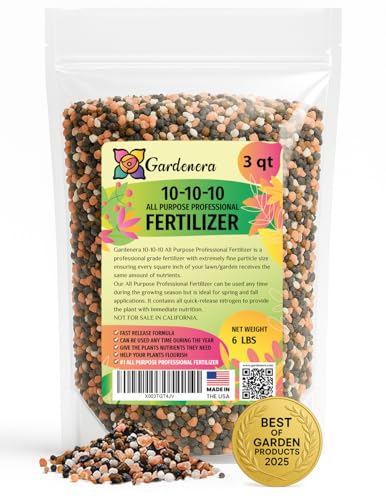
4. Gardenera 10-10-10 Plant Fertilizer Slow Release, 3 Quarts
A balanced all-rounder for the whole yard, not just the evergreens.
The 10-10-10 split spreads nitrogen, phosphorus and potassium evenly, which is why this granule is marketed across fruit trees, evergreens, vegetables, arborvitae, fig trees, shrubs, pines and oaks. A 100-square-foot coverage claim makes it a broad-cast option — you can hand-scatter it or run it through a spreader over a mixed bed in one pass. That is a different job than an acid-targeted feed, so it suits a gardener who wants one bag for everything rather than a dedicated evergreen product.
Here is the honest problem: the feedback on this one is rough in a way the others are not described. A handful of owners mention plants dying within days after application, especially in pots and planters, and one points out that the bag itself states all the fertilizer is immediately available — which undercuts the slow-release label. If your evergreens are the priority and you need gentle, acid-friendly feeding, this is not the pick for that job.
Where it still has a place is general outdoor bed feeding on a mixed property, used carefully and at the correct dose. The takeaway for evergreen owners is to treat it as a broad general fertilizer, not a specialized conifer food. Given the mixed signals, if a low-price all-purpose granule is what you want, use it where you can easily monitor the plants and hold off on the acid-loving specialists until you have something formulated for them.
The trade-off to see clearly: Balanced 10-10-10 feeds everything, but it is not built around the sulfur and acidity an evergreen needs, and customers note it hitting plants hard in pots.
Best use case: General outdoor bed and lawn feeding where you can watch how plants respond and dial the amount back if needed.
Suits you when: You want one balanced granule for a mixed yard and will apply it sparingly outdoors.
Move on if: Evergreens are the main event and you need a gentle, acid-targeted formulation.
5. Jobe’s Tree Fertilizer Spikes 15 Spikes 2 Pack

A long-running crowd favorite that feeds trees all season without a single mixing bowl.
The 16-4-4 formula packs 16% nitrogen to drive leafy growth, and the slow release means it feeds all season rather than all at once. With 30 spikes across two packages, you get enough to ring several trees at the drip line at once. There is no wasteful runoff, no mess and no smell, and the formulation is built to avoid burning trees — a real concern when you are feeding shallow-rooted specimens. You insert the spikes around each tree and skip the mixing and measuring entirely.
The biggest thing owners talk about is simple effectiveness. Jobe’s is the spikes people come back to year after year for their shrubs and trees, and the pattern in the feedback is steady: put them in the ground, water regularly, and the trees look better for it. Dogwoods and new plantings come up repeatedly as success stories, and the ease of application makes it a favorite for beginners who do not want to fuss with ratios.
Two caveats stand out. First, driving spikes into hard or rocky soil takes some muscle — pre-drilling a hole with a metal rod or applying into damp soil helps a lot. Second, several long-time users note the price has crept up, and a few say they may switch to spreading granules instead. The spike format itself delivers a continuous slow feed at the active root zone, which is exactly why so many people tolerate the yearly expense.
Why it keeps winning
- 16-4-4 time release feeds all season from one application
- 30 spikes cover multiple trees across two packs
- No mixing, no runoff and no smell to manage
- Formulated to feed without burning trees
The reality of owning them
- Hard or rocky soil needs pre-drilling or a damp-soil window
- Repeat reviewers point out the cost has climbed over the years
Best match for: Landscapers and homeowners feeding young trees and shrubs who value a hands-off season-long feed.
Not your pick if: You are on a tight budget or your soil is so rocky that pounding spikes in becomes a chore.
6. Espoma Organic Evergreen-Tone 4-3-4 18 lb. Bag

The broadleaf-to-needle-leaf feed built specifically for pines, firs and spruces.
Where Holly-Tone serves the acid-loving flowering crowd, Evergreen-Tone is formulated for all needle-leaf and broadleaf evergreens — pine, fir, spruce, juniper, azaleas, rhododendron and camellias. The 4-3-4 analysis with 5% sulfur matches the organic approach, and the exclusive Bio-tone formula brings added biological content to the blend. It contains no sludges or fillers, and it is approved for organic gardening as a registered Organic Input Material.
Feed it at planting or on established plants, twice a year in early spring and late fall. The 18-pound bag is lighter than the 36-pound Holly-Tone, so it is easier to carry around a border of conifers. You can use it dry, straight from the bag, which makes it a straightforward option for feeding a row of arborvitae or a spruce line without any equipment. The organic breakdown feeds gradually, which is the right pace for evergreens that cannot handle a heavy nutrient spike.
Value is where the reviews divide. Shoppers say real results — arborvitae browning resolved, new light green growth on rescued transplants, richer color and abundant growth from long-term users. Others find the bag pricey for what it is. That is the honest split: it earns its keep on results, and you are paying for the organic blend and the acid-friendly formula rather than sheer weight. If you already trust the Espoma line, this is a natural sibling to Holly-Tone.
Where it shines: Arborvitae recovering from browning and new transplants that need gentle, acid-friendly feeding without a mixing step.
The one gripe: The cost runs high for an 18-pound bag, so it rewards buying for a defined set of trees rather than whole-yard coverage.
The evergreen owner’s call: Go here if your bed is dominated by pines, spruces and junipers that want organic, sulfur-assisted feeding.
The reason to pause: Budget-minded gardeners may find the bag price steep versus a simpler granule.
7. Jack’s Classic 17-6-6 Acid Special 4 lb
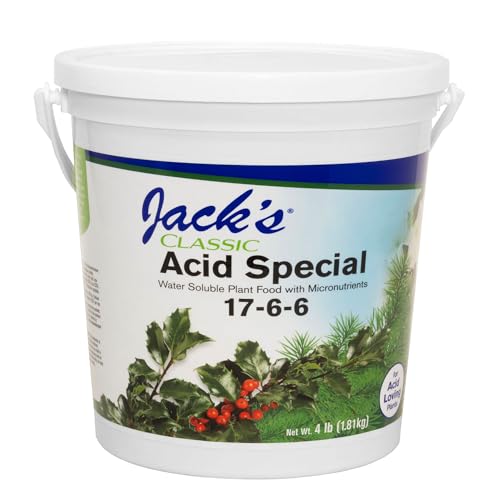
A concentrated acid powder that makes multiple gallons of liquid feed from one tub.
The 17-6-6 analysis leans on improve iron and sulfur to push lush vegetative growth and better blooms in acid-loving plants. That is a much hotter, more concentrated feed than the 4-3-4 granules — you mix a measured powder with water and get several gallons of liquid fertilizer from a small scoop. It can be used as a root drench or a foliar spray directly onto leaves, which makes it the only pick here that lets you feed the foliage directly. A measuring spoon comes in the tub, and added micronutrients round out the mix.
For evergreen owners, the powder is best treated as a targeted acid supplement rather than a bag to scatter across a whole conifer border. It truly earns its keep on berry bushes and acid-lovers — blueberry growers report a container lasting a full season when watering every 10 days on several large bushes, and one noted their bushes turned heavy producers. Hydrangeas, hollies and azaleas also come up in the feedback for better leaf color and more blooms through the growing season.
The catch is that this is a mixing product, so it is not the grab-and-go option a spike is. You also need to get the ratio right — the powder is concentrated, and sloppy mixing is on you, not the bag. Used carefully, one tub goes a long way, and the duration beats a single bag in longevity terms. For feeding a handful of acid-loving trees and shrubs precisely, it is hard to match the precision of a liquid feed.
The powder advantage
- 17-6-6 with improve iron and sulfur for acid-loving plants
- Works as a foliar spray or a root drench
- One tub makes multiple gallons of liquid feed
- Measuring spoon and micronutrients included
What it asks of you
- Requires mixing and measuring before every feeding
- Concentrated powder needs careful dosing to avoid over-feeding
Made for: Precision feeders with acid-loving trees, berries and hollies who do not mind mixing a watering can.
Better elsewhere if: You want to scatter and walk away, or you are feeding a large conifer border at scale.
Know the Specs
The NPK Ratio Explained
The three numbers on any bag show the percentage of nitrogen, phosphorus and potassium by weight. Nitrogen drives green growth, phosphorus supports roots, fruiting and flowering, and potassium strengthens the plant overall. An evergreen feed like a 4-3-4 keeps those numbers low and steady, while a 16-4-4 or 17-6-6 pushes much harder on nitrogen for faster growth. Match the ratio to your goal: a low, even 4-3-4 for steady needle color, a nitrogen-heavy 16-4-4 or 17-6-6 for faster growth.
Why Sulfur and Magnesium Matter
Evergreens grow best in acidic soil, and sulfur is the ingredient that slowly lowers pH over time. A feed carrying 5% sulfur is doing two jobs at once: feeding and nudging the soil the right direction. Magnesium, meanwhile, is tied to the green pigment in needles, so a spike with 6% magnesium is aimed at richer color. Sulfur and magnesium ride alongside the NPK, lowering pH and deepening needle color rather than substituting for nitrogen, phosphorus or potassium.
Common Questions
When should I fertilize an evergreen tree?
Do evergreen trees need a different fertilizer from lawn grass?
Are fertilizer spikes or granules better for evergreens?
What is the difference between Holly-Tone and Evergreen-Tone?
Can fertilizer spikes burn tree roots?
How do I apply granular fertilizer around a tree?
Is a water-soluble acid fertilizer good for evergreens?
How long does a bag or tub of evergreen fertilizer last?
Will organic fertilizer attract dogs or other animals?
Can I use the same fertilizer on arborvitae and blueberries?
The Bottom Line
For most evergreen owners, the winner is the Espoma Organic Holly-Tone 4-3-4 because its 36-pound bag of organic granules with 5% sulfur feeds acid-loving trees through spring and fall at a pace shallow roots can handle. If your priority is speed and no mixing, the Jobe’s Tree Fertilizer Spikes 16-4-4 is the season-long, hands-off choice for young trees. And for precise feeding of acid-lovers and berries, the Jack’s Classic 17-6-6 Acid Special turns a small scoop of powder into multiple gallons of liquid feed.
The steady, consistent crowd favorite here is Holly-Tone, and the sheer volume of positive feedback on its quality and value is what earns it the top spot. One last nudge: evergreens reward years of consistent feeding, so choose the format you will actually repeat each spring and fall.
How we choose
We do not accept paid placement. Every pick is matched to a real buyer and a real use-case; we do not hands-on test units.
Sources
Specifications: manufacturer listings and product documentation. Review insights: verified customer reviews, as of October 2026. Pricing: not shown on this page (it changes often); check the current price via the retailer link.
As an Amazon Associate, Aappliancez earns from qualifying purchases. This does not affect which products we feature.