Disclosure: Some links in this post are affiliate links. As an Amazon Associate I earn from qualifying purchases, at no extra cost to you. Learn more
Specs are compiled from manufacturer listings and verified buyer reviews and can change over time — please confirm the key details on the product page before buying.
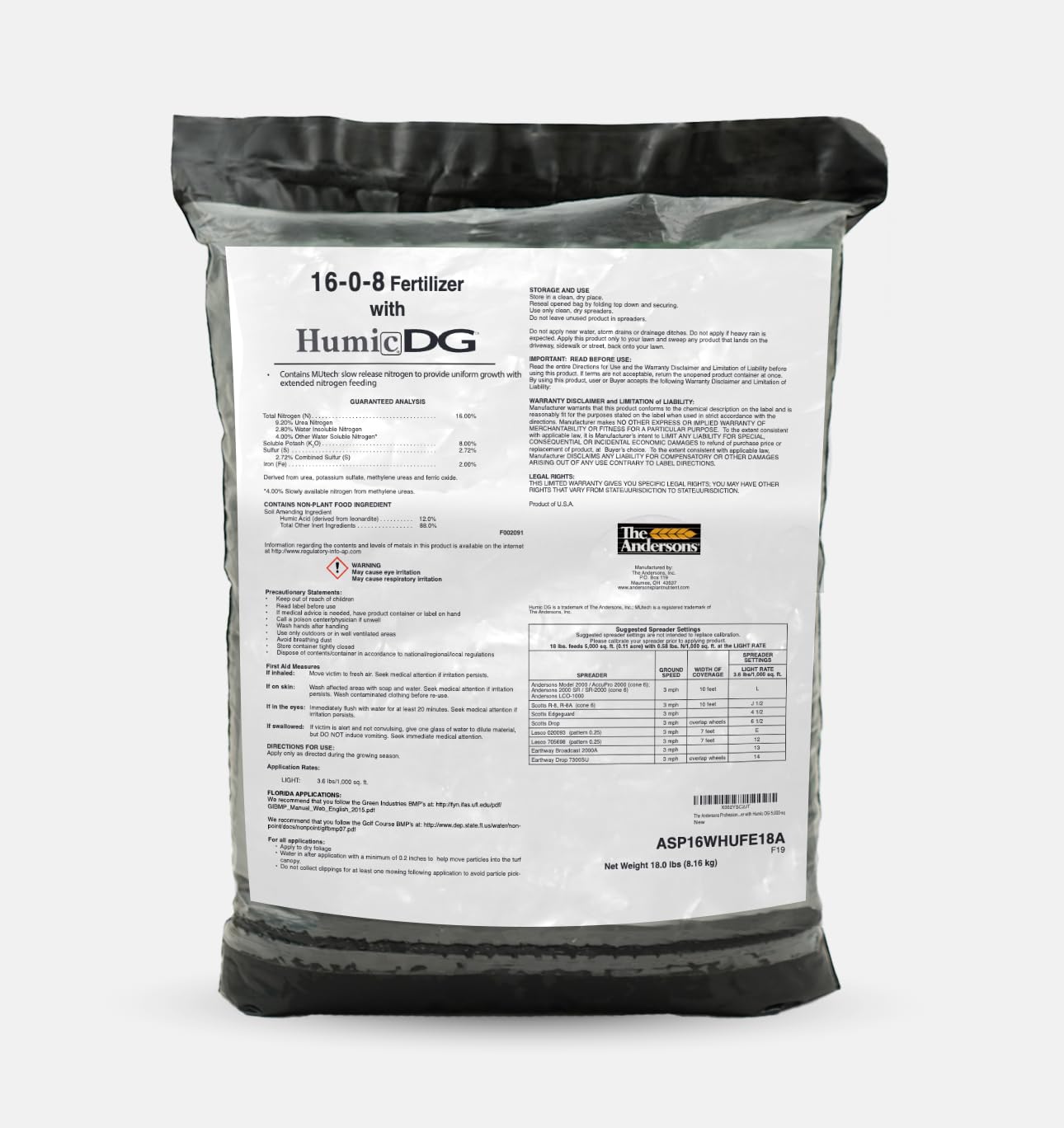
Before you rent a sod cutter, know this: a brown lawn is often dormant, not dead, and the right fertilizer can bring it back. The picks below are sorted by what actually revives struggling turf — a fast nitrogen jolt, a slow steady feed, or a gentle natural formula. The crowd favorite, The Andersons Professional PGF 16-0-8, holds 4.5+ stars across 900+ ratings, and its quick-plus-slow nitrogen feeds for up to 8 weeks.
This guide is built by comparing the manufacturers’ published specifications and the patterns across verified customer reviews, so you get each pick’s real strengths and trade-offs instead of marketing spin.
Reviving a brown lawn starts with matching the fertilizer to your soil and grass type, not guessing. Below you’ll find the best fertilizer for dead grass laid out by job, coverage, and release speed.
Top Picks
How To Choose The Best Fertilizer for Dead Grass
The first thing to know is that “dead” grass is usually just sleeping. When turf goes brown in heat or drought, the roots are alive but the top has shut down. A nitrogen-heavy feed wakes it up. But the wrong feed at the wrong time does nothing, or worse, burns what’s left. These four decisions steer you to the right bag or bottle.
Read the NPK numbers before anything else
Those three numbers on the label (like 16-0-8 or 32-0-5) are the percent of nitrogen, phosphorus, and potassium by weight. Nitrogen drives green top growth, which is what brown grass needs most. Phosphorus supports roots but is often already high in home soil, so a phosphorus-free blend like the 16-0-8 may suit you better. Potassium helps the plant handle heat and cold stress.
Quick release vs slow release
Quick-release nitrogen greens the lawn within days but fades fast, and too much at once can burn turf. Slow-release nitrogen, often polymer-coated, feeds steadily for weeks or months. The best lawn fertilizers pair the two: an immediate jolt plus a long, gentle feed. Check the label for wording like “slow release” or a percentage of slow-release nitrogen.
Match the spread to your lawn size
Coverage is listed in square feet, and it varies widely. A bag that covers 4,000 square feet is fine for a small yard; a 10,000 square-foot bag suits a medium-to-large lawn. Measure your lawn roughly (length times width in feet) so you buy enough in one pass. Under-applying is a common reason fertilizer seems to fail.
Granular or liquid — which suits you
Granular fertilizer goes down with a spreader and releases over time; it’s forgiving and covers a lot of ground. Liquid fertilizer mixes with water and sprays on, greening fast and reaching every blade. Liquid costs more per application but is easy to apply on small or uneven lawns. Granular is the workhorse for big yards.
Side-by-Side Comparison
| Model | Best For | NPK Ratio | Form | Coverage | Amazon |
|---|---|---|---|---|---|
| The Andersons Professional PGF 16-0-8★ Best Overall | Overall reviver with fine, even spread | 16-0-8 | Granules | 10,000 sq ft | Amazon |
| Pennington Full Season 32-0-5Most Convenient | One-and-done season feeding | 32-0-5 | Granules | 4,000 sq ft | Amazon |
| Petramax Liquid Nitrogen 28-0-0 | Fast green-up on small lawns | 28-0-0 | Liquid | Up to 12,800 sq ft | Amazon |
| Safer Brand Lawn Restore 9-0-2 | Pet-friendly natural option | 9-0-2 | Granules | 5,000 sq ft | Amazon |
| GreenView Fairway Formula 27-0-5 | Long 12-week steady feeding | 27-0-5 | Granules | 10,000 sq ft | Amazon |
| SEEDRANCH Urea 46-0-0 | High-nitrogen rescue for large acreage | 46-0-0 | Granules | — | Amazon |
| 18-3-6 Liquid Fertilizer (2.5 Gallons) | All-season liquid with micronutrients | 18-3-6 | Liquid | Full | Amazon |
Detailed Reviews
1. Andersons Professional PGF 16-0-8 Fertilizer
Our pick — 4.5+★ from 900+ verified ratings; the strongest balance of quality and price.
Fine particles that slip through a spreader and reach more turf with every pass
This is the pick for the homeowner who wants a browned lawn to bounce back without guesswork. The 16-0-8 blend is phosphorus-free, so it skips the nutrient many yards already have too much of. That matters if a soil test comes back high in phosphorus — exactly why one owner switched over after seeing test results. The fertilizer uses quick- and slow-release nitrogen, giving an immediate feed and then feeding for up to 8 weeks.
What wins people over is the particle size. Its super-fine granules put twice as many particles per square foot on the lawn, so coverage lands more evenly than with chunky standard fertilizer. Buyers report that straightforward application covers 10,000 sq ft. Green-up shows within a couple of days, and the appearance gets its own round of praise — lush, deep green turf that looks healthy rather than forced.
The catch is the price. Value for money is the one place opinions split, so this is best for someone treating a lawn seriously rather than a bare-minimum patch job. It also carries a regional limit — not for sale in CA or OR — so check before you order. And like any fertilizer, misapplication can burn turf; follow the timing guidelines and don’t overapply.
Why It Leads The Pack
- Super-fine granules put twice the particles per square foot on the lawn for even coverage
- Quick- plus slow-release nitrogen feeds immediately and for up to 8 weeks
- Phosphorus-free 16-0-8 blend suits soil with high phosphorus
- Includes iron, micronutrients, and Humic DG for total nutrition
What To Weigh First
- Cost is the sticking point — value for money draws mixed feelings
- Not for sale in CA or OR
- Overapplication or wrong timing can burn turf
Reach for this if: you want the most even spread and a fertilizer that feeds for weeks, and you’re ready to treat the lawn properly.
Look elsewhere if: your soil already runs high in phosphorus and the regional shipping limit affects you.
2. Pennington Full Season Lawn Fertilizer 4M 32-0-5 RF 3/11.2Lb
One application, one season — the lazy-but-smart way to wake a sleeping lawn
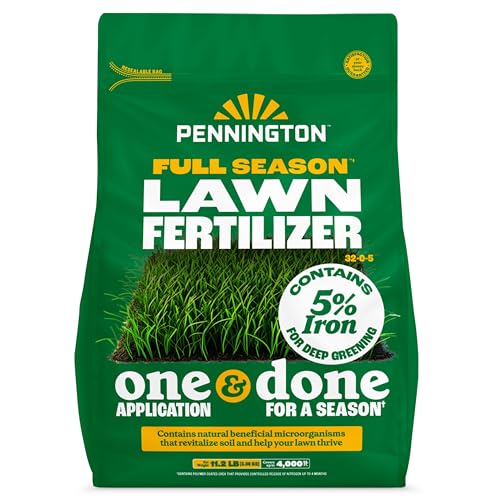
Pennington’s headline promise is that a single application is done for a season. The polymer-coated urea slowly releases nitrogen for up to 4 months, so you fertilize once and let it work in the background. At 32-0-5 the nitrogen load is high, which is exactly what a browned, hungry lawn wants. It also packs 5% iron for deep greening. A bag covers 4,000 square feet.
The story that sells this one is a dormant-lawn rescue. Owners mention that it revived a distressed lawn after a sprinkler shutdown — a cheaper route than resodding, with the grass coming back lush and dark green. The slow-release iron helps the effect hold, so you’re not reapplying every few weeks. Some yard owners like it because it lacks weed killer, which means it won’t harm nearby landscaping plants.
Where it gets murky is consistency. Green-up and value both draw split opinions — some lawns respond with a lush dark green, others report no real change. Not available in Hawaii or South Dakota, so check that first.
The rescue case: When a lawn browns out from drought or a broken sprinkler, this is the one-application bet. The 4-month slow release means less re-thinking, and the 5% iron targets deep color rather than a pale flash of green.
Honest limit: Results vary by lawn and watering routine, and it sells out of some regions. Give it water and it rewards you; skip the watering and it fades.
Your match if: you want set-and-forget season coverage and a lawn that browns out from drought.
One caution: green-up is not guaranteed on every lawn, so water it in properly and it earns its place.
3. Petramax Liquid Nitrogen Fertilizer 28-0-0

The nitrogen jolt that turns yellow, hungry grass green in a hurry
If your grass has gone yellow from a nitrogen shortfall, this liquid delivers it fast. The 28-0-0 formula puts 70% of its nitrogen in quick-release form for rapid green and growth, with 30% slow-release for ongoing feeding between applications. It’s a two-in-one approach: an instant boost plus a gentle tail. You mix 5oz per gallon of water for maintenance or 10oz per gallon to correct a nitrogen deficiency.
One small bottle stretches surprisingly far. A single 32oz container treats up to 12,800 square feet for maintenance, or 6,400 square feet of nitrogen-deficient grass. And it weighs just 2 pounds, versus the 18-pound Andersons bag above, so it’s the one you can carry in one hand. Spraying reaches every blade on small or uneven lawns where a spreader would miss.
The honest note here is cost-per-application and consistency. Effectiveness draws mixed feelings, and value is the other split — the bottle is small and the price-per-ounce is not trivial. It works best as a fast corrective on small lawns, with repeat sprays to hold the color. If you have a big, flat yard, a granular bag is the more economical route.
Speed is the draw: Quick-release nitrogen greens fast, and the spray hits every blade. Grass that’s yellowed from low nitrogen is exactly what this targets.
The trade-off: It’s a small bottle with a pricey per-ounce cost and results vary. Plan to reapply to keep the lawn green.
Best fit: small-lawn owners fighting a nitrogen shortfall who want visible green quickly and don’t mind respraying.
Skip the sprayer for: large flat yards, where a granular bag gives more coverage for less fuss.
4. Safer Brand Lawn Restore 9335SR
A gentle, natural feed for lawns where kids and dogs play right after application
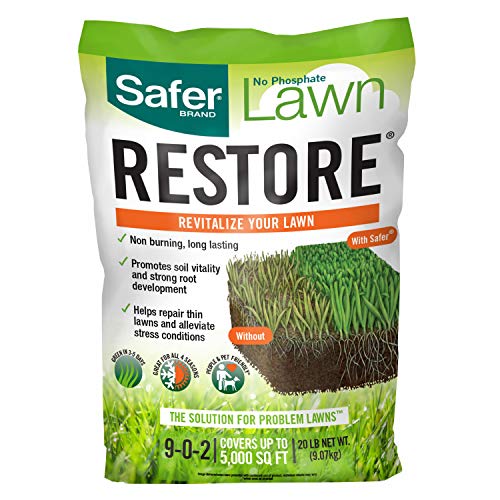
For anyone with a dog that patrols the yard or kids who roll on the grass, this is the pick that lets play resume immediately. The naturally derived 9-0-2 formula is designed not to burn your lawn, and when used as directed your grass is considered safe for kids and pets right after application. It also strengthens root systems so turf handles heat, cold, and drought stress better. Lawns start to green up within 3 to 5 days, and a 20-pound bag covers up to 5,000 square feet.
Where it shines is on yellow or damaged spots. Pet owners love that they don’t have to keep Fido off the lawn, and the grass appearance earns steady praise — within days, browned patches turn green. It works with a hand-crank spreader on small lawns, so you don’t need heavy gear. Year-round, applying once in spring and once in fall keeps a lawn looking maintained. One point worth knowing: it contains corn gluten, which suppresses weeds but also stops seeds from germinating, so don’t apply it while you’re seeding.
The realistic limit is that the light 9-0-2 load is gentle by design. Effectiveness and value both split opinions — this is a formula for the pet-and-family-first buyer, not the fastest or most aggressive green-up.
Family-first formula: Non-burning, pet-safe right after application, and clearly labeled for kids to keep playing. Root-focused care helps turf survive seasonal stress.
The catch to note: Corn gluten blocks seed germination, so it can’t run while you’re overseeding, and the mild NPK suits upkeep more than hard rescue.
Think of it if: you share the lawn with dogs or kids and want a gentle, non-burning feed.
Hold off if: you’re overseeding this season, since the corn gluten will stop new seed from sprouting.
5. GreenView Fairway Formula 33 lb.

Twelve weeks of steady feeding without the feast-then-fade surge
This one is built for the long game. GreenView’s 27-0-5 formula runs 63% slow-release nitrogen, which feeds consistently for up to 12 weeks without the surge pattern that makes grass shoot up then stall. The 33-pound bag covers 10,000 square feet and works on any grass type, from bermuda to St. Augustine, as long as the grass is actively growing. It contains no phosphate, a nod to protecting waterways.
Effectiveness is the thing that lands here — grass turns thick and lush, and it holds. Customers note color shifting from pale to deep green within about 3 days of application. Others describe a poor St. Augustine lawn filling in, though a few bare spots may call for a second dose. The steady feeding also means fewer clippings, since the grass grows evenly instead of in bursts.
One realistic note: the 10,000 square-foot coverage is generous, but real yards rarely match the label exactly, so measure before you commit. If you’ve got a small lawn, you’ll have leftovers; if you have a big one, this hits the spot. It’s a spring-and-growing-season feed, best applied while grass is actively growing rather than in cold dormancy.
Where It Works Hard
- 63% slow-release nitrogen feeds up to 12 weeks without surge growth
- Covers 10,000 sq ft and suits any grass type
- No phosphate, formulated with waterway protection in mind
- Steady feed reduces clippings and keeps color consistent
Before You Commit
- Real-yard coverage varies — a few spots may need a second treatment
- Best saved for active growth, not cold dormancy
- Large bag means leftovers on small lawns
The right call for: medium-to-large lawns that need a long, even feed through the growing season.
Think twice if: you’re feeding a tiny patch and would rather not store a 33-pound leftover bag.
6. SEEDRANCH Urea Fertilizer 46-0-0 Granular – 50 Lbs.
Straight nitrogen in a 50-pound bag for the lawn that needs nothing else
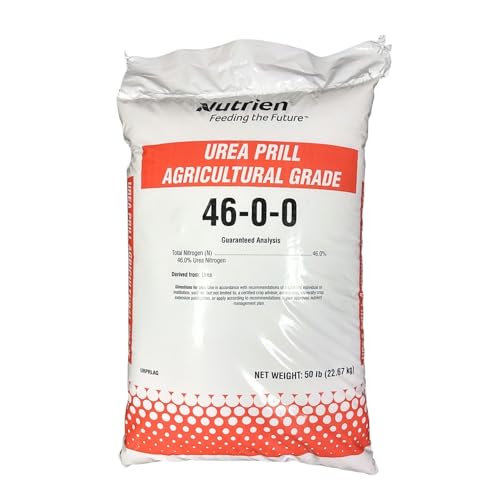
When a soil test says the only thing missing is nitrogen, this is what you reach for. Urea at 46-0-0 is almost all nitrogen, the single nutrient that drives green growth. The 50-pound bag delivers 23 pounds of actual nitrogen, enough to cover a large lawn at the label rate. Granules are uniform in size, so they spread evenly through a standard spreader with minimal overlap.
Buyers like the simplicity and the turnaround. One owner noted lawn improvement visible in about a week, and others describe their turf recovering to its best in years. The math matters with urea: you calculate how much product your yard needs based on the 46% nitrogen content, then spread it at the right time. Applied when grass is actively growing, it greens fast. The granules dissolve readily if you prefer a liquid mix.
The caveat is that it’s pure nitrogen, full stop. It doesn’t carry potassium, micronutrients, or anything else — that’s the point of urea, but it means it’s not a one-bag lawn solution. It’s also a heavy 50-pound bag geared toward large lawns. And with high nitrogen, timing and rate matter; overapplying straight urea can burn turf, so follow directions closely.
Pure and simple: 46-0-0 means almost all nitrogen and little else. Uniform granules spread evenly, and the 50-pound bag is built for acreage where one nutrient is all you need.
Fit note: This isn’t a complete lawn feed — no potassium, no micronutrients. It’s for when a soil test has already told you nitrogen is the gap.
Made for: large-lawn and acreage owners who know nitrogen is the missing piece and want the concentrated stuff.
Not the one if: you want an all-in-one feed, or you’re not ready to measure application rate carefully.
7. 18-3-6 Liquid Fertilizer 2.5 Gallons

A big jug of all-season liquid that feeds turf and ornamentals alike
This 18-3-6 liquid is the all-rounder for someone who wants one product through the whole growing season. Half its nitrogen is slow release, giving a steady feed rather than a quick burn, and it adds micronutrients — iron, copper, manganese, and zinc — that support overall plant health and color. For turf, you mix 3oz of fertilizer for every 1,000 square feet in a spray tank at 1 to 3oz per gallon of water, feeding every 2 to 4 weeks. The same jug also works on ornamentals.
Effectiveness is what carries this one, and the savings are the bonus. Reviewers point out lawns greener than ever, with Bermuda grass thickening up nicely. The value angle gets real praise too — one owner compared it against both liquid sprays and granules and found it just as good or better. Applied on tough rocky clay soil with dog-damaged dead spots, it produced plusher grass in about 30 days, with the dead spots filling in.
The points to watch: it’s a 2.5-gallon jug, so storage and mixing take a little planning, and the mix loses potency if you let it sit — best to use it promptly after mixing. Burn resistance draws mixed opinions, so follow the watering and rate guidance. And it’s a spray product, so you’ll need a tank or hose-end sprayer to apply it evenly.
The all-season case: 50% slow-release nitrogen plus micronutrients means one jug covers turf and ornamentals through the season. Excellent results and value are the recurring themes.
Honest limit: Burn resistance is debated, and mixed batches go stale if stored too long. Use it fresh and follow the mixing ratios.
A good fit for: sprayer owners who want one versatile liquid for both lawn and garden all season long.
Pause if: you don’t own a spray tank, or you’d rather pour from a bag than mix batches by hand.
Know the Specs
NPK Ratio Explained
The three numbers on any bag or bottle are the percentage by weight of nitrogen (N), phosphorus (P), and potassium (K). A 16-0-8 blend has 16% nitrogen, no phosphorus, and 8% potassium. Nitrogen drives green top growth, which is what brown or yellowing grass needs. Phosphorus supports roots but is often already high in home soil, so a phosphorus-free blend can suit a tested lawn. Potassium helps turf handle heat, cold, and drought stress, so it’s the “toughness” nutrient.
Quick Release vs Slow Release
Quick-release nitrogen gives an immediate dose — grass greens within days but fades fast, and too much at once can burn turf. Slow-release nitrogen, often polymer-coated, feeds steadily for weeks or months. The percentage of slow-release nitrogen tells you how much of the feed is the gentle, long-lasting kind. The best results usually come from a blend: a quick kick to wake the lawn, then a slow feed to keep it green.
Coverage in Square Feet
Coverage tells you how much lawn one bag or bottle treats, listed in square feet. It ranges widely — a 4,000 square-foot bag suits a small yard, while a 10,000 square-foot bag serves a medium-to-large one. Measure your lawn (length times width in feet) before you buy. Applying too little because you underestimated coverage is among the most common reasons fertilizer seems not to work.
Granular vs Liquid
Granular fertilizer goes down with a spreader and releases over time; it’s forgiving and covers a lot of ground. Liquid fertilizer mixes with water and sprays on, greening fast and reaching every blade, which helps on small or uneven lawns. Liquid usually costs more per application. Choose granular for big yards and steady feeding; choose liquid for quick corrective green-up and precise coverage on tricky terrain.
Common Questions
Will fertilizer bring back totally dead grass?
How long until I see green after feeding a brown lawn?
What NPK do I want for reviving dead or brown grass?
Can fertilizer really burn my lawn?
Is a phosphorus-free fertilizer better for my lawn?
How much fertilizer does my lawn size need?
Is liquid or granular fertilizer better for reviving dead grass?
When should I feed a brown lawn during the season?
Is it safe to fertilize near kids and pets?
Why doesn’t my fertilizer seem to work on a dead patch?
The Bottom Line
For most lawns, the best fertilizer for dead grass in this lineup is the The Andersons Professional PGF 16-0-8 because its fine particles spread evenly and its quick-plus-slow nitrogen feeds for up to 8 weeks, with a phosphorus-free blend that suits tested soil. If convenience is your priority and you want one application to last the season, the Pennington Full Season 32-0-5 is the set-and-forget pick. And for a gentle, pet-friendly feed that lets the kids and dogs play right away, the Safer Brand Lawn Restore 9-0-2 earns its spot. The Andersons is the strongest seller of the group, with a 4.5+ star rating across 900+ reviews.
How we choose
We do not accept paid placement. Every pick is matched to a real buyer and a real use-case; we do not hands-on test units.
Sources
Specifications: manufacturer listings and product documentation. Review insights: verified customer reviews, as of October 2026. Pricing: not shown on this page (it changes often); check the current price via the retailer link.
As an Amazon Associate, Aappliancez earns from qualifying purchases. This does not affect which products we feature.