Disclosure: Some links in this post are affiliate links. As an Amazon Associate I earn from qualifying purchases, at no extra cost to you. Learn more
Specs are compiled from manufacturer listings and verified buyer reviews and can change over time — please confirm the key details on the product page before buying.
A classroom gets stuffy fast, and a fan that is too loud drowns out the teacher while a fan that is too weak leaves thirty students sweating through the afternoon. The right pick balances three things: enough CFM to stir a packed room, a dB rating that stays under a lecture, and a footprint that fits between desks without becoming a trip hazard. This guide covers five fans that actually suit a classroom, from a compact circulator that punches far above its size to a slim tower that hides in a corner.
This guide is built by comparing the manufacturers’ published specifications and the patterns across verified customer reviews, so you get each pick’s real strengths and trade-offs instead of marketing spin.
Below you will find how airflow, decibel rating, and oscillation shape classroom comfort, plus a side-by-side table and full reviews. I ranked these by the specs that decide whether a room stays breathable on a hot afternoon, so you can pick the right best fans for classrooms for your space.
Top Picks


How To Choose The Best Fans for Classrooms
A bedroom fan rarely survives a classroom: more bodies, longer distances to the outlet, and every sound carrying to the back row. A room full of bodies runs hotter, the seating is further from any outlet, and every sound carries to the back row. Weigh airflow, noise, and footprint before looks.
Match airflow to the room, not the desk
A fan’s reach is measured in CFM (cubic feet per minute, the amount of air it pushes each minute). Higher CFM means the breeze travels further before it fades. A small circulator can still cross a room if its CFM is high, while a slim tower may move less air but spread it wider. For a classroom, favor a fan that pushes air toward the back rows, not one that only cools the first desk.
Take the decibel rating seriously
Noise is measured in decibels (dB), and small differences matter. A fan around 28 dB sits near a quiet whisper, while anything loud enough to raise the TV volume will force the teacher to raise theirs. If the fan runs while students read or take a test, a quieter model beats a stronger one. Check reviews for how it sounds on the top speed, since that is where noise creeps up.
Prefer oscillation and tilt for even coverage
A fixed fan blasts one lane of the room and leaves the rest stagnant. Auto-oscillation sweeps air side to side, and an adjustable tilt lets you angle it upward so it mixes the warm air near the ceiling. Together they keep the whole room moving rather than one row shivering.
Weigh safety and power draw
Rooms with young children or pets favor bladeless designs or a guarded grille, because there are no exposed spinning blades to reach for. Wattage matters too: a lower-watt fan can run all day without stressing a shared circuit, which is why the energy-efficient picks list their wattage plainly.
Side-by-Side Comparison
| Model | Best For | Airflow (CFM) | Noise | Form / Size | Amazon |
|---|---|---|---|---|---|
| DR.PREPARE Oscillating Air Circulator★ Best Overall | Whole-room circulation | 900 CFM | Quiet on low | Table, 11.3″H | Amazon |
| DR.PREPARE Tower FanQuietest Pick | Quiet focused cooling | 1320 CFM | 28 dB | Tower, 16″H | Amazon |
| let’me 13 Inch Bladeless Desk Fan | Bedside and desk safety | — | Quiet (mixed) | Bladeless, 13″H | Amazon |
| TEMPWARE 9 Inch Metal Floor Fan | Hard airflow on a budget | — | Mixed | Floor, 4.92″H | Amazon |
| COMFORT ZONE 32″ Tower Fan | Corner floor coverage | — | Mixed | Tower, 32″H | Amazon |
Detailed Reviews
1. DR.PREPARE Oscillating Air Circulator Fan
Our pick — 4.5+★ from 500+ verified ratings; the strongest balance of quality and price.
The small desk fan that pushes a real breeze the length of a room
If your classroom is long and the back rows cook while the front stays cool, this is the pick. It runs on airfoil blades 6.5 inches across that push up to 900 CFM — a measure of how much air the fan moves each minute — so it stirs a whole room instead of just the corner it sits in. That airflow extends circulation distance up to 60 ft, which means the breeze reaches the last row, not just the desk beside it.
What wins people over is raw performance: it moves serious air for its size. Plenty of buyers describe full-room circulation from a footprint that takes up little space, and the quiet operation keeps it usable while students work. Buyers report the airflow stays noticeable even on low at 8 ft, and only gets cold and strong on high. The auto-oscillation sweeps 70° side to side and the head tilts 100° (90° up and 10° down), so you can aim the stream upward to mix the warm ceiling air back down where it belongs.
The one recurring gripe is the oscillating head — the joint is not tight enough to hold a set angle, and there is no way to tighten it, so it drifts upward over time. A handful also wished the remote were more reliable. Neither stops the fan from doing its main job, but if you rely on a fixed downward angle, this one fights you a little. A 33W draw keeps the energy cost gentle for all-day use, and the front cover pops off for rinsing when dust builds up. It is the pick I would put in front of a full room.
Where it earns its keep
- 900 CFM (cubic feet per minute) of airflow crosses up to 60 ft — reaches back rows
- 70° auto-oscillation plus 100° tilt spreads air evenly
- Quiet on low speeds, so it runs during reading time
- 33W use and a washable front cover
Where it asks for patience
- Oscillating head won’t hold a set position — drifts up with no way to tighten
- Remote reliability is inconsistent for some
Reach for this if: you want one desk-sized fan to cool a full classroom row to row.
Think twice if: you need a head that locks a downward angle — the joint drifts upward.
2. DR.PREPARE Tower Fan, 28 dB
Whisper-level cooling for teachers who need a silent room
For a room where a test is running and every hum counts, this tower fan’s headline number is 28 dB — roughly a quiet whisper — and that is the reason to pick it. It is the quietest fan here by a long margin. Where the circulator above is a broad room-mover, this one is the focused, hush-first option for a teacher who cannot afford a fan that competes with their voice.
Behind the quiet sits a serious air mover: it is rated up to 1320 CFM through a wide 1.7″ × 8.1″ outlet, pushing air at 22 ft per second. That combination means it cools a room without roaring. An 80° left-right auto-oscillation sweeps air across the space, and the top-mounted rotary dial controls three speeds simply. It stands 16 inches tall with a 5.1-inch diameter, so it tucks onto a desk or a counter without crowding a surface.
The catch most buyers notice is the noise on the top setting: on high it is no longer a quiet-space fan, so if you depend on full power continually, know that it speaks up. Level 3 acts like a steady sound machine for some, and levels 1–2 stay gentle. It skips extras like a timer, and it is bladeless with a detachable impeller wheel and rear guard that rinse under the tap to keep dust out of the air. A 26W draw keeps it light on power for all-day use. For a reading room or an exam day, this is the one that stays out of the way.
Silent-first build: a 28 dB rating makes this the fan to choose when the room must stay hush-quiet for tests or quiet reading.
Honest limit: the top speed is not for a whisper-critical room, and there is no timer on the dial-only control.
Best suited to: quiet rooms, exam days, and teachers who value silence over maximum blast.
Less ideal if: you need a timer or depend on the highest speed running continuously.
3. let’me 13 Inch Bladeless Desk Fan
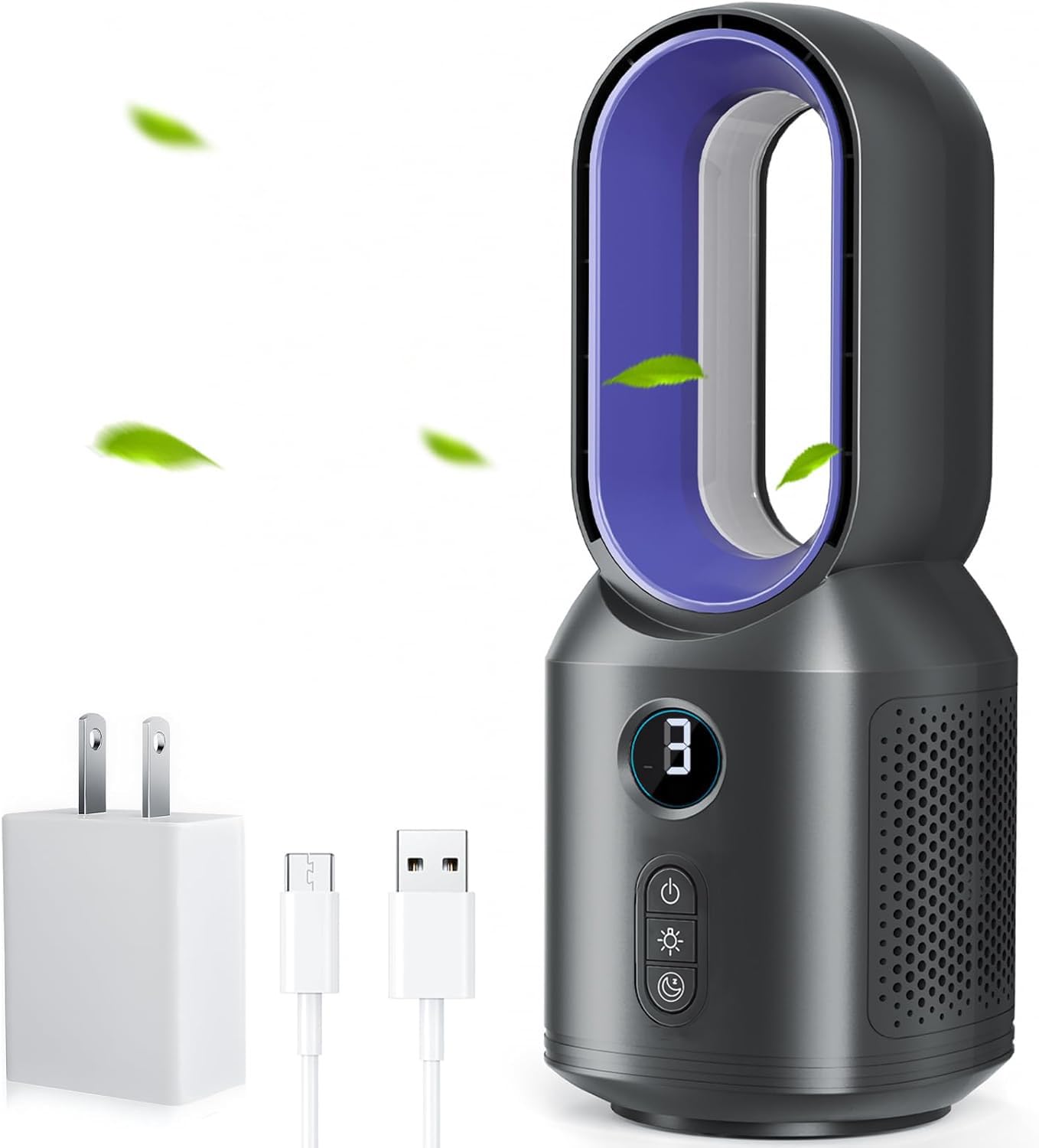
No exposed blades, so little fingers and wagging tails stay safe
In a room full of young children, the exposed spinning blade is the worry, and this fan solves it by removing the blade entirely. A bladeless design pushes a smooth stream of air with nothing to reach for, which is why it suits classrooms with toddlers or pets. The trade-off is scale: its frame is narrow at 4.9 inches wide versus the 13.1 inches of the oscillating circulator, so it is a personal-desk fan, not a room-wide blower.
What people like most is the compact, modern look and the safe bladeless build — it cleans easily and fits neatly on a nightstand or desk at 13 inches tall. It offers three wind speeds and a built-in LED night light with three brightness levels, which can be turned off or covered if you want the room dark. It runs off a USB cable and the included adapter, staying plugged in rather than relying on a battery — a design the maker says holds up longer than rechargeable fans.
Here is the honest part: the airflow gets divided feedback. Some find it quietly moves plenty of air for a desk, while others say it barely blows even on high and is only meant for personal, close-range cooling. It is not going to cool a large classroom on its own. One other fine point: owners mention the power block is not always in the box, so confirm you have a USB plug ready. If bladeless safety and a 13-inch footprint top your list, this is the desk fan to get.
What makes it safe and tidy
- Bladeless build — no exposed spinning blades near kids or pets
- Three speeds plus a three-level LED night light
- Compact 13-inch height and easy-to-clean design
What to know before you buy
- Airflow is modest — best for a single desk, not a whole room
- Requires a USB plug; the block isn’t always included
Pick this for: a young-children classroom where safety and a small footprint matter most.
Skip the whole-room job: this one cools a desk, so pair it with a stronger fan for larger spaces.
4. TEMPWARE 9 Inch Metal Floor Fan

A tough metal fan that hits hard and sits low on the floor
When you want a fan you can park low and aim straight up into a warm room, this metal floor fan does the job without fuss. It is built of metal — a sturdier frame than the plastic-bodied picks — and its cradle design needs no assembly, so it works the moment you unbox it. It sits low, at 4.92 inches tall versus the let’me’s 13 inches, so it hugs the floor and stays out of the walking path.
A full 180° tilt lets you angle it wherever the air needs to go, and three push-button speeds give you everything from a soft breeze to a strong blast. What people praise most is the fan quality and the airflow it delivers for its footprint. Customers note it effectively cools a warm bedroom short on AC airflow, and one notes it made turning the AC off at night possible. The metal blades are a point of pride for some owners — sturdier than plastic, they say.
The honest split is on noise and feel. Some find it reasonably quiet and like the gentle hum; others say it runs louder than expected, and one felt it did not blow as hard as a true industrial fan. Build quality draws mixed words — well made to some, cheap-ish to others. It is a small fan, so treat it as a floor-level spot cooler rather than a whole-room system. At this price, you get strong floor-level airflow and an all-metal frame that takes daily knocks.
Built to take a beating: the all-metal frame and rubber feet keep it stable and durable through daily classroom wear.
Fair warning: noise and build feel split opinion — it leans louder, and it is a small spot-cooler, not a room-scale fan.
Good match for: a budget-minded room that wants strong floor-level airflow and a metal body.
Not for you if: silence is the priority — this one runs louder than the quiet picks.
5. COMFORT ZONE 32″ Oscillating Tower Fan
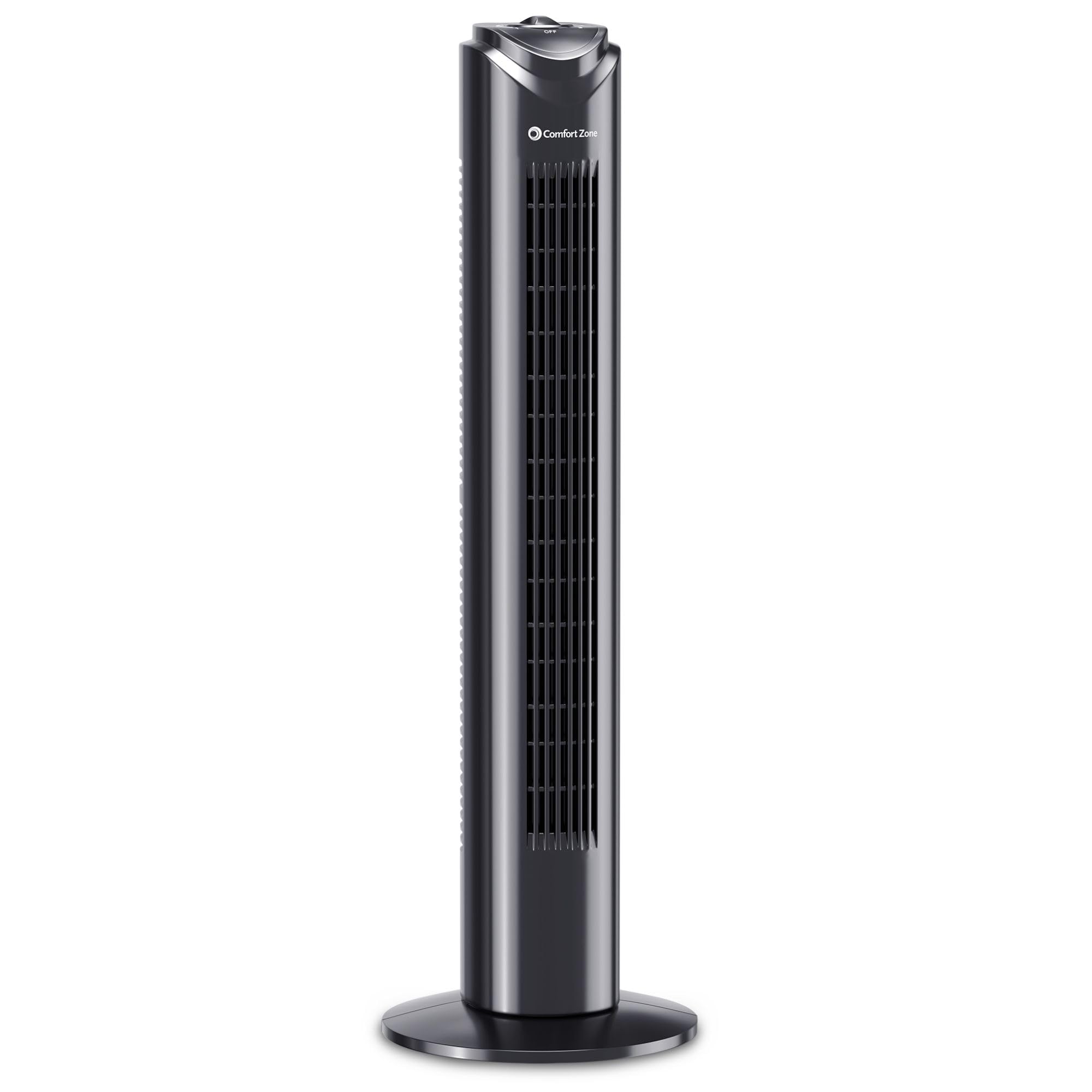
A slim 32-inch tower that broadcasts air across a whole floor
If you would rather put a fan in the corner and forget it, this 32-inch tower is the tallest pick here and spreads air the widest. It stands well above the 16-inch DR.PREPARE tower, so it pushes air out at seated and standing height rather than down at desk level. The ultra-slim profile saves floor space, and a built-in carry handle makes it easy to move from one room to the next.
The bladeless design means no exposed spinning blades near children or pets, and an enhanced safety grille adds a second barrier over the internal moving parts. A 90° oscillation sweeps air side to side across the room, and a top-mounted dial controls three speeds with one turn. It is ETL certified — tested to electrical safety standards — and a built-in fused plug shields it from voltage overloads. For a room that needs broad, even airflow from a corner, this 32-inch tower fits.
The catch here is consistency. The airflow and easy assembly win plenty of praise — cool air reaches across a living room, and setup takes minutes. But quality and value draw mixed reactions, and the most repeated gripe is noise: a few find the top speed loud enough to raise the TV volume. One unit clicked as it oscillated. Treat this as a broad-coverage tower for a room that tolerates some sound, and confirm the box arrives intact. For quiet zones, the 28 dB tower above is the safer bet; for corner-to-corner spread, this one reaches furthest.
The draw of the tall tower
- 32-inch height broadcasts air across a full floor
- 90° oscillation and three-speed dial for wide, even coverage
- Bladeless with a safety grille; ETL certified with a fused plug
- Carry handle and slim profile for easy repositioning
The honest ledger
- Noise on top speed is a recurring complaint
- Build and value feel splits opinion across owners
Choose it when: you want the widest floor-level spread from a corner and can live with some sound.
Look elsewhere if: your room needs silence — go with the quieter tower instead.
Know the Specs
Airflow and CFM
CFM (cubic feet per minute) tells you how much air a fan moves each minute, and it is the single best predictor of whether a breeze reaches the back rows. A high-CFM fan can cool a whole classroom from one spot; a low-CFM fan is really a personal-desk fan. Reach distance (how far the stream travels) matters as much as raw volume when the room is long.
Decibels and Classroom Quiet
Decibels (dB) measure how loud a fan runs, and in a room that must stay quiet, a few dB is the difference between a gentle hum and a distraction. A fan near 28 dB sits close to a whisper; louder fans can force the teacher to raise their voice. Always check how the fan sounds on its top speed, because that is where noise climbs.
Oscillation and Tilt
Oscillation sweeps air side to side, while tilt lets you angle the head up or down. Together they let a single fan serve a whole seated group instead of one desk. An upward tilt is useful for mixing the warm air near the ceiling back down into the room.
Wattage and Safe All-Day Use
Wattage is how much power the fan draws. Lower-watt fans (in the 26W–33W range across these picks) can run all day on a shared classroom circuit without overloading it, which matters when the fan is left on through a full school day.
Common Questions
What CFM airflow do I need to cool a classroom?
Is a 28 dB fan quiet enough for a classroom?
Is a bladeless fan really safer around young children?
Will a tower fan cool a whole classroom or just one area?
How loud is a floor fan compared to a tower fan?
Can these fans run all day without tripping a circuit?
Do these fans oscillate, and does it help circulation?
Can a desk fan cool a room, or do I need a floor or tower fan?
Are these fans easy to clean when dust builds up?
Do any of these fans need a battery or an adapter?
The Bottom Line
For most classrooms the winner is the DR.PREPARE Oscillating Air Circulator, because its 900 CFM airflow and 70° oscillation cool a full room from one desk-sized spot. If silence rules the room on test day, grab the DR.PREPARE Tower Fan at 28 dB. And for a young-children classroom where safety comes first, the let’me Bladeless Desk Fan is the one to reach for. Start with the circulator if you want one fan to cover the whole room.
How we choose
We do not accept paid placement. Every pick is matched to a real buyer and a real use-case; we do not hands-on test units.
Sources
Specifications: manufacturer listings and product documentation. Review insights: verified customer reviews, as of October 2026. Pricing: not shown on this page (it changes often); check the current price via the retailer link.
As an Amazon Associate, Aappliancez earns from qualifying purchases. This does not affect which products we feature.