Disclosure: Some links in this post are affiliate links. As an Amazon Associate I earn from qualifying purchases, at no extra cost to you. Learn more
Specs are compiled from manufacturer listings and verified buyer reviews and can change over time — please confirm the key details on the product page before buying.
A bedroom fan has to disappear at night: quiet motor, dark display, no droning beside your pillow. You want moving air without a motor droning beside your pillow, and you want a display that does not glow like a nightlight at 2 a.m. The seven picks below are ranked on measured low-speed noise, timer length, and how much of the room the airflow reaches.
This guide is built by comparing the manufacturers’ published specifications and the patterns across verified customer reviews, so you get each pick’s real strengths and trade-offs instead of marketing spin.
Some of these fans run as quietly as 20dB while others push far more air across a wide room, so the right pick depends on whether sleep or cooling power matters more to you. Here is how the fans for a bedroom lineup sorts out once you weigh noise against reach.
Top Picks


How To Choose The Best Fans for a Bedroom
Start with the number you will live with every night: the noise floor. A fan rated near 20dB is roughly the sound of a quiet rustle of leaves, while one at 28dB sits closer to a soft whisper you can still hear in a silent room. For a bedside unit, the low-speed figure decides whether it bothers you at all.
Noise floor beats top speed
Almost every fan gets loud at full tilt, so judge a bedroom fan by its low-speed decibel rating, not its top-speed number. Look for a sleep mode and a display-off function, because a bright LED panel in a dark bedroom pulls your eye even when the fan itself is silent. The DREO and Levoit both lean on auto-off displays for this exact reason.
Air throw and oscillation decide room coverage
A fan with a 60- to 100-foot throw and a 90° to 120° sweep circulates air across a whole bedroom, not just one side of the bed. Wide oscillation — the angle the head sweeps side to side — spreads that stream so you are not stuck in one cold spot. Pedestal models also let you raise the head so the breeze lands on your face rather than your knees.
Timer length and motor type
An overnight timer lets the fan switch itself off after you have fallen asleep, so a longer timer is more forgiving. A 24-hour timer outlasts any night’s sleep, so you can set it before bed and never reset it in the morning. DC motors run quieter and draw less power than brushed AC motors — the difference that matters when a fan runs eight hours a night.
Side-by-Side Comparison
| Model | Best For | Noise (Low) | Oscillation | Timer | Amazon |
|---|---|---|---|---|---|
| DREO Bladeless Tower Fan (307)★ Best Overall | All-round bedroom pick | Ultra quiet (auto mute in Sleep) | 90° | 8H | Amazon |
| JRD Oscillating Standing FanWidest Reach | Wide coverage for big rooms | 28dB | 70° horizontal + 85° manual tilt | 24H | Amazon |
| hykolity Pedestal Fan | Widest sweep, most speeds | 20dB | 120° horizontal + 90° vertical | 12H | Amazon |
| Levoit Tower Fan | Hot sleepers on a budget | 20–43dB | 30° / 60° / 90° | — | Amazon |
| OmniBreeze Digital Tower Fan | Easy setup, tall slim frame | Quiet on low | Automatic oscillation | — | Amazon |
| Della 42″ Smart Tower Fan | Smart-home cooling | 23dB | 90° | 24H | Amazon |
| Lasko Elevation DC Tower Fan | Adjustable height beside the bed | 24 dBA | 90° | 12H | Amazon |
Detailed Reviews
1. DREO Bladeless Tower Fan (Tower Fan 307)
Our pick — 4.5+★ from 850+ verified ratings; the strongest balance of quality and price.
The tower fan that turns its own display off so your bedroom stays actually dark.
DREO built this one around a 36-inch tower that pushes air at up to 25ft/s — fast enough that the breeze is noticeable the moment you switch it on. Four speeds run from soothing-soft to storm-strong, and four modes (Normal, Natural, Sleep, Auto) let you dial the character of the airflow rather than just its volume. The Sleep mode auto-mutes the controls, and the display shuts itself off, which is the detail that earns it the top slot for a bedroom.
Here is the direct comparison worth knowing: this DREO carries an 8-hour timer, while the JRD above it in airflow terms runs a 24-hour timer. So if you want the fan to still be running deep into the morning, the JRD stretches longer. But the DREO makes up for that with a slimmer 11.81-inch footprint — it slides into a corner where a wide pedestal base will not go — and a remote that stores in a built-in compartment so it does not vanish into the bedding.
What wins people over is how completely it takes over room cooling without shouting about it. Buyers describe it as noticeably better than the box fans they replaced, with quiet operation and airflow that genuinely cools the space. As owners put it: “Nice fan. Really cools the whole room.” The recurring note is dust collecting in the vents, which wipes out with a duster, and a minority find the top setting less powerful than they expected.
What earns it the top spot
- Display auto-off plus auto-mute in Sleep mode keep the room dark and silent
- 25ft/s airflow moves real air in a bedroom or living room
- Removable rear grille and impeller make dusting straightforward
- 36-inch slim tower with a hidden handle and remote storage
Where it gives ground
- The 8-hour timer is shorter than the JRD’s 24-hour window
- Top speed is less forceful than a dedicated box fan
- Natural mode varies its speed, which some prefer to keep steady
The verdict: the strongest all-round choice for a bedroom, with the crowd behind it — 4.5+ stars from 800+ owners.
Look elsewhere if: you need the fan running past eight hours on a timer.
2. JRD Oscillating Standing Fan
Thirty-two speeds and a 24-hour timer for the person who wants fine control all night.
JRD’s headline number is reach: a 45W motor drives bionic fan blades to push air up to 100 feet. That is a far-throw figure, and it matters in a larger bedroom or a room where the fan sits across from the bed. Thirty-two wind speeds give you fine-grained control — you can step up in small increments instead of jumping between four big settings. Height adjusts from 39 to 43 inches, so you can raise the head to bed level.
Set that against the DREO above, and the trade becomes clear: the JRD stretches to a 24-hour timer versus the DREO’s 8 hours, so it runs through the night and into the morning without a reset. It also tilts a manual 85° vertically on top of 70° horizontal oscillation, though that vertical tilt is a hand adjustment, not a remote one. The 28dB low-speed figure is quiet, but the hykolity below reaches an even lower 20dB.
Sleep quality is the honest split here. The low setting is genuinely quiet, and the 1–24 hour timer plus a no-light design make it a sensible bedside unit. But the performance story is mixed — the recurring gripe is a rattle or click that develops in the head over months, and some find the airflow weaker than the specs suggest. Reliability is the thing to weigh before you commit, not the spec sheet.
What the 32 speeds buy you: a genuinely gradual ramp from a near-still breeze up to strong circulation, with a 100-foot throw that reaches the far wall.
The honest catch: this is the pick to research hardest — a real share of owners hit motor noise or a dead remote down the line, so buy it for the control and coverage, not for long-term certainty.
Reach for this if: your bedroom is on the large side and you want a fan that pushes air the full length of it.
Weigh the risk if: you want a set-and-forget unit you never think about again.
3. hykolity Pedestal Fan
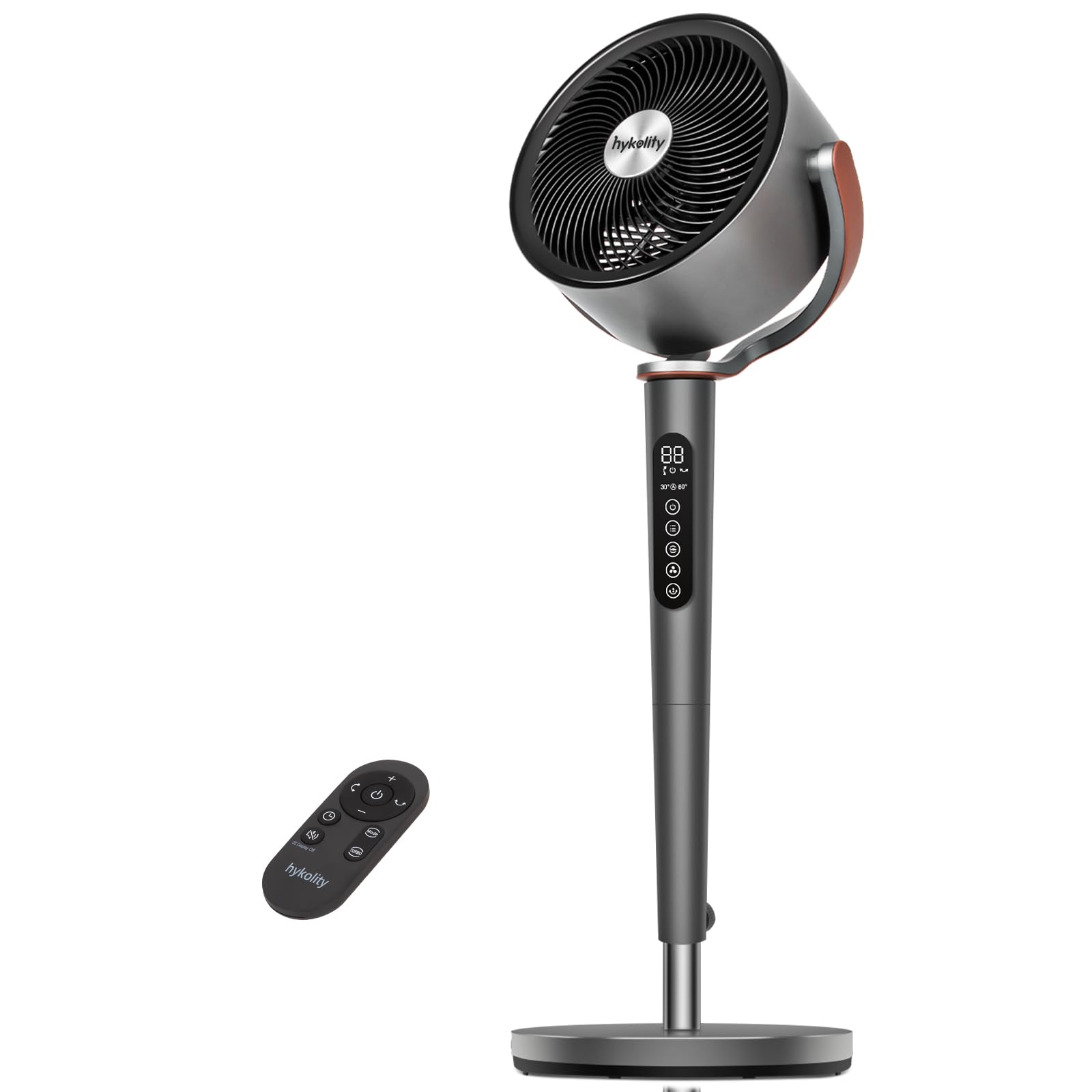
Twenty decibels and a 120-degree sweep — the widest, quietest arc on this list.
If the fan sits in a corner and you want it to cover the whole bed rather than one strip, the hykolity’s 120° horizontal oscillation is the widest sweep here — the JRD above covers 70° by comparison. Add 90° of vertical tilt and it genuinely reaches the corners of a room. The DC motor is rated at 20dB, which is the quietest low-speed figure on this list, and it pairs with 12 speeds and 5 modes including a Sleep setting and a 12-hour timer.
The spec sheet is generous: 900 cfm of airflow across an 85ft range, adjustable height between 37 and 45 inches, and dual control through an LED panel or the remote. There is even an Extreme mode that jumps straight to the top speed. On paper this is the most feature-loaded pedestal fan here, and the fan-quality praise backs up that the good units really do perform.
The catch is consistency. Build quality and reliability are the honest weak points — some units arrive with a missing or broken blade, and durability over the first few months is uneven. It is the smallest review pool on this list too, so you are buying a promising design rather than a proven track record. If you get a good one, the sweep and quiet are hard to match at this tier; if you get a lemon, the return process is where your patience gets tested.
Best suited to: a bedroom where full-room air movement and a near-silent low setting matter more than long-term certainty.
The trade-off: reliability is uneven across units, so check it carefully in the first weeks.
4. Levoit Tower Fan
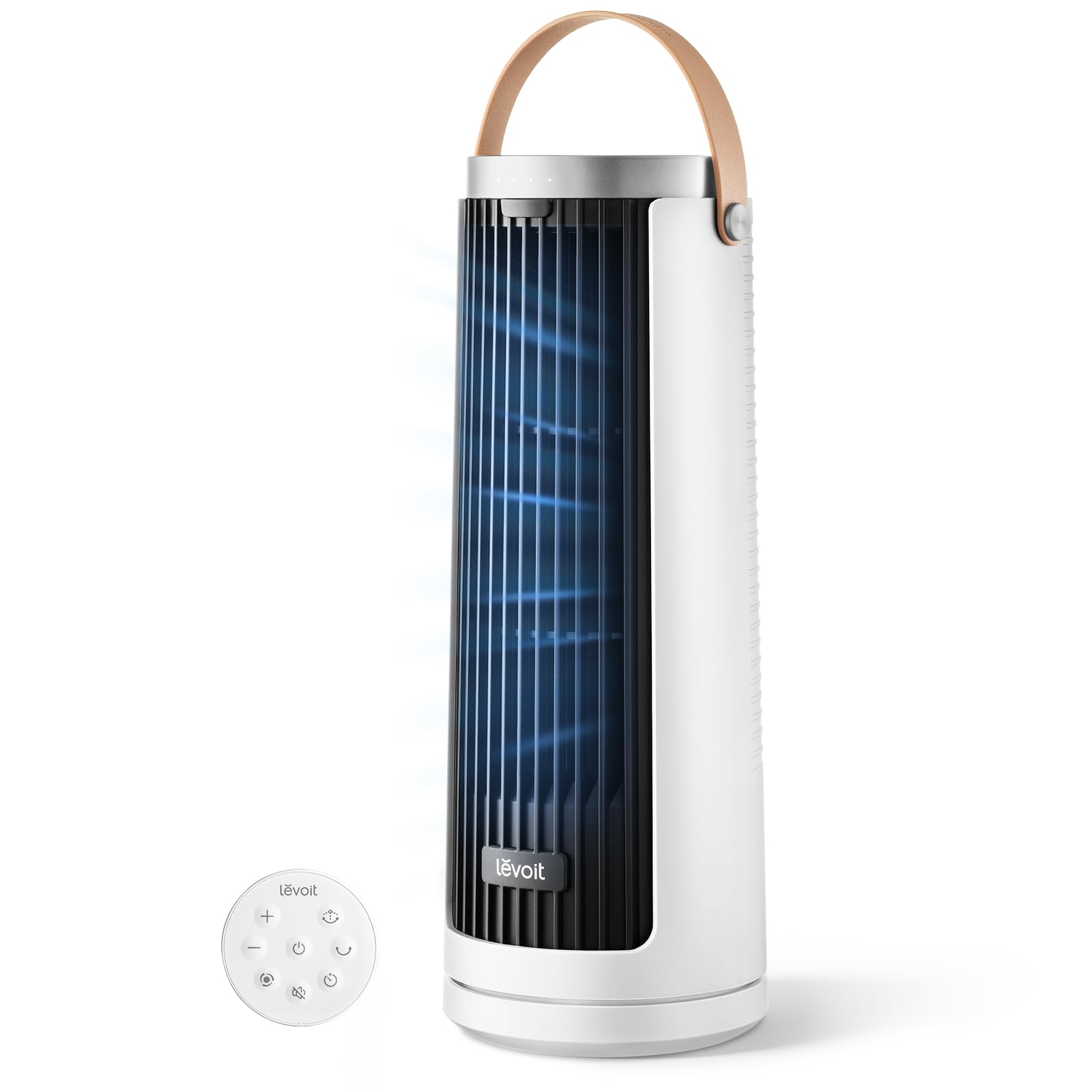
A compact bedside tower that sips power and keeps a hot sleeper cool all night.
The number that defines the Levoit is its 7.5-watt maximum draw, which means it can run all night on a trickle of electricity. A DC motor and VortexAir technology push air at up to 23 ft/s, and the noise band runs from 20dB up to 43dB across the speeds — comfortable on the low end for sleep. Five speeds plus a Turbo setting, and oscillation you can set at 30°, 60°, or 90°, let you aim the breeze exactly where you need it.
Its strength is direct, focused airflow. Owners describe the breeze as feeling almost like air conditioning and say they slept through the night without sweating — one buyer name-checks hot flashes as the reason it works. Compared to the DREO above, it trades the 8-hour timer for a simpler setup, and it is a compact table-style tower that sits on a nightstand rather than the floor. The catch: this model must stay plugged into a wall outlet, so there is no cordless option.
The overall ownership picture is warm. The performance and value aspects are what people talk about most, and the remote with sound-off and display-off functions keeps the room dark and quiet for rest. The honest wrinkle is temperamental settings — some units drift out of your chosen mode overnight or change speed on their own. It is also the widest-selling fan on this list, so a small share of quirks is expected against that volume.
Why it suits a warm sleeper
- 20dB low end with a 30–43dB range across speeds
- Max 7.5 watts keeps overnight running cheap
- Multiple oscillation angles: 30°, 60°, or 90°
- Display-off and sound-off for sleep
Where it needs patience
- Must stay plugged in — no cordless use
- Some units change settings on their own overnight
- Compact size means less whole-room reach than a pedestal
Choose it for: night-sweats and hot flashes, where focused direct airflow beats a wide sweep.
Pass if: you want a fan that holds one preset mode without drifting.
5. OmniBreeze Digital Tower Fan (36 Inch)

Two base halves, one lock nut, and a 36-inch tower standing in half a minute.
OmniBreeze makes the setup its selling point: one main body, two base pieces, and a lock nut, and you are cooling in about 30 seconds with no tools. The 36-inch tower has four modes (Normal, Natural, Sleep, Auto) and four speeds, with Natural mode blending speeds to mimic an outdoor breeze. Sleep mode steps the wind down gradually through the night, and the remote works from up to 20 feet away so you can adjust without leaving bed.
For a bedroom, the sleep-friendly touches are the ones to notice. You can mute the control beeps and switch the display off, so a baby or a light-sensitive sleeper is not disturbed. Automatic oscillation spreads the cool air wider than a fixed head would. And if you want a matching fan for a larger bedroom, note that auto mode adjusts speed to the actual room temperature — a small efficiency win over a straight set-and-forget speed.
Fan performance and airflow are what owners praise most, and the airflow genuinely moves air around a room rather than just in a narrow line. The honest caveat is stability: the unit wobbles noticeably on its base, which is the one thing to check on arrival. Noise is also a matter of expectation — some find it super quiet, others note it steps up on higher settings. Neither is a reason to walk away; both are reasons to buy with clear eyes.
Fastest path to a cool bedroom: 30-second tool-free assembly, a 20-foot remote, and a mute-plus-display-off sleep setup.
The wobble to expect: the base is not the sturdiest here, so set it on a level, firm surface and check it early.
A good match for: someone who wants a tall, slim tower up and running in minutes with minimal fuss.
Think twice if: a rock-solid base is a must, because this one wobbles.
6. Della 42″ Smart Tower Fan

A 23dB smart tower that answers to your voice and reads the room temperature itself.
The Della puts its biggest number where it counts for a bedroom: a 23dB noise rating, which the maker describes as a step below standard 25dB fans. A brushless 35W DC motor spins up to 1550 RPM and delivers up to 1950 CFM with a 28 ft/s top speed across 90° of oscillation — plenty of room coverage from a 42-inch tower. Twelve speeds and four modes (Sleep, Auto, Natural, Normal) with a 24-hour timer give you more granularity than the DREO and a much longer timer than the JRD’s 24-hour spec is matched only here and there.
Where it earns “smartest” is control. Alexa and Google Home voice commands, the DELLA WiFi app, an LED display, and a remote all work together, and in Auto mode built-in sensors adjust speed as the room warms or cools. Safety extras include pinch-proof grills, a child lock, 45° tip-over protection, and a fused plug. It is also light at 9.7 pounds with a carry handle, so moving it between bedrooms is easy.
The performance picture is genuinely strong here, with airflow and quiet operation both drawing warm owner feedback. The trade is that setting it up around your home WiFi takes a few more minutes than a plain remote fan, and the app adds a learning curve for anyone who just wants a dial. Once it is connected, though, the convenience is real — no getting out of bed, no fumbling for a remote in the dark.
Where it pulls ahead
- 23dB rating with 12 speeds and a 24-hour timer
- Alexa, Google Home, app, remote, and touch all on the table
- Child lock, tip-over protection, and a fused plug
- 9.7 lb with a carry handle for room-to-room moves
The setup cost
- WiFi and app pairing add time before first use
- Voice control is overkill if you only ever use the dial
- 42-inch tower needs a little floor space
It wins if: you want voice control and a temperature-aware fan that runs quieter than most at 23dB.
Not for you if: you would rather never touch an app to change a fan setting.
7. Lasko Elevation DC Tower Fan

The tower you raise to bed height so the breeze hits your face, not your knees.
Lasko’s trick is the stand: it extends from 42 inches up to 54 inches, so you can lift the airflow to exactly the height of your mattress instead of settling for a fixed tower. The DC motor runs at 24 dBA, quiet enough for calls and deep sleep, and pushes strong 40 ft/s airflow up to 60 feet away with 90° oscillation. Eight speeds and four wind modes, a sleep mode, and a 12-hour timer round out the controls on the remote.
The adjustable height is the detail that solves a real bedroom problem — most towers blow low, and a tall bed leaves the airflow at your knees. Here you match the tower to the bed. AirSense intelligence also adjusts speed as the room temperature shifts, so the comfort stays consistent without you touching a button. It is sturdy on carpet with no wobble, and the remote responds quickly from across the room.
What draws people in is that soft, non-harsh airflow — a breeze that feels gentle rather than a hard blast. The honest caveat is a spec inconsistency: some units ship with eight speeds as advertised, others with only four, so confirm which you have on arrival. Beyond that, performance and quiet are the strengths, and the adjustable height is where it clearly leads the OmniBreeze and DREO, both fixed-height towers.
The bed-height advantage: 42 to 54 inches of adjustment plus 24 dBA and 40 ft/s airflow make it the easiest fan here to aim at a tall bed.
Confirm the speed count: some units arrive with four speeds instead of eight, so check the controls as soon as it arrives.
Suit yourself to it if: your bed sits high and you want a fan that rises to meet it while staying quiet at 24 dBA.
Double-check if: an advertised eight-speed control is a deal for you — some units arrive with four.
Know the Specs
Decibel (dB) and dBA ratings
A decibel measures sound level, and the “A” in dBA means the figure is weighted to how human ears hear it. In a bedroom, the low-speed number is the one that matters most — a fan rated near 20dB is about as quiet as a rustle of leaves, while one nearer 28dB sits at a soft whisper you can still pick out in a silent room. Almost every fan gets loud at full tilt, so judge it by how quietly it starts.
Oscillation angle and airflow throw
Oscillation is how far the fan head sweeps side to side, measured in degrees — a 90° sweep covers a quarter-turn of the room, while a 120° sweep reaches wider. Air throw distance, in feet, is how far the stream pushes before it fades. Match a wide angle and a long throw to a large bedroom, and a narrower sweep to a small one where you mostly want the fan on you.
DC versus brushed AC motors
The motor is the part that spins the blades. A DC motor typically runs quieter and uses less electricity, which is why the quietest fans here — the hykolity, Levoit, Della, and Lasko — all lean on one. A brushed AC motor, like the JRD’s, can still deliver strong airflow, but it tends to draw more power and can get noisier over time.
Timer length and sleep modes
A timer lets the fan switch itself off after a set number of hours, so you can fall asleep with airflow and not wake to a fan still running at dawn. A 24-hour timer is far longer than most people need but forgives a forgotten reset; an 8-hour timer suits one full night. A dedicated Sleep mode usually steps the speed down gradually and dims or mutes the display.
Common Questions
Will a pedestal fan fit beside a bed without crowding the room?
How quiet is quiet enough to sleep next to a fan?
Can I leave a bedroom fan running all night?
Does a longer timer mean the fan is better?
What does oscillation angle actually change in a bedroom?
Do I need a smart fan with voice control in a bedroom?
Will a tower fan cool a large bedroom as well as a pedestal fan?
How do I keep the fan from blowing directly on my face all night?
Are DC motor fans worth choosing over standard ones?
Can a bedroom fan help with hot flashes at night?
The Bottom Line
For most bedrooms, the fans for a bedroom winner is the DREO Bladeless Tower Fan, because it pairs 25ft/s airflow with an auto-off display and auto-mute Sleep mode — the two details that let a fan disappear at night. If you want the widest sweep and the quietest low setting on the list, the hykolity Pedestal Fan stretches to 120° and 20dB. And for the sleeper who wants voice control and a 24-hour timer without lifting a finger, the Della 42″ Smart Tower Fan is the one to reach for.
The crowd favorite stays the DREO for good reason — 4.5+ stars from a large body of owners is a hard signal to argue with on a bedroom pick. Whichever you choose, match the noise floor to how light a sleeper you are, and let the airflow reach and timer do the rest.
How we choose
We do not accept paid placement. Every pick is matched to a real buyer and a real use-case; we do not hands-on test units.
Sources
Specifications: manufacturer listings and product documentation. Review insights: verified customer reviews, as of October 2026. Pricing: not shown on this page (it changes often); check the current price via the retailer link.
As an Amazon Associate, Aappliancez earns from qualifying purchases. This does not affect which products we feature.