Disclosure: Some links in this post are affiliate links. As an Amazon Associate I earn from qualifying purchases, at no extra cost to you. Learn more
Specs are compiled from manufacturer listings and verified buyer reviews and can change over time — please confirm the key details on the product page before buying.
Fall fertilizer is not about making your grass green right now — it is about feeding the roots so the lawn survives winter and comes back thick in spring. The fastest way to get this wrong is buying a bag that feeds the top of the grass instead of the roots, or buying more bag than your yard can use. Below you will find the seven fall fertilizers worth your money, sorted by what each one actually does best, from a bag that greens up a large yard to a weed-and-feed that stops dandelions before they start.
This guide is built by comparing the manufacturers’ published specifications and the patterns across verified customer reviews, so you get each pick’s real strengths and trade-offs instead of marketing spin.
Each pick below lists its exact N-P-K ratio, its square-foot coverage, and whether its nitrogen releases slowly or all at once. That is what separates a lawn that comes back strong from one that just looks brown all winter, which is why choosing the right fall fertilizer starts with reading the label instead of the picture on the bag.
Top Picks


How To Choose The Best Fall Fertilizer
Fall is when grass stops growing blades and starts storing energy in its roots. Your job with a fall fertilizer is to feed that root system so the plant has reserves to survive frost. Pick a low-nitrogen, high-potassium ratio and spread it early to mid fall, and the lawn needs nothing more from you until spring.
Read the N-P-K ratio before anything else
The three numbers on the bag are nitrogen, phosphorus, and potassium, always in that order. Nitrogen pushes blade growth, phosphorus supports roots and seeding, and potassium hardens the plant against cold and drought. Fall formulas tend to carry a low first number and a high last number — a ratio like 32-0-10 or 10-0-20 — because you want the plant storing energy, not pushing new tender growth right before a freeze. A mid-summer ratio with a big nitrogen number can encourage soft growth that winter damages.
Match coverage to your actual square footage
Coverage is stated in square feet on every bag, and it is the number that decides how many bags you need. A 45 lb bag can cover 15,000 sq. ft. or 5,000 sq. ft. depending on how heavily it is formulated, so weight alone tells you nothing. Measure your lawn once — length times width for a rough rectangle — and buy by coverage. Under-applying gives you a thin, uneven feed; over-applying wastes product and can burn the grass.
Check release speed and iron content
Slow-release nitrogen feeds the lawn gradually over weeks rather than one fast hit, which matters in fall when you want steady root feeding rather than a surge of blades. Look for the slow-release percentage on the label. Iron is the other one to scan for — it deepens green color without pushing growth, and formulas with iron tend to show color faster on an autumn lawn.
Decide if you need weed control built in
A plain fall fertilizer feeds grass. A weed-and-feed does that plus kills listed broadleaf weeds like clover and dandelion. The catch with weed-and-feed is temperature: it needs weeds actively growing and consistent warmth to work properly. If your fall turns cold fast, a plain feeder plus a separate spot treatment usually serves you better.
Side-by-Side Comparison
| Model | Best For | N-P-K Ratio | Coverage | Form | Amazon |
|---|---|---|---|---|---|
| Scotts Turf Builder WinterGuard Fall Lawn Food★ Best Overall | Big yards, dependable basics | 32-0-10 | 12,000 sq. ft. | Granules | Amazon |
| Jonathan Green Winter Survival Fall Lawn FoodDeep Root Pick | Deep root feeding, large lots | 10-0-20 | 15,000 sq. ft. | Granules | Amazon |
| Scotts Turf Builder WinterGuard Fall Weed & Feed₅ | Weeds plus feed in one pass | — | 4,000 sq. ft. | Granules | Amazon |
| Green Thumb GT58105 Winterizer | Budget winterizer for small lawns | 32-0-10 | 5,000 sq. ft. | Powder | Amazon |
| GS Plant Foods Green Envy Liquid Lawn Food | Liquid feeding, hose-end spraying | — | Up to 64 gallons mixed | Liquid | Amazon |
| The Andersons Premium Fall Lawn Food | Fast greening, all turf types | 24-0-14 | 5,000 sq. ft. | Granules | Amazon |
| GreenView Fairway Formula Fall Lawn Fertilizer | Long, steady feeding without surge growth | 30-0-12 | 15,000 sq. ft. | Granules | Amazon |
Detailed Reviews
1. Scotts Turf Builder WinterGuard Fall Lawn Food, 32.3 lbs.
Our pick — 4.5+★ from 13,500+ verified ratings; the strongest balance of quality and price.
One bag of straight fall food that covers a full 12,000 square feet and asks nothing back.
Here is the fall fertilizer that most buyers should start with. The 32-0-10 ratio means almost no nitrogen and a solid potassium load, so you are feeding roots for winter rather than pushing soft blades before a freeze. Each bag covers 12,000 sq. ft., which is a serious suburban yard handled in one pass. The maker lists it for any grass type, and it goes down on a wet or dry lawn, so you do not have to wait for rain.
You can spread it and forget it. The nitrogen (the nutrient that drives green growth) is slow-release, so it keeps feeding your lawn after you walk away instead of washing through in a week. You do not need to water it in afterward, and that watering-in step is the single most common reason fall feeding gets skipped. Buyers report yards greening through the cold months and coming back thick the following spring, a pattern that repeats across the long-running review base. It is the crowd favorite at 4.5+ stars across 13,000+ owners.
As owners put it: “One 32.3 lb. bag of Scotts Turf Builder WinterGuard Fall Lawn Food covers 12,000 sq. ft.” That coverage is the real story here. Compare it to the Scotts Weed & Feed₅ at 4,000 sq. ft. and one bag of this handles three times the ground, which is why it suits a whole-yard plan rather than a single patch.
Where this bag pulls ahead
- 12,000 sq. ft. per bag stretches a single purchase across most lawns
- Slow-release nitrogen keeps feeding for weeks instead of one fast burst
- No watering-in required — toss it on a dry lawn and move on
- Works on any grass type, so you do not need to match turf species
What to plan around
- The 32.3 lb bag is heavy to haul and awkward to pour
- It is straight food with no weed killer, so dandelions need a separate pass
- Coverage assumes an even spreader — a cheap spreader can leave strips light
Buy this when: you want one reliable bag that feeds a mid-size lawn for winter with almost no effort.
Look elsewhere if: your yard also needs weed control — reach for the Weed & Feed pick below instead.
2. Jonathan Green Winter Survival Fall Lawn Food – 15,000 Sq Ft
The high-potassium option for anyone who treats fall as root season rather than green season.
Look at the third number first: a 10-0-20 ratio puts serious potassium into the plant, and potassium is what toughens grass against cold and drought. That high third number is what toughens grass against winter cold and drought. It also carries slow-release nitrogen so the green holds later into the year instead of fading after the first cool snap. One bag covers 15,000 sq. ft., and the maker says to spread it early in fall and follow with a second application in the first week of November to carry the lawn through winter.
Quality is the thing that earns this pick its following, with effectiveness close behind in the pattern of owner feedback — people keep coming back because the bag performs the same way each season. It also gets used on newly seeded lawns as well as established ones, which is rare for a heavy fall formula. The heavy granule size is deliberate: it spreads more predictably and lands where you put it.
Here is the honest trade-off. The bag weighs 45.1 pounds, against 12.6 pounds for the Green Thumb winterizer, so hauling it to the back forty is real work. A cheap spreader can also lay it unevenly, and those coverage strips show up in mid-December, when the treated front lawn looks visibly healthier than the untreated back. Buy a decent spreader to go with it.
The root-first case: a 10-0-20 ratio with slow-release nitrogen is the formula you want for winter survival, and 15,000 sq. ft. of coverage means one bag handles a large lot.
The carry cost: at 45.1 pounds it is a two-hand lift, and uneven spreaders leave light strips that show up weeks later.
Worth the lift if: you have a big lawn and want maximum potassium going into winter.
Think small instead if: lifting a 45-pound bag is more than you want to manage.
3. Scotts Turf Builder WinterGuard Fall Weed & Feed 11.28 lbs

Feeds the grass and kills the dandelions in the same trip across the yard.
If your fall lawn problem is clover and dandelions rather than thin grass, this bag does both jobs at once. It controls more than 50 listed lawn weeds, including clover, dandelion, plantain, morningglory, chicory, evening primrose, and purslane, while feeding the turf underneath. It covers 4,000 sq. ft. per 11.28 lb bag, so it is built for a modest lawn or for spot-and-perimeter work on a bigger one.
Effectiveness is what this product is bought for, and the pattern is consistent: lawns that get this every fall come back in spring without the dandelion flush that hits the neighbors. By spring the treated lawn comes back without the dandelion flush that hits untreated neighbors. It works across Bahiagrass, Bermudagrass, Bluegrass, Centipedegrass, Fescue, Ryegrass, and Zoysiagrass, so nearly everyone is covered on turf type.
The catch is timing and weather. It has to go on a wet lawn while weeds are actively growing and temperatures sit consistently between 60°F and 90°F. Miss that window and the weed half of the job underperforms, even though the feed still works. Apply it too late in a cold fall and you have paid for weed control you did not get.
For weed-heavy lawns: one pass kills over 50 listed weeds and feeds the grass, and it is listed for seven named turf types.
Weather-dependent: it needs a wet lawn and 60°F to 90°F to do the weed half of the job, so cold snaps push the timing earlier.
Reach for it when: weeds are the bigger problem than thin grass and you want one product to handle both.
Skip the combo if: your fall already turns cold — a plain feeder plus a spot spray works better.
4. Green Thumb GT58105 Winterizer Lawn Fertilizer
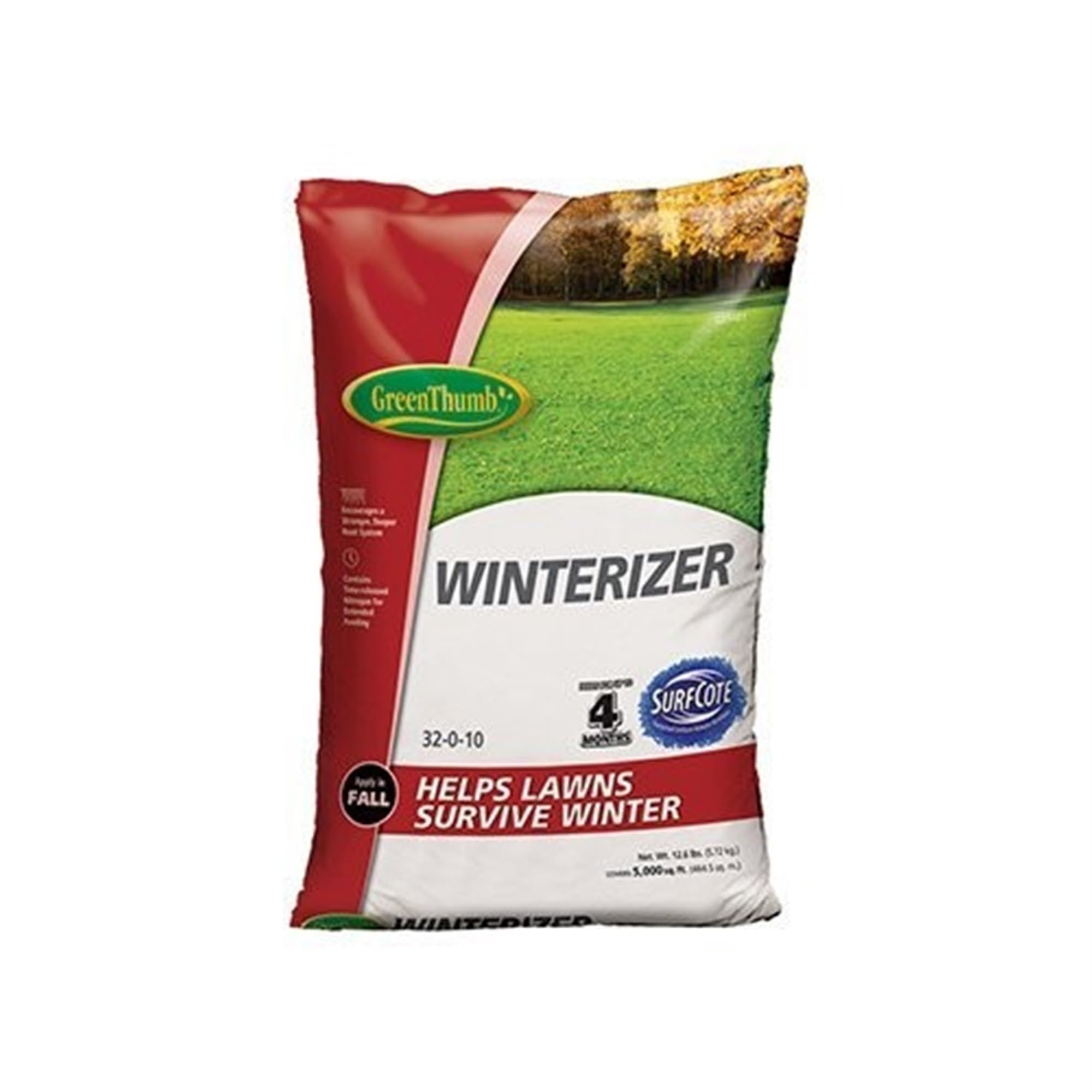
A lighter bag for a smaller yard that still delivers a proper winterizer formula.
At 12.6 pounds this is a bag one person can carry without a struggle, and it covers up to 5,000 square feet. The 32-0-10 ratio matches the big Scotts bag, so you are getting the same root-focused fall formula in a size built for a compact lawn. Two details lift it above a bare-bones budget bag: 2% iron for deep greening, and 50% controlled release nitrogen that the maker says keeps feeding for up to 16 weeks.
The timing that shows up in feedback is late fall — applied in late November, the spring green-up lands as promised. Spreading is straightforward on a normal spreader and the nutrient balance reads well on paper. If you have a smaller lot and the big bags feel like overkill, this is the one that fits your actual square footage instead of leaving half a bag to go stale in the garage.
Where it falls back is depth of feedback: the review base is thinner than the Scotts bags, so you are placing more trust in the label than in a mountain of owner experience. It is also straight feed with no weed killer. And the 16-week feed claim assumes it gets dissolved — in a dry fall you may need to water it in by hand to keep nutrients moving into the soil.
What it does well
- Same 32-0-10 ratio as premium winterizers in a lighter 12.6 lb bag
- 50% controlled release nitrogen feeds for up to 16 weeks
- 2% iron deepens color on an autumn lawn
- Covers up to 5,000 sq. ft. — sized for a compact yard
What it leaves out
- No weed control built in
- Results show in spring, so the payoff takes months to confirm
- Dry weather means hand-watering to activate the feed
This is your bag if: your lawn runs under 5,000 sq. ft. and you want winterizer formula without a 40-pound lift.
The limitation to know: it is food only, so weeds need a separate product.
5. GS Plant Foods Green Envy Liquid Lawn Food 1 Gallon
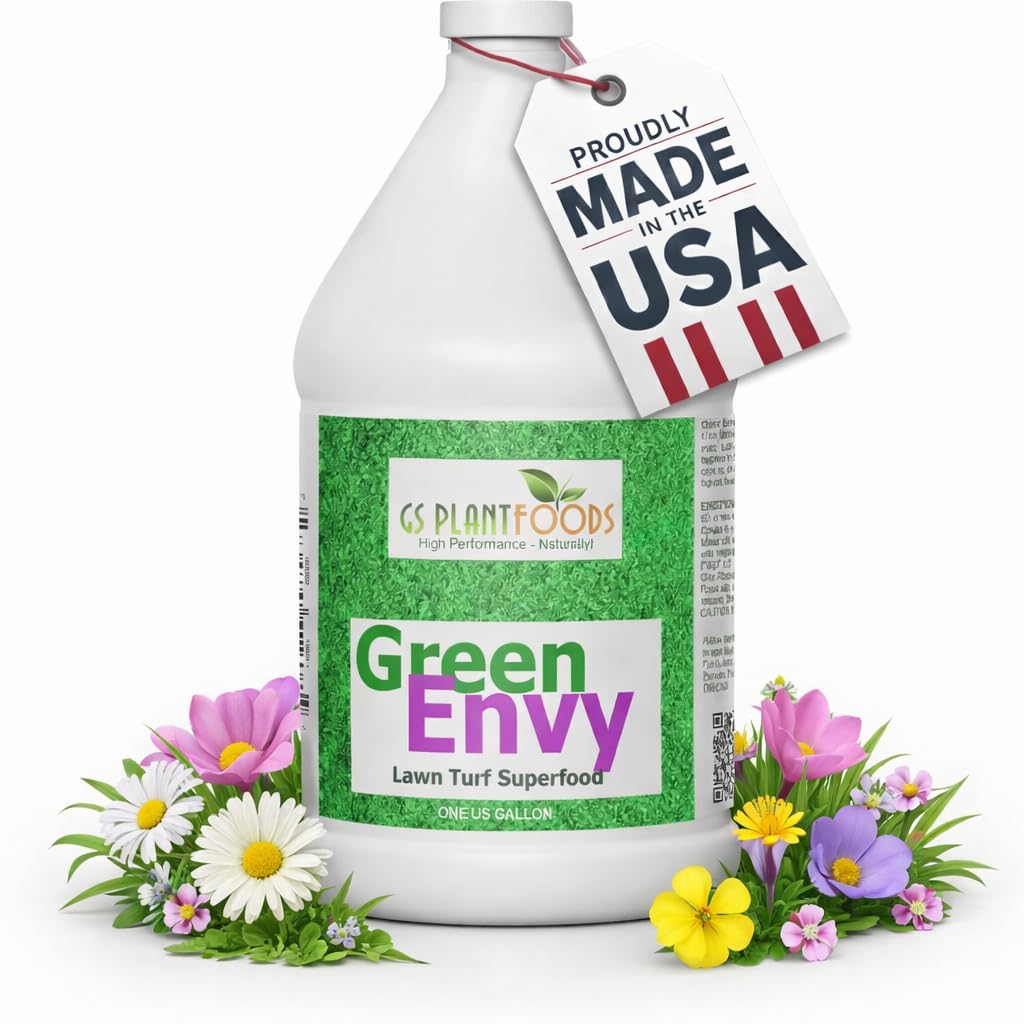
A concentrate you spray rather than spread — one gallon mixes into up to 64 gallons of feed.
For anyone who already owns a hose-end sprayer and would rather not move granules at all, this is the odd one out on the list and that is exactly its appeal. Mix 2 to 4 ounces per gallon of water, spread roughly one gallon of mixed solution per 1,000 sq. ft., and one gallon of concentrate yields up to 64 gallons of prepared feed. No irrigation needed afterward. The humic acid in the blend is there to help the grass take up nutrients more efficiently.
Greening is the effect people come for, and it is the most-praised trait here — lawns color up noticeably and fast. Ease of use follows close behind, and the dark color helps you see where you have already sprayed so you do not double up. It is listed for any grass type and mixes with other fertilizers, so it can slot into an existing fall program rather than replace it.
Here is the part that decides whether it is for you: this is the most divisive product on the list. The smell is strong and earthy, and it is thick enough to clog a hose-end sprayer if you do not dilute carefully — that is the recurring note from lawns that did not respond. Measure the 2 to 4 ounces per gallon and spray evenly and the lawn greens fast; under-dilute and the sprayer clogs and coverage turns patchy. It is a liquid, so expect to mix and spray rather than push a spreader.
The sprayer case: one gallon becomes up to 64 gallons of feed, no watering-in required, and the dark color shows your coverage.
The honest catch: the smell is strong and the concentrate clogs sprayers when under-diluted, so measure before you spray.
Pick this up if: you prefer spraying to spreading and want a concentrate that stretches across a whole lawn.
Pass on it if: strong organic odor or careful measuring with a sprayer is more hassle than a bag of granules.
6. The Andersons Premium Fall Lawn Food 5,000 sq ft
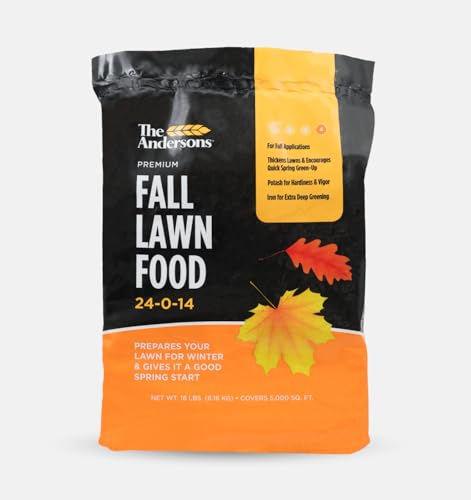
The highest-rated bag on the list, and the one that turns a brown lawn green fastest.
This is the pick to reach for when your lawn has been through a rough summer and you want to see a change before winter. The 24-0-14 ratio includes quick, intermediate, and slow-release nitrogen working together — a fast green-up first, then extended feeding underneath. Iron is in the blend for extra deep greening, and it is safe for all turf types. One 18-pound bag covers 5,000 sq. ft.
Effectiveness leads the owner feedback here, and it is not subtle: lawns show dark green in days after rain, and by the last week of September a treated lawn can be the only green one on the block. The granule size is small, which is part of the reason it works — the little granules dissolve and disperse with minimal moisture rather than sitting on the surface.
That same small granule is the one thing to plan around. It needs watering within 24 hours, and sooner on a breezy day, because light granules can blow off a dry lawn before they dissolve. Spread it twice, two weeks apart, if you want even coverage across a mixed warm-and-cold-season lawn. Water it in within 24 hours and the lawn darkens within days.
Why it rates highest: three nitrogen release speeds plus iron give a fast visible flush on top of long feeding, and it is safe on all turf types.
What it demands: water it in within 24 hours, or the light granules blow off a windy lawn.
Go with this one if: you want visible greening fast and do not mind a quick watering after you spread.
The trade-off: small granules need timely water — leave them dry on a windy day and you lose feed.
7. GreenView Fairway Formula Fall Lawn Fertilizer, 45 lb. Bag

Steady, even greening for a big lawn — no surge of blades, just weeks of quiet feeding.
The 30-0-12 ratio here leans on a proprietary blend of 59% slow-release nitrogen with no phosphate at all, which is designed to protect waterways. That slow-release share is what gives the bag its character: instead of a green spike that fades, the maker says it feeds continuously for up to 12 weeks, and it is formulated to green evenly without surge growth. One 45 lb bag covers 15,000 sq. ft.
Effectiveness and appearance carry this pick, and the standout scene is a mid-October application that turns a lawn deep green within two weeks and holds it through a cold, snowy winter into late spring. Owners who switch to it for that 12-week feed tend to stay with it season after season. It is also the bag that pours without clumping, which sounds minor until you are fighting a clogged spreader on a windy afternoon.
Two things to weigh honestly. It is a 45-pound bag, so the same hauling effort as the Jonathan Green, and pricing sits at the premium end of fall feeders. It is also feed only — no weed control — so if dandelions are your problem, this bag does not touch them. For a large lawn where even greening over months is the goal, those are acceptable terms.
The case for the big bag
- 15,000 sq. ft. of coverage from one bag
- 59% slow-release nitrogen feeds for up to 12 weeks
- No phosphate, formulated to protect waterways
- Moisture-resistant packaging pours without clumping
Terms to accept
- A 45 lb bag to carry, same effort as the heaviest pick here
- Premium-tier pricing in the fall fertilizer aisle
- Feed only — no weed killer included
Best matched to: a large lawn that needs even color held all winter without a growth surge.
Skip the bag if: weeds are your main complaint or premium pricing is out of reach.
Know the Specs
The N-P-K ratio explained
Those three numbers are the whole formula in shorthand: nitrogen for top growth, phosphorus for roots and seeding, potassium for cold and drought hardness. A fall blend usually carries a low first number and a higher last number so the plant stores energy instead of pushing soft blades into frost. Read them in order and you know the job the bag is built for.
Slow-release versus fast nitrogen
Fast-release nitrogen greens a lawn quickly and is used up in days. Slow-release nitrogen, measured as a percentage on the label, feeds over weeks and is the reason a fall bag can keep working after you spread it. Fall formulas often combine both — a quick visible start on top of a long feed underneath. The higher the slow-release percentage, the longer the bag keeps feeding and the less risk of a growth spike.
Common Questions
When should I apply fall fertilizer to my lawn?
Do I really need to water the fertilizer in after spreading?
How do I know how many bags my lawn needs?
Is a weed-and-feed better than a plain fall fertilizer?
Can I use a fall fertilizer on any grass type?
What does the potassium number actually do for my lawn?
Is liquid lawn fertilizer as good as granules in fall?
What is the difference between slow-release and quick-release nitrogen?
Will fall fertilizer get rid of dandelions and clover?
Does a heavier bag cover more lawn?
The Bottom Line
For most lawns, the fall fertilizer winner is the Scotts Turf Builder WinterGuard Fall Lawn Food. It covers 12,000 sq. ft. in one bag, requires no watering-in, and its 32-0-10 ratio pushes root feeding over blade growth — exactly what fall needs.
If your yard is bigger and you want maximum potassium going into winter, the Jonathan Green Winter Survival covers 15,000 sq. ft. at a 10-0-20 ratio. And if weeds are the bigger headache, the Scotts Weed & Feed₅ kills over 50 listed weeds while it feeds — just apply it while temperatures sit between 60°F and 90°F.
How we choose
We do not accept paid placement. Every pick is matched to a real buyer and a real use-case; we do not hands-on test units.
Sources
Specifications: manufacturer listings and product documentation. Review insights: verified customer reviews, as of October 2026. Pricing: not shown on this page (it changes often); check the current price via the retailer link.
As an Amazon Associate, Aappliancez earns from qualifying purchases. This does not affect which products we feature.