Disclosure: Some links in this post are affiliate links. As an Amazon Associate I earn from qualifying purchases, at no extra cost to you. Learn more
Specs are compiled from manufacturer listings and verified buyer reviews and can change over time — please confirm the key details on the product page before buying.
Which one is actually worth buying for a wart on your face? The honest answer is that all three picks here freeze the wart with cold rather than burning it with acid, and that changes the whole decision — you are choosing how precise the freeze is and how much control you have, not whether it works at all. Cold works by freezing the tissue inside the wart so it dies and falls away, and on a face that means a small, targeted hit matters more than raw power.
This guide is built by comparing the manufacturers’ published specifications and the patterns across verified customer reviews, so you get each pick’s real strengths and trade-offs instead of marketing spin.
Below you get three targeted cold-application tools, a plain-English spec explainer, and the honest limits of at-home freezing on delicate skin. The first thing to know is that these are cold-application tools with real precision differences, and that shapes every pick in this face wart remover lineup.
Top Picks

How To Choose The Best Face Wart Remover
A wart on your face has two problems that a wart on your heel does not: you have to look at it, and you cannot hide a scab under a sock. That is why the deciding question is not “which one is strongest” but “which one gives you the smallest, most controlled hit of cold.” Every pick here works on the same principle — spray or press a chilled tip onto the wart, let the tissue freeze, and let it dry up and peel off — so the differences are in the delivery.
Precision beats power on facial skin
A broad blast of cold is easy. Getting a blast of cold onto a wart that is a few millimetres from your eye or lip, and nowhere else, is the hard part. Look at the delivery end first: a fine nozzle tube lets you aim, a spring-loaded pen tip presses only where you place it, and a protective disc physically rings the wart so the healthy skin around it is shielded. If a kit lists no precision tip and no protective discs, expect to do more careful aiming yourself.
Understand the treatment count before you buy
A “7 treatments” box and a “15 applications” box are not competing numbers — they are different systems. A pen-style kit gives you a set number of cartridge-freezes, so a stubborn wart that needs repeat rounds eats through that count fast. A canister with 10 ounces by weight and 295 ml by volume is measured in volume, not individual treatments, so the count is whatever you decide to use. Children’s kits sit in the middle: 15 applications with Skin Shield discs included, sized for small warts.
The honest limits of freezing at home
Freezing a wart is a slow, peeling process, not an overnight fix. Most of the treatment kits here talk about a wart changing over one to two weeks, and a raised wart often needs a second round. That timeline is normal — the wart has to dry, darken, and come away. If a wart does not change after the number of applications your kit allows, that is your cue to stop and ask a doctor or pharmacist, not to spray more.
Side-by-Side Comparison
| Model | Best For | Freezing Method | Treatment Count | Form Factor | Amazon |
|---|---|---|---|---|---|
| Instant Freeze Chilling Spray★ Best Overall | Aim-and-spray freezing with a nozzle tube | Spray, chills to -50 °C (-60 °F) | 10-ounce canister (295 ml) | Aerosol can with nozzle tube | Amazon |
| Dr. Scholl’s Freeze Away | Controlled press-on freezing, one wart at a time | Freeze pen, press-on tip | 7 treatments | Pen with applicator tip | Amazon |
| Compound W Freeze Off for Kids | Small warts with a shield around healthy skin | Accu-Freeze with precision tip | 15 applications | Canister with Skin Shield discs | Amazon |
Detailed Reviews
1. Instant Freeze Chilling Spray
Our pick — 4.0+★ from 1,000+ verified ratings; the strongest balance of quality and price.
The spray that gets coldest fastest, and asks you to aim every drop yourself.
If you want to reach a wart tucked beside a nostril or under an eyebrow, the aiming flexibility here is the whole reason to pick it. This is an aerosol chilling spray that drops to a stated -50 °C (-60 °F) in seconds — cold enough that tissue freezes on contact, which is the effect you are buying. It arrives as a single canister plus a nozzle tube, branded Vaxxen Labs and made in the USA, and the contents are listed at 10 ounces by weight and 295 ml by volume — enough that you are not counting treatments like a pen kit forces you to.
What wins people over is that it does the job on stubborn skin growths once you work out your own technique. As owners put it: “I used it on a wart and within 2weeks it had eroded to nothing.” The makeup of the canister is listed under CAS number 811-97-2, and the whole thing is 295 ml of propellant-driven cold — meaning the spray only behaves when the can is upright.
Here is the catch, and it is a real one for a face. The canister will not spray at an angle or upside down, so a wart in an awkward spot means positioning a mirror and the can together. The trigger also needs a deliberate deep pull rather than a light tap, so a steady hand is not optional. You also get a nozzle tube you may need to shorten for finer control — buyers report trimming the stem extender to get better aim, and it does not affect how the spray works.
Where the spray earns its place
- Chills down to -50 °C (-60 °F) in seconds — fast freezing without waiting on a cartridge.
- 295 ml of spray means you are not rationing a fixed treatment count the way a pen kit makes you.
- Comes with a nozzle tube you can aim at a specific small target on the face.
- Made in the USA, single canister, no assembly needed.
What to plan around
- Will not spray at an angle or upside down — awkward spots take two hands and patience.
- The trigger needs a deep, firm pull.
- Aerosol spray is harder to keep off healthy skin than a press-on tip, so shielding matters.
Reach for this if: you want adjustable aim and a big cold reserve rather than a fixed number of freezes, and you are comfortable controlling where the spray lands.
Think twice if: your wart sits somewhere you cannot hold the can upright — a pen-style tip is the saner tool for that spot.
2. Dr. Scholl’s Freeze Away Wart Remover

Seven counted freezes, applied by pressing a tip straight onto the wart.
For a wart sitting on a cheekbone or the side of the nose, the press-on approach is the one that keeps cold where you put it. This Dr. Scholl’s kit gives you 7 treatments, and “treatment” here means one freeze cycle from the unit — a counted, controlled press rather than an open spray. It is a small, light box that slips into a bathroom drawer, made by Scholl’s Wellness Company, and it handles both common and plantar warts, so the same tool covers a face wart and a foot wart without you buying twice.
The count is the thing to think about. Seven freezes is generous for one thin wart and tight if you are treating several, or if a raised wart needs a second round. On the harder, flatter kind it tends to work in one pass; on the raised kind, plan two. There is a sensible middle ground here that a spray cannot offer — you press, you stop, and the cold goes no further than the tip.
Where it falls short of the spray above is reach and cold depth: the spray gets colder on contact and gives you an aiming tube, while this pen gives you restraint. That is the trade. An occasional owner sees no change at all on a hand wart after the full course, which is a fair reminder that freezing is not guaranteed — and a reason to stop after the stated rounds rather than keep pressing. Heavier than it looks at 4.66 ounces, it still sits easily in a hand for a straight-on press.
Our read: the treatment you reach for when the wart is somewhere you can press a tip onto cleanly and you want the cold to stop at the wart’s edge. Seven rounds is the ceiling — plan which warts get them.
The case for it: the most controllable way to freeze a small, well-placed wart, with both common and plantar warts covered by the same kit.
The other side: a fixed 7 treatments, so a stubborn wart that needs two rounds quietly uses up your supply.
3. Compound W Freeze Off Wart Remover for Kids, 15 Applications
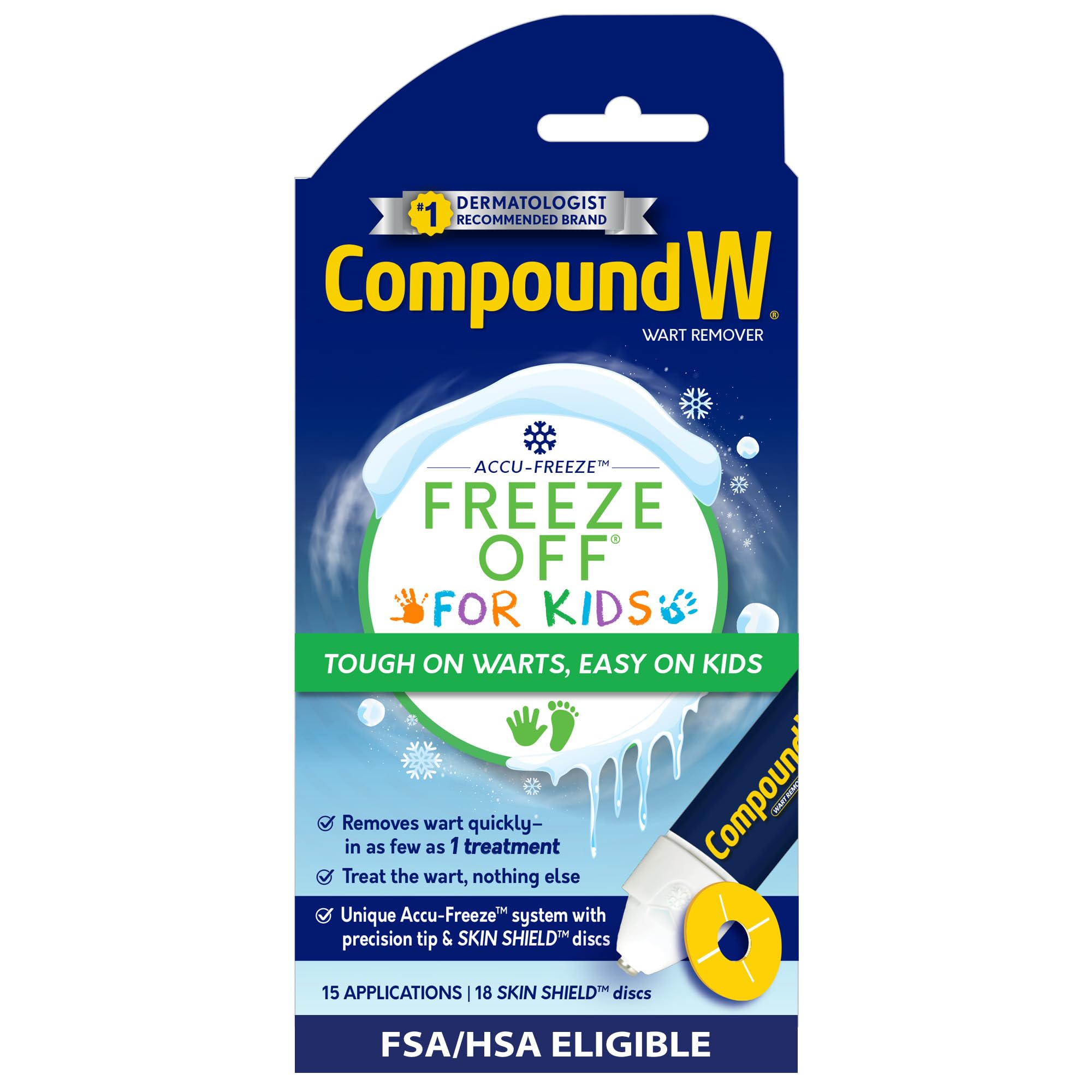
Fifteen small applications with a precision tip and a disc that guards the skin around it.
If the wart belongs to a child of 4 or over, this is the version built with that in mind. The kit carries 15 applications, uses Accu-Freeze technology with a precision tip applicator, and — the detail that matters on a face — includes Skin Shield discs that sit around the wart so healthy skin is protected while you work. The box names Compound W the number-one dermatologist recommended brand, and the kit uses the same freeze method many doctors use, at home.
What buyers actually experience is that this one takes patience. Plenty find success, and as the reviews put it: “Used it on a wart -one time and within two weeks it slowly fell off and disappeared.” Just as many describe nothing happening after the first pass and results only showing up by the second or third application — which is the honest shape of freezing small warts, not a reason to give up early.
Two practical catches sit in plain sight. The kit has a short 3-month shelf life that has surfaced as a recurring gripe, so check the date before you need it, and treat the applications as your whole supply — a couple of retries and the canister is done. On comfort, “pain-free” is optimistic; most find it milder than an adult remover, but not nothing, and one reviewer found it more comfortable for his daughter with protective bandaids over the site. Do keep the discs on for the treated area, that is what they are for.
Why it fits a family: 15 applications, a precision tip, protective discs, and a design cleared for children aged 4 and up are a coherent set for one spot on a small face or hand.
The trade: a short shelf life and a fixed application count mean you want to buy it when you are ready to use it, not keep it in a cupboard.
Good match for: a parent treating one or two small warts on a child, especially where guarding the surrounding skin is the priority.
Less ideal if: you are buying ahead of time — the short expiry means a kit bought early can go unused.
Know the Specs
Freezing temperature and why it matters
A listed temperature such as -50 °C (-60 °F) tells you how cold the spray gets as it leaves the can — cold enough to freeze tissue on contact. Colder is not automatically better on a face; what matters is whether the cold reaches the wart and stops there. A deep freeze on healthy skin nearby is the thing to avoid, which is why precision tips and protective discs earn their place in these kits.
Application count versus canister volume
“7 treatments” and “15 applications” are counted freeze cycles — a pen or the kids’ kit gives you a set number, so a wart that needs a second round uses up two. A spray measured by volume (295 ml here) is different: you are buying the amount of cold, not the number of goes. Neither is better, but a counted kit makes you plan, while a canister asks you to control your own dispensing.
What a protective disc does
A Skin Shield disc is a small ring placed around the wart before treatment. It works as a physical barrier, keeping the freeze on the wart and off the healthy skin beside it — the kind of detail that matters most on a face, where a scab on the surrounding skin is more visible than the wart was. If a kit does not include a disc or tip, you are shielding by hand.
Shelf life and storage
Frozen-treatment kits are not indefinite. A short shelf life means buying near to when you plan to treat, checking the date on arrival, and storing as the packaging directs. A short date does not mean the product is faulty; it means it has a window, and a kit sitting in a cupboard for a year may not be at full strength when you reach for it.
Common Questions
Is a freezing spray or a freeze pen better for a wart on the face?
How long does it take for a wart to fall off after freezing?
Can I use a kids’ freeze kit on my own face wart?
Does freezing a wart hurt?
Is the freezing spray only for warts, or can I use it on other things?
How many treatments will one wart need?
Why does the kids’ Compound W kit have a short shelf life?
Can I use these freeze treatments near my eye or lip?
Will over-the-counter freezing work on a wart that has been there for years?
The Bottom Line
For most people treating a wart on the face, the pick is the Instant Freeze Chilling Spray because it drops to -50 °C (-60 °F) in seconds and comes with a nozzle tube you can aim at a specific small target — and its 295 ml canister means you are not rationing freezes. If you would rather the cold stopped exactly where you press it, the Dr. Scholl’s Freeze Away pen is the more controlled tool with 7 counted treatments. And for a child aged 4 and up, the Compound W Freeze Off for Kids gives 15 applications plus the Skin Shield discs that guard the surrounding skin — buy it fresh, because its shelf window is short.
How we choose
We do not accept paid placement. Every pick is matched to a real buyer and a real use-case; we do not hands-on test units.
Sources
Specifications: manufacturer listings and product documentation. Review insights: verified customer reviews, as of October 2026. Pricing: not shown on this page (it changes often); check the current price via the retailer link.
As an Amazon Associate, Aappliancez earns from qualifying purchases. This does not affect which products we feature.