Disclosure: Some links in this post are affiliate links. As an Amazon Associate I earn from qualifying purchases, at no extra cost to you. Learn more
Specs are compiled from manufacturer listings and verified buyer reviews and can change over time — please confirm the key details on the product page before buying.
Buying the wrong projector screen material is the fastest way to waste a good projector. You can spend a lot on a bright unit and still get a grey, washed-out image because the fabric reflects light in the wrong direction. The fix is simpler than most people think: match the fabric’s gain and ALR rating to your room’s light and your projector’s throw. This guide cuts through the buzzwords and shows you which fabrics hold contrast in a lit room, which stretch flat without tearing at the tacks, and which ones to skip for your setup.
This guide is built by comparing the manufacturers’ published specifications and the patterns across verified customer reviews, so you get each pick’s real strengths and trade-offs instead of marketing spin.
We cover fabric types, gain ratings, and viewing angles across seven real options. By the end you will know which gain, ALR rating and viewing angle suit your wall, your light, and your projector — and you’ll have a short list of the best fabric for projector screen builds without the guesswork.
Top Picks

How To Choose The Best Fabric for Projector Screen Builds
The fabric decides how much light comes back to your eyes and from how far off-centre. Get the gain right and a 2.6X surface makes a modest projector look far brighter than its lumen rating suggests. Get it wrong and a 0.85 gain grey sheet dims the picture no matter how bright the projector is.
Gain: how much brightness the fabric sends back
Gain (a measure of how strongly the surface reflects light toward you) tells you whether the fabric boosts brightness or stays neutral. A 1.0 gain surface reflects light evenly, so the picture looks the same from most seats. A 2.6X gain can make a dim projector look far punchier, so a low-brightness projector still throws a bright image. High gain often comes with a narrower balance, so check viewing angle before you commit.
ALR fabric and room light
Ambient light rejecting (ALR) material is built to block light coming from the sides and ceiling. A 30% ALR rating means it suppresses that stray light so the picture keeps its contrast during the day. Grey ALR fabric usually beats white in a lit room, but it needs a bright enough projector to overcome the darker surface.
Stretch, wrinkles, and installation
Most DIY screen fabric has some stretch, which is good for pulling out wrinkles but bad if you tack too close to an edge. Fix it flat on a solid frame and pull evenly from the centre outward. If you would rather not build a frame at all, a full screen kit with a metal stand removes the whole job.
Side-by-Side Comparison
| Model | Best For | Screen Size | Gain / Contrast | Viewing Angle | Amazon |
|---|---|---|---|---|---|
| LCUIRC 120 Inch Screen with Stand★ Best Overall | Backyard movie nights | 120 inches | Matte, wrinkle-free | 160 degrees | Amazon |
| ZUVMITG 120inch Screen with StandBest for Crowds | Family gatherings outdoors | 120 inches | Milk silk, 4K HD | 160 degrees | Amazon |
| SilverMagic 100″ ALR Grey Material | DIY ALR in a lit room | 100 inches | 2.7X gain, 70% ALR | 30 degrees | Amazon |
| SilverMagic 120″ White Material | Budget movie room build | 120 inches | 2.6X gain, 30% ALR | 160 degrees | Amazon |
| Yandood EPPE Grey Fabric | Large DIY frame builds | 69×118 inch (max 130″) | 0.85 gain | Above 160 degrees | Amazon |
| Elite Screens CineGrey 135″ | High contrast in living rooms | 135 inches | 1.0 gain CineGrey | 160 degrees | Amazon |
| AWOL Valerion 100″ Fixed Frame | Bright-room fixed install | 100 inches | 1.3 gain matte white | 170 degrees | Amazon |
Detailed Reviews
1. LCUIRC 120 Inch Screen with Stand
Our pick — 4.5+★ from 60+ verified ratings; the strongest balance of quality and price.
A big 120-inch picture that packs into one bag and stands up without tools.
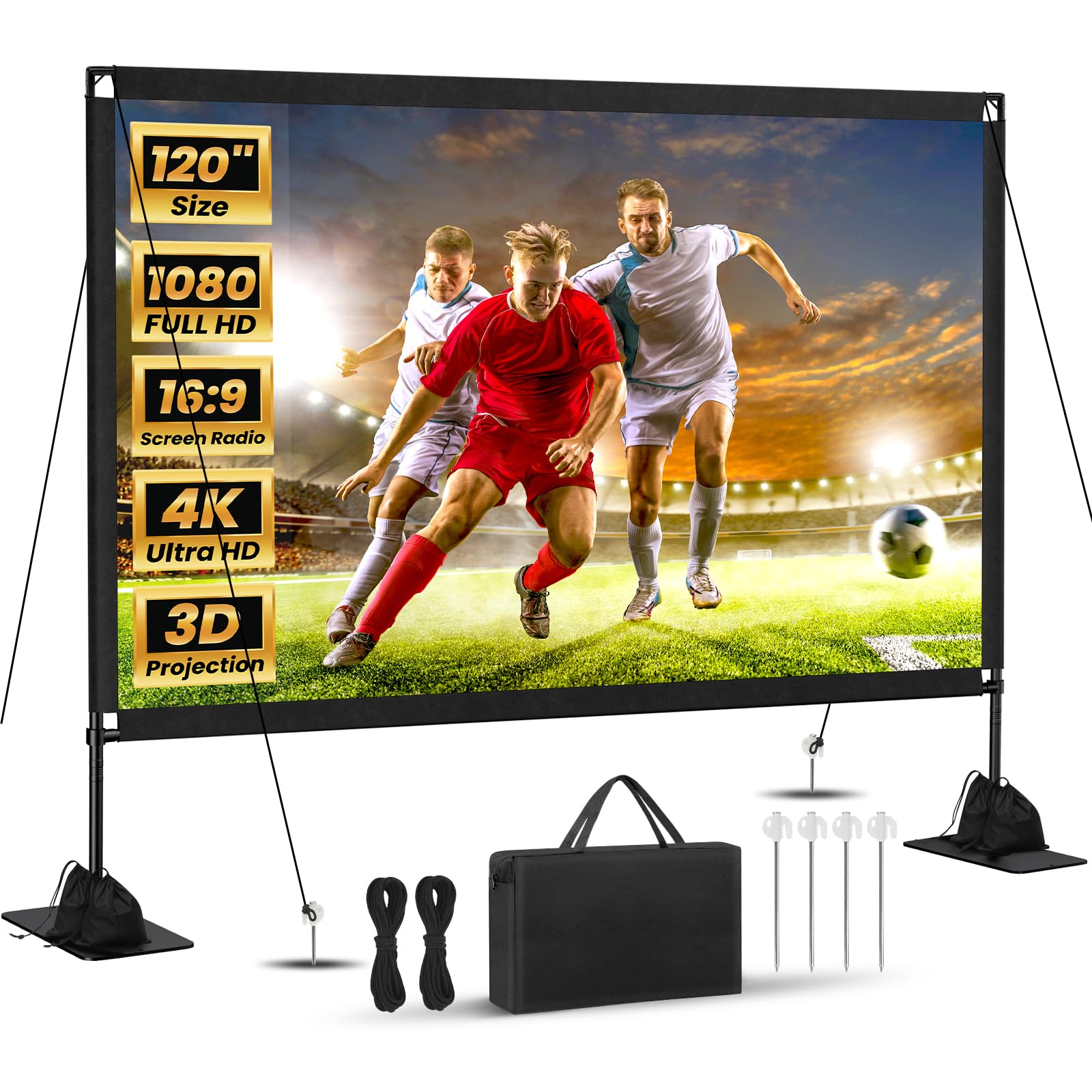
This is the pick for the family that wants a movie night up in minutes and packed away before the mosquitoes win. The screen cloth is thick polyester milk silk, and because it wraps fully around the frame in a three-pocket design, it pulls tight and flat instead of hanging with creases. That flatness is the whole game with fabric — a crease in the three-pocket wrap shows up as a bright line across an actor’s face. Here you get a matte finish and a 160-degree viewing angle, so the crowd spread across the lawn still sees a clean image.
The frame is the other half of the story: a 12″ x 8″ metal base weighing 2 pounds holds the whole rig upright. An all-metal base measuring 12″ x 8″ and weighing 2 pounds holds the whole rig upright, and it slides under a rug or furniture indoors when floor space is tight. Outdoors you get two mounting holes plus windproof ropes and eight ground nails to lock it down. Compare that footprint to the ZUVMITG below, whose dimensions run 265″W x 150″H against this kit’s 106″W x 76″H — the LCUIRC takes up considerably less room in the yard and in the trunk.
This fabric earns its spot because owners praise both the image and the tool-free setup. Image sharpness and colour draw the most praise, and setup follows right behind — the cut-to-size parts slot together without a single tool. One buyer who took it camping reported it “breaks down into a small included travel bag.” A condensed owner write-up clocked assembly at roughly 15 minutes with breakdown even faster, and noted the bag is roomy enough to store a backup 120-inch screen. Weighing 4 kg, it is genuinely one-hand portable.
What earns it the top slot
- Full-wrap three-pocket fabric pulls flat, so wrinkles and curling stay away
- 160-degree angle keeps the whole yard in the picture
- Metal base anchors under furniture indoors or into the ground outdoors
- Matte screen finish handles both front and rear projection
Where it asks for care
- Stability outdoors leans on the ropes and stakes being set properly
- The printed directions read more complicated than the build really is
Take this one if: you want a true 120-inch screen that travels and stands without a frame-building afternoon.
Plan around this: on open ground, use the supplied ropes and ground nails every time — the base alone wants help in a breeze.
2. ZUVMITG 120inch Screen with Stand
The full outdoor kit — screen, frame, sandbags and stakes in one bag.
For tailgates, campouts and backyard parties where the wind never quite quits, this kit brings the anchoring hardware other screens make you buy separately. Four ground stakes, two ropes and two sandbags come in the box, and the reinforced base with a support frame is built to resist the sway that plagues cheaper stands. The frame steel is a premium grade that holds up to repeated assembly. At 12.5 pounds it is heavier than a bare cloth roll, but that weight is the point when the screen has to stay up in a field.
The fabric is washable milk silk with a high colour reproduction rate, and it fits the frame so snugly that the edges stay clean rather than flapping. You get 160-degree viewing both front and back, which makes rear projection a real option at a party. Picture quality lands well — vivid colour, sharp 4K HD detail, and a surface owners describe as large and crease-free. The recurring caution is the storage bag and the anchoring: a few owners found the sandbags and bases too light for real wind. One put it plainly: bases and sandbags are “too light—blown over in 3-5mph wind, needed 20lb weights.” Set it up with extra weight on a gusty day and it behaves.
Room to watch: the 160-degree front-and-back angle means a crowd can spread wide, and the washable fabric shrugs off dust and grass.
The honest catch: the included bag has a thin zipper, and the light sandbags suit a calm evening more than a windy one — bring your own weights if the forecast is breezy.
Made for: hosts who screen outdoors often and want every anchoring piece in one purchase.
Swap in your own weights on a windy day: the bundled sandbags are the weak link when gusts pick up.
3. SilverMagic 100″ ALR Grey Material
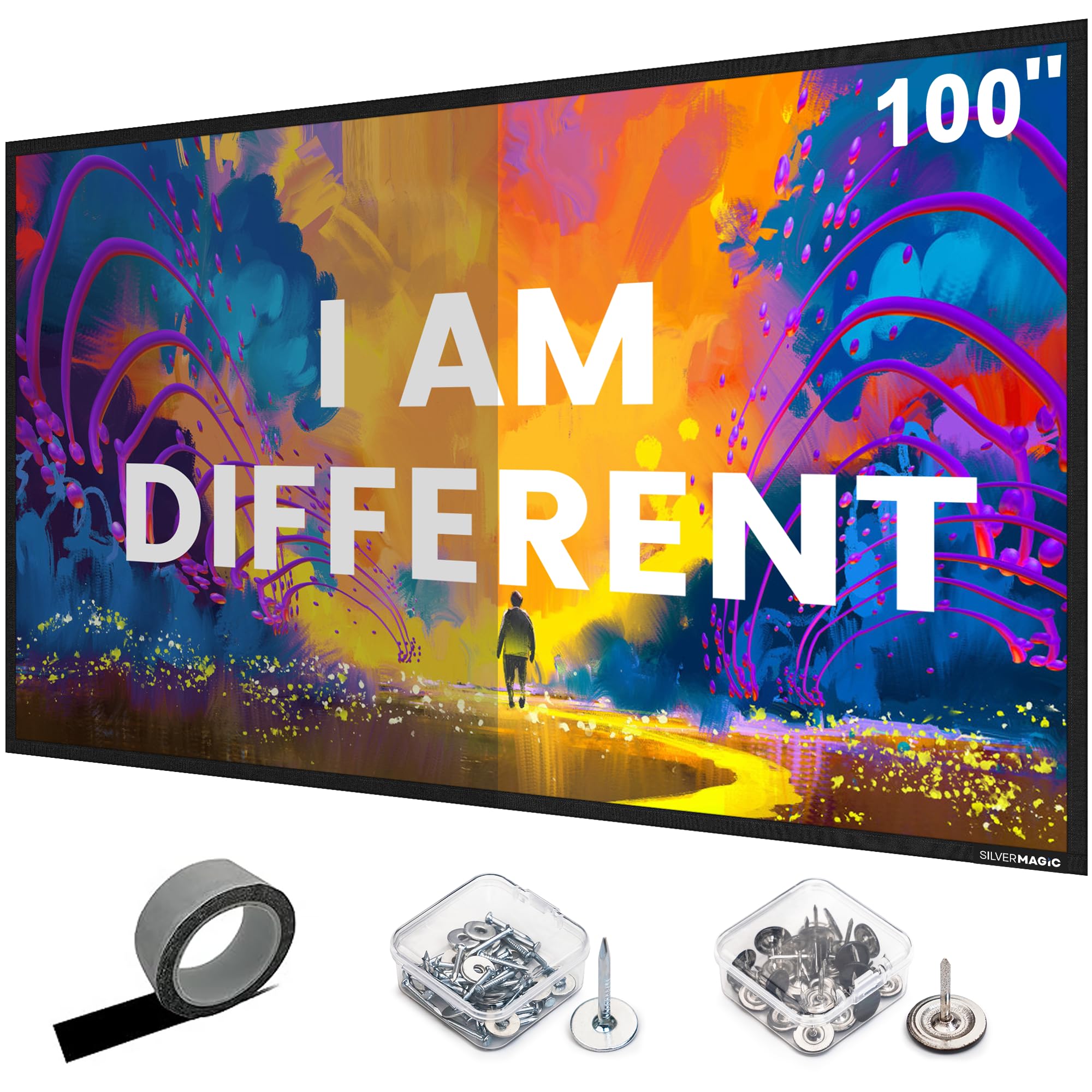
A grey sheet that turns a dim projector into a daylight-capable picture.
If your living room has windows and you refuse to make it a cave, this is the fabric to beat. It is a grey ALR material with a 2.7X gain and 70% ambient light rejecting, so it bounces more brightness back to your eyes while pushing away the light that would otherwise wash out the image. Put a low-lumen projector on it and the picture that was flat on a white wall suddenly has contrast and colour depth. The 100-inch 16:9 sheet arrives as a roll you cut and mount yourself on a wall or frame.
What people rave about most is the raw material quality — the sheet feels dense and premium in the hand, and the install is quick thanks to the wall-safe tape. The brightness engine is what sells it, though. Owners describe a budget long-throw projector coming alive with deeper blacks and better contrast than the matte white wall it replaced, and photos of before-and-after shots back that up.
Here is the trade-off, and it is a big one. The 30-degree viewing angle means the balance is narrow — sit outside it and the picture fades. Owners confirm this directly, noting you need to be seated within the viewing window, and that the magic works best when the projector sits near or above your head. This is not the fabric for a wide sofa spread across a room; it is the fabric for a dedicated seat directly in front of the screen.
Why serious DIYers reach for it
- 2.7X gain with 70% ALR turns a modest projector into a daylight performer
- Sharp, vivid image from reduced light bleed
- Patented wall-safe tape mounts it flat in about 10 minutes
- Trims to fit your space
Read this before you buy
- 30-degree angle means off-centre seats lose brightness
- Not designed for ultra-short-throw projectors
Best match: a single viewer or tight two-seat setup in a room you refuse to darken.
Think twice if: you regularly seat a crowd wide across the room — the angle favors the centre seat.
4. SilverMagic 120″ White Material

A big white sheet you stick to the wall and trim to the exact fit.
This is the pick for someone with a blank wall and a weekend, not a carpenter. It is a 120-inch white 16:9 material with 2.6X gain and 30% ambient light rejecting, and it installs on a wall or frame using the included thumbtacks, nails and black velvet edging. The surface is matte and comes with a 160-degree viewing angle, so a normal living-room spread is comfortably covered. That is a much wider usable spread than the 100-inch grey SilverMagic above, which narrows to 30 degrees.
The dense, stretchy material is what wins people over — it pulls tight enough to banish wrinkles. The material feels dense and stretchy, which lets you pull it tight enough to banish the wrinkles that ruin a cheap sheet. It trims to your wall, so an awkward nook is not a problem. Owners note the price-to-performance for a budget movie room is excellent, and the same picture-quality strengths come through — bright, contrasting images that make a low-lumen projector look far better than its rating.
The one habit to build in: do not tack too close to the edge. The fabric will tear if you punch a hole right at the margin, so give yourself room. A fixed frame, rather than a bare wall, gives the flattest possible result.
Straightforward value: a big 120-inch white surface that installs with household tools and trims to fit any wall size.
Give the edges room: staples and tacks need space from the margin or the fabric tears — measure before you commit.
Reach for this: if you are building a first home theater on a budget and want the biggest screen your wall can take.
Not your fabric if: your room is bright with windows — a grey ALR sheet fights glare better than white does.
5. Yandood EPPE Grey Fabric
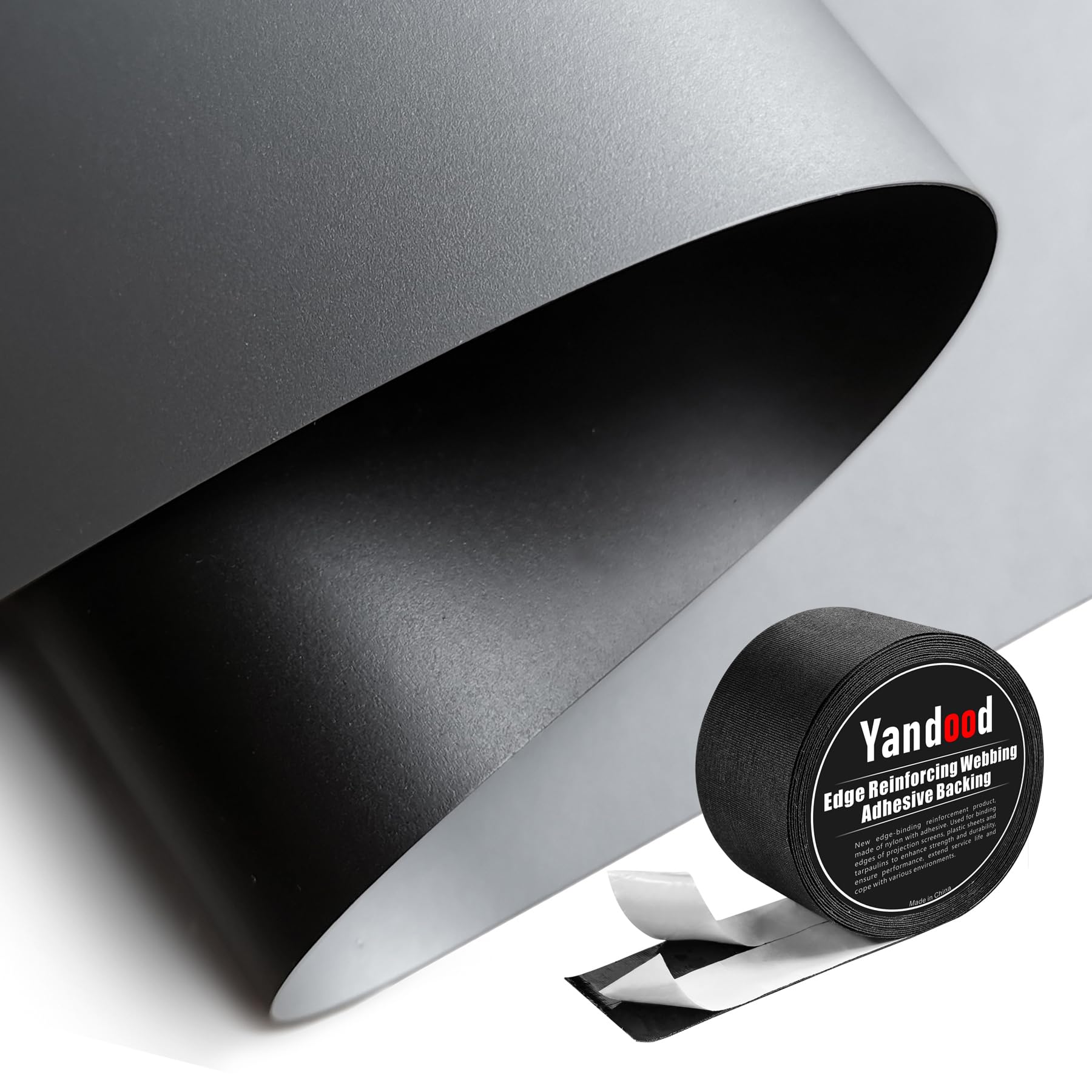
A huge grey roll built for a custom frame and a heavyweight projector.
Fewer seams and a bigger picture is the promise here. The sheet measures 69 x 118 inches, which covers up to a 130-inch diagonal 16:9 screen, and it arrives on a 74-inch reel so you can build one large fixed frame without joining panels. It is a three-layer EPPE polymer composite (a synthetic material the maker says meets EU REACH testing standards) with a black back layer that stops light bleeding through. The matte surface reflects light in all directions and holds its picture above a 160-degree angle, so a full room is in view.
Durability is where it impressed most in practice. One owner uses it as a golf simulator screen and hits real balls into it mounted on a net — with zero signs of damage, and it folds up and comes back wrinkle-free. That is a hard test most screen fabric would fail. It is also a DIY material only: it stretches over a wooden frame you build, or sticks to glass and smooth flat surfaces. It is not for rear projection, short throw or ultra-short throw.
The honest limit is brightness. Grey with a 0.85 gain dims the picture, and the maker itself advises against pairing it with a projector under 2000 ANSI lumens. Push a dim unit onto it and the image can look flat and dark. There is also the effort of the build — the same owner who praised the durability warned that the zip-tie frame method took 2-3 hours and demanded real tension to stretch out every wrinkle.
Where it earns its place
- Covers up to 130 inches diagonal with zero seams
- Black backing blocks all light penetration for a pure image
- Survives heavy abuse without damage and folds back wrinkle-free
- Reaches above 160 degrees, so a wide crowd sees it clearly
Budget the extra effort
- 0.85 gain needs a bright projector — the maker says avoid under 2000 ANSI lumens
- DIY frame build takes hours of stretching and tension
Built for: a large custom frame install driven by a bright projector and a hands-on builder.
Look elsewhere if: your projector is dim or you want a screen up in minutes — this one rewards patience and muscle.
6. Elite Screens CineGrey 135″
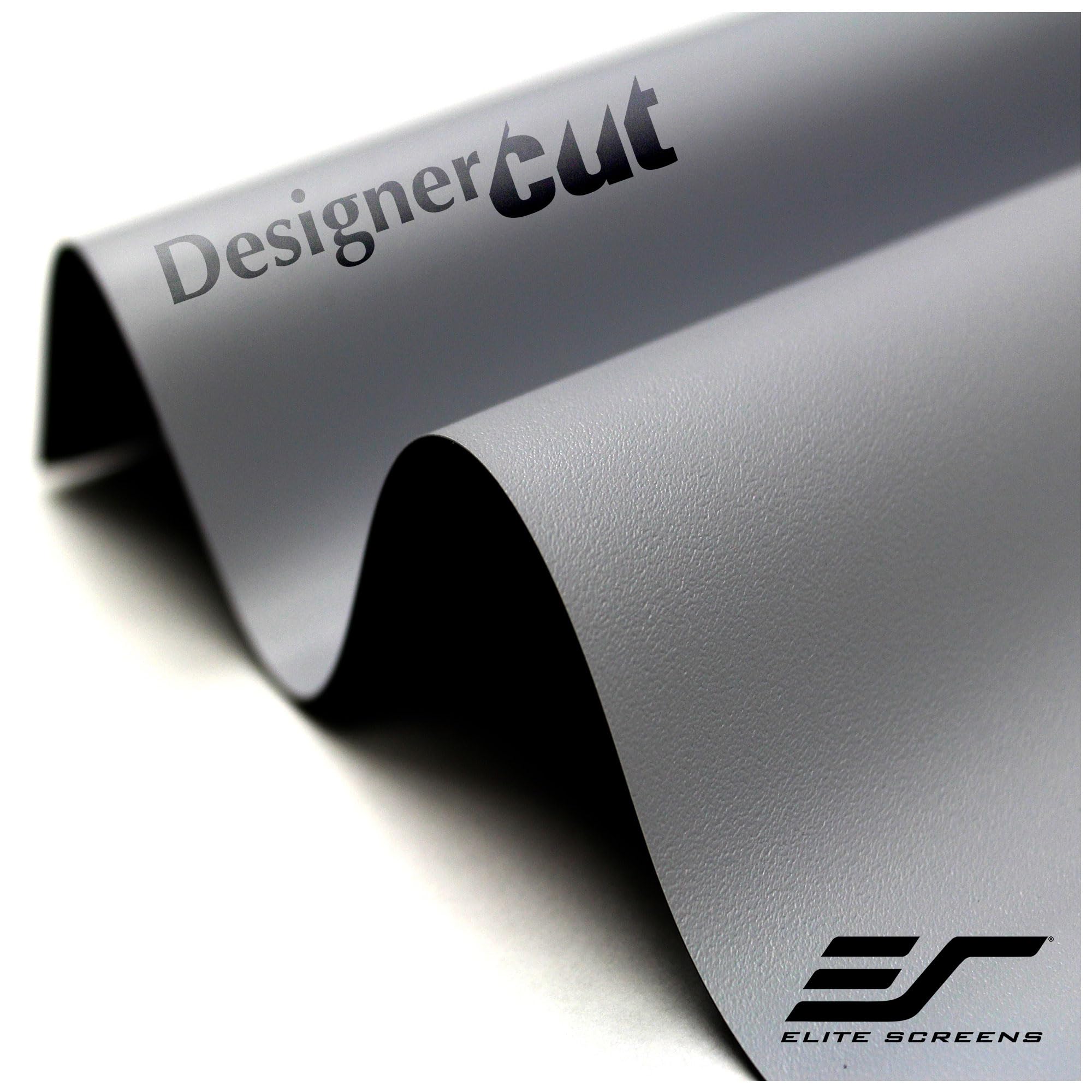
Industry-grade grey cloth that fights room light and keeps colours rich.
This is the material the pros put inside fixed frames, sold here as a raw 135-inch cut. It is Elite Screens’ CineGrey at 1.0 gain — a multi-layer textured PVC with a black backing that stops light penetration. The grey colour deepens black levels and boosts colour contrast, and it is built for low-contrast DLP and LCD projectors that need help making dark scenes look dark. The 160-degree viewing angle keeps the room covered, and the surface is Active 3D and 4K Ultra HD ready. It ships in a roll so it arrives wrinkle-free. Note the frame is not included, and it is not compatible with triple laser projectors.
Picture quality is the reason it sits this high. The grey surface holds up with room lights on — one owner described minimal washout with the lights up, and total satisfaction once they were off, which is exactly the ambient-light fight a living-room screen is for. The black backing means you can build your frame from plain timber and the braces vanish behind the cloth. It cuts neatly and staples onto a wooden frame, and the durable grey vinyl takes the tension without tearing.
The build demands respect. You need real, even tension across the whole width, and one owner noted bright uniform images can reveal ripple lines if the surface is not flat enough — a flat wall with no image on it tells you nothing. Give yourself a helper and heavy-duty staples, and stretch from the centre outward to the corners.
The contrast advantage: a 1.0 gain grey surface with black backing that deepens blacks and keeps colours popping where a white screen goes flat.
The build tax: borderless stapling is unforgiving — uneven tension shows as ripples in bright scenes, so this is not a five-minute job.
Pairs well with: a low-contrast projector in a room with lamps on and curtains that do not fully close.
Budget the frame build: the cloth is premium, but the finish depends on how evenly you stretch it.
7. AWOL Valerion 100″ Fixed Frame
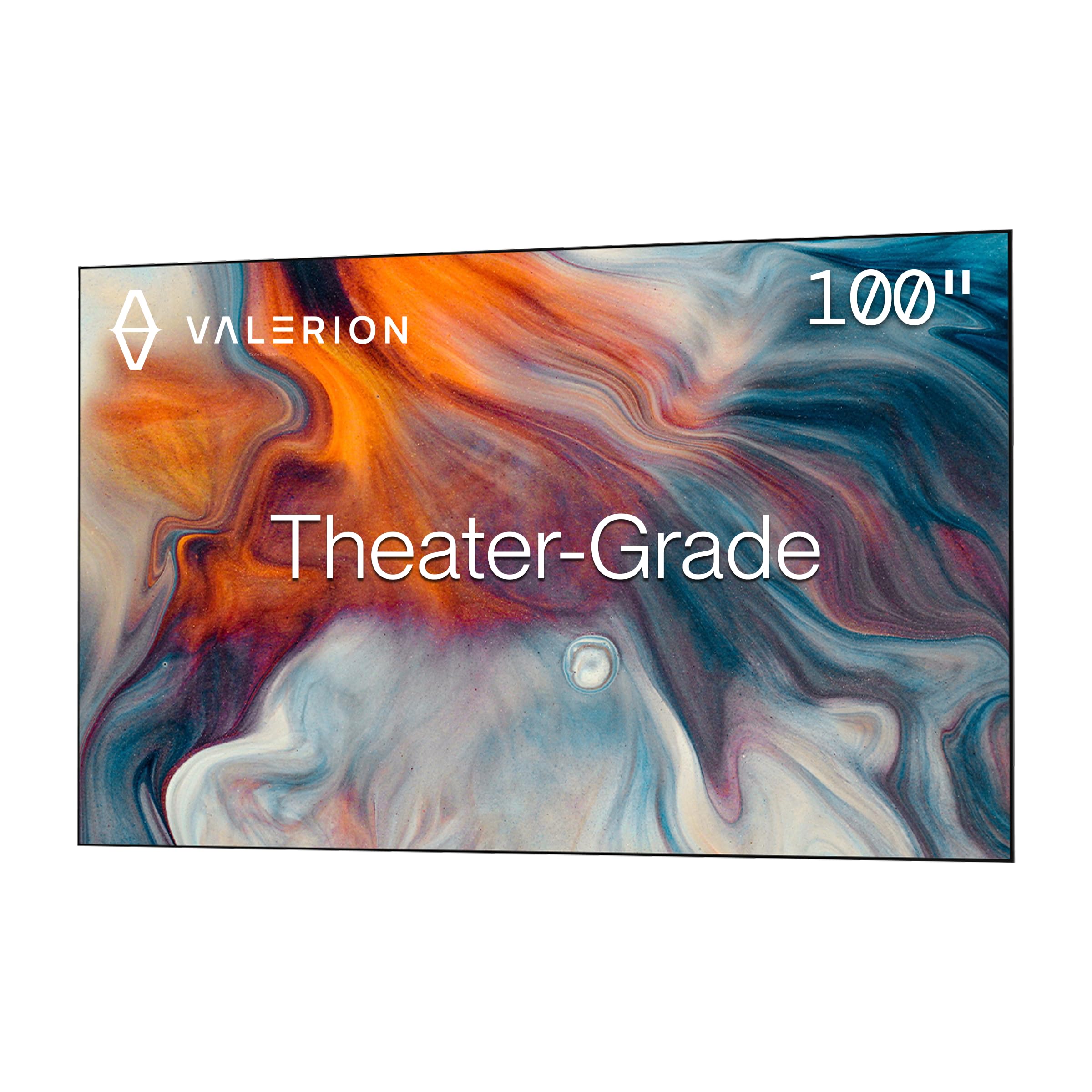
A finished matte-white frame screen that lights up a window-lit room.
Coming in matte white with a 1.3 gain, this screen is tuned to push brightness back into a room that is not fully dark. The 170-degree half-gain angle is the widest in this group, so nearly every seat sees a crisp picture. It is a high-quality PVC surface on a sturdy, thick fixed frame, ready to wall-mount as one finished unit rather than a roll you build around. Weighing 30 pounds, it is a permanent install — this is not a travel screen. It handles long throw, short throw and ultra-short throw projectors.
The brightness is what owners come back to. A matte white surface lets a white screen boost the picture even with a bright living room on, while dark-scene clarity shines at night. One owner, using it in a bright room, praised the “clarity, contrast, and depth” in both daylight and dark, and said the finished picture made the projector very watchable during the day. That is the point of the higher gain and the matte white — it makes a bright room usable, where a grey sheet would dim it further.
Assembly is the caveat. It is time-consuming and wants two people and open floor space to lay the frame out. The screen attaches to the frame with care, tensioning through easy bolts with no balancing headaches. One owner with a low-ceiling setup found ceiling reflection worth noting. And despite the marketing, it is a long-throw and standard fixed-frame screen — a buyer expecting a specific ultra-short-throw-only surface might be surprised, so match it to your projector type.
What the picture delivers
- 1.3 gain matte white keeps a bright room watchable during the day
- 170-degree angle covers the widest seating spread of the group
- Wrinkle-free finished surface after a careful tensioning
- Sturdy thick frame and even tension bolts
Before you commit to the wall
- Assembly takes time and two people
- 30 pounds and a fixed frame mean no portability at all
The right call for: a permanent media wall in a room that gets daylight and cannot go fully dark.
Skip the surprise: confirm your projector throw type first — this is a fixed-frame surface, not a roll you stretch yourself.
Know the Specs
Gain (the brightness multiplier)
Gain tells you how much light the fabric reflects back toward you compared to a plain reference surface. A 1.0 gain surface is neutral, a higher number like 2.6X or 2.7X boosts brightness, and a lower figure like 0.85 keeps it subdued. High gain helps a dim projector, but it usually narrows the angle where the bright image holds. Match gain to your projector’s brightness and your seating layout.
Ambient light rejecting percentage
ALR (ambient light rejecting) fabric is built to turn away light arriving from the sides and ceiling. A 30% ALR rating like the SilverMagic white sheet means a moderate pushback against room light, while a 70% rating like the grey SilverMagic fights glare much harder. ALR works best when the projector sits near or above your head, so light bounces back to your eyes rather than getting swamped.
Viewing angle
Viewing angle is how far off-centre you can sit before the picture dims. A 160-degree rating keeps a wide sofa in view, and 170 degrees is wider still. A narrow 30-degree rating is a dedicated-seat screen — brilliant dead-centre, fading at the edges. Think about how many people watch at once before you pick a narrow-angle ALR sheet.
Wrinkle control and material
Fabric flatness matters as much as gain. Stretchy materials pull tight and let you banish creases, but they tear if you tack too close to the edge. A black backing layer stops light bleeding through and keeps the image pure. Full-wrap pocket designs and textured PVC both hold a flatter surface than a loose sheet, and a fixed frame beats a bare wall for a smooth result.
Common Questions
What fabric is best for a projector screen in a room with windows?
Will higher gain really make my dim projector look brighter?
Can I use projector screen fabric if I do not want to build a frame?
What projector brightness do I need for a grey screen fabric?
Will a 30-degree viewing angle screen work for a family?
Does screen fabric work with ultra-short-throw projectors?
How do I stop wrinkles appearing when I stretch the fabric?
Is a stand kit or a roll of fabric better for outdoor movie nights?
Can I use the same fabric for front and rear projection?
How large a screen can I build from a roll of fabric?
The Bottom Line
The safest all-rounder here is the LCUIRC 120 Inch Screen with Stand — a wrinkle-free cloth on a sturdy metal frame that sets up in minutes and travels in one bag. If your room has windows you cannot darken, the SilverMagic ALR grey material earns its keep with 70% light rejection, as long as your seats stay near centre. And for a permanent bright-room install, the AWOL Valerion 100″ with its 1.3 gain and 170-degree spread is the pick to build your media wall around. Match gain, angle and your projector’s throw, and any of these will look far better than a bare wall ever could.
How we choose
We do not accept paid placement. Every pick is matched to a real buyer and a real use-case; we do not hands-on test units.
Sources
Specifications: manufacturer listings and product documentation. Review insights: verified customer reviews, as of October 2026. Pricing: not shown on this page (it changes often); check the current price via the retailer link.
As an Amazon Associate, Aappliancez earns from qualifying purchases. This does not affect which products we feature.