Disclosure: Some links in this post are affiliate links. As an Amazon Associate I earn from qualifying purchases, at no extra cost to you. Learn more
Specs are compiled from manufacturer listings and verified buyer reviews and can change over time — please confirm the key details on the product page before buying.
Pick the wrong cloth and fine soil washes straight into your drain pipe, clogging the perforations and turning your trench into a mud-filled ditch within a season. The short answer: a heavier, needle-punched non-woven geotextile holds up in a drain trench far better than the thin woven weed barriers sold for flower beds, because it lets water through without letting silt follow. Every pick below can be cut and rolled by hand, and the one that sits first is the crowd favorite — 4.5+ stars across 800+ owners.
This guide is built by comparing the manufacturers’ published specifications and the patterns across verified customer reviews, so you get each pick’s real strengths and trade-offs instead of marketing spin.
You will see how weight per square yard, weave type, and permeability decide whether a cloth survives buried gravel, then five rolls that handle the job. The trick to choosing the right fabric for french drain work is matching cloth density to how much soil your trench actually moves.
Top Picks


How To Choose The Best Fabric for French Drain
A French drain only works while water can still reach the pipe. The fabric wrapped around that pipe has one job: hold the surrounding soil back so it cannot wash into the gravel and clog the drain, while letting the water itself pass straight through. Get that balance wrong and you either block drainage or invite silt in.
Non-woven versus woven cloth
Non-woven geotextile fabric is needle-punched, meaning thousands of barbed needles tangle the fibers into a felt-like sheet. That tangling is what traps fine soil particles while water drains through the open structure. Woven cloth, by contrast, is a grid of flat plastic strands. It drains fast but tends to let fine silt slip through the gaps and is more prone to unraveling when you cut it.
Weight per square yard is your strength gauge
The ounce figure on the label is how much a square yard of the cloth weighs, and heavier generally means denser and tougher. A 3.2oz woven roll suits light jobs like a flower bed. A drain trench buried under gravel and stone wants a heavier cloth, because stones press down hard and thin fabric punctures. Heavier cloth also resists the tearing that starts when you drag it across rough ground.
Permeability and how you cut it
Permeability is how fast water moves through the fabric. You want cloth that lets a heavy rain drain away without the fabric floating or backing up. Cut each piece a little oversize, leave some slack for the pipe, and overlap the seams so soil cannot find a gap. Fold rather than cut where you can, because every raw edge is a spot where the weave can start to fray.
Side-by-Side Comparison
| Model | Best For | Fabric Weight | Roll Size | Material Type | Amazon |
|---|---|---|---|---|---|
| VEVOR 3ft x 100ft Non Woven Geotextile Fabric★ Best Overall | Buried drain trenches and pond underlayment | 4 oz | 3 ft x 100 ft | Non-woven PP | Amazon |
| FEED GARDEN 4FT x 100FT Landscape FabricBest for Beds | Garden beds with included stakes | 3.2 oz | 4 ft x 100 ft | Woven polypropylene | Amazon |
| Weed Barrier Landscape Fabric, Durable Geotextile (4 * 50) | Around trees, shrubs, and driveways | — | 4 ft x 50 ft | Woven polypropylene | Amazon |
| VEVOR 3x100FT 5oz Weed Barrier Fabric Heavy Duty | Driveways and gravel paths | 5 oz | 3 ft x 100 ft | Woven PP | Amazon |
| Winisok 4FT x 200FT Weed Barrier Landscape Fabric | Large-area landscaping and French drains | 3.2 oz | 4 ft x 200 ft | Woven polypropylene | Amazon |
Detailed Reviews
1. VEVOR 3ft x 100ft Non Woven Geotextile Fabric
Our pick — 4.5+★ from 800+ verified ratings; the strongest balance of quality and price.
A needle-punched felt cloth that pond builders trust under water and that holds position through rain.
If your trench sits under gravel with real water running through it, this is the roll to start with. It is a needle-punched non-woven geotextile, meaning barbed needles tangle the fibers into a felt sheet rather than weaving flat strands — so fine soil gets caught while water still drains through. The 350N tensile strength figure tells you how much pull the cloth takes before it tears, which matters the moment you drag it over rocky ground or stretch it around a perforated pipe. At 3 ft x 100 ft, you get a long single run you can unroll in one pass, then slice into exact trench widths with a utility knife.
What wins people over is the cloth density — the quality of the material is the thing that comes up again and again, with durability right behind it. Buyers report laying it as pond underlayment and under deck and concrete pavers, then walking across it after staking and finding it holds position through rain. One owner noted that it is “a very thick geotextile” and used it under a pond, and the same weight that makes it reliable is why it does not shift when a heavy downpour runs through. It also handles weed control as a side benefit, blocking sunlight and cutting water evaporation from the soil.
The one honest caveat is thickness working against you at install: the cloth is stiff enough that deeply set rocks need a relief slice, so plan a little extra time. Weed suppression through the fabric is genuinely mixed in owner experiences — some report it fencing weeds out completely, others see growth pushing through. Weigh that against the physical facts: this roll is 8.37 pounds, versus 5.44 pounds for the Weed Barrier Landscape Fabric (4 * 50) further down — denser material you can feel before you ever bury it.
What earns this the top spot
- Needle-punched non-woven build with 350N tensile strength — it resists punctures from buried stone.
- 4 oz density over a 3 ft x 100 ft run gives you continuous coverage with fewer seams to overlap.
- Permeability designed for filtration — water drains through while gravel and soil stay separated.
Where it asks more of you
- Stiff, thick cloth needs slicing around deeply set rocks during installation.
- Weed-blocking results split between owners — some see breakthrough growth.
Built for: Anyone wrapping a perforated pipe or pond liner where soil filtration has to hold for years.
Think twice if: You want a soft, droopy drop cloth for a quick flower bed — the density here slows you down on rough ground.
2. FEED GARDEN 4FT x 100FT Landscape Fabric
A two-piece bed liner that ships with 30 U-shaped stakes, so nothing else is needed to pin it down.
You get two 4FT x 50FT pieces in one box, plus 30 U-shaped stakes to pin them down. That 4FT x 100FT total covers a wide garden bed or gravel path without splicing three narrow strips together. The polypropylene weave is rated 3.2oz, so it is a lighter cloth than the 4 oz VEVOR above — fine for surface coverage over soil, but less suited to sitting under deep crushed stone that presses hard.
Green guide lines run across the fabric so you can lay out plant rows straight instead of eyeballing them. The weave is permeable, letting water and air move down to the soil beneath, so the bed does not turn into a plastic sheet that starves roots. Cutting to shape is straightforward, if you want a simple rectangular run or a fitted piece around an established shrub.
Here is the trade-off worth knowing before you unpack it: the material quality splits owner opinion, with some finding it satisfyingly thick and others calling it very thin. Durability tells the same story — some beds hold several years, while rough cuts along a bad edge have shredded for others. If your plan is a light weed barrier under mulch or gravel, that is squarely the job it is built for; if you are burying it under heavy stone in a drain trench, a denser non-woven cloth will serve you longer.
What buyers get: A two-piece 4FT x 100FT roll with 30 stakes and printed alignment lines — the full kit for laying out a bed in one afternoon.
The catch: Owner feedback on thickness is genuinely mixed, so this one shines as a surface barrier rather than a buried heavy-duty liner.
Reach for this if: You are covering beds, vegetable plots, or a gravel path and want stakes in the box.
Look elsewhere if: Your project buries the cloth under brick-heavy stone where a heavier weave holds up better.
3. Weed Barrier Landscape Fabric 4 * 50
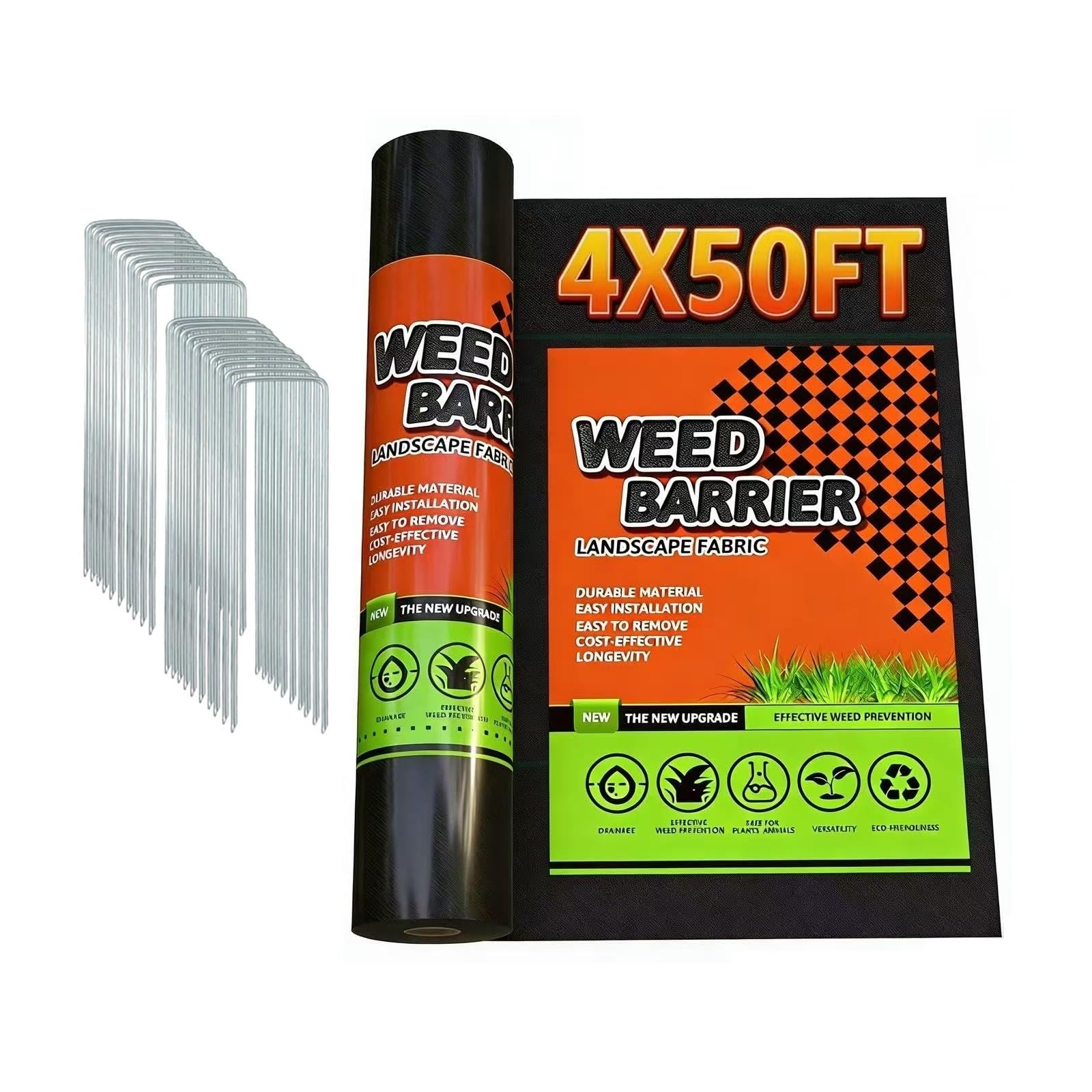
A light woven cloth that bends around trunks, shrubs, and curved borders where stiff fabric resists.
Tree rings, shrub beds, and the awkward gaps around an established root ball are this roll’s home turf. It is a high-density polypropylene woven fabric, and at 5.44 pounds for the 4 ft x 50 ft piece it is the lightest roll on this list — that lower weight is exactly why it wraps and folds around obstacles that a heavier cloth would resist. The high-density weave is what the maker leans on for tear resistance without the bulk.
Quality and function are what carry it, and the practical detail owners keep returning to is how well it works around trees specifically, where roots and curved edges demand a fabric that bends. It drains freely, letting rain reach the soil instead of pooling, and it trims down with scissors or a knife when you need a custom shape. UV resistance is built in, so the woven structure is designed to hold up against prolonged sun exposure rather than going brittle in a season.
The honest trade-off is texture: some owners find the woven material feels too much like plastic underfoot, a fair note if you want a soft natural look in a visible bed. There is also a handling quirk worth flagging — buyers warn it ships doubled over, so unroll and unfold each piece fully before you lay it, or you will end up with half the coverage you paid for. The same buyer who flagged the fold also confirmed it works after a few months, with weeds pushing against the cloth but not tearing through it.
The wrap-and-fold edge: At 5.44 pounds this is the lightest roll here, which is precisely what lets it negotiate roots, curves, and tight planting gaps.
One to know: The woven hand feels plasticky to some, and the roll arrives folded — unfold both layers before laying it out.
Fits you if: You are dressing beds around trees, shrubs, and driveways and want a light, UV-resistant cloth that bends.
Pass it by if: You need a heavy liner buried deep under stone — go denser for that job.
4. VEVOR 3x100FT 5oz Weed Barrier Fabric
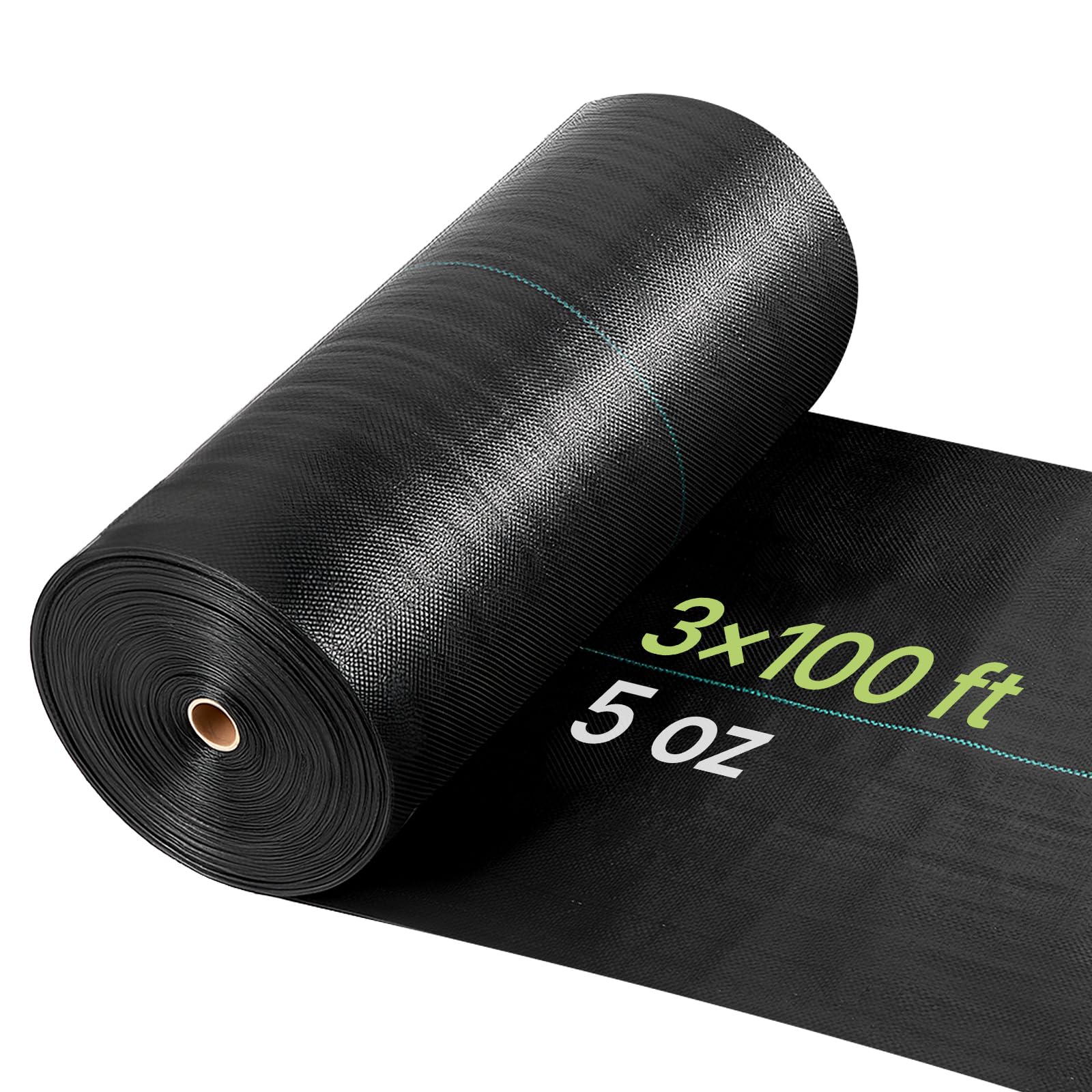
A 5 oz woven cloth built to sit under driveway gravel without puncturing.
When the cloth has to survive under crushed stone or on a driveway, this is where the numbers pull ahead. It is woven — a grid of flat polypropylene strands rather than a felt — and the strand density is graded at 5 oz/141.7g, the heaviest rating in this guide. The 3 x 100 ft/0.9 x 30.5m roll covers about 300 ft², enough for a driveway run or a long greenhouse floor, and it cuts with scissors into whatever shape your layout needs. Green guidelines on the surface keep plant rows in line when you lay it in a bed.
The tight, high-density structure limits weed root penetration and holds steady under gravel and stones, which is the part that matters most when weight presses down on it. Trimming along a border stays manageable because the weave resists fraying, and surface stability is the reason it performs as a driveway or path liner rather than a flimsy sheet that wrinkles. Durability comes up as the theme in owner write-ups, with the thickness and build quality earning the most credit.
The truth is no weed cloth is a perfect shield, and this one is no exception — some owners still see weeds working through over time, and it takes a dense, well-stabilized base to get the clean result people describe. Weigh it against the standout spec: at 10.36 pounds for the roll, this is by far the densest option here, the exact figure that lets a driveway bear down and lets the cloth come through unscathed.
Why the density matters: A 5 oz/141.7g woven structure and a 10.36-pound roll mean this is the heaviest armor against punctures and root penetration in this lineup.
The honest limit: It will not wall out every weed — some still punch through in time, so a well-prepped base does the rest of the work.
Best suited to: Driveways, gravel paths, and any surface where weight-bearing stability beats flexibility.
Heads-up: Its stiffness is a strength under stone but a chore in a tight tree ring — bendier cloth is easier there.
5. Winisok 4FT x 200FT Weed Barrier Landscape Fabric
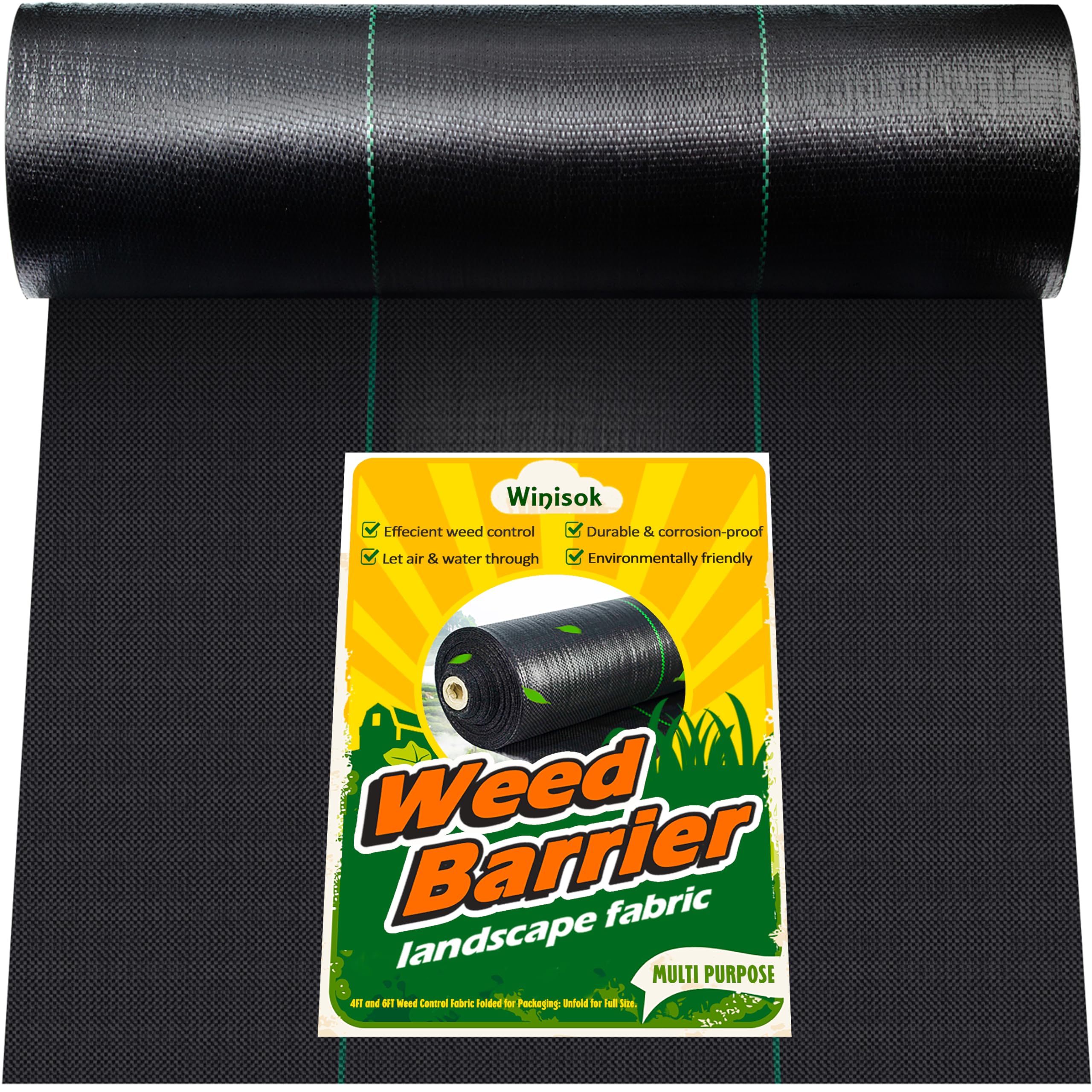
A single 4 ft x 200 ft roll that covers a large garden or a long drain run with fewer seams.
The draw here is simple arithmetic: a single 4FT x 200FT roll, the longest continuous piece in this lineup. Big vegetable plots, retaining-wall drainage, and full French drain runs benefit most, because fewer seams mean fewer spots where soil can sneak through. It is a 3.2oz woven polypropylene cloth, light and breathable so air and water reach plant roots without pooling at the surface. Green stripes printed on the fabric guide plant alignment and let you trim in a straight line.
This is the heaviest roll by shipping weight at 14.98 pounds, a figure that speaks to how much material is packed into the box. Laying it down and trimming to fit is reported as easy, with water reaching the soil underneath and vegetables coming up clean of weeds around them. The design is meant to block sunlight from reaching weeds under the cloth, so it can go directly over existing growth or onto a cleared surface.
Cutting is where you want to slow down. The recurring warning from the field is to skip the scissors for anything but rough sizing — the weave frays significantly at scissor-cut edges and punched holes, and a blow torch is the smoother way to make plant openings. Owner durability is honest about the multi-year picture too: it holds up while your garden layout stays put, but reworking beds repeatedly works against it.
The coverage win: A 4 ft x 200 ft continuous roll is the longest single piece here, ideal for large-area landscaping and French drain work.
The cut caveat: Edge fraying is real with scissors — use a heat method for plant holes and plan a stable garden layout.
Pick it when: You need maximum coverage in one piece for a large garden, retaining wall, or long drain run.
skip it if: You are laying a small single bed and would rather not store a giant roll of leftovers.
Know the Specs
Ounce rating (weight per square yard)
The ounce figure on a roll of landscape cloth is the weight of one square yard of the fabric — how much material you get per area. Heavier rolls are denser, which generally means tougher and harder to puncture. A 3.2oz woven cloth suits surface weed control and light garden coverage, while a 4 oz or 5 oz grade is better suited to sitting under gravel or burying in a drain trench where stone presses down. The ounce rating is the single fastest way to compare two rolls before you commit.
Non-woven versus woven construction
Non-woven geotextile is made by tangling fibers with barbed needles into a felt sheet; that tangled structure is what traps fine soil while still letting water pass, so it is often chosen for drainage and underlayment work. Woven cloth is a grid of flat strands: it drains fast, holds high tensile strength, and is usually cheaper, but it tends to let more fine silt through and can fray along a cut edge. Which you want depends on whether your job is filtering soil out of water or simply blocking sunlight from weeds.
Common Questions
Does non-woven geotextile work better than woven cloth in a French drain?
What ounce weight should I choose for fabric around a drain pipe?
Can I cut these rolls to size without the fabric unraveling?
How deep should I bury landscape fabric over a drain pipe?
Will landscape fabric stop all weeds from growing through?
Does the fabric let water reach plant roots or does it block drainage?
How do I overlap fabric seams so soil cannot wash through?
Is landscape fabric UV resistant enough to leave exposed in the sun?
Can I use weed barrier fabric for both a garden bed and a French drain?
Will heavy gravel sitting on top of the fabric tear or puncture it?
The Bottom Line
The fabric for french drain winner is the VEVOR 3ft x 100ft Non Woven Geotextile Fabric 4 OZ because its needle-punched non-woven build and 350N tensile strength are made for the filtering job a buried drain wrap asks of it. If you want a dense weave that endures driveway gravel, the VEVOR 3x100FT 5oz Weed Barrier Fabric at 5 oz/141.7g gives you the heaviest armor here. And for a bed around trees and shrubs, the Weed Barrier Landscape Fabric (4 * 50) bends where rigid cloth will not. Whichever roll you pick, unroll it fully a day before laying, and cut deliberately — careful unrolling and deliberate cutting above ground is what keeps soil out of your drain for seasons to come.
How we choose
We do not accept paid placement. Every pick is matched to a real buyer and a real use-case; we do not hands-on test units.
Sources
Specifications: manufacturer listings and product documentation. Review insights: verified customer reviews, as of October 2026. Pricing: not shown on this page (it changes often); check the current price via the retailer link.
As an Amazon Associate, Aappliancez earns from qualifying purchases. This does not affect which products we feature.