Disclosure: Some links in this post are affiliate links. As an Amazon Associate I earn from qualifying purchases, at no extra cost to you. Learn more
Specs are compiled from manufacturer listings and verified buyer reviews and can change over time — please confirm the key details on the product page before buying.
If you want a patch that keeps a crisp edge through hundreds of stitches, a dense felt or a tight poly-cotton twill does it far better than a loose, stretchy knit. That is the short answer. The longer answer is that the fabric has to match your backing, your stitch density, and how the patch will be worn — and the five options here cover the three jobs patchmakers actually face.
This guide is built by comparing the manufacturers’ published specifications and the patterns across verified customer reviews, so you get each pick’s real strengths and trade-offs instead of marketing spin.
The biggest mistake new patchmakers make is buying the cheapest bolt on the shelf and hoping a stabilizer will fix it. Below, I break down thickness, fiber content, and width so you can pick the right fabric for embroidery patches the first time.
Top Picks


How To Choose The Best Fabric for Embroidery Patches
Patchmaking is not the same as general sewing. Your needle punches the same spot hundreds of times, and the fabric has to survive that without stretching, puckering, or fraying at the cut edge. Three things decide whether a bolt is right for the job: thickness, fiber content, and how much surface area you get per order.
Thickness In Millimeters Is The First Filter
A felt under about 2 mm tends to compress flat once you add a dense satin-stitch border. Thicker felt — 3 mm and up — holds its loft so the patch keeps a raised, dimensional edge. Thicker also means the fabric resists puckering when you hoop it tight.
Fiber Content Decides How It Embroiders
Polyester felt is dense and cuts clean without fraying at the edge, which suits simple shapes and keychains. Acrylic felt is softer and comes in more colors, so it suits decorative patches and appliqué. A poly-cotton twill woven fabric is the classic choice when you want a flat, printable-looking patch face rather than a fuzzy one.
Width, Length, And Pieces Per Pack
A bolt is sold as one continuous piece; a precut pack is sold as a set of fixed-size squares. Bolt fabric gives you freedom to cut any shape. Precut squares are faster if your patch design already fits the square’s dimensions.
Cutting, Backing, And Edge Finish
Whatever fabric you pick, plan for a stabilizer behind it and a finished edge. Cut felt edges hold without hemming. Woven twill edges need a sewn or sealed finish or they will fray with handling.
Side-by-Side Comparison
| Model | Best For | Thickness | Fabric Type | Size Per Order | Amazon |
|---|---|---|---|---|---|
| aufodara Felt Fabric Roll★ Best Overall | Dense patches and thick shapes | 3 mm | Polyester felt | 11.8 x 98.4 inch roll | Amazon |
| Felt Fabric 1.8 mm by The YardLarge Format Pick | Large flat panels and linings | 1.8 mm | 100% Polyester felt | 36 x 72 inch piece | Amazon |
| FabricLA Craft Felt Rolls | Color variety across small patches | — | 100% Acrylic felt | 6 rolls, 12 x 18 inch each | Amazon |
| Pico Textiles Poly Cotton Twill | Machine-embroidered uniform patches | Medium weight | 65% Polyester / 35% Cotton | 60 inch wide, sold by the yard | Amazon |
| British Tweed 100% Wool Remnants | Textured, traditional-looking patches | — | 100% Wool | 10 pieces, 9 x 9 inch each | Amazon |
Detailed Reviews
1. aufodara Felt Fabric 11.8 x 98.4 inch
Our pick — over 4.5★ from 300+ verified ratings; the strongest balance of quality and price.
At 3 mm, this polyester felt is the thickest pick here, so patch edges hold their shape under dense stitching.
If your patch design has tight curves or a heavy satin-stitch border, density matters more than anything else. This roll measures 11.8 inches wide and 98.4 inches long — that is roughly 1,160 square inches of continuous felt to cut from. The dense fibers resist compression under the needle, so satin-stitch borders stay raised instead of sinking into the felt.
Buyers report it cuts and engraves cleanly: “Laser engravable and the laser can cut it.” That means you can cut shaped patches, stenciled logos, and keychains without a die cutter. Buyers also use it as a sound and airflow damper under AC and heat vent covers and as a barrier layer between flooring and mats, which confirms the fibers are tightly packed rather than loose.
The one catch is color range. White is what you see here, and while the felt is consistent and true to the swatch, you may need to dye it or layer it if you want more than one tone in a single patch series. Size your pattern to the 11.8-inch width and you will get dozens of standard 3-inch patches out of one roll.
What Earns It First Place
- The 3 mm thickness is the heaviest on this list — 67% more than the 1.8 mm felt — so patch edges hold their shape under dense stitching
- A 98.4-inch continuous bolt gives you the most usable length of any pick here
- Cuts and engraves cleanly, so shaped patches and keychains come out with crisp edges
- Dense enough to double as a vent damper or floor barrier when you are not making patches
Where It Falls Short
- White only — you will need dye, layering, or a second bolt for multi-color patch lines
- At 3 mm it is thick to fold around tight corners without clipping the seam
- Wider than some small cutting mats, so you will want to trim before you hoop
Your pick if: your patches have tight curves, dense borders, or need to keep a raised edge.
Think twice if: you want a rainbow of ready-to-cut colors in one order.
2. Felt Fabric 1.8 mm Thick 36″ x 72″
A full yard-wide sheet when your patch panel is bigger than a standard bolt.
Most felt arrives in narrow strips, and that limits the shape of the panel you can cut. This one ships as a single 36-inch by 72-inch piece — roughly four times the width of the aufodara roll above. That width is the reason to buy it: large patch backs, banner panels, and full board covers all cut in one pass without a seam down the middle.
The 1.8 mm thickness is on the lighter side, which is the honest trade-off. Thinner felt lies flatter and conforms around curved backing, but it can compress under very dense stitch fills. Owners describe it as soft and flexible, with tightly compressed fibers that resist fraying, and it glues cleanly without soaking through — useful if you attach patch backs with adhesive rather than stitching every edge.
Care is restricted: spot clean or hand wash only. A machine cycle will pill the surface. If you need patch fabric that survives a hot wash, a woven twill is the better route — this one is built for flat, carefully handled panels.
Width is the whole argument: 36 inches wide and 72 inches long in a single uncut piece — the most generous flat panel on this list.
The cost of that width: 1.8 mm is thin, so heavy stitch fills can compress it and the surface needs hand-washing.
Buy it for: big flat panel work where a seam would ruin the look.
Not for you if: your patches go through a washing machine.
3. FabricLA Craft Felt Fabric Rolls 6 Pieces
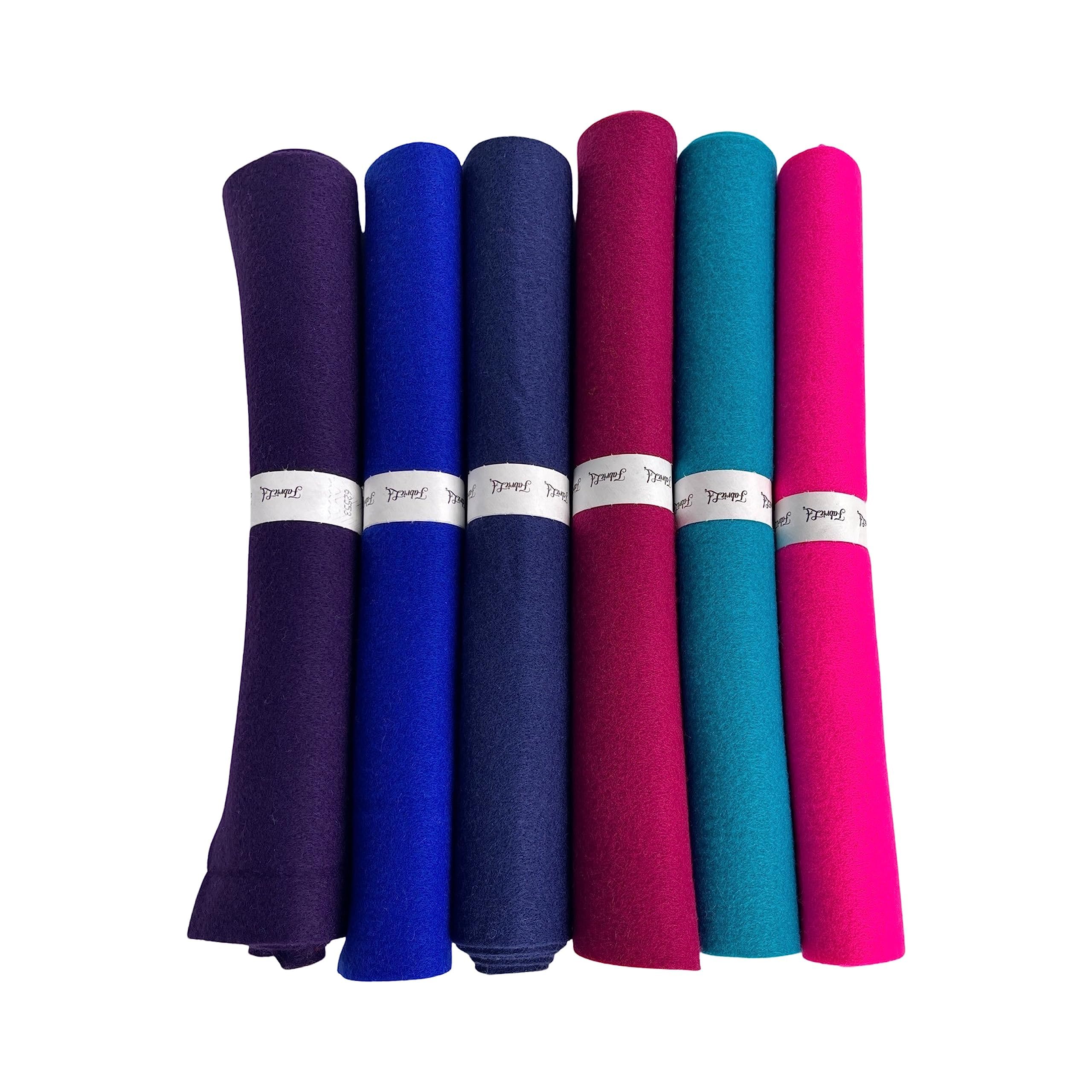
Six color families in one order, cut to a workable 12-by-18-inch roll each.
When a patch series needs multiple colors, buying separate bolts is wasteful. This pack packs six 12-inch by 18-inch rolls across named color lines including Autumn Colors, Shade of Greens, Pastel Lovers, Brown Palette, Colorful Grays, Imperial Yellows, and Color Visions. That is enough variation to build a matched set of patches without ordering five different bolts.
The material is 100% acrylic — non-woven, soft to the touch, and easy to cut, sew, and layer. The acrylic is fade resistant, which matters for patches on outdoor wear or a display banner under light. Buyers describe it as stiff enough to hold a shape yet soft enough to sit beside wool-blend felt, and it takes a cut edge without crumbling the way a loose weave would.
Two notes worth knowing before you commit. First, the listing itself warns that on-screen color can vary from the physical roll, so if you need an exact match, order a swatch first. Second, colors are packed as sets — you cannot request a specific six.
The value case: six separate 12 x 18 inch rolls across named color series means one order covers a whole patch colorway, not one tone at a time.
Acrylic, not wool: labeled 100% acrylic, so treat the “feels like wool-blend” comparisons as softness, not fiber content.
Made for: crafters building a multi-color patch set who want all the shades in one box.
Skip the pack if: you already own a color chart and only need a single repeat tone.
4. Pico Textiles 1 Yard Bolt White Poly Cotton Twill Fabric

The flat, woven face that machine embroidery was designed around.
Felt gives you a soft, fuzzy patch. Twill gives you a smooth, flat surface that reads like a printed logo. This bolt is 65% polyester and 35% cotton — a woven twill that stays wrinkle-resistant and holds a pressed edge. It is 60 inches wide, so you cut patch shapes from any point across the roll without wasting the middle. For anyone making embroidered patches on a machine, this is the referenced standard, and the review pattern here supports it: the fabric is praised most for its quality, with color close behind.
Owners mention the 65/35 poly-cotton takes stabilizer well and washes without shrinking much. Trim, back, and finish the edge and you have a patch that survives repeated laundering — a different durability class than felt, which needs hand-washing. It also takes applied color cleanly, so dyed or printed patches stay true through a wash cycle.
The honest downside is a structural one: on very dense machine embroidery, the fabric can pucker even with a good stabilizer and correct hooping. It is also a smooth white — no texture to hide tiny stitch errors. If you need a plush, textured patch face rather than a flat one, wool is the better pick below.
The functional edge: a woven, wrinkle-resistant 65/35 poly-cotton face is the cleanest surface for dense machine embroidery and holds up to a machine wash.
The trade-off: dense stitching can still pucker a woven fabric, and the smooth face leaves nowhere to hide imperfect stitching.
Choose this if: you run an embroidery machine and want a flat, wash-safe patch face.
Stay with felt if: you want a fuzzy, dimensioned patch edge instead.
5. British Tweed 100% Wool Remnants 10 Pieces

Real tweed texture in ten random squares, if you can work within the mix.
Not every patch should look flat. Wool tweed brings a woven pattern into the fabric — checks, herringbones, plains, and plaids pulled from active production runs. Ten pieces per pack, each a minimum 9 inches by 9 inches, gives you real variety for textured patch designs, mixed-media pieces, and traditional-looking badges. The maker, Huddersfield Fine Fabrics, sources from English and Scottish weavers, and customers single out the quality most — well ahead of every other attribute people mention.
The material is 100% wool. It is warm, dense, and takes a hand stitch and a decorative stitch beautifully. It also presses and molds around curves in a way acrylic will not. If you are making three-dimensional patches — pinwheels, folded ornaments, wool flowers — this is the fabric type that rewards that approach.
Two cautions worth reading twice. First, the packs are random, and the listing is explicit that what you receive will differ from the photos. Second, thickness varies piece to piece — the same run includes both heavy plaids and lighter plains, so do not design a patch that depends on a consistent weight. If you need one uniform fabric across fifty identical patches, this is not the bolt for that job. Machine embroidery is also a hard ask on wool; handwork is where it shines.
Why Buyers Keep Coming Back
- Ten different 100% wool squares per pack, each at least 9 x 9 inches
- Genuine tweed patterning — checks, herringbones, plains, and plaids — in every pack
- Takes decorative hand stitching, pressing, and folding far better than synthetic felt
- Quality is what people notice most about this fabric, and it leads the other attributes by a wide margin
Know Before You Order
- Packs are random and the listing warns they differ from the photos
- Thickness varies piece to piece, so it suits one-off designs rather than long identical runs
- Wool is not the ideal face for machine embroidery — this is handwork fabric
Reach for this if: your patches lean textured, traditional, or hand-stitched.
Look elsewhere if: you need fifty identical patches from one consistent cloth.
Know the Specs
Thickness (in millimeters)
Thickness is written in millimeters and it decides how much a patch edge can hold. Felt in the 3 mm range keeps a raised, dimensional edge under dense stitching. Felt around 1.8 mm lies flatter and conforms better around a curved backing, but compresses more easily under a heavy stitch fill. Woven twill is described by weight class rather than millimeter thickness, and it is measured differently because the surface is flat rather than lofted.
Fiber Content
Polyester felt is dense, cuts clean without fraying, and takes laser engraving. Acrylic felt is non-woven, soft, and comes in a wider color range — it is the pick for decorative patches. Wool is warm, textured, and molds around curves, but it suits handwork over machine stitching. A poly-cotton blend woven as twill gives you a flat, wrinkle-resistant face with minimal shrinkage in the wash, which is why it is the standard for machine-embroidered uniform patches.
Common Questions
What thickness of felt works best for embroidered patches?
Can I machine embroider on 100% wool tweed fabric?
Does acrylic felt fray when I cut patch shapes?
Will poly-cotton twill shrink when I wash a finished patch?
How many patches can I cut from one felt roll?
Is wool better than felt for textured patch designs?
Do I still need stabilizer when embroidering on thick felt?
Why do the British Tweed packs not match the listing photos?
Can I iron patches made from acrylic felt?
What is the difference between a felt bolt and precut felt squares?
The Bottom Line
The fabric for embroidery patches that wins is the aufodara Felt Fabric Roll — the 3 mm thickness holds a dense patch edge better than anything else here, and its 98.4-inch bolt gives you the most cutting material. If your patches go through a washing machine, the Pico Textiles Poly Cotton Twill is the one to grab. And if a textured, traditional look matters more than machine speed, the British Tweed Wool Remnants bring the richest surface on the list. One nudge before you order: match the 3 mm roll to your needle size and a stabilizer layer, and your edge will come out crisp on the first pass instead of the third.
How we choose
We do not accept paid placement. Every pick is matched to a real buyer and a real use-case; we do not hands-on test units.
Sources
Specifications: manufacturer listings and product documentation. Review insights: verified customer reviews, as of October 2026. Pricing: not shown on this page (it changes often); check the current price via the retailer link.
As an Amazon Associate, Aappliancez earns from qualifying purchases. This does not affect which products we feature.