Disclosure: Some links in this post are affiliate links. As an Amazon Associate I earn from qualifying purchases, at no extra cost to you. Learn more
Specs are compiled from manufacturer listings and verified buyer reviews and can change over time — please confirm the key details on the product page before buying.
Watery eyes sound harmless until you are dabbing your face every ten minutes and your vision keeps blurring at the worst possible moment. The fix is rarely a “stronger” drop — it is matching the drop type to the trigger. If allergies are the trigger, an antihistamine drop shuts the reaction down. If your eyes water because they are dry and irritated, a lubricating drop calms them instead.
This guide is built by comparing the manufacturers’ published specifications and the patterns across verified customer reviews, so you get each pick’s real strengths and trade-offs instead of marketing spin.
Below you will find five genuinely different options, from once-daily allergy formulas to preservative-free single-use vials, each matched to a specific kind of watery-eye problem. The goal is simple: help you pick the eye drops for watery eyes that fits your trigger.
Top Picks

How To Choose The Best Eye Drops for Watery Eyes
Before you buy anything, answer one question honestly: are your eyes watering because they itch, or because they feel dry, gritty, and tired? That single answer decides which half of this list you should be shopping in. An antihistamine drop is the wrong tool for plain dryness, and a lubricant will not stop an allergy flare.
Antihistamine drops versus lubricating drops
If your watering comes with itching, redness, and a season or a pet you can blame, you want an antihistamine drop — the active ingredient is usually olopatadine, measured as a percentage on the label. If your watering comes with a dry, sandy feeling and long screen sessions, you want a lubricant that mimics your own tears instead. Some people need both, using one for the allergy and the other in between.
Why single-use vials matter to some buyers
Multi-dose bottles carry a preservative so the liquid stays clean after you open it. For most people that is completely fine. But if you use drops many times a day, or your eyes react to preservatives, single-use vials give you a fresh, preservative-free dose every time and remove any worry about contamination.
Check the dosing instruction before you commit
A once-daily drop is convenient, but “once daily” is a firm instruction, not a suggestion — putting in extra drops does not make it work harder. If you want the freedom to dose as often as your eyes demand, a lubricating drop is the better fit.
Side-by-Side Comparison
| Model | Best For | Type | Dosing | Format | Amazon |
|---|---|---|---|---|---|
| REFRESH CLASSIC Lubricant Eye Drops★ Best Overall | All-day dry, gritty eyes | Lubricant | As often as needed | 30 single-use vials | Amazon |
| Glenmark Therapeutics Olopatadine 0.2%Best Value | Seasonal and pet allergies | Antihistamine | Once daily | Twin-pack bottles | Amazon |
| Bausch+Lomb Advanced Eye Relief | Fast itch relief that lasts the day | Antihistamine | Once daily | Single bottle | Amazon |
| NaturalCare by bioAllers Allergy Treatment | Mold, yeast, and dust sensitivity | Homeopathic formula | Drops, several times daily | 1 fl oz liquid | Amazon |
| Systane Ultra Lubricant Eye Drops | Long-lasting dryness protection | Lubricant | As needed | Multi-dose bottle | Amazon |
Detailed Reviews
1. REFRESH CLASSIC Lubricant Eye Drops
Our pick — over 4.5★ from 1,000+ verified ratings; the strongest balance of quality and price.
The preservative-free classic that keeps a fresh, clean dose in your bag at all times.
Thirty individual vials is the number that decides this pick. Each one holds a single preservative-free dose, so every drop that touches your eye is sterile and sting-free — no bottle that has been sitting open for weeks, and no worry about contamination. For anyone whose eyes water because they are persistently dry and irritated, that combination is the reason this formula has stuck around so long. It is designed to act like your own natural tears rather than coat your eye with something foreign.
What wins people over is the soothing itself. Owners describe the drops as moisturizing and long-lasting, and they are frequently used as the spacer between allergy drops — one set for the itch, this one for the dryness underneath. The vial format also earns real affection: it slips into a pocket or a glovebox, needs no refrigeration, and lets you dose as often as your eyes ask without ever counting drops. People recovering from Lasik mention keeping a box on the nightstand and working through it steadily.
The size of the pack, though, is worth a thought before you commit. Thirty vials go fast if you are a heavy user, and some buyers find the per-dose cost harder to justify than a multi-dose bottle, while a handful of users with extra-sensitive eyes still notice irritation. If your watering is driven by allergy itching rather than dryness, this is a lubricant first and foremost — it calms, it does not switch off an allergic reaction. Pair it with an antihistamine drop and you cover both jobs. It holds a 4.7-star rating and is the safest starting point on this list for most people.
What earns it the top spot
- Preservative-free formula designed to act like your own natural tears
- 30 single-use vials mean a fresh, contamination-free dose every time
- Gentle enough to use as often as needed, and small enough to live in a bag or glovebox
- FSA and HSA eligible, so pre-tax dollars may cover it depending on your plan
Where it asks a little patience
- Single-use format means a higher ongoing cost than a multi-dose bottle
- A few sensitive users still notice irritation
- It is a lubricant — it will not switch off an allergy reaction on its own
Reach for this if: your eyes water from dryness, screen strain, or post-surgical sensitivity and you want a clean, preservative-free dose on demand.
Look elsewhere if: you want to buy once and forget it — a multi-dose bottle stretches further.
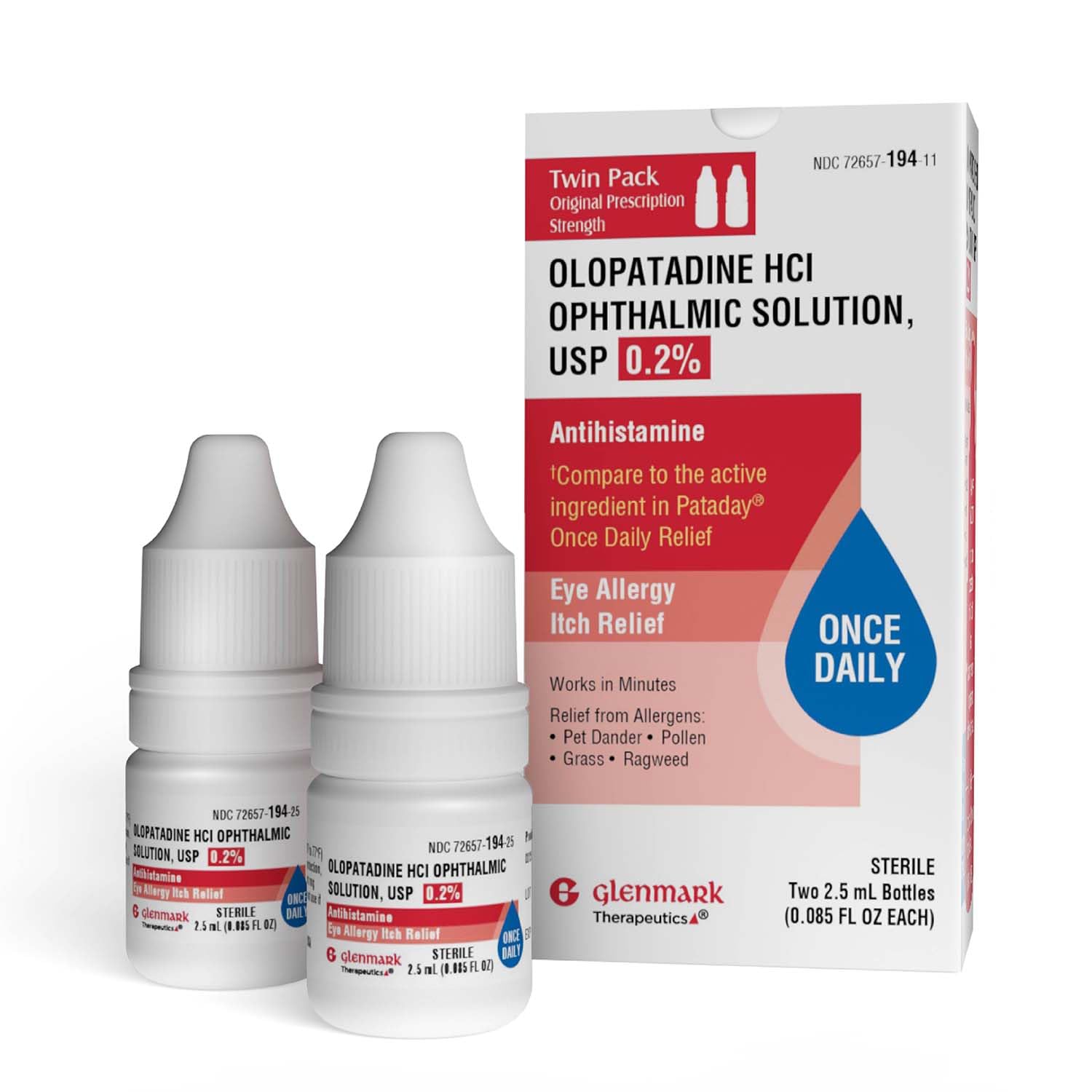
2. Glenmark Therapeutics Olopatadine Eye Drops
A twin-pack of the once-daily antihistamine formula that stops allergy watering at the source.
The label strength is the story here: Olopatadine HCl 0.2%, a concentration that used to require a prescription before it became available over the counter. One drop in each affected eye, once a day, no more than once a day, and it starts easing itch within minutes. For adults and children two years and older, that is a routine you can actually keep — no mid-afternoon rescue dose, no counting hours. Each bottle works out to roughly a 30 day supply.
Where this earns its place is the arithmetic of owning two. You are buying the twin-pack, which is the format that makes the whole proposition work for people who use these every single allergy season. The relief covers the usual suspects — pollen, ragweed, grass, and animal hair and dander — and owners use it across the family, including on their dogs during a bad relocation year, with the eyes finally stopping their constant gooping. Because the bottle is small, heavier users wish it were bigger.
That small bottle is the honest catch. It is light enough to vanish in a bag, which is exactly why people lose track of it. And if you want something you can reapply whenever your eyes feel scratchy, this is not it — once daily is the rule, not a guideline. Compared with the Bausch+Lomb pick further down, this is the more economical way to run the same active ingredient across a whole season, and the twin-pack is what makes that math land. Judge it on the formula and the two-bottle supply, not on the label.
The case in one line: prescription-strength olopatadine, now available without one, running about a 30 day supply per bottle across a two-bottle pack.
One practical caveat: the compact bottle drains quickly for anyone treating a whole household, so heavy users should plan on reordering through the season.
Built for: seasonal and pet-allergy sufferers who want one drop in the morning and relief that carries the day.
Not the one if: you need a drop you can use repeatedly whenever symptoms flare.
3. Bausch+Lomb Advanced Eye Relief Eye Drops
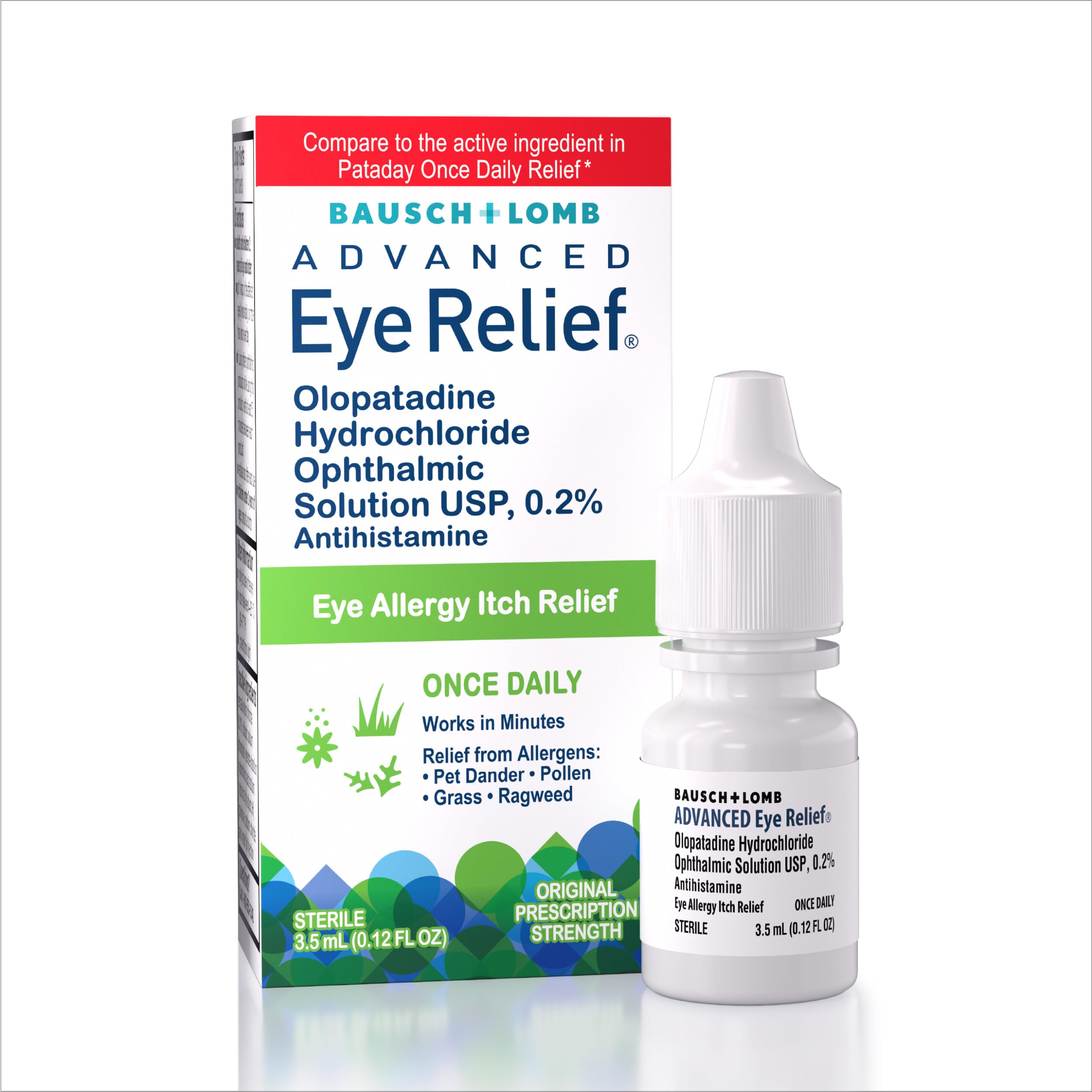
The one-drop morning routine that holds eye itch down for up to sixteen hours.
Sixteen hours of itch control from a single drop is what you are paying for, and it is the reason this bottle beats a two-or-three-times-a-day antihistamine for anyone with a real schedule. The active ingredient is Olopatadine 0.2% Hydrochloride — the same strength as the original prescription formula, an antihistamine that gets to work in minutes. Pollen, pet dander, grass, and ragweed are the four triggers it targets, which covers the overwhelming majority of seasonal watery-eye complaints.
Owners tend to describe two things: relief that arrives within the first day, and a consistency they did not get from thicker rivals. Bausch + Lomb has been making eye care products for over 150 years, and this formula is the version owners settle on after trying the alternatives.
The recurring gripe is pure volume: the bottle is smaller than buyers expect, and some feel the price is steep for what shows up. That is a fair read, and it is the one thing to weigh against the sixteen hours. Compared with the Glenmark twin-pack above, this gives you the longer relief window but less liquid for the money, so the honest split is convenience on this side, quantity on that one. If you want the fastest-acting once-daily antihistamine and do not mind a small supply, this is the pick.
The verdict: buy this when you want one morning drop to cover a full working day of allergy itch.
Think twice if: bottle size matters more to you than the length of relief — this one runs small.
4. NaturalCare by bioAllers Allergy Treatment

A liquid drop that treats the whole allergy picture, watery eyes included.
This one is built differently from everything else here: it is a homeopathic liquid formula taken as drops, designed to address allergy symptoms at the source rather than only the eye. That means it covers the runny nose, the sneezing, the sinus congestion, and the itchy, watery eyes together, in a non-drowsy format without the jitters, dryness, or thirst that some allergy medicines bring. It contains no known medication interactions, and the one-ounce liquid bottle is made to deliver precise levels of its ingredients in drop form.
Its specialty — and the reason to choose it over a straight eye drop — is environmental sensitivity. The formula is aimed specifically at reactions triggered by mold spores, yeast particles, and household dust, which is a narrower and more specific target than the pollen-and-pet-dander crowd. That focus shows in the way owners describe it: people who react to something in a dusty room, a damp basement, or an older house tend to be the ones who keep reordering. Some have used it for a very long time and treat it as a permanent fixture.
Two honest notes. First, it is a homeopathic formula, so if you want a measured pharmaceutical ingredient with a percentage on the label, this is not that — it is a different philosophy of relief. Second, users are split on how long a dose holds: some find it carries them for hours, others find it fades within a couple. A few very sensitive people report doing better on fewer drops than the suggested serving. Used consistently and early, it earns its keep for environmental triggers; expect to experiment with your own dose.
Why it earns a spot: it handles the sneezing, congestion, and watery eyes as one problem, non-drowsy, with no known medication interactions.
Why it is a niche call: it leans on homeopathic principles and specific environmental triggers rather than a labelled drug concentration.
Pick this one if: mold, yeast, or dust sets off your whole allergy picture and you want one gentle non-drowsy liquid to handle all of it.
Better to pass if: you specifically want a measured antihistamine percentage targeting your eyes alone.
5. Systane Ultra Lubricant Eye Drops

The thicker lubricant that leaves a protective shield instead of a quick splash.
Relief that lasts is exactly what owners describe — this is a drop people reach for when a plain saline-style tear dries out too quickly. Several users have leaned on it across decades of dry, tearing eyes, and those with blocked tear ducts find it is the one that actually gets the watering under control alongside their prescription routine. The bottle is also easy to squeeze a clean drop from, including the larger bottles that some competitors make awkward to dispense.
Two things to know. It is a lubricant, so it soothes and protects the eye surface rather than switching off an allergy itch — for that, you want one of the antihistamine picks above. And while many find it a fine value, others find it on the expensive side for a bottle, with the thicker feel sitting oddly for a small number of first-timers. If your eyes water because they are dry underneath, though, the protective-shield effect is the whole point, and it is a 4.7-star staple for that reason.
The bottom line: this is the pick when dryness is the true source of the tearing and you want one drop to hold through a long day.
Not the fix if: the root cause is an allergy — go antihistamine instead.
Know the Specs
Active strength and the percentage
On an antihistamine drop, the percentage on the label tells you how much of the active ingredient — usually olopatadine — the formula contains. A higher percentage like 0.2% is a once-daily strength, meaning one drop in the affected eye once a day is the full dose. That is not an approximation you can round up; one extra drop does not add relief, and the label instruction is the ceiling.
Preservative-free versus multi-dose
A multi-dose bottle carries a preservative so the liquid stays hygienic after opening. A preservative-free format, like single-use vials, instead gives you a fresh sealed dose every time. If your eyes water from dryness and you dose frequently, the preservative-free route removes the sting some sensitive eyes feel and any concern about contamination in a bottle that sits open.
Antihistamine versus lubricant
These solve two different problems. An antihistamine drop quiets the allergic reaction that makes eyes itch and water. A lubricant replenishes the moisture layer the eye surface is missing. Watery eyes can be the result of either, which is why matching the drop to the cause matters far more than buying the strongest one on the shelf.
Dosing frequency and daily routine
Once-daily formulas suit people who want one drop in the morning and no more decisions after that. Lubricants used as needed suit people whose symptoms come and go through the day. A homeopathic liquid taken as repeated drops suits a different routine entirely. Choose the cadence you can actually keep up, not the one that sounds most convenient on the package.
Common Questions
What is the difference between allergy eye drops and lubricating eye drops for watery eyes?
Can I use once-daily olopatadine eye drops more than once a day?
Are preservative-free eye drops better for sensitive eyes?
Can I wear contact lenses while using these eye drops?
How long do antihistamine eye drops take to work on itchy watery eyes?
What allergens do olopatadine eye drops actually treat?
Is the NaturalCare by bioAllers formula safe to take alongside other allergy medication?
How many drops of the homeopathic formula should I take?
Why do my eyes water more when they are actually dry?
Which of these eye drops is best for watery eyes caused by pet dander?
The Bottom Line
If your eyes water from dryness, screen strain, or post-surgical sensitivity and you want a clean dose you can reach for whenever you need one, the RefresH Classic preservative-free vials are the pick — preservative-free, designed to act like your own natural tears, and the safest starting point for most people. If your watering is driven by seasonal or pet allergies, the Glenmark Olopatadine twin-pack gives you prescription-strength relief with two bottles to carry you through a season. And if you want the longest single-drop window for an allergy, reach for the Bausch+Lomb Advanced Eye Relief, which holds itch down for up to sixteen hours.
How we choose
We do not accept paid placement. Every pick is matched to a real buyer and a real use-case; we do not hands-on test units.
Sources
Specifications: manufacturer listings and product documentation. Review insights: verified customer reviews, as of October 2026. Pricing: not shown on this page (it changes often); check the current price via the retailer link.
As an Amazon Associate, Aappliancez earns from qualifying purchases. This does not affect which products we feature.