Disclosure: Some links in this post are affiliate links. As an Amazon Associate I earn from qualifying purchases, at no extra cost to you. Learn more
Specs are compiled from manufacturer listings and verified buyer reviews and can change over time — please confirm the key details on the product page before buying.
What you actually want is a preservative-free lubricant that soothes without stinging, comes in a clean single-use vial, and matches whatever your eye doctor told you to use. Below are five options that fit those exact needs, sorted by what each one does best so you can pick in a couple of minutes.
This guide is built by comparing the manufacturers’ published specifications and the patterns across verified customer reviews, so you get each pick’s real strengths and trade-offs instead of marketing spin.
Preservative-free single-use vials are the practical starting point, since they stay sterile and let you dose as often as your doctor allows. Here is how the leading bottles and vials compare for eye drops after eye injection.
Top Picks

How To Choose The Best Eye Drops After Eye Injection
The right pick after an injection is the one your eye doctor named, used exactly the way they described. If they gave you a specific brand, that is the answer — everything below is about understanding why those instructions look the way they do, and what to pick if you were told to use “preservative-free artificial tears” without a name attached.
Preservative-free is the baseline
A preservative is an ingredient added to keep a multi-use bottle from growing bacteria once it is opened. Preservatives are fine for occasional use, but the surface of an eye that has just been injected is already irritated, so many doctors steer patients toward preservative-free formulas for the days that follow. A preservative-free drop is also gentler on eyes that sting easily, and it can be used more often because there is no preservative building up.
Single-use vials versus multi-use bottles
A single-use vial (sometimes called a unit-dose container) holds one measured dose of sterile drops with no preservative inside, because nothing needs to survive being reopened. You twist or snap the top, use the drops, and discard what is left over. The trade-off is packaging waste, and the upside is that every dose starts clean — which matters a lot when your eye is healing. A multi-use bottle is cheaper per drop, but once opened it carries a discard date printed on the label that you need to respect.
Lubricating tears versus hypertonic saline
Most drops on this list are lubricating tears: they add moisture and mimic part of your natural tear film, which is what makes a gritty, dry eye feel better. Hypertonic saline is a different job entirely — it is a saltier solution used for a specific swelling-related purpose, and it does not feel like a comfort drop going in. Do not swap one for the other on your own; use whichever category your doctor told you to use.
Side-by-Side Comparison
| Model | Best For | Format | Preservative-Free | Units Included | Amazon |
|---|---|---|---|---|---|
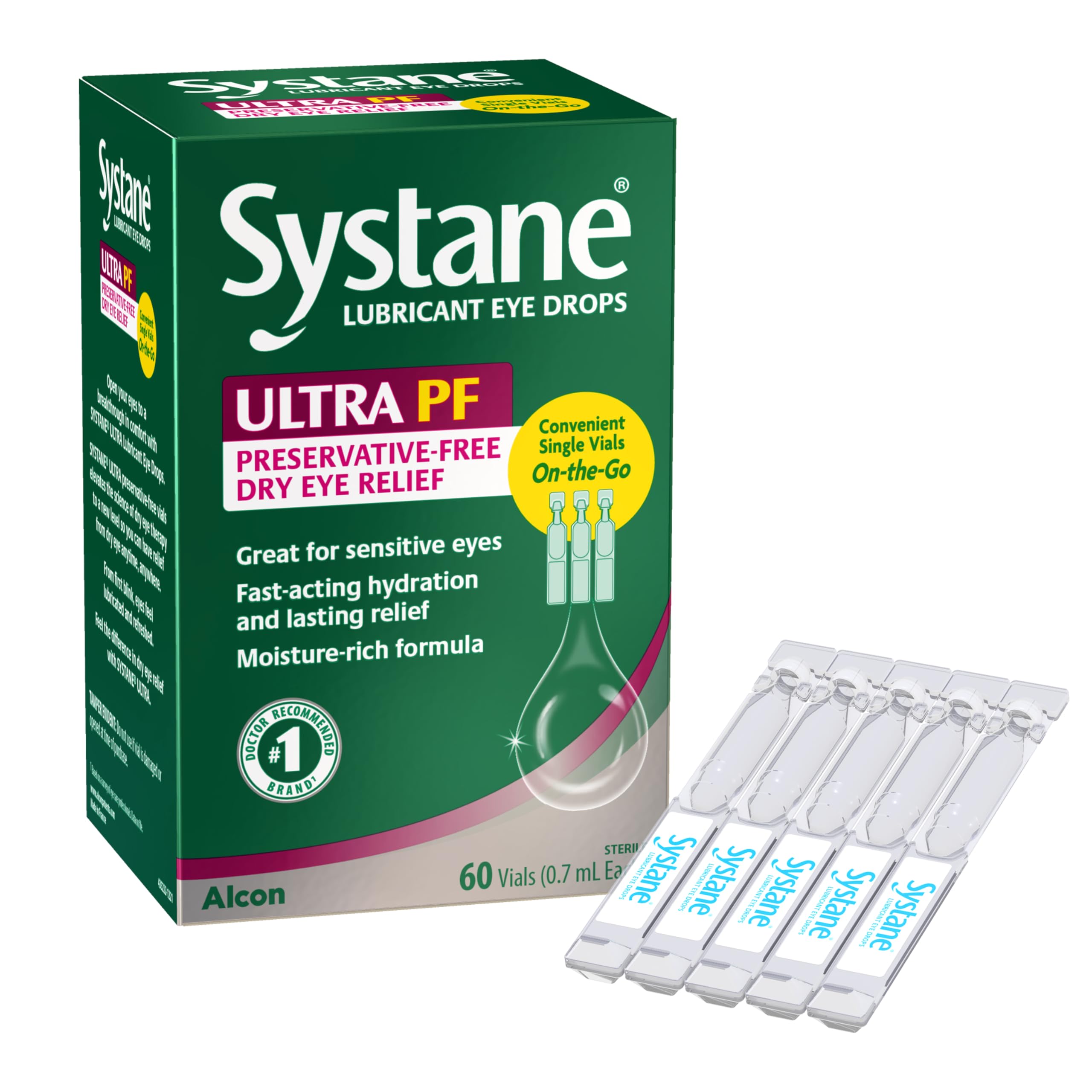
| Systane Ultra Preservative Free Lubricant Eye Drops★ Best Overall | All-around everyday dry eye | Single-use vials | Yes | 60 vials | Amazon |
| Lumify Eye Drops, 7.5 mL (Pack of 2)Best for Redness | Redness that will not quit | Multi-use bottle | No | 2 bottles | Amazon |
| REFRESH PLUS Preservative-Free Artificial Tears | Post-surgical dryness | Single-use vials | Yes | 70 vials | Amazon |
| GenTeal Tears Liquid Drops, Single-Use Vials | Sensitive eyes that sting easily | Single-use vials | Yes | 36 vials per pack, 3 packs | Amazon |
| Muro 128 5% Sodium Chloride Ophthalmic Solution | Swelling-related use only | Multi-use bottle | No | 3 bottles | Amazon |
Detailed Reviews
1. Systane Ultra Preservative Free Lubricant Eye Drops
Our pick — 4.5+★ from 11,000+ verified ratings; the strongest balance of quality and price.
The bottle-free vial that keeps an irritated eye hydrated without a single preservative inside.
Systane Ultra Preservative Free is the pick to start with if you want one box that covers the whole stretch after a procedure and beyond. It ships as 60 single-use vials weighing 4.69 ounces as a package — light enough to drop in a bag or a nightstand drawer. Two ingredients do the actual work here: Polyethylene Glycol 400 and Propylene Glycol. In plain terms, they are lubricants that top up the watery layer of your tear film, which is exactly the layer that thins out and leaves an eye feeling sandy.
What wins people over is the quality of the formula itself, and it shows in how broadly owners use it — everything from long screen days to wind, dust, and low humidity. The review pages include a post-PRK comparison that puts Systane Ultra toward the top of the preservative-free field for portable relief, and another long-running dry-eye user who says the Ultra version simply worked where the standard preservative-free line did not. One practical note from that same body of feedback: contact lens wearers should dose about 30 minutes before putting lenses in, or after taking them out.
There is one honest catch, and it is about waste rather than performance. A vial does not always get fully used in a single sitting, and several owners say the leftover goes down the drain — that is the cost of the single-use format. A condensed review also flags the relief window at roughly 30 minutes for some users in that PRK comparison, so if your eye is severely dry you may be reaching for the next vial sooner than you would like. On value the crowd splits, which is fair for a premium-brand vial.
What earns it the top spot
- Preservative-free formula that suits eyes sensitive to irritation
- 60 single-use vials, so every dose starts sterile and travel-ready
- Polyethylene Glycol 400 and Propylene Glycol target the watery layer of the tear film
- 4.69 ounces for the whole box, easy to keep in a bag or drawer
Where it asks a little patience
- Leftover drops in a partially used vial get discarded
- For very dry eyes the comfort window can run short before the next dose
- The premium brand price is the most common reservation
Best fit: anyone who wants one dependable preservative-free box for the days after an injection and for everyday dryness.
Think twice if: your eye needs a much longer single-dose window, or you want the lowest cost per drop.
2. Lumify, Eye Drops, 7.5 mL (Pack of 2)
The whitening drop people reach for when the injection left the eye looking red, not dry.
Start here only if redness is your problem, because Lumify does a different job than the lubricating vials above. It is a redness-relief drop from Bausch + Lomb, sold as two 7.5 mL bottles weighing 1.45 ounces total. Compare that with the 4.69 ounces of the Systane box — the Lumify pair is the far lighter thing to slip into a pocket. Two small bottles also outlast a single-vial format for some users, since you are not opening a fresh container every time.
Speed is the whole story with this one. Buyers report that “They clear any redness immediately using just 1-2 drops- the most 3-4.” That is the pattern across the feedback: eyes looking white within a minute, with the effect holding for a reasonable stretch and the eye still feeling moisturized rather than tight. For anyone whose main complaint after an injection is a bloodshot look, this is the closest match on the list.
The recurring gripe is cost, not performance — a small bottle at a premium-brand price is the trade-off, and it comes up repeatedly in the feedback. There is also a second, more important caveat: Lumify is not a preservative-free artificial tear, so if your doctor handed you post-injection instructions that specifically call for preservative-free lubrication, this is not the drop to substitute in. Use what you were told to use.
The speed factor: redness is the one thing this bottle is built for, and it settles the eye faster than anything else here.
Reach for this: when a red, bloodshot look is the complaint and your doctor has not restricted you to preservative-free tears.
Look elsewhere if: you need preservative-free lubrication, or you want the lowest cost per milliliter.
3. REFRESH PLUS Lubricant Eye Drops Preservative-Free

The one brand that openly names eye surgery on the label — which is exactly the situation you are in.
The REFRESH PLUS packaging states it can be used after LASIK or other eye surgeries, following your eye doctor’s instructions. That is the manufacturer telling you this formula was built with post-procedure eyes in mind. You get 70 single-use containers at 4 ounces for the box, so it is the largest vial count here — more doses on hand than the 60 in the Systane box or the GenTeal sets.
Moisturizing is the trait owners mention most, and the texture is the reason. A buyer summed it up neatly: “These little vials are really handy and the product is just right. Not too thin, not too thick. They travel well too. Since they are without preservatives, they can be used many more times a day than the bottled stuff. Each vial holds about six drops.” That six-drops-per-vial figure is worth holding onto, because it tells you how far one container stretches when you are dosing frequently. The formula is original-strength, preservative-free, and made with zero preservatives, and customers also describe it as working well with scleral contacts.
Where this one pushes back is quantity and value, both flagged as mixed in the feedback — some people feel short-changed per vial and some find the price high for the format. Both are fair. Weigh them against the fact that this is the only pick here whose own labeling speaks directly to post-surgical use, and the value math changes depending on how often you are dosing.
The surgery credential: a lubricating tear that the maker says can follow LASIK and other eye procedures, with 70 sterile vials to get through the recovery stretch.
Built for you if: you want a preservative-free tear whose own label addresses post-surgical dryness and you plan to dose several times a day.
Not the one if: you want a thicker drop, or the per-vial quantity matters more to you than the surgery guidance on the box.
4. GenTeal Tears Liquid Drops, Single-Use Vials

For the eye that flinches at everything — the vial owners keep describing as the one that never stings.
If the thought of putting anything in a freshly injected eye makes you wince, this is the name that comes up again and again for not stinging. That is a big claim to earn, and the feedback backs it up from multiple directions: users who have stayed with it for 35 years, and people who say it is the only drop they have tried that does not sting at all. The formula is preservative-free specifically to cut the irritation preservatives can cause.
The format is three packs of 36-count single-use vials — the same sterile, pre-measured, one-dose-per-container approach as the other vials here, on a larger overall supply. You get more total vials than the 60 in the Systane box, spread across three separate packs you can stash in different places. Lubrication is set at a moderate level, aimed at most dry eye symptoms rather than the heaviest cases.
Two trade-offs are worth knowing before you commit. First, this is a moderate-lubrication formula, so a severely dry eye may want something heavier — that is a match question, not a flaw. Second, the feedback on shelf life is genuinely mixed, and a few users note the drop can run a bit oily and leave a deposit. Storage habits will matter more here than with the other vials, so keep the vials where you can actually see the dates on them.
What buyers keep coming back to: a gentle, non-stinging feel that suits eyes which react badly to almost everything else.
Your pick if: stinging is the thing you dread most and you want a moderate, gentle lubricant in bulk single-use vials.
skip it if: your dryness is severe enough that you need heavy-duty lubrication, or you want the longest shelf life you can get.
5. Muro 128 5% Sodium Chloride Hypertonicity Ophthalmic Solution

Not a comfort drop at all — a specialist saline solution with one narrow, doctor-directed job.
Be clear about what this is before you buy it, because it is the odd one out on this list. Muro 128 is a 5% sodium chloride hypertonicity solution — the saltier mix that makes it a hypertonic drop rather than a lubricating tear. Its stated use is temporary relief of corneal edema, and the label directs two drops in the affected eye every three to four hours, or as directed by your doctor. It comes as a three-pack of 0.5 fl oz bottles from Bausch + Lomb.
The experience is not a gentle one, and owners mention so plainly. As owners put it, it “burns like hades when you put it in, but really helps with dryness.” That sting is expected with this kind of solution, not a defect — the same feedback notes it helps tired eyes and severe dryness when a doctor approves it. One long-time user applies it nightly for corneal inflammation, and another says it eased post-surgical burning that numbing drops could not touch. Note that those are individual experiences, not a guarantee of what yours will be.
Here is the part that matters most: this is not an artificial tear and not a substitute for the preservative-free lubricants above. It is a multi-use bottle, so it carries no preservative-free claim, and it is not sold as a redness or comfort drop. Buy it only if a doctor has told you to use a hypertonic saline solution, and follow their dosage rather than the general label.
One job, done by the book: a 5% sodium chloride solution for temporary relief of corneal edema, bought on a doctor’s direction.
Only for you if: your eye doctor has specifically directed you to a hypertonic saline solution for swelling-related relief.
Leave it out if: you are shopping for general post-injection comfort — that is what the preservative-free lubricating vials above are for.
Know the Specs
Preservative-Free vs Preserved
A preservative is an added ingredient that stops bacteria growing in a bottle once it has been opened. That is useful in a multi-use bottle, but it is an extra chemical touching an eye that has just been injected. A preservative-free formula skips it entirely, which is why the single-use vials here are preservative-free by design and the multi-use bottles — Lumify and Muro 128 — are not. If your doctor said preservative-free, that instruction rules out the multi-use bottles.
Vial Count and Per-Dose Volume
The vial count tells you how long a box lasts, not how much liquid you get per dose. Seventy vials go further than sixty, and both go further than three packs of thirty-six in the sense of total containers in the house. What matters more day to day is how many drops each container gives you — REFRESH PLUS vials run about six drops apiece, so a single container can cover more than one dosing if you recap it cleanly. Always discard a vial once its printed window has passed.
Common Questions
Can I use the same drops after an eye injection that I use every day?
Is preservative-free better right after an injection?
How many drops does one single-use vial hold?
Can I put leftover drops from a vial back in the container for later?
Are redness drops like Lumify okay after an eye injection?
What is the difference between lubricating tears and hypertonic saline drops?
How long should I wait after an injection before using drops?
Can I wear contact lenses while using these drops?
Are the multi-use bottles safe to keep using for weeks?
How should I store single-use vials between doses?
The Bottom Line
For most people working through the days after an injection, the strongest single pick is Systane Ultra Preservative Free. Its formula goes to work on the watery layer of the tear film, and it comes as 60 sterile single-use vials you can dose from wherever you happen to be — rated 4.5+ stars by 11,000+ owners. If your doctor’s instruction was specifically about eye surgery, the REFRESH PLUS set is the one whose own label speaks to post-surgical use, with those 70 vials lasting the recovery stretch. And if the whole problem is a lingering red, bloodshot look, the Lumify pair handles that faster than anything else on the list. Whatever you choose, buy the category your eye doctor named rather than the one that sounds best.
How we choose
We do not accept paid placement. Every pick is matched to a real buyer and a real use-case; we do not hands-on test units.
Sources
Specifications: manufacturer listings and product documentation. Review insights: verified customer reviews, as of October 2026. Pricing: not shown on this page (it changes often); check the current price via the retailer link.
As an Amazon Associate, Aappliancez earns from qualifying purchases. This does not affect which products we feature.