Disclosure: Some links in this post are affiliate links. As an Amazon Associate I earn from qualifying purchases, at no extra cost to you. Learn more
Specs are compiled from manufacturer listings and verified buyer reviews and can change over time — please confirm the key details on the product page before buying.
If your under-eye area has started catching the light differently — shadows that sit deeper, skin that looks thinner, lines that seem to grab every bit of makeup you put near them — you are not imagining it. Mature under-eyes need a different kind of product: something that hydrates first, corrects color second, and does not settle into the very lines you are trying to soften. The picks below split into two jobs that work best together: a cream that treats the skin over time, and a targeted corrector or concealer that handles the look of darkness on the day.
This guide is built by comparing the manufacturers’ published specifications and the patterns across verified customer reviews, so you get each pick’s real strengths and trade-offs instead of marketing spin.
You will see where a hydrating retinol eye cream beats a pigment product for long-term texture, and where a peach-toned corrector does more for a bluish shadow in ten seconds than any thick concealer can. Each pick below is matched to a real under-eye problem, so you can stop guessing at the beauty counter and start with the eye corrector for mature skin that fits yours.
Top Picks

How To Choose The Best Eye Corrector for Mature Skin
Mature under-eye skin is thin, often dry, and quick to show every bit of texture you press onto it. The right product for you depends less on brand name and more on which problem you are solving: darkness, puffiness, fine lines, or the way makeup settles into them by mid-afternoon. Figure out your main complaint first, then match the formula to it.
Corrector or concealer — know which one you are buying
A color corrector is not meant to match your skin tone. It is a tinted base — often peach, pink, or warm-toned — that visually balances the blue, purple, or gray cast of a dark circle before you add coverage on top. A concealer is the coverage layer itself. The clearest example in this lineup is the Elizabeth Mott Thank Me Later brightener base, which is explicitly described as a base used before concealer rather than a full-coverage product on its own. If you expect a corrector to erase a shadow by itself, you will be disappointed; layer a concealer over it and the difference shows.
Look at the texture, not just the shade
Under-eye skin on mature faces tends to be drier, so a formula that hydrates while it covers tends to wear better than a flat matte one. Ingredients like niacinamide and cucumber fruit extract in the Laura Geller concealer are there to keep the finish from turning cakey. A buttery cream like the Charlotte Tilbury Magic Vanish blends easily but can highlight dry patches if your under-eye area is parched. Creamy textures generally suit dry skin; anything too heavy can slide or feel greasy under makeup in the morning.
Decide if you want treatment or instant coverage
Two very different jobs sit in this category. A retinol eye cream like the RoC Correxion works on the look of puffiness, dark circles, and wrinkles over weeks of nightly use. A pigment product like a corrector or concealer changes the look of your under-eyes in the time it takes to blend. Mature skin routines often run both: treatment at night, correction in the morning. Buying one when you wanted the other is the most common mismatch in this category.
Side-by-Side Comparison
| Model | Best For | Product Type | Size / Weight | Key Ingredient | Amazon |
|---|---|---|---|---|---|
| LAURA GELLER NEW YORK Concealer Deep★ Best Overall | Full coverage that stays off fine lines | Full-coverage concealer | 2.4 ounces | Niacinamide, Cucumber Fruit Extract | Amazon |
| Elizabeth Mott Under Eye Brightener Warm Peach | Priming and brightening before concealer | Brightener base (not a concealer) | 0.63 ounces | Shea Butter, Niacinamide, Hyaluronic Acid | Amazon |
| RoC Retinol Correxion Under Eye Cream for Dark Circles & Puffiness | Nightly retinol treatment for puffiness and lines | Retinol eye cream | 0.50 ounces | Retinol, mineral complex | Amazon |
| Charlotte Tilbury Magic Vanish Color Corrector | Peach-toned correction under fair skin | Color corrector | 0.09 ounces | Vitamin E, flavonoids, Mica | Amazon |
Detailed Reviews
1. LAURA GELLER NEW YORK Concealer Deep
Our pick — 4.5+★ from 950+ verified ratings; the strongest balance of quality and price.
Full coverage that goes on creamy and dries powdery — without grabbing at fine lines.
What wins people over here is coverage, and it is not a thin, watery cover-up. This is a full-coverage concealer built to camouflage the look of redness, dark circles, and other discoloration. The formula is blended with niacinamide (a skin-friendly ingredient used to support a more even-looking tone) plus antioxidant-rich cucumber fruit extract. That combination is why it reads as hydrating rather than cakey on mature skin. For deep skin tones, the Deep shade is the one to look at in this range.
Texture is the second reason it lands here. It feels smooth and silky going on — reviewers describe it as feeling like silk on the skin — and it blends easily for a natural-looking finish rather than a mask. There is a cream-to-powder behavior worth knowing: it goes on light and creamy, then dries down to a powdery finish without drying your skin out. On aging skin that is the balance you want, because a formula that stays wet can slide, and one that sets too hard can emphasize every line. Used with a light hand, the 2.4-ounce jar is described as lasting close to a year.
Here is the cross-check worth making: this 2.4-ounce jar is heavier on the scale than the 0.63-ounce Elizabeth Mott base. Its package is a compact 2.32 x 2.32 x 0.55 inches versus the slim 4.72 x 0.79 x 0.75-inch tube of the Elizabeth Mott. In practice that means the Laura Geller sits on a vanity while the Elizabeth Mott slips into a purse. The catch is honestly minor: longevity and value-for-money come up as mixed notes, and a small number of buyers find the amount inside the compact modest for the price. A little goes a long way, though, so the jar stretches further than the size suggests.
What buyers keep coming back for
- Full coverage that hides dark circles and discoloration without a heavy, greasy feel.
- Creamy texture that blends easily and dries to a soft powdery finish without drying skin.
- Niacinamide and cucumber fruit extract keep the formula hydrating on mature, dry skin.
Where it asks a little patience
- Longevity is a mixed note — some find it needs a setting step to last all day.
- The compact holds a modest amount, so frequent full-face users may run through it faster.
Reach for this if: you want one product that covers darkness and discoloration fully while feeling weightless on mature skin.
Look elsewhere if: you prefer a slim tube you can touch up with on the go — the compact is a vanity piece.
2. Elizabeth Mott Under Eye Brightener Warm Peach
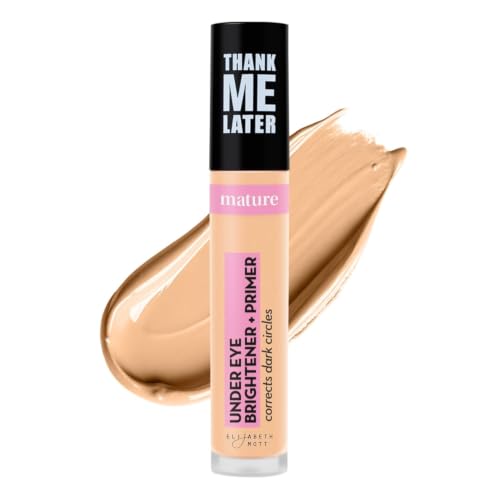
The warm-peach base that makes your concealer behave — and keeps it put from morning to night.
Read the label carefully before you buy: this is a brightener base, not a concealer. It is meant to be applied before concealer to help dull, tired-looking under-eyes look brighter, smoother, and more even. It is not designed to match your skin tone or provide full coverage on its own. The Warm Peach tone works like a warm light in a cool room — it visually balances the blue, purple, or gray cast of a dark circle so the under-eye area looks brighter. It softens the look of darkness rather than erasing it, so follow with concealer for fuller coverage.
Where it earns its slot is layering performance. Like a primer before paint, it creates a smoother surface so concealer applies more evenly and wears fresher. The formula is made with shea butter, niacinamide, white mulberry extract, and hyaluronic acid, which is why it stays lightweight enough to layer comfortably on mature under-eyes. The brand’s own guidance is to apply after skincare has absorbed, wait 60 seconds, then add concealer on top — and it works with cream, liquid, or stick concealers. The honest catch is that it is described as drying under-eye by some, which is the trade-off for its grip; if your under-eye area is very dry, hydrate first and use a thin layer.
Put it next to the Charlotte Tilbury corrector and you see two philosophies. This Elizabeth Mott tube is 4.72 x 0.79 x 0.75 inches — slim, purse-ready — while the Charlotte Tilbury compact is a squat 2.56 x 2.56 x 0.79 inches. This one is a base layer; the Charlotte Tilbury is a standalone corrector. If you want the smoothest possible canvas under concealer, this is your first layer.
The everyday payoff: owners describe it as the best no-smudge eye base they have used — it dries down quickly, grips cream shadow evenly, and keeps concealer from sliding through heat and oil. The multi-use angle is real too: it can double as an inner-eye brightener and lid prep.
The one honest caveat: a thin layer is essential. Too much, or a wet/gel shadow applied over it before it has dried, can lift the primer — work fast and keep the layer ultra-thin.
Best for: anyone whose concealer creases or fades by lunchtime and wants a gripping base underneath.
Skip if: you want full coverage from a single product — this is a base, not a concealer.
3. RoC Retinol Correxion Under Eye Cream

A retinol eye cream that works on the look of puffiness and lines while you sleep — no pigment, no coverage.
The defining spec here is the ingredient list: this is a retinol eye cream, not a corrector or concealer. It is built to address three signs of eye aging — puffiness, dark circles, and wrinkles — with one cream. Retinol is a vitamin A derivative used over time to support the look of firmer, smoother skin, and here it is combined with a mineral complex. The retinol formula is described as hypoallergenic and gentle enough for daily use. It does its job over weeks, not minutes, so pair it with a pigment product for same-day coverage.
What mature users report most consistently is effect on texture and lines rather than on dark circles. Owners in their mid-fifties report under-eye wrinkles looking diminished and skin feeling tighter with a glow after about three weeks of nightly use. One long-run report at age 53 describes under-eye hollows looking plumped and dark circles significantly reduced after two months of nightly use. Dark circles are the honest weak spot: for some the change is clear, for others it is minimal after months of use. If darkness is your main concern, this is a support layer, not the main event.
The clear trade-off is texture in daylight. The cream is rich, which is great at night but can be too heavy under makeup in the morning — so most people apply it as the last step before bed. It weighs 0.64 ounces and comes in a small 2 x 2 x 3-inch pot, so it lives comfortably on a nightstand.
What earns it a nightly spot
- Retinol plus a mineral complex targets the look of puffiness, dark circles, and wrinkles together.
- Hypoallergenic and gentle enough for nightly use on delicate under-eye skin.
- A rich cream that many mature users find visibly smoother on fine lines within weeks.
What to know before you commit
- Results are gradual — this is a weeks-to-months routine, not an instant fix.
- Too rich to layer under daytime makeup for many users; it belongs in the evening.
The long game: pick this if you want to work on the look of fine lines and puffiness over time, and you have the patience for a nightly routine.
The honest limit: it will not give you instant coverage — keep a corrector or concealer for the morning.
4. Charlotte Tilbury Magic Vanish Color Corrector

A peach-toned buttery corrector that cancels blue under-eye shadows for fair skin — before concealer.
This one earns its place on color theory. The peach-toned pigmentation is designed to neutralize blue-toned circles under fair skin, and that is the mechanism that makes a corrector different from a concealer. Mica brings a luminous, brightening effect to the skin, while vitamin E and flavonoids are included to nourish the under-eye area. It blends in a buttery, smooth way — you tap it under the eye with a ring finger or a brush, then follow with concealer to match your natural tone. It is the only pure color corrector in this lineup, which is exactly why it looks different on the skin.
The coverage is the standout, and it is not heavy. It goes on easily with no caking, and owners describe the bags under their eyes barely showing. It works beyond the under-eye too — it doubles on redness where you need color correction, and it can act as a low-coverage pre-concealer with a little touch-up in a purse. The main honest trade-off is crease resistance: it is a buttery cream, so on very dry under-eyes it can accentuate dry patches, and some find it settles into fine lines by the end of the day. At 0.09 ounces it is a small compact — a little tapped on is all you need.
Compare it with the Elizabeth Mott base and the difference is role, not quality. The Elizabeth Mott 0.63-ounce tube is a gripping primer layer; this Charlotte Tilbury 0.09-ounce compact is a standalone corrector. Pick the Tilbury if you want a single product to cancel a shadow, and the Elizabeth Mott if your goal is to lock a concealer in place.
Why it works on fair skin: the peach tone does the color work that a flat concealer cannot — it counteracts the blue cast of a dark circle so the area looks brighter, not just covered.
Where it needs a lighter hand: it is a cream, so on dry under-eyes use a hydrating eye prep first — otherwise it can settle into the same fine lines you are trying to blur.
Pick this if: you have fair skin and a blue-toned shadow you want neutralized before concealer.
Pair it instead if: your priority is a gripping base under a full-coverage product — the Elizabeth Mott is the better layering choice.
Know the Specs
Color correction vs coverage
A corrector is tinted to balance a color cast — peach for blue-toned under-eyes on fair skin, for example — while a concealer is the coverage layer that matches your skin and hides what remains. Confusing the two leads to disappointment: a corrector alone will not erase a shadow, and a concealer alone often looks gray over a strong blue cast. On mature skin, a thin corrector layer under a lighter concealer usually looks more natural than one thick concealer layer, because less product means less to settle into fine lines.
Retinol vs pigment: treatment vs quick fix
Retinol eye creams work on the look of texture, puffiness, and fine lines over weeks — the change is gradual, not immediate. Pigment products like concealers and correctors change the look of your under-eyes instantly but do nothing for the skin underneath. A mature skin routine often uses both: the retinol cream at night to support the skin, and a corrector or concealer in the morning for the look of a brighter under-eye. Buy for the timeline you actually want — instant or gradual.
Crease resistance and texture
Creasing happens when a cream formula gathers in the folds of fine lines. A cream-to-powder finish like the Laura Geller concealer sets and resists sliding, while a rich buttery cream like the Charlotte Tilbury corrector needs a lighter application and a hydrated base. The amount matters as much as the formula: a thin layer patted on with a ring finger, rather than a heavy swipe, is what keeps the product sitting on the surface instead of sinking into lines.
Size, format, and where it lives
Eye products come in small pots and slim tubes, and the format tells you where it belongs. A 2.32 x 2.32 x 0.55-inch compact sits on a vanity; a 4.72 x 0.79 x 0.75-inch tube slips into a purse for touch-ups. A 0.50-ounce eye cream pot works on a nightstand. None of these sizes is a flaw — they are different jobs in different places. Match the format to when and where you will actually reach for it.
Common Questions
Should I put a corrector on before or after my concealer?
Will a color corrector actually hide my dark circles on its own?
What is the difference between a corrector and a concealer for mature skin?
How long does a retinol eye cream take to show a difference?
Can I layer a brightener base and a retinol eye cream together?
Why does my under-eye product crease by the afternoon?
Does the Warm Peach shade work on deeper skin tones?
Is the Charlotte Tilbury corrector only for fair skin?
How much product do I actually need per use?
Can I use an under-eye corrector on redness elsewhere on my face?
The Bottom Line
For most mature under-eyes, the strongest single product here is the LAURA GELLER NEW YORK smooth Finish Full Coverage Concealer — it delivers full coverage that stays weightless and hydrating, which is the exact balance mature skin needs from the coverage layer. If you want a gripping base under your concealer, reach for the Elizabeth Mott Thank Me Later Under Eye Brightener Base. And if your real concern is the look of fine lines and puffiness over time, the RoC Retinol Correxion Under Eye Cream is the nightly treatment worth building the routine around.
The honest nudge: mature under-eyes rarely need one product — they need a treatment layer and a correction layer. Build the pair that fits your day, keep the layers thin, and you will get the smooth, bright look without the crease.
How we choose
We do not accept paid placement. Every pick is matched to a real buyer and a real use-case; we do not hands-on test units.
Sources
Specifications: manufacturer listings and product documentation. Review insights: verified customer reviews, as of October 2026. Pricing: not shown on this page (it changes often); check the current price via the retailer link.
As an Amazon Associate, Aappliancez earns from qualifying purchases. This does not affect which products we feature.