Disclosure: Some links in this post are affiliate links. As an Amazon Associate I earn from qualifying purchases, at no extra cost to you. Learn more
Specs are compiled from manufacturer listings and verified buyer reviews and can change over time — please confirm the key details on the product page before buying.
If your fridge water has started to taste like a swimming pool or a plastic bottle, the fix is usually one part — not a new refrigerator. This guide covers the external water filter for refrigerator setups that replace or bypass the cartridge inside your fridge door, plus the OEM drop-in cartridges that keep a specific brand running exactly as designed. The short answer: the Frigidaire ULTRAWF is the strongest all-rounder for anyone with a genuine Frigidaire PureSource Ultra system, while the Frizzlife MS99 is the pick if you want to stop buying branded cartridges altogether.
This guide is built by comparing the manufacturers’ published specifications and the patterns across verified customer reviews, so you get each pick’s real strengths and trade-offs instead of marketing spin.
Some filters drop straight into a factory slot, while others are inline systems that mount behind the fridge. Knowing which style your appliance accepts decides everything that follows. That one compatibility check decides whether an external water filter for refrigerator use is a five-minute install or a return label.
Top Picks


How To Choose The Best External Water Filter for Refrigerator
The first decision is not brand or budget. It is whether your fridge wants a cartridge pushed into a slot, or whether you are plumbing an external filter into the water line that feeds it. Get it wrong and no spec on the box will save the install.
Work out which filter style your fridge takes
Fridges with a built-in filter bay — a compartment behind the crisper drawer or inside the door — take a drop-in cartridge. You pull the old one out, push the new one in until it clicks, and you are done. Fridges without a filter bay, or owners who want to stop buying branded cartridges, use an inline filter. That is a canister mounted behind the fridge or under the sink that the water line runs through before it reaches the ice maker.
An inline system typically does not care which fridge brand you own. It connects to a standard water supply line with compression brass fittings, which is why it fits copper tubing and PEX piping alike.
Read the certification line, not the marketing line
NSF/ANSI 42 covers taste, odor and chlorine — the aesthetic stuff. NSF/ANSI 53 covers contaminants with health effects, which often includes lead. NSF/ANSI 401 covers emerging contaminants. A filter certified to all three has been independently tested on more fronts than one certified to 42 alone. That difference is not academic if lead is your concern.
Check filter life against what you drink
Cartridge life is quoted in months or gallons. A drop-in cartridge rated for 6 months means you buy two a year. An inline cartridge rated for 2 years means you buy one every other year. Both are honest numbers — the difference is how much waste and repeat cost you take on.
Side-by-Side Comparison
| Model | Best For | Type | Certification | Filter Life | Amazon |
|---|---|---|---|---|---|
| Frigidaire ULTRAWF★ Best Overall | Frigidaire PureSource Ultra owners | Drop-in cartridge | NSF 42, 53, 401 | 6-month reminder cycle | Amazon |
| Fisher & Paykel 847200Exact Match | Fisher & Paykel fridge models | Drop-in cartridge | NSF 42 | Twice-yearly replacement | Amazon |
| Samsung HAF-QIN-2P/EXP | Samsung French door and side-by-side | Drop-in cartridge (2-pack) | NSF 42, 53, 401 | 6 months per cartridge | Amazon |
| Frizzlife MS99 | Replacing a leaking or costly OEM filter | Inline system | NSF 42 & 53 | 2 years / 1600 gallons | Amazon |
| Frizzlife SK99-NEW | Under-sink plus fridge on one system | Under-sink system | NSF 42, 53, 372 | Core-only replacement | Amazon |
| CuZn UC-200 | Long-life, low-maintenance installs | Inline system | NSF 42 & 372 | 5 years | Amazon |
| Sub-Zero 4204490 / 7007067 | Sub-Zero owners needing air plus water | Drop-in combo pack | NSF 42 & 53 | — | Amazon |
Detailed Reviews
1. Frigidaire ULTRAWF Refrigerator Water Filter Replacement
Our pick — 4.5+★ from 46,500+ verified ratings; the strongest balance of quality and price.
Three certifications on one cartridge, and a push-in fit that takes seconds.
The ULTRAWF is a genuine Frigidaire cartridge for fridges with the PureSource Ultra filter system, and it is the most-proven option on this list — 4.5+ stars across 46,000+ owners. What wins people over is build quality, because this is not a generic “compatible” cartridge. Frigidaire has it tested and certified by NSF International against Standards 42, 53 and 401, plus a WQA/ASPE/ANSI S803 sustainability certification. In plain terms: it has been independently checked for chlorine and taste (42), for contaminants with health effects such as lead (53), and for emerging contaminants (401).
The install is about as simple as fridge maintenance gets. Push the old cartridge to release it, discard it, then push the new one in until it clicks. Run water for 3 minutes to prime it and throw that first batch away — it may carry harmless dissolved air and carbon particles. If your fridge has a 6-month reminder light, it will not reset itself; most models clear it by holding the Water Filter button on the dispenser panel for 3 seconds until the display flips from red to green.
The honest catch is taste, which is the one split in the feedback. Most describe crisp, clean water, but a minority report a plastic note or cloudiness, usually in the first days after a swap. Give it the full 3-minute prime and a few dispensing cycles before you judge it. The other thing to know is that this is a sealed cartridge by design — the carbon block and polyethylene housing get thrown out together, so there is no cheaper core to swap.
What holds up
- Certified to NSF 42, 53 and 401 — three separate test standards, not just the taste one
- Push-to-release, push-to-click install with no tools and no water line work
- 46,000+ owners and a 4.5+ rating, the broadest track record here
- The 3-minute prime and 3-second reminder reset are spelled out in the manual, so no guesswork
Where it asks patience
- Some owners taste plastic or see cloudiness right after a change — prime it fully first
- Only fits fridges with the PureSource Ultra system, so check your model before ordering
- The reminder light stays on until you manually reset it
Reach for this if: your Frigidaire has a PureSource Ultra bay and you want the cartridge with the deepest certification list.
Check your model first: this is a brand-specific drop-in, not a universal fit — a non-Frigidaire fridge needs an inline system instead.
2. Fisher & Paykel 847200 Refrigerator Water Filter
When the fridge is a Fisher & Paykel, a substitute cartridge can cost you your ice maker.
This cartridge drops straight into fridges that take OEM part 847200, so you can swap it in without hunting for a brand-name replacement. It fits model numbers starting with E402, E442, RF135, RF170, RF201, RF402, RF522, RF540, RF605, RF610, RF730, RS1884, RS2484, RS3084, RS36, RS4621, RS6121, RS7621, RS90 or RS9120. If your model is not on that list, the cartridge will not seat — that is the whole compatibility question, answered above. It carries IAPMO certification and NSF 42 (the standard for chlorine, taste and odor reduction), so your water tastes clean rather than pool-like. It is made in the USA.
Here is the case for paying for the genuine part rather than a copy. One owner’s compatible third-party filter caused the ice maker to leak water onto the ice; switching back to this official filter fixed it outright. That is not a knock on every substitute, but it is the scenario this cartridge exists to prevent. The install itself is genuinely simple — push in, twist, done. Expect to flush roughly 12L in 4L cycles with 4-minute waits, then wait 2 hours, and note that no pre-soaking is needed.
The grab is how it is priced. Value is the one recurring complaint in the feedback, consistently framed as “very expensive” — owners accept it rather than like it, and a few mention the removal can feel snug because of the plastic adapter parts. Treat that adapter gently on the way out. Twice a year is the rhythm, so the cost turns up on your calendar like clockwork.
What buyers settle on: the authentic part is the draw — it performs the job the fridge was built for, and the water tastes fine afterwards. That reliability is what people are paying for.
Budget honestly for it: this is a twice-yearly expense at a premium, and the plastic adapter needs a gentle hand when you pull the old cartridge out.
Worth it for: any Fisher & Paykel owner who has already been burned by a cut-rate cartridge and lost ice-maker function.
Look elsewhere if: your model number is not on the compatibility list — no amount of force will make it seat.
3. Samsung HAF-QIN-2P/EXP Genuine Refrigerator Water Filter
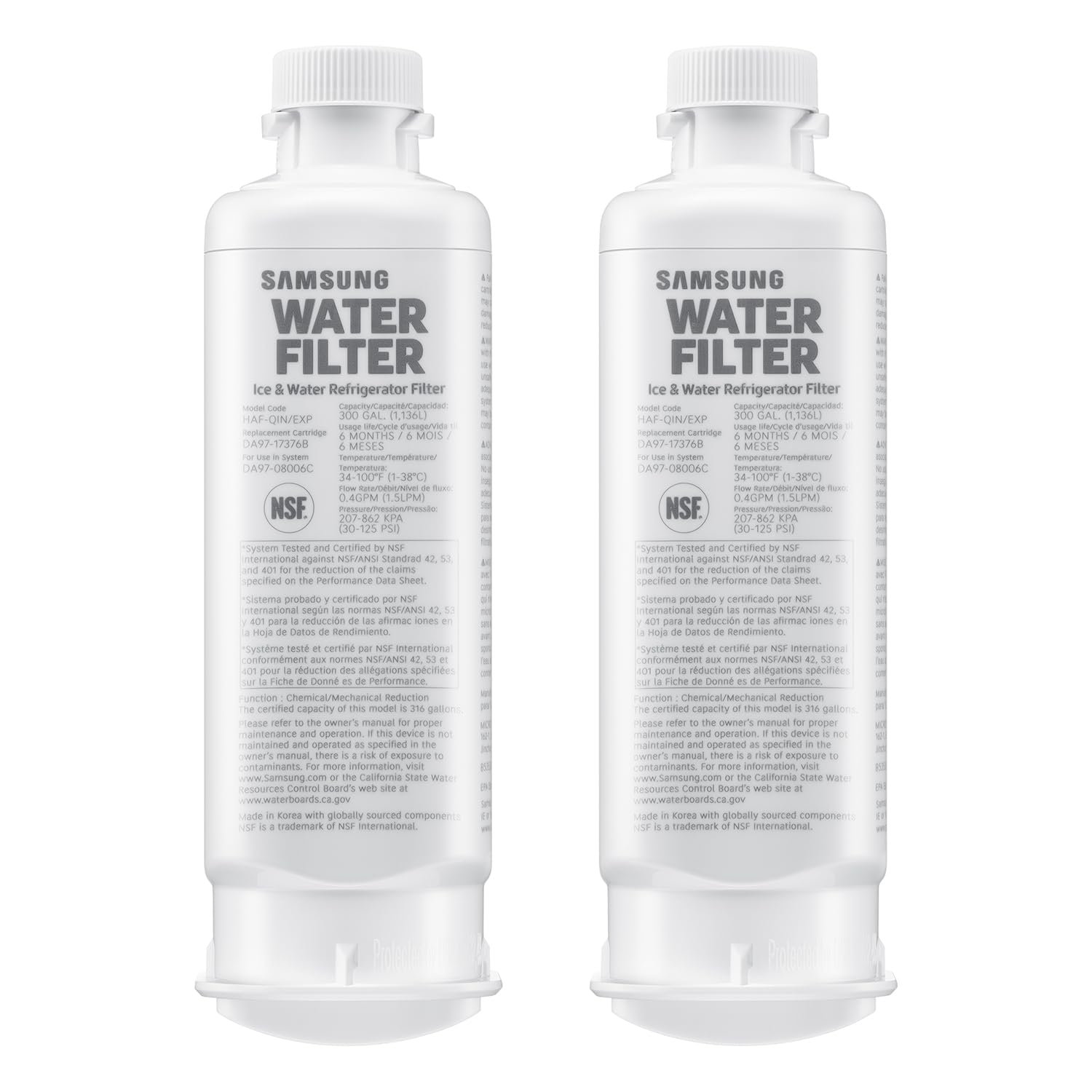
Two cartridges in the box, so one fridge is covered for a full year.
Samsung’s own cartridge arrives as a 2-pack, which maps neatly onto the 6-month replacement schedule the brand recommends — one in the slot, one on the shelf. The filtration is the headline: a high-grade carbon block that Samsung says cuts 99% of potentially harmful contaminants, certified to NSF 42, 53 and 401. That trio covers taste and chlorine, contaminants with health effects, and 15 emerging contaminants respectively. Across a very large pool of Samsung owners it holds 4.5+ stars.
Where it earns its keep is fit. The compatible-model list runs long — from RF18A5101S9 and RF22R7551SG through RF28R7551DT and RS28A5F61SR — so check your fridge against it before you buy. Once seated, the fridge reads the cartridge immediately with no compatibility warnings, and the replacement itself is a push-in job.
Authenticity is the real dividing line among Samsung buyers, so check the tag before you trust the cartridge. Samsung now uses an authentication tag instead of the old magnetic strip. You verify it through a third-party app that scans a QR code and reports a scan count — 1 means genuine, thousands means a copy has been reused. It works, but it is fiddly. Separately, a minority of buyers report leaks or a change in taste. The genuine cartridge is built to avoid the leak-and-flood risk that unbranded copies carry.
The strong points
- Certified to NSF 42, 53 and 401 — a broad spread of contaminant testing
- Two cartridges per pack matches the recommended 6-month change interval
- Fits a long list of Samsung French door and side-by-side models
- Fridge recognises the cartridge immediately, no error codes
The friction points
- The authenticity check needs a third-party app and a clean QR scan
- A minority report taste changes or leaks after installation
- Samsung-branded cartridges cost more than generic “compatible” ones
The sensible buy: a Samsung owner who wants a year of filtration in one order and values the flooding protection a genuine cartridge is designed to give.
Slow down if: you cannot verify the QR tag — the scan count is your one real check.
4. Frizzlife Inline Water Filter System MS99

The cartridge you buy once every two years instead of every six months.
This is the crossover pick — an inline canister that takes over filtration for a fridge with no filter bay, or one whose branded cartridge has become a money pit. The numbers do the arguing: 1600 gallons of capacity and a 2-year filter life cycle, against the 6-month cycle most drop-in cartridges run on. It is certified by IAPMO R&T to NSF/ANSI 42 and 53, so it covers chlorine, taste, odor and particulates as well as contaminants with health effects such as lead. Filtration accuracy is 0.5 micron, and it leaves the beneficial minerals in.
Installation is the part that surprises people. Everything needed is in the box — PEX tubing included — and the compression brass filter head fits either the supplied PEX tubing or flexible copper tubing, so it works with most standard 3/8″ US water supply lines. Mount it under the sink, behind the fridge, or inside a cabinet. If you are going behind the refrigerator, reserve 6 inches of clearance. The canister measures 5″ x 5″ x 13.5″ and weighs in at about a pound.
Flow is a real strength here: a maximum flow rate of 1.4 gpm, which Frizzlife frames as filling a 330ml cup of ice water in 3 seconds — no thin trickle from the dispenser. The replacement routine is the clever bit. There is no need to shut off the supply; you twist off the housing and use the included wrench to screw out the inner core. Just know two things. The cartridge head can pop off its mount and spray if you fight it, so kill the water first if you are unsure. And the kit ships with a single 90-degree brass fitting, which is tight in a cramped cabinet — a second one would be welcome.
Why it earns its spot: swapping a leaking, short-lived OEM cartridge for this one is the exact scenario this system was built for — clear ice, good-tasting water, no drip.
The one wrinkle: in a tight space the single 90-degree fitting and a stubborn cartridge head can turn a quick swap into a wrestling match.
Made for: a fridge with no filter bay, or an owner tired of buying a cartridge twice a year.
Measure first: it needs 6 inches of clearance behind the fridge and a 3/8″ supply line.
5. Frizzlife Under Sink Water Filter System SK99-NEW
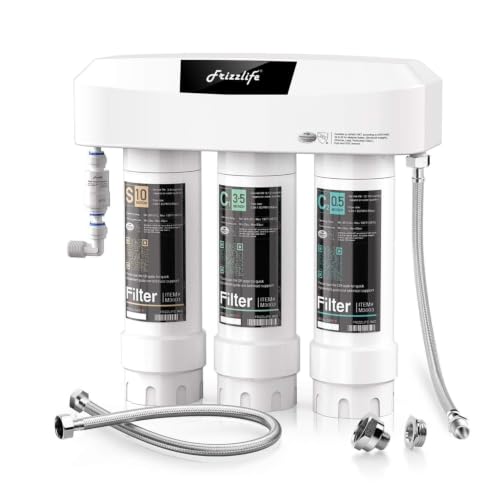
One system that feeds the kitchen tap and the fridge ice maker at the same time.
The SK99 is the most capable setup here on paper: certified by IAMPO to NSF/ANSI 42, 53 and 372, with a maximum flow rate of 2.5 gpm and a 0.5 micron rating. Frizzlife claims that 0.5 micron rating is nearly 10X finer than other brands, achieved with 8 layers of filtration material in one compounded cartridge. That combination is why it reduces lead, chlorine, taste and odor and particulates while leaving the beneficial minerals in. What it does not do is reduce TDS — the dissolved solids reading — which only reverse osmosis handles.
The party piece is that it can serve both your sink and your refrigerator at once using the ice maker kit IMC-2. If you have been running a separate fridge filter and a separate pitcher, this consolidates them. Setup takes under 15 minutes with no plumber, all parts are in the box, and a pressure regulator is built in as double insurance against leaks. The filter change is a twist-in job that only replaces the inner core, so the plastic housing stays out of the bin.
Two things to plan around. The faucet is the weak link in the feedback — the spout feels light and wobbles when you touch it, so handle it gently. And though the system is rated for cabinet installs, it works best with room around the housing; the dimensions run 14.5″ by 4.7″ by 14.1″, so measure the cupboard before you commit.
What it does well
- Certified to NSF 42, 53 and 372 with a 0.5 micron accuracy
- Can serve the sink and the fridge at once via the IMC-2 ice maker kit
- 2.5 gpm maximum flow, so filling a bottle stays quick
- Twist-in core replacement keeps the housing out of landfill
What to watch
- The faucet spout feels thin and wobbles when touched
- Will not lower your TDS reading — that needs reverse osmosis
- The cabinet footprint needs checking before you buy
Ideal for: a household that wants drinking water at the sink and filtered ice from the fridge, from one canister under the counter.
Think twice if: your cupboard is shallow, or you were hoping to see a TDS number drop.
6. CuZn UC-200 Under Sink Water Filter

One install, then nothing to think about for roughly five years.
The pitch here is simple and unusual: a 5-year filtration life, against the 6-month cycle most under-sink filters run on. That is the whole argument, and it is a strong one for anybody who resents being reminded to change a cartridge. The filtration is a 3-stage blend of micro sediment membranes, KDF-55 and coconut shell carbon, put together to purify without stripping the beneficial minerals out. Independent testing backs its reduction of PFAS, PFOA/PFOS, lead and chlorine, and its components are NSF/ANSI 42 certified.
Installation is renter-friendly. It connects directly to the kitchen or bathroom sink cold line, needs no drilling, and ships with all the parts including a stainless steel connection hose. No outlet is needed, which is the difference between this and a reverse osmosis unit. Flow drop is near-unnoticeable once it is in, and the water comes out clear with no chlorine smell.
The catch is size and scope. It measures 5.5″ by 14″ by 5.5″, so check the cupboard before you commit — it stands in a corner rather than lying flat. It also will not reduce TDS, since only reverse osmosis does that, and it is not the tool for well water or a supply carrying pollutants. If that describes your water, a different approach is warranted.
The long-game math: a single cartridge expected to run about five years turns a twice-yearly chore into a one-time install — the water clarity and lack of chlorine taste are the visible payoff.
Space check first: it is a substantial corner-standing canister, and it expects a municipal-style water supply rather than a well.
Built for: anyone who wants to fit a filter once and forget about replacement runs.
Not the one if: you are on well water or you are chasing a lower TDS reading.
7. Sub-Zero Replacement Water and Air Filter Combo Pack

Not just a water cartridge — the air filter that keeps your vegetables from spoiling.
This combo pack pairs one Sub-Zero water filter (part 4204490) with one air filter (part 7007067, also sold as 7042798). It is genuine factory OEM, meets or exceeds NSF/ANSI Standards 42 and 53, and filters 750 gallons of water. The air filter is the overlooked half: it strips ethylene — the gas that speeds ripening — from the fridge air, so produce keeps longer. The water side brings the taste in line with a filtered pitcher.
If you own a Sub-Zero, this is a straightforward fit — the parts slot in with clear instructions and no adaptation. The water filter quality is the strength most owners point to, and it is the reason people come back to the OEM pack rather than a copy.
The thing you will notice, and should not panic about, is the air filter itself. New cartridges often arrive sounding like they are full of broken glass, with tiny glass bits on the outside of the casing. That is normal — the cartridge holds small glass tubes around UV bulbs, and Sub-Zero confirms the fragments are expected. A few owners have returned units over it before learning that. Do check the air filter carefully on arrival, though, since a small number have reported them failing sooner than the 10 to 12 months they used to get.
Why Sub-Zero owners buy it
- Genuine OEM parts, both filters in one order
- Meets or exceeds NSF/ANSI 42 and 53
- 750 gallons of water filtration per water cartridge
- The air filter removes ethylene, which slows produce spoilage
What to expect
- The air filter rattles and sheds tiny glass bits — normal, per Sub-Zero, but it surprises people
- Air filter lifespan has reportedly come up short for a small number of owners
- Pricier than third-party alternatives
Right choice for: a Sub-Zero owner who wants both filters genuine and sorted in a single order.
Don’t be alarmed by: the glass-like rattle in the air filter cartridge — it is how they are built.
Know the Specs
NSF/ANSI 42, 53 and 401 — what each one covers
These are independent test standards, and each covers a different slice of what a filter removes. NSF 42 handles aesthetic impurities — chlorine, taste and odor. NSF 53 covers contaminants with health effects, which often means lead. NSF 401 covers emerging contaminants, and Samsung’s cartridge is certified against 15 of them. A filter with all three has been tested on more fronts than one with 42 alone. If lead is your concern, 53 is the line to look for.
Filter life — months versus gallons, and why both matter
Cartridge life gets quoted two ways, and you need both to plan. A 6-month cycle means two cartridges a year. A 2-year cycle means one cartridge every other year. A capacity figure in gallons, like the 1600 gallons on the Frizzlife MS99 or the 750 gallons on the Sub-Zero water filter, tells you the total water volume before the cartridge is spent. Combine the two and you can work out your real repeat cost before you buy.
Flow rate in gpm — and why your ice maker cares
Flow rate is measured in gallons per minute (gpm), and it governs how fast water comes out of the dispenser and how quickly the ice maker refills. The Frizzlife SK99 tops out at 2.5 gpm; the MS99 at 1.4 gpm. A restricted flow does not just slow your glass — it can leave the ice maker waiting. If you fill large bottles daily, this is the spec worth checking before anything else.
0.5 micron accuracy — the size of what gets caught
A micron rating describes the size of particle a filter catches. At 0.5 micron, the Frizzlife MS99 and SK99 are catching particles far smaller than the eye can see, which is why both are certified to reduce particulates alongside chlorine. TDS is a different measure entirely — total dissolved solids — and neither of these filters reduces it, because dissolved minerals pass straight through a carbon block.
Common Questions
How do I know if my fridge takes a drop-in cartridge or an inline filter?
Will the Fisher & Paykel 847200 fit my fridge?
Do I have to flush a new filter before drinking the water?
How often should I change a refrigerator water filter?
Why does the new filter make the water taste like plastic at first?
Can an inline filter replace the cartridge built into my fridge?
How can I tell if a Samsung cartridge is genuine?
Does a refrigerator water filter lower TDS?
Why does the Sub-Zero air filter rattle and shed glass bits?
What size water line does an inline filter need?
The Bottom Line
Your first question is simple: does your fridge already have a filter bay? If it does and it is a Frigidaire with the PureSource Ultra system, the Frigidaire ULTRAWF is the pick. It holds 4.5+ stars across 46,000+ owners, and it carries NSF 42, 53 and 401 certification (covering chlorine taste and odor, contaminants, and emerging compounds) — about as solid a case as this category offers.
And if you want the kitchen tap and the fridge ice maker running off one canister, the Frizzlife SK99 does both.
One last note before you buy: match the cartridge to your model number, prime it fully, and reset the fridge reminder light by hand. Those three steps are where nearly every “it tastes bad” or “it did not fit” story actually starts.
How we choose
We do not accept paid placement. Every pick is matched to a real buyer and a real use-case; we do not hands-on test units.
Sources
Specifications: manufacturer listings and product documentation. Review insights: verified customer reviews, as of October 2026. Pricing: not shown on this page (it changes often); check the current price via the retailer link.
As an Amazon Associate, Aappliancez earns from qualifying purchases. This does not affect which products we feature.