Disclosure: Some links in this post are affiliate links. As an Amazon Associate I earn from qualifying purchases, at no extra cost to you. Learn more
Specs are compiled from manufacturer listings and verified buyer reviews and can change over time — please confirm the key details on the product page before buying.
You want wood that still looks like wood next spring, not a grey, furred board that drinks water. That is the whole job of a good exterior stain and sealer: color the timber, then lock out rain and sun. The picks below do exactly that, and one sits clearly ahead of the rest. The TWP 1501 Cedartone leads because it penetrates instead of sitting on top, so it protects without forming a film that can peel. Below you get a fast comparison, then honest write-ups on each can.
This guide is built by comparing the manufacturers’ published specifications and the patterns across verified customer reviews, so you get each pick’s real strengths and trade-offs instead of marketing spin.
Color shift, coverage per gallon, and dry time decide whether a weekend job turns into a redo, so every pick here is judged on those. This breakdown of the best exterior wood stain and sealer covers coverage, color honesty, and how each finish holds up to weather.
Top Picks


How To Choose The Best Exterior Wood Stain and Sealer
Most disappointment on a deck job starts before the brush comes out. You picked the wrong type of product for the wood, or you bought one can when the job needed two. Get the type and the volume right and the rest is just patience.
Penetrating oil versus film-forming sealer
A penetrating stain soaks into the wood fibers and dries inside them. It cannot peel, because there is no skin on the surface to lift. A film-forming sealer sits on top like a thin coat of paint, and that coat is what eventually cracks and flakes. On horizontal deck boards that take foot traffic and standing water, penetrating wins more often than not. On vertical siding, a film former can work fine.
Read the coverage number before you buy
Coverage is written in square feet per gallon, and it is the number that keeps you from a second store run. Rough-sawn or weathered wood drinks far more than smooth new boards, so budget for the low end of the stated range. Two coats always beat one for water beading, and that means roughly double the cans.
Transparent, semi-transparent, or clear
Pick your finish by one question: do you want to see the grain, or see a color? A transparent stain hides the grain but still lets texture show, and it delivers bolder color than the label mood suggests. A semi-transparent stain keeps some grain visible under a tint. A clear sealer changes nothing about the wood’s look and simply waterproofs it.
Side-by-Side Comparison
| Model | Best For | Coverage | Finish | Base | Amazon |
|---|---|---|---|---|---|
| TWP 1501 Cedartone★ Best Overall | Log homes and decks | 350 sq ft | Matte or Textured | Low VOC | Amazon |
| Thompson’s Transparent Natural CedarBudget Pick | Budget waterproofing | 150–400 ft²/gal | Transparent | Wood | Amazon |
| Thompson’s Semi-Transparent Chestnut Brown | Fences and rough boards | 150–400 ft²/gal | Semi-Transparent | Wood | Amazon |
| KILZ Waterproofing Cedar Naturaltone | Soap-and-water cleanup | 250–500 sq ft | Satin | Acrylic | Amazon |
| Ready Seal Natural Cedar | No back-brushing jobs | 125–150 sq ft/gal | Oil | Oil-based | Amazon |
| Seal-Once Nano Clear | Keeping natural wood color | — | Clear gloss | Polyurethane | Amazon |
| Armstrong-Clark Cedar Semi-Transparent | Professional-grade color | 150–300 sq ft/gal | Oil | Oil-Based | Amazon |
Detailed Reviews
1. TWP 1501 Cedartone Low VOC Wood Preservation Stain
Our pick — 4.5+★ from 300+ verified ratings; the strongest balance of quality and price.
The log-home pick: an EPA-registered preservative that soaks into cypress beams instead of sitting on top.
If your wood is structural — logs, posts, heavy beams — you want a preservative, not a pretty topcoat. TWP 1501 is registered with the EPA as a wood preservative under EPA number 51578-1, which is the part that matters when decay is the worry rather than faded color. One gallon covers 350 square feet, so a modest deck or a set of porch posts comes in on a single can. It is built for low VOC states, so you stay compliant without switching products.
What wins people over is how it goes down. The quality of the finish is the thing buyers rate highest, and the ease of application sits right behind it. A long-time North Florida user recoated his log home after 32 years with this Cedartone, brushed it on after a soft wash, and had it dry in 48 hours with deep soak into the cypress. Another owner sealed new cedar porch posts right away and found the penetrating formula simply does not peel the way his old Thompson’s did as it aged.
The catch is the color and the smell. Cedartone lands darker than many people expect, and the oil base throws a strong odor for a week or more. It also stays tacky for around four days, so leaves stick and the surface is slick underfoot while it cures. Plan the job for a dry stretch when nobody needs the deck. One buyer also flagged that long-term durability is unproven on his own deck — the record here is good, but nothing is guaranteed.
What earns its keep
- EPA registered preservative (EPA 51578-1) aimed at decay, not just looks
- 350 square feet of coverage from one gallon
- Penetrating formula that will not peel like a film coat
- Low VOC for regulated states
- Built for log homes, decking, fencing and siding alike
Where it asks patience
- Cedartone dries darker than expected
- Strong odor for a week or more
- Tacky for roughly four days, slick underfoot while curing
Reach for this if: you are sealing logs, posts, or a deck where rot is the real enemy and you can leave the surface alone for a week.
Hold off if: you want a light, barely-there tint or you need the deck back in use the next day.
2. Thompson’s WaterSeal Transparent Wood Stain
A transparent coat that waterproofs first and colors second — and colors more than you think.
The honest headline on this Thompson’s is the color. It is labeled transparent Natural Cedar, and the finish genuinely is transparent — you will still see wood texture — but the tint runs far richer than “slightly there.” Expect a real cedar look, not a whisper. If you want your boards to keep their exact current shade, this is the wrong can. If you want a warm cedar tone with waterproofing on a tight budget, it delivers. The polymer formula resists fading and UV, and it exceeds the ASTM D-4446 standard for waterproofing wood.
The convenience is real, though. You can apply it to damp or dry wood, which means you are not waiting two days after a wash. A gallon spans 150 to 400 square feet per gallon depending on the surface, so rough old fence sits at the thirsty end and smooth decking at the generous end. Buyers report spraying it on with a bug sprayer and getting solid coverage, quick drying, and easy cleanup. It is the pick that gets the whole fence done in an afternoon.
Where it falls short is in the details. The transparent finish hides the grain, which is the opposite of what “transparent” makes people expect, and the cedar tone varies wildly from board to board. Drying time and value are both split verdicts among owners, and a few cans arrive dented. On a vertical surface it holds up fine; on a horizontal deck that takes feet and puddles, reapplication comes sooner.
Bottom line on color: treat the tint as a bold cedar wash, not a clear coat. Buy a spare can and test on an offcut before committing to the whole deck.
Best fit: a fence or shed where you want fast, budget-friendly waterproofing and are happy with a stronger cedar tone.
Look elsewhere if: preserving the current color of prized boards matters more than speed.
3. Thompson’s WaterSeal Semi-Transparent Wood Stain

Chestnut Brown with the most owner experience behind it of anything on this list.
This is the semi-transparent sibling of the transparent Thompson’s above, and the slight tint makes all the difference on rough wood. It fills grooves and settles into texture instead of streaking over it. Coverage runs 150 to 400 square feet per gallon, so a gallon goes further on a smooth fence than on weathered decking. It resists UV fade, meets the same ASTM D-4446 waterproofing standard, and takes damp or dry wood like the rest of the family.
The ownership record is the reason it ranks here. Quality and application are the two things buyers weigh most, both positive, and owners mention decks stained with this line lasting 20 years with a recoat every few years. A 64-year-old with knee arthritis rolled on one coat alone and watched sprinkler water bead right up. Others revived mildew-covered decks after pressure washing and sanding and say the second coat is what seals the deal.
Two honest caveats. Chestnut Brown looks red and chalky going on, separates if you skip mixing, and dries a few shades darker — so stir it hard and accept that the wet color is not the final color. And one coat is often not enough on a hot, sun-blasted deck. Buy double the quantity you think you need, because the second coat is what gives you the water beading.
The real cost: this can is inexpensive, but the job is not a one-coat job. Two coats plus prep is the difference between a deck that sheds water and one that drinks it.
Go with this: if you are working on weathered decking or fence and want a rich brown tint with proven water repellency.
skip it if: you refuse to sand and brighten first — the finish only looks right on properly prepped wood.
4. KILZ Semi Transparent Wood Stain

The acrylic option you can wash out of your brushes in the sink.
KILZ takes a different route from the oil-based picks here: a 100% acrylic formula. That means soap and water cleanup, no solvent smell hanging in your garage for a week, and a satin finish that stands up to rain, snow and sun. It carries a warranty of up to 3 years on decks and up to 5 years on fences and siding. A gallon covers roughly 250 to 300 square feet on the first coat and 500 to 600 square feet on the second, with about 1 to 2 hours before recoating.
Effectiveness is what owners keep landing on, with ease of application close behind. One owner’s 15-year-old deck, power washed and bleached, then brushed and rolled with this, was still beading rain with no thinning or wear at the 45-day mark. A 45-year wholesale and retail veteran chose it for his own first deck job and came away pleased. It works on surfaces from new to moderately weathered and unsealed, roughly 0 to 10 years of exposure.
The catch is prep and coverage. Cleanup is genuinely easy, but no acrylic sets a heavier coat than an oil, and one buyer ordered four times and only received two cans thanks to shipping losses. Buy an extra.
Why it earns a spot
- 100% acrylic means soap-and-water cleanup and no solvent odor
- Warrantied up to 3 years on decks, up to 5 on fences and siding
- 250–300 sq ft first coat, 500–600 sq ft second
- Satin finish with UV, mildew and rain resistance
Things to know before you buy
- Needs properly prepared wood to look right
- Coverage is a split verdict on thirsty surfaces
- Shipping losses have been an issue for some buyers
Pick this one for: decks and fences where you want no solvent fumes and a brush you can rinse in the sink.
Pass if: you want a deep oil soak into rough-sawn timber — the acrylic sets up on the surface.
5. Ready Seal Stain & Sealer for Wood, Natural Cedar

Oil-based, self-blending, and happy to be left alone once it hits the board.
Ready Seal skips the fuss. No primer, no thinning, no back-brushing — the self-blending formula evens itself out so you do not get lap marks where one section meets the next. That makes it the can to reach for if you are rolling a big fence alone or spraying a long run of siding. It is an oil-based stain and sealer in one, with UV and weather protection built in, at 125 to 150 square feet per gallon.
Stain quality is what carries it — buyers rate the finish itself above everything else, with appearance next. On cedar siding it simply looked great. On a weathered raised bed it went on smoothly after a light sand and held up after a week. A one-year-old application still shows no sign of wear, even on the steps, which is the part of a deck that takes the worst of it.
Thin is the word to understand here. The stain is water-like, so it is easy to over-apply and drips will run. On cooler, wetter wood at 40°F in a garage, one owner found it took about three days to fully dry on the damp sections. And the annual question is real: like most penetrating preservatives, it wants a fresh coat every year to keep its edge. Budget for that and there are no surprises.
For the DIY soloist: the no-back-brushing formula is the whole reason to choose it. If you are applying alone and cannot walk the whole run twice, this saves real hours.
For the showpiece deck: the color result is strong, but the thin consistency punishes a careless hand with drips.
Choose this if: you want a fence or siding job done in one pass and can live with a yearly top-up.
Choose something else if: you hate re-coating — the acrylic KILZ above holds a multi-year warranty instead.
6. Seal-Once Nano Wood Sealer and Waterproofer, Clear

Zero color change, and a warranty that runs up to a decade on vertical wood.
If your wood is already the color you love and you simply want it protected, Seal-Once is the answer. It is a clear water-based sealer that penetrates below the surface rather than forming a topcoat, so it shields the wood without hiding the grain or shifting the shade. It is odorless, cleans up with soap and water, and is ultra-low VOC. The stated warranty runs up to 10 years on vertical surfaces and 6 years on horizontal ones.
Effectiveness and sealing performance are what customers note, with quick drying and easy cleanup close behind. A screened porch treated with it beads rain and rolls it off, and the same owner reckons on about six years between coats versus the annual re-do he was used to. Rolls on milky and dries clear, which is a relief the first time you see it. One reviewer even painted over a two-coat application on pine after a day and had no adhesion trouble.
The trade-off: a clear sealer does not fight UV (sunlight) greying the way a tinted stain does. The maker describes it as allowing the wood to grey naturally, and you get UV protection only if you mix in a semi-transparent tint. Value is a split verdict, so some buyers do not feel the clear finish justifies the price. Buy it when keeping the wood’s natural look, not adding color, is the goal.
The clear advantage: nothing else on this page lets wood stay exactly the wood it is. That matters on a log home or a stained-and-loved fence you want to keep as-is.
That one is yours if: you want waterproofing with the grain and color completely untouched.
Think twice if: your wood is already greying — a tinted stain fights UV better than a clear coat.
7. Armstrong-Clark Oil-Based Wood Stain, Cedar Semi-Transparent
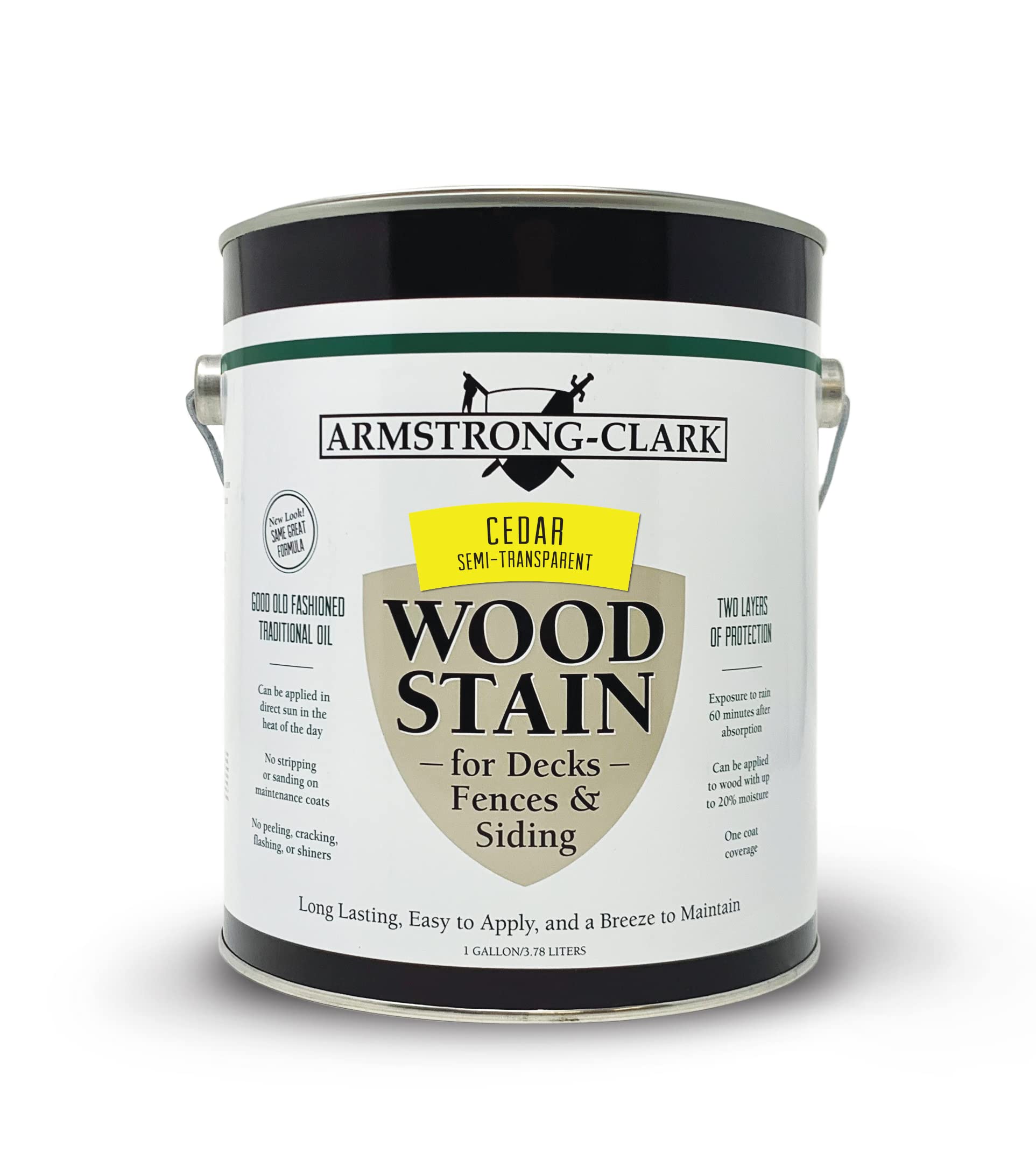
The restorer’s stain: conditioning oils that sink in and a color that lands just right.
Armstrong-Clark builds this for people who take decks seriously. Conditioning oils soak deep into the fibers while drying oils lock in the protection, and that combination is what heads off cracking, peeling and premature decay instead of just covering it. Coverage runs 150 to 250 square feet per gallon on horizontal softwoods, 200 to 300 on vertical, and 300 to 400 on hardwoods. It is rated for cedar, redwood, pine and pressure-treated, and it can go on in direct sunlight and warm temperatures — a real advantage when the only free weekend is a hot one.
Maintenance is what makes it the premium pick. Recoating typically means cleaning and reapplying, with no extensive sanding, stripping or media blasting (blasting the wood with abrasive grit). A Minnesota owner used it three years back, was pleased with how the deck held through both winter and hot sun, and reapplied two coats across a 16 x 16 red cedar deck, eight steps, six 6 x 6 posts and the facia boards. Another on pressure-treated pine with full southern exposure had it looking great a month in and hoped for three years of life. This is a professional restoration product and it behaves like one.
The honest catch is color control. Stain tones shift with the wood type, age, prep and application, so the same Cedar Semi-Transparent can read differently on two decks. On exotic hardwoods like IPE and mahogany you are steered toward Amber, Mahogany or Black Walnut instead. It is also an oil, so you get the usual solvent handling and curing care.
The premium case
- Penetrating oil formula resists cracking and peeling instead of coating over
- Can be applied in direct sun and warm temperatures
- Maintenance recoats need no sanding, stripping or blasting
- 150–300 sq ft per gallon across wood types
The fine print
- Final color shifts with wood type, age and prep
- Exotic hardwoods need the Amber, Mahogany or Black Walnut shades instead
- Oil base brings solvent handling and curing care
Worth it for: cedar and pine decks, pergolas and railings where you want a restorer’s finish and easy future recoats.
Not the fit for: exotic hardwood decks — pick one of the hardwood-specific shades instead.
Know the Specs
Coverage in square feet per gallon
This is the number that tells you how far one can goes. A rough, weathered board has open pores and drinks far more stain than a smooth new one, so always plan for the low end of the stated range. If the can says 150 to 400 square feet, a porous old fence could use up a gallon on the low end while a tight new deck stretches to the high end. Always buy for two coats if the wood is bare.
Penetrating versus film-forming
A penetrating stain soaks into the fibers and protects from the inside, so there is no surface skin to peel. A film-forming sealer sits on top and shields the surface, but it can crack as the wood moves. Horizontal surfaces that take feet and standing water tend to favor penetrating formulas. Vertical siding can do fine with either.
Transparent, semi-transparent and clear explained
Transparent means you still see wood texture but color is applied. Semi-transparent keeps some grain visible under a tint. Clear changes nothing about the look and simply waterproofs. Pick by whether grain or color matters more to you, and remember transparent still delivers a stronger tint than most people expect.
VOC and cleanup type
VOC stands for volatile organic compounds — the solvent that gives oil stains their smell and some states restrict. A low VOC formula keeps you compliant and easier to live with. Water-based acrylics and sealers clean up with soap and water; oil-based products need solvent for the brush and rags.
Common Questions
Can I put a semi-transparent stain over an old transparent coat?
How many gallons do I need for a 16 by 20 deck?
Why did my transparent cedar stain turn out darker than expected?
Do I really need two coats of exterior stain?
How long should I wait before walking on a freshly sealed deck?
Can I apply these stains in direct sunlight?
Will a clear sealer stop my wood from greying?
What is the difference between a stain and a sealer?
Do I need to sand or strip before recoating an oil stain?
How often does an exterior deck need restaining?
The Bottom Line
For a log home or a structural deck, I would put the TWP 1501 Cedartone on it, because it is an EPA registered preservative (a wood treatment the U.S. Environmental Protection Agency lists) that penetrates and will not peel — the crowd favorite here at 4.5+ stars across 300+ ratings. If your wood just needs waterproofing on a budget, the Thompson’s Semi-Transparent Chestnut Brown has the deepest track record and the best coverage per gallon. Want the wood to keep its exact color? Reach for the Seal-Once Nano clear sealer. And if you want a restorer’s color with no sanding on maintenance, the Armstrong-Clark is worth the step up.
How we choose
We do not accept paid placement. Every pick is matched to a real buyer and a real use-case; we do not hands-on test units.
Sources
Specifications: manufacturer listings and product documentation. Review insights: verified customer reviews, as of October 2026. Pricing: not shown on this page (it changes often); check the current price via the retailer link.
As an Amazon Associate, Aappliancez earns from qualifying purchases. This does not affect which products we feature.