Disclosure: Some links in this post are affiliate links. As an Amazon Associate I earn from qualifying purchases, at no extra cost to you. Learn more
Specs are compiled from manufacturer listings and verified buyer reviews and can change over time — please confirm the key details on the product page before buying.
Paddling open water for hours depends on two things: staying dry and tracking straight. For fishing days, the Pelican Catch Mode 110 is the pick. For fast touring, the Perception Expression 11.5 is the pick. Everything below covers how each boat behaves once you are a mile from the launch and the wind picks up. Length, hull shape, seat comfort and dry storage decide that, not the badge on the side.
This guide is built by comparing the manufacturers’ published specifications and the patterns across verified customer reviews, so you get each pick’s real strengths and trade-offs instead of marketing spin.
You will see sit-on-top fishing rigs, sit-inside tourers and one modular pedal boat that splits in two for a trunk. Each one is here because it solves a specific expedition problem. The expedition kayak that suits you is the one whose hull, seat and storage match the water you actually paddle.
Top Picks

How To Choose The Best Expedition Kayak
An expedition kayak is a boat you trust when the far shore is still an hour away. That means the first question is not which brand — it is what water you paddle and how long you stay out. Get those two answers right and the spec sheet starts making sense.
Hull length and why the number matters
A longer waterline (the part of the hull actually touching water) gives you glide, so each paddle stroke carries further and you tire less on a long crossing. The Wilderness Systems Tsunami 125 runs 12 ft 9 in and the Pungo 125 runs 12 ft 6 in, which is why both track straight with little correction. Shorter boats like the 10 ft 8 in Catch Mode 110 turn faster but need more strokes to cover the same distance.
Sit-on-top versus sit-inside
A sit-on-top is a boat you sit on rather than in, and water drains through scupper holes in the floor. That makes it easier to climb back onto after a swim and better for fishing, because you can stand and cast. A sit-inside puts your legs below the waterline, keeps wind off your lower body and paddles warmer in cold weather — but you need a spray skirt to stay dry in chop.
Tracking aids: skegs and rudders
A skeg is a fin that drops from the stern to stop the boat weathercocking, which is the tendency to spin into the wind. A rudder is a steerable blade you work with your feet. The Pelican Catch HDII uses a rudder with hand controls that you can also deploy as a skeg. Serious flatwater paddlers often prefer a fixed skeg because it is one less thing to adjust mid-crossing.
Capacity, dry storage and weight
Maximum weight capacity is everything the boat carries: you, your gear, your water and your catch. An overloaded hull sits low and turns sluggish, so leave headroom. Sealed bulkheads (walls inside the hull that create airtight compartments) keep your sleeping bag and spare clothes dry and add flotation if you capsize. And weight matters at the launch ramp: 44 lb is liftable alone, while 67 lb wants a cart or a second pair of hands.
Side-by-Side Comparison
| Model | Best For | Length | Weight | Max Capacity | Amazon |
|---|---|---|---|---|---|
| Pelican Catch Mode 110★ Best Overall | Stand-and-cast fishing | 10 ft 8 in | 67 lb | 375 lb | Amazon |
| Perception Expression 11.5Featherweight Tourer | Fast day touring | 11 ft 6 in | 44 lb | — | Amazon |
| Perception Carolina 12 | Calm lakes and slow rivers | 12 ft | 49 lb | 275 lb | Amazon |
| Pelican Catch HDII | Weedy shallows by pedal power | 10 ft 6 in | 67 lb | — | Amazon |
| Reel Yaks Raptor | Trunk-stored pedal fishing | 9 ft 7 in | 62 lb | 380 lb | Amazon |
| Wilderness Systems Tsunami 125 | Twisting coastal touring | 12 ft 9 in | 51 lb | 300 lb | Amazon |
| Wilderness Systems Pungo 125 | Tall paddlers, all-day comfort | 12 ft 6 in | 53 lb | — | Amazon |
Detailed Reviews
1. Pelican Catch Mode 110 Kayak
Our pick — 4.5+★ from 300+ verified ratings; the strongest balance of quality and price.
A 10 ft 8 in fishing platform that stands up and holds 375 lb without a wobble.
This is the pick if your expedition is really a fishing trip with a long paddle at each end. The tunnel hull — a channel running the length of the underside — is what makes the deck wide and flat enough to stand on and cast. The anti-slip deck carpet keeps your boots planted while you are up there. Two 4″ rigging tracks take rod holders, a fish finder or a camera mount, and you get three flush-mount rod holders plus front and rear tank wells for gear. The 375 lb maximum weight capacity leaves a big paddler room for a crate of tackle and a cooler without pushing the hull low.
What wins people over is the build itself — it is far and away the most praised thing about this boat, and stability runs a clear second. Buyers report loading it with a 200 lb paddler and a 100 lb dog and never seeing water come up through the scuppers. The ERGOBOOST seat (an adjustable lawn-chair style seat with an EVA foam pad underneath) reclines, sits you higher for a better view of the water, and hides storage underneath — one 13×13 milk crate fits neatly behind it. The seat folds flat so you can sit low and paddle like a normal kayak when you want to cover distance.
The honest catch is weight. At 67 lb, this is not a boat you throw on a roof rack solo after a long day. Pelican lists a lighter figure in its own marketing copy, but the spec sheet says 67 lb and that matches what owners feel when they load it. A kayak cart solves it and several owners recommend one. The skeg (the drop-down fin that keeps you tracking straight) helps a lot on open water but can pop off if you hit something, so keep it raised in the shallows.
What earns its place on this list
- 375 lb capacity — the biggest on the list, so gear and a fishing buddy’s worth of tackle ride easy
- Flat, anti-slip standing deck for casting on the move
- Adjustable ERGOBOOST seat with under-seat storage and a folding back
- Two 4″ rigging tracks, three rod holders and twin bottle holders
- Skeg keeps a straight line in wind once deployed
Where it asks a little back
- 67 lb is a two-person or kayak-cart job to load
- Wide hull paddles slower than a touring shape
- Skeg can pop off on impact in rocky shallows
- No paddle included in the box
Go for it if: you fish from the water more than you travel it, and you want to stand up and cast.
Think again if: you plan long crossings where a narrower, lighter hull would save your shoulders.
2. Perception Expression 11.5 Sit Inside Kayak
The boat that made a five-foot paddler stop asking for help at the launch.
Forty-four pounds is the number that sells this one, and it is not marketing — it is the lightest boat on this list by a clear margin. A 5 ft tall owner reports carrying it on her shoulder alone, and that is the difference between paddling on a whim and paddling only when someone else is free. At 11 ft 6 in it still has enough waterline to glide, and the skeg keeps it pointed straight when the wind wants to spin you. Owners describe it as fast across a lake, a saltwater canal and a river in the same afternoon.
Performance stands out most here, with stability right behind it. You can adjust the seat angle even while you are on the water, so you can shift position mid-paddle. The adjustable footrests let a taller paddler and a shorter one both find a comfortable leg position. Owners mention the rotomolded hull holding up over four summers with only minor scrapes. That one-piece rotomolded shell (rotational molding, where the plastic is baked in a spinning mold for a smooth hull) is also what keeps spray out better than an open sit-on-top deck.
Two things to plan around. First, a sit-inside like this needs a spray skirt in real chop or you will ship water over the coaming. Second, several of these arrive unwrapped rather than boxed, so inspect the hull before you sign for it — scuffs are the recurring note. The 25.75 in cockpit is a good size for most adults, but try the fit if you are broad in the hips.
What it actually solves: long distances without a trailer or a helper — 44 lb, a skeg for tracking and a seat you can recline mid-paddle.
The trade to accept: a sit-inside deck and a 25.75 in cockpit that rewards a spray skirt and a deliberate fit check.
Reach for this if: you paddle solo and want the lightest boat here that still tracks.
Look elsewhere if: you want to stand up and fish — that is a different hull entirely.
3. Pelican Catch HDII Premium Angler

Pedal power that gets you into the weeds and back out without lifting a paddle.
Picture a shallow bay choked with lily pads. You want to creep along the edge and cast, not fight a paddle through salad. The HyDryve II pedal system (a fin drive you work with your feet) is built for exactly that water. It is the whole reason to pick this boat over the Catch Mode 110, which is otherwise the same 10 ft 6 in fishing platform.
The Ergocast G2 seat is the standout in daily use — it is comfortable enough to sit in on the beach if you beach it for a break. You get four accessory rails for rods, a camera or a fish finder, plus three flush-mount rod holders. Dry storage is included, and the pedal drive slips into the shallows where a prop would ground out. It is the cheapest way into a fin-drive pedal kayak, and the HyDryve II drive is the reason to choose it over the paddle-only Catch Mode 110.
Here is where honesty matters: this boat is the most divisive on the list, and the reviews split right down the middle. Some owners love it and others feel it falls short of the price. One report says the hull took on water on the first outing and support did not make it right — treat that as a reason to inspect on arrival and register the warranty promptly, not as a pattern. There is no instant reverse, so you plan your stops. And at 67 lb it is a two-person roof load.
Why fishermen pick it: a fin pedal drive for weedy shallows, a hand-controlled rudder that doubles as a skeg, and a seat you can lounge in.
What to weigh first: mixed feedback on value and a hull that warrants a close post-delivery inspection.
Best for: the angler who wants feet-free fishing in shallow cover without paying touring-kayak money.
Second thoughts if: you need instant reverse or want a spotless quality record from the start.
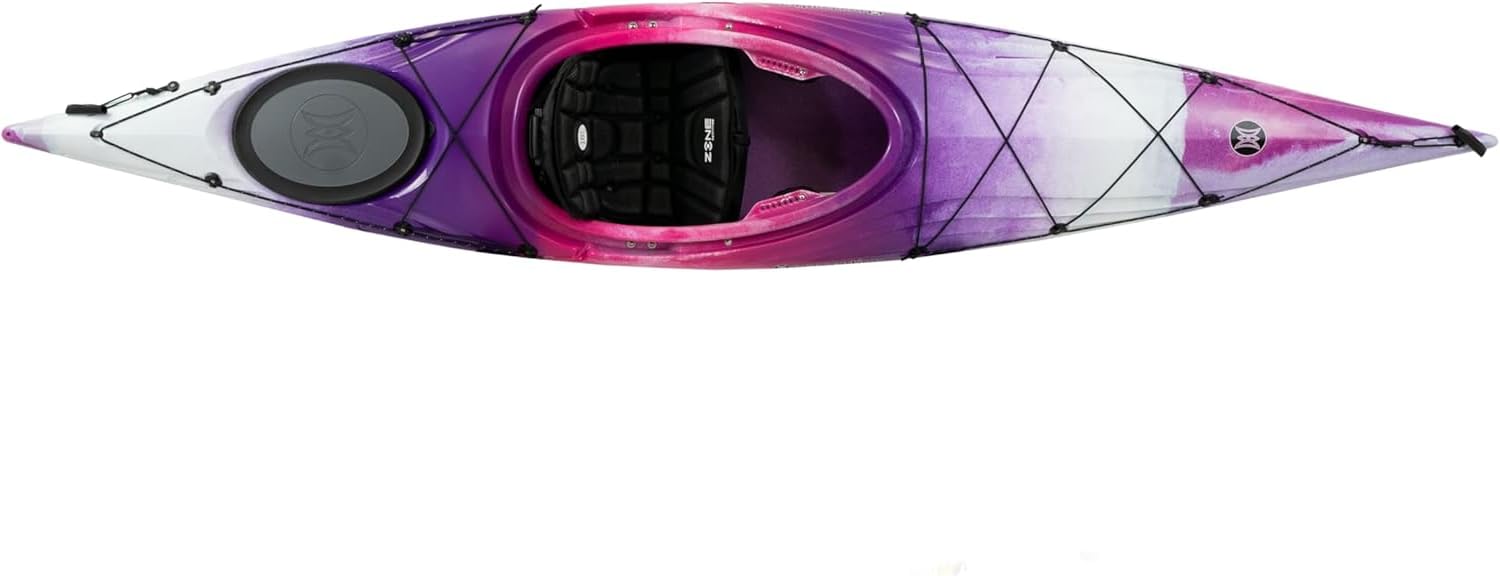
4. Perception Carolina 12 Sit Inside Touring Kayak

Two sealed hatches and a 12-foot waterline for the paddler hauling overnight gear.
If your expedition means a loaded boat and a night on a sandbar, storage is the deciding spec, and the Carolina 12 is built around it. Large sealed dry compartments sit at both the front and the rear, so your sleeping bag and spare clothes stay dry and your load balances. The 12-foot sit-inside hull tracks well and handles calm lakes, slow rivers and coastal water without constant correction. At 275 lb maximum capacity it is a solo overnight boat, not a gear-hauler for two.
Compared to the Catch Mode 110, this boat gives up standing room and deck space but gains a much lighter carry — 49 lb versus the Pelican’s 67 lb, and you feel that difference at the end of a long day. The Zone adjustable seat adapts through long paddling sessions, so you stay comfortable on multi-hour trips. Being made in the USA matters to buyers who want parts and support close to home. This is a hybrid and crossover design, comfortable on a lake and competent on a river slough.
The thing to check before you paddle is the foot braces. The most detailed complaint describes a right brace installed 12″ offset from the left, straight from the factory, and there are reports of a broken pedal with slow manufacturer response. Set both braces to the same mark and test them before you leave the driveway. Hull scuffs in transit are also a recurring note, so open the wrap and look.
Where it shines on a long trip
- Large sealed dry storage front and rear keeps overnight gear dry
- 12 ft sit-inside hull tracks well on lakes and slow rivers
- 49 lb is a realistic solo carry
- Zone adjustable seating for long days in the saddle
Check before you launch
- Foot braces have shipped misaligned — verify them yourself
- A broken pedal and slow support response has been reported
- 275 lb capacity rules out a heavy paddler plus big load
- Hull scuffs from shipping are common
The fit: solo overnighters and day trips where dry clothes and dry gear are non-negotiable.
The mismatch: big paddlers who need more than 275 lb of headroom.
5. Reel Yaks Raptor Modular Fishing Kayak
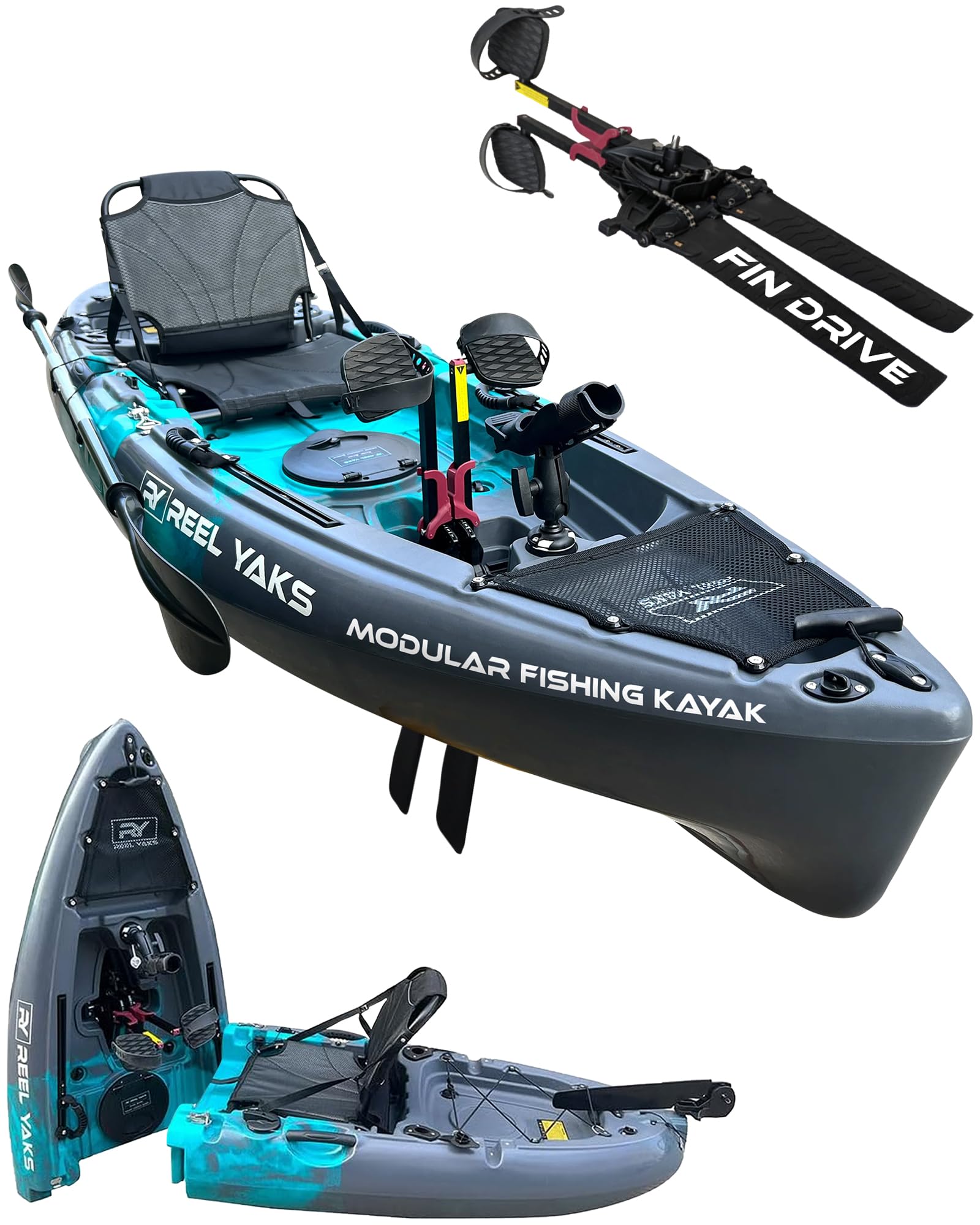
A 9.5 ft pedal kayak that splits in two and lives in the trunk of your car.
Most pedal kayaks need a trailer or a roof rack. This one breaks into halves that each weigh about 31 lb, so it goes in a compact SUV trunk and you can carry each piece alone. That modular design is the whole proposition, and it is why this boat exists at all. The fin pedal drive (a propeller-free fin system you work with your feet) moves you quietly through weedy lakes, and the wide W-hull and 380 lb capacity — the highest here — keep you upright while you cast.
What owners appreciate most is the build quality, with functionality right behind it. Assembly is reported as quick and mostly done for you, with pedals and rudder the only real steps, and the halves snap together with no water seepage. Each half floats on its own if you drop one at the ramp. There are flush-mount rod holders, track rails and storage hatches ready to go. An electric motor plug even lets you swap the fin drive for a trolling motor.
Two honest limits. A 9.5 ft hull is less stable for standing in wind, so this is a seated fishing boat rather than a stand-and-cast platform. And several owners note that getting the rudder fitted right takes patience — the diagram in the box is not always clear, so watch the manufacturer’s own site videos over third-party clips. A missing pedal pin on arrival has also been reported, so count parts before your first trip.
Storage is the feature: two sections around 31 lb each, 9.5 ft assembled, and it fits where a regular kayak cannot.
The catch to plan for: rudder setup takes patience and the hull is not a standing platform in a breeze.
Pick this one for: apartment and trunk storage plus pedal fishing without a trailer.
Pick another if: you need to stand and cast in wind, which asks for a wider, longer boat.
6. Wilderness Systems Tsunami 125 Touring Kayak
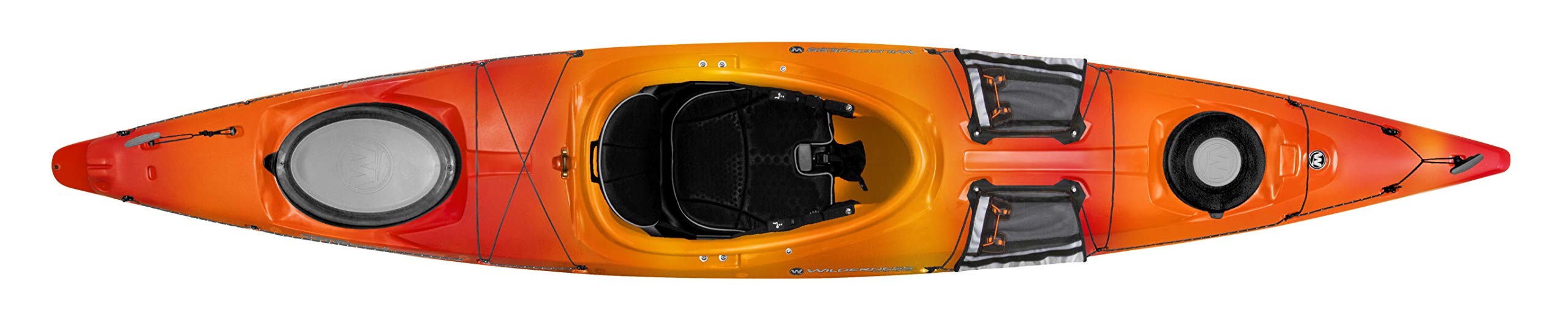
Five strokes on one side and the nose barely moves — that is the Tsunami promise.
This is the longest boat on the list at 12 ft 9 in, and that waterline is why it tracks like it is on rails. Customers note paddling five strokes on one side with the direction barely changing. The design is aimed at tight, twisting environments and medium-to-large paddlers, so it does both open water and narrow creeks. Sealed bulkheads at both ends create water-resistant storage and extra buoyancy, and two hatches give you a large oval in the rear and a round one in the bow.
Comfort is where this boat earns its following. The Phase 3 AirPro Tour Seat trims forward and back with improved back strap routing, and the Slidelock XL foot rests adjust for a range of leg lengths. Padded thigh braces let you edge the hull for confident turns. A size 13 foot and a 6 ft frame both fit. Secondary stability — how hard the boat is to tip once it starts to lean — is reported as very confident, which is exactly the trait that matters on a loaded expedition.
The trade-off is maneuverability: that long hull needs more effort to turn, which is the price of straight tracking. The arrival stories are the weak point — this boat sometimes ships unwrapped, and there are reports of a wrong hatch and hull damage. One owner describes a replacement hatch sent after email but no further remedy. Inspect on delivery and photograph the hatch. At 51 lb it carries easier than the 67 lb Pelican, though it is heavier than the 44 lb Expression.
The case for a long waterline
- 12 ft 9 in hull tracks straight with minimal correction
- Twin sealed bulkheads and hatches for dry gear and buoyancy
- Phase 3 AirPro seat with Slidelock XL foot rests and padded thigh braces
- 51 lb carries solo with effort
The honest overhead
- Long hull takes real effort to turn in tight creeks
- Unwrapped shipping and wrong-hatch reports make inspection essential
- Support after a delivery issue has drawn criticism
Worth it for: the paddler who values a straight line and a long, stable glide over tight turns.
skip it if: your water is mostly narrow, winding creeks where a shorter boat turns easier.
7. Wilderness Systems Pungo 125 Sit Inside Kayak

Vented foam that keeps your back cool and foot braces that adjust without reaching into the hull.
If you are tall and you have given up on finding a recreational kayak that fits, start here. A 6 ft 4 in, 260 lb paddler with a 34 in inseam reports the footrests are not even at their maximum, with about 2 in still to spare. The Phase 3 AirPro seat uses mesh covers over honeycomb-vented 3D foam, so air moves behind your back and your lower spine stays supported on a long day. The Slidelock XL foot brace system adjusts with an extension rod, so you reach it from the cockpit rather than digging inside the hull.
The 12 ft 6 in hull tracks straight, and reviewers point out it holds a line in headwinds and tailwinds without weathercocking. Shoppers say it paddles with about the effort of a 9.5 ft kayak, so the 12 ft 6 in tracking comes without a heavy stroke penalty. The Pungo dashboard is the clever part: a removable drybox, two cupholders and a recess shaped for a Wilderness Systems battery to keep your electronics charged. An Orbix stern hatch with dual locks keeps gear dry.
One thing to know before you buy: this boat sometimes arrives without a box, and scuffs are the common note. Open it up and inspect the hull the day it lands. The other caveat is that a sit-inside of this length is a lake-and-slow-river boat — it is not built for surf or standing casts. At 53 lb it is a manageable solo carry for most adults, though a cart helps on long ramps.
Fit as a feature: 6 ft 4 in paddlers fit with room to spare, a vented seat keeps your back cool, and the dashboard keeps your phone charged in a drybox.
The fine print: ships unboxed, so inspect the hull on arrival, and the hull is for flat water rather than surf.
Made for you if: you are a tall paddler who wants an all-day seat and a stable flatwater hull.
Step back if: you want a fishing deck to stand on — this is a recreational sit-inside.
Know the Specs
Maximum weight capacity
This is the total load the hull is rated to carry: you, your gear, your water and your catch. A boat loaded near its limit sits lower, turns slower and is harder to paddle in chop, so leave margin. The Catch Mode 110 is rated to 375 lb, the Reel Yaks Raptor to 380 lb, the Tsunami 125 to 300 lb and the Carolina 12 to 275 lb. Match the number to your body plus the gear you actually bring.
Skeg versus rudder
A skeg is a fixed fin that drops from the stern to stop the boat turning into the wind. A rudder is a steerable blade you control with your feet. The Expression 11.5 and Carolina 12 rely on a skeg, while the Catch HDII uses a hand-controlled rudder you can also deploy as a skeg. Neither is required on a calm lake, but on open water with crosswind, one of them is the difference between a straight line and a long day of correction.
Hull length and tracking
Longer hulls track straighter and glide further per stroke, but turn with more effort. The Tsunami 125 at 12 ft 9 in and the Pungo 125 at 12 ft 6 in are the straight-line specialists. The 9 ft 7 in Raptor and 10 ft 8 in Catch Mode 110 turn faster but need more strokes to cover distance. Pick length for the water you paddle, not for a spec sheet.
Sealed bulkheads and hatches
A bulkhead is a sealed wall inside the hull that creates a watertight compartment. On a touring boat like the Carolina 12 or Tsunami 125, those compartments keep your sleeping bag dry and add flotation if you capsize. A sit-on-top like the Catch Mode 110 skips bulkheads and instead relies on scupper holes and built-in flotation inside the hull, so gear lives in tank wells rather than sealed holds.
Common Questions
How long can I paddle an expedition kayak in one day?
Is a sit-on-top or sit-inside kayak better for expedition paddling?
Do I need a rudder or a skeg on a long kayak?
Can I carry a 67 lb kayak alone?
How much gear weight can I safely add on top of my body weight?
Will a modular pedal kayak hold up over several seasons?
How do I inspect a kayak that arrives unwrapped?
Is a pedal drive worth it over a paddle for fishing?
What cockpit size fits a tall paddler?
The Bottom Line
The crowd favorite is the Pelican Catch Mode 110, holding 4.5+ stars across 300+ ratings. It earns that spot because a 375 lb capacity, a flat standing deck and a skeg make it the most versatile fishing platform here. If your priority is covering water solo with ease, the Perception Expression 11.5 wins on weight at 44 lb. For a pedal boat you can store in a closet, reach for the Reel Yaks Raptor, because it splits in two and still holds 380 lb.
How we choose
We do not accept paid placement. Every pick is matched to a real buyer and a real use-case; we do not hands-on test units.
Sources
Specifications: manufacturer listings and product documentation. Review insights: verified customer reviews, as of October 2026. Pricing: not shown on this page (it changes often); check the current price via the retailer link.
As an Amazon Associate, Aappliancez earns from qualifying purchases. This does not affect which products we feature.