Disclosure: Some links in this post are affiliate links. As an Amazon Associate I earn from qualifying purchases, at no extra cost to you. Learn more
Specs are compiled from manufacturer listings and verified buyer reviews and can change over time — please confirm the key details on the product page before buying.
If you are buying a machine to support bone health, the goal is steady, standing load you can repeat every day, not high-impact cardio with twisting. The machines below are the ones that let you put weight through your legs on your own terms, with seat and handle options that let you sit down the second anything feels wrong.
This guide is built by comparing the manufacturers’ published specifications and the patterns across verified customer reviews, so you get each pick’s real strengths and trade-offs instead of marketing spin.
Start with the vibration plate and the standing-position bikes; both give you load without a jolt. Below, every pick is chosen for one job — making safe, repeatable movement the easiest part of your day, and this breakdown of the exercise machines for osteoporosis is ordered so you can match one to your body and your room.
Top Picks
How To Choose The Best Exercise Machines for Osteoporosis
The first decision is not the brand. It is if you want to be on your feet or in a seat. Standing machines load your legs and hips the way a walk does. Seated machines take the balance question out of the session entirely, which is why so many people recovering from a knee or hip replacement start there.
Standing load versus seated load
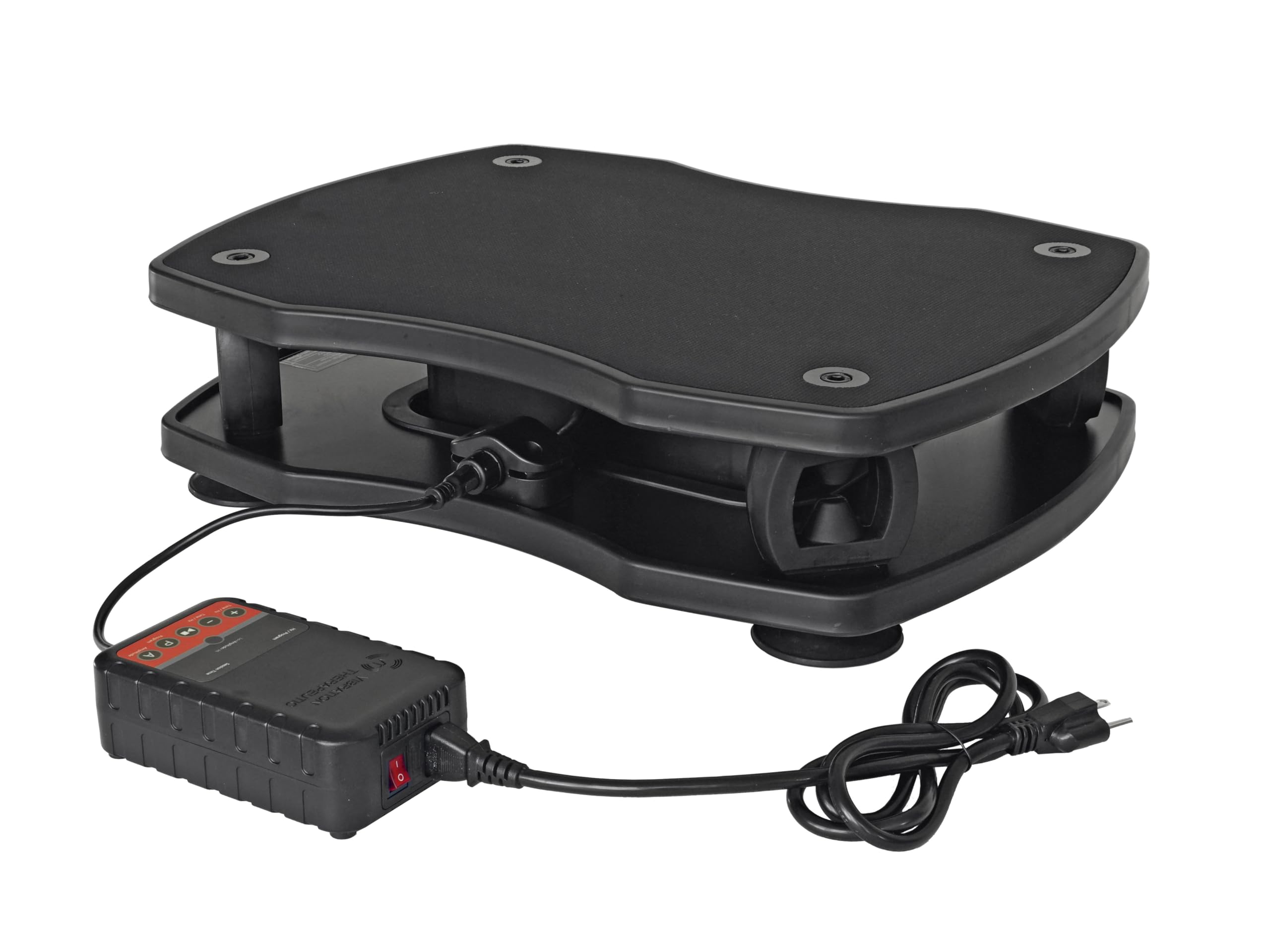
A vibration plate gets you upright in a small footprint. The VT007 runs 10 to 40 Hz, meaning 10 to 40 vibration cycles every second, and it has two amplitude settings — how far the platform travels on each cycle. Higher frequency feels faster and finer; the higher amplitude setting feels stronger underfoot. Both are controls you set before you step on, not something you chase mid-session.
A recumbent bike or elliptical keeps you supported through the back. You still push through your legs, but your hips and spine rest against a backrest, so a long session never turns into a balance test. If getting on and off a machine is your main worry, look for a step-through frame and a seat you can slide without dismounting.
Weight capacity and seat range
Capacity is the frame’s rated limit, and it is the number to check before anything else. The range across these picks runs from 250 pounds on the vibration plate up to 400 pounds on the pooboo recumbent bike and 450 pounds on the VANSHE. A frame rated well above your own weight tends to feel settled rather than springy.
Seat adjustment matters just as much. A slider rail lets the seat move continuously to suit your leg length; a bike with fixed holes gives you a handful of positions. Check the maker’s stated height range against your own height before you commit, because a seat that will not reach your leg length makes every session a compromise.
What the stride and handles do for your knees
Stride length is how far each foot travels per step on an elliptical. A shorter stride keeps the knee bend shallow and the motion compact; a longer stride feels more like walking. If your knees are sensitive, a shorter, controlled path is usually easier to live with than a big sweeping one.
Moveable handles let you add an upper-body push, which raises your breathing and heart rate without adding load to your legs. Fixed handles with a pulse sensor give you something stable to hold. Decide which of those two you want before you compare models.
Side-by-Side Comparison
| Model | Best For | Weight Capacity | Resistance / Frequency | Footprint (D x W x H) | Amazon |
|---|---|---|---|---|---|
| VT007 Vibration Plate★ Best Overall | Standing bone and circulation sessions | 250 pounds | 10–40 Hz, two amplitudes | 16.5″D x 22″W x 5.7″H | Amazon |
| pooboo E399 EllipticalTop Performer | Standing cardio with arm involvement | 350 pounds | 16 levels, magnetic | 49.2″D x 29.92″W x 62.2″H | Amazon |
| pooboo W216 Recumbent BikeMost Versatile | Seated arm-and-leg work | 400 pounds | 8 levels, magnetic | 43″D x 18.5″W x 45.28″H | Amazon |
| Hyperwear Hyper Vest ELITE | Adding load to your daily walk | 20 pounds of steel weights | Removable 2.25 oz weights | Slim enough to wear under a jacket | Amazon |
| REP FID AB-3000 Bench | Seated and supported strength work | 1000 pounds | Flat, incline and decline positions | 55.6″D x 25.8″W x 17.1″H | Amazon |
| MERACH S19 Recumbent Bike | Daily seated cardio, small rooms | 330 pounds | 8 levels, magnetic | 48.03″D x 23.62″W x 46.46″H | Amazon |
| VANSHE RB405 Recumbent Bike | Heavier riders wanting a big seat | 450 pounds | 8 levels, magnetic | 50″D x 25″W x 44″H | Amazon |
| Marcy ME-706 Recumbent Bike | Cordless pedaling anywhere | 300 pounds | 24 levels, 23 programs | 59″D x 24.5″W x 42″H | Amazon |
| Sunny Elite Recumbent Cross Trainer | Full-body low-impact sessions | 300 pounds | 16 levels, electromagnetic | 71.7″D x 33.3″W x 50.8″H | Amazon |
Detailed Reviews
1. VT007 Vibration Plate Exercise Machine
Our pick — 4.5+★ from 400+ verified ratings; the strongest balance of quality and price.
Ten minutes of standing load you can set and repeat, in a footprint the size of a doormat.
The VT007 earns the top slot because it gets you upright and loaded in the smallest space of anything here. Its platform measures 16.5″D x 22″W x 5.7″H, against 49.2″D x 29.92″W x 62.2″H on the pooboo elliptical — so this is the one that lives in a hallway, beside a bed, or in a corner of a living room without you rearranging furniture. You stand on it, press the buttons for frequency and amplitude, and the machine does the work of driving the movement.
What wins people over is how solid it feels and how quietly it runs. The frame is rated for 250 pounds and carries a straight 10-year warranty with a 90-day free return, which is a long window to decide whether daily standing sessions suit you. Buyers report: “Used 3 months, 10 min twice daily.” Ten minutes twice a day is the shape of routine this machine is built around, and the low mechanical noise is a big part of why that routine is easy to keep.
One trade-off is worth naming plainly. The vertical thrust is strong, so the machine wants solid ground-floor placement. On an upper floor it can rattle unless you put foam padding underneath, and that is a question of where you set it up rather than how well it is built. The other limit is the absence of handles — there is nothing to grip while you are on it, so if you want support under your hands during a session, a seated machine is the friendlier shape for you.
Why this one leads
- Takes up almost no floor at 16.5″D x 22″W x 5.7″H — no room reshuffle needed.
- 10 to 40 Hz adjustable plus two amplitude settings, so you can start gentle and add intensity later.
- 10-year warranty and a 90-day free return on a 250-pound-rated frame.
- Runs quietly enough for daily home sessions without disturbing the household.
Where it asks something of you
- No handle to hold, so you need steady balance or something nearby to touch.
- Wants a solid ground-floor spot; on an upper floor it may rattle without foam padding.
Reach for this if: you want the shortest daily routine here — ten minutes upright, twice a day, in a space you already have.
Think twice if: you want something to grip while you stand, in which case a recumbent bike gives you a backrest instead.
2. pooboo E399 Elliptical Machine
Standing cardio that loads your legs while your hands keep hold of the moving bars.
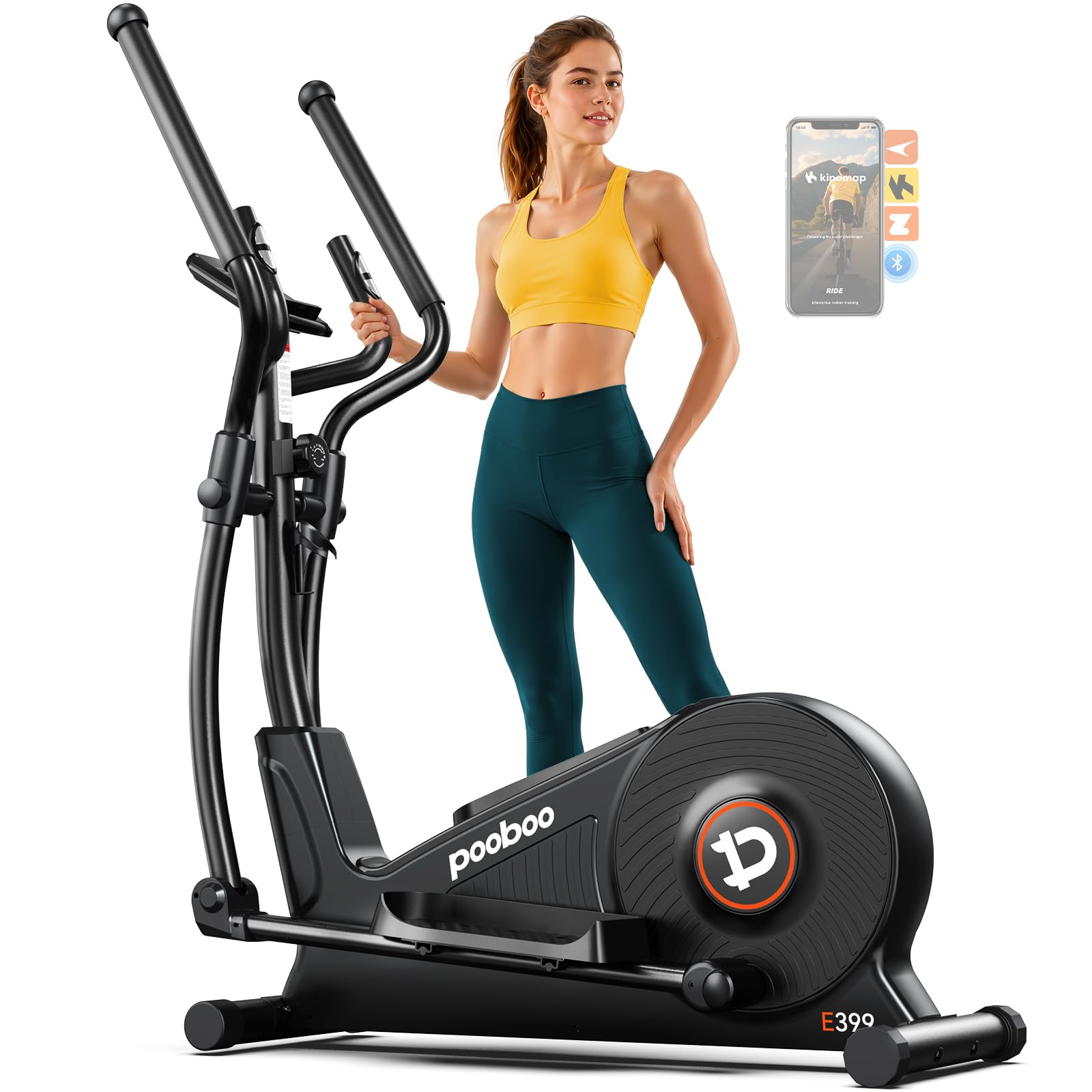
This is the pick for someone who wants to be on their feet and moving, not seated. The pooboo E399 carries a 350-pound capacity on a thickened steel frame, which is a hundred pounds above the VT007’s 250-pound rating — the reason it feels planted rather than lively when you step on. You push through a 15.5-inch stride, a short path that keeps the knee bend shallow and the motion compact rather than sweeping.
The magnetic drive with a 16-pound flywheel runs at a stated 20 dB, quiet enough that a morning session will not carry through a wall. Sixteen resistance levels are grouped into three bands: the low settings for gentle limb movement, the middle for flexibility work, and the top end for harder calorie-burning sessions. The digital monitor tracks time, speed, distance, calories, pulse and a total odometer, so you can see a week of sessions adding up.
Here is the honest limit. Several taller riders find the 15.5-inch stride too cramped and report a jerky feel rather than a smooth glide, which is a fit question, not a build fault — shorter users tend to be perfectly happy. Assembly lands around 45 minutes with most parts pre-built, though the printed instructions are the weak point; the maker’s own video is the faster route. If you are over roughly average height, sit on one at a shop first or accept that your stride will feel short.
Built for the long haul: a steel frame at 350 pounds and a lifetime service promise from pooboo, who state they will supply replacement parts free of charge.
The fit question: the 15.5-inch stride suits compact bodies best; taller riders should treat stride length as the deciding spec, not resistance levels.
Best match for: a compact-home rider who wants full-body motion with their hands engaged on the bars.
Worth a pass if: you are tall and want a long, walking-style stride under each foot.
3. pooboo W216 Recumbent Exercise Bike
Two machines in one frame: your legs pedal while your arms crank the handlebars.
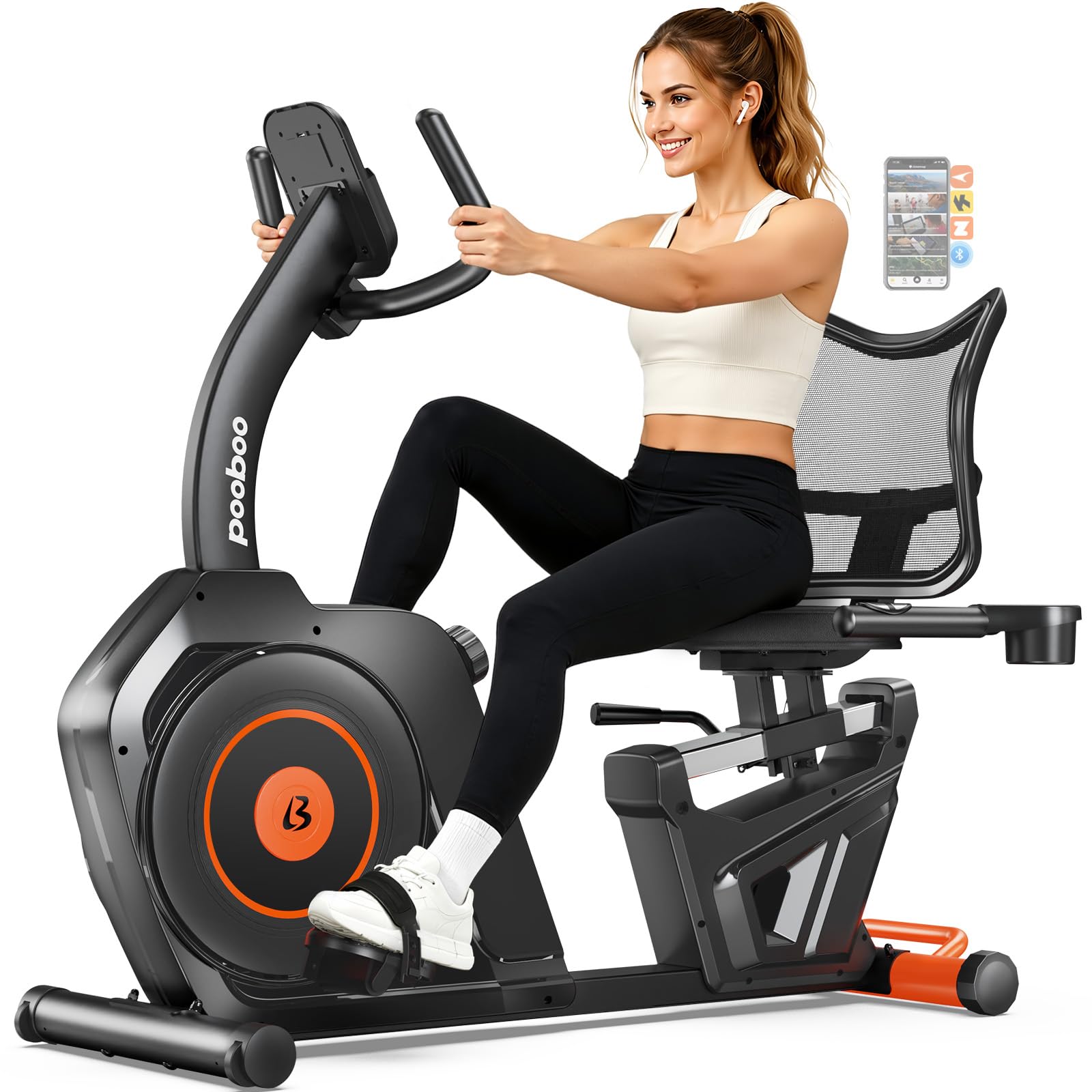
Most recumbent bikes work your legs and leave your arms resting. The W216 adds hand cranks on the front armrest, so you can drive both upper and lower body at once, or alternate them so one half of you rests while the other works. That makes it the pick here for anyone whose legs tire before their session is done — you can keep the habit going by switching effort to your arms. The frame is rated to 400 pounds, the second-highest capacity on this list.
The seated position is where this bike earns its keep for bone-conscious buyers: an ergonomic backrest shaped to the spine, a breathable mesh cover, and a seat that slides along a rail, adjusted continuously rather than by fixed holes. Resistance is a simple 8-level knob, split into warm-up, steady aerobic and harder climbing effort. The 15-pound flywheel and belt drive run at a stated 20 dB, and it arrives 80% pre-assembled with transport wheels for moving it to a corner.
The catch is the seat itself. It draws the most mixed feedback of anything on this bike, with the firmness landing wrong for some riders on long sessions — a cushion or pad solves it for most people. Two smaller notes: the hand cranks do not let you change their resistance independently of the legs, and it takes up more floor than you might picture at 43″D x 18.5″W x 45.28″H. Neither is a reason to pass on it; both are things to plan around.
The case for the W216
- Hand cranks let you train arms and legs together or separately — useful when leg fatigue ends sessions early.
- 400-pound frame with a continuous slider seat rather than pre-drilled positions.
- 80% pre-assembled, with transport wheels and a tail handle for moving it.
Plan around this
- The seat firmness is the recurring gripe; a pad fixes it for most riders.
- Hand crank resistance does not adjust separately from the pedal resistance.
- Needs a real corner of floor at 43″D x 18.5″W x 45.28″H.
Suits you when: you want to keep a daily habit going on days your legs feel spent, using the arm cranks instead.
Look elsewhere when: a plush seat is non-negotiable straight from the start.
4. Hyperwear Hyper Vest ELITE Weighted Vest

Not a machine at all — it turns the walk you already take into loaded work.
Every other pick here asks you to go to it. The Hyper Vest comes with you. It arrives pre-loaded with 20 pounds of removable 2.25 oz steel weights held evenly across your torso by a stretch CORDURA fabric, with side cords you tighten for a snug fit. Because the load sits close to your body, it does not swing or tug at your neck the way a loose vest does — and that even distribution is the thing owners talk about more than anything else.
The sizing is fixed rather than adjustable in the frame sense, so the fit matters. The vest runs Small through X-Large, and booster packs let you add load over time: up to 15 pounds extra in a Small, 20 in Medium and Large, 25 in X-Large. Reflective stripes and orange side cords keep you visible on early walks, and the weights come out so the shell can go in a cold machine wash and air dry.
Two honest notes. Some wearers find it runs small, so check the size chart against your chest measurement rather than guessing — a tight fit is the point, but too tight rubs at the neck. And re-loading the weights is fiddly; it is not a job you will want to do before every walk, so pick a load and leave it. Comfort overall draws mixed feedback, with the snug compression suiting some bodies and feeling restrictive on others.
What the vest gives you: 20 pounds of steel held flat against your torso, so a normal-paced walk becomes resistance work with no bounce to manage.
What it costs you: fixed sizing and a fiddly weight-loading routine — set it once and stop adjusting it.
Pick this if: you already walk daily and would rather add load to that habit than learn a new machine.
Leave it if: you dislike close-fitting garments or want a machine that dictates the movement for you.
5. REP FID Foldable Weight Bench AB-3000

A thousand-pound-rated platform that folds away — for the strength half of a bone routine.
Bone work is not only cardio: supported strength training counts too. Supported strength training — sitting or lying on a firm bench and pressing or rowing a light dumbbell — lets you load a muscle group without any balance demand at all. The REP AB-3000 is rated to 1000 pounds, by far the highest capacity on this list, and it adjusts through flat, incline and decline positions so you can set the angle your shoulders and hips prefer.
At 89.3 pounds with an alloy steel frame, it does not slide or shift mid-rep. The bench folds down for storage and rolls on integrated wheels, which is what makes an 89.3-pound bench practical in a home room. It measures 55.6″D x 25.8″W x 17.1″H when set up and is built for dumbbell and bodyweight work rather than barbell loads alone.
The trade-off here is size, not strength. It is a full-length bench, so it claims floor space whenever it is unfolded, and shorter users will likely want a plate or block under their feet when it is set flat. What you get in return is the most stable platform in this guide — the kind of frame that stays exactly where you put it, rep after rep, which matters when the whole point is controlled, supported pressing and rowing.
What makes it worth the floor space
- 1000-pound rating — the most capable frame here by a wide margin.
- Flat, incline and decline positions give you angle choice for supported pressing and rowing.
- Folds and rolls away on integrated wheels despite weighing 89.3 pounds.
The honest caveats
- Full-length footprint at 55.6″D x 25.8″W x 17.1″H when unfolded.
- Shorter users may want their feet raised when the bench sits flat.
Made for: anyone building a supported strength routine alongside their cardio and wanting one frame that will not move.
Not the one if: floor space is the tightest constraint in your home.
6. MERACH S19 Recumbent Exercise Bike
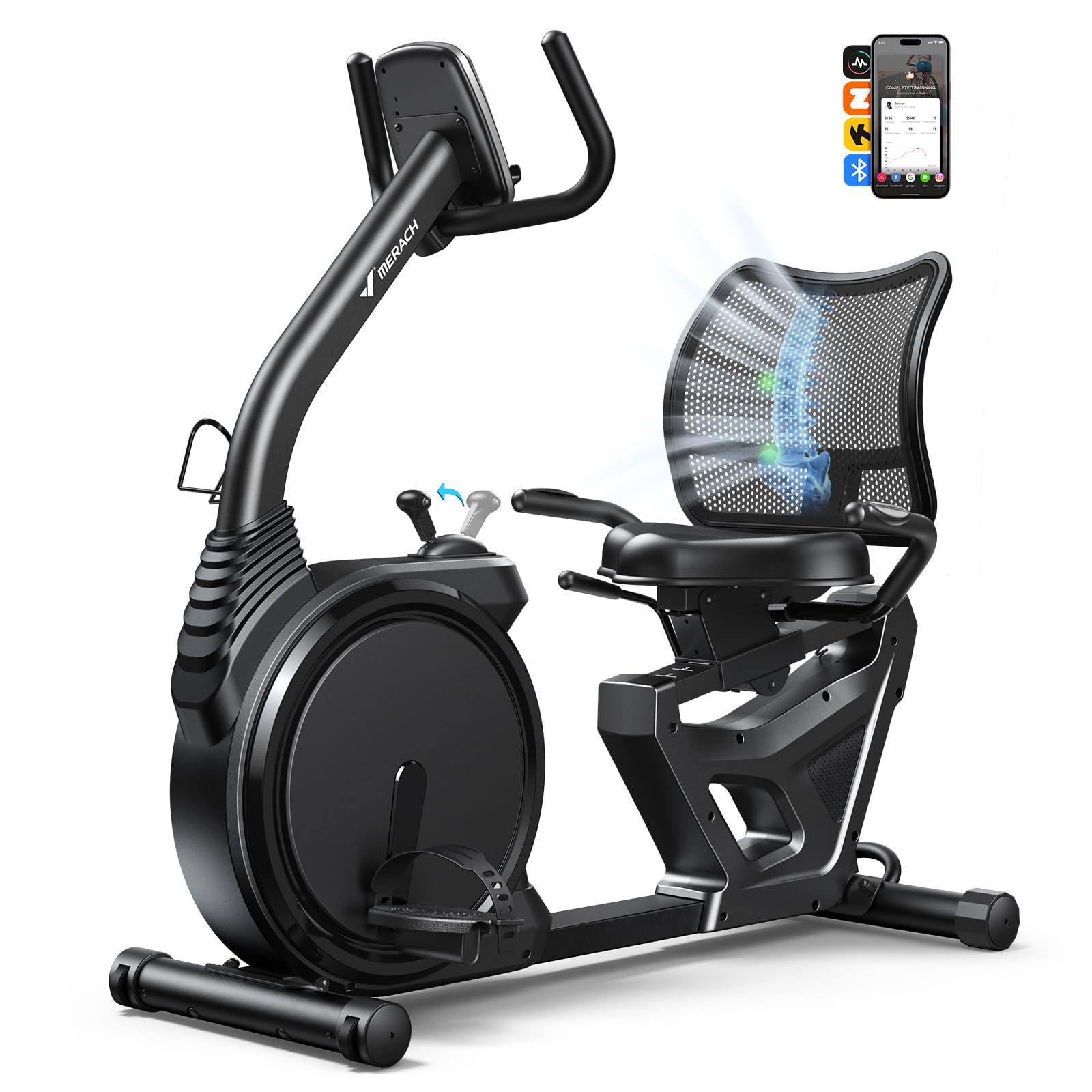
The seated bike that gets you in and out easily and lets you adjust the seat without standing up.
If your priority is a session you can start without thinking about balance, the S19 is the strongest all-round seated option here. It rates 4.5+ stars from 900+ owners — the largest body of feedback in this guide — and the seat is the reason it holds up. Eight positions let you set the seat to your inseam, and the backrest is thicker with a breathable mesh cover than most bikes this size offer.
It runs on a dual-belt drive with a 6.6-pound perimeter-weighted flywheel, which spreads momentum evenly so pedaling stays smooth from the first stroke. The 8-level car-style lever lets you change resistance with one shift rather than a twist knob, and the LED display shows time, distance, speed, calories and heart rate. The recommended height band is stated as 5’2″ to 5’10”, with an extended seated leg length of 28.35 to 35.43 inches — check that against your own leg length before buying.
The honest limit is pedal size. The footplates are smaller than most, and the pulse reading off the handlebar can be less reliable than a watch, so do not treat its heart-rate number as a medical reading. Assembly takes under 30 minutes per the maker, and 80% arrives pre-built, with an install video included if the print instructions are unclear.
Where it shines: seat comfort and on-the-move adjustment — eight positions you can shift without dismounting.
The small gripe: compact pedals and a pulse sensor that trails a wrist watch for accuracy.
Ideal for: daily seated cardio in a small room, especially if a long backrest and a wide seat are what keep you coming back.
Consider another if: you are taller than the stated 5’10” top of the height band.
7. VANSHE RB405 Recumbent Exercise Bike
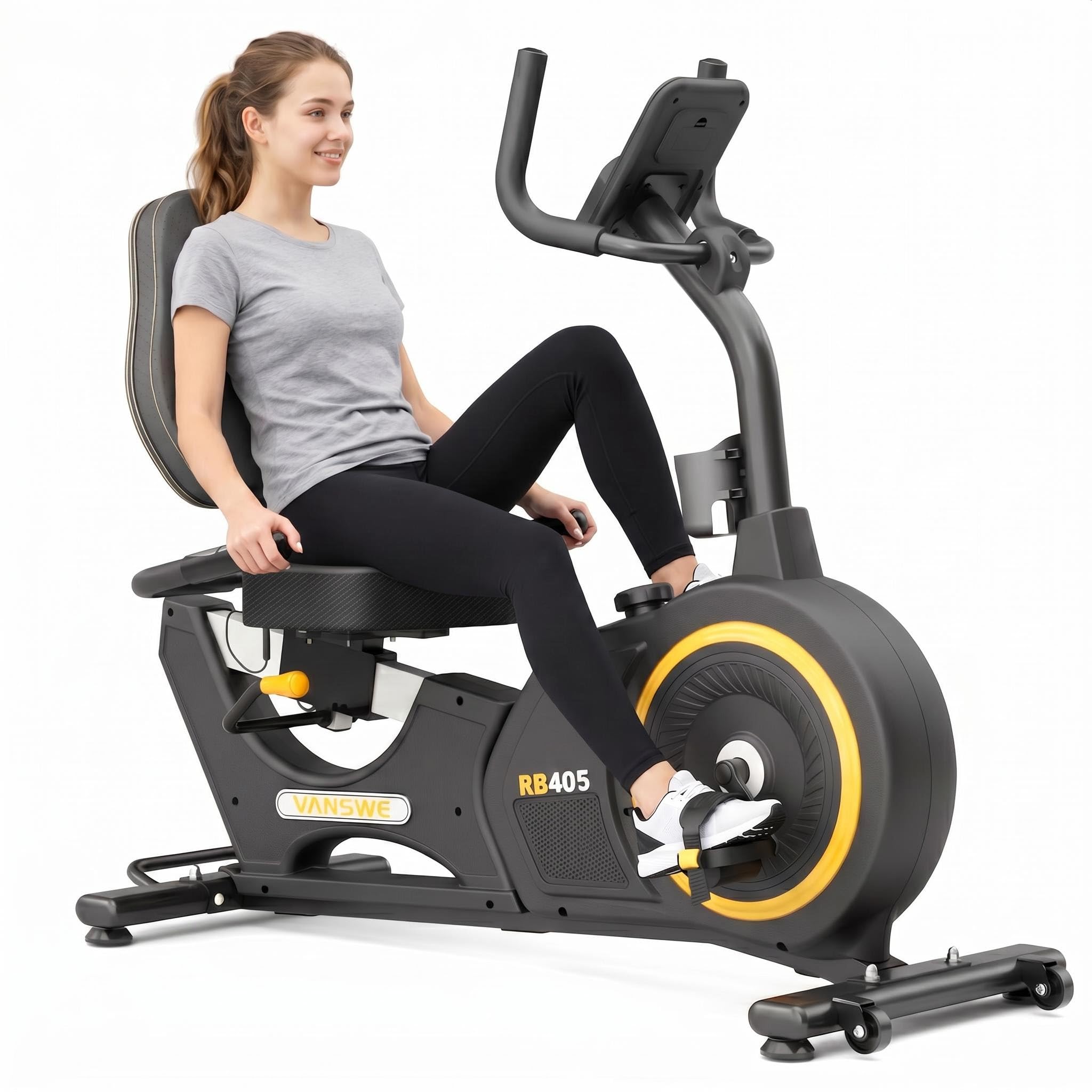
A 450-pound frame built for the plus-size rider who has been told “it will hold you” one too many times.
Capacity is the headline and it is the right place to start. The VANSHE RB405 is rated to 450 pounds, the highest of any bike in this guide, on a commercial-grade steel frame the maker describes as wobble-free.
The seat slides continuously rather than stopping at pre-drilled holes, with a stated leg-length range of 29 to 40 inches and a user height band of roughly 5’1″ to 6’4″. The cushion is a 3.4-inch padded seat with a contoured backrest — the kind of support that helps when you are sitting for 45 minutes at a stretch. An 11-pound flywheel with 8-level magnetic resistance runs quietly, and a backlit LED monitor shows your metrics or connects over Bluetooth to apps like Kinomap and Zwift.
The recurring gripe is the seat lock. Some riders find the seat will not click firmly into place after adjustment, and the fix is a habit rather than a repair — push the slider all the way and check it seated before you pedal. Two riders also found the pedals sit close to the cranks, which flexible pedal extenders resolve. Neither undercuts what you get in the frame; they are setup details to work through in the first week.
Why heavier riders shortlist it
- 450-pound rating on a commercial-grade steel frame — the largest margin here.
- Continuous slider seat covering a 29-to-40-inch leg range, so most of a household can share it.
- 3.4-inch padded seat and contoured backrest for long, supported sessions.
- Backlit LED monitor with Bluetooth connection to Kinomap and Zwift.
What to expect
- The seat lock takes some care — check it engaged before each ride.
- Pedals sit close to the cranks for some riders; pedal extenders are the usual fix.
Choose it when: you need real weight margin in the frame and a seat that adjusts to a long or short leg without compromises.
Look past it if: you want a light bike you can lift and stow — at 73 pounds this one stays put.
8. Marcy ME-706 Regenerating Recumbent Bike

Pedal to power the display — no cord, no outlet, no fixed spot in the house.
Most home bikes need a wall socket. The ME-706 does not: a regenerating motor powers the computer as you pedal, so you can set it wherever you like and start moving. That is genuinely useful when the best spot for a bike is the sunniest corner or the one without a plug nearby. It carries a 300-pound capacity and 24 levels of magnetic resistance spread across 23 built-in programs, the widest resistance range of any bike in this guide.
The step-through frame makes getting on and off simple — you swing a leg through rather than over — and the seat adjusts with a lever while you are still sitting on it. A step-through frame plus a lever-adjusted seat makes this the budget-friendly pick for starting a seated routine without fuss. The display tracks time, speed, distance, calories and pulse, and the whole thing weighs 93 pounds, so it stays where you put it.
The honest trade-off is assembly. Directions are thin and leave out steps, so it is a two-person job with help from a video rather than a quick solo build. The pulse sensors also work only when both hands sit squarely on the grips, and the seat is firmer than most. None of that changes what the bike does once it is together — the pedaling is smooth and quiet.
The headline win: a regenerating motor means you pedal to power the display, so no electrical connection is needed and the bike can live anywhere.
The build-day reality: budget extra time and a second pair of hands for assembly, and expect a firm seat you may want to pad.
Right for you if: your best workout spot has no nearby outlet and you want 24 resistance levels to grow into.
Reconsider if: you would rather unbox something pre-assembled than spend an afternoon with a manual.
9. Sunny Health & Fitness Elite Recumbent Cross Trainer

A recumbent seat married to elliptical-style pedals and arm handles — a full-body session with a backrest.
This is the pick that combines the two halves of everything else here. You sit in a padded seat with a mesh backrest, but instead of pedals in front of you the machine runs an elliptical path, and the moveable handles let your arms push and pull in step. Use the handles or the foot pedals independently and you can target one half of your body while the other rests. It is the only machine in this guide that gives you a backrest and full-body motion at once.
Resistance runs through 16 electromagnetic levels — a magnetic brake rather than a mechanical one, so dialing effort up or down is silent. Twelve pre-programmed workouts are built in, plus up to four user programs for your own sessions, and a performance monitor tracks time, speed, RPM, distance, watts, calories and heart rate. The seat adjusts with a lever while you stay seated, so you can shift position mid-session without dismounting.
Be ready for the footprint. At 71.7″D x 33.3″W x 50.8″H this is the largest machine on the list by a clear margin, and at 113.1 pounds it is the heaviest — it will claim a room rather than a corner. Assembly is the other hurdle; it takes around two hours and some owners mention the printed guide is thin, so download the full manual before you start. Once it is assembled and placed, the ride itself is steady and kind to knees and hips.
What you gain
- Backrest plus moveable arm handles — a full-body session without standing up.
- 16 electromagnetic resistance levels and 12 pre-set programs, plus 4 user programs.
- Seat adjusts with a side lever while you stay seated.
What you give up
- Largest footprint here at 71.7″D x 33.3″W x 50.8″H — plan the room before you order.
- Around two hours of assembly; download the manual online before starting.
Built for: the buyer who wants arm and leg work together but will not stand on a machine to get it.
Look away if: you are short on floor space — this one needs a dedicated spot.
Know the Specs
Frequency and amplitude on a vibration plate
Frequency is measured in Hz — the number of vibration cycles per second. The VT007 runs 10 to 40 Hz, so you can start slow and fine and work up to a faster, denser feel. Amplitude is how far the platform travels per cycle; this plate offers two settings. Together they decide how strong a session feels underfoot, and both are fixed before you step on, which keeps the routine predictable.
Weight capacity and frame feel
Capacity is the most weight the maker rates a frame to hold. It is not a target to hit — it is margin. A bike rated to 450 pounds, like the VANSHE, or a bench rated to 1000 pounds, like the REP, tends to feel settled rather than bouncy because the steel is built for loads well beyond yours. Always leave headroom between your own weight and the rating.
Seat adjustment range and leg length
A slider rail lets the seat move continuously; fixed holes give you a set number of spots. The figure that actually matters is the leg-length range the maker states — the VANSHE lists 29 to 40 inches, and the MERACH lists a recommended height of 5’2″ to 5’10”. Measure your own leg length and match it to the stated range before buying. A seat that will not reach your leg length makes every session an awkward compromise.
Stride length on an elliptical
Stride length is how far each foot travels per step. The pooboo E399 runs a 15.5-inch stride, a short, compact path that keeps the knee bend shallow. Short strides suit smaller frames and tighter rooms; taller riders often want a longer path so the motion feels like walking. Read the stride figure before the resistance count — it is the number that decides whether the machine fits your body.
Common Questions
Is a vibration plate or a recumbent bike better for someone with osteoporosis?
Does the VT007 vibration plate need to be on a ground floor?
Will a 15.5-inch stride be too short for a tall rider?
Do any of these machines need to be plugged into a wall outlet?
How much weight margin should I leave under a recumbent bike’s capacity?
Can I adjust a recumbent bike’s seat without getting off?
Is a weighted vest safe to wear for bone loading on a walk?
How long does assembly take on these machines?
Do I need a weight bench if I already have a bike or vibration plate?
What warranty lengths do these machines carry?
The Bottom Line
For most people, the strongest starting point in this exercise machines for osteoporosis shortlist is the VT007 Vibration Plate, because it puts you upright and loaded for ten minutes twice a day in a 16.5″D x 22″Wx 5.7″H footprint, with a 10-year warranty behind a 250-pound-rated frame. If you would rather sit down for your sessions and want a backrest and arm cranks doing the work with you, grab the pooboo W216 Recumbent Bike. And for the days your legs need a rest but you still want to keep the habit going, the Hyperwear Hyper Vest ELITE turns the walk you already take into loaded work.
One last honest note on picking: the vibration plate has a smaller ratings base than the recumbent bikes here, but the feedback on it is the most consistent in the whole group — it is the pick that draws the fewest caveats from owners, and the one most likely to still be in daily use a year from now because ten minutes twice a day is a routine almost anyone can keep.
How we choose
We do not accept paid placement. Every pick is matched to a real buyer and a real use-case; we do not hands-on test units.
Sources
Specifications: manufacturer listings and product documentation. Review insights: verified customer reviews, as of October 2026. Pricing: not shown on this page (it changes often); check the current price via the retailer link.
As an Amazon Associate, Aappliancez earns from qualifying purchases. This does not affect which products we feature.