Disclosure: Some links in this post are affiliate links. As an Amazon Associate I earn from qualifying purchases, at no extra cost to you. Learn more
Specs are compiled from manufacturer listings and verified buyer reviews and can change over time — please confirm the key details on the product page before buying.
If your lower back aches every morning and stretching, foam rolling, and a new mattress have not helped, the fix is probably not more stretching. You likely need a machine that pulls your spine into gentle traction or builds the muscles that hold it up. Here is the short answer: a decompression table or inversion chair is the right first buy if the pain sits in your lower back or sciatica zone. An inversion table is the right buy if you want a full stretch with ankle support. A Roman chair or seated row machine is the right buy if you want to build back strength rather than chase relief. Below is what nine real back machines actually do, translated out of the spec sheets and into plain English.
This guide is built by comparing the manufacturers’ published specifications and the patterns across verified customer reviews, so you get each pick’s real strengths and trade-offs instead of marketing spin.
Back equipment is one of the few home-fitness categories where the wrong buy genuinely hurts. So each pick below pairs a plain explanation of what the machine does with the one setup detail that decides whether it works for your body. The short version of the exercise machine for back search: decompression first if you are in pain, strength work if you are building back.
Top Picks
How To Choose The Best Exercise Machine for Back
The mistake almost every first-time buyer makes is treating “back machine” as one category. It is not. A traction device stretches your spine lengthwise, an inversion table tips you backward so gravity does the pulling, and a Roman chair or seated row builds the muscle that keeps your spine supported. Buy the wrong type for your body and it ends up gathering dust. Buy the right type and it slots into a five-minute daily routine.
Decide between relief and strength first
If you want to take pressure off a sore lower back, you want decompression or inversion — the machines that lengthen the spine rather than load it. If you want to prevent the ache from coming back, you want extension and rowing work that strengthens the erectors, glutes, and mid-back. Most people eventually want both, so it is fine to start with a traction or inversion pick and add a bench later.
Your height and torso length decide everything
Back machines are fit-critical in a way treadmills are not. On a Roman chair, the gap between the thigh pad and the leg rollers has to land your hip joint on the pivot, and that distance is fixed on several designs. On an inversion table, you set the ankle lock and the main shaft to your height, and a long-waisted frame tips differently than a short-torso one. Before you buy, check the stated height range and — if you are under about 5’4″ or over 6’2″ — read the fit comments closely.
Weight capacity is a stability number, not a vanity number
A 250 lb rating and a 350 lb rating tell you how much steel is under you. That matters most on machines where your body weight is cantilevered, like an inversion table or a hyperextension bench, because a light frame tips or rocks when you move with momentum. If you are near the top of a machine’s stated capacity, plan to bolt, weight, or wall-anchor it.
Side-by-Side Comparison
| Model | Best For | Type | Max User Weight | Adjustability | Amazon |
|---|---|---|---|---|---|
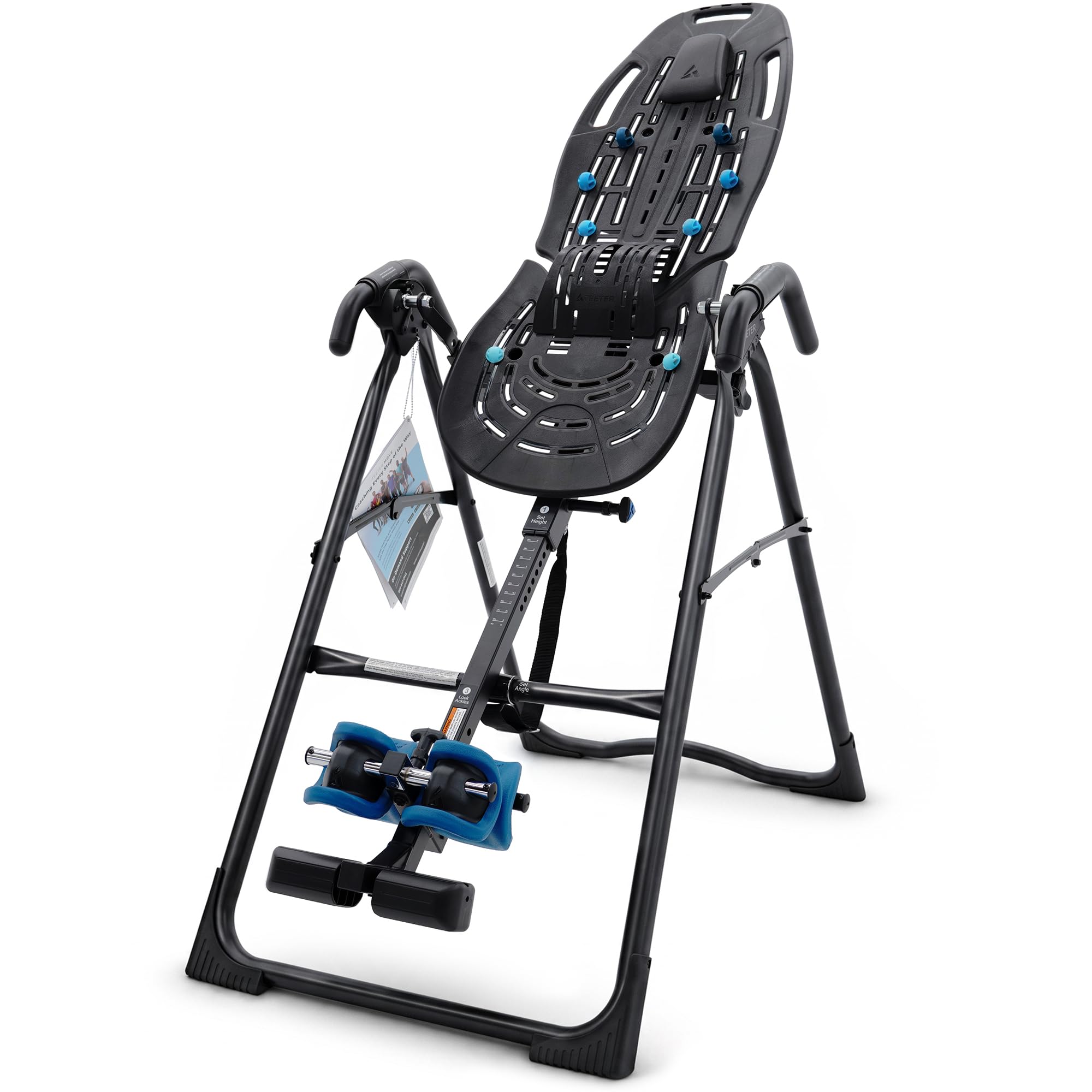
| Teeter EP-560 Inversion Table★ Best Overall | Full-spine decompression | Inversion table | 300 lb | 2-position foot platform | Amazon |
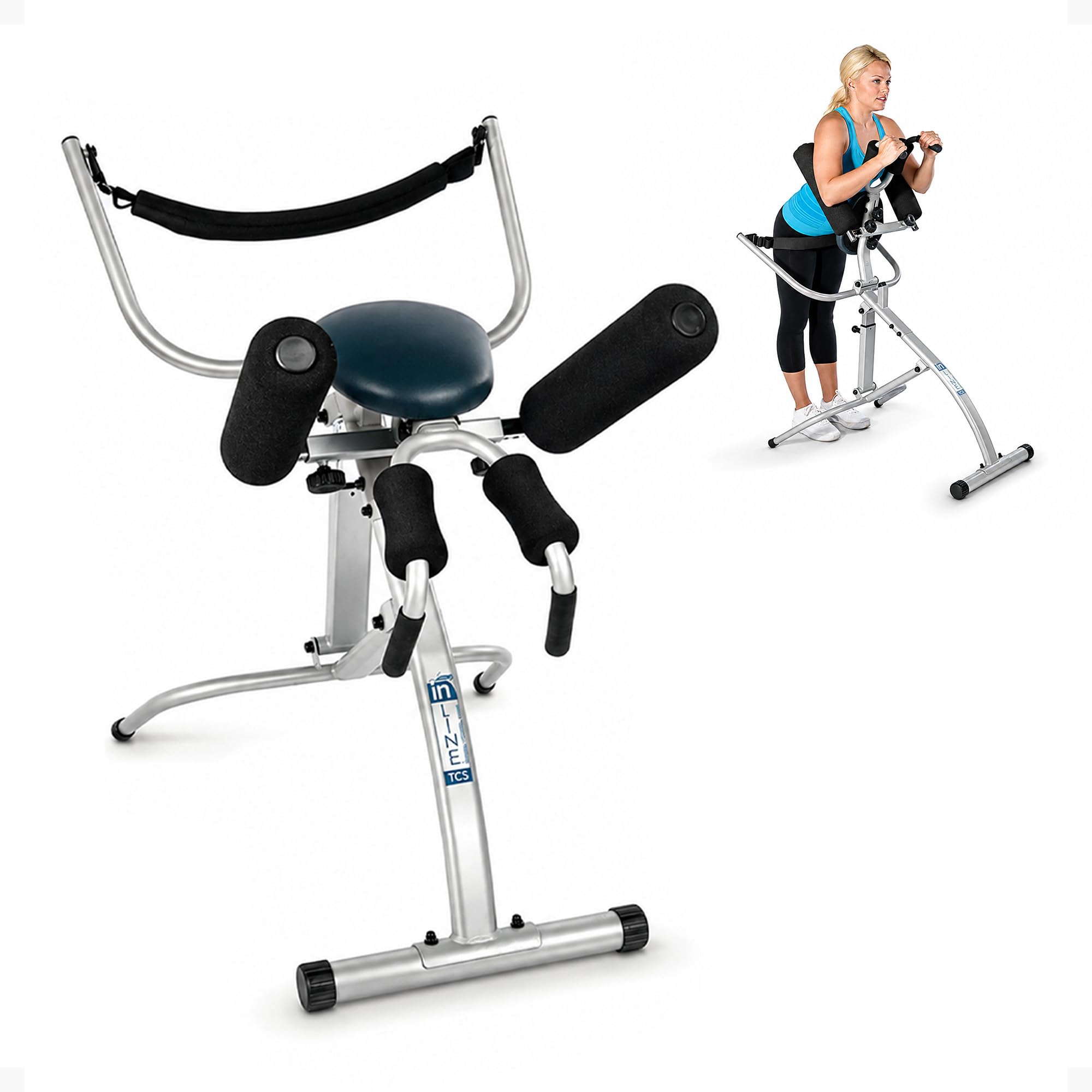
| Stamina InLine Traction Control SystemBest for Tight Spaces | Lower-back traction without going upside down | Standing traction trainer | 250 lb | Adjustable lap belt, arm supports | Amazon |
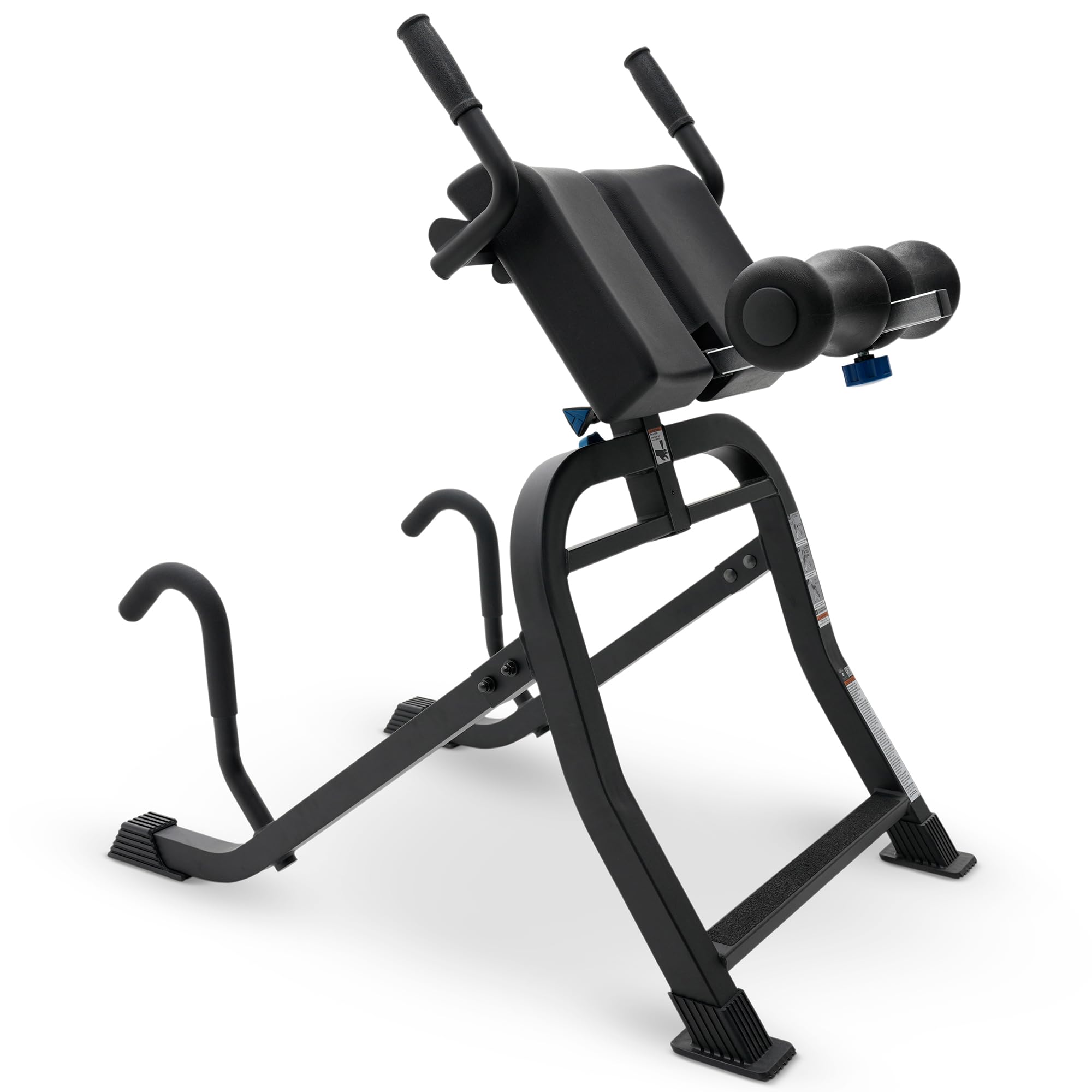
| Teeter DEX II Inversion & Core TrainerHip-Supported Pick | Inversion without ankle locks | Hip-supported inversion chair | 350 lb | Spring-loaded lap cushion, 4’8″–6’6″ height range | Amazon |
| Body-Solid Back Hyperextension Machine | Gym-grade extension bench | Roman chair | 120 kg | Vertical and horizontal pop-pin | Amazon |
| Stamina Hyperextension Bench 2014 | Small-space starter bench | Foldable Roman chair | 250 lb | Height-adjustable cushions | Amazon |
| GMWD AB/Back Machine | Two exercises, one seat | Ab crunch / back extension combo | 350 lb | 5 seat heights, 8 foot-restraint positions | Amazon |
| syedee Seated Row Machine | Building lat and mid-back strength | Plate-loaded row | 400 lb | Adjustable seat and chest pad | Amazon |
| SUCXDZQ Roman Chair Back Extension Machine | Adjustable height and angle on a budget | Roman chair | 245 lb | 26.7–35 in height, adjustable angle | Amazon |
| HVO Seated Calf Raise Machine | Lower-leg support work | Seated calf raise | 660 lb | 6-level leg pad, 4-level support rod | Amazon |
Detailed Reviews
1. TEETER EP-560 Inversion Table with Accessories
Our pick — 4.5+★ from 500+ verified ratings; the strongest balance of quality and price.
The full-length inversion table that stretches your whole spine, ankles locked and all.
Start with the number that decides whether this table is safe for you: a 300 lb user capacity, held up by a heat-treated steel frame. That is serious steel — the kind that does not flex when you rotate back. The table itself rotates you to a full hang, and it folds flat in seconds for storage, so a spare bedroom or a corner of the garage works fine.
What wins people over here is build quality — it is the most-praised trait on this table by a wide margin, ahead of even the back relief itself. Owners describe it as solid at every angle, including a 260 lb user who reported it feeling stable with no wobble. The ComforTrak backrest slides with your body as you rotate, which lets your spine decompress along its whole length instead of just hinging at the hips. The wrap-around ankle cups and the 2-position foot platform are the parts that make or break an inversion table, and these are dialed in: you set your height once and the hold stays put.
The honest catch is weight and comfort, in that order. At 65 lb this is a heavy piece — heavier than the Stamina Hyperextension Bench by a wide margin — and it slides on hardwood. So you will want a helper or a mat if your back is already angry. Comfort is the mixed note in the reviews: the lumbar support is arched, and some frames find it too firm, while others call the hard plastic backrest a plus because it does not stick to bare skin. If you have never inverted before, start with short sessions — the review pages sum it up as a tool that rewards a gentle ramp rather than a full hang on day one.
Where it holds up
- 300 lb user capacity on a heat-treated steel frame
- Folds flat with no disassembly, so it stashes in a closet or corner
- Wrap-around ankle cups and a 2-position foot platform lock your fit
- Ships with the Teeter Move app for guided sessions
What to plan around
- 65 lb frame is heavy to move solo, especially on hardwood
- Arched lumbar support is a love-it-or-not shape
- Full inversion takes getting used to; short sessions first
Reach for this if: you want the deepest full-spine stretch and can give the table a permanent home.
Think twice if: you live alone with an active back injury — the 65 lb frame needs a second pair of hands.
2. Stamina InLine Traction Control System
Decompression without tipping upside down or lying on the floor.
If the idea of hanging by your ankles makes you nervous, this is the machine built for you. The InLine holds you in a standing lean — feet flat, lap belt against your hips, arms on padded supports — and lets your body weight create a slow, controlled pull through your spine. There is no inversion angle and no ankle lock, just a stretch you can step out of whenever you want.
Effectiveness is what this machine is known for, and it is the biggest strength here by a clear margin in the owner feedback. People with long histories of back trouble describe it reaching the spots an inversion table could not, adjusting the stretch by leaning forward harder, by changing the belt height, and by moving the elbow and knee supports. It carries a 250 lb weight limit on a steel frame, and the whole thing weighs 29 lb — light enough that moving it out of the way is a one-person job.
The trade-off is that traction rewards experimentation, not plug-and-play. This is not a machine you nail on the first try — you adjust the padded lap belt to hip height, dial in the arm supports, and lean until the pull feels right. That trial period is the most common note in the reviews, and it can take a few sessions. If you have very sensitive shoulder joints, watch the rolling pads under your arms; a few owners mention pressure there and ease in gradually. Also note this is a stretching and traction machine, not a strength builder.
The case for the InLine: it delivers standing decompression for a fraction of the cost of an inversion table, and it fits in a corner. Adjustability across upper and lower back is the main reason people choose it over a table.
Worth knowing: the stretch is only as good as your setup, so budget a few short sessions to find your belt height and lean angle before judging it.
Best matched to: anyone who wants traction but cannot or will not invert.
Look elsewhere if: you need progressive loading — this machine stretches, it does not add strength.
3. Teeter DEX II Inversion & Core Trainer
An inversion chair that hangs you by the hips, so your ankles never take the load.
Here is the design idea in one sentence: instead of locking your feet and tipping you backward, the DEX II rotates you forward into a hip-supported hang at a 90/90 posture. Your ankles are free, your hips carry the weight, and your lower spine decompresses without a single pound hanging off your feet. That single change is why people who could not tolerate an ankle-lock table — including those with prior ankle problems — end up using this one daily.
The platform does more than inversion. Traction grips and lower handles let you use it for back extensions, ab crunches, pushups, pullups, dips, leg raises, and anchoring resistance bands. The height range is genuinely wide — 4’8″ to 6’6″ — and the 350 lb capacity sits at the top of this list. Teeter builds it on a heavy-duty steel base with a powder-coated finish and a non-slip boarding step, and throws in the subscription-free Move app if you want guided classes on your phone.
The honest limit is the same one that makes it comfortable: hip support. A 6’2″ owner found it pinches the belly coming back to standing, which is a real note for heavier users. If you are on the short side, measure before you order — the pelvic support is long, and a 5′ occupational therapist found she could not adjust it short enough for her thigh length. And unlike the EP-560 with its ankle cups, this design puts all the support on your midsection, which some find far more comfortable and others find restrictive.
Reasons this one earns the premium
- 350 lb capacity and a 4’8″–6’6″ height range
- No ankle loading — hips do the work
- Doubles as a Roman chair, pullup, dip, and band station
- Spring-loaded lap cushion adjusts in seconds between users
The honest trade-offs
- Hip support can pinch the stomach on the way back up
- Short torsos may not get enough thigh-length adjustment
- At 60 lb it stays put — setup, not portability, is its job
Go with it if: ankle-lock tables bother you and you want daily, low-effort decompression.
Hold off if: you are well under 5’4″ — check the pelvic support length against your thigh before ordering.
4. Body-Solid Back Hyperextension Machine

The bench that feels like the Roman chair at your gym, because it is built like one.
Look at the frame before anything else: commercial 2″ x 3″ heavy-gauge steel, and the whole unit weighs 40 lb. That is a different class of steel from the lighter home benches on this list. It carries a 120 kg maximum user weight, and the oversized 8″ foam rollers plus the 3¾” DuraFirm pads give you contact points that do not dig in mid-rep.
Build quality is the trait that carries this bench, followed closely by how solid it feels under normal use. Both vertical and horizontal pop-pin adjustments let you set the footrest to your height, and the no-slip step-up surface makes mounting safe even when your hands are full. It handles back extensions, reverse hyperextensions, ab crunches, and Roman chair work, so it is one machine doing the job of two or three separate pieces of home equipment.
The catch is assembly and the break-in period. Owners describe a 2–3 hour build with tight bolt spots that call for standard wrenches rather than an adjustable one, and a few find they have to crank the bolts very tight to stop a slight rock. The thigh pad stays put rather than sliding fore and aft, so the fit suits most frames well but may crowd someone around 5’5″ or shorter. If you are heavier than the 120 kg rating, size up — this is a home unit dressed in commercial steel, not a commercial unit itself.
Why the build wins: 2″ x 3″ heavy-gauge steel, 3¾” pads, and 8″ rollers put this bench at a level most home Roman chairs do not reach.
Give it an afternoon: the 2–3 hour assembly with tight bolt spots is the price of that steel — plan for it and have a socket set ready.
Suits the buyer who: wants a gym-feel extension bench and does not mind a weekend build.
Not the pick for: anyone who needs a quick setup or moves the bench around often.
5. Stamina Hyperextension Bench 2014

Twenty pounds, one fold, and your back extension station disappears.
If you have a spare bedroom or a corner of the living room, the whole story of this bench is its 20 lb frame and the fact that it folds away. Set it up, do your extensions, fold it flat, and move it out of the way. The carbon steel frame carries a 250 lb maximum user weight, and the padded back and leg cushions with the pivoting foam rollers adjust to a few different heights and thigh lengths.
The price-to-value read is what makes this one easy to recommend as a starter bench. Owners describe it as well made, stable once you are set up, and easy to assemble in well under an hour with clear instructions. It supports lower back work, glutes, and even preacher curls if you flip it around and match the pad height. For someone who wants to add extensions to their routine but has almost no floor space, it is the obvious fit.
The honest limit is who it fits. The bench is built for people up to 250 lb and roughly 5’0″ to 6’0″, and shorter frames have less room — a 5’3″ user found the pads sat too high on their abdomen even at the lowest setting, needing a foot elevation to line up at the hips. There is a slight wobble at higher body weights during explosive reps, which is normal for a 20 lb foldable. If you are taller than 6’0″ or lifting heavy, look at the Body-Solid bench above instead.
The 20 lb advantage: at 20 lb this bench folds flat and stows, so a studio apartment can still own a Roman chair.
Fit is the deciding factor: shorter users may need shoes or a foot block to get their hips on the pivot.
Pick it when: space is the thing holding you back from a home back routine.
Size up if: you are over 6’0″ or north of the 250 lb rating — the geometry gets tight at the edges.
6. GMWD AB/Back Machine

Crunch one direction, extend the other, never leave the seat.
This machine is two exercises bolted into one footprint. A rotary flywheel with 27 selectable holes gives you over 180 degrees of adjustment. So you can set the start position for a back extension and then flip a plug to convert to an abdominal crunch without moving the machine. The seat height adjusts across 5 options, and the foot restraints adjust across 8 positions with a 31.4″–36.3″ distance range. That range is the spec that decides whether tall and short users can both lock in.
Build quality is what owners respond to — the thing everyone raves about is how solid it feels in a home gym. The 2″ padded leatherette cushion cleans easily and holds up between sessions, and the weight selector pin and stack are positioned so you are not hunting for a change mid-set. With a 350 lb maximum weight recommendation, it sits near the top of this list on capacity, and the footprint (62″ D x 45″ W x 44″ H) is compact for what it does.
Two things to plan for. First, assembly is the most common complaint in a split of easy-versus-hard — a few people get the flat key in place in an afternoon, others fight it. Second, the machine needs weight or resistance to stay planted, so budget for plates or the 12″ resistance bands that owners found work well. A loose plastic weight holder can crack during the build, though the maker generally replaces it quickly. If you want one machine for both core directions and have a little floor space, it is a smart buy.
What makes it click
- Two exercises on one frame saves floor space and cost
- 180+ degrees of flywheel adjustment across 27 holes
- 350 lb capacity and a clean 2″ leatherette pad
What trips people up
- Assembly is love-it-or-hate-it; set aside an afternoon
- Needs weights or bands to anchor it down
- A plastic weight holder can crack in transit
Worth grabbing if: you want both ab crunches and back extensions without buying two benches.
Pick something simpler if: you handle assembly solo and want a machine that is ready in minutes.
7. syedee Seated Row Machine

The machine that actually builds your lats — no cable, no wobble, no guesswork.
Most home rowing is done on a cable in an unstable stance. This one fixes the path in steel, which is why the power transfer feels so different. The plate-loaded arms hit your lats, rhomboids, and traps along a rigid line, and the handles rotate so your wrists and elbows can follow a natural arc. You get two grip styles — a fully rotating grip for comfortable rowing and a fixed grip for precise loading, the same way a barbell row or T-bar row works.
The spec sheet is set up for real weight. A 400 lb maximum weight recommendation on an alloy steel frame, a 110 lb machine weight, and the ability to run the arms together or independently — which lets you isolate one side of your back at a time. The seat and chest pad both adjust, so you can set your body up before each set rather than muscling into position. It measures 63.7″ x 28.7″ x 42.2″ overall, so it tucks into a home gym without dominating the room. Both 1″ and 2″ weight plate adapters are included, and plates are not.
The catch is stability at the top end. This machine stays planted with light plates, but the same 400 lb rating does not mean it stays flat when you stack heavy. Owners found it stable at around 90 lb and tipping when they pushed past that point, and one reported welds breaking at the base after a few months. A counterweight under the seat is the workaround. Treat the capacity as a ceiling and add weight gradually, and it rewards you with one of the best back workouts in this price range.
Why it earns the strength crown: fixed-path, plate-loaded arms on an alloy steel frame with independent sides — that is a serious lat machine in home-gym clothing.
Load it gradually: the tipping point arrives once you push past light plates, so add weight slowly or anchor the base.
Reach for this if: building a strong, defined back is your goal and you already own plates.
Skip the heavy stack if: you plan to load it near its 400 lb ceiling — the base wants help staying down.
8. SUCXDZQ Roman Chair Back Extension Machine

The budget Roman chair that adjusts taller and lower than most benches at its price.
Most benches at this level give you one height. This one adjusts from 26.7 to 35 inches and lets you change the angle too, which is the reason it suits a wider spread of body types. Designed for users up to 6 ft 3 in, it carries a 245 lb maximum load on a carbon steel frame with a triangular support structure. The whole footprint is 43.4 x 23.5 inches — small enough for a corner and light enough at 20 lb to wheel out of the way.
The parts that touch your body are split support pads, padded leg rollers, side handles, and footplates, so back extensions, crunches, and side work all have somewhere to anchor. Setup is quick according to the feedback — instructions and hardware are included and most people are done in about 30 minutes. The recurring theme in owner reviews is that it does the job well for the money and is easy to adjust between different users in the same house.
Where it falls short is at the high end of its capacity. A few owners over 200 lb found it wobbles under aggressive use, and the ankle pads are narrow enough to limit some side-bending work. A handful report shipping damage and hardware mismatches, and one thought the frame felt basic compared with gym equipment. None of that changes the fact that this is a legitimate home back-extension bench — it just wants a steadier hand with the assembly and realistic expectations about how much load it will hold.
Its one real edge: a 26.7–35 inch height range and an adjustable angle give you fit options most sub- Roman chairs skip.
Size the expectations: this is a 20 lb home bench, so wobble at high weight is part of the deal.
Best fit for: a household with mixed heights that needs one bench to serve everyone.
Go heavier if: you are well over 200 lb and train with force — this one wants a lighter touch.
9. HVO Seated Calf Raise Machine
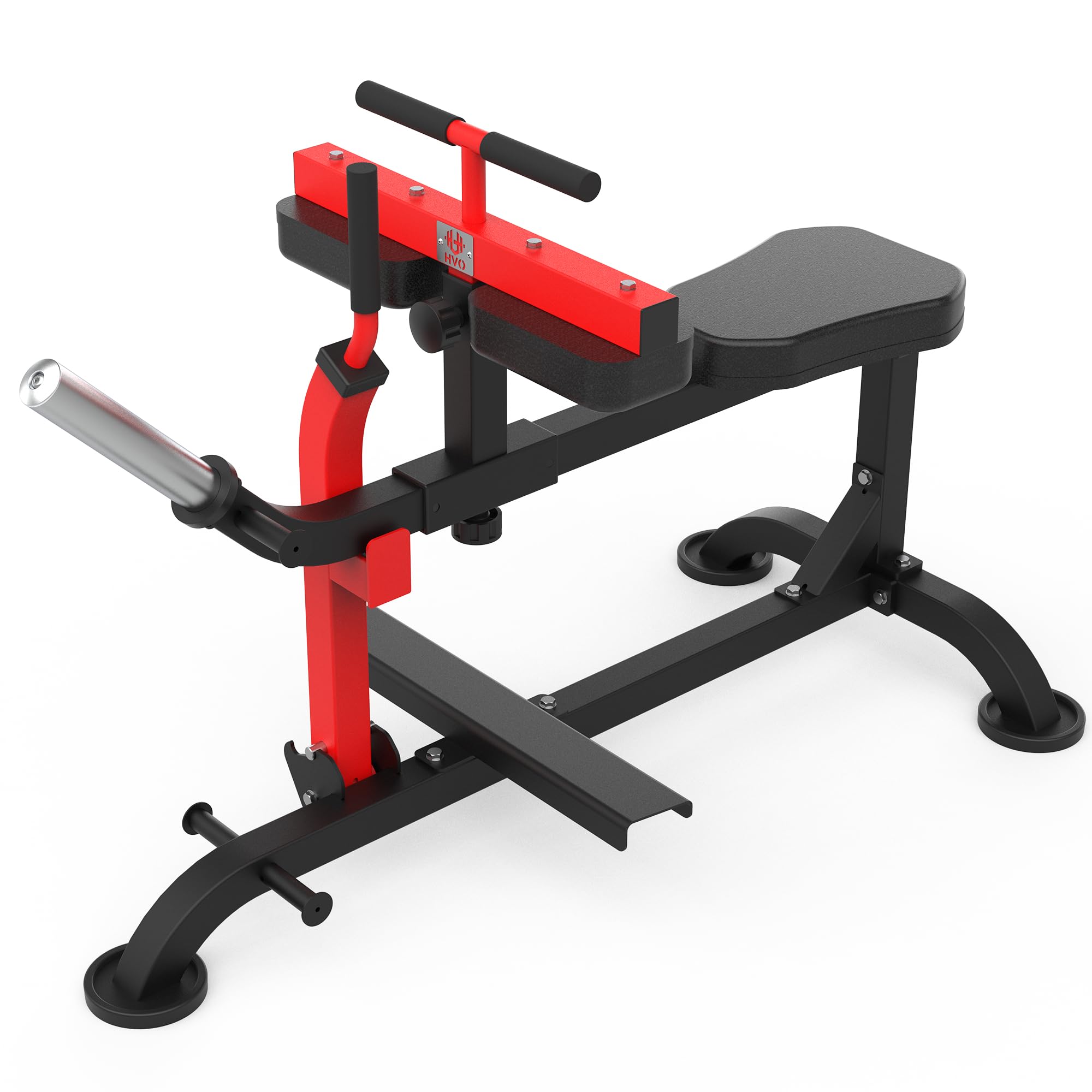
A 660 lb-rated lower-leg machine — the highest capacity on this list, by a wide margin.
It sounds odd to put a calf machine in a back-machine guide until you remember what the calves do. Strong soleus and calf muscles carry your stance and take load off the lower back, and this is the machine that trains them with a 660 lb maximum weight recommendation. The frame is commercial tubing with a bearing-based structure designed to eliminate the shaking that plagues cheaper calf machines. The leg pad adjusts across 6 levels, the support rod moves across 4, and the foot plate is wide and anti-slip.
You have two resistance routes. Detachable sleeves accept 1″ or 2″ plates (plates not included), and 4 elastic band hooks on both sides let you add light resistance without buying steel. The included bands also help stabilize the motion, which reduces wobble between reps. On space, it stands on its back legs for storage and takes up very little floor — a genuine advantage in a small home gym. Legs can be trained two at a time or one at a time if you want to isolate a weaker side.
The catch is the same one every budget-framed machine has: heavy-duty does not mean commercial-grade. A light-use user had the upright seat support weld fail after months, and assembly reviews split between “under 30 minutes” and “took longer than expected.” If you are pushing near the 660 lb limit with real weight, treat the frame with respect and check the welds on arrival. If you are a home lifter who wants a rock-solid calf station without a full gym, this delivers.
Built for the work: 660 lb rating, 6-level leg pad, 4-level support rod, and both plate and band resistance cover almost every home lifter.
Read the welds: this is a home-gym frame, so inspect the seat support on arrival and keep loads within reason.
Made for you if: your lower legs are the weak link in your squat and deadlift and you have a small floor footprint to spare.
Step up if: you train extremely heavy and want a commercial weld on every joint.
Know the Specs
Maximum user weight capacity
This is the heaviest body weight the frame is rated to hold. It is not vanity sizing: a higher rating usually means thicker steel and a wider base, which is what keeps the machine from tipping when you shift. On an inversion table or hyperextension bench, your full weight hangs off a frame, so choose one whose rating leaves you some headroom. A rating close to your body weight is workable on a seated machine but tight on one that cantilevers you.
Height and torso adjustability
Back machines are fit-critical. Look for a stated height range, an adjustable foot platform or leg pad, and — on a Roman chair — a thigh pad you can move fore and aft. An adjustable angle adds another axis of fit and lets you change the difficulty of an extension. If you are shorter than about 5’4″ or taller than 6’2″, check the fit notes before buying; a fixed geometry is the most common reason a bench feels wrong.
Load type: plate, band, or body weight
Decompression machines use gravity and your own body weight. Roman chairs load you through a hinged hip pivot. Seated row and combo machines take weight plates or resistance bands, and some take both. Plates let you add load in small steps, but they are not always included. Bands offer lighter, smoother resistance and are often used to stabilize a machine in motion. Match the load type to the plates or bands you already own, or you will stall out shopping for weights before the first session.
Footprint and stowability
A machine you can leave set up in one spot gets used; one you must clear away each time does not. Check the published footprint before ordering and find the spot first. Folding designs and machines that stand on their back legs for storage buy you real floor space, but a heavier folding machine is harder to move alone. Decide between permanent and folded before you decide between brands.
Common Questions
What is the difference between an inversion table and a traction machine for back pain?
Will an inversion table work if I am short?
How long does a session on a back machine usually last?
Is a Roman chair or a seated row machine better for lower back strength?
Do I need weight plates for a home back machine?
Can I fold a hyperextension bench away after every use?
What does FDA registered actually mean on an inversion table?
How much floor space does a seated row machine need?
Is a back machine safe if I already have a diagnosed disc problem?
Will a hyperextension bench fit me if I am taller than six feet?
The Bottom Line
For most buyers hunting an exercise machine for back, the winner is the Teeter EP-560 Inversion Table — it has the strongest build on this list, folds flat for storage, and holds a 300 lb user capacity on a heat-treated steel frame. If ankle locks or full inversion are off the table for you, the Stamina InLine Traction Control System delivers standing decompression with far less commitment. And if your goal is a stronger back rather than relief, the syedee Seated Row Machine is the one to reach for, with a 400 lb capacity and independent arms that let you isolate each side. Whichever you pick, the honest nudge is this: the machines in this guide with the strongest track record are the ones you will actually set up and leave up, so choose the footprint that fits the room you train in.
How we choose
We do not accept paid placement. Every pick is matched to a real buyer and a real use-case; we do not hands-on test units.
Sources
Specifications: manufacturer listings and product documentation. Review insights: verified customer reviews, as of October 2026. Pricing: not shown on this page (it changes often); check the current price via the retailer link.
As an Amazon Associate, Aappliancez earns from qualifying purchases. This does not affect which products we feature.