Disclosure: Some links in this post are affiliate links. As an Amazon Associate I earn from qualifying purchases, at no extra cost to you. Learn more
Specs are compiled from manufacturer listings and verified buyer reviews and can change over time — please confirm the key details on the product page before buying.
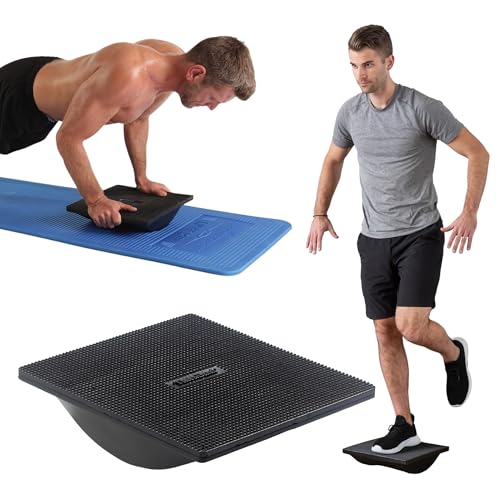
If your main worry is falling, your first purchase should be something that keeps you low and slow — not a machine that fights you. The picks below all share one thing: they let you work on balance and leg strength while your feet stay close to the ground. That low, controlled setup is the whole point when steadiness matters more than sweat. Start with the Fitterfirst rocker board if you want one piece of equipment that grows with you, or the foam beam if walking practice is the goal.
This guide is built by comparing the manufacturers’ published specifications and the patterns across verified customer reviews, so you get each pick’s real strengths and trade-offs instead of marketing spin.
Some picks are boards you stand on and rock; others are seated machines that keep your legs moving without any balance risk at all. That split matters, because the right choice depends on whether you are training stability or just trying to stay active. Every option here is chosen to make home movement safer and easier, and this breakdown of the best exercise equipment for parkinson’s explains which one fits your situation.
Top Picks

How To Choose The Best Exercise Equipment for Parkinson’s
The wrong first purchase is a tall, tippy board you are afraid to stand on. The right one lets you train balance with a chair or counter within arm’s reach, so it gets used instead of stored. Work out what you are training first — standing stability, walking gait, or seated leg circulation — and the list narrows fast.
Start with how low the surface sits
A rocker board that tilts in one plane keeps your feet planted while it pitches forward and back. That single-direction motion is easier to control than a round wobble board that moves every way at once. The Fitterfirst board sits 4 inches high and tilts through three settings of 10, 12 and 15 degrees, so you can begin at the gentlest angle. A foam beam sits even lower at 2.5 inches — low enough that stepping off is a small shuffle, not a fall.
Match the gear to what you want to practise
Short boards train standing balance and ankle strength. A 64-inch foam beam trains walking — you step heel to toe along its length, which is closer to the real-world stability you need crossing a room. Seated pedalers and recumbent bikes skip the balance question entirely and focus on keeping legs moving and circulation going. Decide which of those three jobs you need before you spend anything.
Check the numbers that decide safety
Weight capacity, tilt angle and seat height range are the specs that actually govern whether a piece suits you. A board rated to 350 pounds and a bike rated to 400 pounds are built for very different loads, so match the rating to the person using it. For seated machines, look at the resistance levels and how far the seat slides — if you cannot reach the pedals comfortably, the machine sits unused.
Side-by-Side Comparison
| Model | Best For | Type | Footprint / Size | Load Rating | Amazon |
|---|---|---|---|---|---|
| Fitterfirst Professional Rocker Board – 20”★ Best Overall | Adjustable standing balance work | Single-plane rocker board | 20″L x 20″W x 4″H | 350 pounds | Amazon |
| THERABAND Rocker BoardBest Value | Portable, budget-friendly balance training | Lateral rocker board | 18″L x 15″W x 3″H | 150 kg | Amazon |
| Foam Balance Beam | Walking and gait practice | Foam beam | 64″L x 6″W x 2.5″H | — | Amazon |
| UMAY Under Desk Elliptical Eclipse | Seated leg circulation with zero balance risk | Motorized pedal exerciser | 15″D x 15″W x 9″H | 330 pounds | Amazon |
| MDODM Pedal Exerciser Bike for Seniors | Upper and lower body from a chair | Manual pedal exerciser with bands | 21.5″D x 15.7″W x 40.5″H | 264 pounds | Amazon |
| Kawnina Recumbent Exercise Bike | Heavier users wanting a full seated workout | Recumbent bike, 16 resistance levels | 49.5″D x 27.2″W x 42.9″H | 400 pounds | Amazon |
| Sunny Health & Fitness Smart Recumbent Bike | App-guided seated cardio | Recumbent bike, 16 resistance levels | 46.1″D x 25.6″W x 51.8″H | 300 pounds | Amazon |
Detailed Reviews
1. Fitterfirst Professional Rocker Board – 20”
Our pick — 4.5+★ from 800+ verified ratings; the strongest balance of quality and price.
A rocker board that starts gentle and gets harder as you get steadier.
The single-plane tilt is the reason this board earns the top spot. It pitches back and forth in one direction only, so your feet stay planted while your ankles and legs do the correcting. You set the difficulty with two adjustable spheres underneath, choosing 10, 12 or 15 degrees of tilt — the gentlest setting is the one to start on. That progression is what separates a board you grow with from one you outgrow or give up on.
What wins people over is the balance work itself — it is what this board is praised for more than anything else. Owners describe small muscles in the legs and ankles waking up, and one puts it simply: “made well! it’s a great exercise for my balance.” The 20-inch width gives you a wide stance, and the non-slip surface helps on carpet or a yoga mat. It is built from Baltic birch plywood and rated to 350 pounds, with no assembly needed.
The catch is honest and worth planning around: this is a wobbling surface, and the same review pages that praise it warn you can lose your footing early on. Keep a counter or a sturdy chair within arm’s reach, and use a spotter for the first few sessions. It also slides on bare tile, so put it on a mat. At 7.5 pounds it stays put once positioned and stores upright in a closet.
What earns it the crown
- Three tilt settings (10, 12 and 15 degrees) let you start easy and add difficulty as balance improves
- Wide 20-inch stance with a non-slip surface for confident foot placement
- Solidly built Baltic birch plywood, rated to 350 pounds, with zero assembly
- Rocking both forward-back and side-to-side works small ankle and leg muscles
Where it asks more of you
- It genuinely tips — keep a counter or chair within reach, especially in the first weeks
- The smooth wooden base slides on slick floors; carpet or a mat is the safer surface
- Premium-tier pricing compared with simpler boards
Made for: anyone who wants one board that starts easy and ramps up as steadiness returns.
Think twice if: you have no carpet or mat to put under it, since bare tile lets the smooth base scoot.
2. THERABAND Rocker Board
The gym-standard board that travels in a suitcase and costs a fraction of the rest.
This one weighs 3.5 pounds — roughly half the Fitterfirst board’s 7.5 pounds — and that difference is the whole pitch. You can carry it room to room, tuck it in a car boot, and take it on trips so your routine never breaks. Buyers report it as “13 1/8″ x 14″ with a 30° angle of deflection,” giving a linear plane for balance and core work. It holds up to 150 kg and comes with an illustrated guide covering over 37 exercises, which is more variety than most people learn in a clinic.
The molded plastic top has a tactile, textured surface and the bottom is anti-skid, so it grips a rug properly. Nothing needs assembling. Set it beside a counter and rock gently in one plane at a time — forward and back, then side to side on a different session. The budget-friendly positioning is the real story here: it delivers the core balance training of boards costing far more, at 3.5 pounds instead of 7.5.
Honest read: the lateral rocking motion is harder to control than some expect, and the surface feels genuinely unstable at first. Work in short sessions and build up. The board’s smaller footprint also means a narrow stance, so larger feet may feel cramped.
Built to travel: at 3.5 pounds with a non-slip bottom, it goes from living room to guest room to hotel floor without fuss — and the included exercise book keeps sessions varied.
Budget reality check: the plastic build and modest footprint are what keep it affordable; it will not feel as planted as a wide wooden board under a heavy user.
Reach for this if: you want clinic-style balance training you can carry anywhere at an entry-level outlay.
Look elsewhere if: you need a wide, rock-solid stance underfoot — this one is compact by design.
3. Foam Balance Beam – Stability Trainer for Physical Therapy
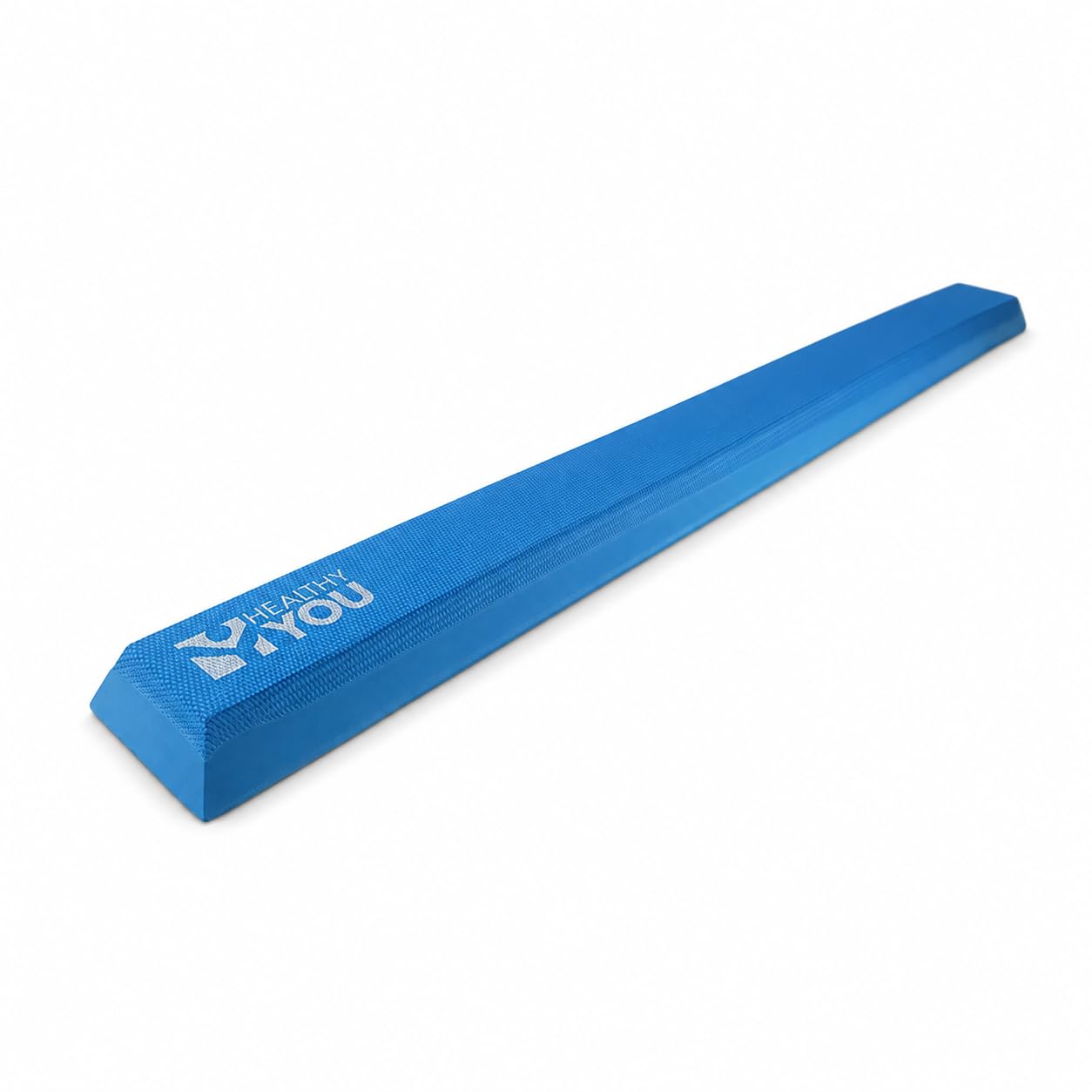
A 64-inch walking beam that trains stepping, not just standing.
Length is the number that matters here. At 64 inches, this beam is more than three times longer than the 18-inch THERABAND board — long enough that you can walk heel to toe along it rather than balance in place. That is a different exercise entirely, and it maps closer to crossing a room than a single-leg hold ever will. The beam measures 6 inches wide and sits just 2.5 inches off the floor, so a misstep is a short shuffle, not a fall.
The soft-yet-firm foam is what makes it approachable. It gives a little underfoot, which adds a balance challenge without the hard edge of wood. One home user’s take, from the review pages: “I used this at physical therapy and my balance improved 100 percent so I bought one for home use.” The same style of beam shows up in clinics for gait and stability work. It wipes clean with a damp cloth and slides under a bed or stands in a closet between sessions.
The trade-off to know: at 6 inches wide, some people find the walking surface too narrow for comfort, and the mixed size feedback reflects that. If you need a wide, forgiving platform, a board serves better. If your goal is practising heel-to-toe walking with the safety of a low surface, this is the piece to get.
Why it stands out: the 64-inch length turns balance practice into real walking practice — heel-to-toe gait you cannot do on a short board.
Honest sizing note: the 6-inch width is narrow; if wide footing matters more than walking distance, choose a board instead.
Right for: anyone whose therapy homework involves walking practice and stepping confidence.
Pass if: a narrow line underfoot makes you tense up — width, not length, is the limit here.
4. UMAY Under Desk Elliptical Eclipse Leg Exerciser Electric
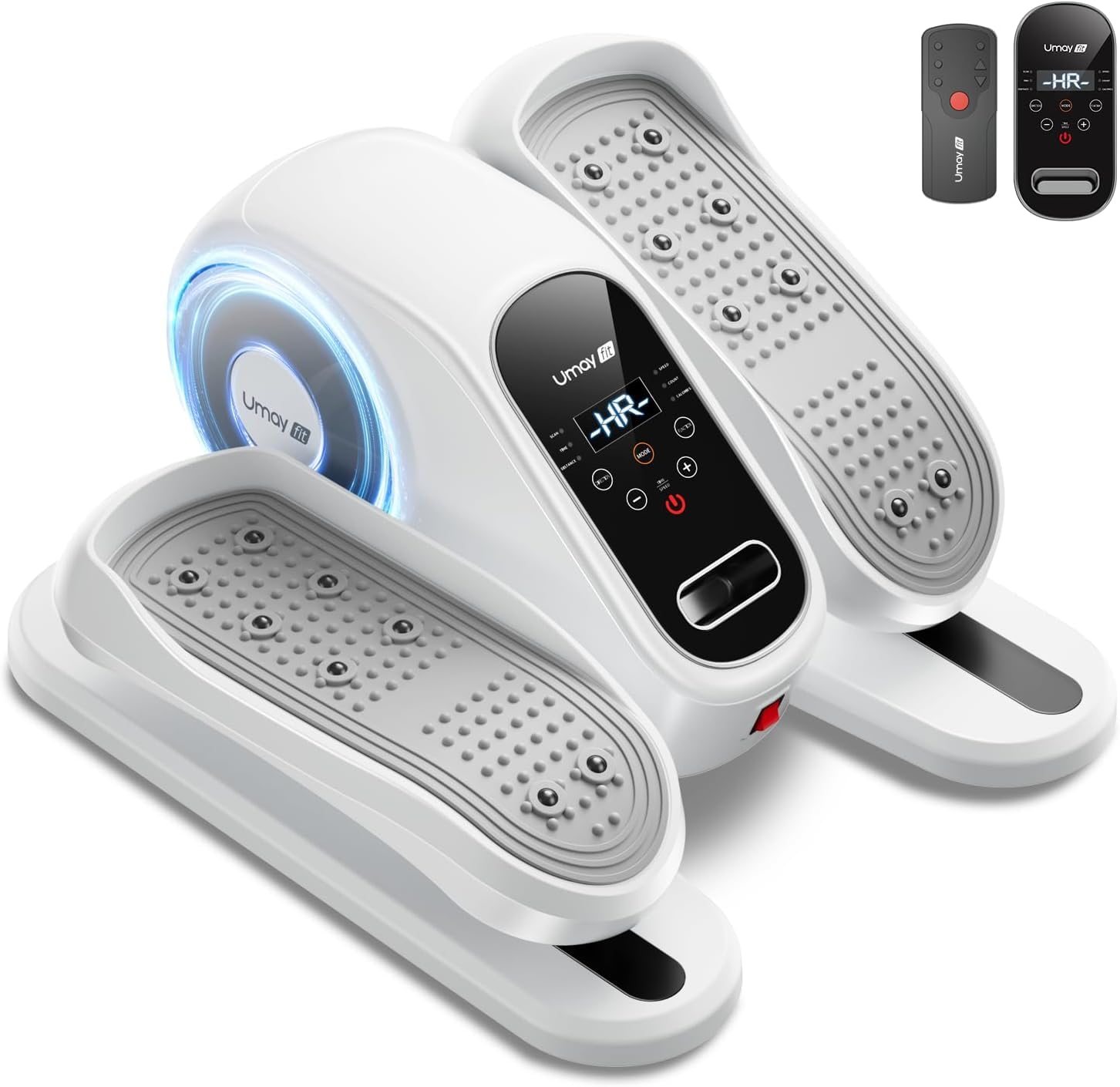
Motorized pedaling so quiet you can run it during a phone call.
Nothing here asks you to balance. You sit down, put your feet on the contoured pedals, and the quiet-drive motor moves them for you at under 15dB — quieter than a whisper, so the television stays audible and nobody in the next room notices. Two modes cover it: automatic with 12 preset programs that vary speed and direction, or manual where you control speed and forward or reverse motion. The included remote means no bending down, which helps if reaching the floor is hard.
What it does well is keep legs and circulation moving on days when standing feels risky. It weighs around 10 to 12 pounds with no assembly beyond plugging it in, and measures 15 by 15 by 9 inches, so it slides under a desk or beside a couch. The LCD tracks time, distance, count and calories. It is rated to 330 pounds.
Know the honest limit: the motor does the work, so there is no resistance to push against. That makes it gentle and joint-friendly, but it is passive motion rather than a strength workout. A son or daughter setting one up for a parent will find it nearly easy to learn. Use it seated only — the maker is clear about that. If you want to actually push against resistance, look at the manual pedal bike instead.
The quiet edge
- Under 15dB operation and a smooth motion that suits replaced knees and stiff joints
- Remote control means no bending; ideal if limited mobility makes reaching down hard
- No assembly, around 10 to 12 pounds, fits under a desk or beside a couch
- 12 preset programs plus manual control for forward or reverse pedaling
What to expect going in
- The motor does all the work — no resistance for strength building
- The remote needs AAA batteries that are not included
- Seated use only, and the small LCD is hard to read without the remote
Best for: keeping circulation and leg movement going with zero balance risk and zero noise.
Skip if: you want to build resistance strength — this lets the motor carry the load by design.
5. MDODM Pedal Exerciser Bike

Pedals for the legs, resistance bands for the arms, one frame in between.
Most pedal exercisers work your legs and stop there. This one adds resistance bands and a massage function so the same seated session also reaches your arms and shoulders. The frame adjusts over a wide range: 5-level handlebar and center-pillar height from 31 to 43 inches, plus a base that slides from 15.7 to 21.5 inches for different body lengths. The tension knob on both the handles and pedals lets you dial the resistance from gentle to firm. Rated to 264 pounds.
The newer U-shaped base widens floor contact, and four non-slip suction cups grip the floor. One note from the review record: the cups hold better on hard flooring than carpet, and a heavier user may need weight on the base to keep it planted. Beyond that, an 82-year-old user put it together without trouble. The LCD cycles through time, counts, total counts and calories at a button press.
Set expectations on the bands — they add upper-body motion, but they are light and some find they make the frame feel less steady. The pedal motion itself is the reliable part. Beginners, and anyone rebuilding strength after injury, will get the most from it in short daily sits.
Where it shines: one seated machine covering arms, legs and coordination, with height and length adjustment to fit a range of bodies.
The trade-off: the suction-cup base is fussiest on carpet, and the resistance bands add movement but not much challenge to the frame.
Pick this if: you want to work arms and legs together from a chair without buying two machines.
Not for you if: you exercise on carpet — the suction cups need a hard floor to hold.
6. Kawnina Recumbent Exercise Bike – 400LB Capacity
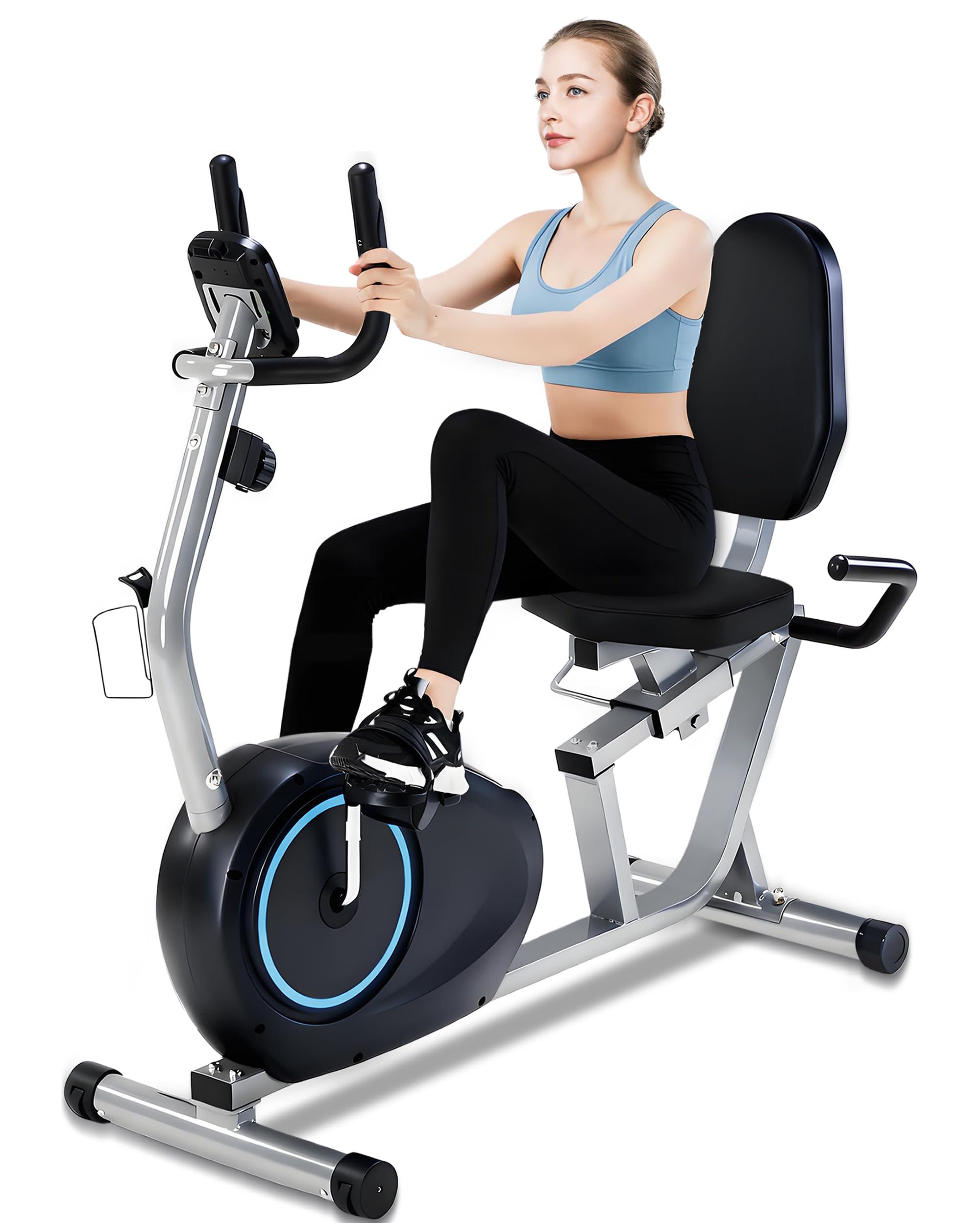
Built for bigger bodies, with a backrest that takes the load off your spine.
The step-through frame and padded backrest mean you sit down like a chair rather than swing a leg over a bar. The seat and backrest use sports sponge at a 10-degree forward tilt, and a handle slides the seat back and forth for your leg length.
Resistance comes in 16 magnetic levels driven through a belt, and the maker claims noise as low as 5DB — quiet enough that watching TV while you ride is realistic. The LCD tracks speed, distance, time, calories, odometer and pulse, and holds a tablet. It arrives pre-assembled to 85% and most people finish within about 30 minutes.
The recurring gripe is the seat lock — a few find it stiff, and the maker suggests a little lubricating oil if the seat is hard to slide. Assembly instructions draw mixed feedback too: one experienced builder finished in about an hour but wanted clearer pictures. A taller buyer around 5’5″ made it work comfortably. If traditional bikes feel unsafe to climb on, this is the sturdy alternative.
The strength of the design: a 400-pound build with a step-through frame, padded back, quiet magnetic resistance and a sliding seat — all for a lighter rider and a heavier one alike.
The one wrinkle: the seat slide can stick; keep the adjuster oiled and it stays smooth.
Go for it if: you need real load capacity and a backrest that supports you while you pedal.
Hold back if: you dislike any DIY setup — assembly still takes roughly half an hour even from 85%.
7. Sunny Health & Fitness Smart Recumbent Bike
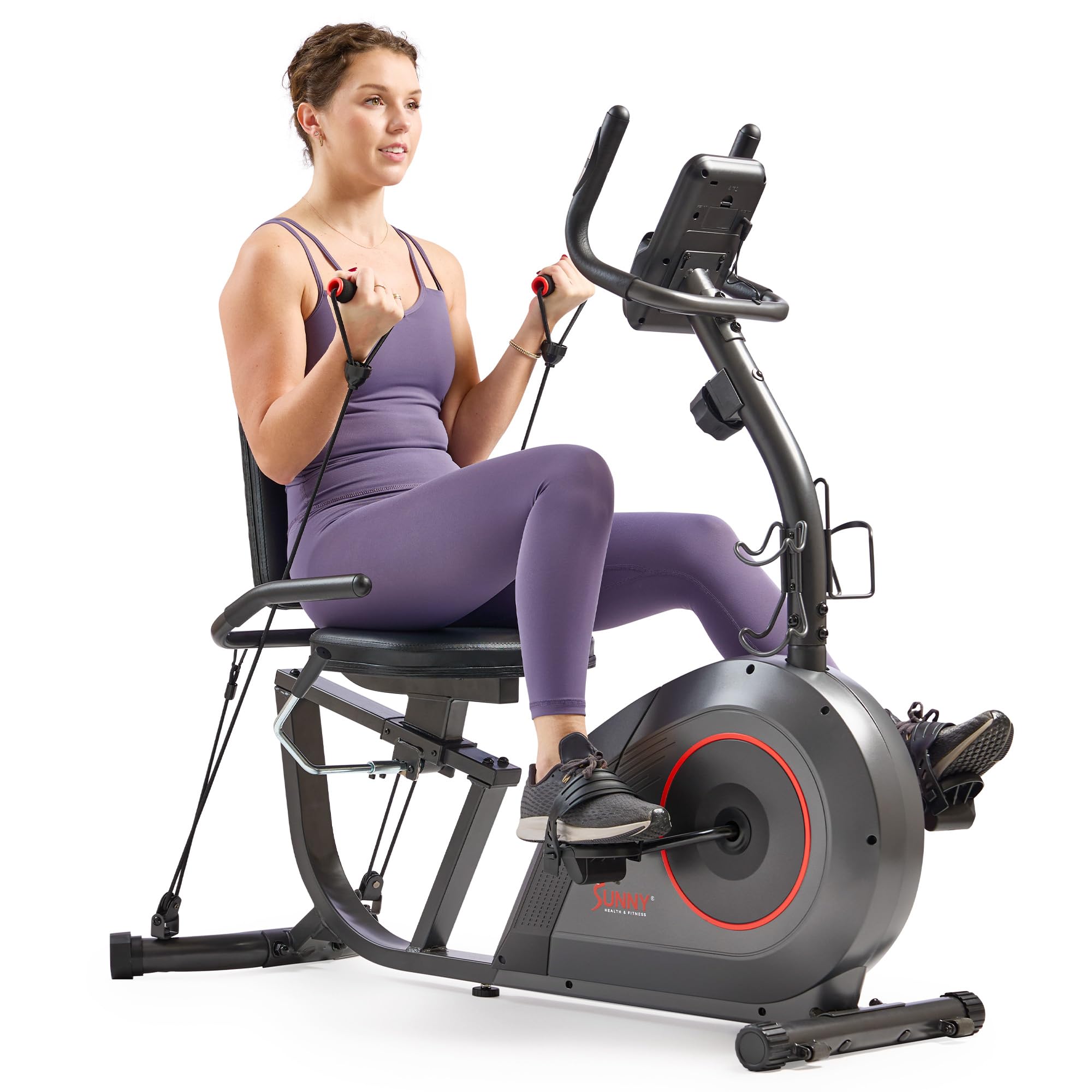
An app-connected recumbent bike that makes long, gentle rides easy to stick with.
The SunnyFit app is the headline, and it costs nothing extra — no membership fees. Inside are more than 1,000 trainer-led workouts and 10,000-plus virtual scenic tours, plus progress tracking. On the bike itself you get a wide cushioned seat and padded backrest, a flip-able side handle for easy on and off, and 16 magnetic resistance levels driven by a belt. Two 20-pound resistance bands with foam grips swivel through a full range of motion for your arms. The inseam range runs 27.2 to 35.8 inches, and it is rated to 300 pounds.
A belt drive keeps the pedaling smooth and quiet, which matters in a shared home. The free app is what keeps people coming back to the Sunny bike day after day. Set it in front of a screen and the rides pass quickly.
Be ready for two small things. The seat adjusts far enough for most, but a very small rider around 4’11” finds the seat too far forward even at its closest. And the seat itself is firm — a cushion pad is a common add-on. Assembly takes around an hour for most, though the printed instructions are thin; a video walkthrough helps. The cable routing is tidy but the resistance cable runs slightly short on some units.
What makes it the full package
- Free SunnyFit app with 1,000-plus workouts and 10,000-plus virtual rides, no membership fee
- Wide cushioned seat, padded back, flip-able handle and 27.2 to 35.8 inch inseam range
- Two 20-pound swivel resistance bands for upper-body work
- Quiet belt drive with 16 magnetic resistance levels
Where it asks a little back
- Very short riders around 4’11” may find the seat too far forward
- The seat is firm — most add a cushion pad
- Printed assembly instructions are thin; a video walkthrough helps
Made for: someone who wants guided, screen-backed rides they will actually keep doing.
Think twice if: you are very short — the seat’s closest position may still be a stretch.
Know the Specs
Tilt angle and plane of motion
A rocker board’s tilt angle is how far it leans before it stops — steeper means harder. The Fitterfirst board offers 10, 12 and 15 degrees, so you can start shallow. Plane of motion is the direction it moves: single-plane boards pitch forward and back, which is easier to control than a board that rolls side to side or every way at once.
Beam length versus board width
Length lets you walk; width gives you a stance. A 64-inch foam beam supports heel-to-toe stepping, while a 20-inch board supports standing balance. If walking confidence is the goal, length wins; if a wide, stable stand matters more, a board does. Both keep you low to the ground so a wobble is manageable.
Resistance levels on seated machines
Resistance is how hard you push — more levels mean finer steps between easy and firm. The Sunny and Kawnina bikes each offer 16 levels of magnetic resistance, so you can start gentle and progress. Motor-driven pedalers like the UMAY have none, which makes them passive motion rather than a strength workout.
Noise in decibels
Quieter machines get used more, especially in a shared living room or bedroom. The Kawnina bike claims noise as low as 5DB and the UMAY pedal exerciser runs under 15dB — both quiet enough to use while watching TV. A loud bike tends to end up folded in a corner, so check the decibel rating before you buy.
Common Questions
Is a rocker board or a foam beam safer for someone with shaky balance?
How much weight can these balance boards hold?
Can I use a rocker board on carpet?
Do seated pedal exercisers build strength or just move your legs?
What noise level should I expect from a recumbent bike?
How long does it take to assemble a recumbent bike?
Is an under-desk elliptical worth it or should I get a manual pedal bike?
How much room does a recumbent bike take up?
Can a taller user fit the Sunny or Kawnina bike?
The Bottom Line
For most people who want one piece of gear that starts gentle and grows with them, the Fitterfirst Professional Rocker Board is the pick — its three tilt settings and 350-pound wooden build make it a board you will not outgrow. If you want balance training you can carry anywhere at a budget-friendly outlay, the THERABAND board gives you clinic-style training at 3.5 pounds. For walking practice specifically, the Foam Balance Beam turns balance work into real heel-to-toe stepping along 64 inches. And if balance itself feels risky right now, start seated — the UMAY under-desk elliptical keeps your legs moving with no chance of a fall. Whichever you choose, keep a counter within reach for the first few weeks on any standing board.
How we choose
We do not accept paid placement. Every pick is matched to a real buyer and a real use-case; we do not hands-on test units.
Sources
Specifications: manufacturer listings and product documentation. Review insights: verified customer reviews, as of October 2026. Pricing: not shown on this page (it changes often); check the current price via the retailer link.
As an Amazon Associate, Aappliancez earns from qualifying purchases. This does not affect which products we feature.